
Life, 1900-11-15 · page 4 of 28
Life — November 15, 1900 — page 4: what you’re looking at
What you’re looking at
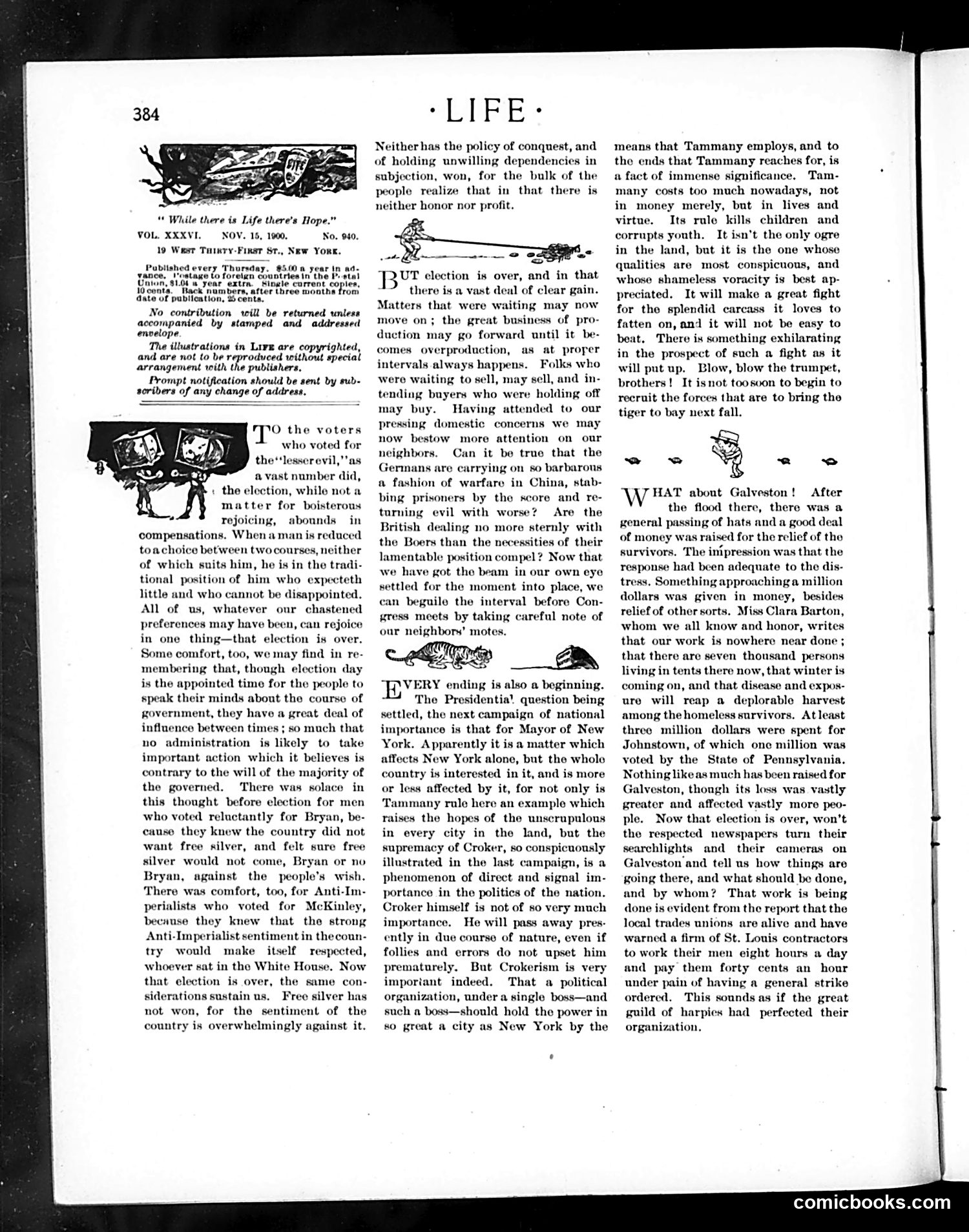
The page contains political editorial commentary rather than cartoons. The text discusses the 1900 U.S. election, specifically addressing voters who supported William Jennings Bryan (the "Free Silver" candidate who lost to McKinley) and Anti-Imperialists. The small illustration at top-left appears to show figures examining or debating something, though details are unclear in reproduction. The editorial argues against Bryan's platform and Anti-Imperialist sentiment, suggesting free silver supporters should accept McKinley's victory. It also discusses Tammany Hall's political influence in New York and references Galveston flood relief efforts. The commentary represents Life's Republican/pro-McKinley editorial stance during the contentious 1900 election featuring imperialism and monetary policy as key issues.
📄 Transcribed text from this page (OCR, searchable)
Machine-transcribed from the original scan — historical spelling and the odd misread are preserved.
“* While there is Life there's Hope.” XXXVI. NOV. 15, 1900, 19 Weer Tarwry-Finst & No, 940. York. edevery Thursday. $5.00 year in ad~ ratage to foreign countries in the P--stal $1.06 4 year extra. Single current copl lOcents. ack numbers, after three months from date of publication, % cents. No contribution twill be returned unless accompanied by stamped and addressed envelope The illustrations in Live are copyrighted, and are not to be reproduced without speciat arrangement with the publishers, Prompt notification should be sent by sub- soribers of any change of address, O the voters who voted for lesserevil,’’as avast number did, « the election, while not a er for boisterous abounds in compensations. When a man is reduced toachoice between twocourses, neither of which suits him, he is in the tradi- tional position of him who expecteth little and who cannot be disappointed. All of us, whatever our chastened preferences may have been, can rejoice in one thing—that election is over. Some comfort, too, we may find in re- membering that, though election day is the appointed time for the people to speak their minds about the course of government, they have a great deal of influence between times ; so much that no administration is likely to take important action which it believes is contrary to the will of the majority of the governed. There was solace in this thought before election for men who voted reluctantly for Bryan, be- cause they knew the country did not want free silver, and felt sure free silver would not come, Bryan or no Bryan, against the people’s wish. There was comfort, too, for Anti-Im- perialists who voted for McKinley, because they knew that the strong Anti-Imperialist sentiment in thecoun- try would make itself respected, whoever sat in the White House. Now that election is over, the same con- siderations sustain us. Free silver has not won, for the sentiment of the country is overwhelmingly against it. Neither has the policy of conquest, and of holding unwilling dependencies in subjection, won, for the bulk of the people realize that in that there is neither honor nor profit. Bit election is over, and in that there is a vast deal of clear gain. Matters that were waiting may now move on; the great business of pro- duction may go forward until it be- comes overproduction, as at proper intervals always happens. Folks who were waiting to sell, may sell, and in- tending buyers who were holding off may buy. Having attended to our pressing domestic concerns we may now bestow more attention on our neighbors. Can it be true that the Germans are carrying on so barbarous a fashion of warfare in China, stab- bing prisoners by the score and re- turning evil with worse? Are the British dealing no more sternly with the Boers than the necessities of their lamentable position compel? Now that we have got the beam in our own eye settled for the moment into place, we can beguile the interval before Con- gress meets by taking careful note of our neighbors’ motes. WYER ending is also a beginning. The Presidentia’. question being settled, the next campaign of national importance is that for Mayor of New York. Apparently it is a matter which affects New York alone, but the wholo country is interested in it, and is more or less affected by it, for not only is Tammany rale here an example which raises the hopes of the unscrupulous in every city in the land, but the supremacy of Croker, so conspicuously illustrated in the last campaign, is a phenomenon of direct and signal im- portance in the politics of the nation. Croker himself is not of 80 very much importance. He will pass away pres- ently in due course of nature, even if follies and errors do not upset him prematurely. But Crokerism is yery imporiant indeed. That a political organization, under a single boss—and such a boss—should hold the power in so great a city as New York by the means that Tammany employs, and to the ends that Tammany reaches for, is a fact of immense significance. Tam- many costs too much nowadays, not in money merely, but in lives and virtue. Its rule kills children and corrupts youth, It isn't the only ogre in the land, but it is the one whose qualities are most conspicuous, and whose shameless voracity is best ap- preciated. It will make a great fight for the splendid carcass it loves to fatten on, and it will not be easy to beat. There is something exhilarating in the prospect of such a fight as it will put up. Blow, blow the trumpet, brothers! It isnot toosvon to begin to recruit the forces that are to bring the tiger to bay next fall. 2- 6S a 2 V HAT about Galveston After the flood there, there was a general passing of hats and a good deal of money was raised for the relief of the survivors. The inipression was that the response had been adequate to the dis- tress, Something approaching a million dollars was given in money, besides relief of other sorts. Miss Clara Barton, whom we all know and honor, writes that our work is nowhere near done ; that there are seven thousand persons living in tents there now, that winter is coming on, and that disease and expos- ure will reap a deplorable harvest among the homeless survivors. Atleast three million dollars were spent for Johnstown, of which one million was yoted by the State of Pennsylvania. Nothing likeas much has been raised for Galveston, thongh its loss was vastly greater and affected vastly more peo- ple. Now that election is over, won't the respected newspapers turn their searchlights and their cameras on Galveston’and tell us how things are going there, and what should be done, and by whom? That work is being done is evident from the report that the local trades unions are alive and have warned a firm of St. Louis contractors to work their men eight hours a day and pay them forty cents an hour under pain of having a general strike ordered. This sounds as if the great guild of harpies had perfected their organization, comicbooks.com