
Life, 1900-11-15 · page 6 of 28
Life — November 15, 1900 — page 6: what you’re looking at
What you’re looking at
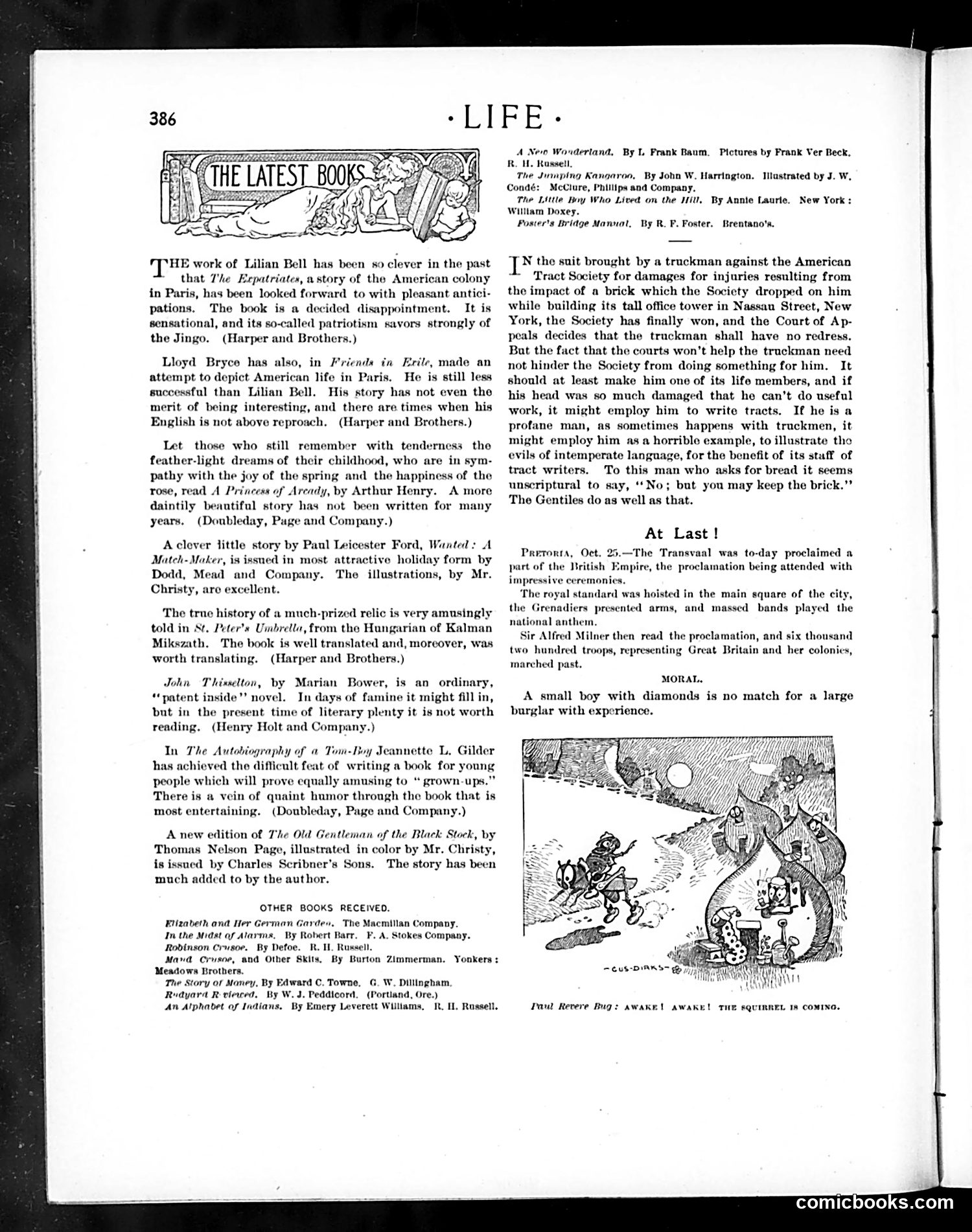
This page is primarily a **book review section** titled "The Latest Books," discussing new publications like *The Expatriates* by Lilian Bell and *Friends in Exile* by Lord Bryce. The only cartoon appears at bottom right, captioned "Two Beaver Bag! AWAKE! AWAKE! THE SQUIRREL IS COMING." It shows two beavers sleeping in their dam while a squirrel approaches—a humorous animal illustration with no apparent political meaning. This appears to be simple comedic content rather than satire. The section also mentions a proclamation in Pretoria regarding the Transvaal being incorporated into the British Empire, suggesting this magazine dates from the Boer War era (around 1900-1902). The book reviews dominate the page's content.
📄 Transcribed text from this page (OCR, searchable)
Machine-transcribed from the original scan — historical spelling and the odd misread are preserved.
«LIFE « HE work of Lilian Bell has been so clever in the past that 7'ke Expatriates, a story of the American colony in Paris, has been looked forward to with pleasant antici- pations. The book is a decided disappointment. It is sensational, and its so-called patriotism savors strongly of the Jingo. (Harper and Brothers.) Lloyd Bryce has also, in F attempt to depict American life in Paris. He is still less successful than Lilian Bell. His story has not even the merit of being interesting, and there are times when his English is not above reproach. (Harper and Brothers.) Let those who still remember with tenderness the feather-light dreams of their childhood, who are in sym- pathy with the joy of the spring and the happiness of the rose, read A Princess of Aready, by Arthur Henry. A more daintily beautiful story has not been written for many years, (Doubleday, Page and Company.) enda in Exile, made an Acclever little story by Paul Leicester Ford, Wanted: A Mateh- Maker, is issued in most attractive holiday form by Dodd, Mead and Company. The illustrations, by Mr. Christy, aro excellent. ‘The truc history of a much-prized relic is very amusingly told in St. Peter’s Umbrella, from the Hungarian of Kalman Mikszath. The book is well translated and, moreover, was worth translating. (Harper and Brothers.) John Thixselton, by Marian Bower, is an ordinary, “patent inside” novel. In days of famine it might fill in, but in the present time of literary plenty it is not worth reading. (Henry Holt and Company.) In The Autobiography of a Tom-Boy Jeannette L, Gilder has achieved the difficult feat of writing a book for young people which will prove equally amusing to “ grown-ups.” There is a vein of quaint humor through the book that is most entertaining. (Doubleday, Page and Company.) A new edition of The Old Gentleman of the Black Stock, by Thomas Nelson Page, illustrated in color by Mr. Christy, is issued by Charles Scribner's Sons. The story has been much added to by the author. OTHER BOOKS RECEIVED. Etizabeth and Her German Garden, ‘The Macmillan Company. In the Midst of Alarms, By Robert Barr. F. A. Stokes Company. Rodinson Crusoe. By Defoe. R. I. Russell, Mand Crusoe, and Other Skits, By Burton Zimmerman. Yonkers : Meadows Brothers. The Story of Maney, By EAward C. Towne, G. W. Dillingham. Rudyard R viewed, By W. 4. Peddicord. (Portiand, Ore.) An Alphabet of Indians. By Emery Leverett Willams, It, I, Russell, A New Wondertand, By 1. Frank Baum. Pictures by Frank Ver Beck, R. HL. Russell, The Jumping Kangaroo, By John W. Harrington. Condé: McClure, Phillips and Company, The Little Buy Who Lived on the Hit, Willtam Doxey. Poster's Bridge Manat, Ilustrated by J. W, By Annte Laurie. New York : By R. P. Foster. Brentano's. J N the suit brought by a truckman against the American Tract Society for damages for injuries resulting from the impact of a brick which the Socicty dropped on him while building its tall office tower in Nassau Street, New York, the Society has finally won, and the Court of Ap- peals decides that the trackman shall have no redress. But the fact that the courts won't help the trackman need not hinder the Society from doing something for him. It should at least make him one of its life members, and if his head was so much damaged that he can’t do useful work, it might employ him to write tracts. If he is a profane man, as sometimes happens with trackmen, it might employ him asa horrible example, to illustrate the evils of intemperate language, for the benefit of its staff of tract writers. To this man who asks for bread it seems unscriptural to say, ‘‘No; but you may keep the brick.” The Gentiles do as well as that. At Last! Prerorta, Oct. 25.—The Transvaal was to-day proclaimed a part of the British Empire, the proclamation being attended with impressive ceremonies. ‘The royal standard was hoisted in the main square of the city, the Grenadiers presented arms, and m national ant \« Sir Alfred Milner then read the proclamation, and six thousand two hundred troops, representing Great Britai marched past. and her colonies, MORAL, A small boy with diamonds is no match for a large burglar with experience. Paul Revere Bug: AWAKEA AWAKE! THE EQUINREL 18 COMINO. comicbooks.com