
A complete issue · 20 pages · 1900
Life — April 26, 1900
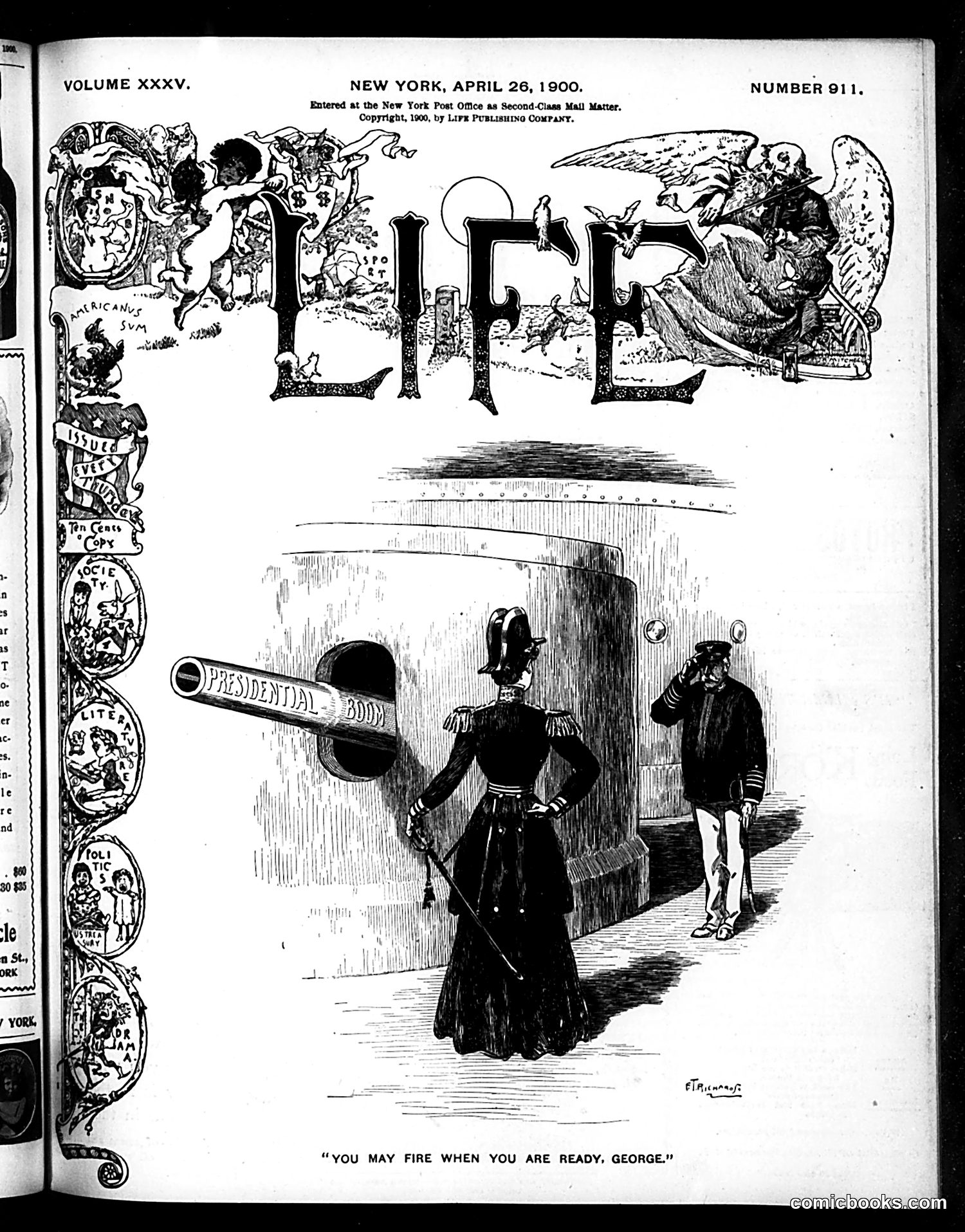
The main cartoon depicts a woman in military dress holding a large cannon labeled "PRESIDENTIAL BODY," addressing a man named George with the caption "YOU MAY FIRE WHEN YOU ARE READY, GEORGE." This appears to reference the 1900 U.S. presidential election cycle. The "Presidential Body" cannon suggests the machinery of presidential politics or succession. The woman figure likely represents either the Republican Party establishment or a political faction preparing to launch a candidacy. "George" possibly refers to a specific political figure of that era, though the identity isn't entirely clear from context alone. The satire mocks the military-style orchestration of electoral politics—suggesting presidential campaigns are weaponized, mechanized operations controlled by political elites rather than organic democratic processes.
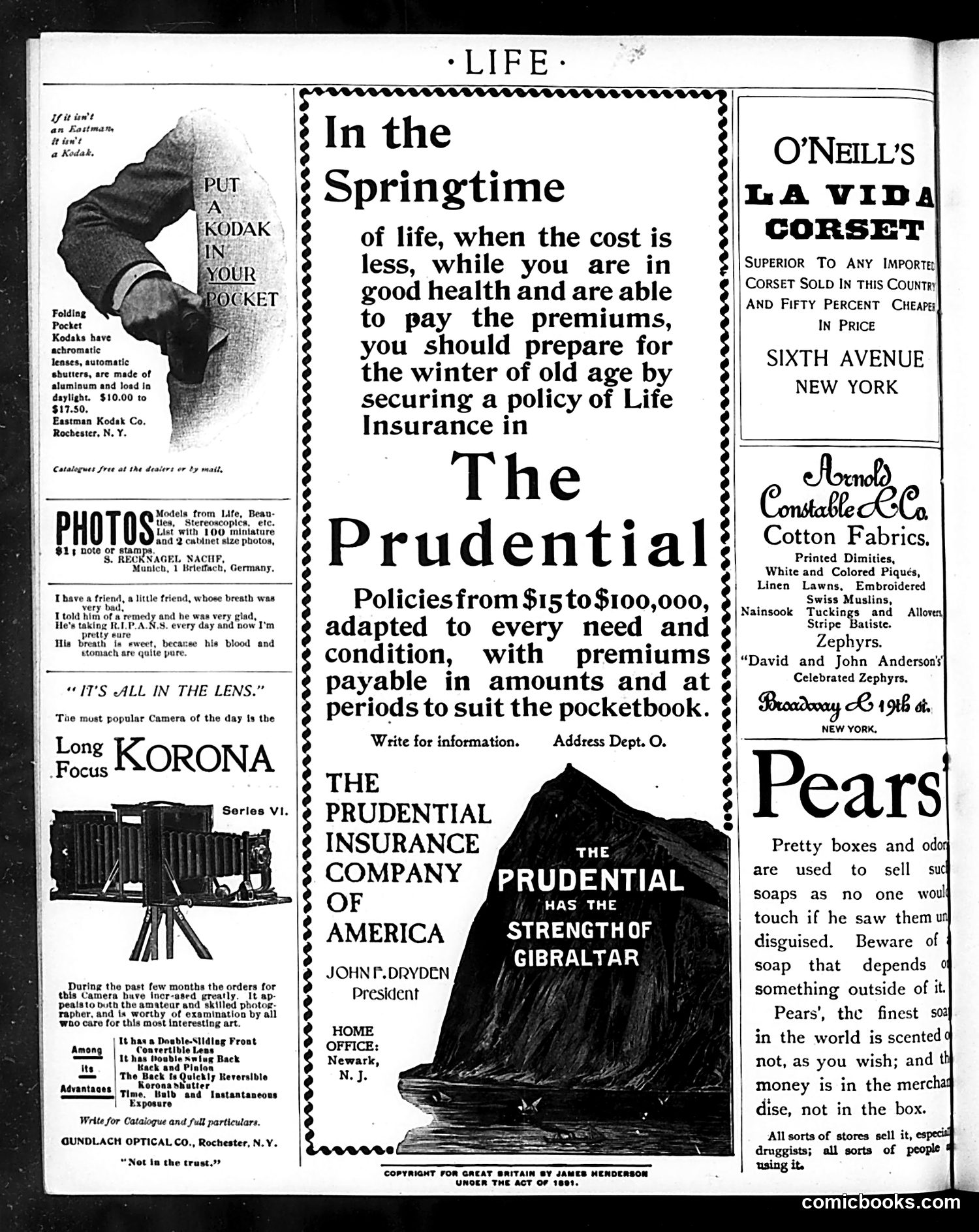
This page is primarily **advertising rather than editorial content**. The dominant central advertisement is for Prudential Insurance, promoting life insurance policies ranging from $15 to $100,000. The pitch emphasizes securing financial protection in youth while healthy and employed, to prepare for "the winter of old age." The surrounding ads include cameras (Kodak, Korona), fabric products (Arnold Constable), and Pears soap. There is **no political cartoon or satirical content** visible on this page. The Prudential ad's use of the Gibraltar imagery ("strength of Gibraltar") was a common early 20th-century marketing trope suggesting stability and permanence—not satire, but straightforward commercial messaging typical of Life magazine's advertising content from this era.
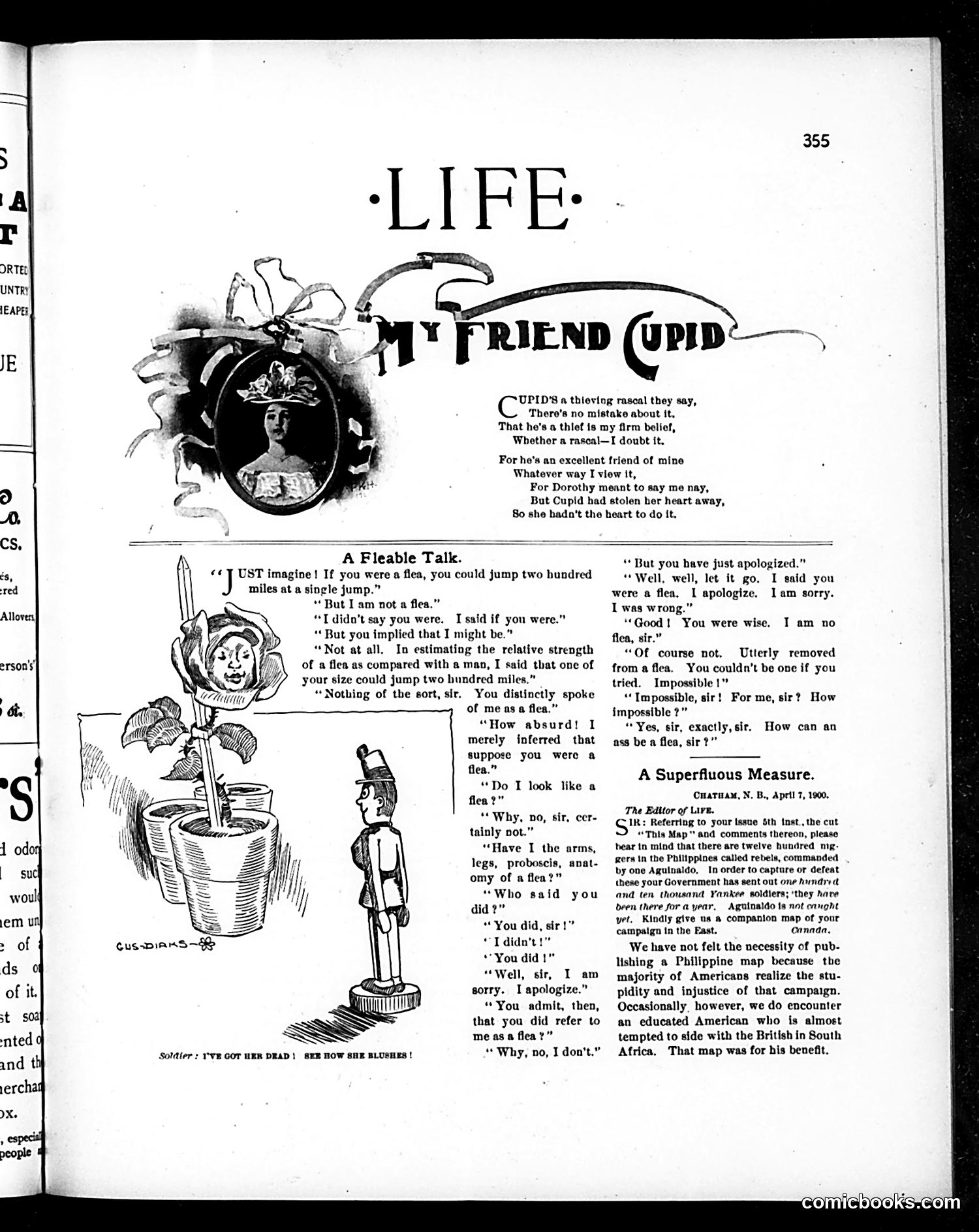
**"My Friend Cupid"** (top): A poem mocking Cupid as a thief who steals hearts. The decorative header shows Cupid's head in a medallion surrounded by arrows and flowers—standard romantic imagery that the text ironically undercuts. **"A Fleeable Talk"** (bottom): A humorous dialogue between a flea and a soldier. The soldier insists fleas can jump 200 miles; the flea protests this exaggeration. The joke satirizes absurd military boasting and the gap between claimed abilities and reality. The accompanying illustration shows a potted plant with a flea character and a tiny soldier figure, emphasizing the flea's perspective and the ridiculousness of the claim. The humor relies on scale inversion and deflating military pretension.
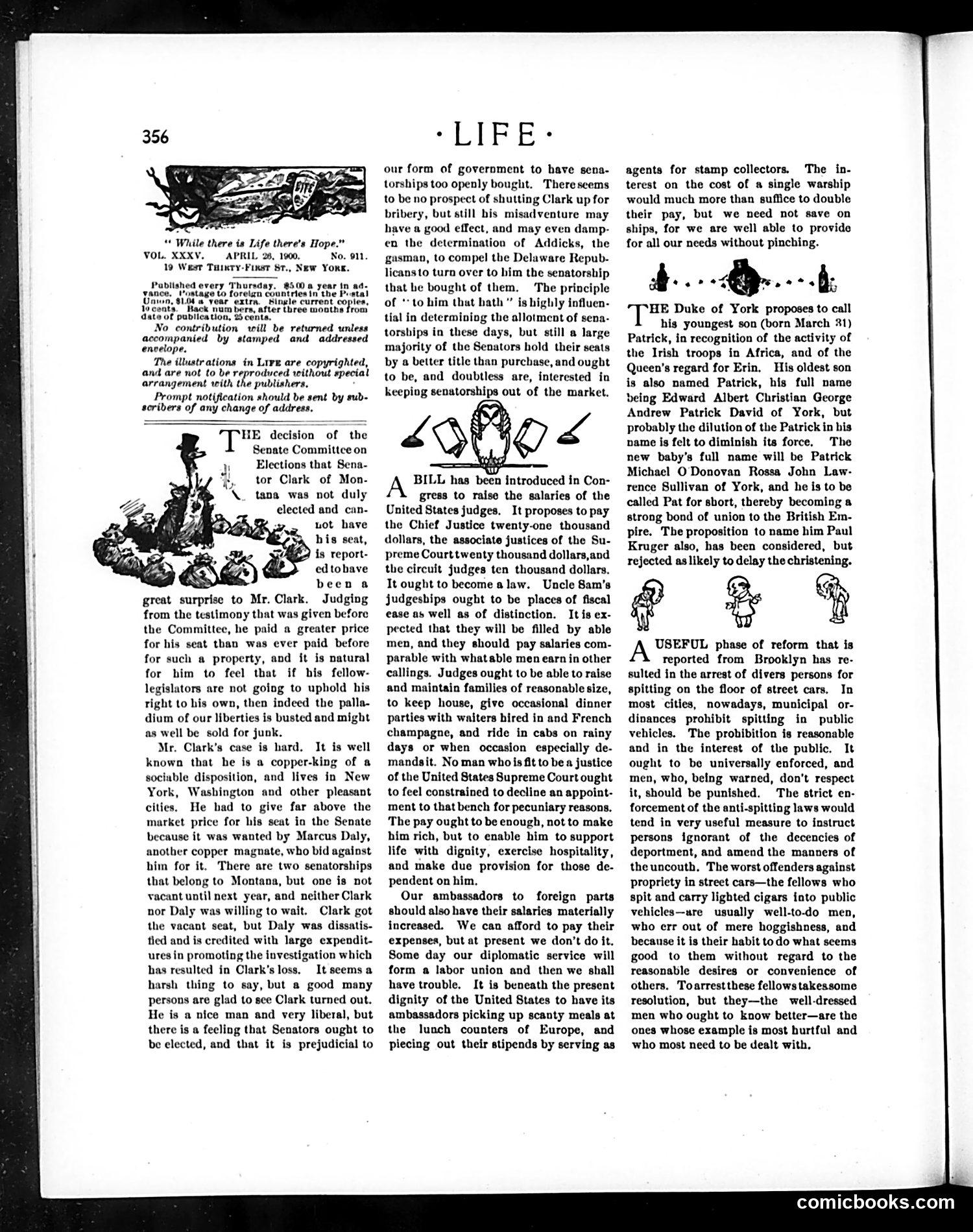
This page contains three editorial cartoons satirizing American political figures and institutions: 1. **Top cartoon**: Depicts the Senate Committee's decision regarding Senator Clark of Montana, who was not re-elected despite reportedly purchasing his seat. The satire mocks the irony that Clark—a copper magnate and known briber—is surprised to lose his position, suggesting the Senate's alleged corruption and venality. 2. **Middle cartoon**: Illustrates proposed legislation to raise U.S. judges' salaries, arguing they deserve better compensation to maintain dignity and prevent financial desperation that might encourage corruption. 3. **Bottom cartoon**: Critiques a reform effort to arrest street-car drivers for spitting, suggesting this petty enforcement trivializes real social problems while ignoring more serious public nuisances and behavioral issues. The page's satirical tone reflects Progressive Era concerns about political corruption, judicial integrity, and misplaced reform priorities.
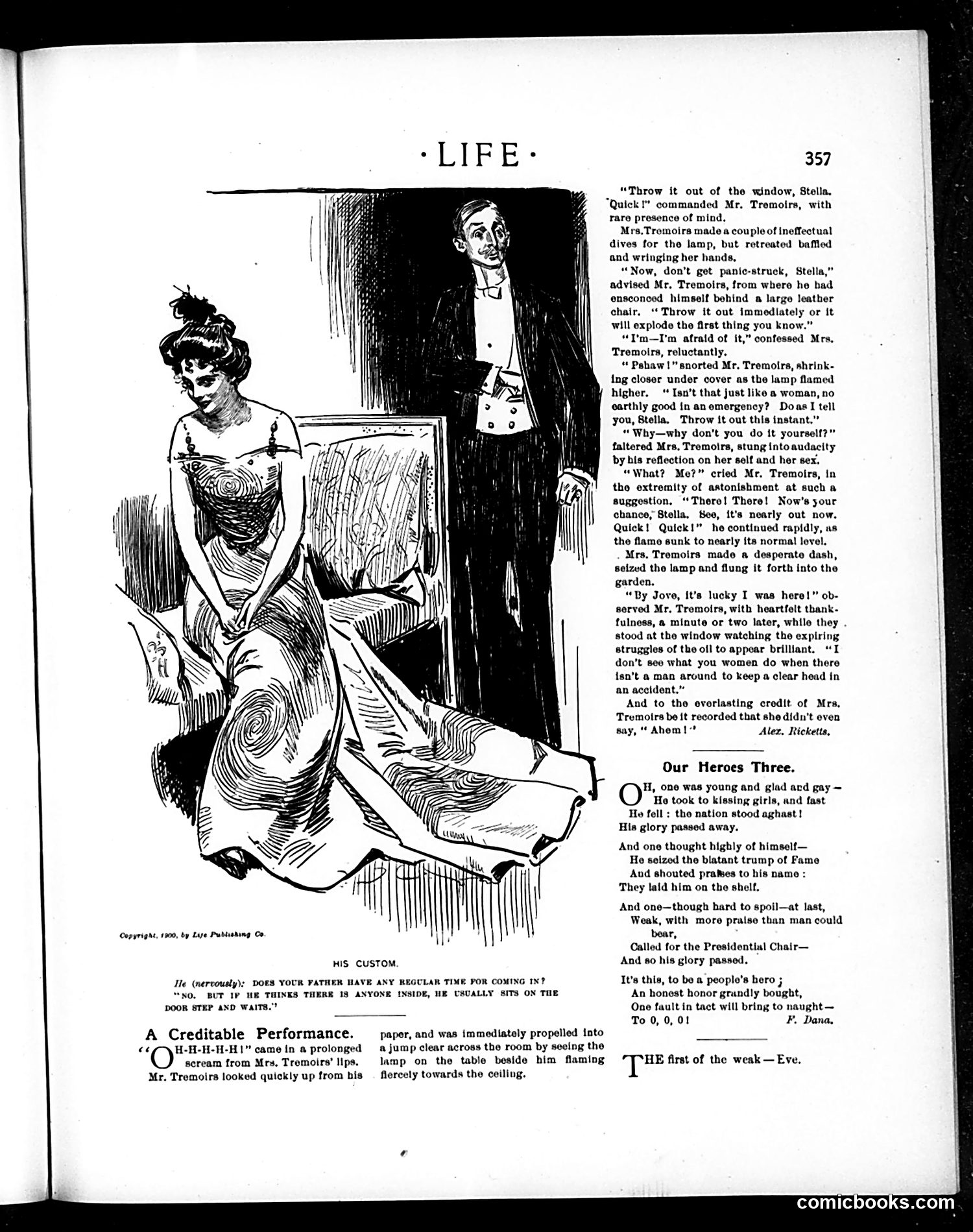
This page contains two separate satirical pieces from early 1900s Life magazine: **"His Custom"** (bottom left): A domestic humor sketch mocking husbands' inconsiderate behavior. The caption jokes that fathers never have time to come home, yet when inside, they habitually sit by the door—suggesting men are simultaneously absent and obstructive in household life. **"A Credible Performance"** (center): Brief text describing Mrs. Tremoira's panicked reaction to a flaming oil lamp accident. The humor derives from her dramatic overreaction and Mr. Tremoira's deadpan response to near-disaster. **"Our Heroes Three"** (right): A poem celebrating three types of men—the youthful romantic, the ambitious opportunist, and the failed poet—whose various fates (death, imprisonment, obscurity) are presented ironically as heroic. The satire critiques sentimental notions of heroism. The illustrations are period pen-and-ink drawings typical of early 1900s magazine comedy.
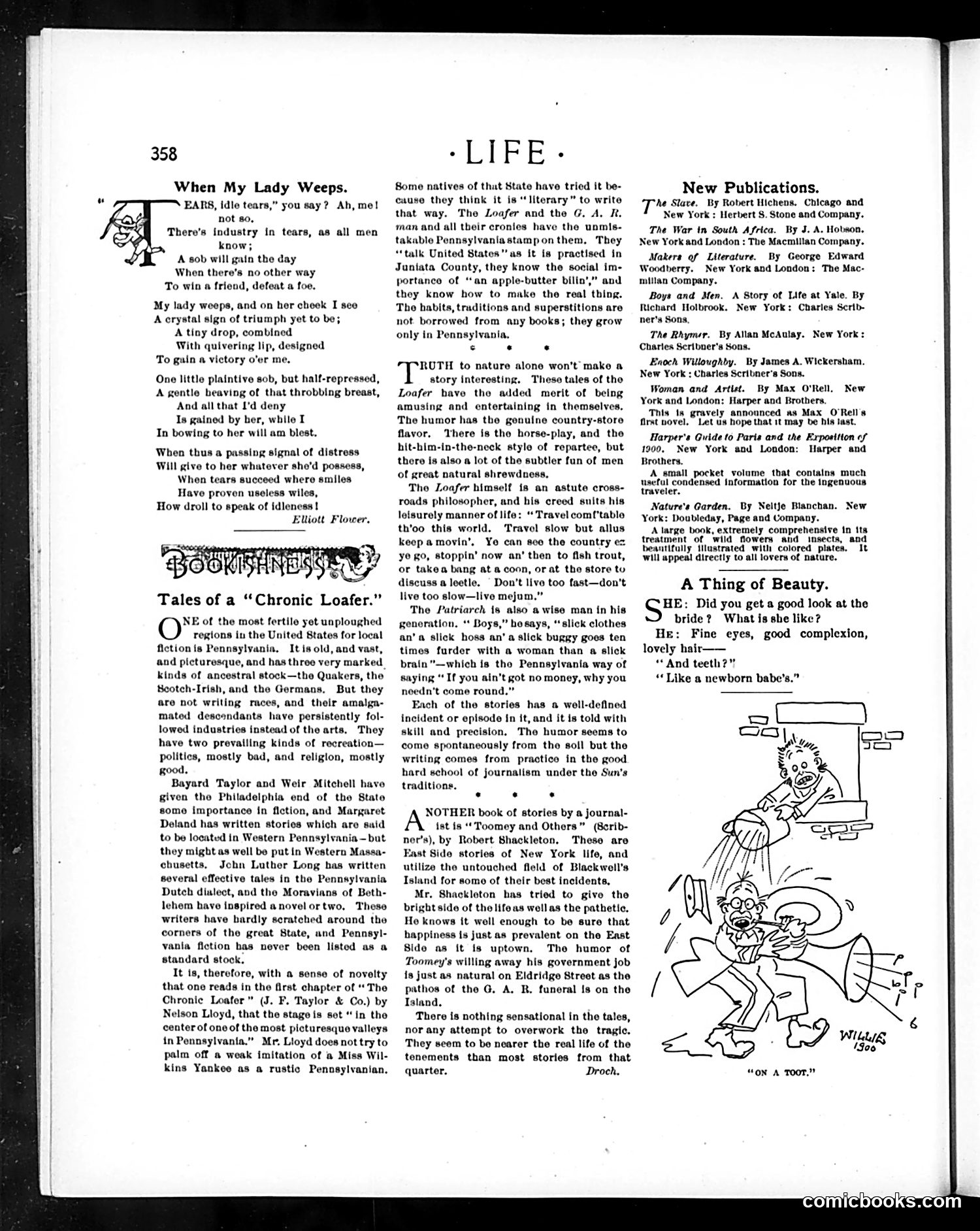
This cartoon by Wills depicts a humorous domestic scene captioned "On a Toot." The illustration shows what appears to be a disheveled man being confronted by a woman (likely his wife) in a home setting, with various household items scattered about. The joke plays on the phrase "on a toot"—slang from this era meaning "on a drinking spree" or bender. The cartoon satirizes the common domestic conflict of a husband returning home intoxicated. The woman's stern expression and the chaotic setting suggest her disapproval of his behavior. This reflects early 20th-century American humor about marital discord resulting from male drinking—a recurring satirical theme in Life magazine during this period.
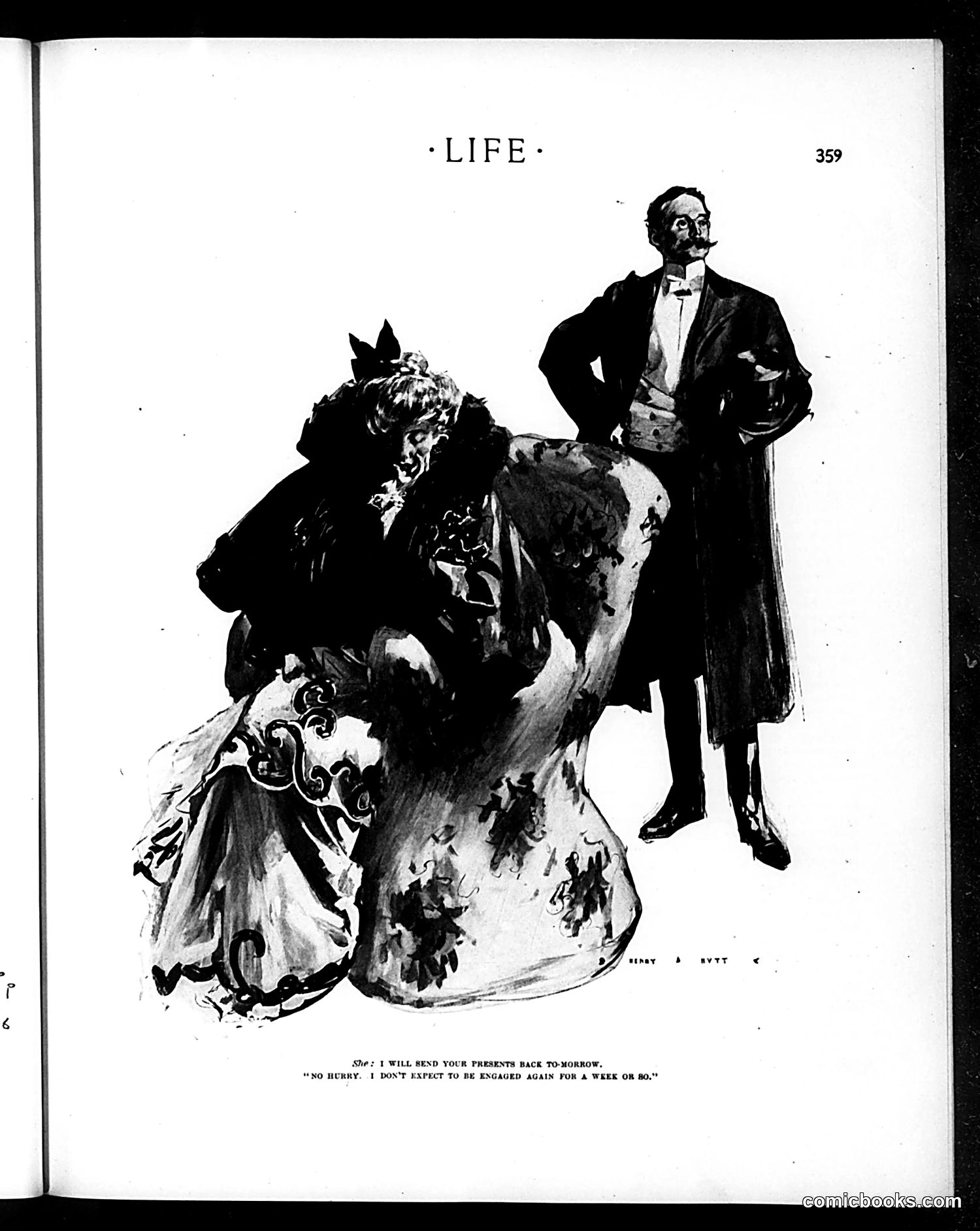
This is a satirical cartoon from *Life* magazine (page 359) depicting what appears to be a social scene involving class dynamics. A well-dressed man in formal evening wear stands confidently while an ornately dressed woman (wearing elaborate jewelry and a decorative gown) sits nearby. The caption reads: "She: I will send your presents back to-morrow. No Henry, I don't expect to be engaged again for a week or so." The satire mocks either broken engagements or casual romantic entanglements among the wealthy. The woman's casual dismissal of the engagement—treating it as temporary inconvenience rather than serious commitment—and her immediate expectation of future proposals satirizes the superficiality of high-society romance and the disposable nature of engagements among the privileged class. The cartoon critiques wealthy social circles' treatment of matrimony as casual sport.
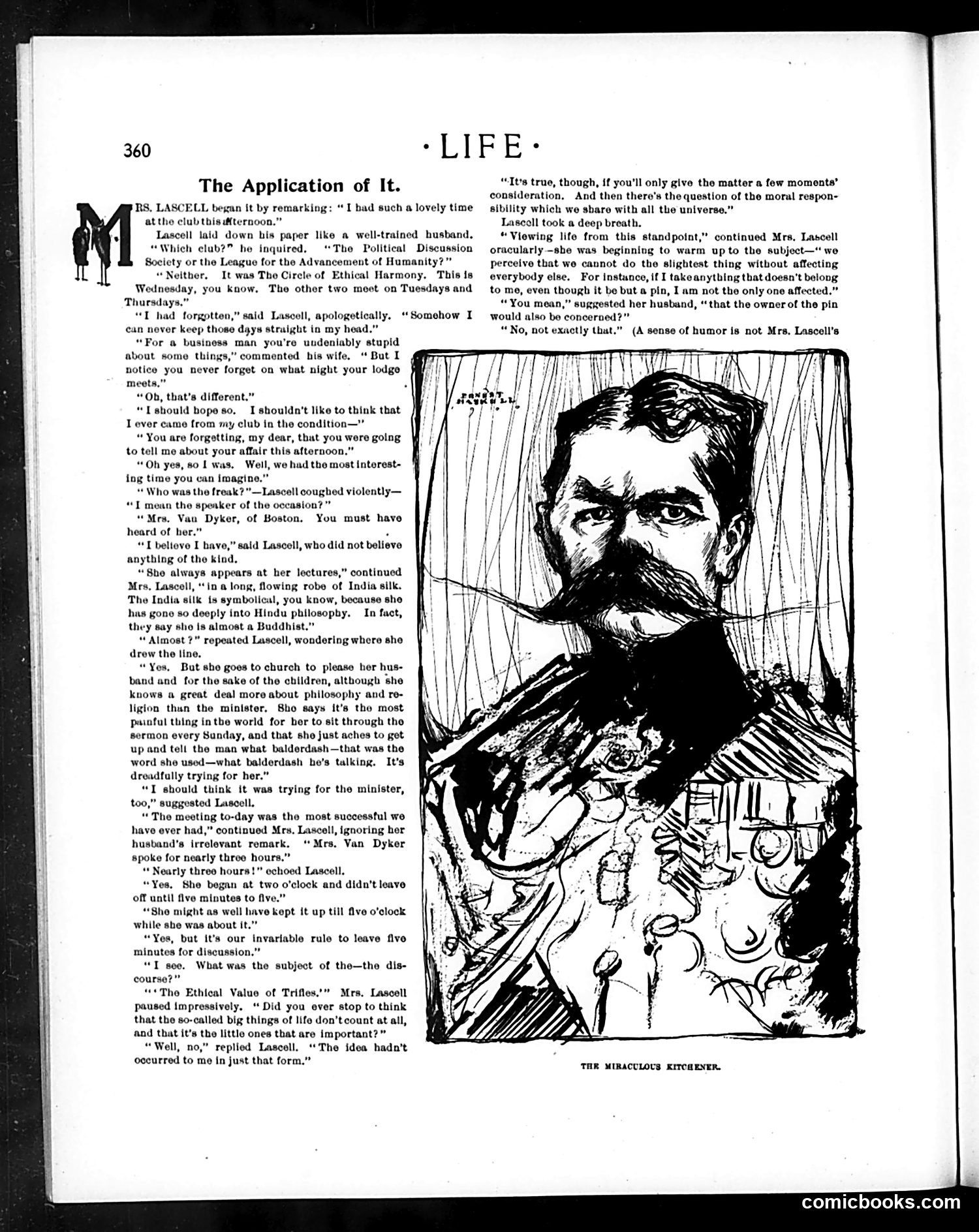
The illustration depicts a stern military figure (labeled "THE MIRACULOUS KITCHENER") holding a rifle, surrounded by cooking implements and food items. The accompanying text is a satirical dialogue about a "Political Discussion Society" meeting where speakers discussed "The Ethical Value of Trifles." The satire appears to target **Lord Kitchener**, the famous British military leader, by ironically juxtaposing his martial authority with domestic kitchen imagery. The joke likely mocks the incongruity of applying serious ethical philosophy to trivial matters, while a powerful military figure dominates the composition. The text's discussion of philosophy versus "big things of life" reinforces the satirical contrast between lofty ideals and mundane reality, though the specific historical context requires additional knowledge to fully clarify Kitchener's contemporary relevance.
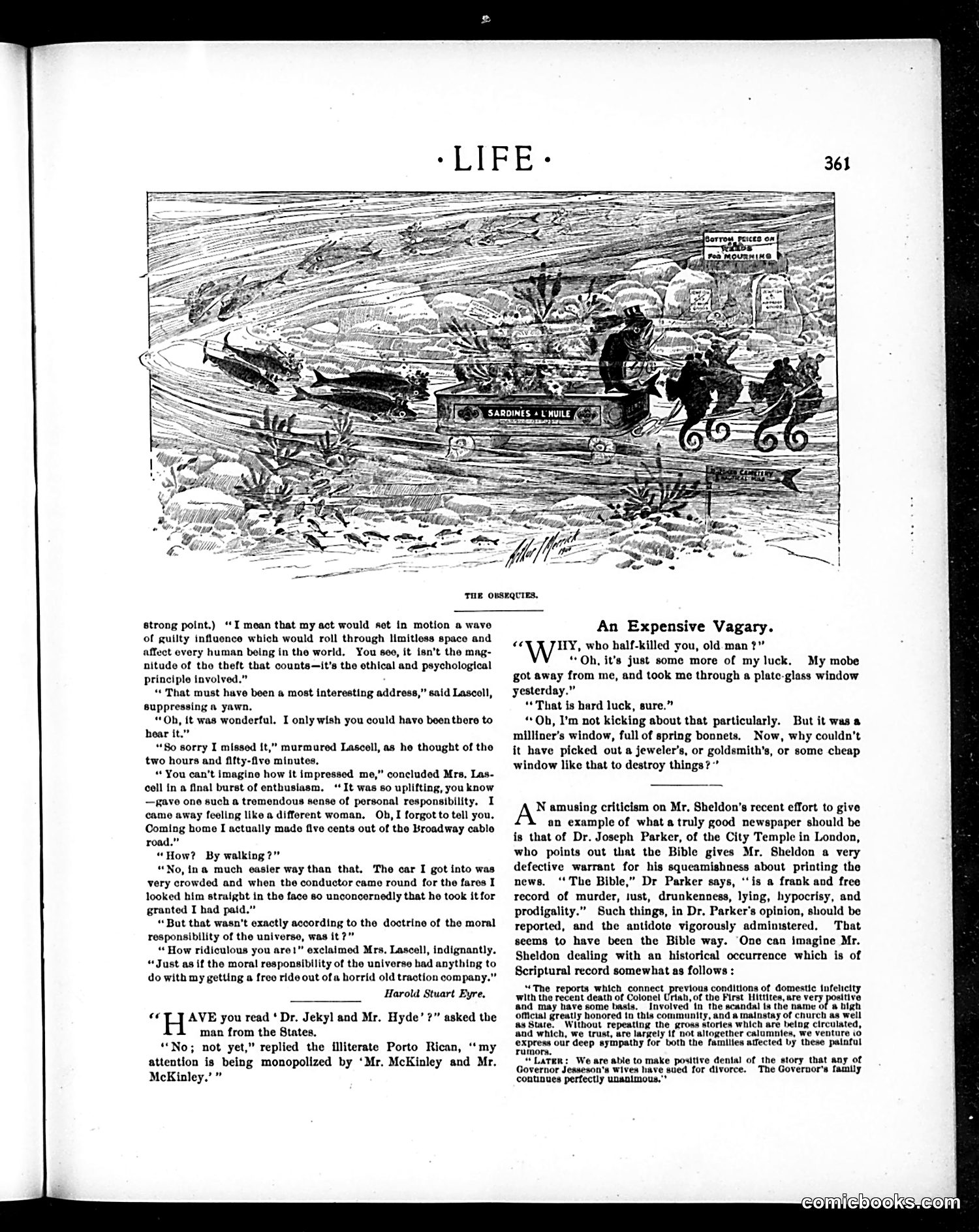
The main illustration titled "The Obscures" depicts an underwater scene with figures in what appears to be a submarine or diving vessel labeled "SARDINES À L'HUILE" (sardines in oil). This is a visual pun—the vessel itself resembles a sardine tin, with the occupants portrayed as sardine-like figures. The satirical point seems to target overcrowded conditions or claustrophobic circumstances, playing on the double meaning of "sardines" (the fish packed tightly in cans versus people packed tightly together). The text below discusses various social and domestic scandals, including references to "Dr. Jekyll and Mr. Hyde," divorce, and newspaper sensationalism. The overall page combines visual and textual satire critiquing contemporary society's obsessions with scandal and human behavior.
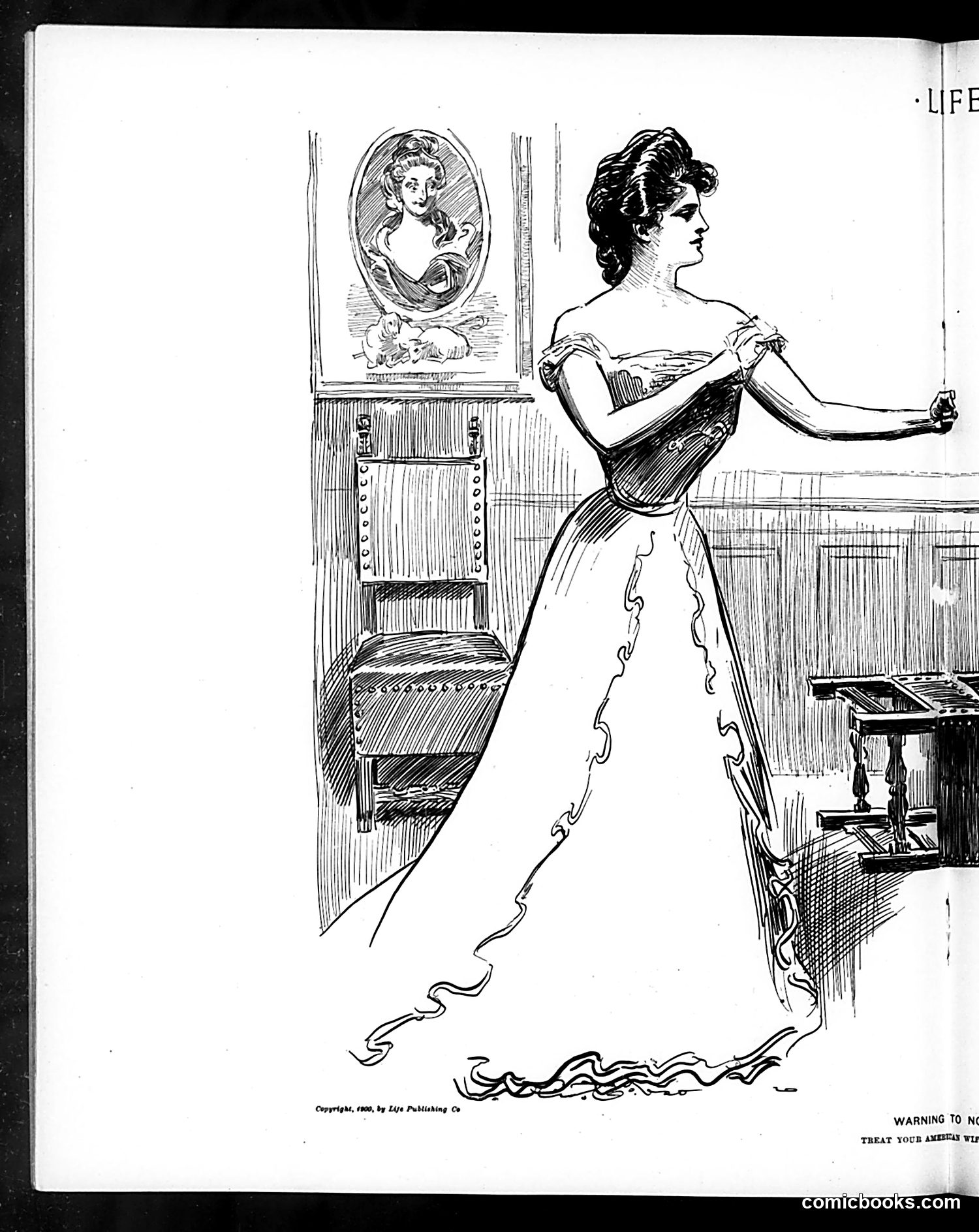
This appears to be a satirical illustration from Life magazine depicting a fashionable woman in an elegant gown with decorative trim, posing in what seems to be a bedroom or dressing room. A portrait hangs on the wall behind her. Without clearer text or identifying captions visible in the image, I cannot definitively identify who this figure represents or what specific social or political commentary the cartoon makes. The illustration style and fashion suggest early 20th-century publication, and the ornate gown and interior setting suggest satire about wealth, vanity, or social pretension—common Life magazine targets. The partial text at bottom mentions "WARNING TO NO[...]" and "TREAT YOUR AIRBUS WI[...]" but is too obscured to interpret the full message or context of the satire.
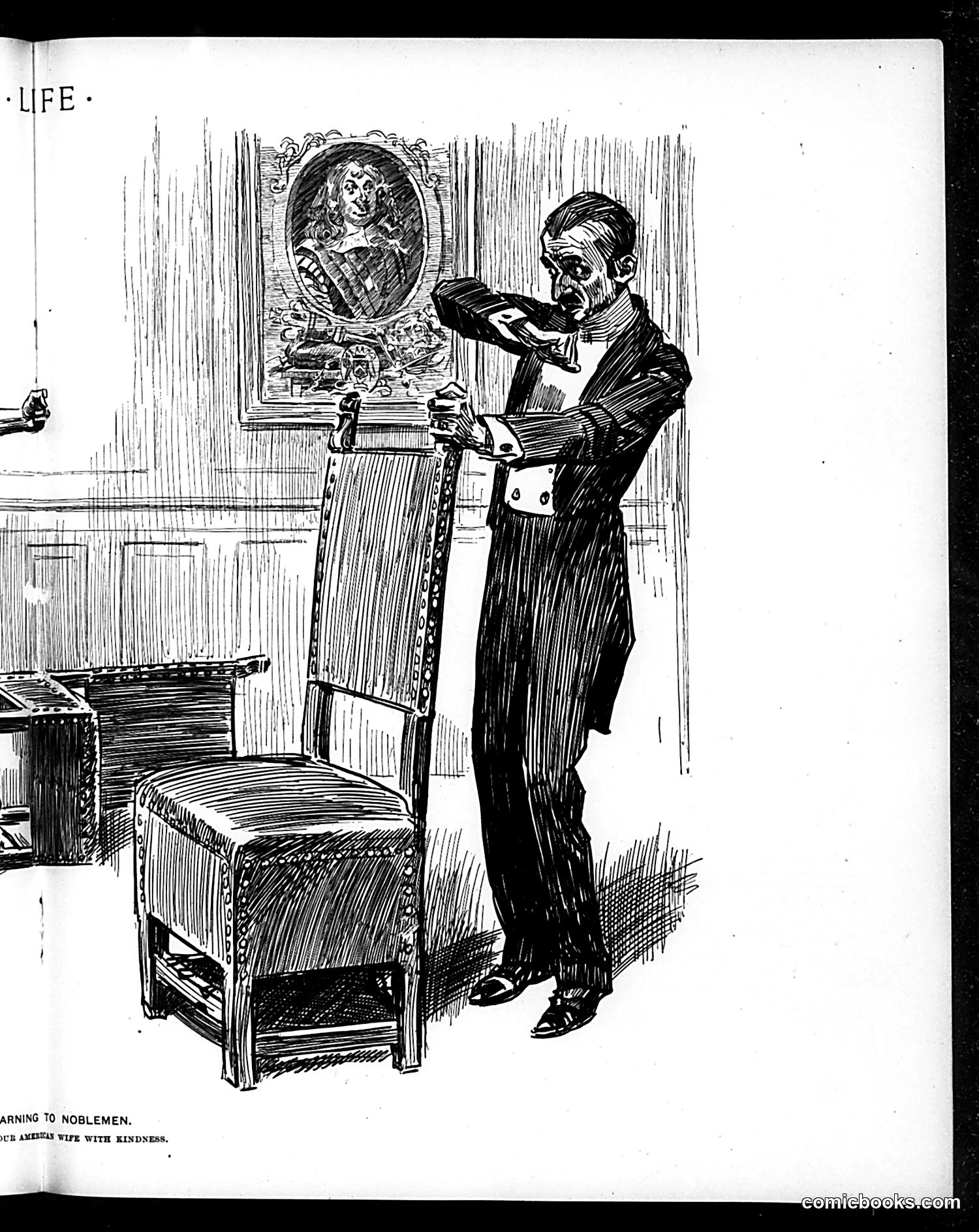
This is a satirical illustration from *Life* magazine titled "LIFE" at top. The image shows a well-dressed man in formal attire presenting or adjusting a portrait of a woman in an ornate frame. The partial text visible at bottom reads "ARNING TO NOBLEMEN" and "[?]ER AMENIAN WIFE WITH KINDNESS." The cartoon appears to satirize wealthy American men (likely nouveaux riches industrialists) marrying European nobility or aristocratic women. The joke seems to be about displaying one's wife like a prized possession—literally presenting her in a frame—while the caption ironically advises treating an "Armenian wife with kindness," suggesting such marriages were transactional rather than based on affection. This reflects Gilded Age anxieties about American wealth purchasing foreign aristocratic titles and status.
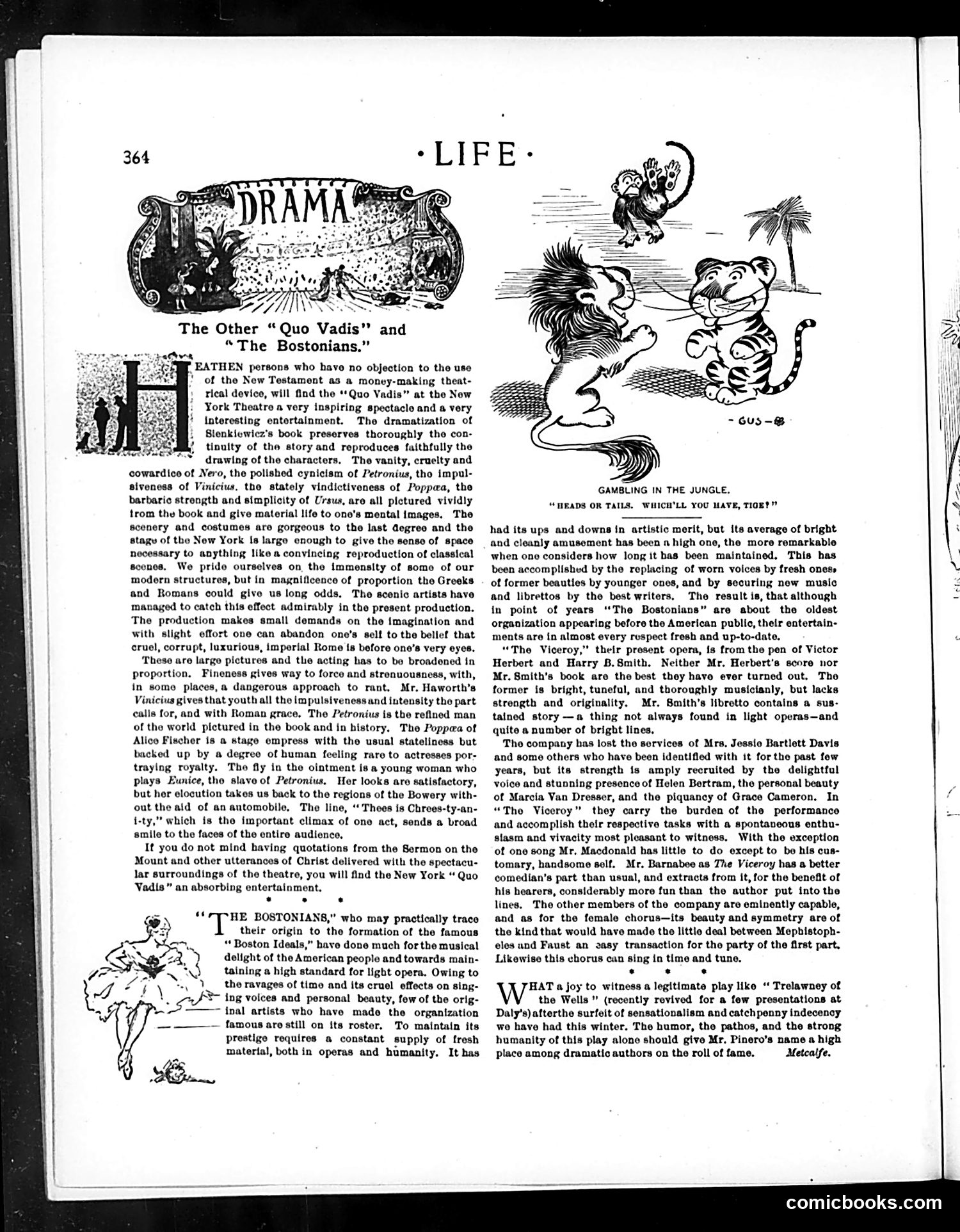
This page reviews theatrical productions, primarily "Quo Vadis" and "The Bostonians." The main cartoon illustration (titled "Gambling in the Jungle") depicts animals—a lion and tiger—with the caption "Heads or Tails. Which'll You Have, Tiger?" The satire appears to mock theatrical competition and risk-taking in entertainment. The animal imagery suggests producers are "gambling" with their productions, essentially betting on success like wild beasts in nature. The text discusses how these dramatic adaptations preserve literary source material while requiring constant innovation to maintain audience interest. The reviews suggest both productions successfully balance faithfulness to original works with theatrical spectacle—a delicate balance the author compares to genuine gambling.
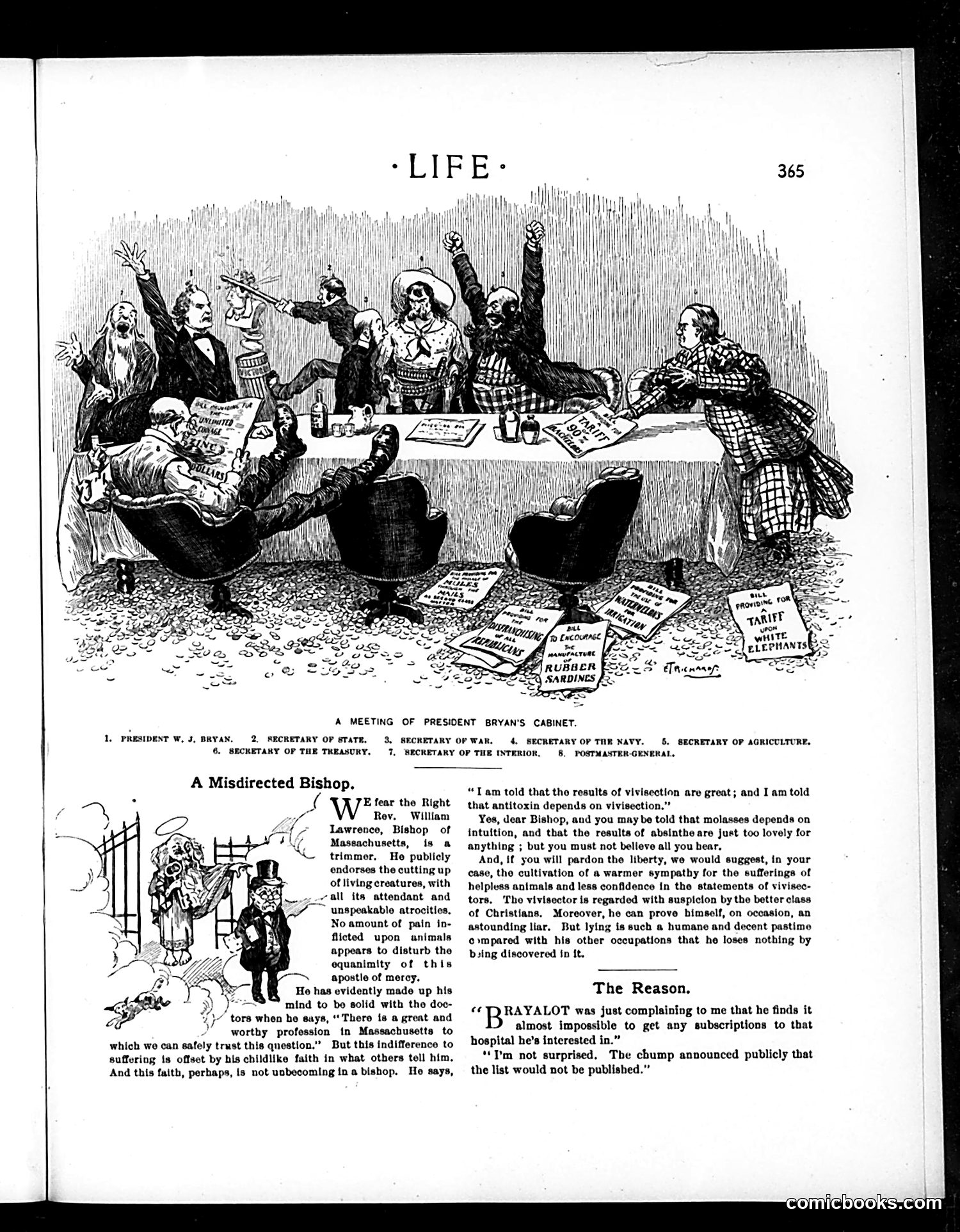
**"A Meeting of President Bryan's Cabinet"** (top): This mocks William Jennings Bryan's potential presidential administration. The cartoon depicts his cabinet members as rowdy, chaotic figures surrounded by papers labeled with controversial issues—tariffs, free trade, rubber, sardines—suggesting incompetence and disorganization in handling economic policy. **"A Misdirected Bishop"** (bottom left): Critiques Rev. William Lawrence of Massachusetts for publicly endorsing animal vivisection. The satire argues his justifications (that medical benefits depend on it) are hollow; he uncritically accepts claims from vivisectors while ignoring animal suffering. **"The Reason"** (bottom right): A brief joke explaining why a hospital couldn't secure subscriptions—the organizer publicly announced the donor list wouldn't be published, discouraging contributors who wanted public recognition. All three pieces employ characteristic Life magazine satire: political lampooning, moral criticism of public figures, and dry wit about social hypocrisy.
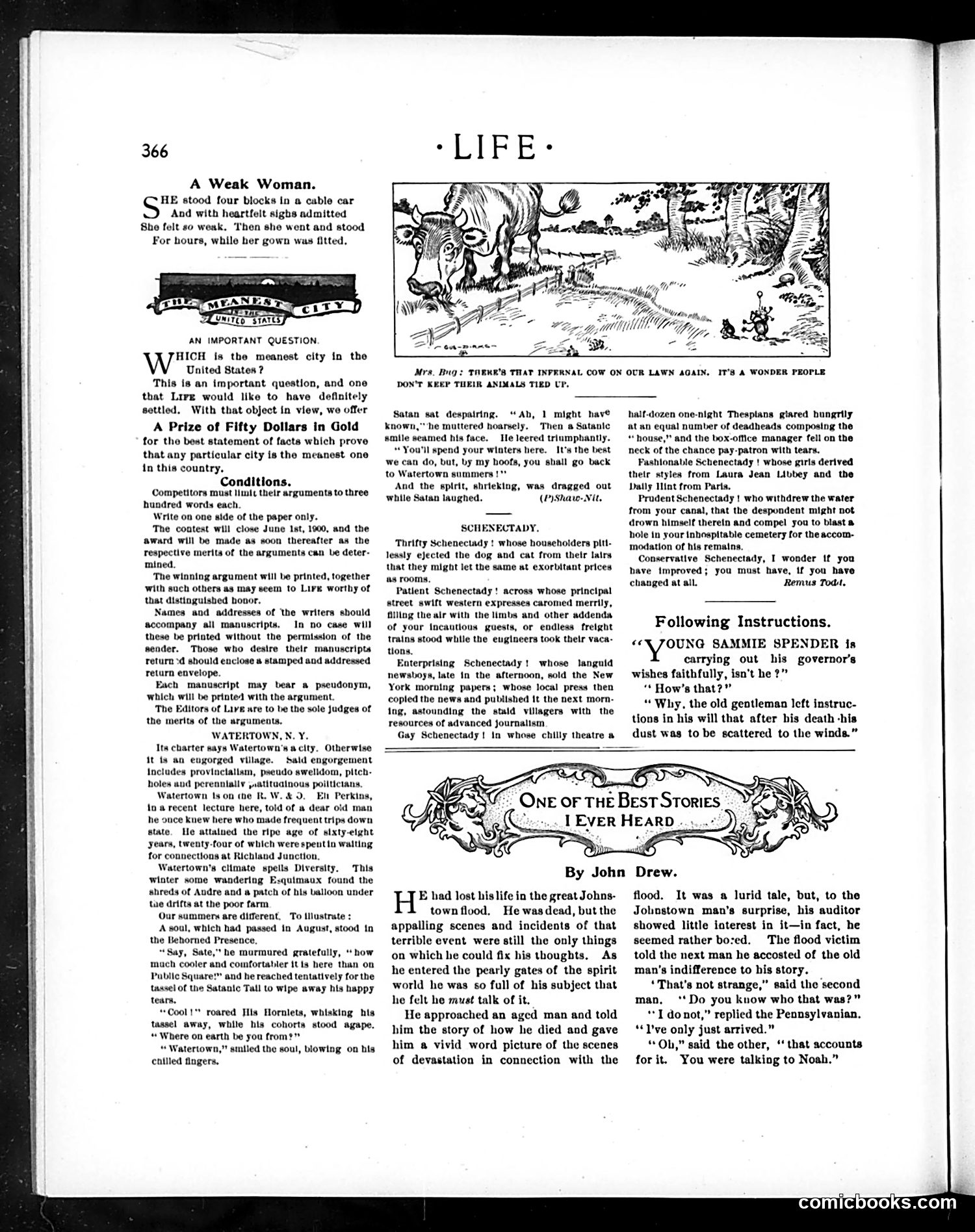
This page combines several pieces of satirical commentary typical of Life magazine's style. **"A Weak Woman"** mocks Victorian-era gender contradictions: a woman claims exhaustion after standing four blocks in a cable car, yet can stand for hours during a dress fitting—suggesting women's complaints about weakness were selective and socially performative. **"Which is the meanest city in the United States?"** is a humorous contest inviting readers to nominate America's worst city, with submissions visible below. The entries saririze specific towns: **Watertown** is mocked for cold winters, poor connections, and having summer heat so extreme that even Hell seems preferable. **Schenectady** is ridiculed for exploitative landlords, trains blocking streets, and newspapers reprinting yesterday's New York news as current events—critiquing both civic dysfunction and journalistic laziness. The cartoon shows a cow on a lawn, illustrating rural intrusions into supposedly civilized spaces—a common complaint in early-1900s America as cities expanded.
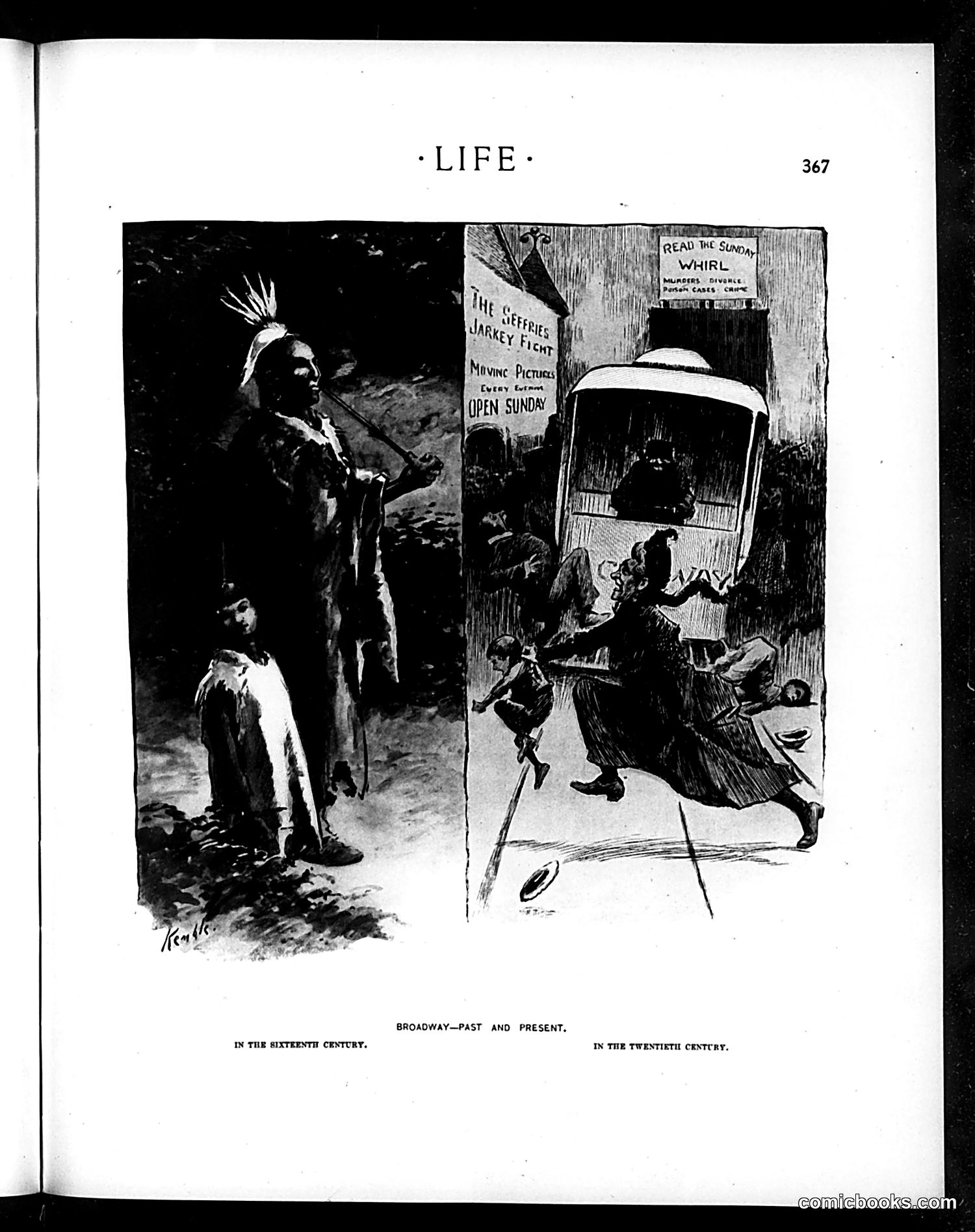
This two-panel satirical comparison contrasts entertainment across centuries. The left panel depicts a Native American performer in traditional dress with a headdress, apparently representing 16th-century "Broadway." The right panel shows a 20th-century theater scene with a movie marquee (advertising "The Jeffries-Dempsey Fight" and "Maving Pictures"), where fashionably dressed pedestrians hustle past the entrance. The satire appears to mock how Broadway entertainment has evolved from "exotic" spectacles to modern commercial ventures. It likely critiques both historical exploitation of Indigenous peoples as entertainment and contemporary Broadway's focus on sensationalism and mass consumption. The contrast emphasizes how entertainment has become more urbanized, commercialized, and tied to technology (moving pictures, boxing matches) rather than live performance.
This page contains political and social satire typical of Life magazine's style. The main cartoon appears to reference debates about **vaccination and medical authority** in a French aristocratic context (note the French dialogue and references to "Cyrano de Bergerac"). The satire mocks resistance to mandatory vaccination laws, showing a count attempting to avoid vaccination through absurd means—ultimately being vaccinated anyway despite his theatrical objections. The opening section critiques a **political paradox**: that offices should seek qualified men, yet struggle to find them—a commentary on incompetent public officials. Other brief satirical pieces mock theater conventions, rowing teams, and clerical pretension. The page is heavily laden with **period advertisements** (Wilson Whiskey, Nestor Cigarettes, Esterbrook Steel Pens), indicating this is primarily a commercial publication masquerading as serious satire—a common Life magazine format of the era.
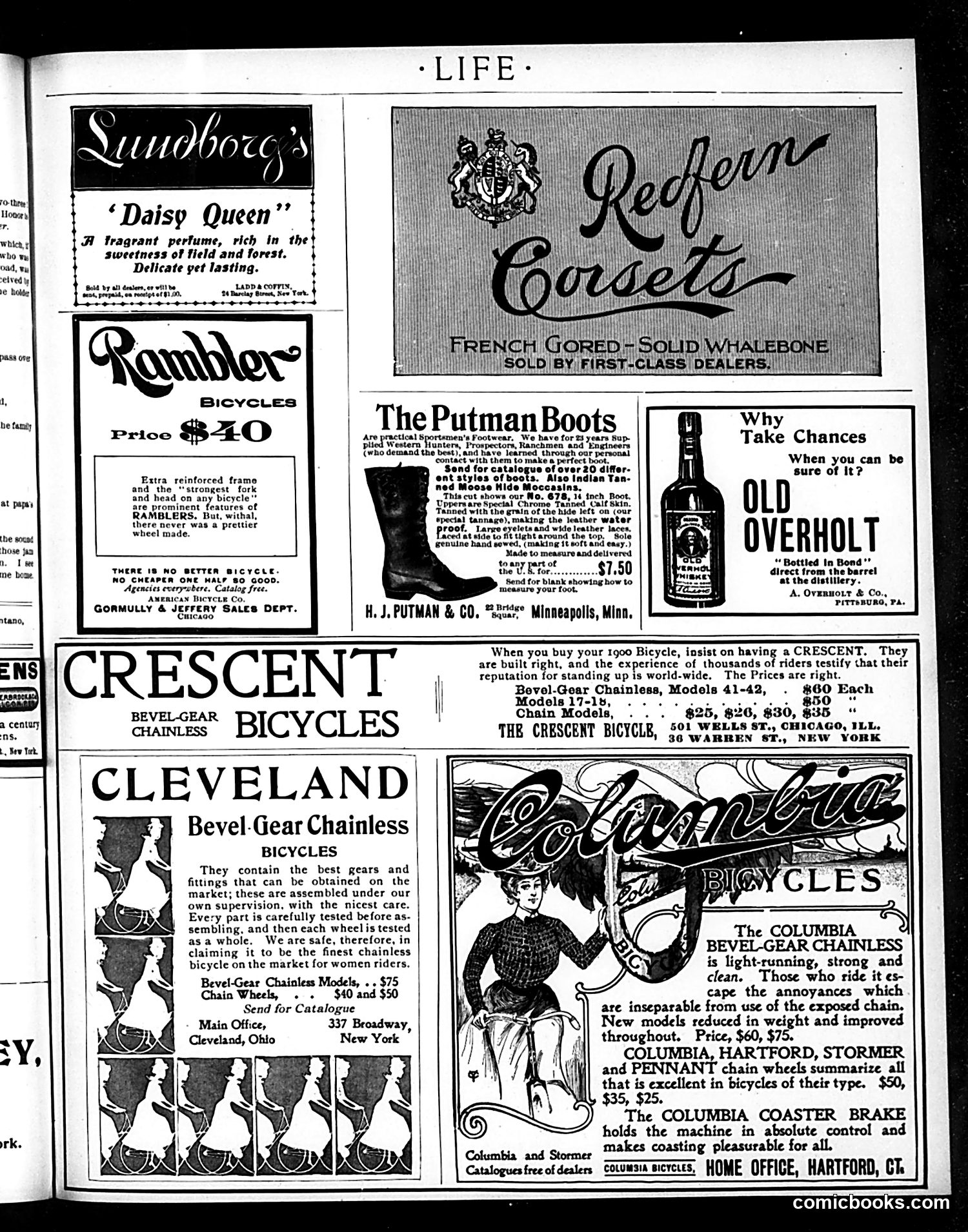
This is **not a cartoon or satire page**—it's primarily a advertisements section from Life magazine, circa 1900 (based on references to "1900 Bicycle"). The page showcases competitive bicycle advertisements from major American manufacturers: Rambler, Crescent, Cleveland, and Columbia. These ads emphasize technical innovations like "bevel-gear chainless" designs, which were cutting-edge at the time. Interspersed are advertisements for other products: Lunoborg's "Daisy Queen" perfume, Putman Boots (marketed as sportsmen's footwear), and Old Overholt whiskey ("bottled in bond"). The content reflects the **bicycle boom of the 1890s**, when cycling was enormously popular and manufacturers competed aggressively on innovation and price. The emphasis on chainless designs and safety features indicates these were selling points to consumers—particularly women riders, as one Cleveland ad explicitly notes. This is a straightforward commercial page with no satirical content.
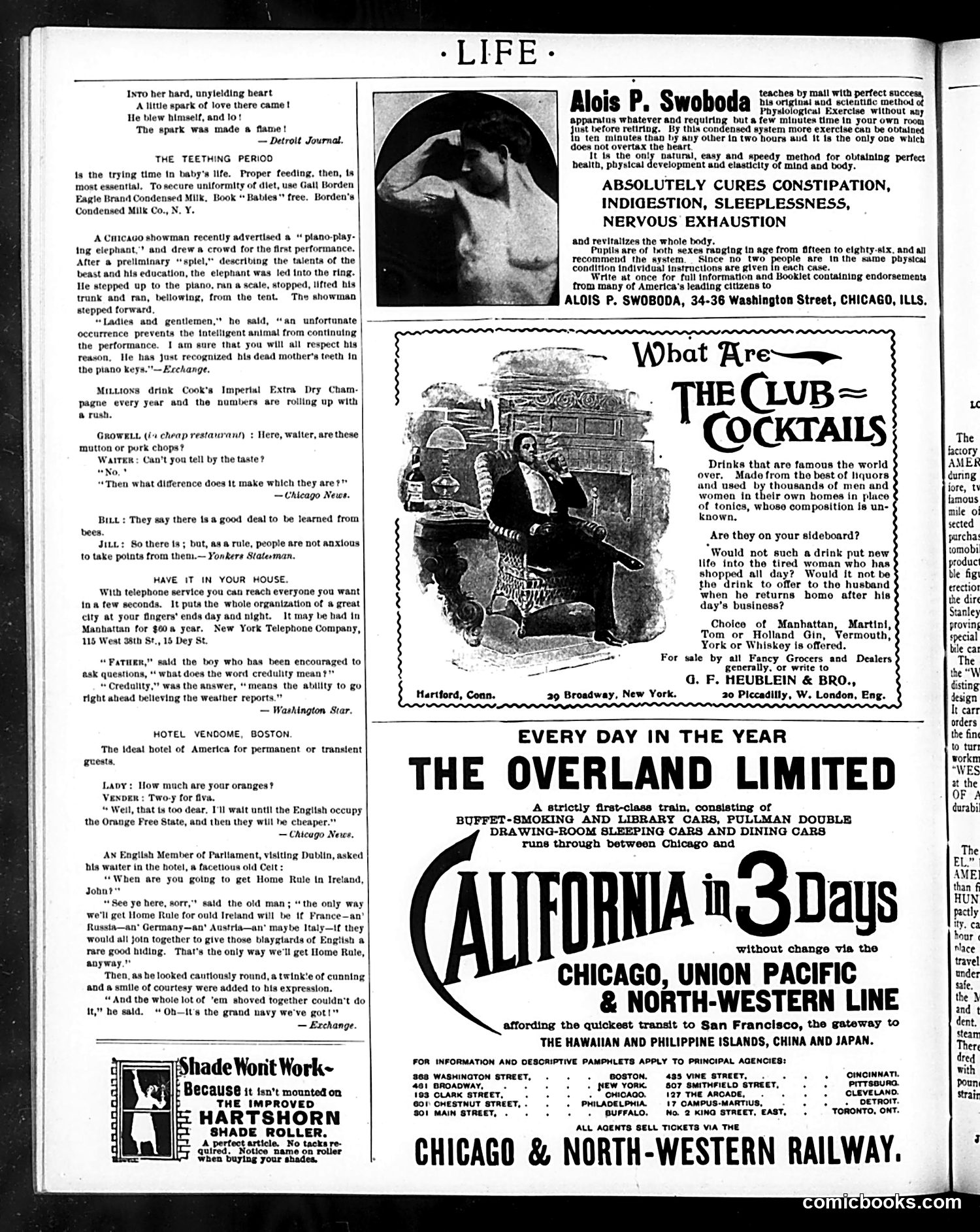
This page is primarily **advertisements and light humor**, not political cartooning. The small jokes scattered throughout are typical early-20th-century comic filler: - A joke about a piano-playing elephant that recognizes "its dead mother's teeth" in piano keys—absurdist humor relying on wordplay - Dialogue jokes about pork vs. mutton chops, bee wisdom, and weather forecasts—gentle, non-topical comedy - An Irish character's humorous complaint about English rule in Ireland, using exaggeration for laughs rather than serious satire The page is dominated by **period advertisements**: Alois P. Swoboda's mail-order exercise system, Club Cocktails, The Overland Limited train service to California, and various hotels and consumer products. There is **no significant political cartoon or social commentary**—just commercial content with scattered comic anecdotes typical of Life magazine's mixed entertainment and advertising format from this era (appears early-1900s based on typography and ad styles).
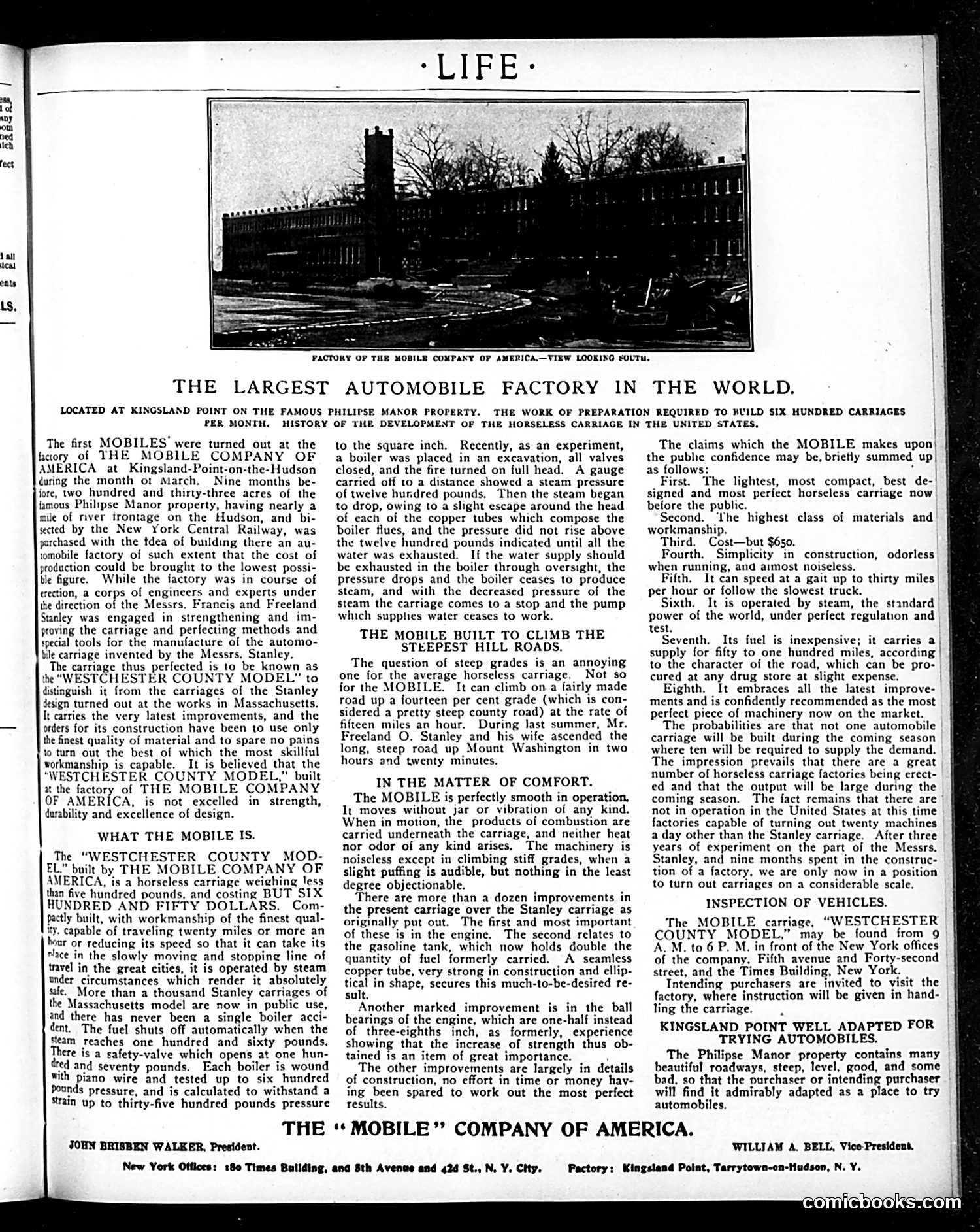
This is primarily **advertisement disguised as editorial content** for the Mobile Company of America's new automobile factory at Kingsland Point, New York. The photograph shows the factory building; the text promotes the "Mobile"—a steam-powered horseless carriage. There is **no political cartoon or satire** on this page. Instead, it's a detailed product advertisement extolling the Mobile's virtues: affordability ($650), safety features (automatic fuel shutoff, reinforced boiler), efficiency (fifty to one-hundred-mile range), and capability (climbing steep grades). The emphasis on safety reflects contemporary concerns about early automobiles, particularly steam-powered vehicles. The page represents early-1900s industrial advertising strategy—presenting commercial promotion as factual journalism in a magazine context, a practice common in *Life* magazine of that era.
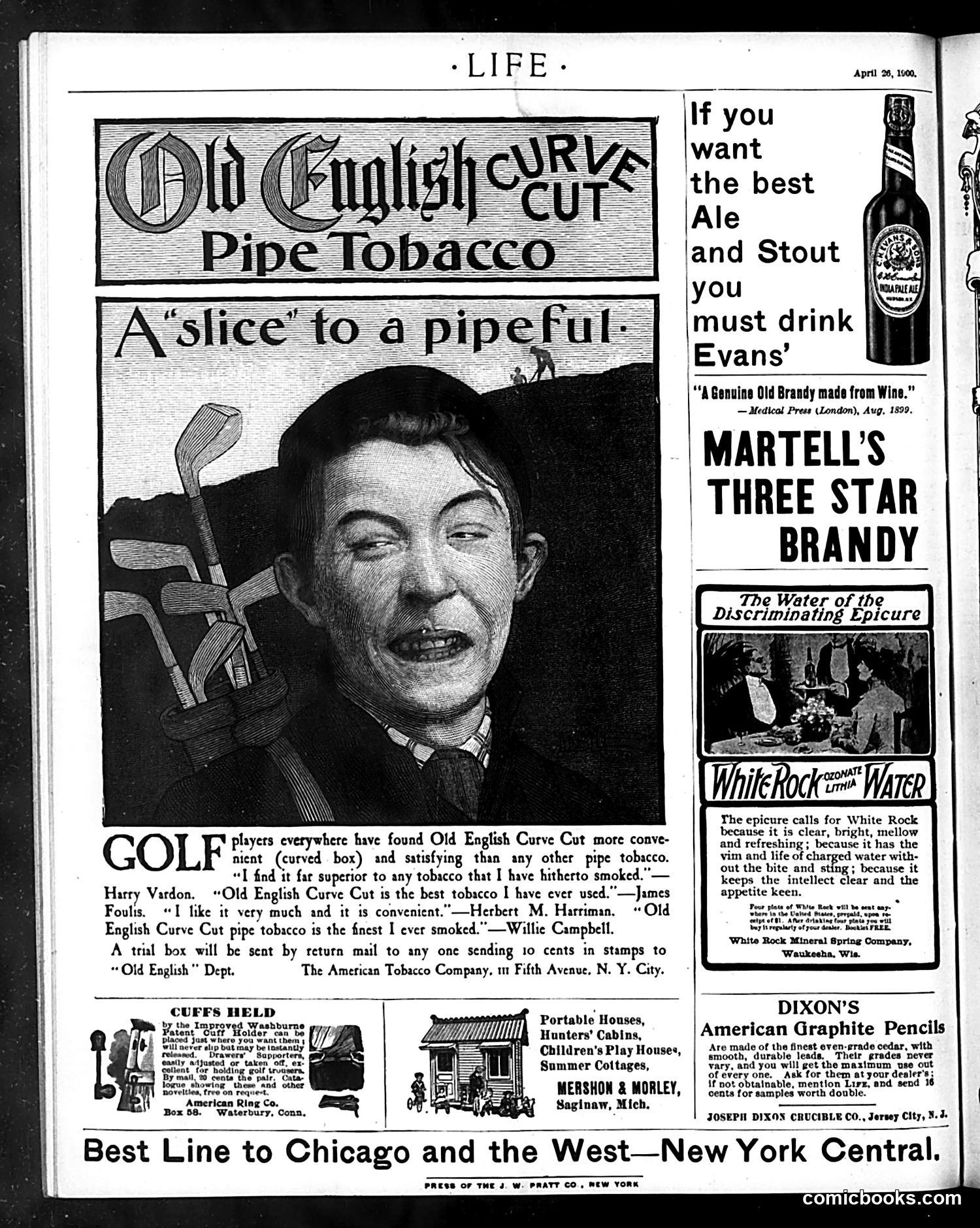
This page is **primarily advertising**, not satire. The main content features testimonials from famous golfers (Harry Vardon, James Foulis, and Willie Campbell) endorsing "Old English Curve Cut" pipe tobacco. The accompanying illustration shows a smiling golfer holding golf clubs, emphasizing the product's appeal to the sporting gentleman. The page reflects turn-of-the-century marketing practices: celebrity endorsements were a novel advertising strategy. Golf itself was a relatively new leisure activity for American gentlemen, making golfer testimonials particularly valuable for brand positioning. Surrounding advertisements promote other luxury goods—brandy, ale, mineral water, graphite pencils, and portable vacation homes—targeting affluent male readers. This clustering reflects Life's audience: wealthy, leisured professionals interested in golf, fine spirits, and modern conveniences. There is no political satire present; the page simply demonstrates period advertising conventions and consumer culture aimed at the upper class.