
Life, 1900-04-26 · page 6 of 20
Life — April 26, 1900 — page 6: what you’re looking at
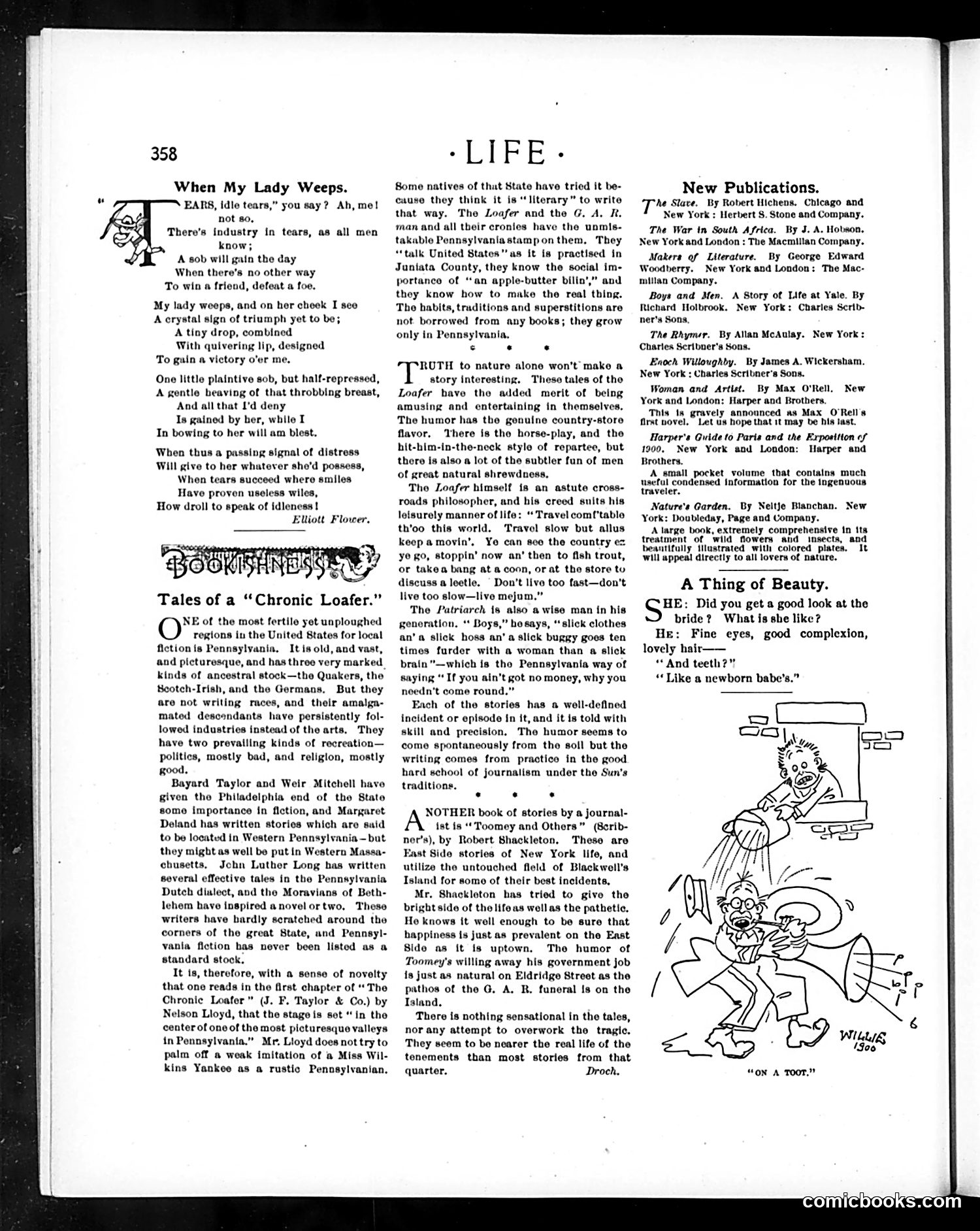
What you’re looking at
This cartoon by Wills depicts a humorous domestic scene captioned "On a Toot." The illustration shows what appears to be a disheveled man being confronted by a woman (likely his wife) in a home setting, with various household items scattered about. The joke plays on the phrase "on a toot"—slang from this era meaning "on a drinking spree" or bender. The cartoon satirizes the common domestic conflict of a husband returning home intoxicated. The woman's stern expression and the chaotic setting suggest her disapproval of his behavior. This reflects early 20th-century American humor about marital discord resulting from male drinking—a recurring satirical theme in Life magazine during this period.
📄 Transcribed text from this page (OCR, searchable)
Machine-transcribed from the original scan — historical spelling and the odd misread are preserved.
358 When My Lady Weeps. EARS, Idle tears,” you say? Ah, me! not 80, Thero’s industry in tears, as all men know; A sob will gain the day When there's no other way To win a friend, defeat a foe. My lady weeps, and on her check I see A crystal sign of triumph yet to be; A tiny drop, combined With quivering lip, designed To guin a victory o'er me. One little plaintive sob, but half-repressed, A gentle heaving of that throbbing breast, And all that I'd deny Is gained by her, while I In bowing to her will am blest. When thus a passing signal of distress Will give to her whatever sho'd possess, When tears succeed where smiles Have proven useless wiles, How droll to speak of idleness ! Eliott Flower. Tales of a “Chronic Loafer.” NE of the most fertile yot unploughed regions in the United States for local fiction is Pennsylvania, It is old, and vast, and picturesque, and has three very marked kinds of ancestral stock—the Quakers, the Scotch-Irish, and the Germans. But they Gre not writing races, and their amalga- mated descendants have persistently fol- lowed industries instead of the arts, They have two prevailing kinds of recreation— politics, mostly bad, and religion, mostly good, Bayard Taylor and Weir Mitchell havo given the Philadelphia end of the State somo importance in fiction, and Margaret Deland has written stories which are suid to be located in Western Pennsylvania —but they might as well be put in Western Massa- chusetts, John Luther Long bas written several effective tales in the Pennsylvania Dutch dialect, and the Moravians of Beth- lehem have inspired a novel or two. These writers have bardly scratched around the corners of the great State, and Pennsyl- vanla fiction bas never been listed as a standard stock. It 1g, therefore, with a sense of novelty that one reads in the first chapter of “Tho Chronic Loafer” (J. F. Taylor & Co.) by Nelson Lloyd, that the stage is set “in the center of ono of the most picturesque valleys in Pennsylvanta.” Mr, Lioyd does not try to palm off a weak imitation of a Miss Wil- kins Yankeo as a rustic Pennsylvanian, -LIFE- Some natives of that State have tried it be- cause they think it is “literary” to write that way. The Loafer and the G. A, R. man and all their cronies have the unmis- takable Pennsylvania stampon them. They “talk United States""as it is practised in Juniata County, they know the social im- portance of ‘an apple-butter bilin’,” and they know how to make the real thing. The habits, traditions and superstitions are not borrowed from any books; they grow only in Pennsylvania. € . . RUTH to nature alone won't’ make a story interesting. These tales of tho Loafer bave tho added merit of being amusing and entertaining in themselves, ‘The humor has the gonuine country-storo flavor, ‘There is tho horse-play, and the hit-bim-in-the-neck style of repartee, but thero is also a lot of the subtler fun of men of great natural shrewdness, Tho Loafer himself is an astute cross- roads philosopher, and his creed suits his leisurely manner of life: “Travel comftablo th’oo this world. Travol slow but allus keop a movin’, Yo can seo the country e= yo go, stoppin’ now an’ then to fish trout, or takea bang at a coon, or at tho store tu discuss a leetle. | Don’t live too fast—don't live too slow—livo mejum.” The Patriarch {6 also a wise man in his generation, “ Boys,” hosays, “slick clothes an’a slick hoss an’ a slick buggy goes ten times furder with a woman than a slick brain”"—which is tho Pennsylvania way of saying “If you ain't got no money, why you noedn't come round.” Each of the stories has a woll-deflned incident or episode In it, and it is told with skill and precision. Tho humor seems to come spontaneously from tho soll but the writing comes from practice in tho good hard school of journalism under the Sun's traditions. . . NOTHER book of stories by a journal- A ist is Toomey and Others” (Bcrib- nor’s), by Robert Shackleton, Theso aro East Sido stories of New York life, and utilize the untouched fleld of Blackwell's Island for somo of their best incidents, Mr. Shackleton has tried to givo the bright side of tho lifeas well as the pathetic. He knows {t well enough to be sure that happiness is just as prevalent on the East Sido as it {8 uptown, Tho humor of Toomey's willing away his government job {s just as natural on Eldridgo Street as tho pathos of the G. A. R. funeral fs on the Island. Thore is nothing sensational in the tales, nor any attempt to overwork the tragic. ‘They seem to bo nearer the real life of the tenements than most stories from that quarter. Droch. New Publications. ‘he Slave. By Robert Hichens. Chicago and New York : Herbert S. Stone and Company. The War in South Africa. By J. A. Hobson, New York and London : The Macmillan Company. Makers of Literature. By George Edward Woodberry. New York and London: The Mac- millan Company. Boys and Men. A Story of Life at Yale. By Richard Holbrook. New York: Charles Scrib- ner’s Sona, The Rhymr. By Allan McAulay. New York : Chartes Scribner's Sons. och Willoughby. By James A. Wickersham. New York : Charles Scribner's Sons, Woman and Artist. By Max O'Rell. York and London: Harper and Brothers, This 1s gravely announced as Max O'Rell's first novel, Let us hope that it may be bis last, Harper's Quide to Paris and the Exposition of 1900, New York and London: Harper and Brothers. A small pocket volume that contains much usefal condensed information for the ingenuous traveler. Nature's Garden. By NeitJe Blanchan. New York: Doubleday, Page and Company. A large book, extremely comprehensive in tts treatment of wild flowers and insects, and beautifully MMlustrated with colored plates. It will appeal directly to all lovers of nature. New A Thing of Beauty. HE: Did you get a good look at the bride? What is she like? He: Fine eyes, good complexion, lovely hair—— “And teeth?" “Like a newborn babe’s.” “ON A Toor,”