
Life, 1900-04-26 · page 4 of 20
Life — April 26, 1900 — page 4: what you’re looking at
What you’re looking at
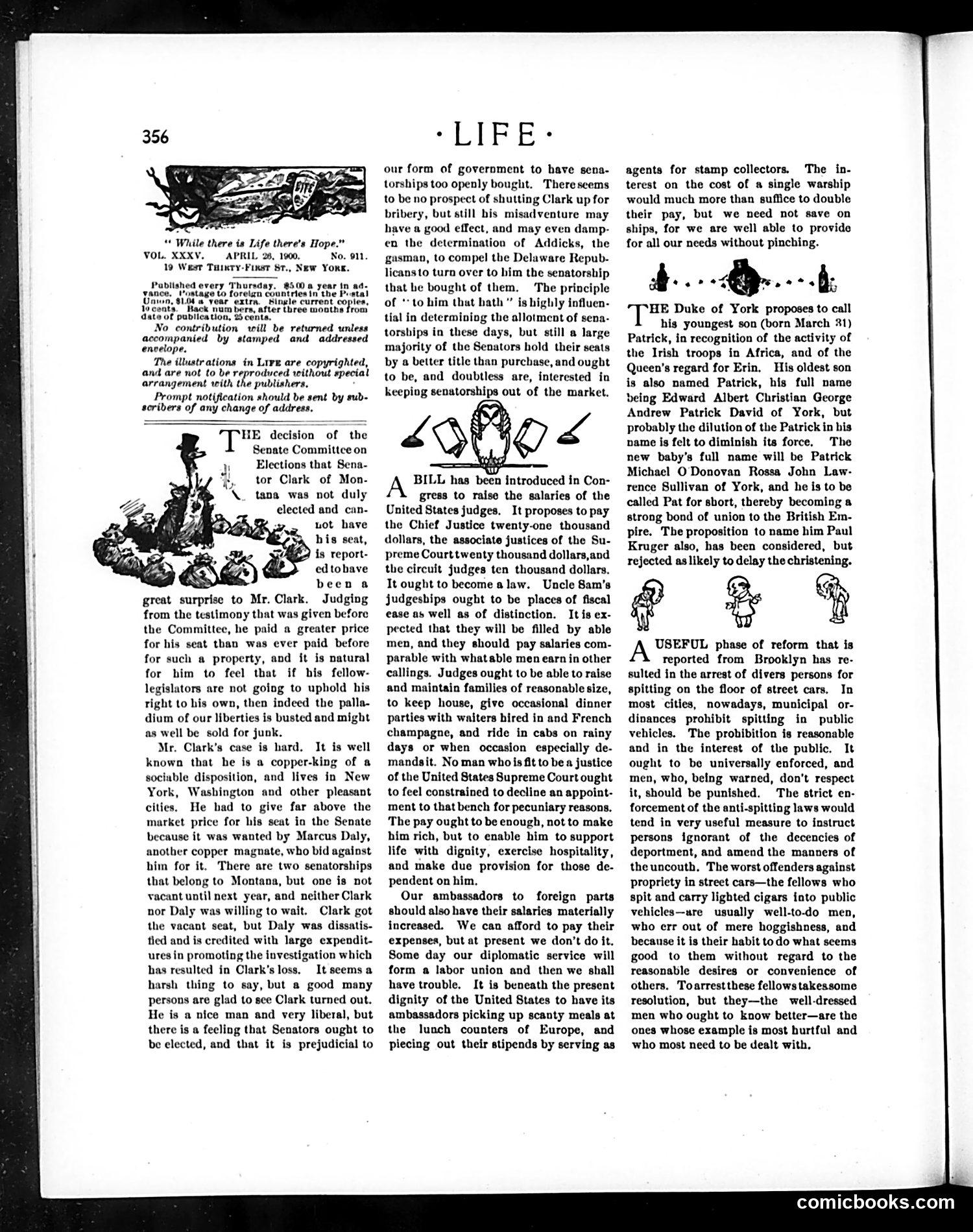
This page contains three editorial cartoons satirizing American political figures and institutions: 1. **Top cartoon**: Depicts the Senate Committee's decision regarding Senator Clark of Montana, who was not re-elected despite reportedly purchasing his seat. The satire mocks the irony that Clark—a copper magnate and known briber—is surprised to lose his position, suggesting the Senate's alleged corruption and venality. 2. **Middle cartoon**: Illustrates proposed legislation to raise U.S. judges' salaries, arguing they deserve better compensation to maintain dignity and prevent financial desperation that might encourage corruption. 3. **Bottom cartoon**: Critiques a reform effort to arrest street-car drivers for spitting, suggesting this petty enforcement trivializes real social problems while ignoring more serious public nuisances and behavioral issues. The page's satirical tone reflects Progressive Era concerns about political corruption, judicial integrity, and misplaced reform priorities.
📄 Transcribed text from this page (OCR, searchable)
Machine-transcribed from the original scan — historical spelling and the odd misread are preserved.
“* While there is Life there’s Hope.” VOL. XXXV. APRIL 28, 1900. No. 911. 19 West Taixry-Finst St., New Yor. Un 168, Weonts. Back num bere. after three wonthe froa date of publication, % cents, No contribution will be returned unless accompanied by stamped and addressed envelope. The illustrations in LrvE are copyrighted, and are not to be reproduced weithout spectat arrangement with the publishers, Prompt notification should be sent by sub- scribers of any change of address, HE decision of the Senate Committce on mM Elections that Sena- ‘ tor Clark of Mon- tana was not duly elected and can- uot have his seat, is report- edtobave been a great surprise to Mr. Clark. Judging from the testimony that was given before the Committee, he paid a greater price for his seat than was ever paid before i for such a property, and it is natural for him to feel that if his fellow- legislators are not going to uphold his right to his own, then indeed the palla- dium of our liberties is busted and might as well be sold for junk, Mr. Clark’s case is hard. | i] | It is well known that he is a copper-king of a | sociuble disposition, and lives in New | | } York, Washington and other pleasant cities, He had to give far above the market price for his seat in the Senate because it was wanted by Marcus Daly, another copper magnate, who bid against him for it. There are two senatorships that belong to Montana, but one is not vacant until next year, and neither Clark nor Daly was willing to wait. Clark got the vacant seat, but Daly was dissatis- tied and is credited with large expendit- ures in promoting the investigation which has resulted in Clark's loss. It seems a harsh thing to say, but a good many persons are glad to see Clark turned out. He is a nice man and very liberal, but there is a fecling that Senators ought to be elected, and that it is prejudicial to LIFE our form of government to have sena- torships too openly bought. Thereseems to be no prospect of shutting Clark up for bribery, but still bis misadventure may have a good effect, and may even damp- en the determination of Addicks, the gasman, to compel the Delaware Repub- licansto turn over to him the senatorship that be bought of them. The principle of ‘to him that hath ” is highly influen- tial in determining the allotment of sena- torships in these days, but still a large majority of the Senators hold their seats by a better title than purchase, and ought to be, and doubtless are, interested in keeping senatorships out of the market. LORIO S BILL has been introduced in Con- gress to raise the salaries of the United States judges. It proposes to pay the Chief Justice twenty-one thousand dollars, the associate justices of the Su- preme Courttwenty thousand dollars,and the circuit judges ten thousand dollars, It ought to become a law. Uncle Sam’s judgeships ought to be places of fiscal ease as well as of distinction. It is ex- pected that they will be filled by able men, and they should pay salaries com- parable with whatable men earn in other callings. Judges ought to be able to raise and maintain families of reasonable size, to keep house, give occasional dinner parties with waiters hired in and French champagne, and ride in cabs on rainy days or when occasion especially de- mandsit. No man whois fit to be a justice of the United States Supreme Court ought to feel constrained to decline an appoint- ment to that bench for pecuniary reasons. The pay ought to be enough, not to make him rich, but to enable him to support life with dignity, exercise hospitality, and make due provision for those de- pendent on him. Our ambassadors to foreign parts should also have their salaries materially increased. We can afford to pay their expenses, but at present we don’t do it. Some day our diplomatic service will form a labor union and then we shall have trouble. It is beneath the present dignity of the United States to have its ambassadors picking up scanty meals at the lunch counters of Europe, and piecing out their stipends by serving as agents for stamp collectors. The in- terest on the cost of a single warship would much more than suffice to double their pay, but we need not save on ships, for we are well able to provide for all our needs without pinching. HE Duke of York proposes to call his youngest son (born March 21) Patrick, in recognition of the activity of the Irish troops in Africa, and of the Queen’s regard for Erin. His oldest son is also named Patrick, his full name being Edward Albert Christian George Andrew Patrick David of York, but probably the dilution of the Patrick in his name is felt to diminish its force. The new baby’s full name will be Patrick Michael O'Donovan Rossa John Law- rence Sullivan of York, and he is to be called Pat for short, thereby becoming a strong bond of union to the British Em- pire. The proposition to name him Paul Kruger also, has been considered, but rejected as likely to delay the christening. @ & & AA USER ot phase of reform that is reported from Brooklyn has re- A in the arrest of divers persons for spitting on the floor of street cars, In most cities, nowadays, municipal or- divances prohibit spitting in public vehicles, The prohibition is reasonable and in the interest of the public. It ought to be universally enforced, and men, who, being warned, don't respect it, should be punished. The strict en- forcement of the anti-spitting laws would tend in very useful measure to instruct persons ignorant of the decencies of deportment, and amend the manners of the uncouth, The worst offenders against propriety in street cars—the fellows who spit and carry lighted cigars into public vehicles—ure usually well-to-do men, who err out of mere hoggishness, and because it is their habit todo what seems good to them without regard to the reasonable desires or convenience of others, Toarrestthese fellowstakessome resolution, but they—the well-dressed men who ought to know better—are the ones whose example is most hurtful and who most need to be dealt with. comicbooks.com