
Life, 1900-04-26 · page 12 of 20
Life — April 26, 1900 — page 12: what you’re looking at
What you’re looking at
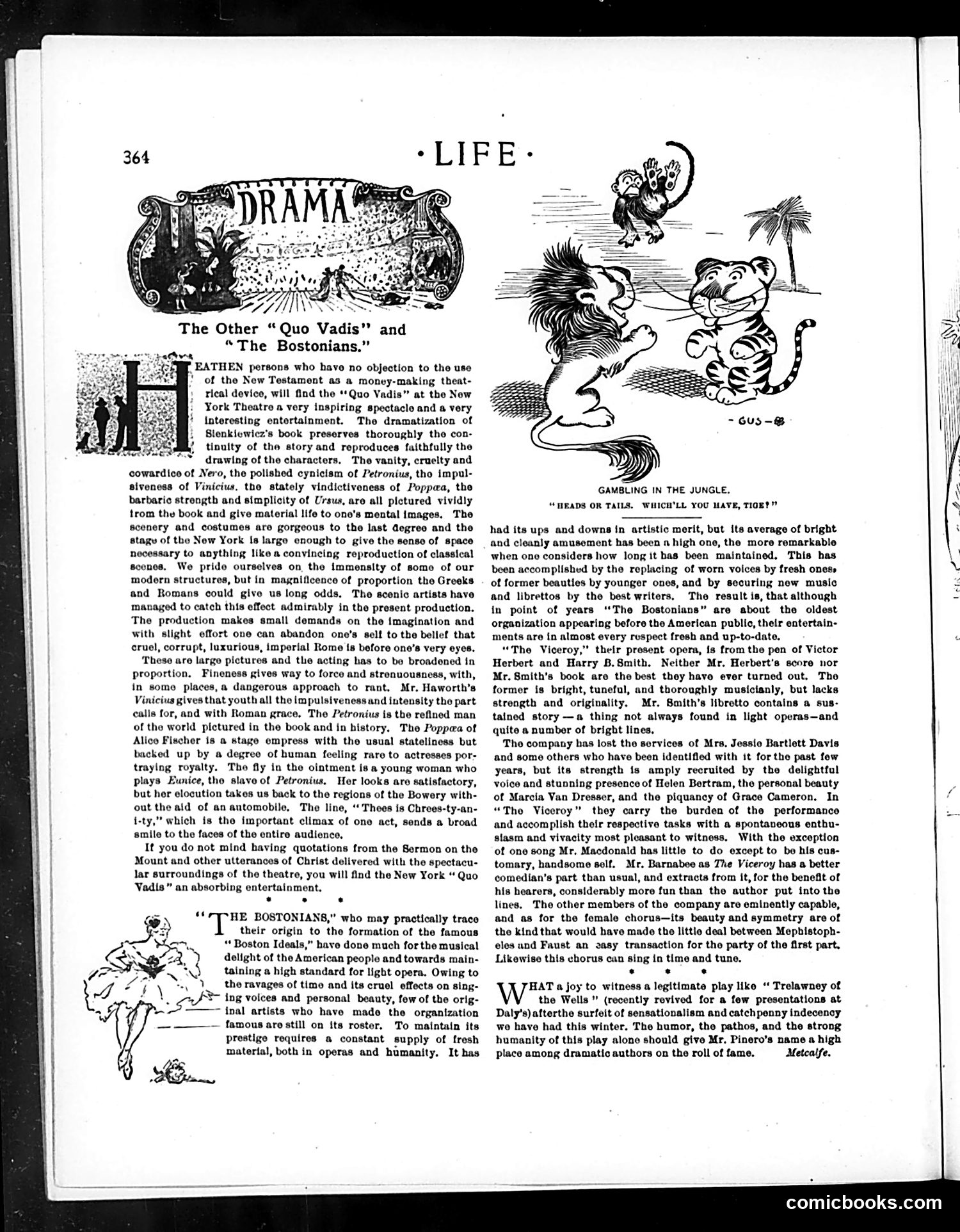
This page reviews theatrical productions, primarily "Quo Vadis" and "The Bostonians." The main cartoon illustration (titled "Gambling in the Jungle") depicts animals—a lion and tiger—with the caption "Heads or Tails. Which'll You Have, Tiger?" The satire appears to mock theatrical competition and risk-taking in entertainment. The animal imagery suggests producers are "gambling" with their productions, essentially betting on success like wild beasts in nature. The text discusses how these dramatic adaptations preserve literary source material while requiring constant innovation to maintain audience interest. The reviews suggest both productions successfully balance faithfulness to original works with theatrical spectacle—a delicate balance the author compares to genuine gambling.
📄 Transcribed text from this page (OCR, searchable)
Machine-transcribed from the original scan — historical spelling and the odd misread are preserved.
The Other “Quo Vadis” and “The Bostonians.” PEATHEN persons who havo no objection to tho use of the New Testament as a money-making theat- rical device, will find the “Quo Vadis” at the Now York Theatre a very inspiring spectaclo and a very interesting entertainment. Tho dramatization of Blenkiewicz’s book preserves thoroughly tho con- tinulty of the story and reproduces faithfully the drawing of the characters. The vanity, cruelty and cowardice of Nero, the polished cynicism of Petronius, tho impul- siveness of Vinicius. the stately vindictiveness of Poppea, the barbaric strength and simplicity of Ursus, are all pictured vividly trom the book and give material life to one's mental {mages. The i scenery and costumes are gorgeous to the last degreo and the stage of the Now York Is largo enough to give the sense of space necessary to anything like a convincing reproduction of classical scones. We pride ourselves on tho immensity of somo of our modern structures, but in magnificence of proportion the Greeks and Romans could give us long odds. Tho scenic artists have mavaged to catch this effect admirably in the present production. The production makes small demands on the imagination and with slight effort one can abandon one’s self to the belief that cruel, corrupt, luxurious, imperial Rome ts before one’s very eyes. ‘These are large pictures and the acting has to be broadened in proportion, Fineness gives way to force and strenuousness, with, in some places, a dangerous approach to rant, Mr. Haworth’s Vinicius gives that youth all the impulsivenessand intensity the part calls for, and with Roman grace. The Petronius is the reflned man of the world pictured in the book and in history, The Poppea of Alico Fischer is a stage empress with tho usual stateliness but backed up by a degree of human feeling raro to actresses por- traying royalty, The fly in tho ointment i¢ a young woman who plays Eunice, tho slave of Petronius, Her looks are satisfactory, but hor elocution takes us back to the regions of the Bowery with- out the aid of an antomobile, The line, Thees is Chrees-ty-an- {-ty,""which is the important climax of one act, sends a broad smile to the faces of the entire audience, It you do not mind baving quotations from the Sermon on the Mount and other utterances of Christ delivered with the spectacu- lar surroundings of the theatre, you will find the New York “ Quo | Vadis” an absorbing entertainment. . 8 e Gi HE BOSTONIANS,” who may practically traco _ their origin to the formation of the famous i em ** Boston Ideals,” have done much forthe musical ny 2 delight of the American people and towards main- ur A. taining a high standard for light opera. Owing to | the ravages of timo and its cruel effects on sing- | an Na ay ing voices and personal beauty, few of the orig- } WA | — ———— famous aro still on its roster, To maintain its prestige requires a constant supply of fresh material, both in operas and humanity. It has GAMBLING IN THE JUNGLE. “HEADS OR TAILS. WHICHLL YOU MAVE, TIGE?” had its ups and downs in artistic morit, but its averago of bright and cleanly amusement has been a high one, the more remarkable when one considers how long it bas been maintained. This has been accomplished by the replacing of worn voices by fresh ones» of former beauties by younger ones, and by securing new music and librettos by the best writers, The result is, that although in point of years “The Bostonians” are about the oldest organization appearing before the American public, their entertain- ments aro {n almost every respect fresh and up-to-date. “The Viceroy,” their present opera, is from the pen of Victor Herbert and Harry B.Smith. Neither Mr. Herbert's score nor Mr. Smith’s book are the best they have ever turned out. Tho former is bright, tuneful, and thoroughly musicianly, but lacks strength and originality, Mr. Smith's libretto contains a sus- tained story —a thing not always found in light operas—and quite a number of bright lines, Tho company has lost the services of Mrs, Jessio Bartlett Davis and some others who have been identified with it forthe past fow years, but ite strength {s amply recruited by the delightful voice and stunning presence of Helen Bertram, the personal beauty of Marcia Van Dresser, and the piquancy of Grace Cameron. In “The Viceroy” they carry the burden of the performance and accomplish their respective tasks with a spontaneous enthu- slasm and vivacity most pleasant to witness, With the exception of one song Mr. Macdonald has little to do except to be his cus- tomary, handsome self. Mr. Barnabee as The Viceroy has a better comedian’s part than usual, and extracts from it, for the benefit of his bearers, considerably more fun than the author put into the lines, The other members of the company are eminently capable, and as for the female chorus—its beauty and symmetry are of the kind that would have made the little deal between Mepbistoph- eles und Faust an easy transaction for tho party of the first part, Likewise this chorus can sing in time and tune. . . . HAT a joy to witness a legitimate play like “ Trelawney of the Wells ” (recently revived for a few presentations at Daly's) atterthe surfeit of sensationalism and catchpenny indecency wo have had this winter. The humor, the pathos, and the strong humanity of this play alone should give Mr. Pinero’s name a high place among dramatic authors on the roll of fame. Metcalfe. comicbooks.com