
Life, 1900-04-26 · page 8 of 20
Life — April 26, 1900 — page 8: what you’re looking at
What you’re looking at
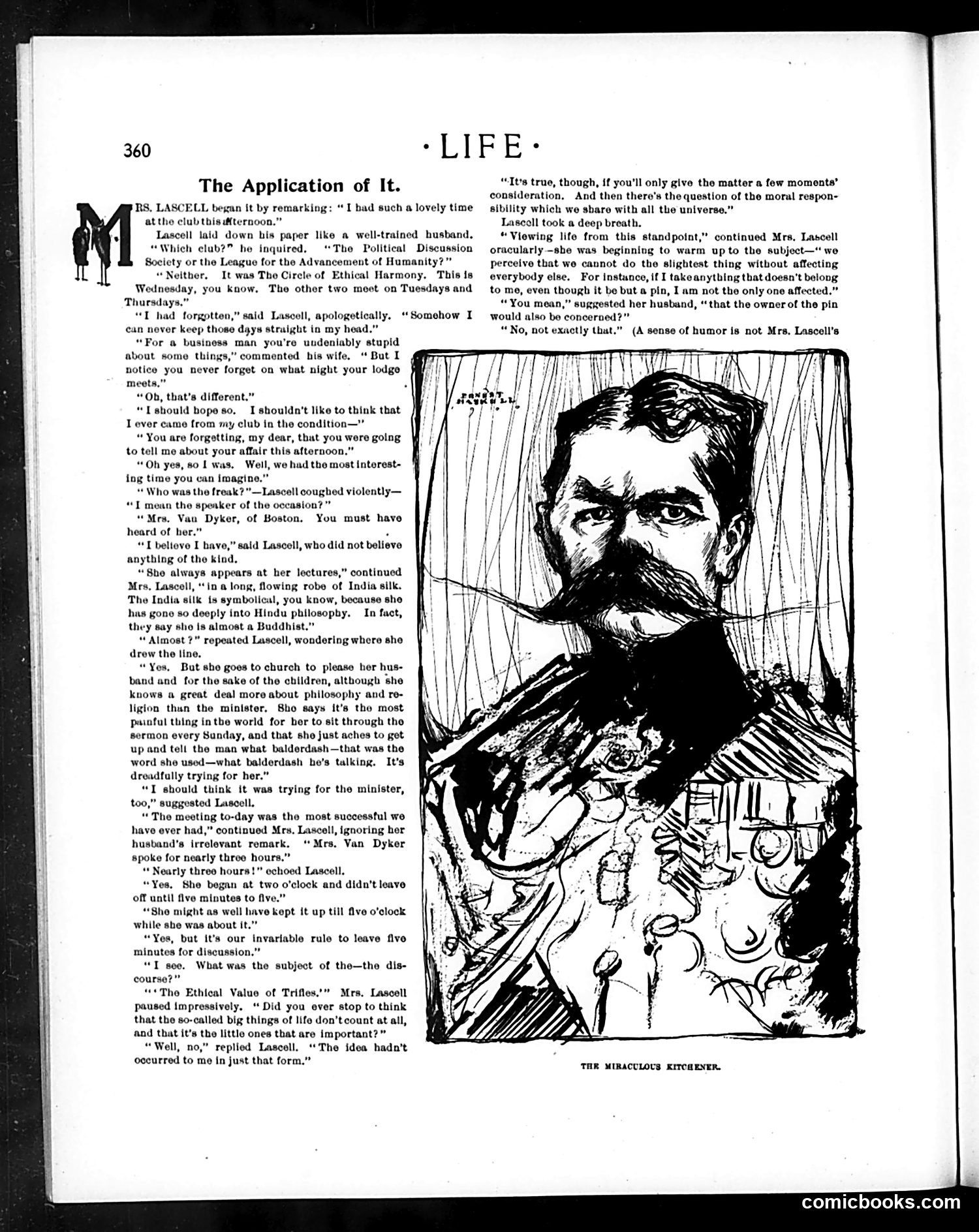
The illustration depicts a stern military figure (labeled "THE MIRACULOUS KITCHENER") holding a rifle, surrounded by cooking implements and food items. The accompanying text is a satirical dialogue about a "Political Discussion Society" meeting where speakers discussed "The Ethical Value of Trifles." The satire appears to target **Lord Kitchener**, the famous British military leader, by ironically juxtaposing his martial authority with domestic kitchen imagery. The joke likely mocks the incongruity of applying serious ethical philosophy to trivial matters, while a powerful military figure dominates the composition. The text's discussion of philosophy versus "big things of life" reinforces the satirical contrast between lofty ideals and mundane reality, though the specific historical context requires additional knowledge to fully clarify Kitchener's contemporary relevance.
📄 Transcribed text from this page (OCR, searchable)
Machine-transcribed from the original scan — historical spelling and the odd misread are preserved.
360 The Application of It. RS. LASCELL began it by remarking: “I bad such a lovely time at the club thisit{ternoon.” A Lascell laid down bis paper like a well-trained husband. “Which club?” he inquired, “The Political Discussion Society or the League for the Advancement of Humanity?” “Neither, It was Tho Circle of Ethical Harmony. This ts Wednesday, you know. The other two meet on Tuesdays and Thursdays.” “I had forgotten,” said Lascoll, apologetically. can nover keep those dgys straight in my head.” “For a business man you're undeniably stupid about some things,” commented bis wife. “But I notice you never forget on what night your lodge meets,” “Ob, that’s different.” “LT ehould bope 80, I shouldn't like to think that T ever came from my club in the condition—” “ You are forgetting, my dear, that you were going to tell me about your affair this afternoon.” “Oh yes, 80 L was. Well, we had the most intorest- ing time you can {magine.” * Who was the freak? "—Lascell coughed violently— “T mean the speaker of the occasion?” “Mes. Vau Dyker, of Boston, You must havo heard of her.” : “I beltove I havo,” sald Lascoll, who did not believe 4 anything of the kind, “Sho always appears at her lectares,” continued Mrs, Lascoll, “ina long, flowing robe of India silk. Tho India silk {s symbolical, you know, because she has gono so deeply into Hindu philosophy. In fact, they say sho 1s almost a Buddhist.” “Almost 2” repeated Lascell, wondering where sho drow the line. “Yes, But sho goes to church to please her hus- band and for the sake of the children, although she knows a great deal moro about philosophy and re- ligion than the minister, Suo says it's tho most } painful thing in tbe world for hor to sit through tho i sermon every Sunday, and that sho just aches to get up and tell the man what balderdash—that was the i word she used—what balderdash he’s talking. It’s dreadfully trying for her.” “I should think it was trying for the minister, suggested Lascell. “The meeting to-day was the most successtul wo havo ever had,” continued Mfrs, Lascell, ignoring hor husband's irrelevant remark. “Mrs. Van Dyker spoke for nearly three hours.” “ Nearly threo hours!” echoed Lascell. “Yes. She began at two o'clock and didn't leave | off until five minutes to five.” } “Sho might as well have kept it up till vo o'clock while she was about it.” “Yea, but It’s our invariable rule to leave five minutes for discussion,” “I see, What was the subject of the—the dis- course?” “«Tho Ethical Value of Trifles.’” Mrs, Lascoll paused impressively, “Did you ever stop to think that the so-called big things of life don’t count at all, and that it’s the little ones that are important?” “Well, no,” replied Lascell. “The idea hadn't occurred to me in just that form.” “Somehow I “LIFE > “It's true, though, if you'll only give the mattor a few moments’ consideration, And then there's the question of the moral respon- sibility which we sbaro with all the universe.” Lascoll took a deep breath. “Viewing life from this standpoint,” continued Mrs, Lascell oracularly—she was beginning to warm upto the subject—“ wo perceive that wo cannot do the slightest thing without affecting everybody else. For instance, if I take anything that doesn't belong to me, even though it be but a pin, I am not the only one affected.” “You mean,” suggested her husband, ‘that the owner of the pin would also be concerned?” “No, not exactly that.” (A sense of humor is not Mrs, Lascell’s THR MIRACULOUS KITCHENER. comicbooks.com