
A complete issue · 32 pages · 1900
Life — April 7, 1900
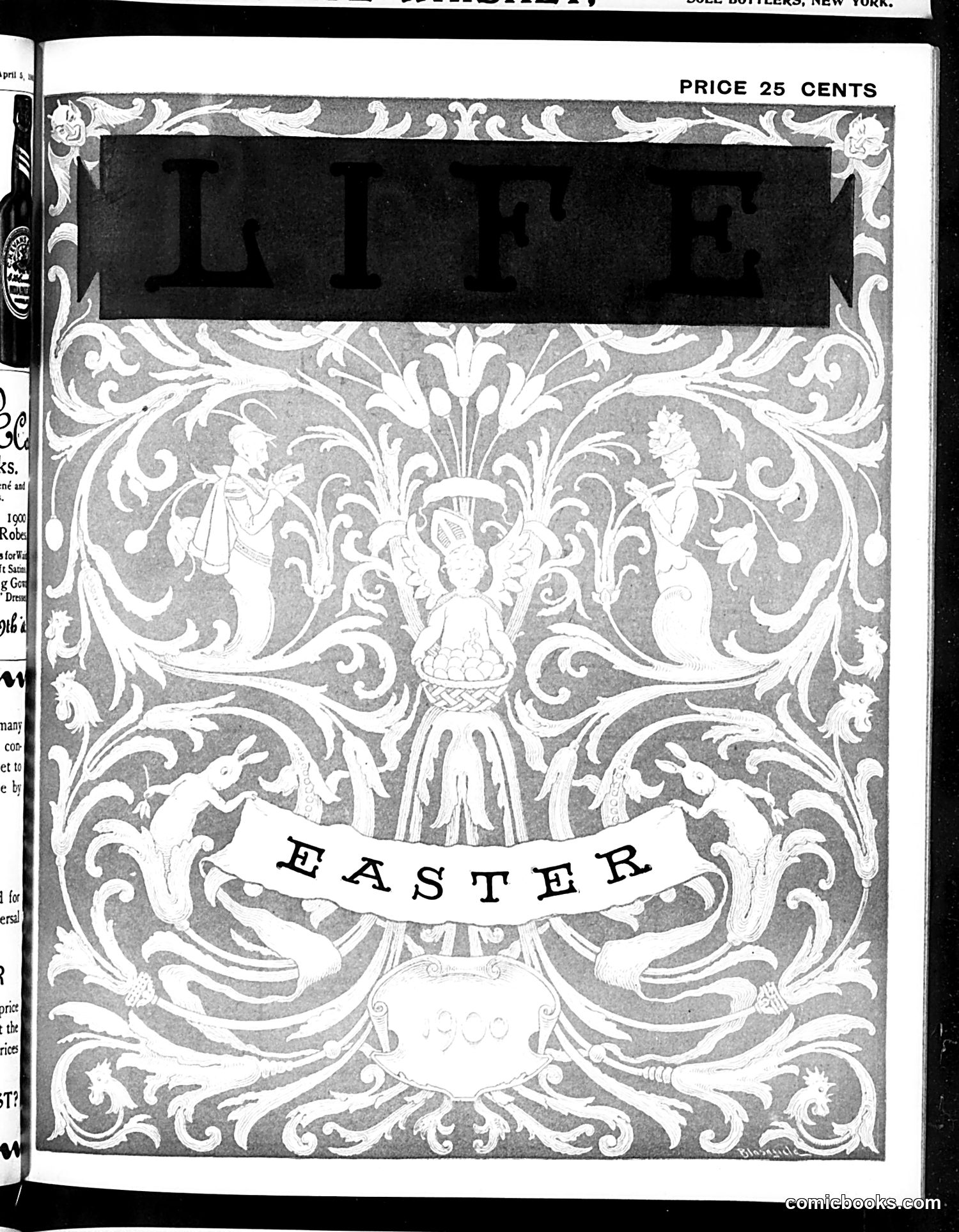
I can see this is a decorative Easter cover from Life magazine (price 25 cents), featuring ornate baroque-style scrollwork with cherubs and an elaborate central urn or vessel. The word "EASTER" appears on a banner at the bottom, and there's a date that appears to be "1900." However, the actual title or any explanatory text at the top is obscured by a black redaction bar, making it impossible to identify specific political figures, satirical targets, or the intended meaning. Without the OCR text being legible or the header visible, I cannot reliably explain what cartoon or social commentary this Easter-themed cover was meant to convey. It appears to be a seasonal holiday cover rather than political satire, but the context is unclear.
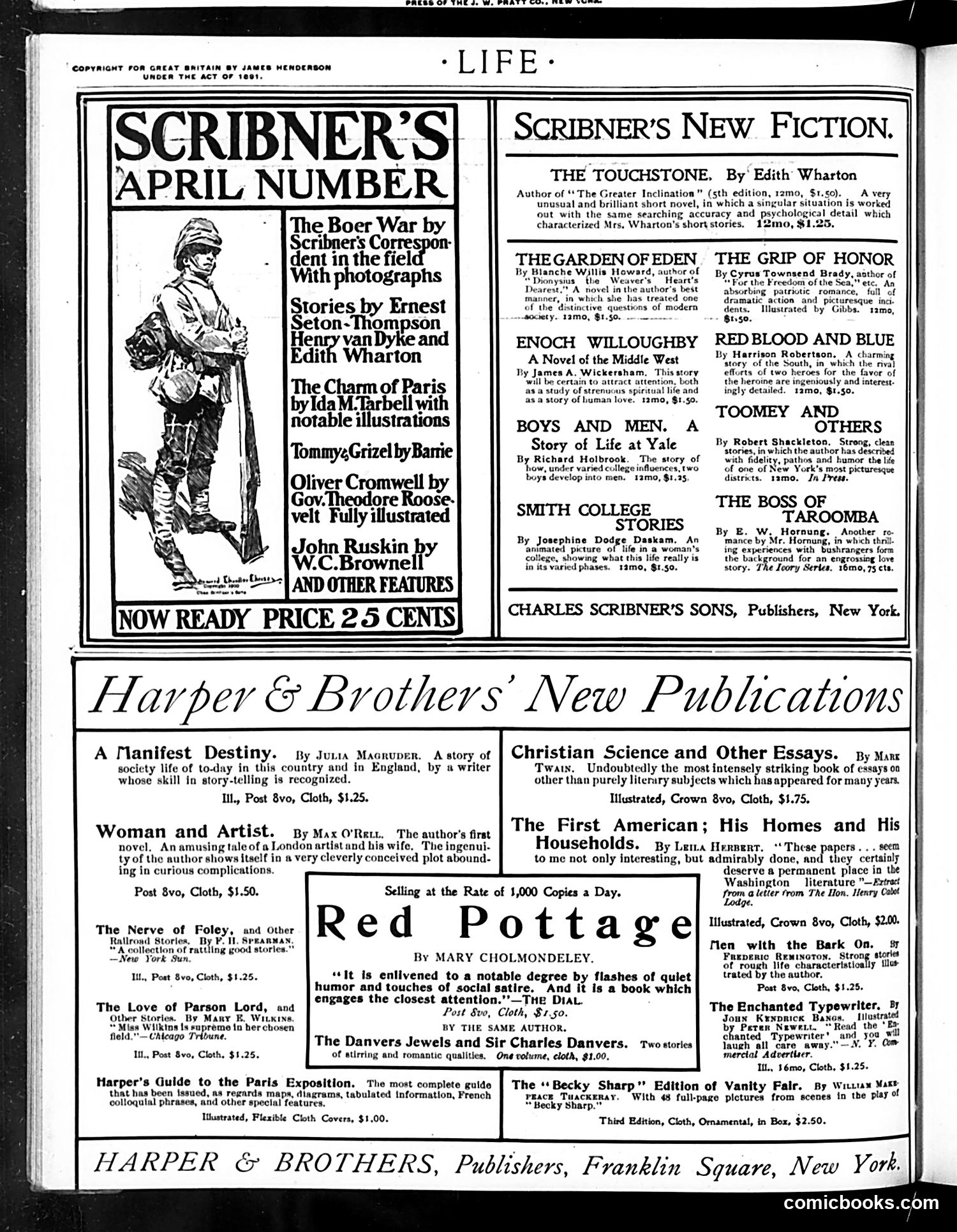
This page is **primarily advertising** for book publishers rather than satirical content. The left side features **Scribner's Magazine's April Number** advertisement, prominently advertising coverage of the Boer War with field photographs and stories by Ernest Seton-Thompson and other authors. The price is 25 cents. The right side and lower section showcase **Harper & Brothers' new publications**, including titles like "A Manifest Destiny," "Woman and Artist," and notably "Red Pottage" by Mary Cholmondelay, described as selling at "1,000 Copies a Day." The soldier illustration on the left likely relates to the Boer War content being advertised. There is **no evident political satire or cartoon humor** on this page—it functions as a straightforward publishing industry advertisement page typical of early 1900s magazines.
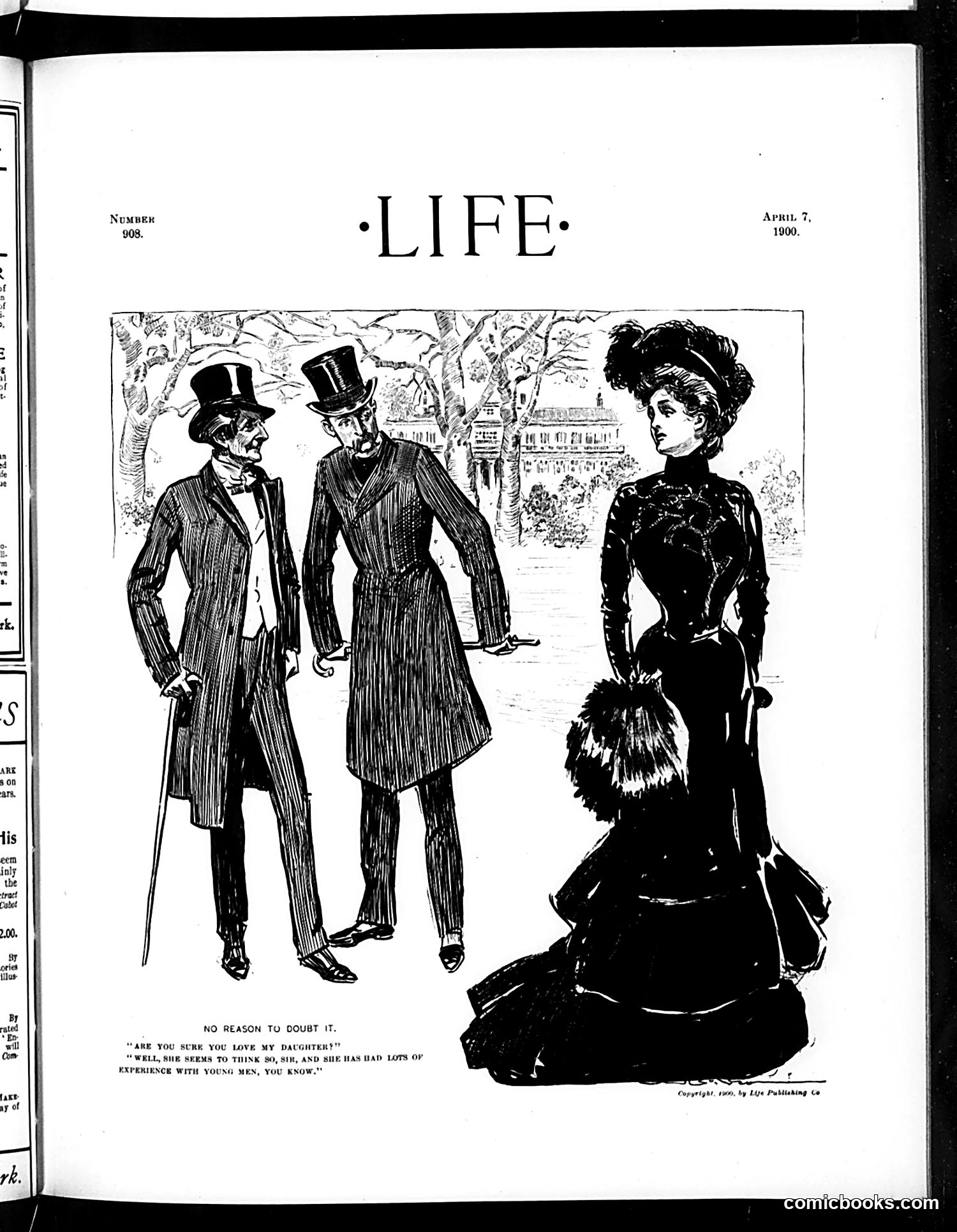
This cartoon illustrates a social comedy about courtship and parental concerns. Two well-dressed men in top hats encounter a fashionably dressed woman on what appears to be a public street or park. The dialogue reveals the humor: one man asks another if he's "sure you love my daughter," to which the other responds that she "seems to think so" and has "had lots of experience with young men." The satire mocks both paternal anxiety about daughters' romantic experience and the social pretense of the era. The implication that a young woman had "lots of experience" with suitors was scandalous by 1900 standards, yet presented here as matter-of-fact. The cartoon critiques the gap between Victorian propriety and actual courtship practices.
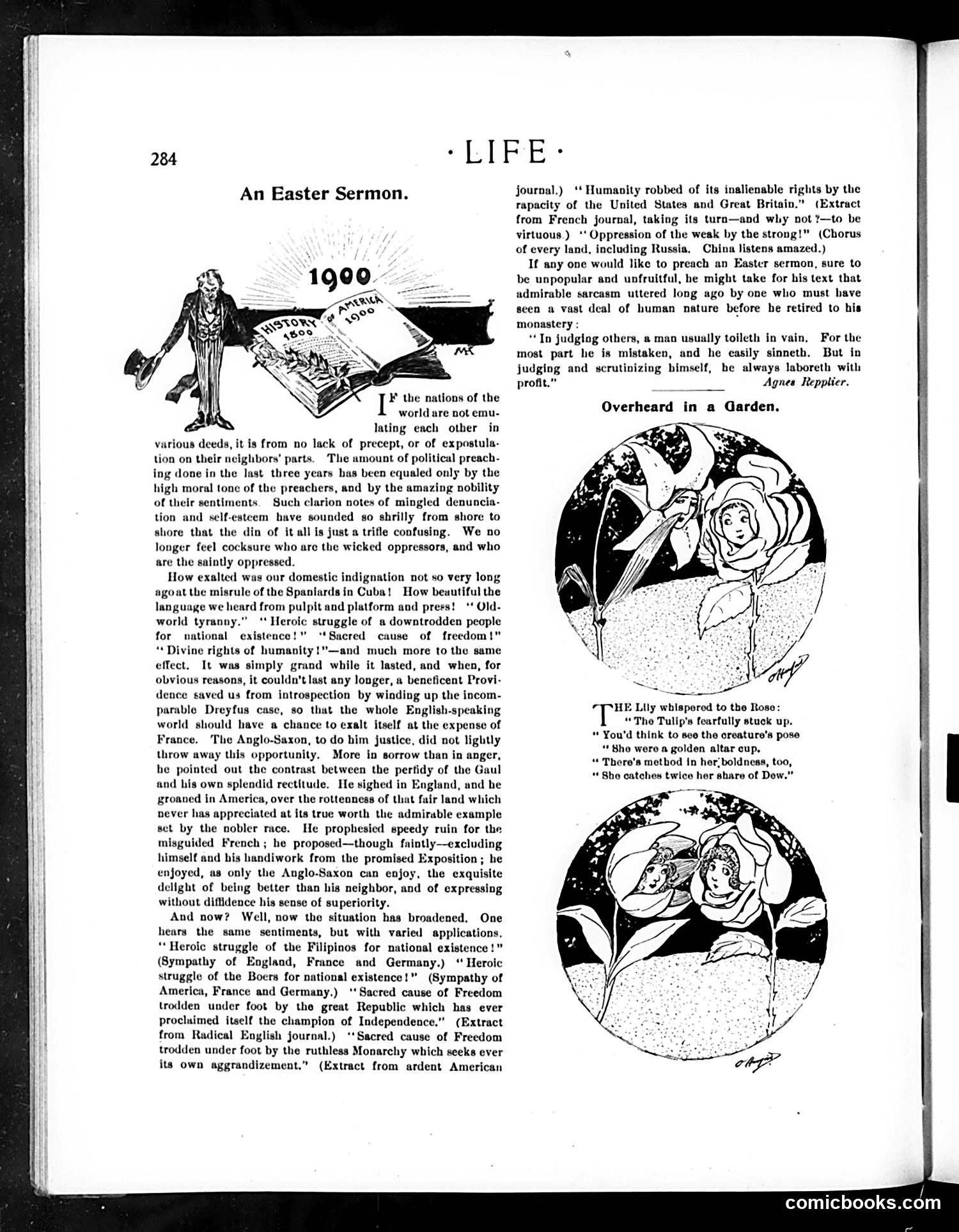
This page satirizes international political hypocrisy around 1900. The top cartoon depicts a figure (appears to be representing a Western power or Britain) preaching from a pulpit labeled "1900" while trampling on documents, mocking nations that preach morality while committing imperialism. The text criticizes Western powers for denouncing oppression while themselves engaging in colonial expansion—specifically referencing the Boer War in South Africa and the Boxer Rebellion context. It attacks their selective moral outrage: condemning tyranny abroad while ignoring their own imperial conquests. The two illustrations on the right ("Overhead in a Garden") are unrelated charming domestic scenes with children and flowers, providing visual contrast to the political critique below.
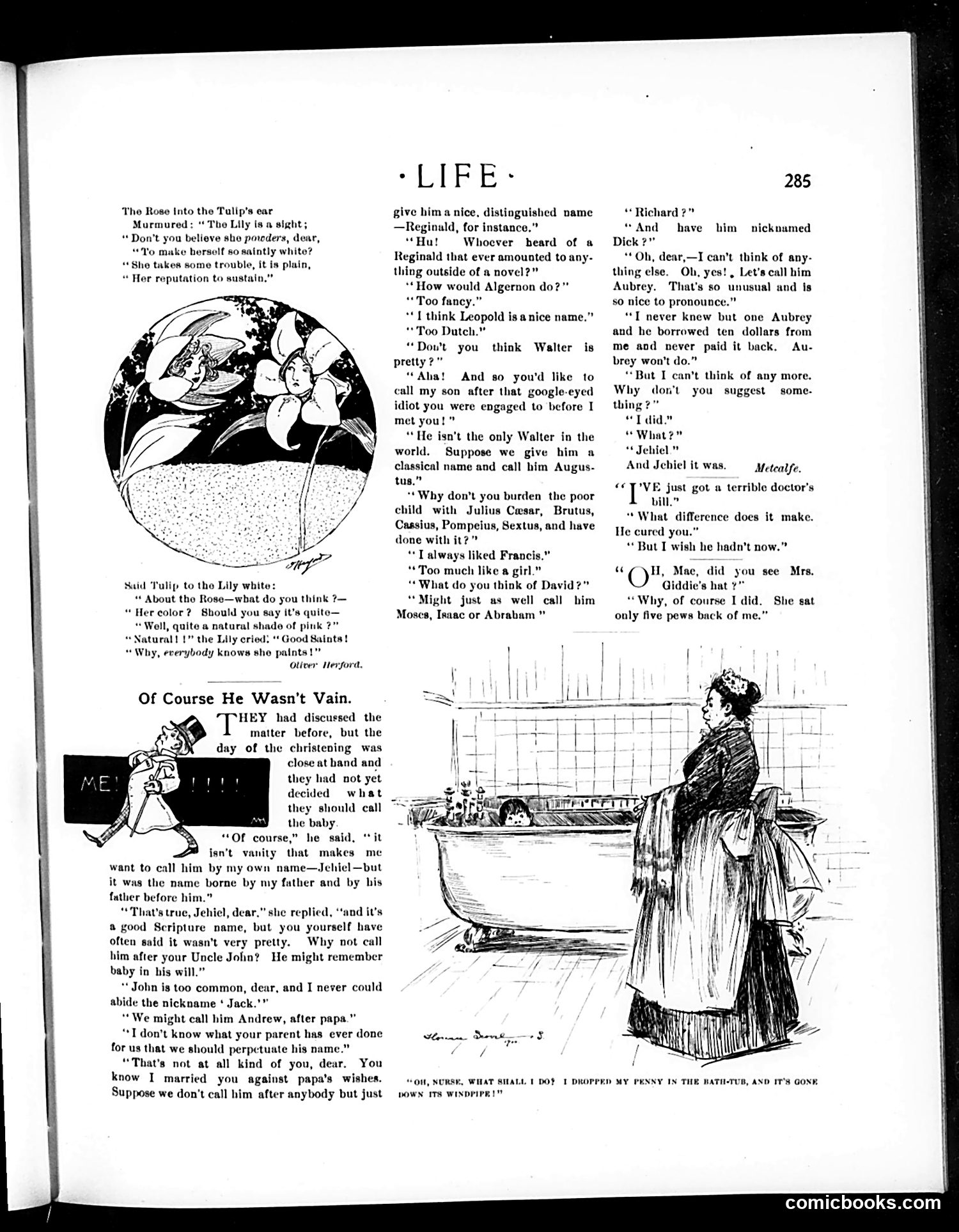
This page contains two separate satirical pieces from *Life* magazine about naming children. **Top section** ("The Rose Into the Tolly's ear"): Mocks the pretentious practice of giving children elaborate, classical names. The dialogue debates naming a son after classical figures (Augustus, Julius Caesar, Brutus) or biblical names (Moses, Abraham), with a character suggesting "Francis" as a sensible alternative. The illustrated woman appears exasperated by the affectation. **Bottom section** ("Of Course He Wasn't Vain"): Satirizes parents who name children after themselves or family members out of vanity rather than affection. A father insists naming his son "Jehiel" (matching his own name) is proper, despite the mother's objection. The humor lies in the father's self-deception about his motivations—he claims it's scriptural tradition while actually seeking to perpetuate his own name. Both pieces mock Victorian-era pretentiousness about child-naming.
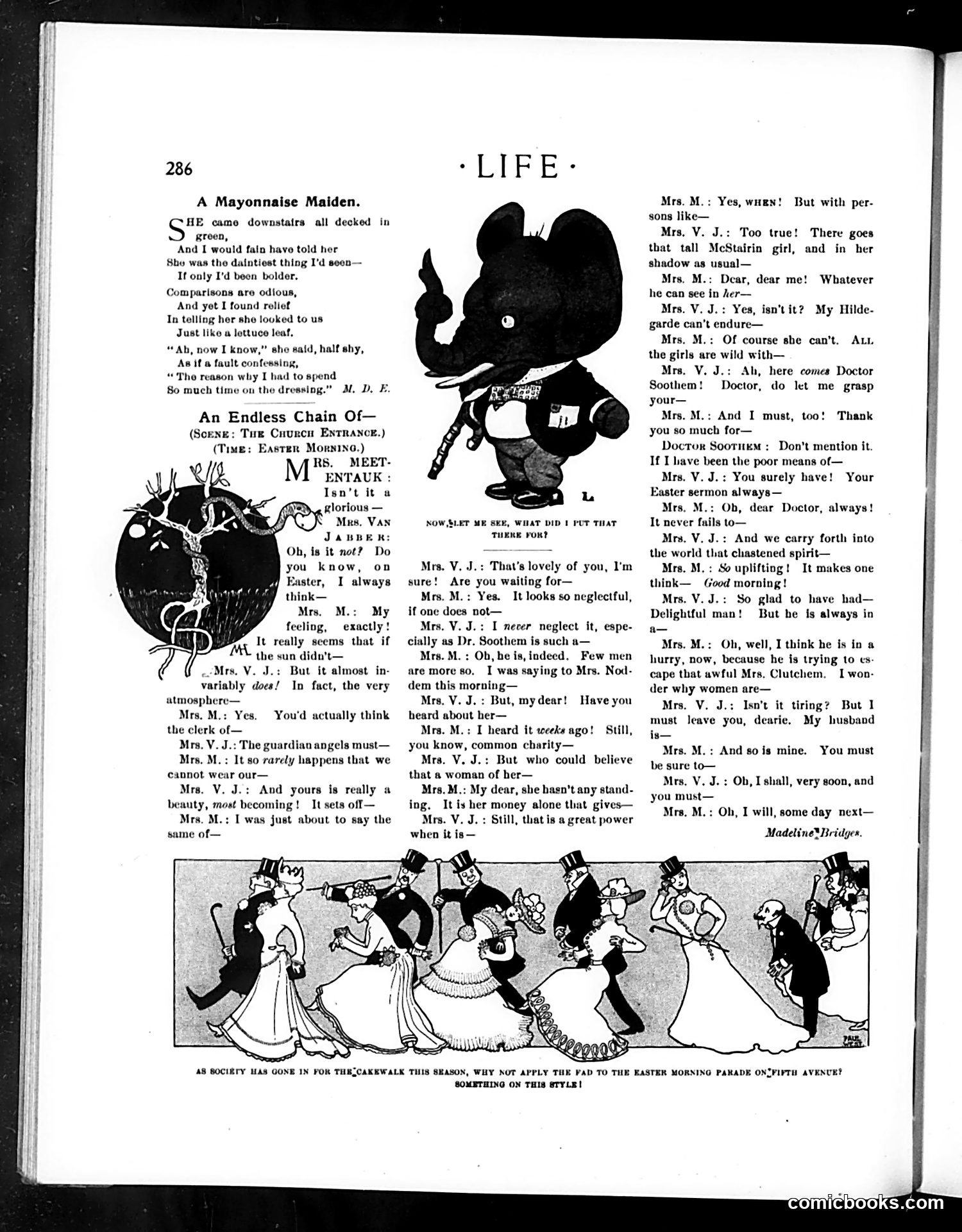
This page contains two distinct pieces: **"A Mayonnaise Maiden"** is a poem about a woman in green who wore lettuce, presented as the "daintiest thing" seen—likely a lighthearted food-related visual pun. **"An Endless Chain Of..."** features a dialogue between Mrs. M. and Mrs. V.J. discussing Easter, church attendance, and social obligation. The conversation satirizes superficial religiosity—women attending Easter services out of social convention rather than genuine faith. Mrs. V.J. mentions an overbearing Mrs. Cletckem, suggesting the piece mocks pretentious social gatekeeping within church communities. The bottom illustration shows fashionably dressed figures in a conga line or parade, likely referencing Easter fashion displays or spring social season activities, reinforcing the theme of performative rather than authentic spiritual observance.
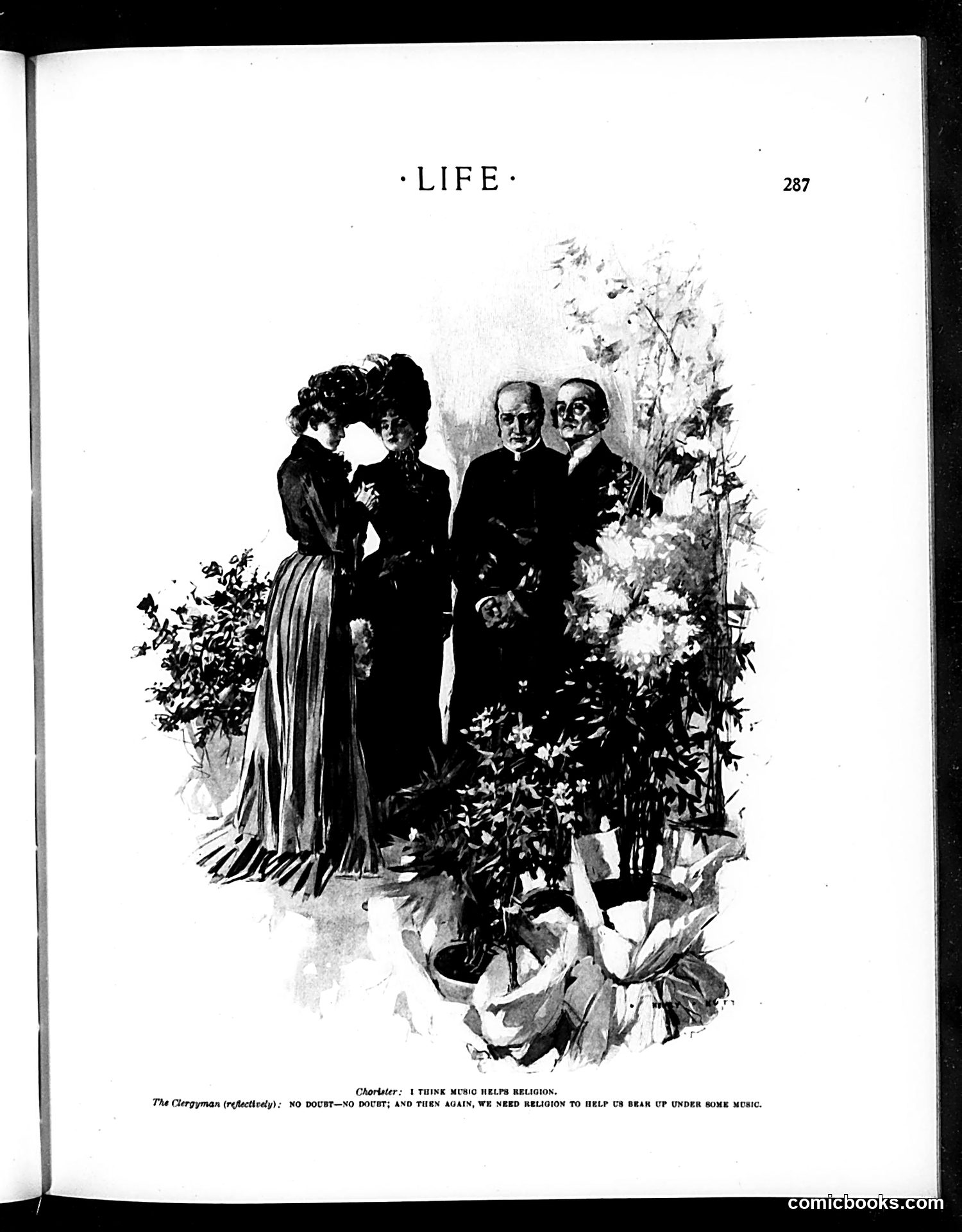
This page presents a satirical illustration titled "The Clergyman (reluctantly)" featuring four figures in Victorian-era dress surrounded by flowering plants. The caption reads: "I THINK MUSIC HELPS RELIGION. NO DOUBT—NO DOUBT; AND THEN AGAIN, WE NEED RELIGION TO HELP US BEAR UP UNDER SOME MUSIC." The satire mocks the relationship between religious practice and music in churches. A clergyman reluctantly acknowledges that while music supports religion, the reverse is also true—people need religious faith to endure poor-quality church music. This is a commentary on the often-criticized quality of Victorian-era hymnal and sacred music performances, suggesting that some church music was so unpleasant that only religious devotion could make it bearable.
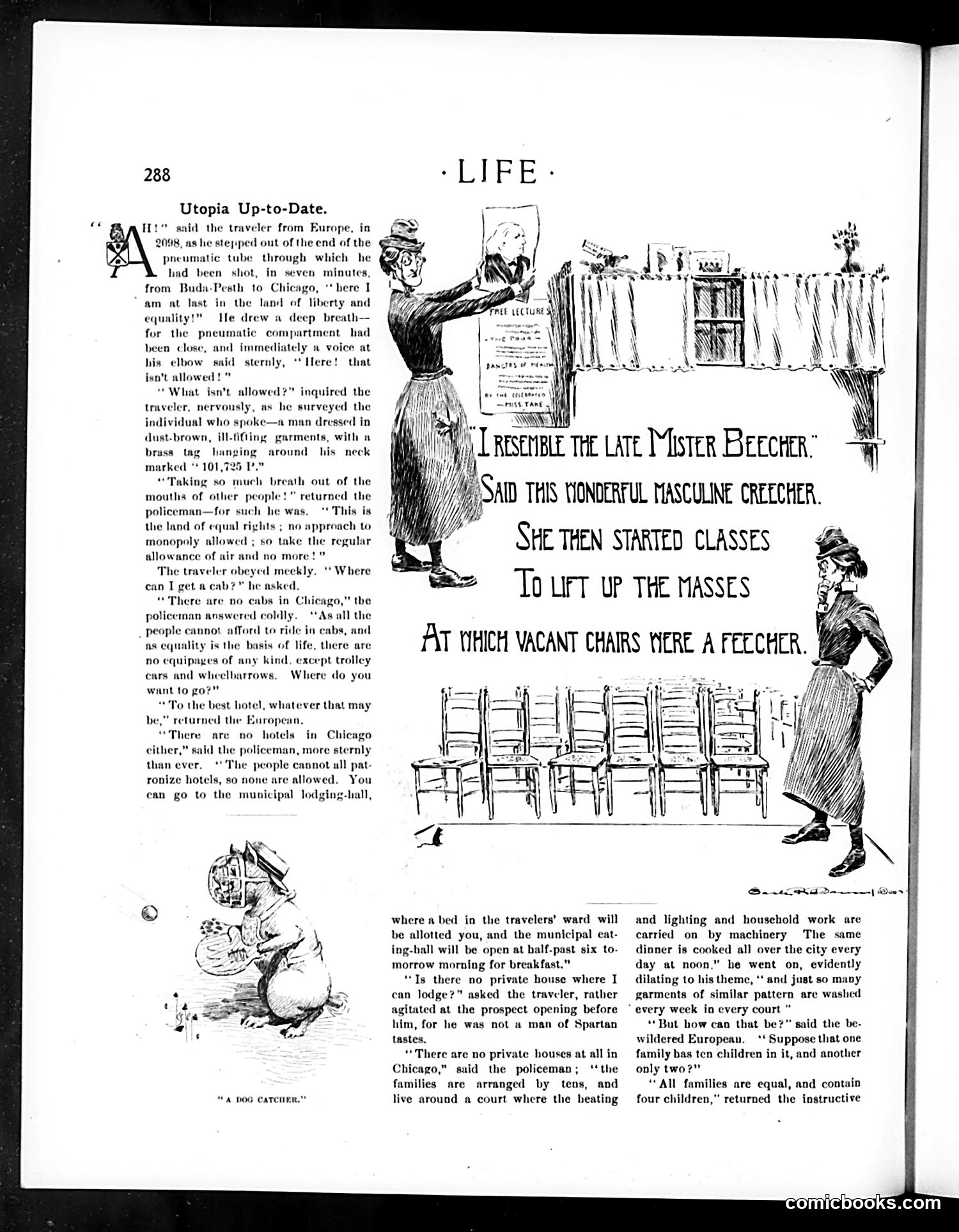
This satirical piece mocks utopian socialist ideas, likely from the 1890s-1900s. A European traveler arrives in a futuristic Chicago where a woman—resembling Henry Ward Beecher (a famous preacher)—has eliminated private property and traditional gender roles. She's established communal housing, public dining, and mechanical labor to free women from domestic work. The satire ridicules egalitarian ideology through the traveler's shocked responses: no private hotels, equal-sized families enforced, communal living in "tens." The cartoon suggests such utopian schemes are absurdly impractical and infringe on individual liberty. The small illustration labeled "A Dog Catcher" likely comments on the invasive government control required to enforce such equality. This reflects contemporary American anxiety about socialism and women's liberation movements.
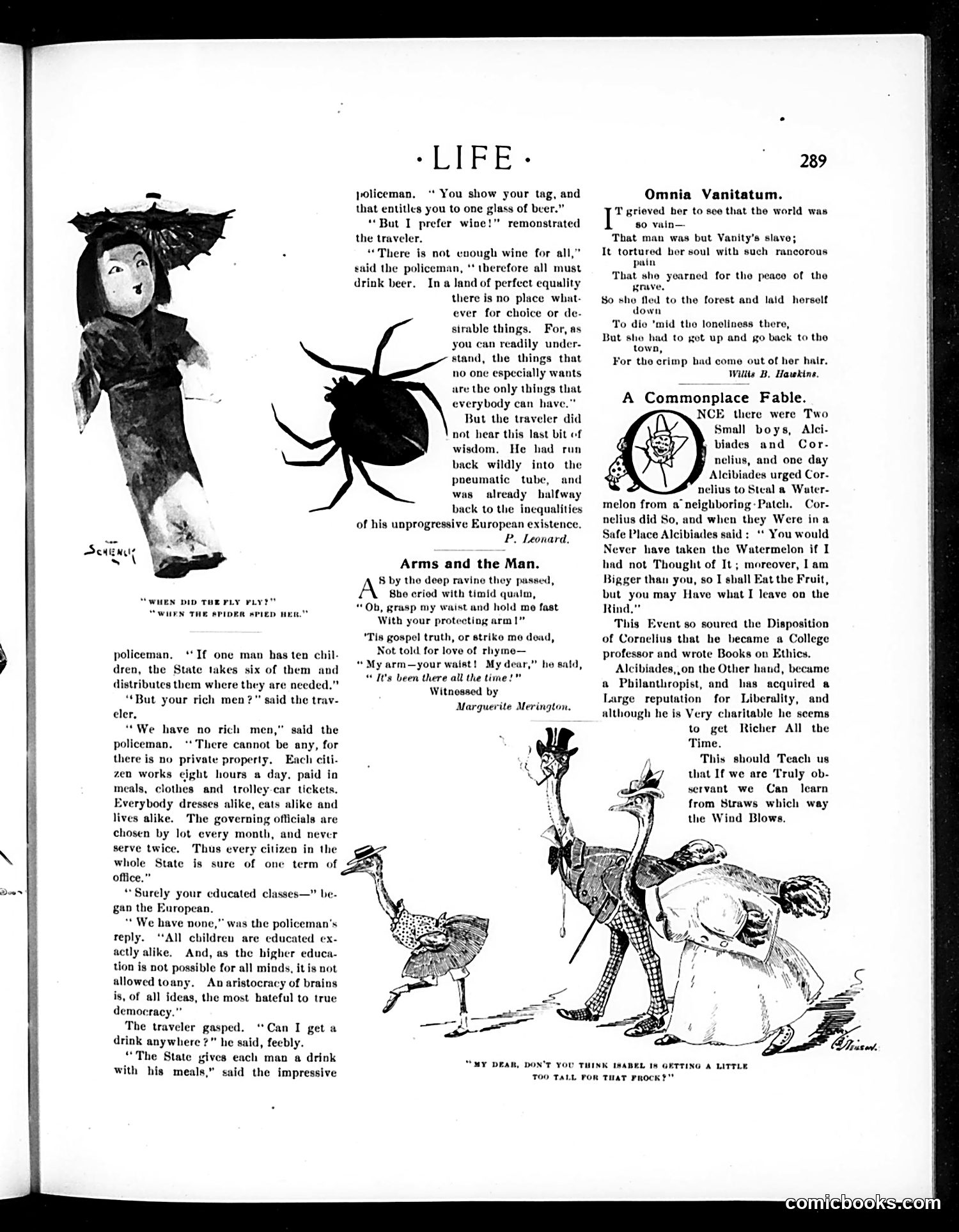
This page contains three satirical pieces about inequality and social hierarchy: **Left illustration**: A fashionable woman with an umbrella and spider, accompanying a dialogue between a policeman and traveler. The satire critiques a utopian state where "there is no private property" and all citizens are equal—yet the policeman explains everyone must drink beer, not wine, because equality means no one gets preferred treatment. The joke: even in perfect equality, individual choice disappears. **Right section**: "A Commonplace Fable" mocks charitable hypocrisy. Cornelius the wealthy man refuses to give a watermelon to poor boys (Alcibiades), citing libertarian principles about self-reliance. The illustration shows ostriches—likely representing the wealthy ignoring obvious suffering. The satire suggests the rich rationalize indifference to poverty through ideology. Both pieces critique inequality and how the privileged justify or maintain it.
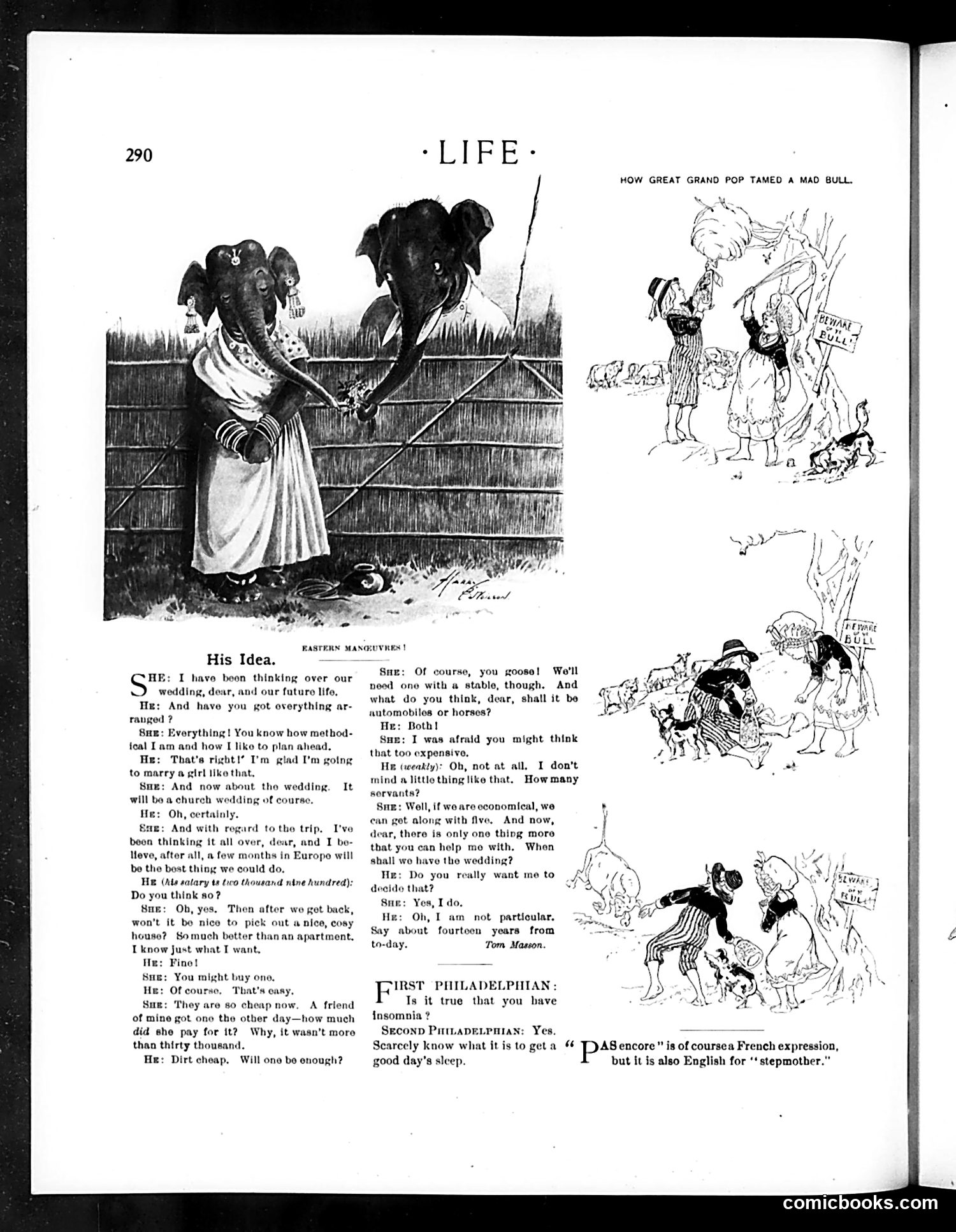
The left cartoon depicts a couple (anthropomorphized as elephants) in "Eastern Manners" discussing marriage. The husband proposes a honeymoon trip to Europe, but the wife demands he help with household expenses first—she's concerned about wedding costs and needs practical financial support before luxury travel. The satire targets husbands who prioritize romantic gestures while neglecting economic responsibilities to their wives. The elephant caricatures likely reference Republican political symbolism (the GOP mascot), suggesting critique of a particular political figure's financial irresponsibility or broken promises. The right side contains unrelated comic strips about a "mad bull" and a brief joke about insomnia among Philadelphians. This appears to be a typical Life magazine layout mixing political satire with lighter humor.
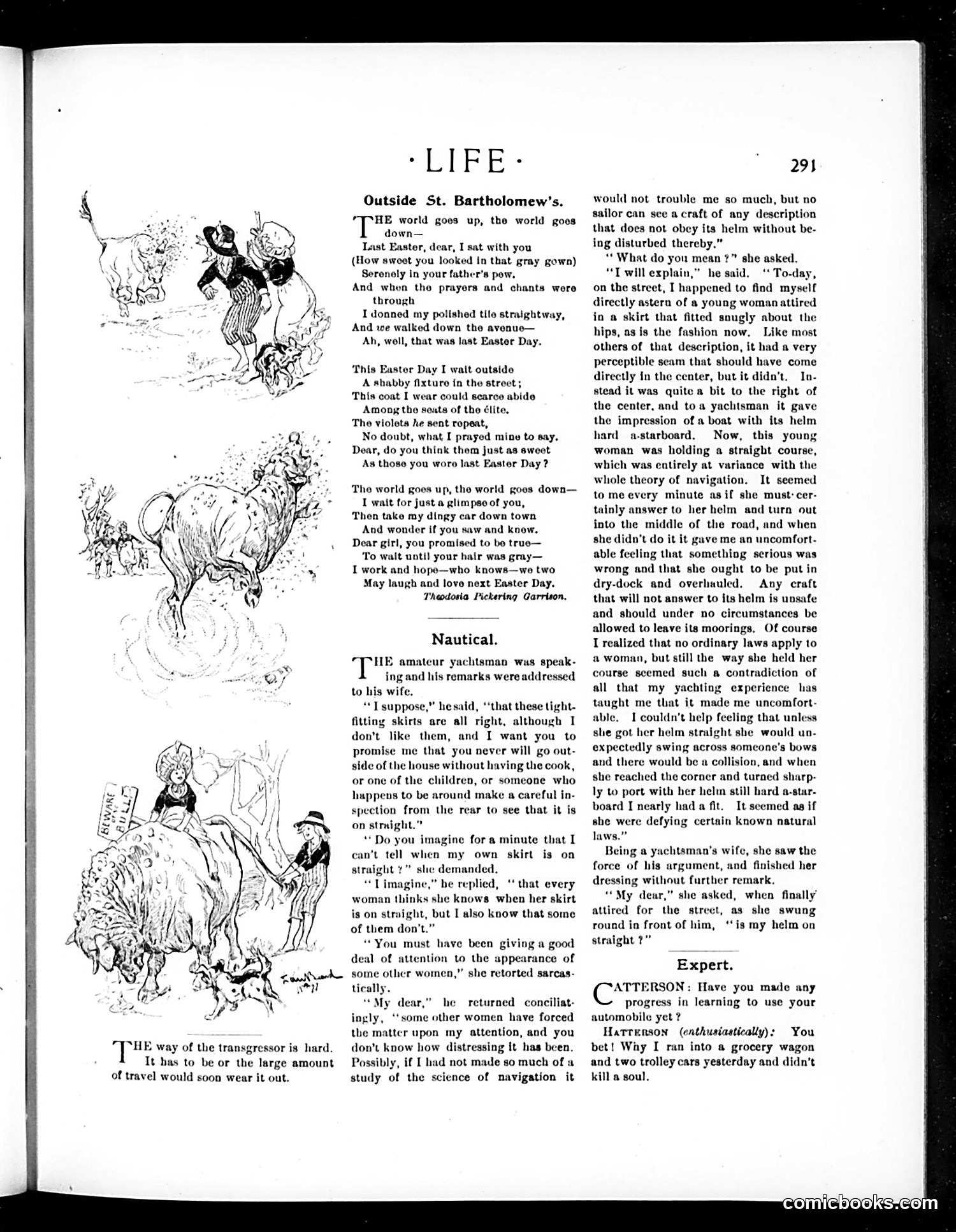
This page contains three distinct sections: 1. **"Outside St. Bartholomew's"** — A poem with accompanying illustrations satirizing Easter fashion parade. The verses mock well-dressed Parishioners displaying their "polished" appearance and new outfits while walking down the avenue on Easter Sunday. The drawings show fashionably-dressed figures, poking fun at the social performance of religious observance. 2. **"Nautical"** — A domestic comedy about a husband criticizing his wife's tight-fitting skirts, warning against leaving home without the cook or children present for inspections. She sarcastically questions whether he thinks she doesn't know her own clothing. The satire targets gender dynamics and marital tensions over women's fashion choices. 3. **"Expert"** — A brief joke exchange about automobile driving incompetence.
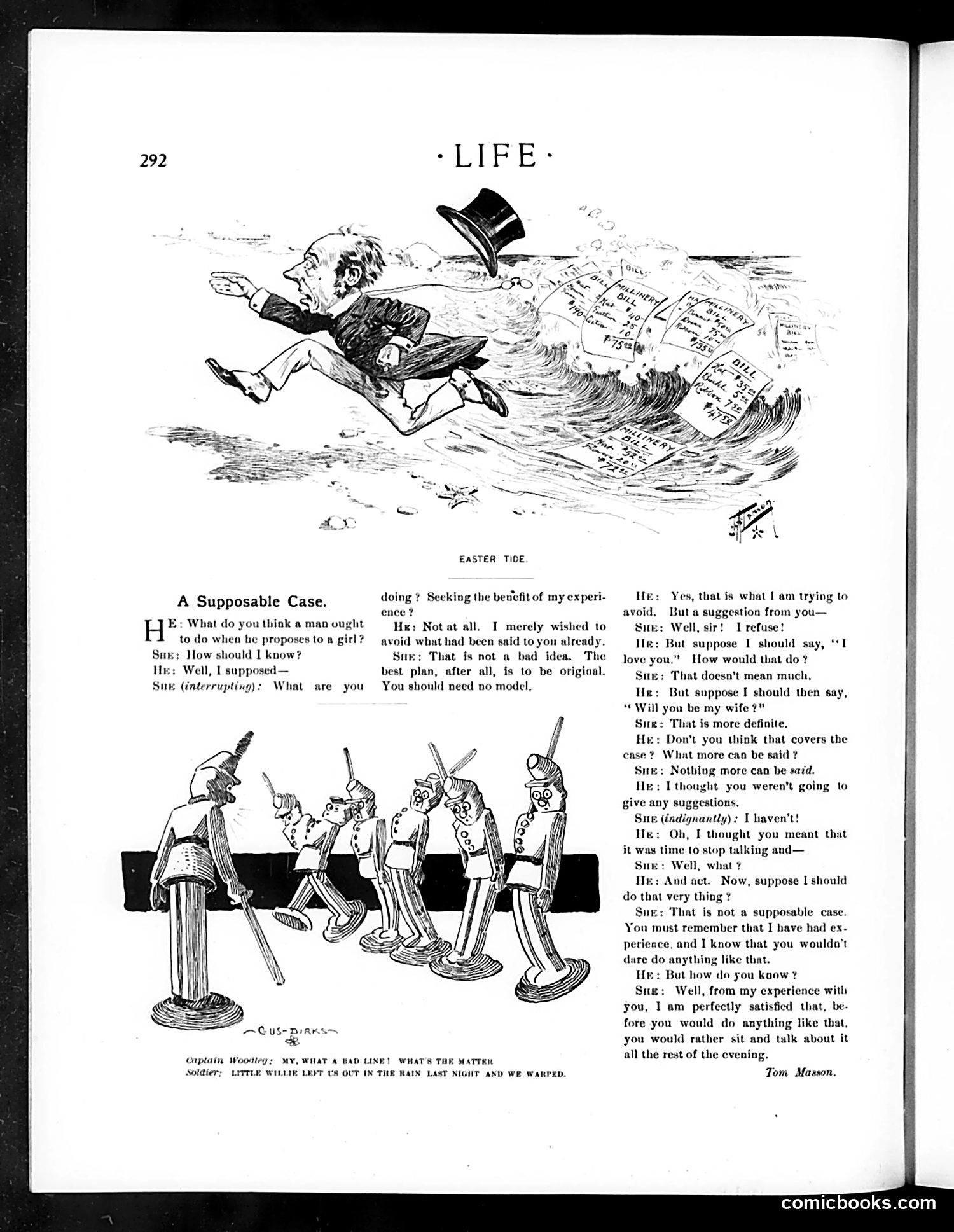
**Top Cartoon ("Easter Tide"):** A man in formal dress is swept away by a massive wave of papers labeled with financial figures and percentages—likely stock market or investment documents. His top hat floats above. This satirizes financial panic or market collapse during Easter season, a traditionally optimistic period. The irony is visual: formal dignity overwhelmed by economic chaos. **Bottom Cartoon & Dialogue ("A Supposable Case"):** A military officer addresses soldiers with rifles. The caption references "Little Willie" being left out in rain, likely a German reference (appears WWI-era). The lengthy dialogue between "He" and "She" concerns whether a man should propose marriage—a domestic dispute contrasted absurdly with military scenes, suggesting the disconnect between domestic concerns and wartime realities.
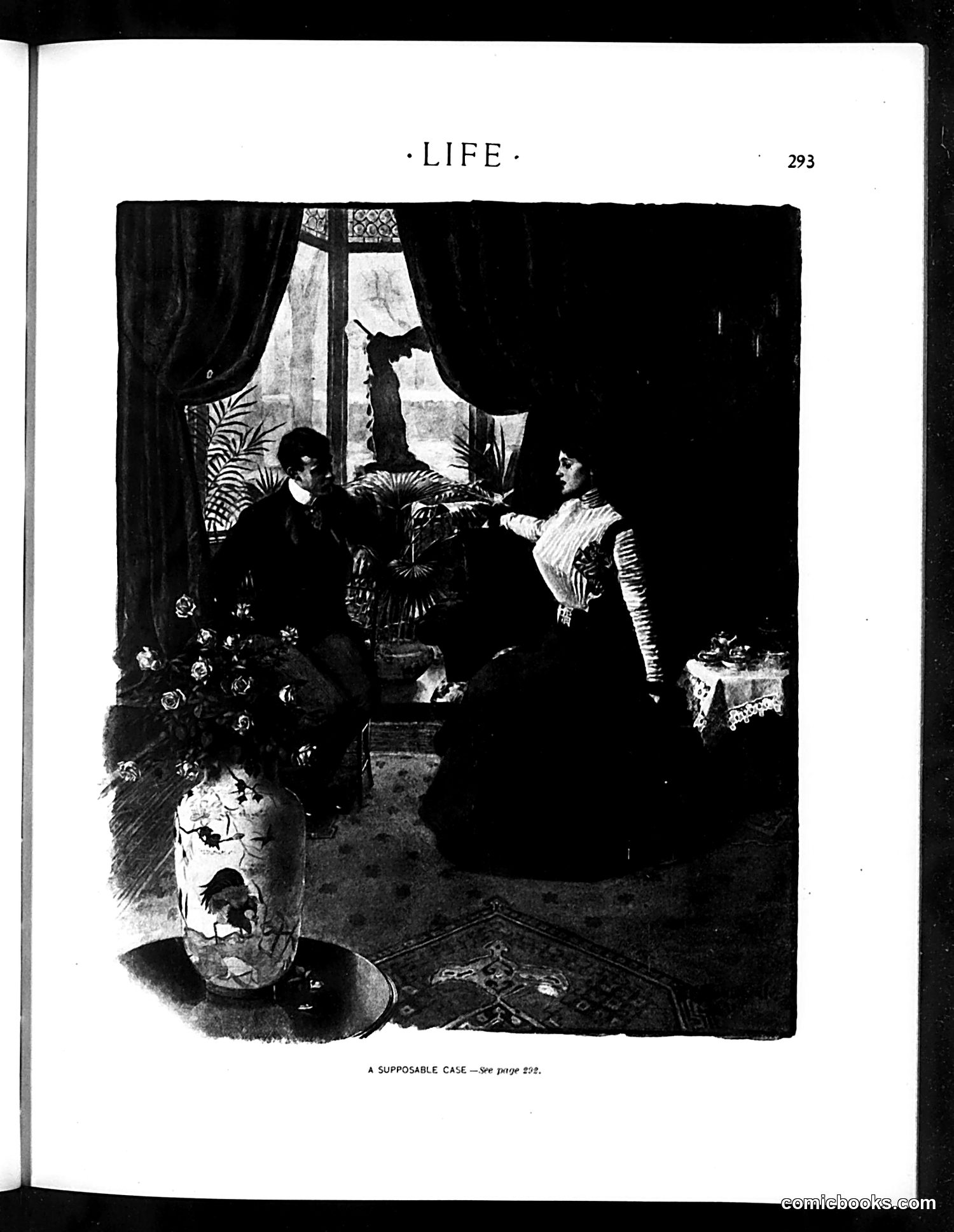
This illustration from *Life* magazine (page 293) depicts an interior scene with two figures conversing near a window, with decorative plants and furnishings visible. A prominent decorative vase sits in the foreground. The caption references "See page 292," indicating this cartoon comments on or continues a story from the previous page. Without access to that context, the specific political or social satire remains unclear. However, the title "A Supposable Case" suggests the illustration presents a hypothetical scenario—likely meant to satirize contemporary social situations, possibly involving class distinctions, domestic life, or romantic entanglements typical of *Life* magazine's satirical humor during this era. The dramatic lighting and composition emphasize the interior's elegance and the figures' interaction, but the precise satirical point requires the referenced previous page.
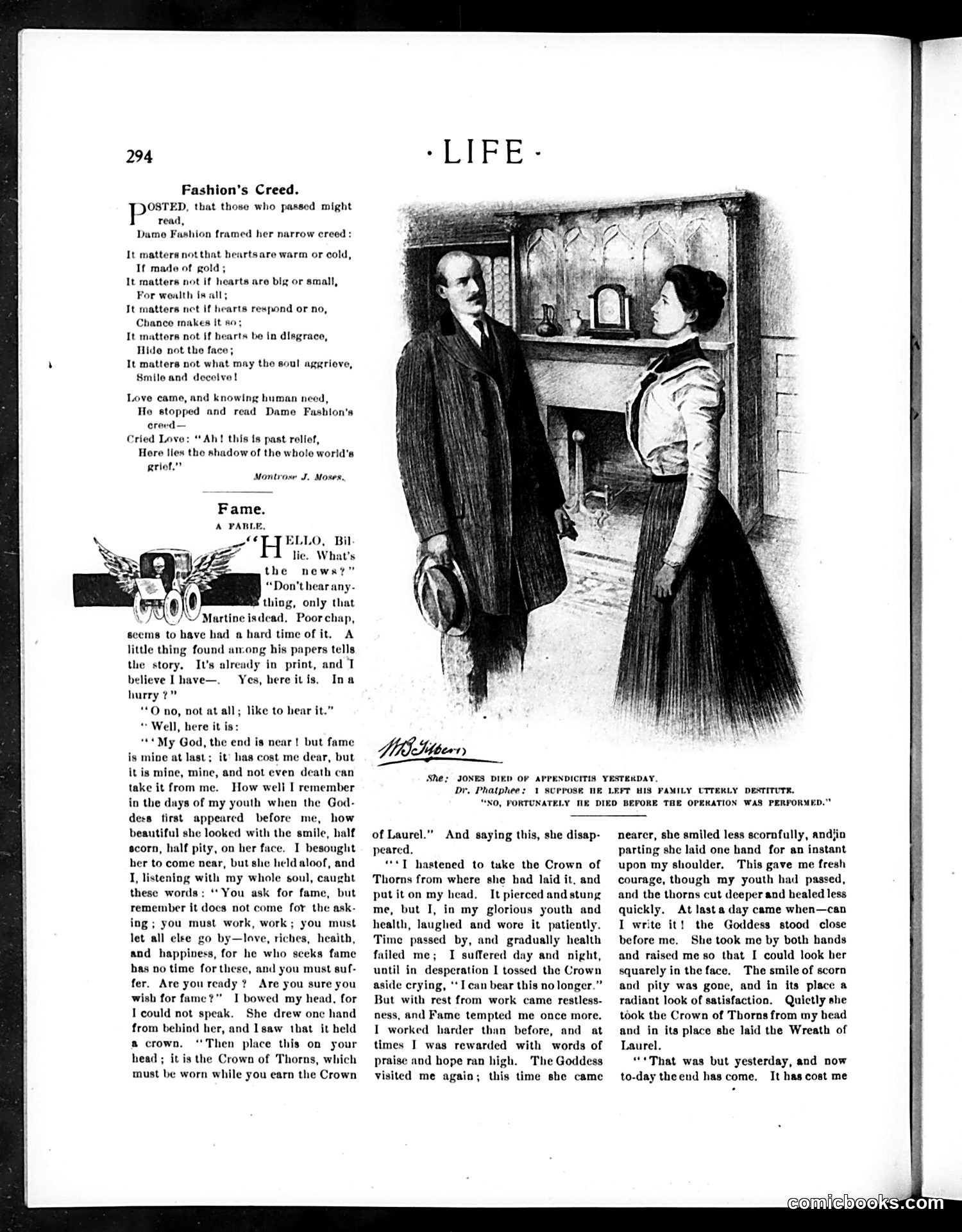
This page contains two satirical pieces about ambition and social values in early 20th-century America. **"Fashion's Creed"** critiques shallow materialism: Dame Fashion's philosophy values only wealth and appearance ("hearts of gold"), not genuine character or integrity. Love confronts this creed, recognizing it represents "the shadow of the whole world's grief." **"Fame: A Fable"** tells of a man who pursues fame despite the Goddess's warning it demands sacrifice—symbolized by the "Crown of Thorns." After decades of suffering and health decline, he finally achieves recognition (the "Wreath of Laurel"), but dies the very next day. **The bottom cartoon** depicts a dark joke: a doctor tells another that a patient named Jones died of appendicitis *before* surgery could be performed—ironically, this prevented the family from being "utterly destitute" (since no medical bills accrued). The satire targets the financial burden of medical care on ordinary families. All three pieces mock American society's priorities: wealth, fame, and survival itself come at crushing human cost.
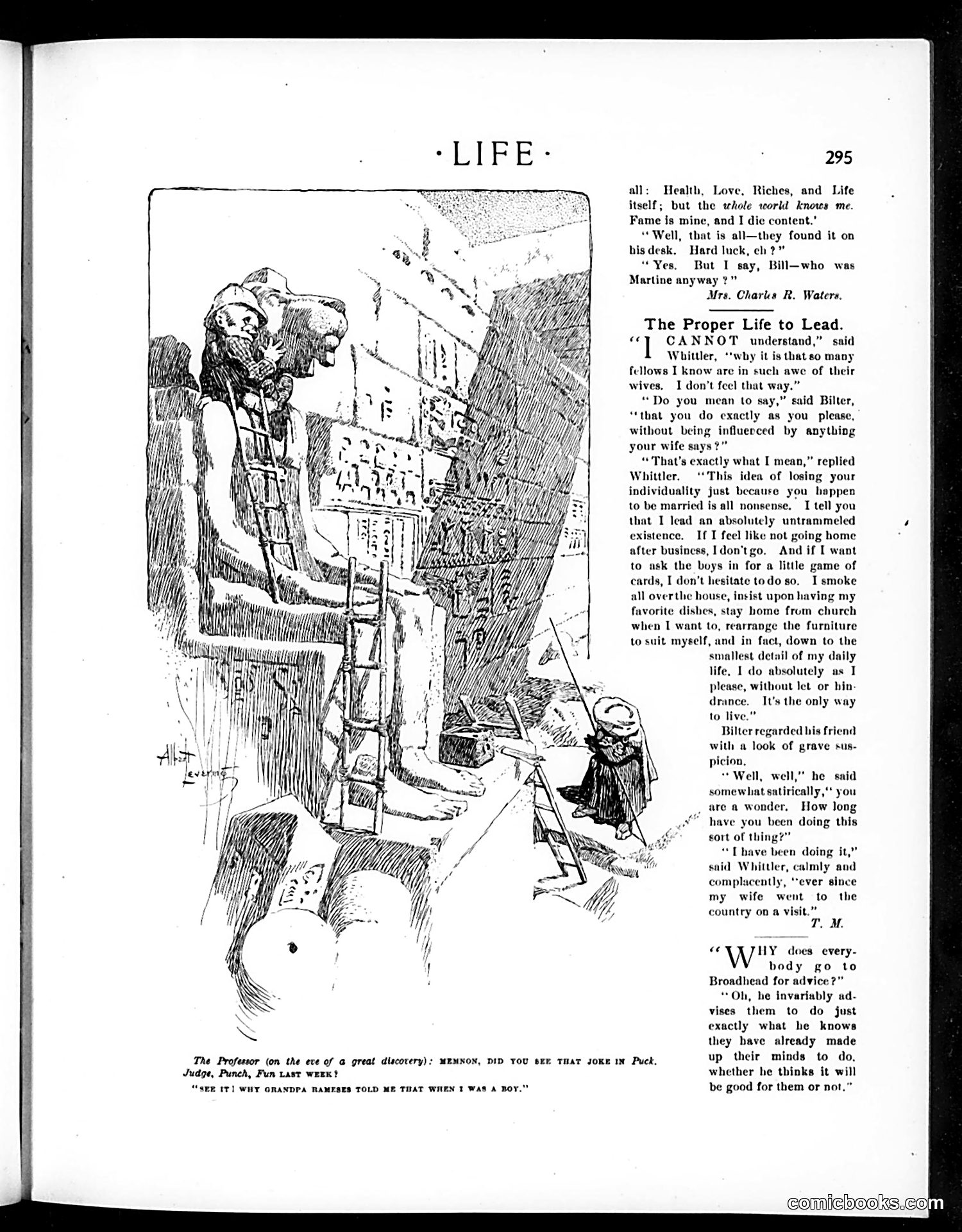
This page contains two satirical pieces about male independence and decision-making. **"The Proper Life to Lead"** presents a dialogue between Whittler and Bilter. Whittler boasts of his absolute freedom—smoking throughout the house, inviting friends for cards, skipping church, rearranging furniture—all "without let or hindrance." The satire's punchline reveals the joke: Whittler has enjoyed this complete autonomy only "ever since my wife went to the country on a visit." The humor lies in exposing the hollowness of his claims to independence; he's only "free" during his wife's absence, undermining his entire argument about marital authority. **The illustration** (credited to artist signature) depicts what appears to be a street scene with figures, though its specific connection to the text is unclear. **The brief exchanges at bottom** reference a "Professor" and contain period humor about advice-giving that appears unrelated to the main narrative. The overall theme satirizes masculine pretense about domestic independence—a common subject in early 20th-century American humor magazines.
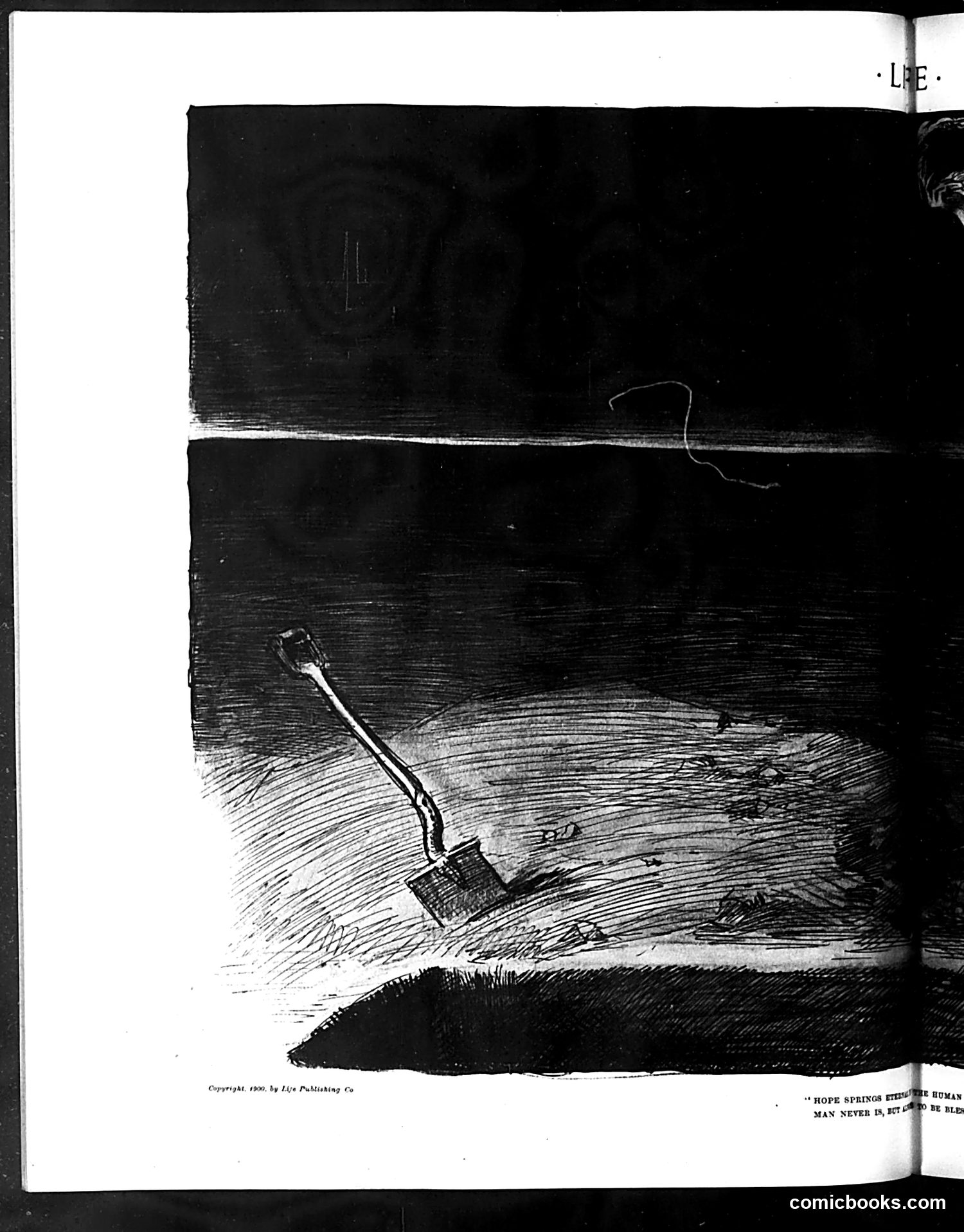
This appears to be a satirical illustration from *Life* magazine showing a figure with a shovel working on barren, scratched earth. The incomplete caption reads: "HOPE SPRINGS ETERNAL—MAN NEVER IS, BUT—" This is likely a commentary on human optimism versus reality. The reference alludes to Alexander Pope's famous line "Hope springs eternal in the human breast," but the cartoon subverts it cynically. The solitary figure laboring on harsh, unforgiving ground suggests futile effort—that while hope may be eternal, human success or satisfaction never is. The worn, heavily-etched landscape emphasizes struggle and disappointment. Without the full caption, the exact satirical target is unclear, but the image critiques the gap between human aspiration and actual achievement.
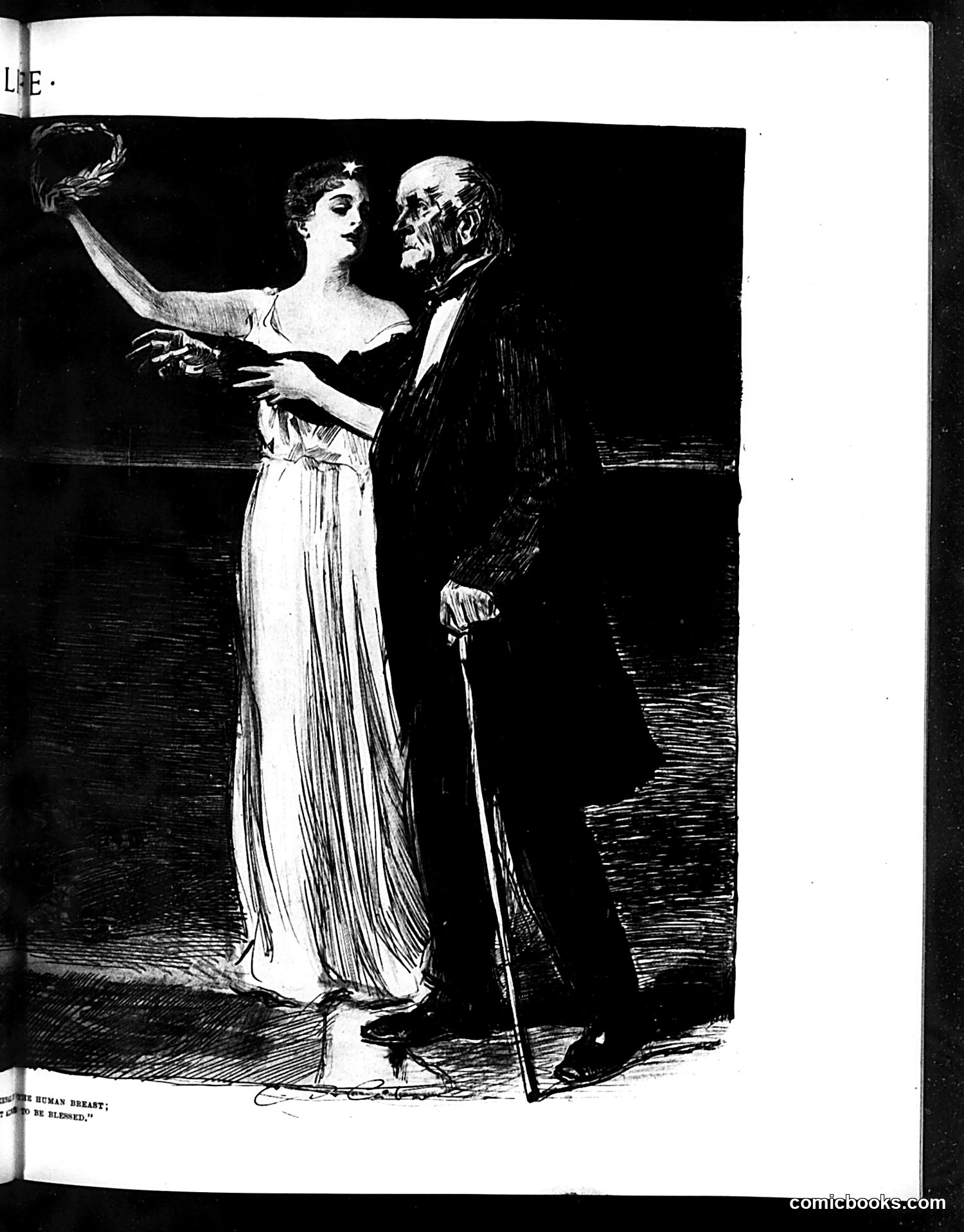
This appears to be a satirical illustration from *Life* magazine showing two figures in formal dress. A woman in a classical white gown holds what appears to be a laurel wreath or torch aloft, while an older man in dark formal wear with a cane stands beside her looking upward at her offering. The partially visible caption at bottom reads "THE HUMAN BREAST" and "TO BE BLESSED," though the full text is obscured. Without the complete caption and publication date, the specific political or social commentary remains unclear. The classical imagery (the woman's pose suggests Liberty or Victory) and the interaction between the figures suggests this satirizes some form of power dynamic, idealization, or relationship between public figures or concepts—but the exact target and point of the satire cannot be definitively determined from the visible elements alone.
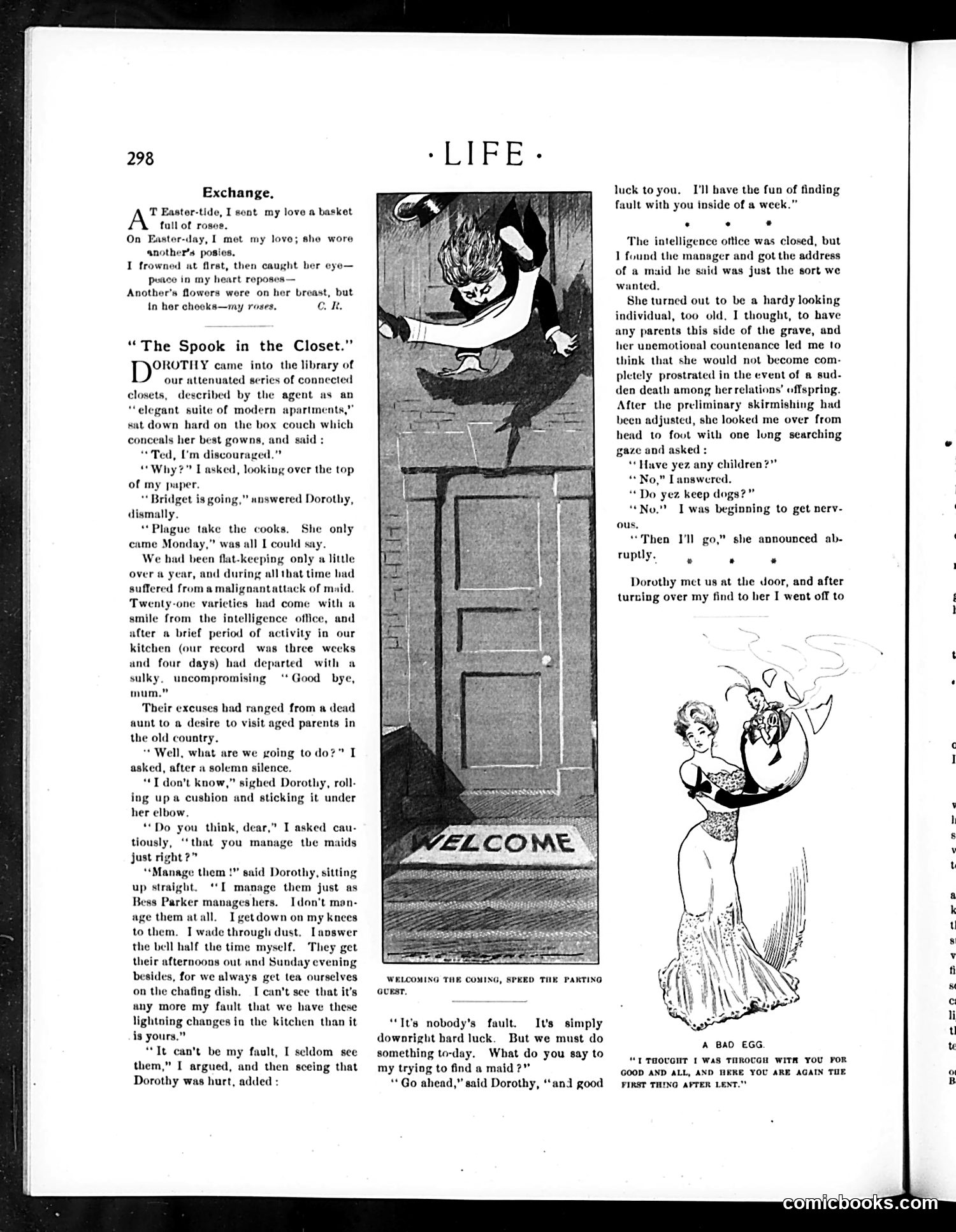
This story satirizes the acute domestic-service crisis afflicting early 20th-century urban households. The narrator and his wife Dorothy struggle to retain household staff in their cramped apartment ("elegant suite of modern apartments" being ironic marketing speak). The humor derives from the era's servant-employment reality: maids constantly quit, citing various excuses (dead relatives, visiting parents abroad). Dorothy defends her management against her husband's implicit blame, noting she treats servants generously—giving them afternoons and Sundays off, doing work herself. The punchline: when the husband finally finds a replacement maid, she interviews *them*, asks if they have children or dogs, then immediately refuses the position. The servant holds all power despite appearing to occupy a subservient role. The accompanying illustrations show domestic life's indignities: a woman arriving with luggage ("Welcoming the Coming, Speed the Parting Guest") and a separate cartoon about romantic disappointment. The satire targets both middle-class assumptions about servant loyalty and the actual leverage working-class domestics possessed in tight labor markets.
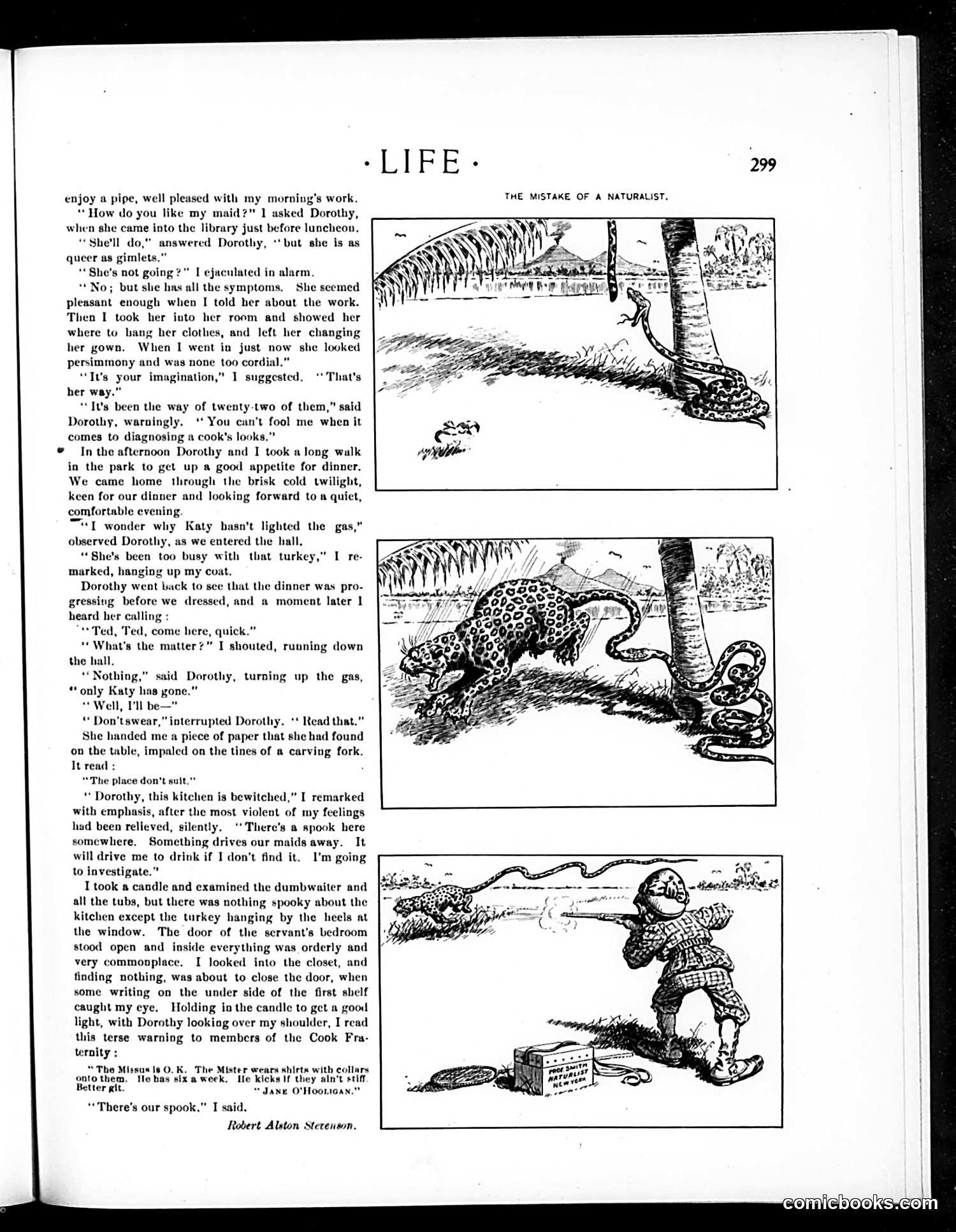
This story-cartoon satirizes the "servant problem" — a common complaint among upper-class households of the early 20th century about domestic staff quitting unexpectedly. The narrator prides himself on being a rational observer (a "naturalist"), yet fails to diagnose why his maids keep leaving. His wife correctly predicts their departures based on their expressions, but he dismisses her intuition as imagination. The punchline: the real culprit is a hidden message left by a previous servant warning others about the master's petty demands — specifically, that he requires stiffly-starched collars changed weekly and will "kick" (complain harshly) if they're not perfect. The crude spelling ("Jang O'HOOLIGAN") suggests a working-class servant's voice. The satire targets two things: the employer's obliviousness to his own unreasonable behavior, and the irony that his scientific objectivity blinds him to obvious social reality that his wife understood immediately. The servant network's informal communication system — leaving warnings for others — is portrayed as practical intelligence the "naturalist" completely missed.
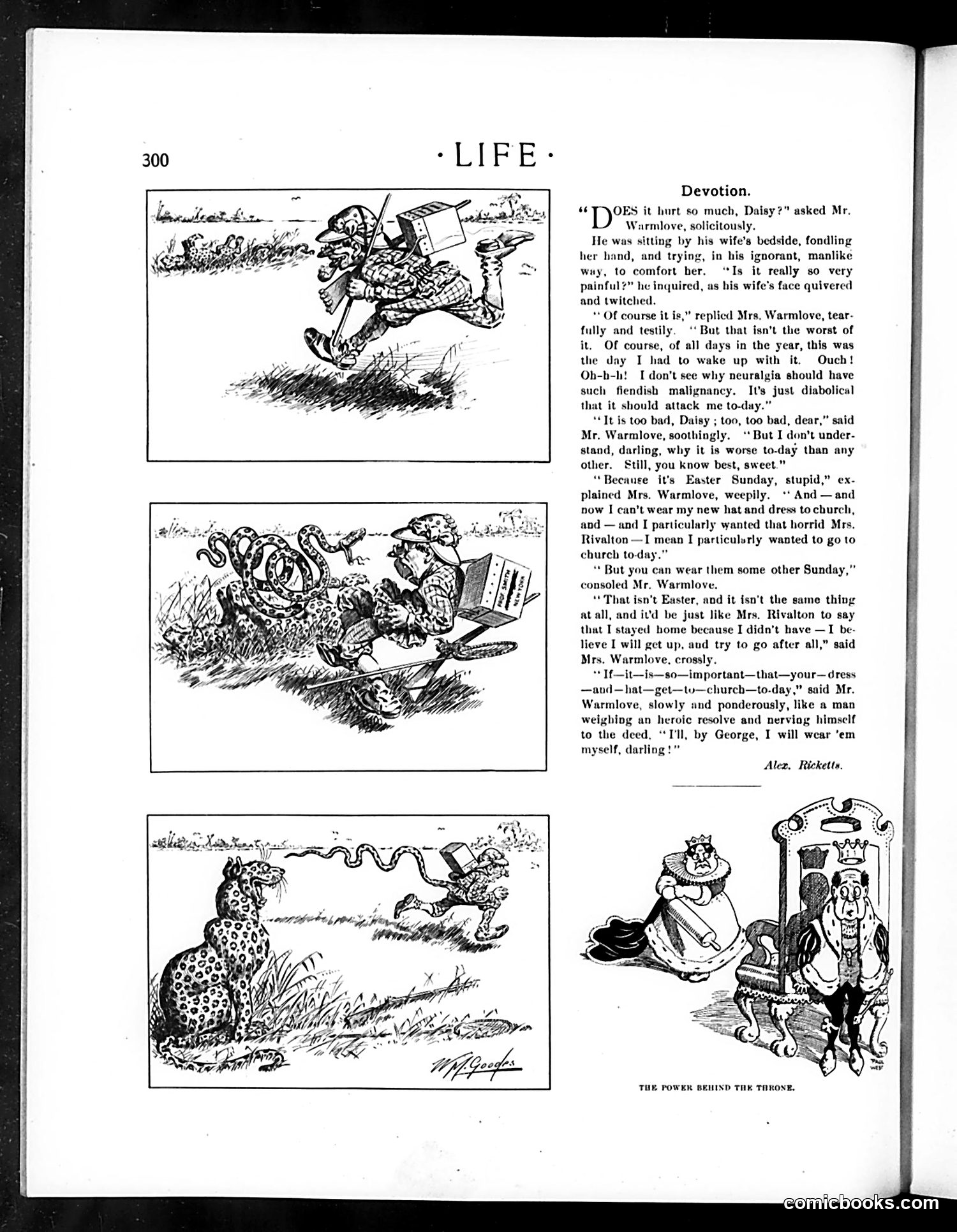
This page contains a humorous domestic scene written by Alex Ricketts. Mr. Warmlove finds his wife Daisy suffering from neuralgia (nerve pain) on Easter Sunday. She's distressed not primarily about the pain itself, but because she cannot wear her new hat and dress to church—specifically, she wanted to be seen there by her rival, Mrs. Rivalton. The joke satirizes female vanity and social competition: Daisy's religious observance is secondary to displaying her finery and outshining a social rival. Mr. Warmlove's final quip—that he'll wear the dress and hat himself to church—is absurdist humor mocking the absurdity of prioritizing appearance over genuine devotion. The three cartoon illustrations on the left (artist's signature visible) appear to depict humorous animal or fantastical scenes, though their specific connection to the story is unclear. The small illustration labeled "THE POWER BEHIND THE THRONE" shows royal figures and likely offers separate satirical commentary.
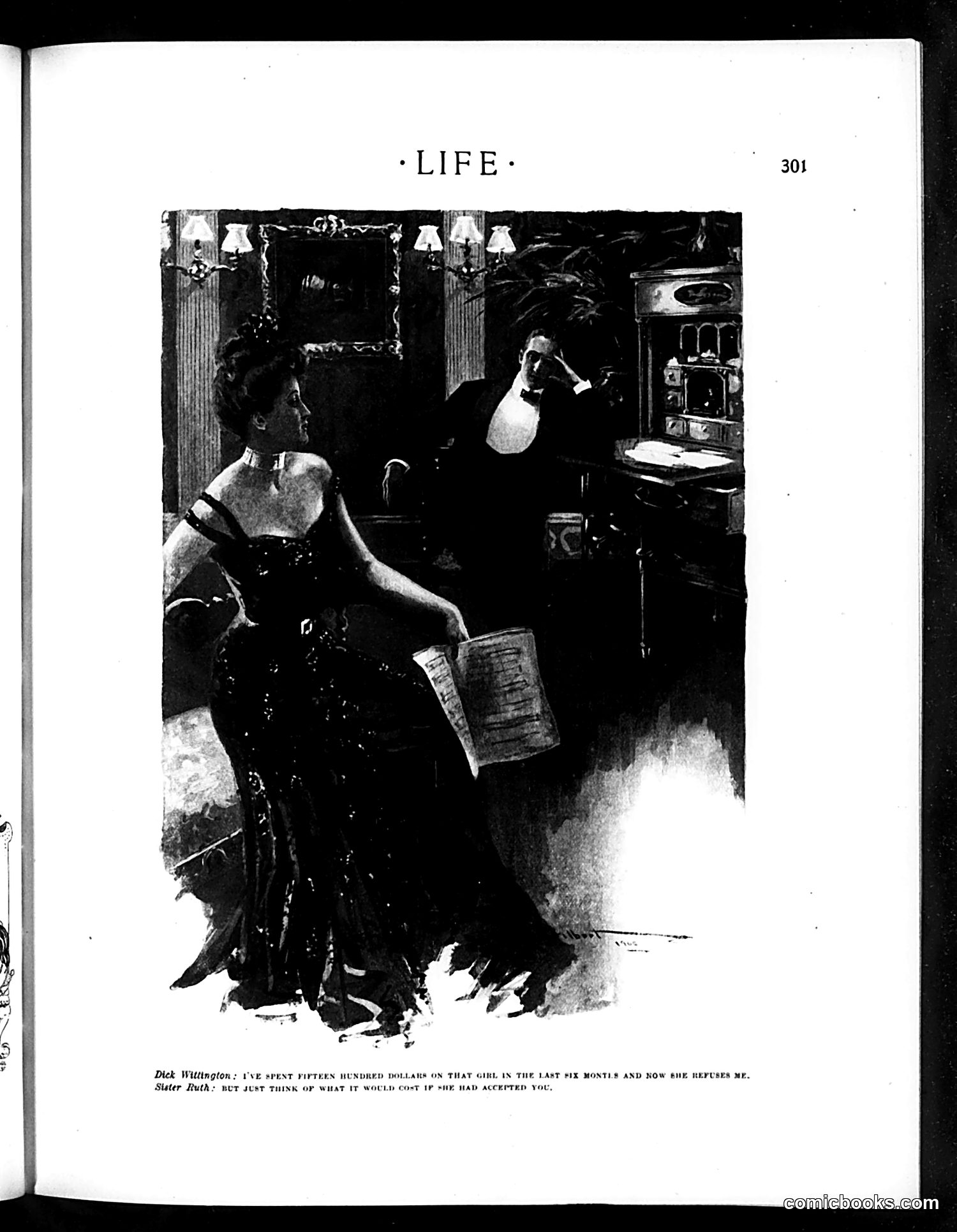
This is a satirical dialogue cartoon depicting a wealthy man (Dick Willington) complaining to a woman (Sister Ruth) that he's spent $1,500 courting a girl who rejected him. Sister Ruth's response delivers the joke: she suggests the girl wisely calculated that accepting his proposal would cost *her* far more than the money he spent—implying marriage to him would be an expensive mistake. The satire targets materialistic courtship and male entitlement. The implication is that women should be grateful for a man's spending, while Sister Ruth reframes it as a financial transaction where the woman has the most to lose. It's a reversal of the typical "gold-digger" stereotype, suggesting even paid courtship doesn't obligate a woman's acceptance.
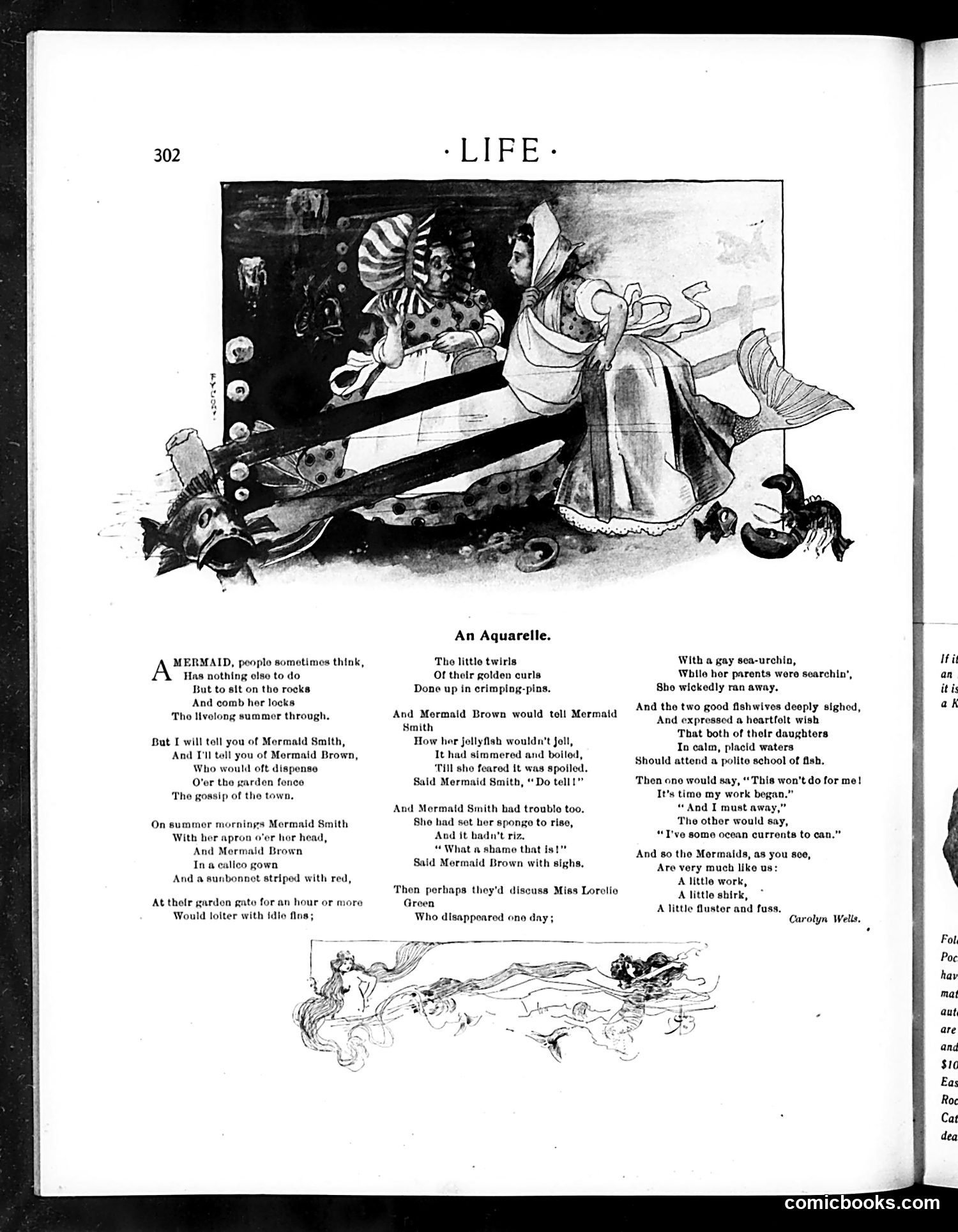
This humorous poem by Carolyn Wells satirizes domestic life and gossip by transplanting it underwater. Two mermaids—Smith and Brown—occupy their summer days exactly like human housewives: chatting over garden fences, discussing household failures (failed jellies, unrisen sponges), and spreading rumors about a scandalous neighbor, Miss Lorello Green, who eloped with a sea-urchin. The satire's point: mermaids are "very much like us"—all human society shares the same small dramas of "a little work, / A little shirk, / A little fluster and fuss." The whimsy makes social commentary about women's domestic routines and gossip culture. The accompanying watercolor illustrations reinforce the absurdist humor of applying ordinary suburban life to mythical sea creatures, deflating both mermaid romanticism and domestic monotony.
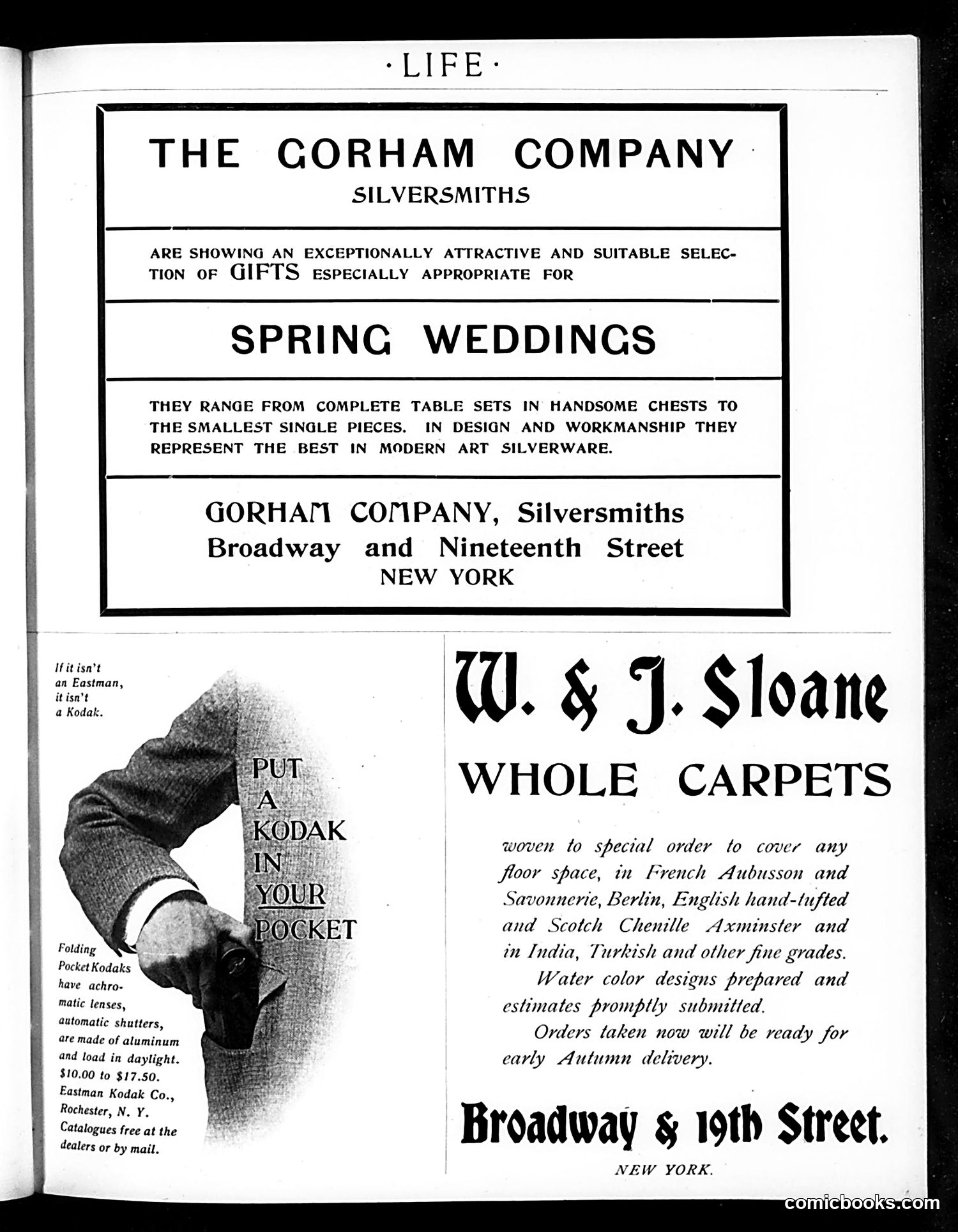
This page is primarily **advertising**, not satire or political commentary. It contains three luxury product advertisements aimed at wealthy consumers: 1. **Gorham Company Silversmiths** (top): promotes fine silverware gifts for spring weddings, from complete table sets to individual pieces. 2. **Kodak Pocket Camera** (left): advertises folding pocket cameras ($10–$17.50) with automatic features, targeting affluent consumers who could afford portable photography. 3. **W. & J. Sloane Carpets** (right): offers custom-woven carpets in premium materials (French, English, Indian, Turkish) for any floor space, with water-color designs and autumn delivery. The page reflects early 20th-century consumer culture targeting the wealthy. There is no visible cartoon or satire—Life magazine at this era mixed editorial content with high-end advertising. The repeated Broadway/19th Street addresses indicate New York's commercial district.
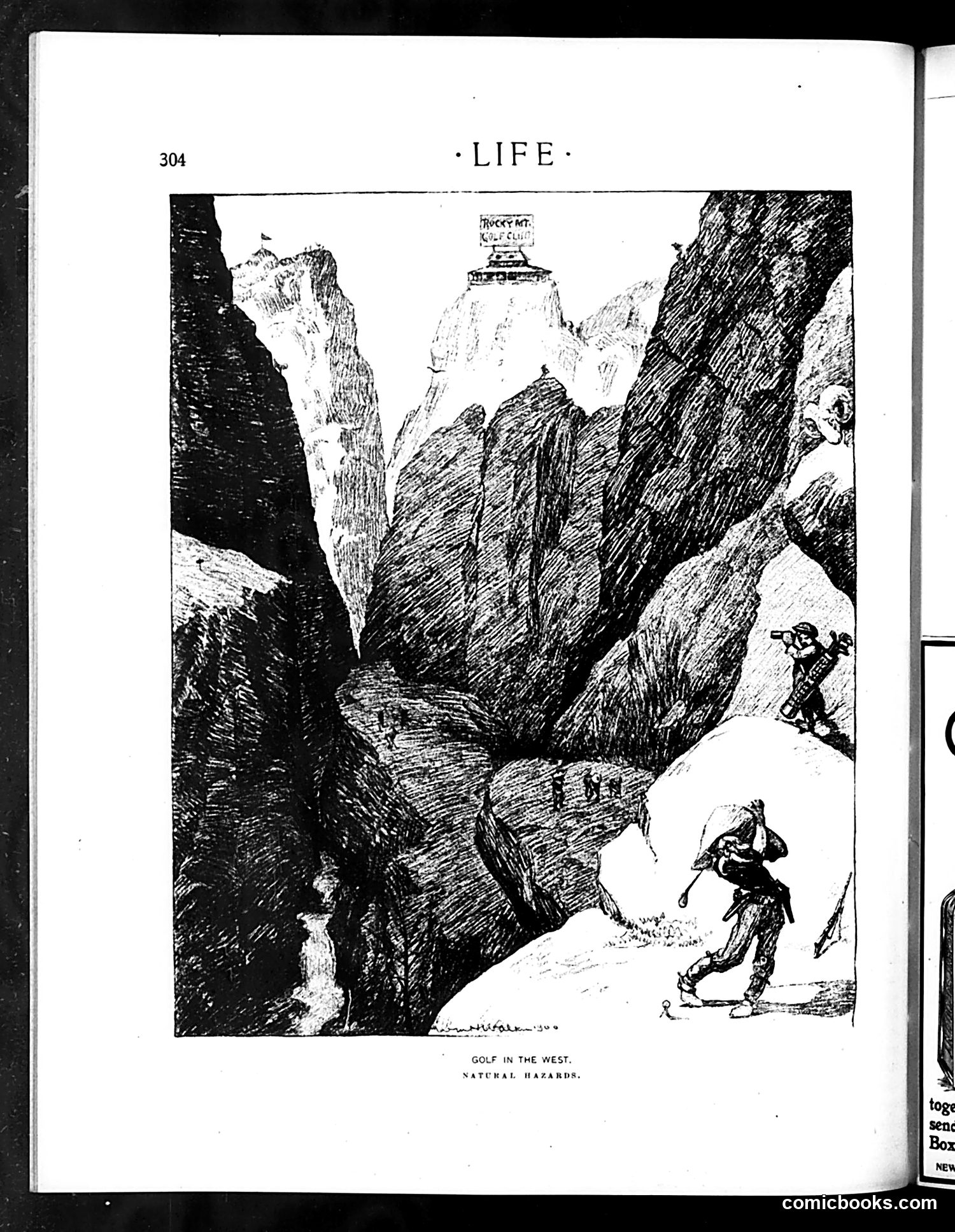
This satirical illustration depicts golfers navigating a treacherous mountain gorge, treating geological danger as merely another golf course obstacle. The humor relies on the incongruity of an genteel, Eastern sport (golf) being played in the American West's harsh wilderness. The "natural hazards" of the title—steep cliffs, narrow passages, and extreme terrain—are presented as comedic impediments to the golfers' game, similar to sand bunkers or water hazards on a proper course. The figures appear to be struggling against the landscape rather than being deterred by actual danger. This likely satirizes either wealthy Easterners' obliviousness when visiting the rugged West, or the broader turn-of-century trend of commercializing and "civilizing" the American frontier for leisure activities.
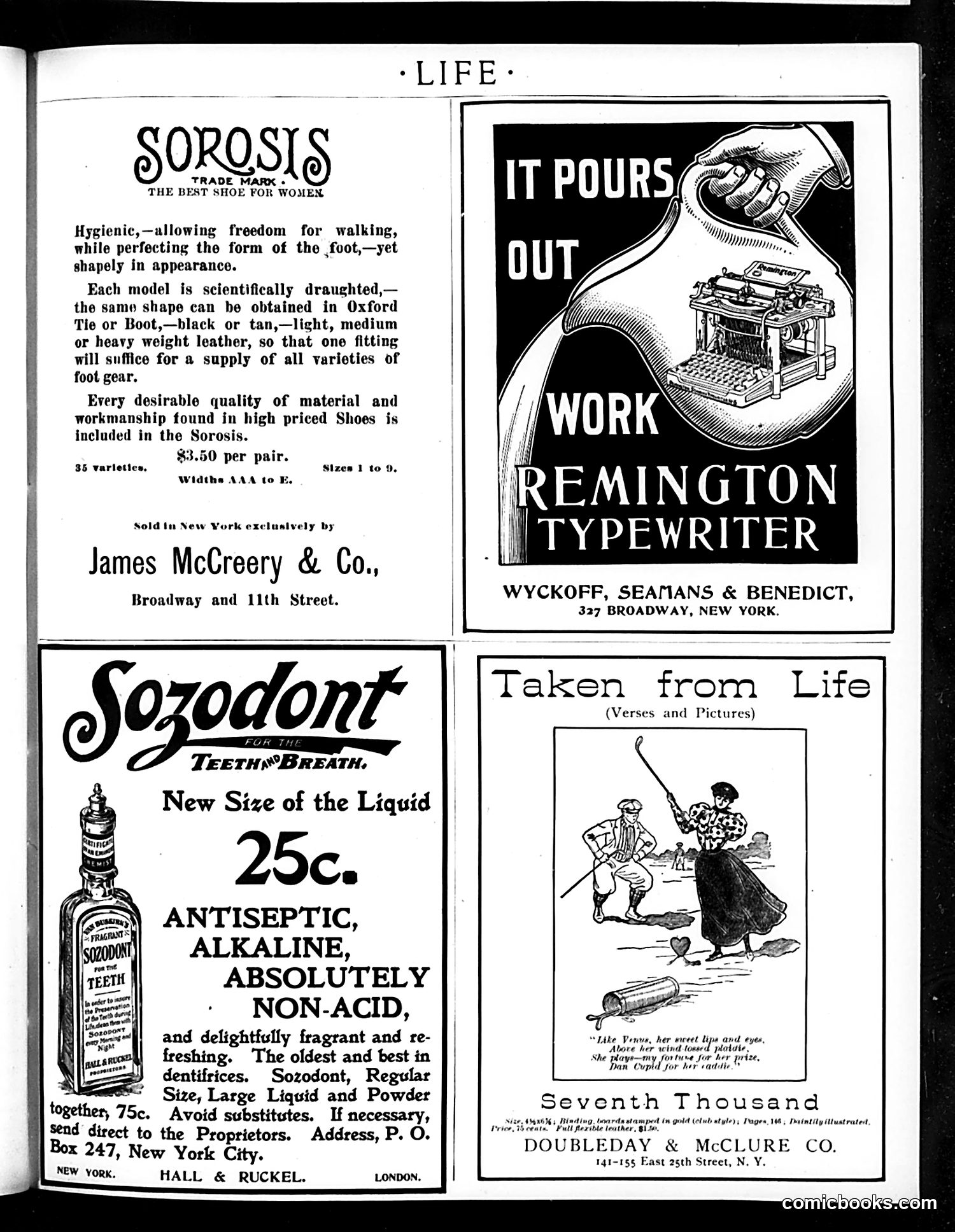
This page is primarily **advertising**, not political satire. It contains four distinct advertisements from early 1900s Life magazine: 1. **Sorosis shoes** — marketed as hygienic women's footwear offering both comfort and fashionable appearance at $3.50/pair 2. **Remington typewriter** — advertised with an illustration showing liquid "pouring out" work from the machine, emphasizing productivity 3. **Sozodont mouthwash** — promoted as an antiseptic dental product in a new 25-cent size 4. **"Taken from Life"** — a book of verses and pictures published by Doubleday & McClure, showing what appears to be a romantic or humorous scene with figures fishing The only visual humor appears in the typewriter ad's metaphor and the book illustration, but these are straightforward product promotions rather than satirical commentary. This represents typical period magazine advertising targeting middle-class consumers.
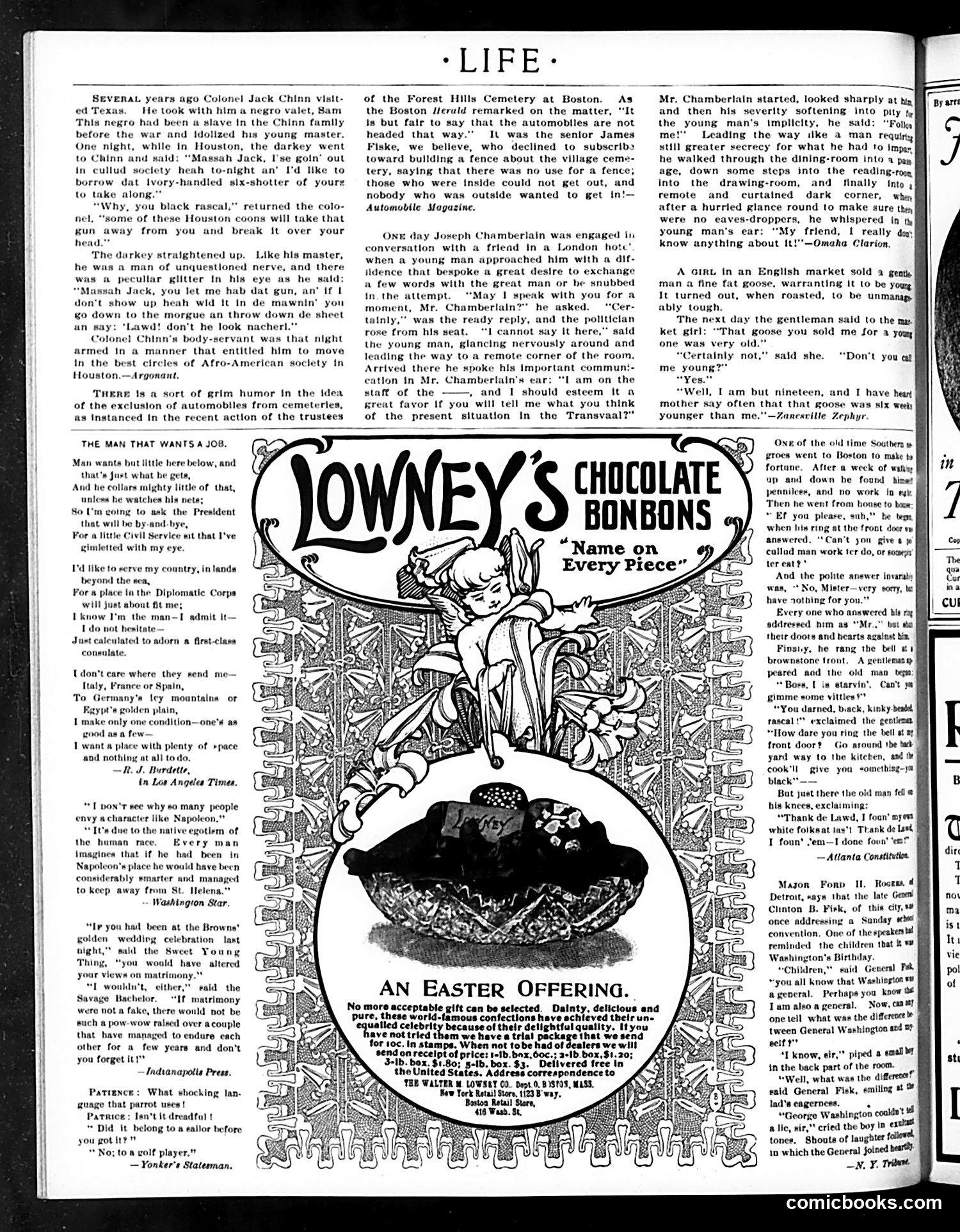
This page contains three distinct satirical pieces typical of early 20th-century *Life* magazine: **1. The Colonel Chinn Story**: A racist anecdote about an enslaved Black man requesting a pistol for a social event, with a darkly humorous punchline about potential death. The "humor" relies on dehumanizing stereotypes of the era. **2. The Joseph Chamberlain Anecdote**: A joke about a nervous young journalist attempting to get political commentary from the British politician about the Transvaal (South African conflict). The satire mocks the reporter's over-cautious secrecy and Chamberlain's ultimate evasion—a commentary on political non-answers. **3. The Goose Market Story**: A brief anecdote about a vendor's false warranty, with a girl's clever comeback about the goose's actual age. **The Downey's Chocolate Bonbons Advertisement** dominates the center—an Easter confectionery ad with decorative fairy imagery. The page reflects *Life*'s mix of social satire, political commentary, and period advertising, though the racist content reflects deeply problematic historical attitudes.
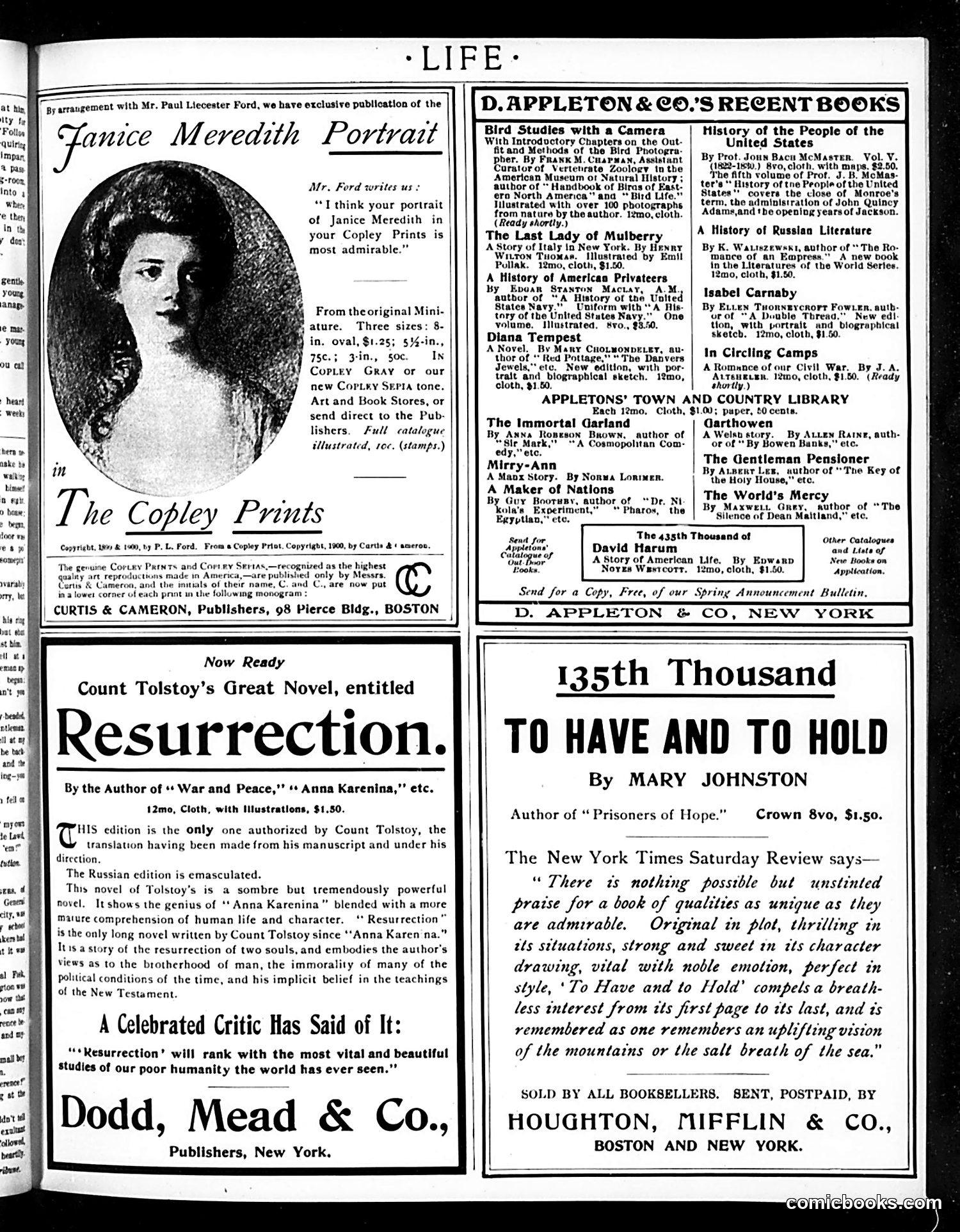
This page is primarily advertising, not political cartoons. The main content includes: **Upper Left:** An advertisement for "The Copley Prints" featuring a portrait of Janice Meredith (a fictional character from Paul Leicester Ford's novel). The ad includes a quote from Ford praising the portrait's quality and offers three sizes for purchase. **Right Side:** Publisher D. Appleton & Co. advertises recent books across various genres—history, literature, biography—including titles by respectable contemporary authors. **Lower Section:** Advertisements for Count Tolstoy's *Resurrection* (published by Dodd, Mead & Co.) and Mary Johnston's *To Have and to Hold* (published by Houghton, Mifflin & Co.). The page reflects early-1900s literary culture and book marketing rather than satirical commentary. It demonstrates how *Life* magazine, while known for satire and humor, also carried substantial book advertising to reach educated readers.
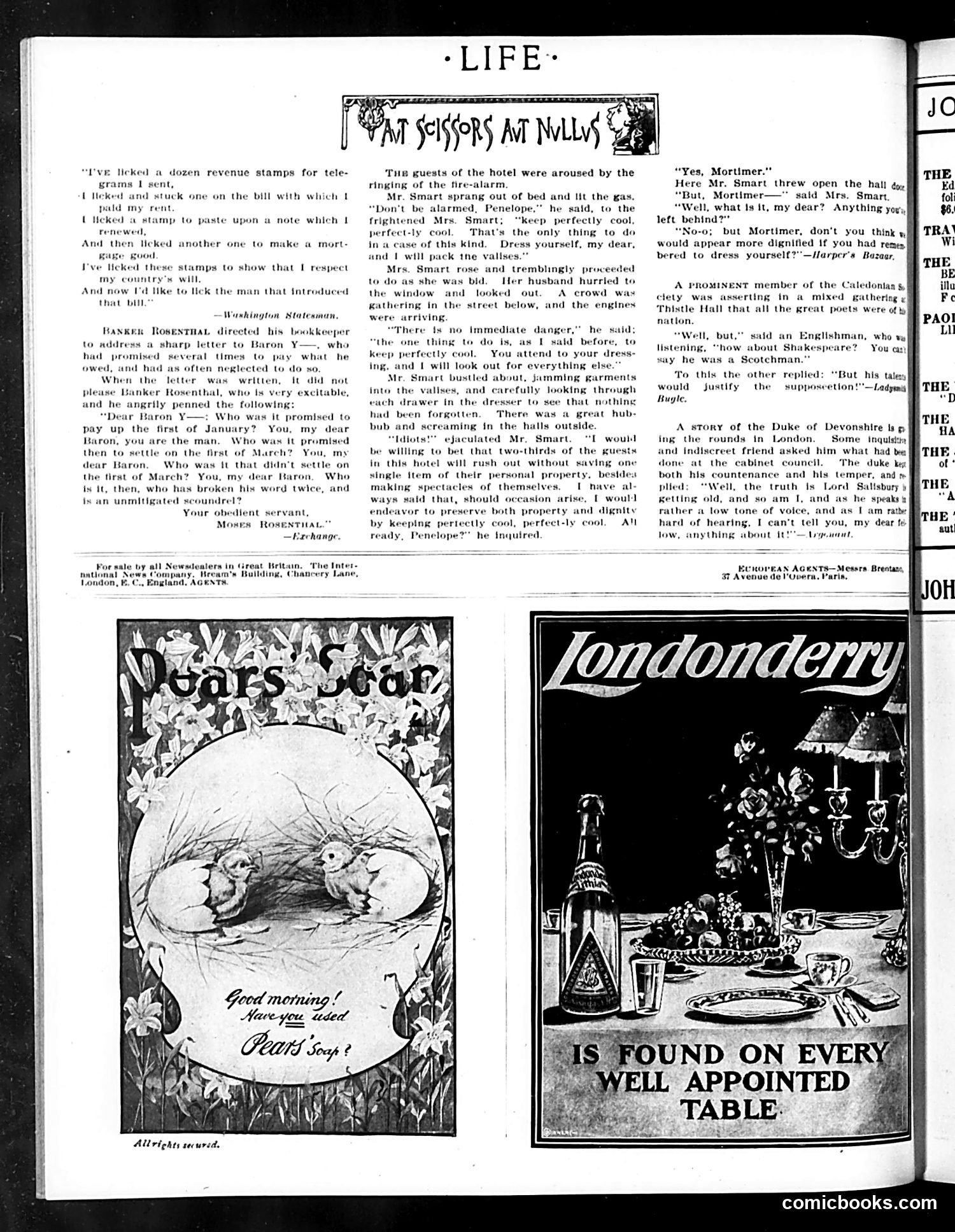
This page contains several humorous anecdotes mocking social pretension and human folly: **"Am Scissors Am Nullus"** ridicules a man obsessively licking revenue stamps to demonstrate patriotism—absurd performative nationalism. **The hotel fire scene** satirizes Mr. Smart's pompous insistence on "keeping perfectly cool" during emergency, only to emerge fully undressed—his dignity destroyed by his own obliviousness. The joke: vanity and composure mean nothing without basic awareness. **The Scotsman anecdote** appears to mock ethnic stereotyping, though details are unclear in the OCR. **The Duke of Devonshire story** gently ridicules elderly government officials (Lord Salisbury) who are simultaneously aging, speaking inaudibly, and hard of hearing—rendered incompetent by age yet remaining in power. The advertisements for Pears' Soap and Londonderry products frame these class-conscious social critiques typical of Life's satirical approach to American and British society.
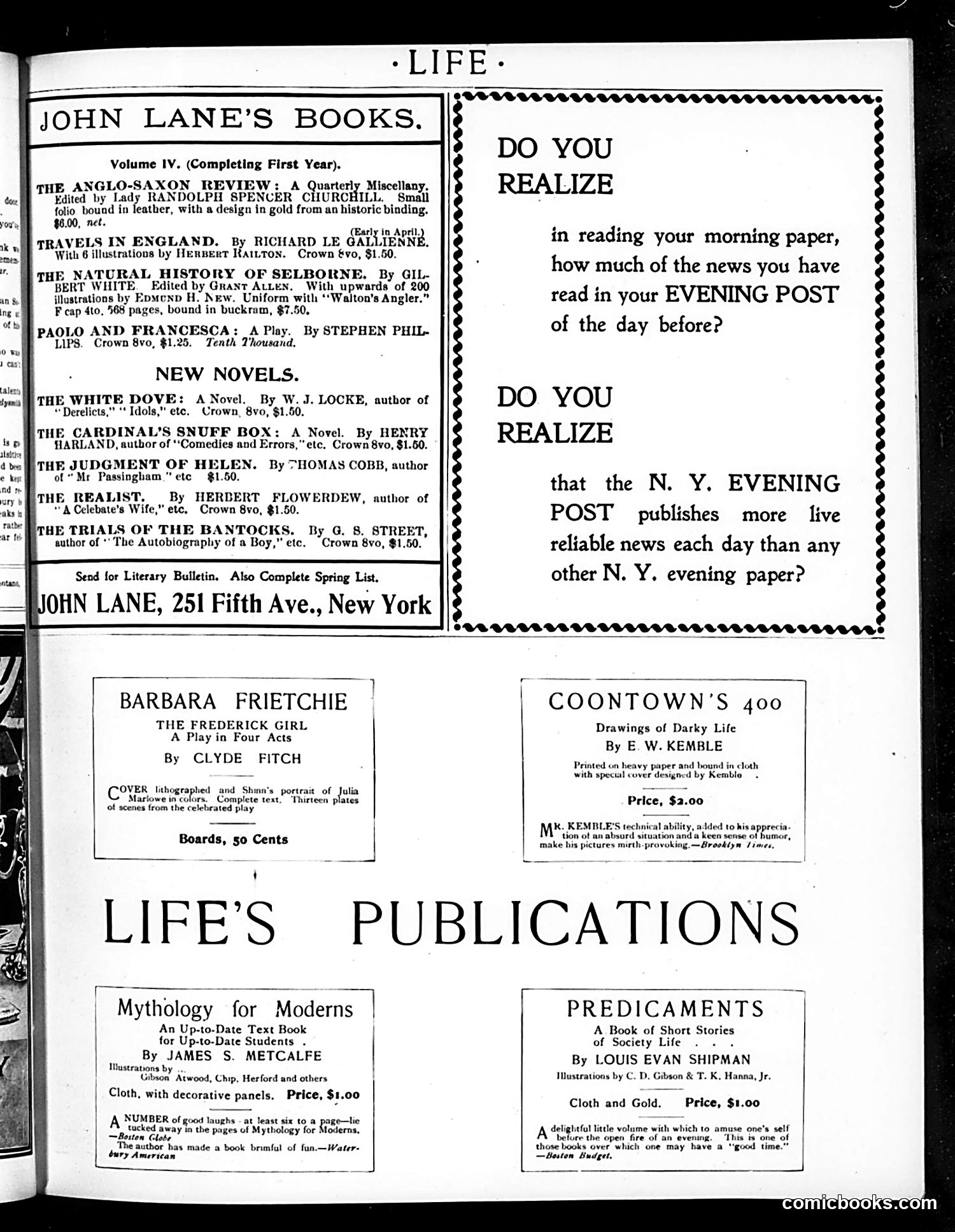
This is primarily an **advertising page** with no political cartoons. It showcases publications from John Lane (a major publisher) and Life Magazine itself, circa early 1900s. **Key Content:** The page advertises literary works including novels by W.J. Locke and Henry Harland, plays like "Paolo and Francesca," and Barbara Frietchie (a popular Civil War-era play). **Notable Element:** A prominent advertisement for the *N.Y. Evening Post* uses rhetorical questions challenging readers about news awareness—suggesting the Evening Post claims superior news coverage compared to competitors. This reflects **turn-of-century newspaper competition** for readership. **Social Context:** "Coontown's 400" by E.W. Kemble represents **period racist imagery** (caricatured depictions of Black life), which, while commonplace then, is deeply offensive by modern standards. The page reflects a leisured, literate audience consuming books, theater, and newspapers in the Gilded Age.
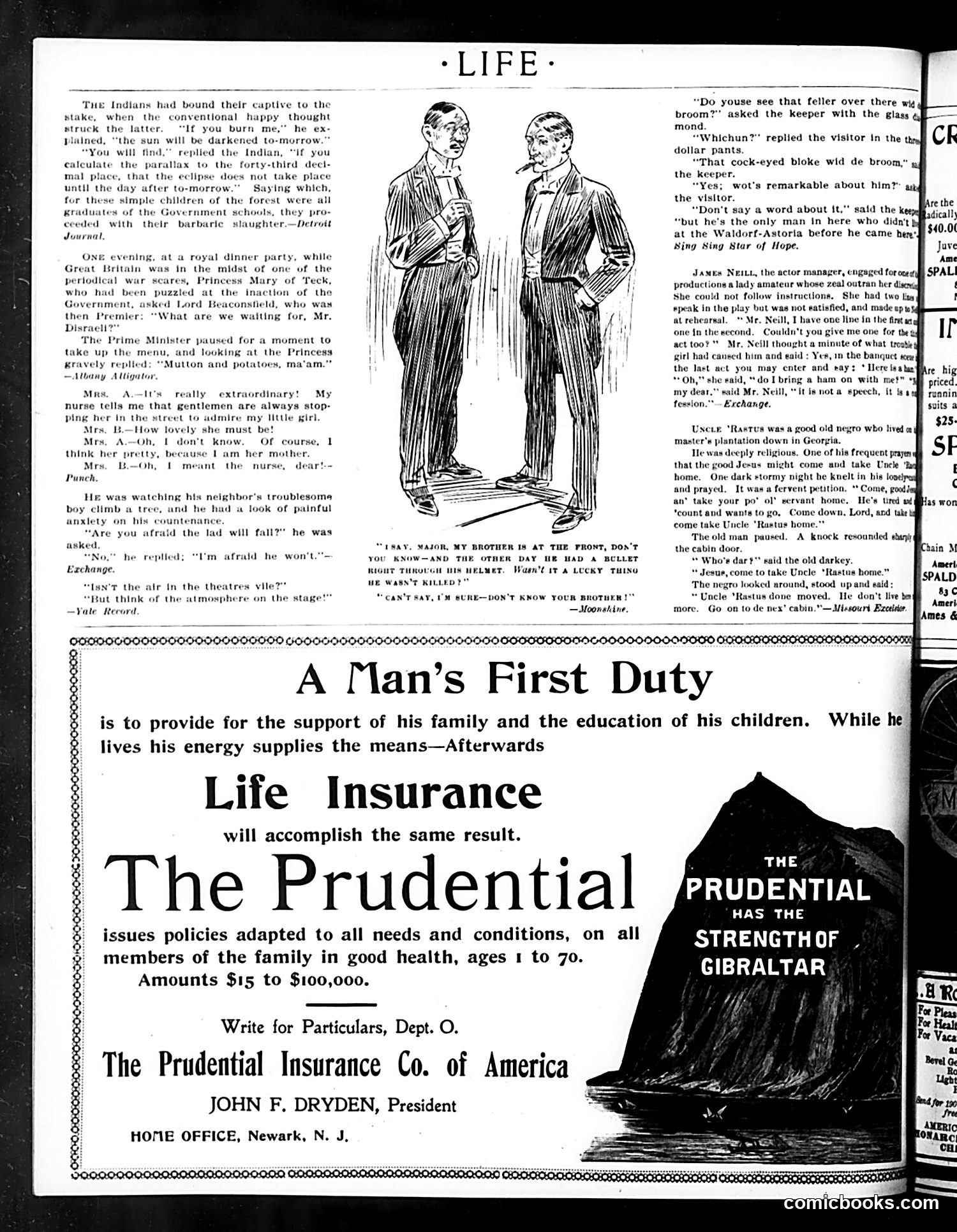
This page contains several short humorous anecdotes typical of *Life* magazine's satirical style, plus a life insurance advertisement. The cartoons satirize various social absurdities: one mocks Native Americans' education by showing they're so mathematically sophisticated they can calculate eclipse parallax, yet still practice "barbaric slaughter"—critiquing both racist stereotypes and the gap between education and morality. Another jokes about a nervous observer hoping a climbing boy *will* fall, inverting expected sentiment. A third features racist dialect humor about an African American man ("Uncle Rastus") so eager for heavenly salvation he tells Jesus to try the next cabin—a dehumanizing caricature common to the era. The dialogue snippets satirize social pretension and absurdity: a woman admiring another's "pretty" nursemaid rather than her child; theater-goers debating air quality. The page's advertisement promotes *Prudential Insurance*, claiming it fulfills "a man's first duty" to support his family—the magazine's commercial message framed as moral obligation. The humor reflects early-20th-century attitudes, including casual racism now recognized as offensive.
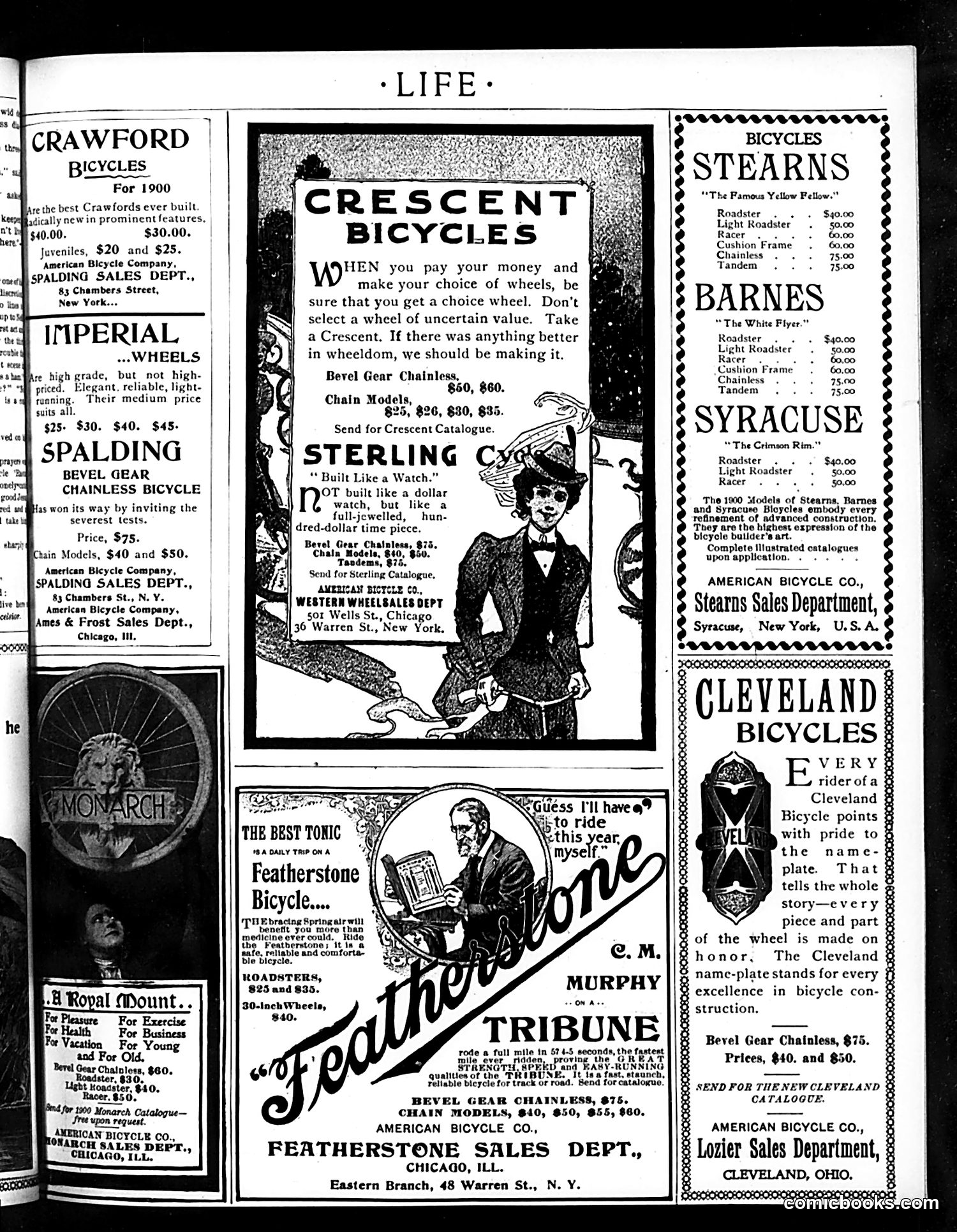
This page is entirely **bicycle advertisements** from circa 1900—not political cartoons or satire. The content reflects the bicycle boom of that era, when bicycles were major consumer goods and status symbols. Multiple competing brands (Crawford, Imperial, Spalding, Crescent, Sterling, Featherstone, Stearns, Barnes, Syracuse, Cleveland) advertise through the American Bicycle Company and its various sales departments. Notable details: prices range from $25–$75; manufacturers emphasize engineering ("built like a watch," "bevel gear chainless"); the Featherstone ad mentions Murphy setting a speed record (riding a mile in 61.4 seconds); tandem models suggest bicycles were social vehicles. The "name-plate" reference in the Cleveland ad indicates brand reputation mattered to buyers. There is **no satire, political content, or caricature** visible—purely commercial promotion targeting turn-of-century consumers.
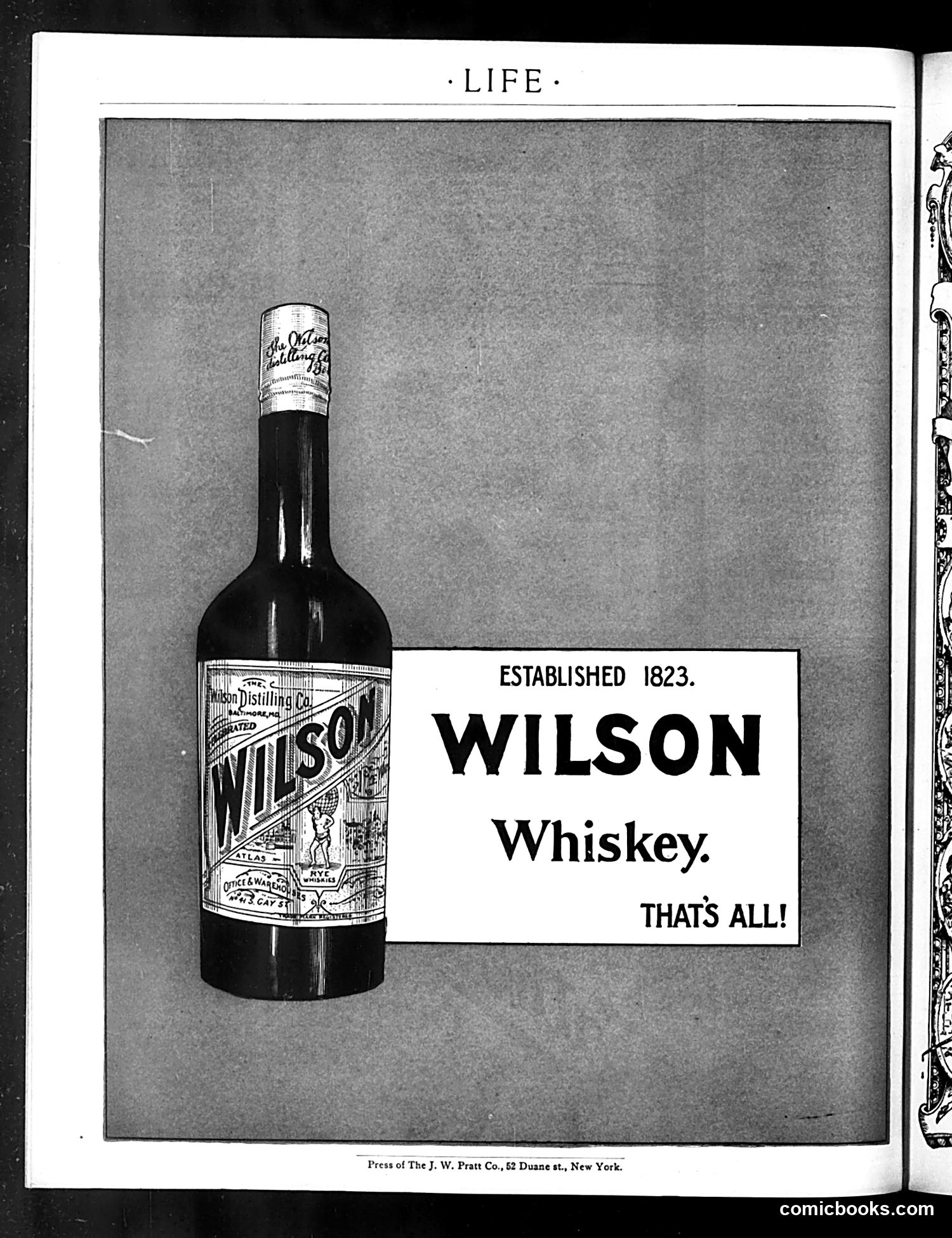
This is a straightforward **advertisement**, not satire or political commentary. It shows a bottle of Wilson Whiskey, established 1823, with the tagline "THAT'S ALL!" The ad's simplicity is notable—just a product image, the brand name, founding date, and a minimal slogan. The phrase "THAT'S ALL!" suggests the advertiser is emphasizing that the whiskey needs no elaborate marketing claims or explanation; the product's long history and reputation speak for themselves. This appeared in *Life* magazine during the early 20th century, when product advertisements regularly filled pages. There is no identifiable caricature, political figure, or satirical intent visible—it's purely commercial messaging using the magazine's space.