
Life, 1900-04-07 · page 8 of 32
Life — April 7, 1900 — page 8: what you’re looking at
What you’re looking at
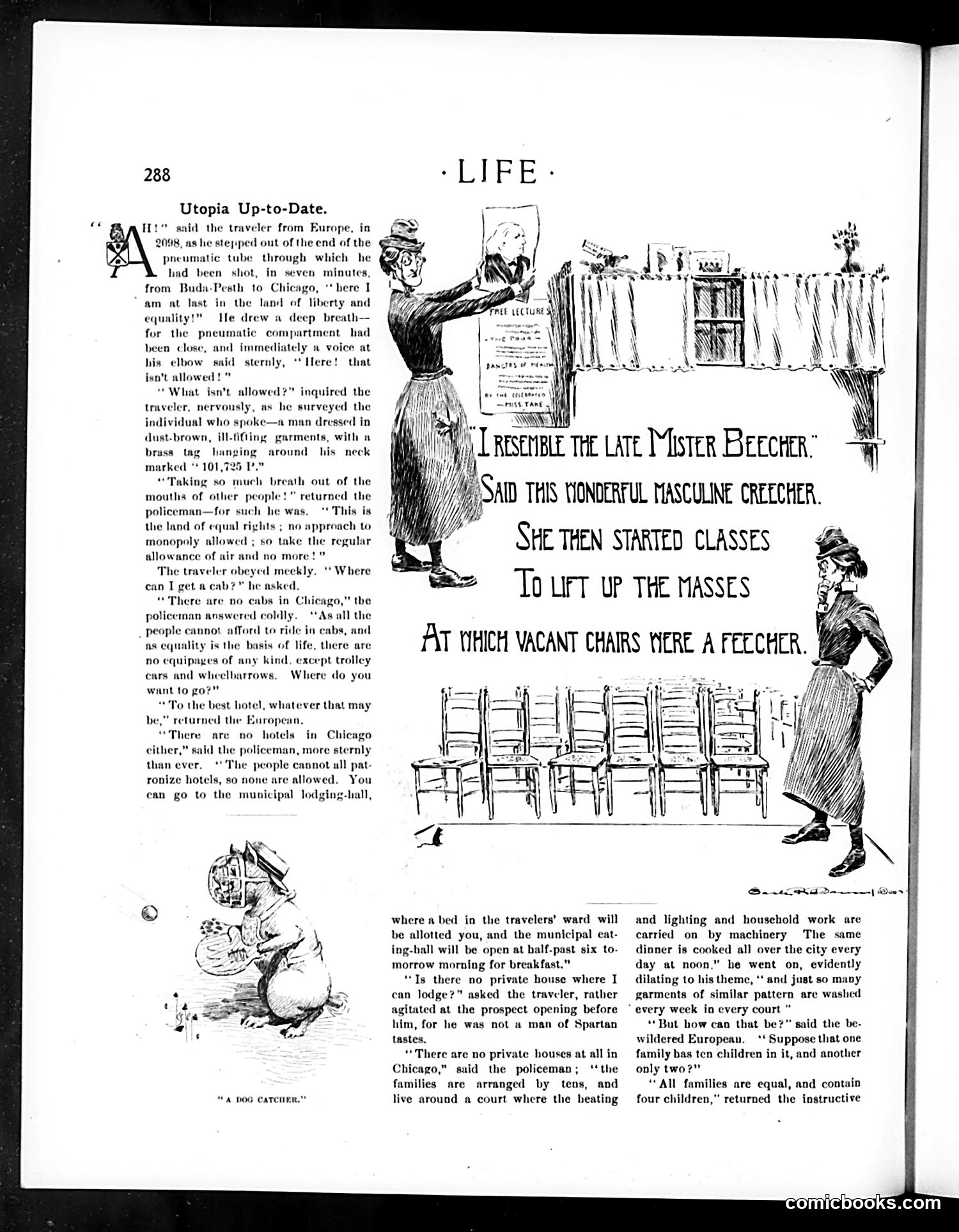
This satirical piece mocks utopian socialist ideas, likely from the 1890s-1900s. A European traveler arrives in a futuristic Chicago where a woman—resembling Henry Ward Beecher (a famous preacher)—has eliminated private property and traditional gender roles. She's established communal housing, public dining, and mechanical labor to free women from domestic work. The satire ridicules egalitarian ideology through the traveler's shocked responses: no private hotels, equal-sized families enforced, communal living in "tens." The cartoon suggests such utopian schemes are absurdly impractical and infringe on individual liberty. The small illustration labeled "A Dog Catcher" likely comments on the invasive government control required to enforce such equality. This reflects contemporary American anxiety about socialism and women's liberation movements.
📄 Transcribed text from this page (OCR, searchable)
Machine-transcribed from the original scan — historical spelling and the odd misread are preserved.
288 Utopia Up-to-Date. 11!” said the traveler from Europe, in 2098, as he stepped out of the end of the pneumatic tube through which he had been shot, in seven minutes, from Buda-Pesth to Chicago, ‘bere 1 am at last in the land of liberty and equality!” He drew a deep breath— for the pneumatic compartment had been close, and immediately a voice at his elbow said sternly, ** Here! that isn’t allowed!” “What isn’t allowed?” inquired the traveler, nervously, as he surveyed the individual who spoke—a man dressed in dust-brown, ill-fifling garments, with a brass tag hanging around his neck marked “101 | ad “Taking so much breath out of the mouths of other people!” returned the policeman—for such he was. ‘* This is the land of equal rights ; no approach to monopoly allowed ; so take the regular allowance of air and no more!” The traveler obeyed meekly. ‘ Where can I get acab?” he asked. “There are no cabs in Chicago,” the policeman answered coldly. ‘As all the people cannot afford to ride in cabs, and as equality is the basis of life, there are no equipages of any kind, except trolley cars and wheelbarrows. Where do you want to go?” “To the best hotel, whatever that may be,” returned the European, “There are no hotels in Chicago jd the polic in, more sternly than ever. ‘* The people cannot all pat- ronize hotels, so none are allowed. You can go to the municipal lodging-hall, “A poG CATCHER.” ‘SAID THIS THONDERFUL MASCULINE CREECHER. SHE THEN STARTED CLASSES ‘To LIFT UP THE MASSES AAT (HICH VACANT CHAIRS WERE A FECCHER. where a bed in the travelers’ ward will be allotted you, and the municipal cat- ing-ball will be open at half-past six to- morrow morning for breakfast.” “Is there no private house where I can lodge?” asked the traveler, rather agitated at the prospect opening before him, for he was not a man of Spartan tastes. “There are no private houses at all in Chicago,” said the policeman; ‘‘the families are arranged by tens, and live around a court where the heating and lighting and household work are carried on by machinery The same dinner is cooked all over the city every day at noon.” he went on, evidently dilating to his theme, ‘‘ and just so mavy garments of similar pattern are washed “every week in every court ” ‘But how can that be?” said the be- wildered European. *t Suppose that one family bas ten children in it, and another only two?” “All families are equal, and contain four children,” returned the instructive