
Life, 1900-04-07 · page 19 of 32
Life — April 7, 1900 — page 19: what you’re looking at
What you’re looking at
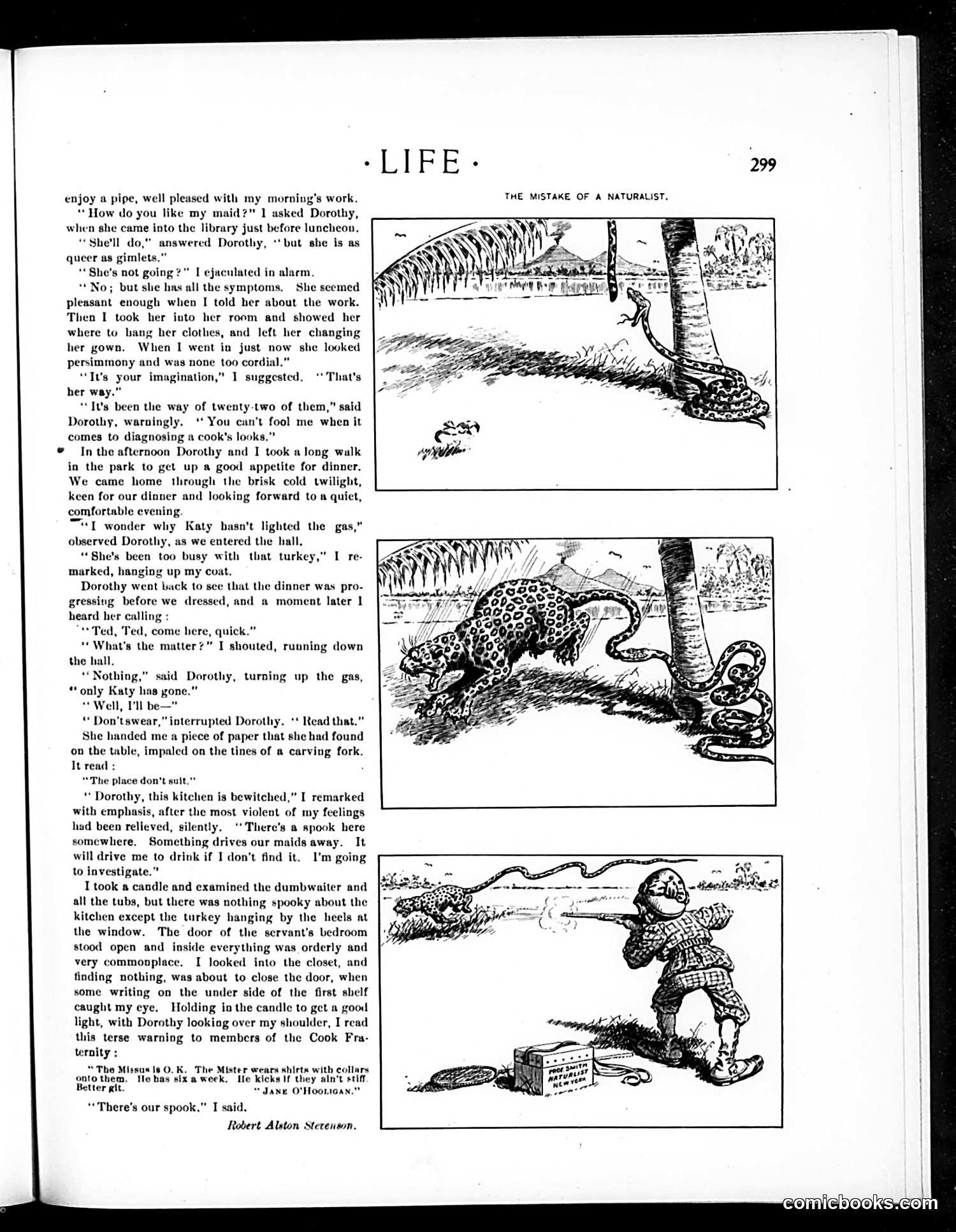
This story-cartoon satirizes the "servant problem" — a common complaint among upper-class households of the early 20th century about domestic staff quitting unexpectedly. The narrator prides himself on being a rational observer (a "naturalist"), yet fails to diagnose why his maids keep leaving. His wife correctly predicts their departures based on their expressions, but he dismisses her intuition as imagination. The punchline: the real culprit is a hidden message left by a previous servant warning others about the master's petty demands — specifically, that he requires stiffly-starched collars changed weekly and will "kick" (complain harshly) if they're not perfect. The crude spelling ("Jang O'HOOLIGAN") suggests a working-class servant's voice. The satire targets two things: the employer's obliviousness to his own unreasonable behavior, and the irony that his scientific objectivity blinds him to obvious social reality that his wife understood immediately. The servant network's informal communication system — leaving warnings for others — is portrayed as practical intelligence the "naturalist" completely missed.
📄 Transcribed text from this page (OCR, searchable)
Machine-transcribed from the original scan — historical spelling and the odd misread are preserved.
enjoy a pipe, well pleased with my morning's work. ‘How do you like my maid?” 1 asked Dorothy, when she came into the library just before luncheon, “She'll do," answered Dorothy, ‘‘but she is as queer as gimlets.” “She's not going?” I ejaculated in alarm ‘*No; but she has all the symptoms. She seemed pleasant enough when I told her about the work. Then I took her iuto her room and showed her where to hang her clothes, and left her changing her gown. When I went in just now she looked persimmony and was none too cor “It's your imagination,” I suggested. “That's her way.” “Iv's been the way of twenty-two of them,” said Dorothy, warningly. ‘* You can’t fool me when it comes to diagnosing a cook's looks.” In the afternoon Dorothy and I took along walk in the park to get up a good appetite for dinner. We came home through the brisk cold twilight, keen for our dinner and looking forward to a quiet, comfortable evening “1 wonder why Katy hasn't lighted the gas,” observed Dorothy, as we entered the hall, “She's been too busy with that turkey,” I re- marked, hanging up my coat, Dorothy went back to sce that the dinner was pro- gressing before we dressed, and a moment later I heard her calling : “* Ted, Ted, come here, quick.” ‘* What's the matter?” I shouted, running down the hall. “Nothing,” said Dorothy, turning up the gas, “only Katy has gone.” “Well, I'll be: “ Don'tswear,” interrupted Dorothy. ** Read that.” She handed me a piece of paper that she had found on the table, impaled on the tines of a carving fork. It read : “The place don't suit,” “ Dorothy, this kitchen is bewitched,” I remarked with emphasis, after the most violent of my feelings had been relieved, silently. ‘There's a spook here somewhere, Something drives our maids away. It will drive me to drink if I don’t find it. I’m going to investigate.” I took a candle and examined the dumbwaiter and all the tubs, but there was nothing spooky about the kitchen except the turkey hanging by the heels at the window. The door of the servant's bedroom stood open and inside everything was orderly and very commonplace. I looked into the closet, and finding nothing, was about to close the door, when some writing on the under side of the first shelf caught my eye, Holding in the candle to get a good light, with Dorothy lookiog over my shoulder, I read this terse warning to members of the Cook Fra- ternity : “Tho Misuse is O.K. The Mister wears shirts with collars ontothem. Hebas sixa week. Me kicks If they ain't stiff Better git. Jang O*HOOLIGAN.” “There's our spook.” I said. Robert Alston Stetenson.