
Life, 1900-04-07 · page 4 of 32
Life — April 7, 1900 — page 4: what you’re looking at
What you’re looking at
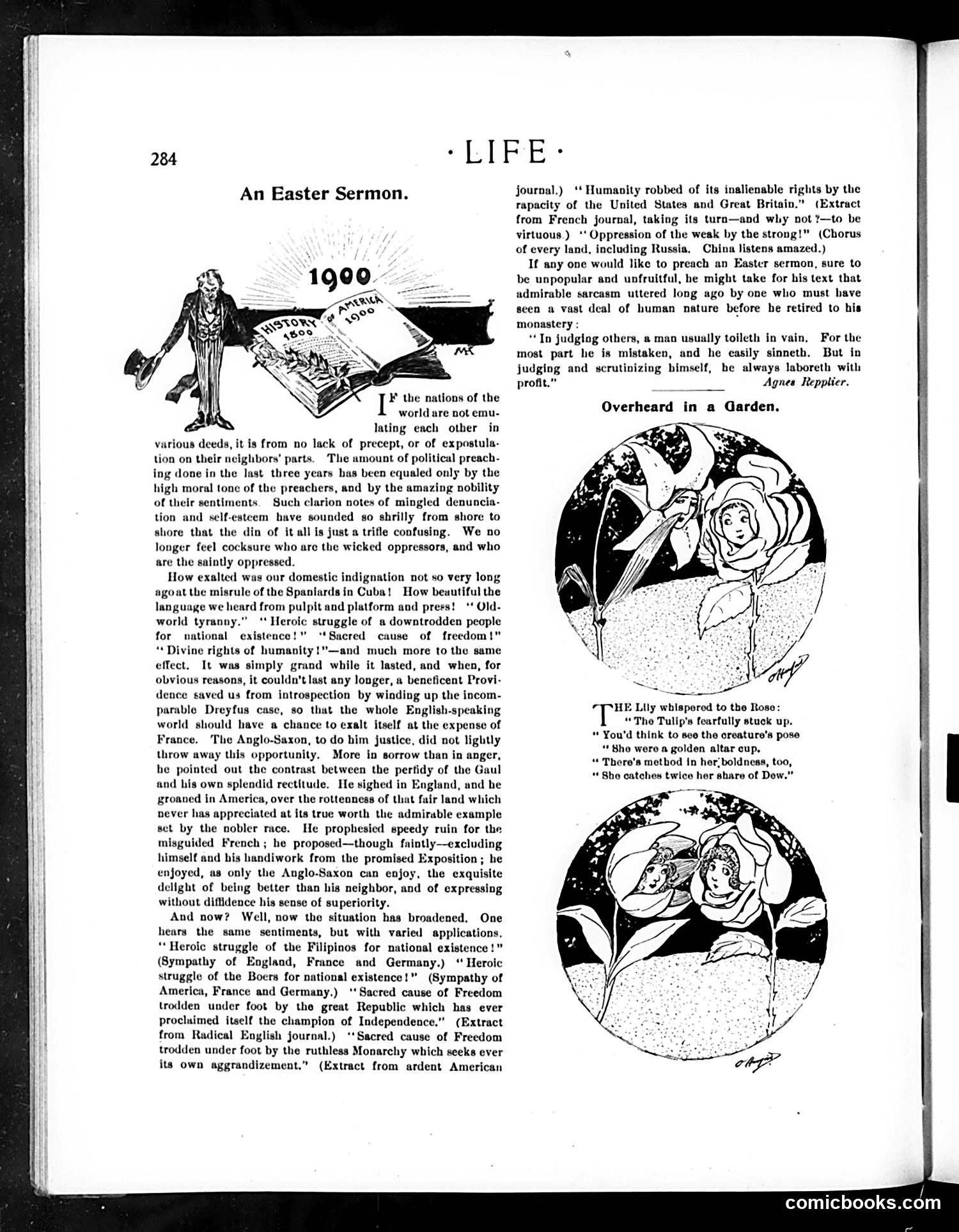
This page satirizes international political hypocrisy around 1900. The top cartoon depicts a figure (appears to be representing a Western power or Britain) preaching from a pulpit labeled "1900" while trampling on documents, mocking nations that preach morality while committing imperialism. The text criticizes Western powers for denouncing oppression while themselves engaging in colonial expansion—specifically referencing the Boer War in South Africa and the Boxer Rebellion context. It attacks their selective moral outrage: condemning tyranny abroad while ignoring their own imperial conquests. The two illustrations on the right ("Overhead in a Garden") are unrelated charming domestic scenes with children and flowers, providing visual contrast to the political critique below.
📄 Transcribed text from this page (OCR, searchable)
Machine-transcribed from the original scan — historical spelling and the odd misread are preserved.
* LIE - r rmon. journal.) ‘* Humanity robbed of its inalienable rights by the A Easter Se rapacity of the United States and Great Britain.” (Extract from French journal, taking its turn—and why not 7—to be virtuous.) ‘‘ Oppression of the weak by the strong!" (Chorus of every land, including Russia, China listens amazed.) If any one would like to preach an Easter sermon, sure to be unpopular and unfruitful, he might take for bis text that admirable sarcasm uttered long ago by one who must have seen a vast deal of human nature before he retired to his monastery : “In judging others, a man usually toileth in vain, For the most part he is mistaken, and he easily sinneth. But in judging and scrutinizing bimself, be always laboreth with profit.” Agnes Repplier. F the nations of the I worldare notemu: Overheard in a Garden, on lating each other in various deeds, it is from no lack of precept, or of expostula- tion on their neighbors’ parts. ‘The amount of political preach- ing done in the last three years bas been equaled only by the high moral tone of the preachers, and by the amazing nobility of their sentiments. Such clarion notes of mingled denuncia- tion and self-esteem have sounded so shrilly from shore to shore that the din of it all is just a trifle confusing. We no longer feel cocksure who are the wicked oppressors, and who are the saintly oppressed. How exalted was our domestic indignation not so very long agoat the misrule of the Spaniards in Cuba! How beautiful the language we heard from pulpit and platform and press! “* Old- world tyranny.” ‘‘ Heroic struggle of a downtrodden people for national existence!" “Sacred cause of freedom!" “Divine rights of humanity!"—and much more to the same effect. It was simply grand while it lasted, and when, for obvious reasons, it couldn’t last any longer, a beneficent Provi- dence saved us from introspection by winding up the incom- a parable Dreyfus case, so that the whole English-speaking ‘TTHE Lily whispered to the Rose: world should have a chance to exalt itself at the expense of The Tullp’s tearfally stuck up. France. The Anglo-Saxon, to do him justice, did not lightly ‘Youd think to se the creature's pose throw away this opportunity. More in sorrow than in anger, Feist a he pointed out the contrast between the perfidy of the Gaul «Bio oatohes Ewiea hor aharé of Dew.” and his own splendid rectitude. He sighed in England, and he groaned in America, over the rottenness of that fair land which never has appreciated at its true worth the admirable example set by the nobler race. He prophesied speedy ruin for the misguided French ; he proposed—though faintly—excluding himself and bis handiwork from the promised Exposition ; he enjoyed, as only the Anglo-Saxon can enjoy, the exquisite delight of being better than his neighbor, and of expressing without diffidence his sense of superiority. And now? Well, now the situation has broadened. One hears the same sentiments, but with varied applications, ‘Heroic struggle of the Filipinos for national existence!” (Sympathy of England, France and Germany.) ‘“ Heroic struggle of the Boers for national existence!” (Sympathy of America, France and Germany.) ‘‘ Sacred cause of Freedom trodden under foot by the great Republic which has ever procluimed itself the champion of Independence.” (Extract from Radical English journal.) ‘*Sacred cause of Freedom trodden under foot by the ruthless Monarchy which seeks ever its own aggrandizement,” (Extract from ardent American = / comicbooks.com