
Life, 1900-04-07 · page 14 of 32
Life — April 7, 1900 — page 14: what you’re looking at
What you’re looking at
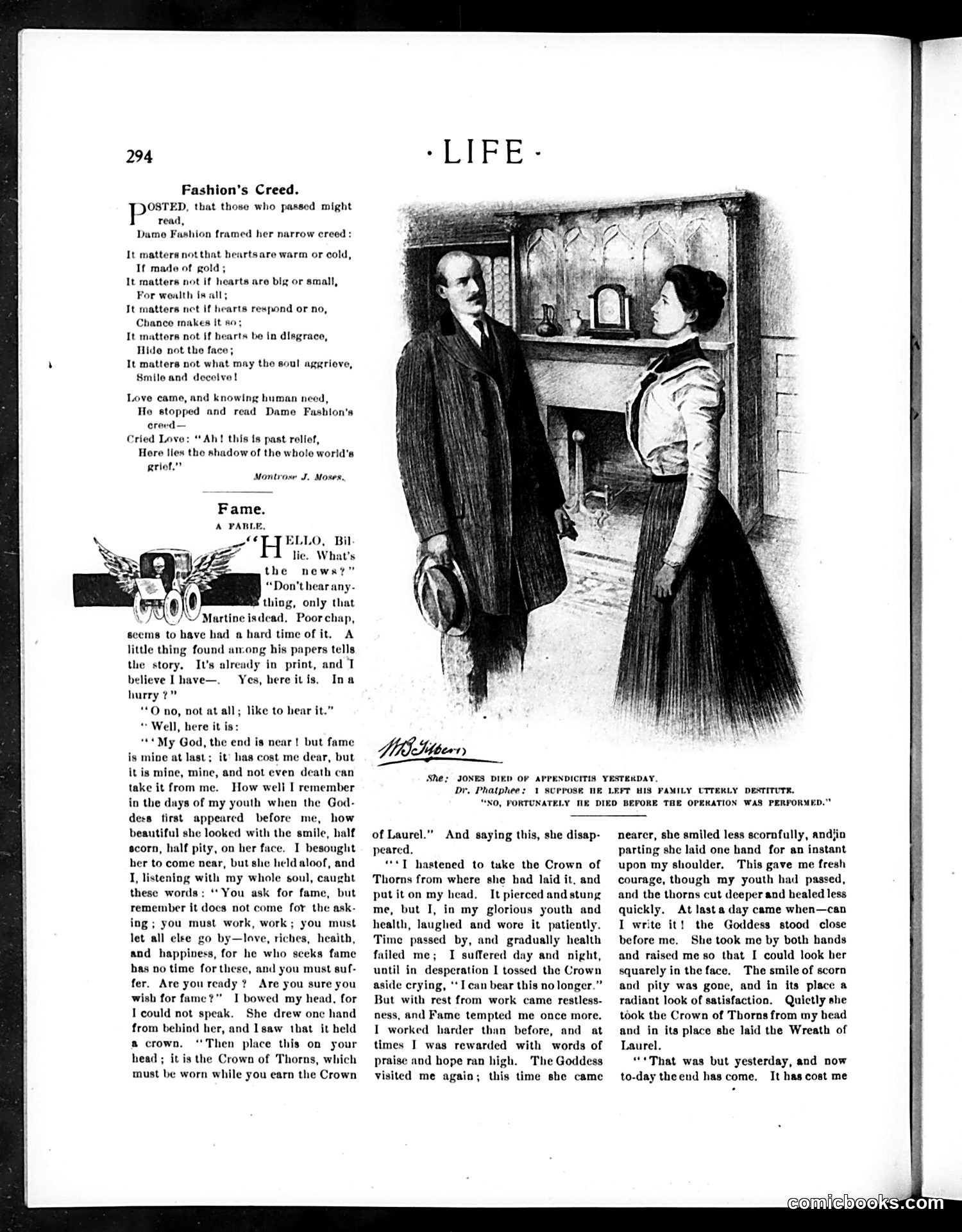
This page contains two satirical pieces about ambition and social values in early 20th-century America. **"Fashion's Creed"** critiques shallow materialism: Dame Fashion's philosophy values only wealth and appearance ("hearts of gold"), not genuine character or integrity. Love confronts this creed, recognizing it represents "the shadow of the whole world's grief." **"Fame: A Fable"** tells of a man who pursues fame despite the Goddess's warning it demands sacrifice—symbolized by the "Crown of Thorns." After decades of suffering and health decline, he finally achieves recognition (the "Wreath of Laurel"), but dies the very next day. **The bottom cartoon** depicts a dark joke: a doctor tells another that a patient named Jones died of appendicitis *before* surgery could be performed—ironically, this prevented the family from being "utterly destitute" (since no medical bills accrued). The satire targets the financial burden of medical care on ordinary families. All three pieces mock American society's priorities: wealth, fame, and survival itself come at crushing human cost.
📄 Transcribed text from this page (OCR, searchable)
Machine-transcribed from the original scan — historical spelling and the odd misread are preserved.
294 Fashion's Creed. pe. that those who passed might read, Damo Fashion framed her narrow creed : It matters not that hearts are warm or cold, If mado of gold ; It matters not if hearts are big or small, For woalt It matters not if hearts respond or no, Chance makes It 80; It mattors not if hearts be in disgrace, Hide not the face; It matters not what may the soul aggriove, Smile and deceive! Love came, and knowing human need, Ho stopped and read Dame Fashion's creed — Cried Love: “Ah! this ts past rellof, Hore Ilex the shadow of the whole world’s grief.” Montrose J. Moses, Fame. A PABLE. “HH ELLO, Bil lie. What's the news?” “Don'thearany- \ thing, only that XY Martine isdead, Poor chap, seems to have had a hard time of it. A little thing found among his papers tells e story. It’s already in print, and T believe Lhave—. Yes, here itis. Ina hurry 7” "*O no, not at all; like to hear it.” « Well, here it is: ***My God, the end is near! but fame is mine at last; it’ has cost me dear, but it is mine, mine, and not even death can take it from me. How well I remember in the days of my youth when the God- dess first appeared before me, how beautiful she looked with the smile, half scorn, half pity, on her face. I besought her to come near, but she held aloof, and I, listening with my whole soul, caught these words: ‘You ask for fame, but remember it docs not come for the ask- ing ; you must work, work; you must let all else go by—love, riches, heaith, and happiness, for he who sceks fame has no time for these, and you must suf- fer. Are youready ? Are you sure you wish for fame?" I bowed my head, for I could not speak. She drew onc hand from behind her, and Isaw that it held a crown, “Then place this on your head ; it is the Crown of Thorns, which must be worn while you earn the Crown PCMberr She; JONES DIED OF APPENDICITIS YESTERDAY, Dr, Phatphee: 1 SUPPOSE NE LEFT HIS PAMILY UTTERLY DESTITUTR. “NO, PORTUNATELY M18 DIED BEPORE THE OPRKATION WAS PERFORMED.” of Laurel.” peared, “*T hastened to tuke the Crown of Thorns from where she had laid it, and putiton my head. It pierced and stung me, but I, in my glorious youth and health, laughed and wore it patiently. Time passed by, and gradually health failed me; I suffered day and night, until in desperation I tossed the Crown aside crying, ‘* I can bear this no longer.” But with rest from work came restless- ness, and Fame tempted me once more. I worked harder than before, and at times I was rewarded with words of praise and hope ran high. The Goddess visited me again; this time she came And saying this, she disap- nearcr, she smiled less scornfully, andjio parting she laid one hand for an instant upon my shoulder. This gave me fresh courage, though my youth had passed, and the thorns cut deeper and healed less quickly. At last a day came when—can I write it! the Goddess stood close before me. She took me by both hands and raised me so that I could look ber squarely in the face. The smile of scorn and pity was gone, and in its place a radiant look of satisfaction. Quictly she took the Crown of Thorns from my bead and in its place she laid the Wreath of Laurel. “«That was but yesterday, and now to-day theend has come, It has cost me