
Life, 1900-04-07 · page 9 of 32
Life — April 7, 1900 — page 9: what you’re looking at
What you’re looking at
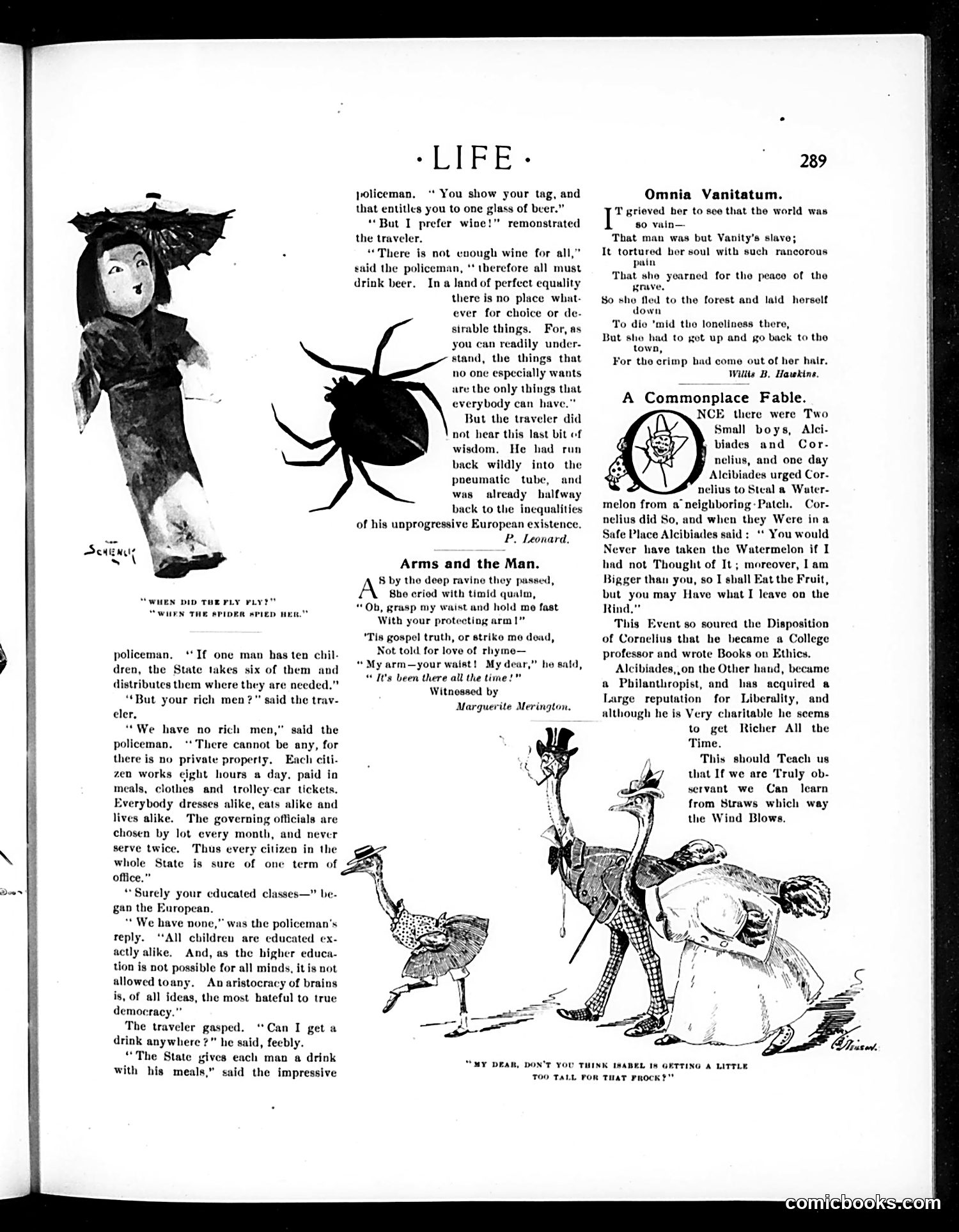
This page contains three satirical pieces about inequality and social hierarchy: **Left illustration**: A fashionable woman with an umbrella and spider, accompanying a dialogue between a policeman and traveler. The satire critiques a utopian state where "there is no private property" and all citizens are equal—yet the policeman explains everyone must drink beer, not wine, because equality means no one gets preferred treatment. The joke: even in perfect equality, individual choice disappears. **Right section**: "A Commonplace Fable" mocks charitable hypocrisy. Cornelius the wealthy man refuses to give a watermelon to poor boys (Alcibiades), citing libertarian principles about self-reliance. The illustration shows ostriches—likely representing the wealthy ignoring obvious suffering. The satire suggests the rich rationalize indifference to poverty through ideology. Both pieces critique inequality and how the privileged justify or maintain it.
📄 Transcribed text from this page (OCR, searchable)
Machine-transcribed from the original scan — historical spelling and the odd misread are preserved.
“WHEN DID THE FLY FLY?” “WHEN THE APIDER arieD HEE.” policeman, ‘If one man has ten chil- dren, the State takes six of them and distributes them where they are needed.” “‘But your rich men?” said the trav- eler, ““We have no rich men,” said the policeman, ‘There cannot be any, for there is no private property, Each citi- zen works eight hours a day. paid in meals, clothes and trolley-car tickets. Everybody dresses alike, eats alike and lives alike. The governing officials are chosen by lot every month, and never serve twice. Thus every citizen in the whole State is sure term of office.” “Surely your educated classes—” be- gan the European, ** We have none,” was the policeman’s reply. ‘All children are educated ex- actly alike. And, as the bigher educa- tion is not possible for all minds, it is not allowed toany. An aristocracy of brains is, of all ideas, the most hateful to true democracy.” The traveler gasped. “Can I get a drink anywhere ?” he said, feebly. “The State gives each man a drink with his meals,” said the impressive of one ‘LUPE « policeman, ‘* You show your tag, and that entitles you to one glass of beer.” “But I prefer wine!" remonstrated the traveler, “There is not euough wine for all,” said the policeman, * therefore all must drink beer. Ina land of perfect equulity there is no place what- ever for choice or de- sirable things. For, as you can readily under- stand, the things that no one especially wants are the only things that everybody can have.” But the traveler did not hear this last bit of wisdom. He had run back wildly into the pneumatic tube, and was already halfway back to the inequalities of his unprogressive European existence. P. Leonard, Arms and the Man. 8 by the deep ravine they passed, Bho cried with timid qualm, “Ob, grasp my waist and hold me fast With your protecting arm!” ‘Tis gospel truth, or striko mo dead, Not told for love of rhyme— “ My arm—your waist! My dear,” he sald, «It's Leen there all the time! Witnessed by Marguerite Merington, 289 Omnia Vanitatum. T grieved her to see that the world was That man was but Vanity’s slavo; It tortured bor soul with such rancorous pain That sho yearned for the peace of the grave. So sho fled to the forest and laid herself down To dic ‘mid tho loneliness there, But sho had to got up and go back to the town, For the crimp had come out of her hair, Wilts B, Hawkins. A Commonplace Fable. NCE there were Two Small boys, Alci- biades and Cor- nelius, and one day Alcibiades urged Cor- nelius to Steal a Wate melon from a neighboring-Patch. Cor- nelius did So, and when they Were ina Safe Place Alcibiades said: ‘* You would Never have taken the Watermelon if I had not Thought of It; moreover, I am Bigger than you, so I shall Eat the Fruit, but you may Have what I leave on the Rind.” This Event 80 soured the Disposition of Coroclius that he became a College professor and wrote Books on Ethics, Alcibiades, on the Other hand, became a Philanthropist, and has acquired a Large reputation for Liberality, and although he is Very charitable he seems to get Richer All the Time. This should Teach us that If we are Truly ob- servant we Can learn from Straws which way the Wind Blows. “MY DEAR, DON'T YOU THINK ISABEL 18 GETTING A LITTLE TOO TALL FOR THAT FROCK!"