
A complete issue · 20 pages · 1900
Life — March 1, 1900
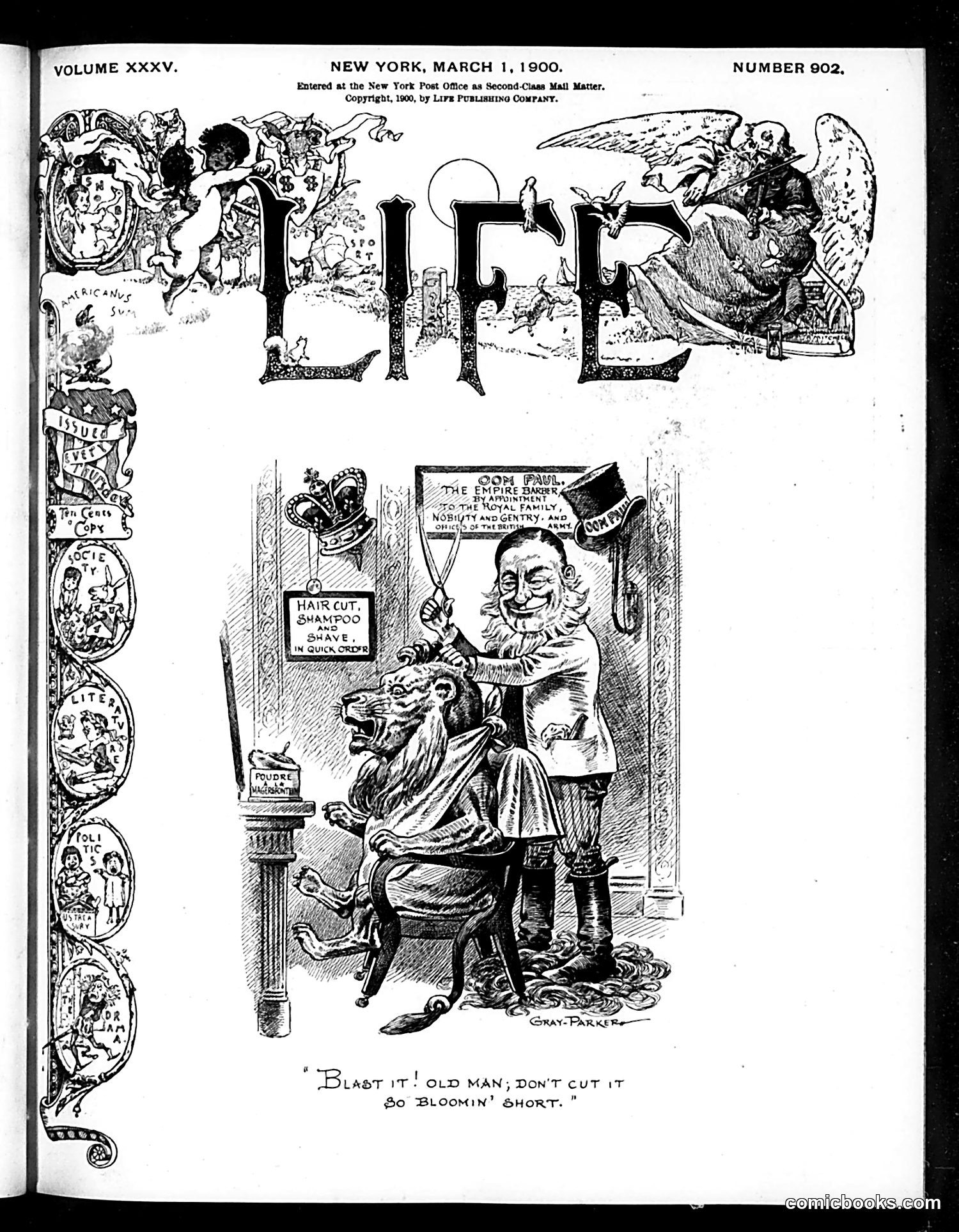
The main cartoon depicts a barber shop scene with satirical commentary on British imperial affairs. A figure in a top hat (likely representing a British politician or nobleman) is having his hair cut while holding a sign reading "Don the Empire" and references to "The Royal Family, Nobility and Gentry." The barber, caricatured with exaggerated features, clips his hair while the customer complains "Blast it! Old man; don't cut it so bloomin' short." This appears to satirize British imperial pretensions and class hierarchies of the Edwardian era, possibly critiquing how British elites were being "trimmed down" or diminished by colonial conflicts or domestic political changes. The specific historical context remains unclear without additional dating or caption information.
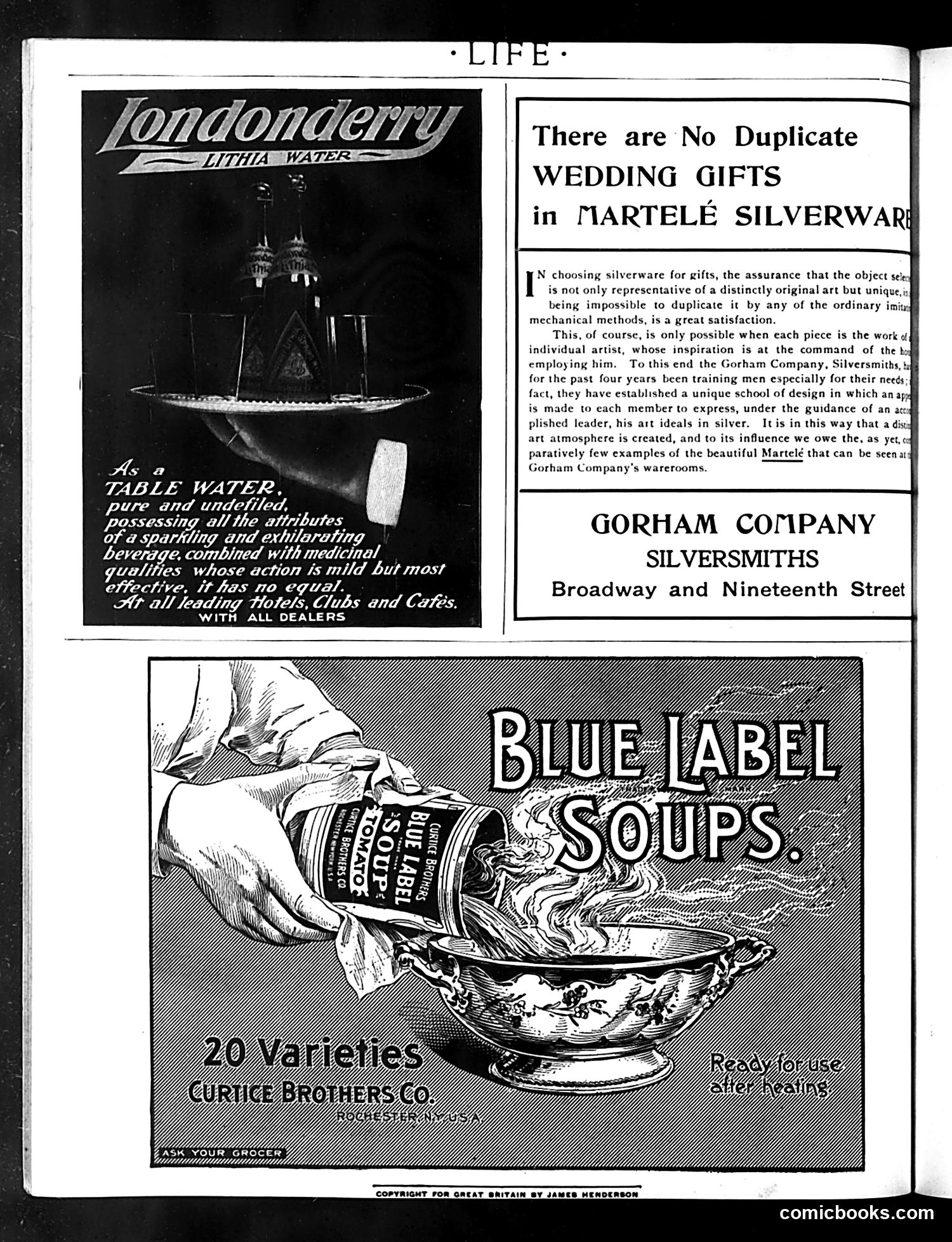
This page contains **three advertisements, not political cartoons**. 1. **Londonderry Lithia Water**: Promotes a mineral water as a table beverage for restaurants and clubs, claiming medicinal properties ("mild but most effective"). 2. **Gorham Company Silversmiths**: Advertises luxury silverware for wedding gifts, emphasizing that each piece is artistically unique and hand-crafted by individual artisans at their Broadway location. 3. **Blue Label Soups**: Shows hands pouring soup from a branded tin into a decorative bowl, advertising 20 varieties from Curtice Brothers Co., marketed as ready-to-use after heating. These are straightforward commercial advertisements typical of early-20th-century *Life* magazine, with no satirical or political content.
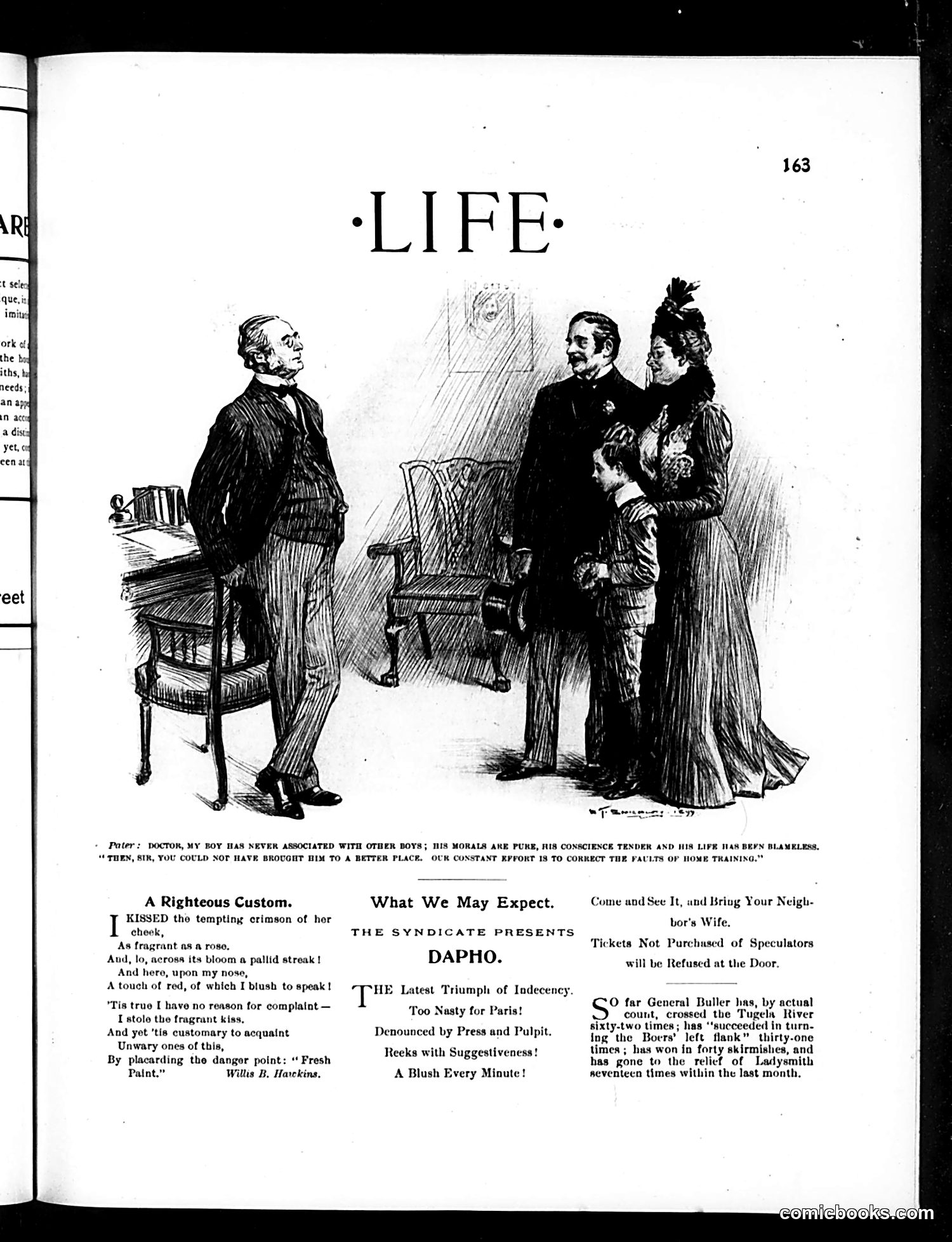
The main illustration depicts a domestic scene with a caption about a father defending his son's moral character and pure conscience against accusations of "falls of home training." Below are three short humorous notices: 1. **"A Righteous Custom"** — A poem by Willis B. Hawkins mocking the Victorian practice of blushing as an affectation, presented with gentle irony. 2. **"What We May Expect"** — Lists of theatrical announcements (Dapho, press reviews) presented as satirical predictions. 3. **"Come and See It"** — A brief joke about General Butler crossing the Tugela River during what appears to be a military campaign, with the humor deriving from repeated crossings and accumulated skirmishes. The page primarily contains social satire rather than overt political commentary.
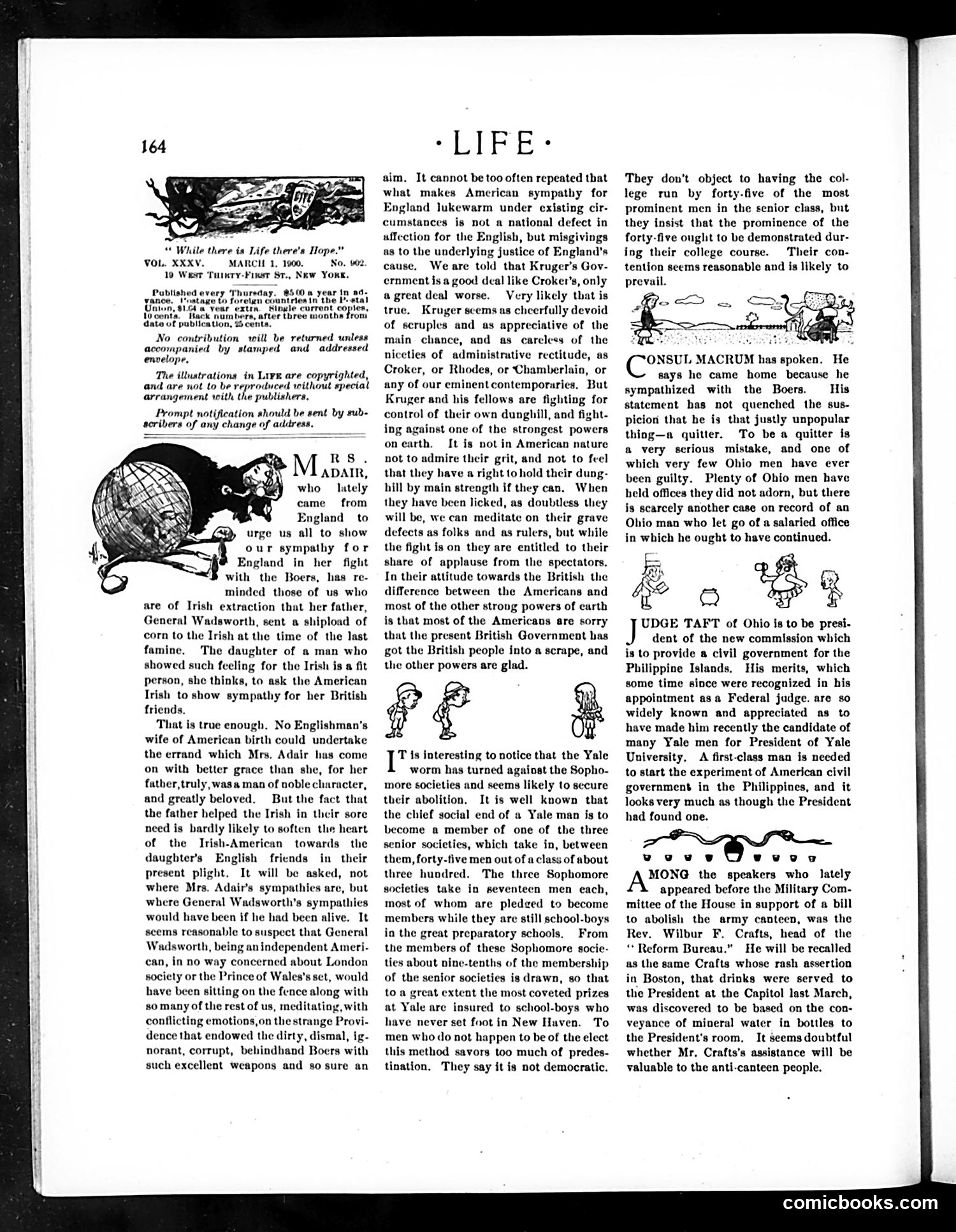
The page contains two distinct editorial cartoons with accompanying text commentary. The first cartoon depicts a figure labeled "MAHATMA" (appears to reference a spiritual or philosophical leader) who "came from England" and is associated with Irish sympathies. The accompanying text discusses English treatment of Ireland and Irish-American sentiment, suggesting the cartoon satirizes conflicting loyalties regarding the Boer War—Americans sympathizing with Irish grievances while British fight in South Africa. The second cartoon section references Yale University's exclusive social societies and their elitist membership practices, mocking how these "three Sophomore societies" select only the most privileged students. The satire critiques the undemocratic nature of these institutional hierarchies among America's social elite. Both pieces exemplify *Life* magazine's early-1900s satirical approach to contemporary social and political tensions.
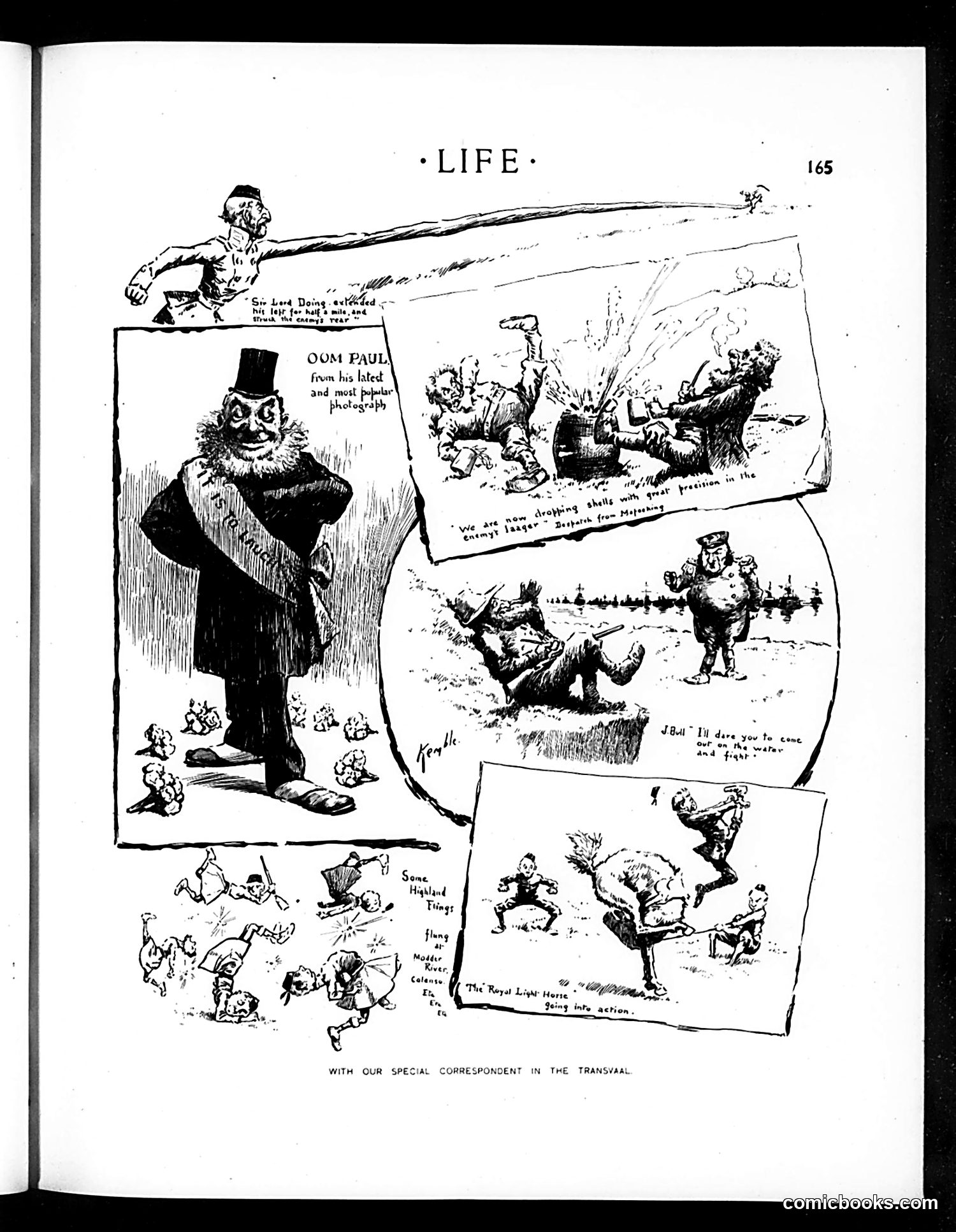
This page features "OOM PAUL" (a caricatured figure labeled "from his latest and most popular photograph"), likely Paul Kruger, president of the Transvaal during the Boer War era. The large central portrait uses exaggerated features common in period political caricature. The surrounding vignettes appear to depict scenes from the Transvaal conflict, showing military or combat situations. The caption at bottom references "our special correspondent in the Transvaal," suggesting Life's coverage of this colonial conflict. The satire mocks Kruger through unflattering portraiture and seems to comment on the war's absurdities through the smaller illustrated scenes. This reflects American editorial attitudes toward the British-Boer conflict of 1899-1902.
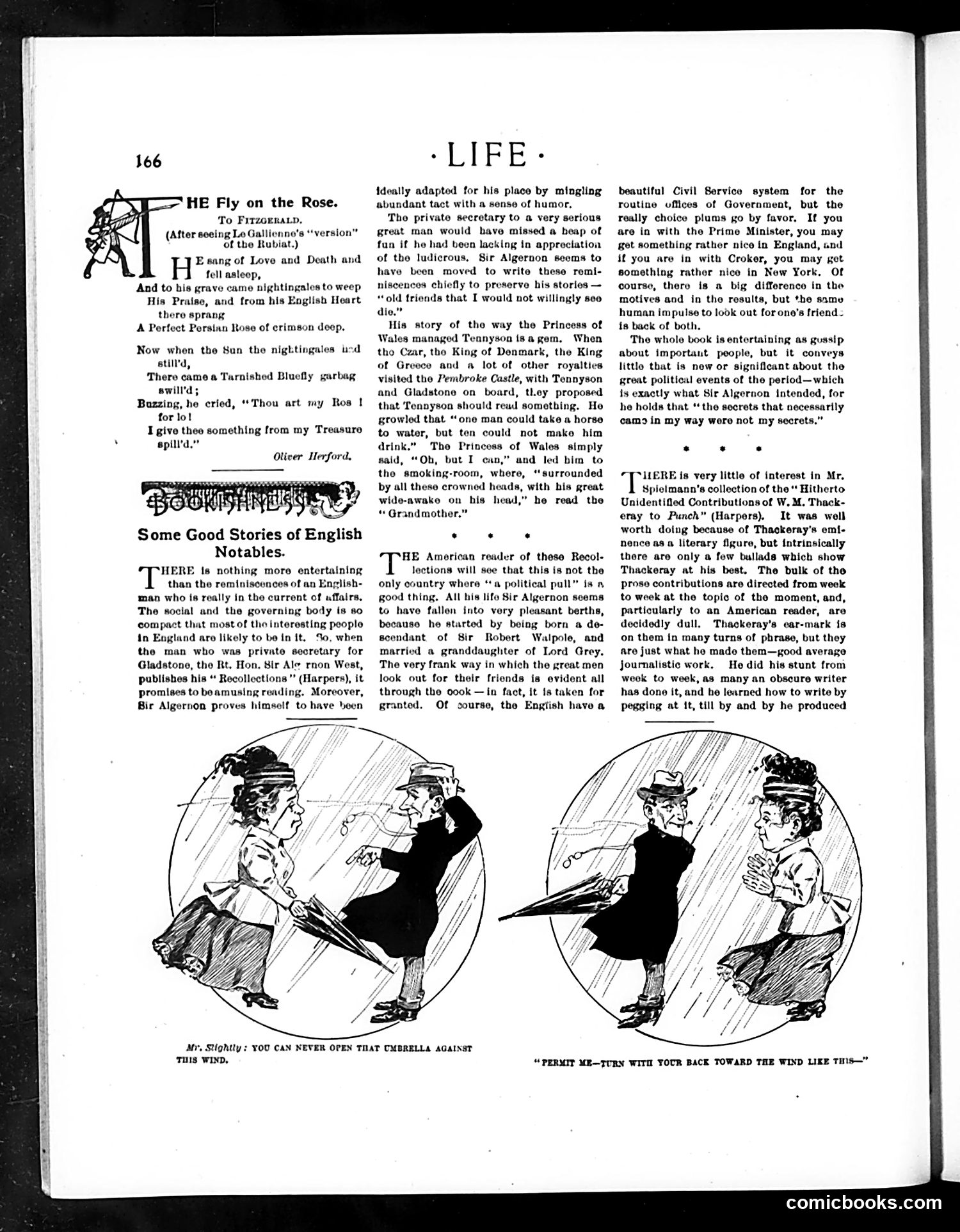
This page contains two umbrella-related cartoon vignettes satirizing romantic or social dynamics. Both depict a man and woman struggling with an umbrella in windy rain. In the left cartoon, the man says "Mr. Slightly: you can never open that umbrella against this wind" — suggesting masculine incompetence or futility. The right cartoon shows the man saying "Permit me—turn with your back toward the wind like this" — implying the man is offering practical advice or attempting to assert authority. The humor likely plays on gender dynamics and courtship rituals of the early 20th century: either mocking male pretension to usefulness, or depicting common romantic scenarios where men try to impress women with gallantry. The umbrella serves as a prop for examining social interaction between the sexes.
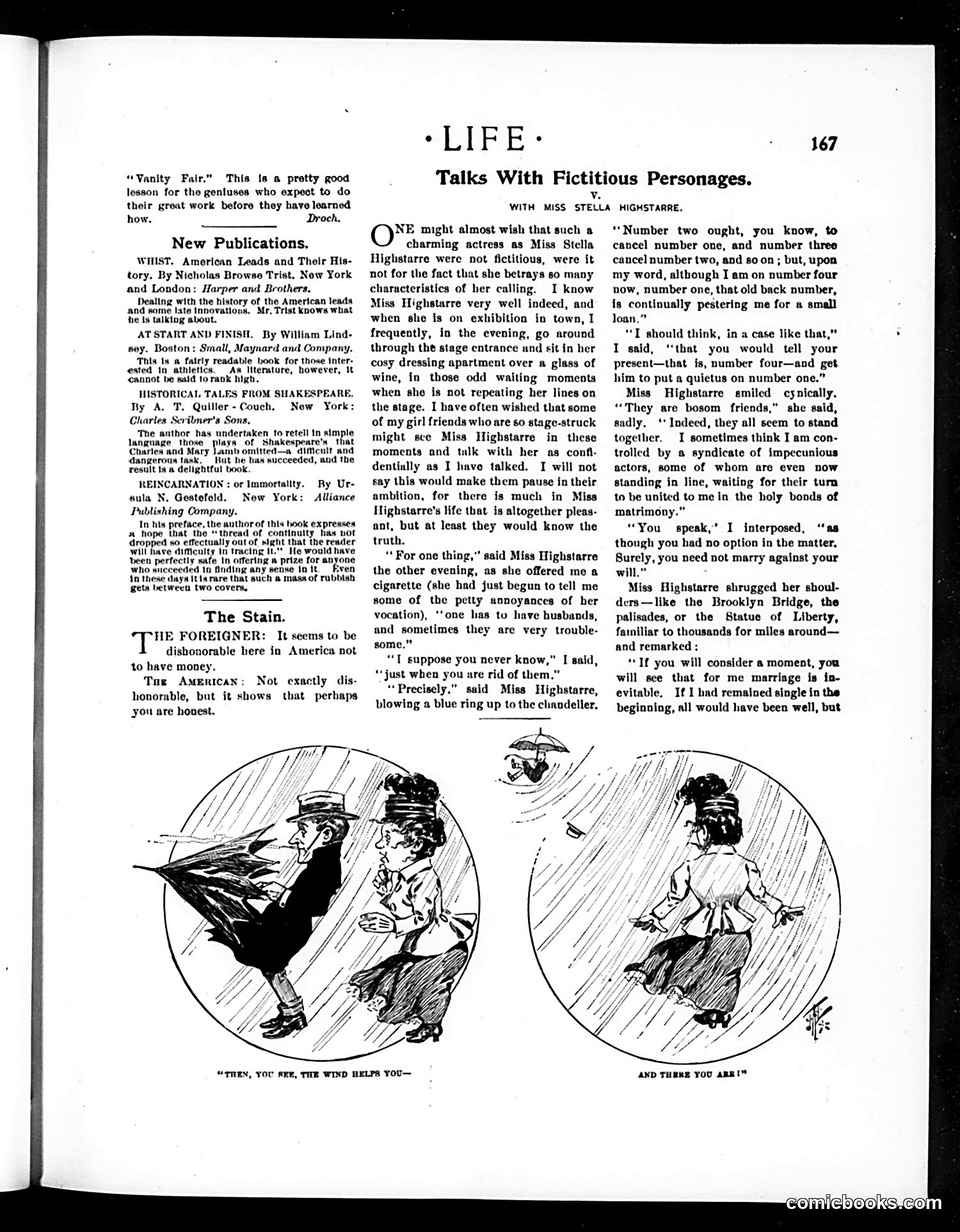
This page contains a conversational interview titled "Talks With Fictitious Personages" featuring actress Miss Stella Highstarre. The article humorously presents her discussing the challenges of her theatrical career and marriage prospects. The accompanying cartoons illustrate a comedic scenario about windy weather. In the left panel, a man's clothing is blown about by wind while a woman watches. The right panel shows the same woman being affected by the wind. The captions read "Then, you see, the wind helps you—" and "And there you are!" The satire appears to mock the superficiality of theatrical life and perhaps gender dynamics of the era. Miss Highstarre's concerns about husbands being "troublesome" and marriage being "inevitable" reflect early-20th-century attitudes toward women's roles and matrimony.
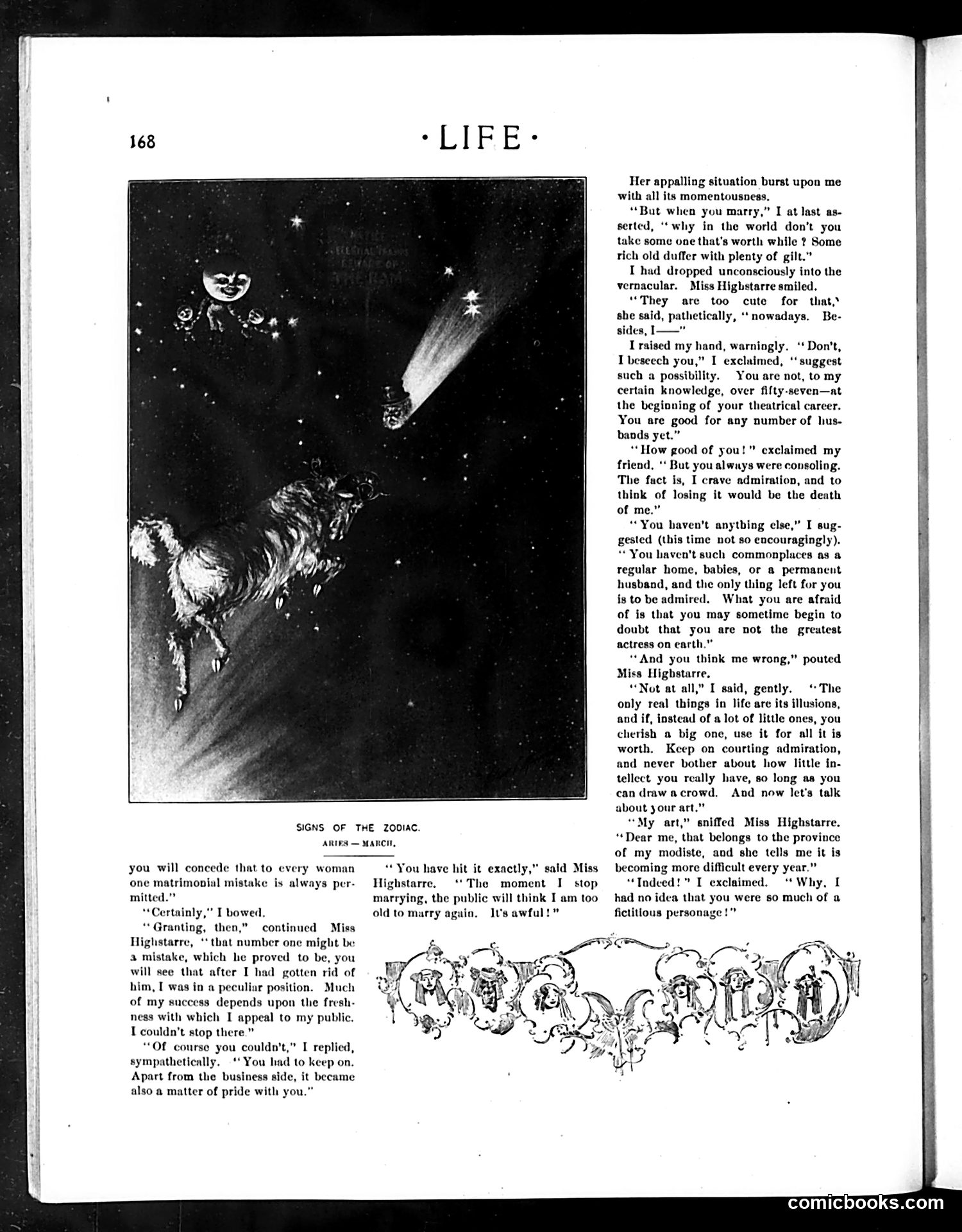
**Main Illustration**: "Signs of the Zodiac: Aries—March" depicts astrological imagery—a ram's head and celestial bodies—typical of early 20th-century satirical decoration. **Content**: The page features dialogue between two women (one identified as "Miss Highstarre") discussing marriage and women's careers in theater. Miss Highstarre defends her choice to remain unmarried, arguing that marriage would end her theatrical career and public appeal. Her companion counters that she risks becoming a cautionary tale—a woman who didn't marry. **Social Satire**: The piece satirizes early 20th-century tensions between women's professional ambitions and marriage expectations. It mocks both society's pressure on unmarried women and the genuine career penalties actresses faced if they married. **Decorative Footer**: Small illustrated vignettes depict various romantic or domestic scenes, reinforcing the marriage theme.
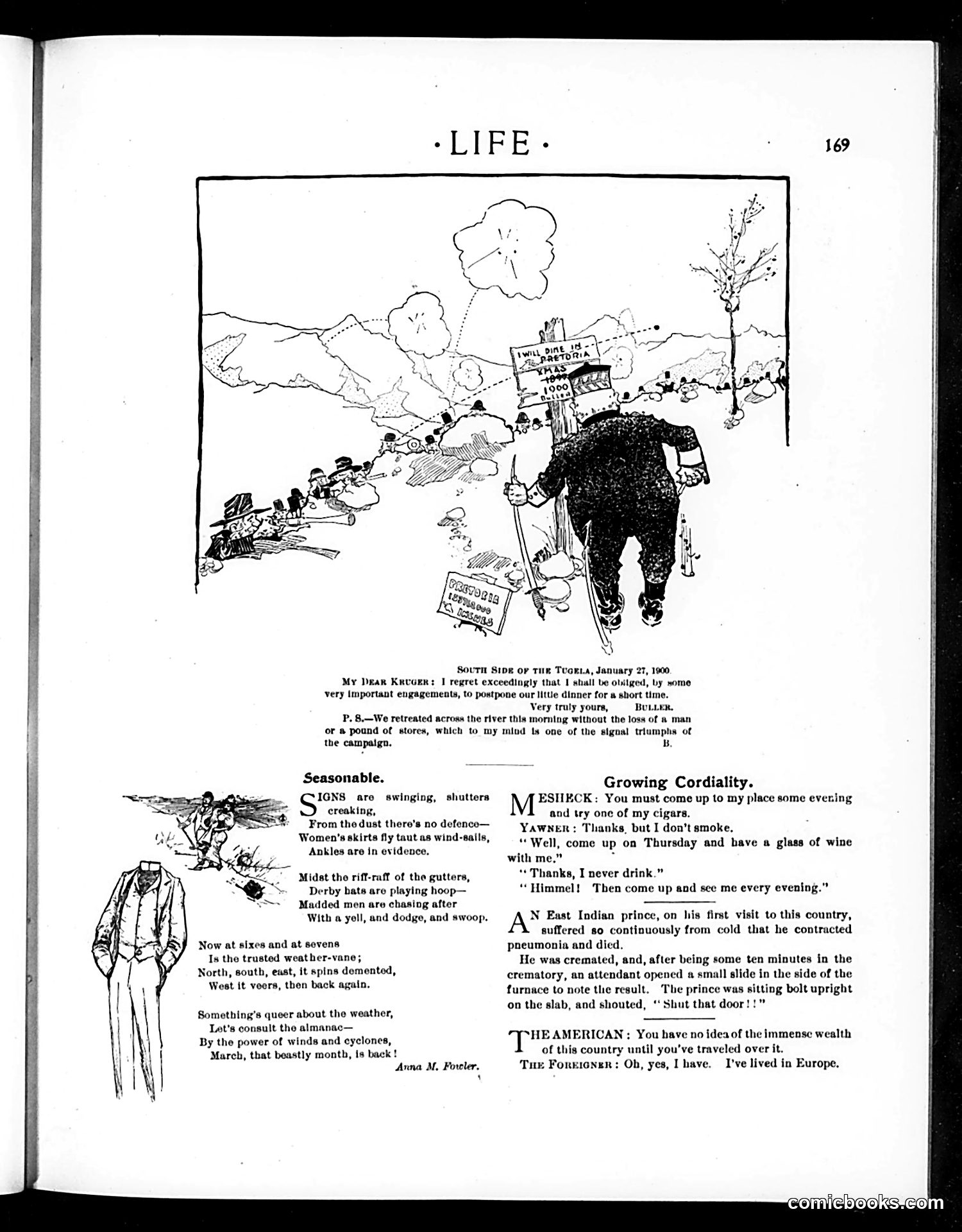
This page contains satirical commentary on the Boer War (dated January 27, 1900, based on visible text). The large political cartoon depicts a massive dark figure—likely representing British military/imperial authority—striding across a landscape marked "South Side of the Tugela River," trampling smaller figures and signs representing Boer forces or resistance. The accompanying text includes a letter attributed to "Huller" expressing regret about postponing dinner due to campaign demands, satirizing how the war disrupted civilian life. Below are lighter pieces: "Seasonable" mocks March weather unpredictability, and "Growing Cordiality" presents humorous dialogue between characters discussing social visits and wine, offering comic relief from heavier war commentary. The overall effect critiques both the war's scope and its intrusion into everyday American life.
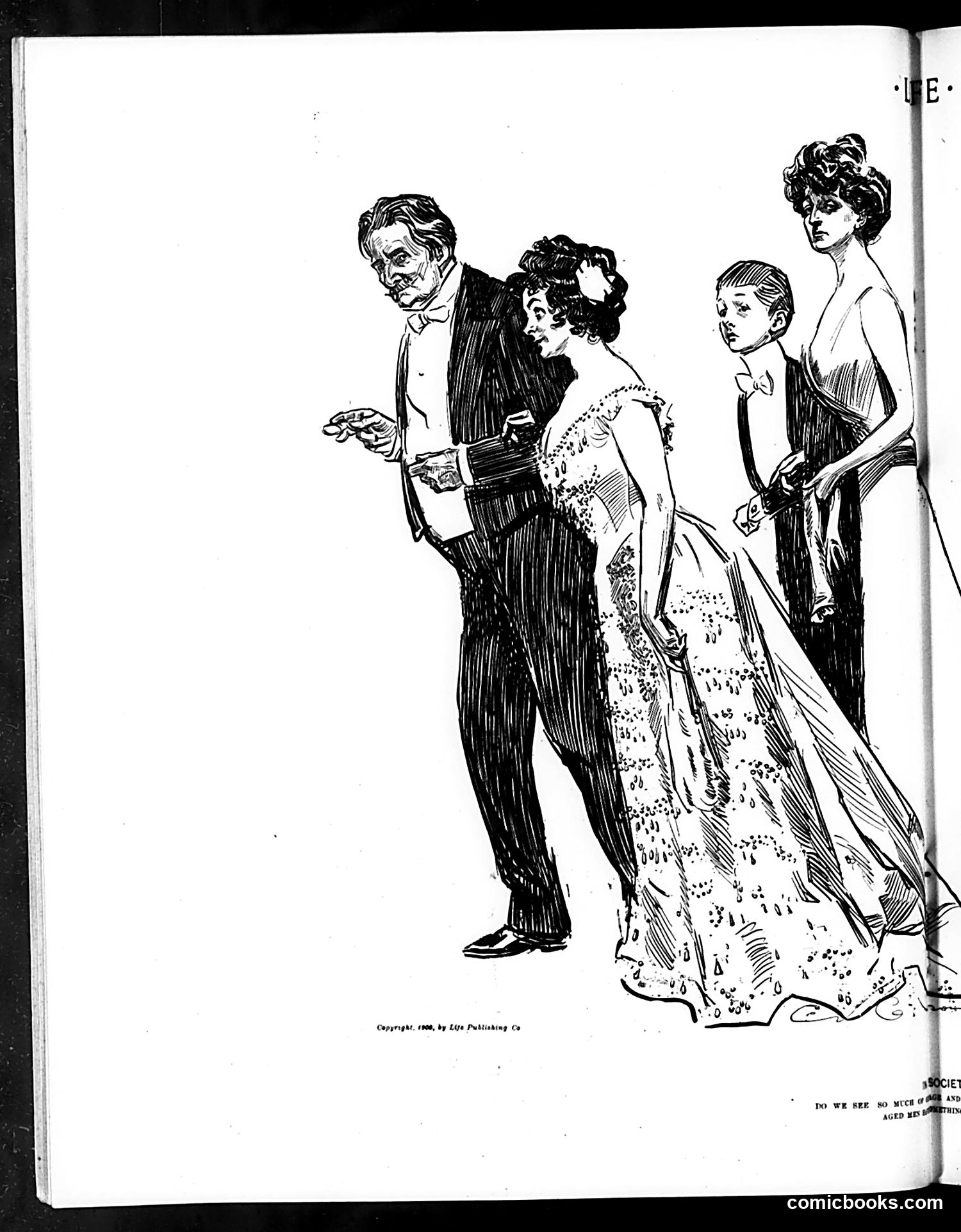
This appears to be a satirical illustration from Life magazine (copyright 1908, per the footer) depicting a social commentary on wealth and class. The image shows a well-dressed man in a pinstriped suit holding money, accompanied by what appears to be a fashionably dressed woman and two children in formal attire. The cartoon likely satirizes the nouveau riche or wealthy class's display of affluence and their social pretensions. The man's prominent display of currency and the family's elaborate formal dress suggest mockery of ostentatious wealth. The partially visible caption at bottom mentions "society" and appears to comment on class dynamics. Without the complete caption text, the specific satirical target remains somewhat unclear, but this represents typical early-1900s American commentary on wealth inequality and social climbing.
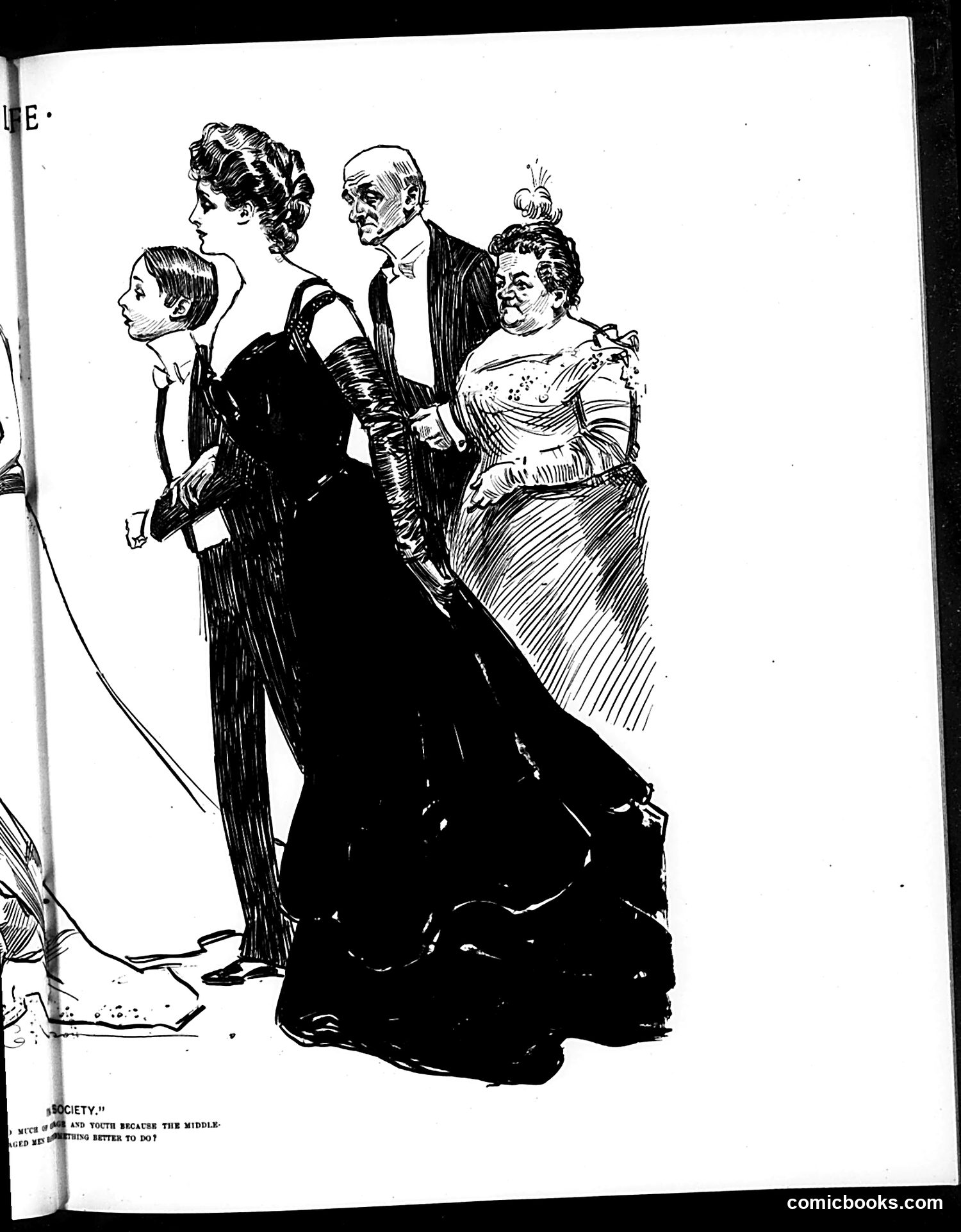
This appears to be a satirical illustration about social class and etiquette in early 20th-century America. The cartoon depicts five figures of varying ages and apparent wealth standing together, with the caption referencing "society" and something about "youth because the middle-[class]" and "better to do" (text is partially cut off). The satire likely comments on social pretension—how people of different economic standings interact within formal "society." The contrast in dress and bearing between the figures suggests commentary on class anxiety or the aspirations of the middle class to move upward socially. Without the complete caption, the specific joke's target remains unclear, though it mocks either social climbers or the rigid hierarchies of polite society itself.
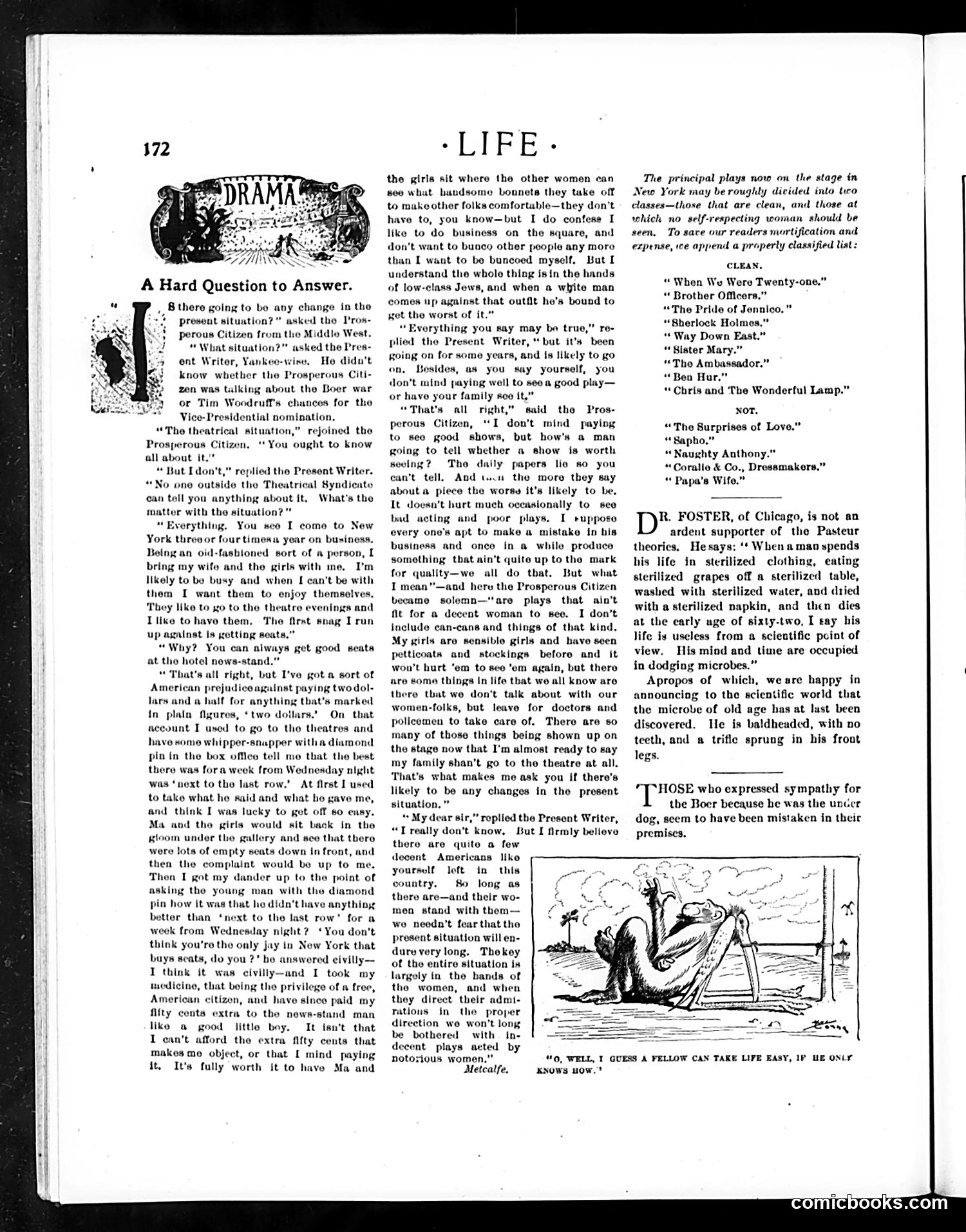
This page contains two distinct sections: **"A Hard Question to Answer"** is a debate piece where a "Prosperous Citizen" questions whether theatrical syndicate monopolies harm theater access. The citizen argues that theater tickets are expensive and that families cannot afford frequent attendance—a genuine economic complaint about early 20th-century entertainment industry consolidation. **The cartoon at bottom right** depicts a man being thrown from a horse into water. The caption reads: "O Well, I guess a fellow can take life easy, if he only knows how." This appears to be ironic commentary on the difficulty of leisure and relaxation—the figure's predicament contradicts the caption's claim about taking life easily. The page reflects concerns about corporate monopolies in theater and the illusion of easy living during this period.
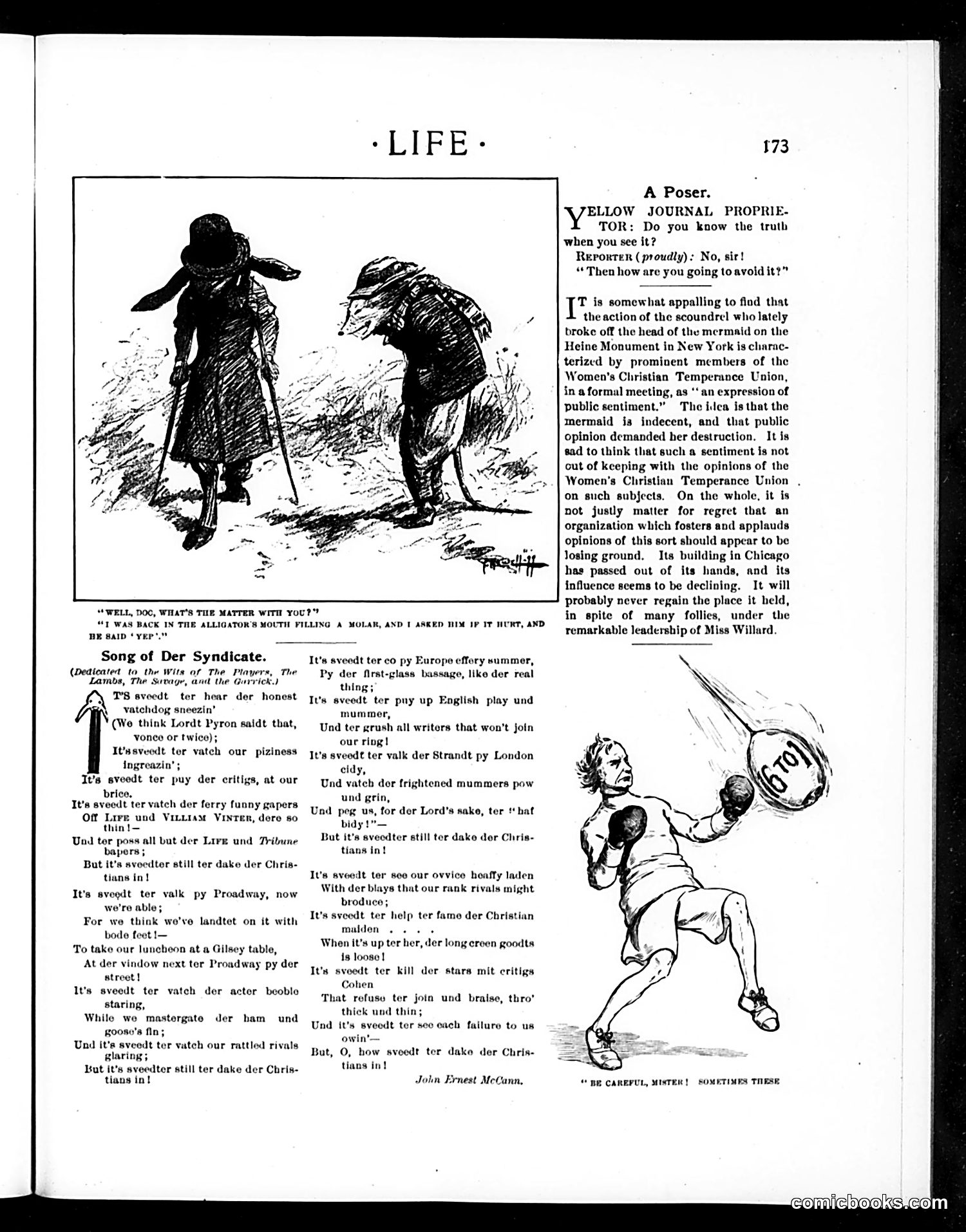
This Life magazine page contains three distinct satirical pieces: **Top cartoon**: A joke about a dog claiming to have pulled a tooth from an alligator's mouth—absurdist humor with no deeper political meaning. **"Song of Der Syndicate"**: A satirical poem in exaggerated German-accented English mocking theatrical syndicates (monopolistic theater companies) that control productions, bribe critics, suppress rival playwrights, and exploit performers. The repeated refrain "But it's sweeter still to take the Christians in!" suggests defrauding the public. This attacks monopolistic business practices in American theater. **"A Poser"**: A brief satirical exchange between a Yellow Journal (sensationalist newspaper) proprietor and a reporter, mocking how such papers deliberately avoid truth. **Editorial piece**: Criticizes the Women's Christian Temperance Union for celebrating vandalism of a mermaid statue they deemed "indecent," arguing this reflects the organization's puritanical hypocrisy and explains its declining influence (even losing its Chicago building).
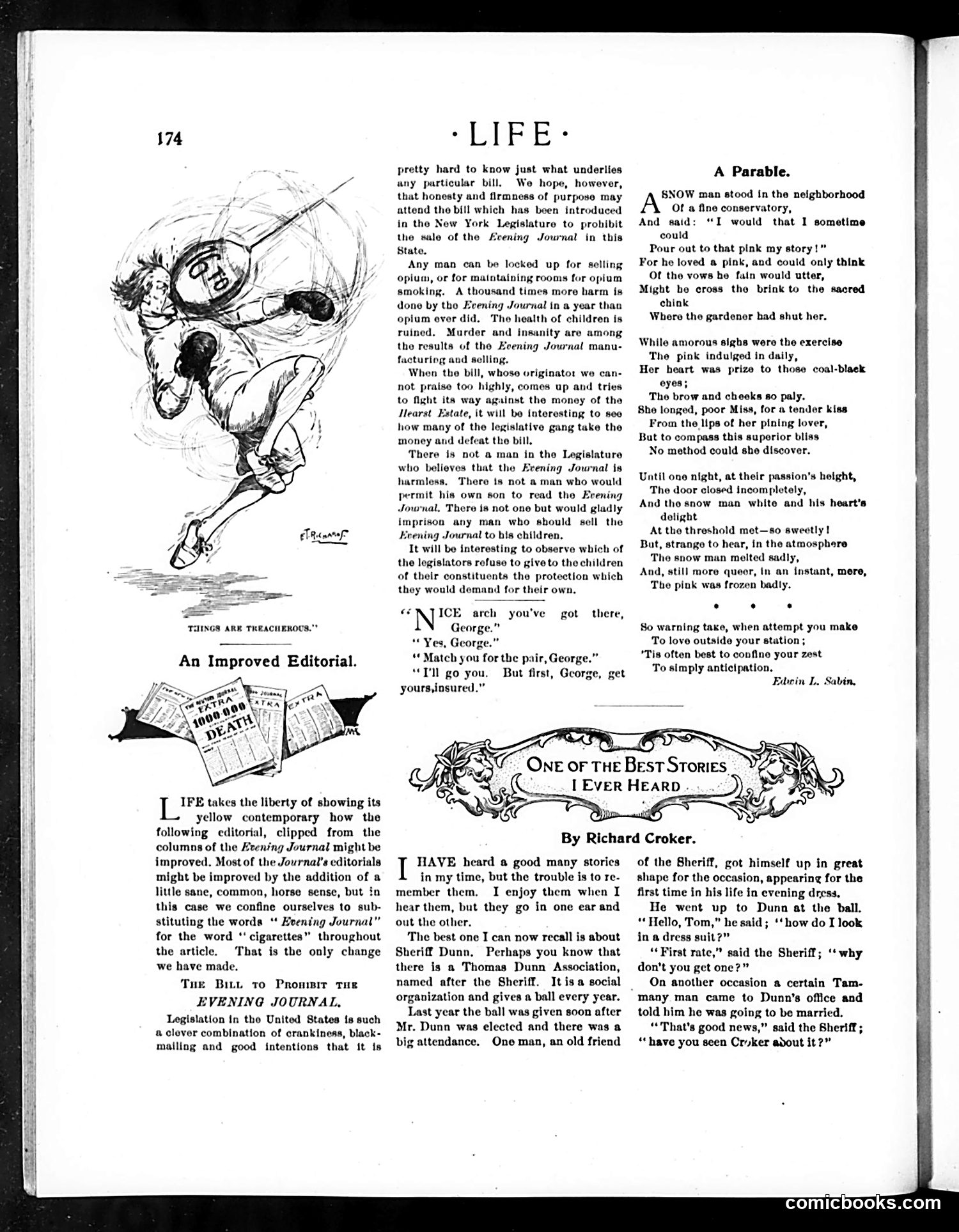
This section mocks William Randolph Hearst's *Evening Journal*, a rival yellow journalism tabloid. Life magazine's satire is brutally effective: they reprinted an actual editorial attacking cigarettes, simply substituting "*Evening Journal*" wherever the word "cigarettes" appeared. The point: Life argues the Journal's sensationalism causes *more social damage* than opium—ruining children's health and inciting "murder and insanity." The satire exposes hypocrisy in New York's legislature: no legislator genuinely believes the Journal is harmless or would let their own son read it, yet Life suggests they'll accept bribes from the Hearst Estate to defeat a proposed prohibition bill. The editorial's caustic closing questions whether legislators will protect other people's children as fiercely as their own—a damning indictment of political corruption and the power of Hearst's wealth.
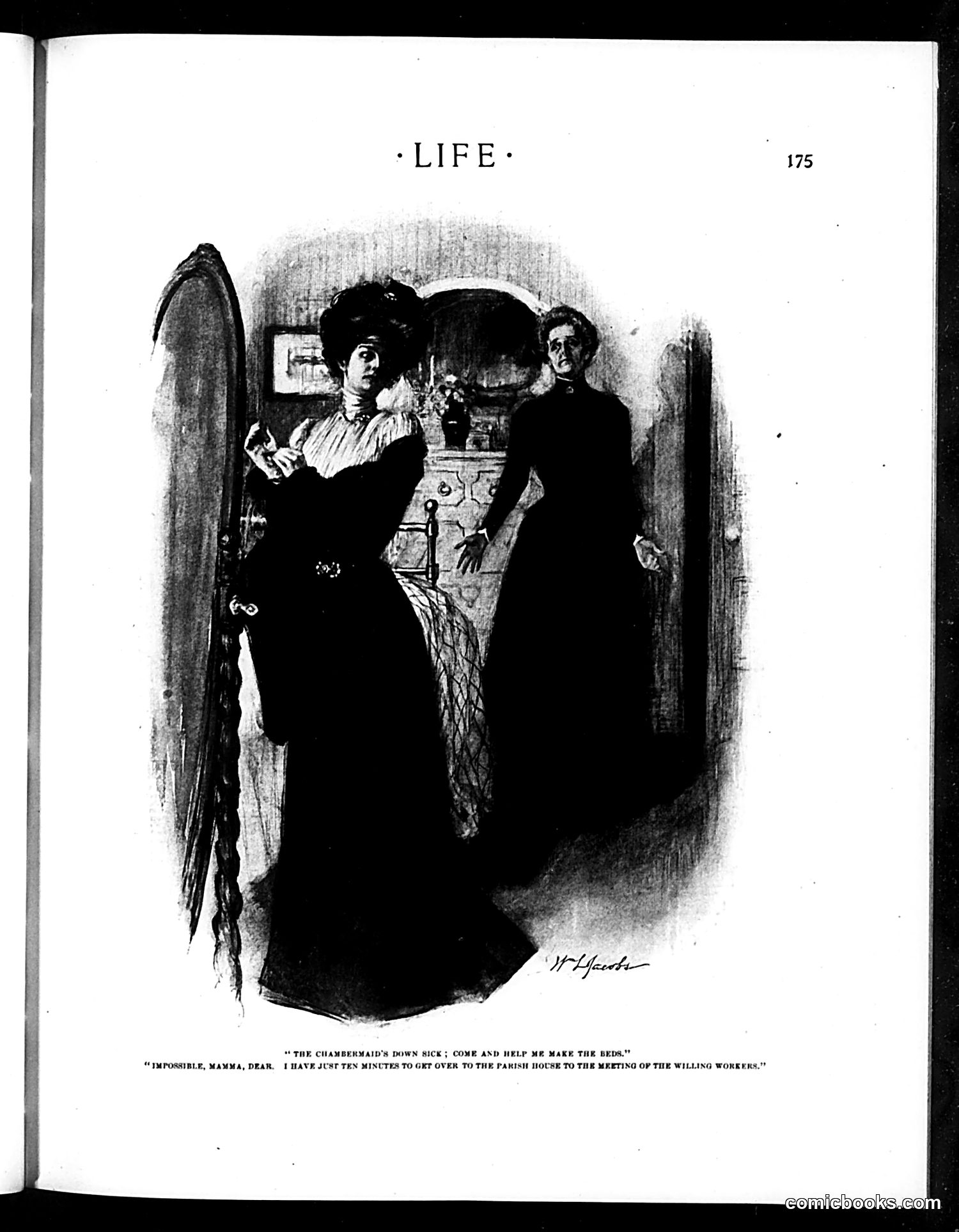
This cartoon satirizes the hypocrisy of upper-class women's charitable work. A daughter refuses to help her mother with domestic duties—making beds after a chambermaid's absence—claiming she lacks ten minutes to reach the parish house for a "Willing Workers" meeting (a charitable organization). The joke mocks the contradiction: the daughter considers herself too busy with organized charity work to perform basic domestic assistance for her own family. The satire suggests that such women used public charitable activities as fashionable social cover while neglecting practical family responsibilities. The illustration's formal Victorian dress and interior setting emphasize the class dynamics—the family can afford servants but the daughter won't substitute when needed, prioritizing her social standing through organized charity over unglamorous household work.
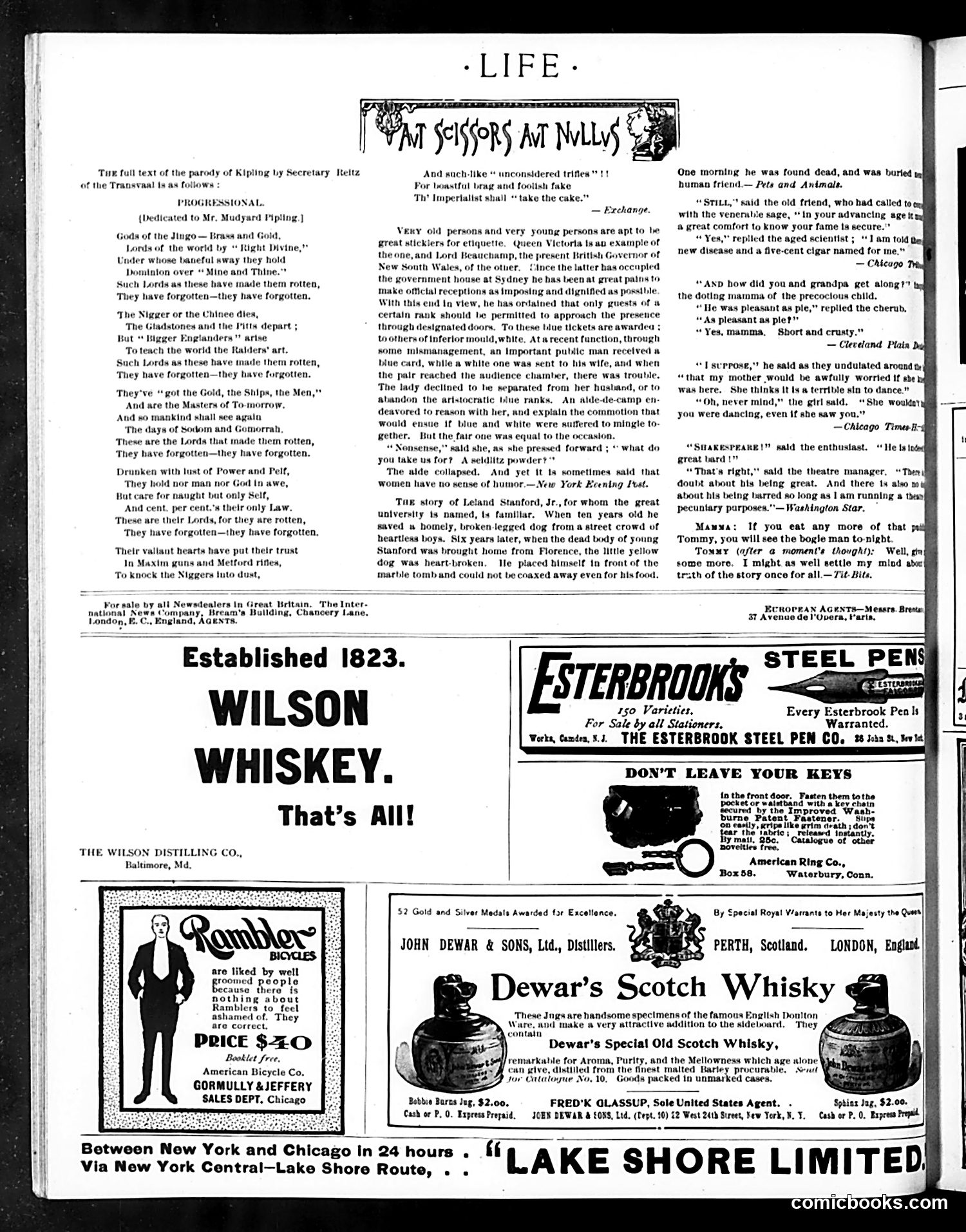
This page from Life magazine contains **political satire and social commentary** rather than traditional comics. The main text is a parody of Rudyard Kipling's poetry, written by a Transvaal secretary, attacking British imperialism and "Jingo" expansionism. It mocks British imperial powers for their greed, militarism, and moral corruption—particularly regarding colonial violence against non-European peoples ("the Nigger or the Chinee"). The page also includes **social humor anecdotes** about etiquette (Lord Beauchamp's rigid protocols in New South Wales) and a sentimental story about Stanford's loyal dog. The **advertisements** (Wilson Whiskey, Dewar's Scotch, Ramblers Bicycles, Esterbrook Pens) are period commercial content, not satirical. The satire's context: this reflects late 19th-century American criticism of British imperial overreach during the Boer War era, using Kipling's own romantic nationalist language against itself.
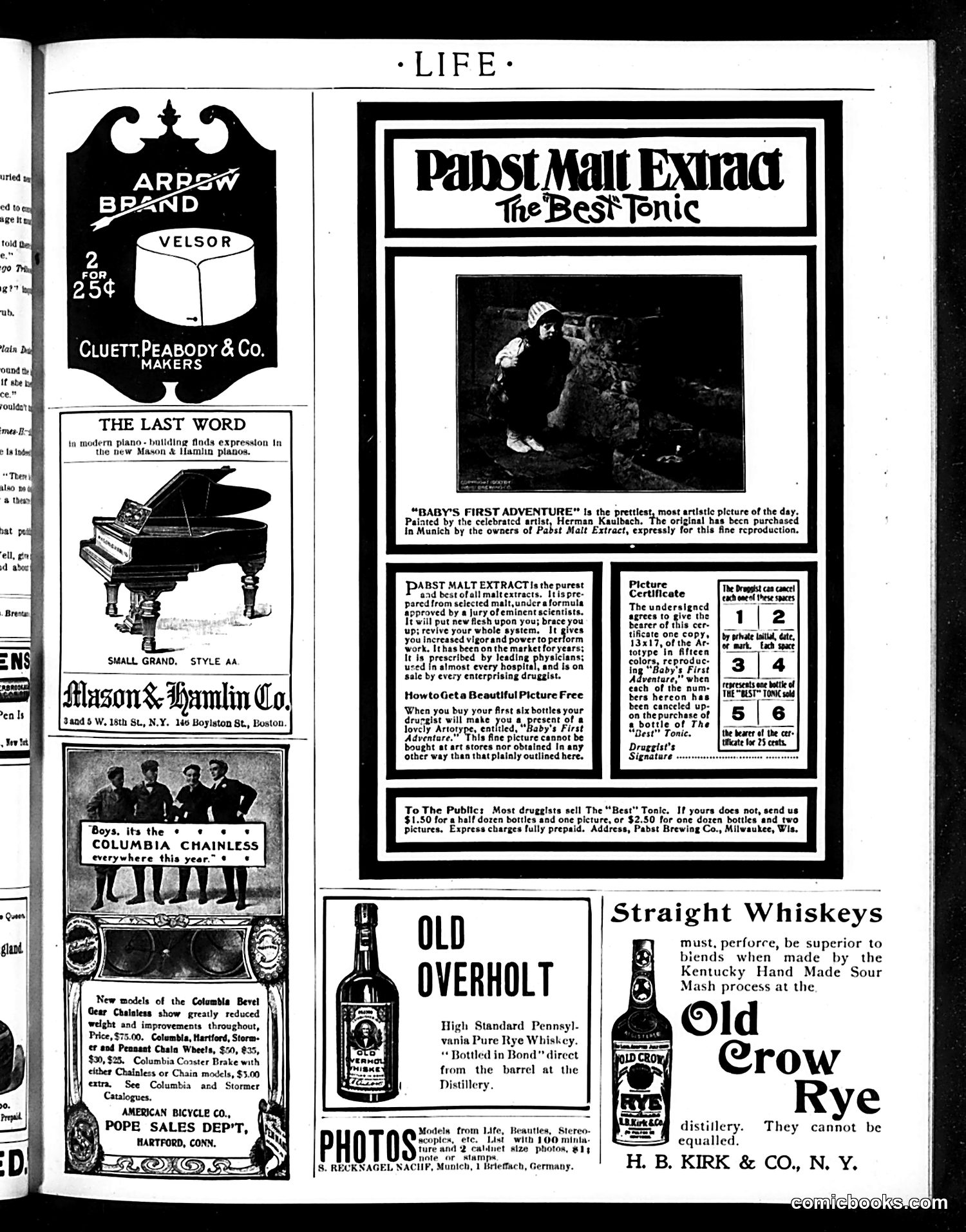
This page is primarily **advertising, not editorial content**. It contains six separate advertisements with minimal satirical or editorial cartooning: 1. **Arrow Brand Velsor collars** - Standard product ad 2. **Mason & Hamlin pianos** - "The Last Word" in modern piano design 3. **Columbia Chainless bicycles** - Features new bevel gear technology; the small illustration shows boys enthusiastically endorsing the model as fashionable ("everywhere this year") 4. **Pabst Malt Extract** - The largest ad, promoting a "health tonic" with an art reproduction of Kaulbach's "Baby's First Adventure" as a giveaway incentive 5. **Old Overholt whiskey** and **Old Crow Rye** - Liquor advertisements The bicycle ad contains the only mild humor: boys peer-pressuring each other about fashion. The Pabst ad conflates fine art with patent medicine marketing—common in this era. No political satire is evident on this page.
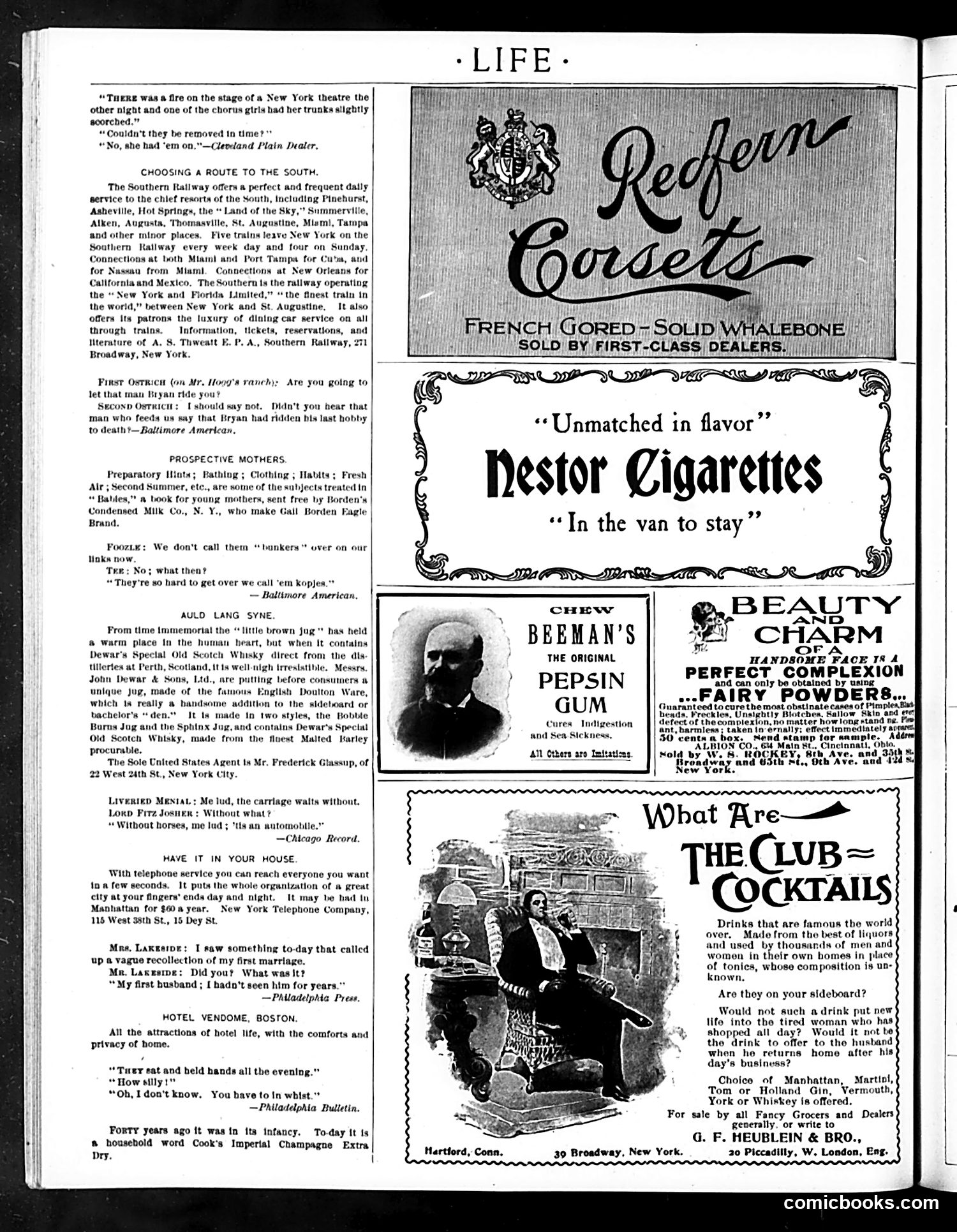
This page is primarily **advertising**, with brief satirical jokes interspersed throughout. The jokes target: 1. **A chorus girl's modesty** (Cleveland Plain Dealer joke): A theater fire; the girl refused to remove her trunks despite danger, prioritizing propriety over safety—satire on Victorian prudishness. 2. **William Jennings Bryan** (Baltimore American): The "First Officer" joke mocks Bryan as exhausted politically. "Ridden his last hobby to death" suggests his repeated failed presidential campaigns (he ran three times: 1896, 1900, 1908) had worn out public patience. 3. **Automobile novelty** (Chicago Record): A lord's servant reports the carriage waits "without horses"—it's an automobile. Satirizes the early-1900s shock of motorized vehicles replacing horse transportation. The page's main content is **advertisements** for Southern Railway, Redfern Corsets, Nestor Cigarettes, Beeman's Gum, Pepsin Gum, and Club Cocktails—typical early-20th-century product promotions.
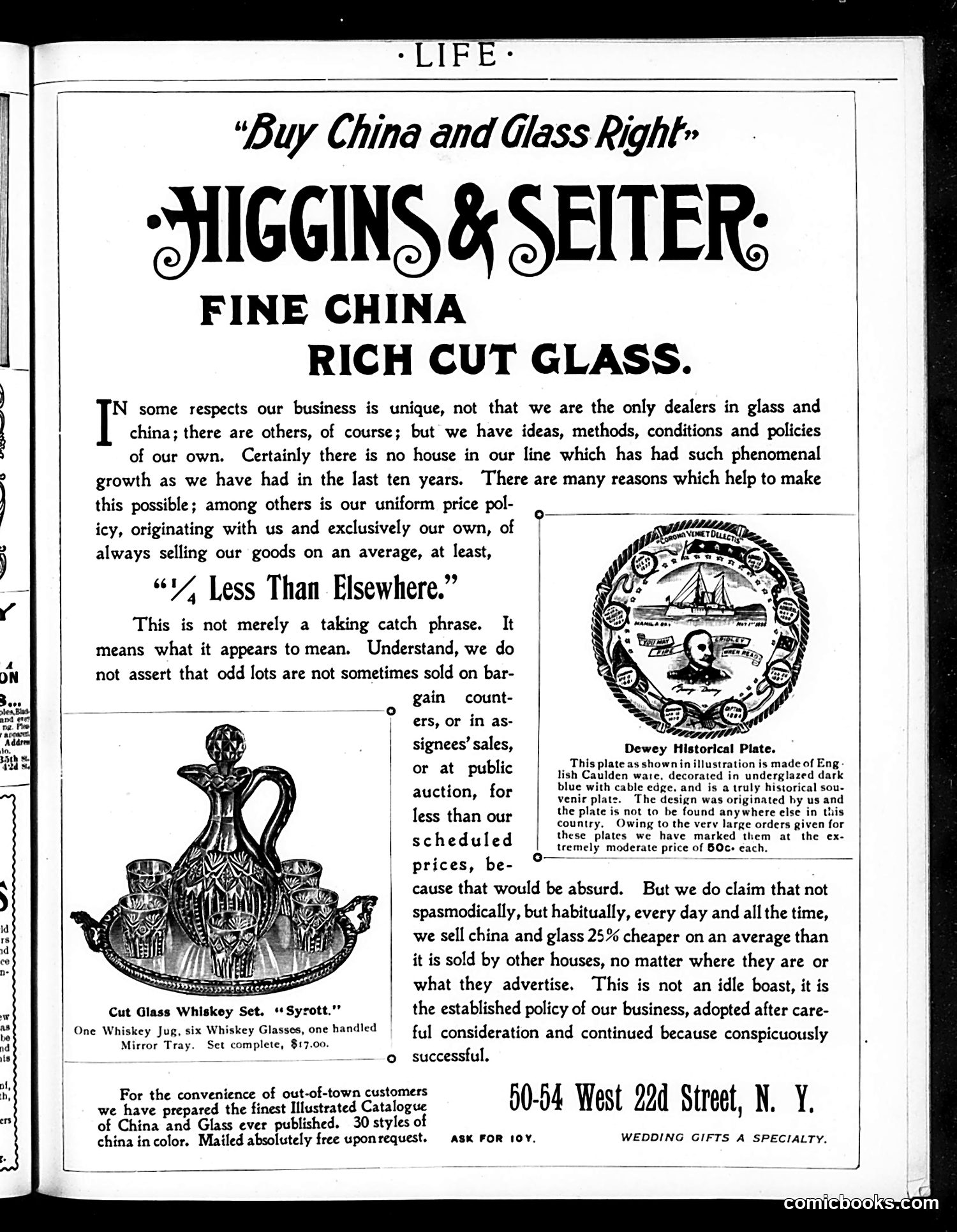
This is primarily a **commercial advertisement**, not a political cartoon. It's a full-page ad for Higgins & Seiter, a New York china and glassware retailer (50-54 West 22nd Street). The page contains product illustrations—a decorative cut-glass whiskey set and a "Dewey Historical Plate" (a commemorative china plate)—alongside sales copy boasting the company's business success and pricing strategy. The main claim is that they consistently undercut competitors by 25% on average, framed as their exclusive "uniform price policy." For a modern reader: this represents early 20th-century retail advertising emphasizing competitive pricing and product quality to affluent customers shopping for household goods and wedding gifts. The reference to Admiral Dewey (likely from the Spanish-American War era) dates the publication, while the detailed product descriptions and free catalogue offer reflect pre-digital consumer marketing methods.
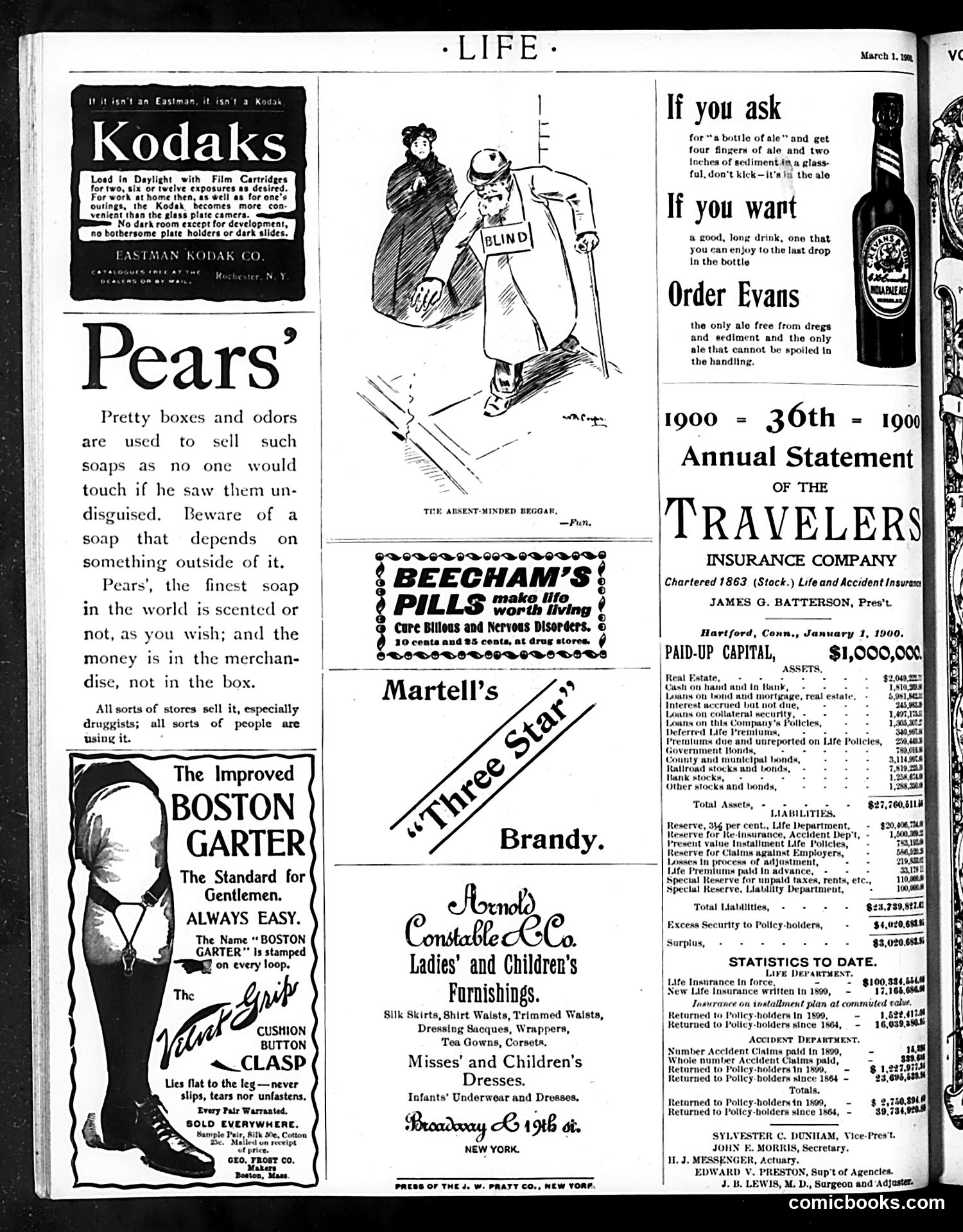
This page is primarily **advertising** with one small editorial cartoon titled "The Absent-Minded Beggar" (credited to *Fun* magazine). The cartoon depicts a blind beggar being pickpocketed by a figure behind him. The satire is straightforward: the "absent-minded" beggar is so preoccupied or distracted that he fails to notice a thief robbing him—a visual pun on his blindness and inattention. The joke trades on class stereotypes of beggars as simultaneously vulnerable and oblivious. The page otherwise features period advertisements (Kodak cameras, Pears' soap, Boston Garters, etc.) and an insurance company's annual financial statement, with no additional political or social commentary.