
Life, 1900-03-01 · page 7 of 20
Life — March 1, 1900 — page 7: what you’re looking at
What you’re looking at
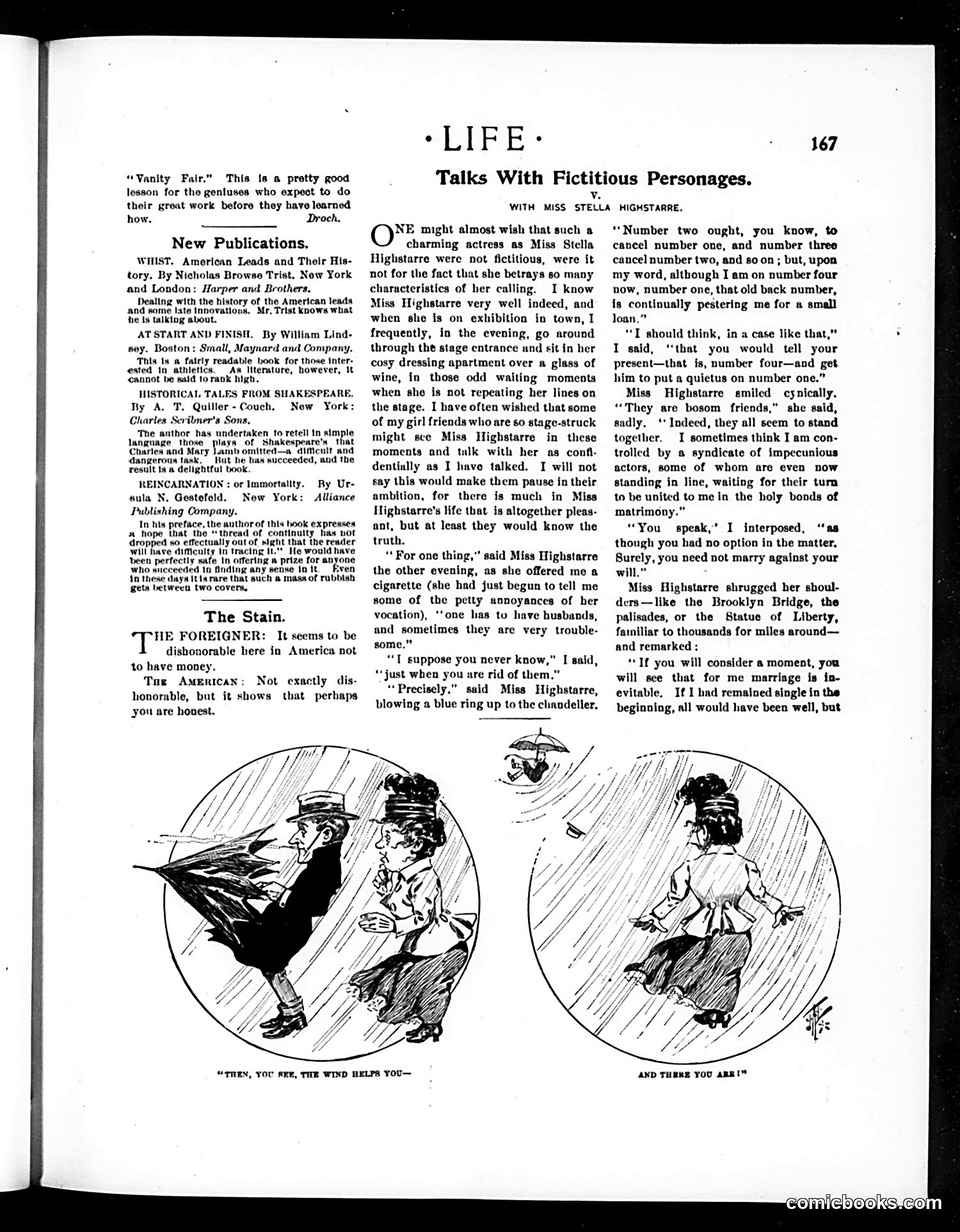
This page contains a conversational interview titled "Talks With Fictitious Personages" featuring actress Miss Stella Highstarre. The article humorously presents her discussing the challenges of her theatrical career and marriage prospects. The accompanying cartoons illustrate a comedic scenario about windy weather. In the left panel, a man's clothing is blown about by wind while a woman watches. The right panel shows the same woman being affected by the wind. The captions read "Then, you see, the wind helps you—" and "And there you are!" The satire appears to mock the superficiality of theatrical life and perhaps gender dynamics of the era. Miss Highstarre's concerns about husbands being "troublesome" and marriage being "inevitable" reflect early-20th-century attitudes toward women's roles and matrimony.
📄 Transcribed text from this page (OCR, searchable)
Machine-transcribed from the original scan — historical spelling and the odd misread are preserved.
“Vanity Fair.” This {6 a pretty good lesson for tho genluses who expect to do their great work before they have learned how. Droch. New Publications. WHIST. American Leads and Their His- tory. By Nicholas Browse Trist. New York and London: Harper and Brothers, Dealing with the history of the American leads and some late Innovations. Mr, Trist knows what ‘he Is talking about. AT START AND FINISH, By William Lind- sey. Boston: Small, Maynard and Company. This 1s a fairly readable book for those inter- ested tn athletics. As literature, however, it cannot be sald to rank high, HISTORICAL TALES FROM SHAKESPEARE, By A. T. Quiller- Couch, New York: Charles Scribner's Sons, ‘The anthor has undertaken to retell in simple langnage those plays of Shakespeare's that Charles and Mary Lamb omitted—a diMcult and dangerous task,” Tut he has succeeded, and the result is a delightful book. REINCARNATION : or Immortailty. sula N, Gestefold. Now York: Publishing Company. In his preface, the author of this book expresses a hope that the “thread of continulty has uot dropped so effectually out of aight that the reader Will have dimculty in tracing It." He would have deen perfectly safe In offering a prize for anyone who succeeded tn finding any sense to it. fiven in these days it 14 rare that such @ mass of rubbish gels between two covers, Ry Ur- Alliance The Stain. HE FOREIGNER: It seems to be dishonorable here ia America not to have money. Tne American: Not exactly dis- honorable, but it shows that perhaps ‘you are honest. “BIF'EA Talks With Fictitious Personages. Vv. WITH MISS STELLA HIGHSTARRE, NE might almost wish that such a charming actress as Miss Stella Highstarre were not fictitious, were it not for the fact that she betrays so many characteristics of her calling. I know Miss Highstarre very well indeed, and when she is on exhibition in town, I frequently, in the evening, go around through the stage entrance and sit in her cosy dressing apartment over a glass of wine, in those odd waiting moments when she is not repeating her lines on the stage. I have often wished that some of my girl friends who are so stage-struck might sce Miss Highstarre in these moments and talk with her as confi- dentially as I have talked. I will not say this would make them pause in their ambition, for there is much in Miss Highstarre’s life that is altogether pleas- ant, but at least they would know the truth, ‘For one thing,” said Miss Highstarre the other evening, as she offered me a cigarette (she had just begun to tell me some of the petty annoyances of ber vocation), ‘‘one has to have husbands, and sometimes they are very trouble- some.” “T suppose you never know, “just when you are rid of them.’ “Precisely,” said Miss Highstarre, blowing a blue ring up to the chandelier. “THEN, YOU RK, THE WIND HELPS YOU— “‘Number two ought, you know, to cancel number one, and number three cancel number two, and 80 on ; but, upon my word, although I am on number four now, number one, that old back number, is continually pestering me for a small Joan.” “T should think, in a case like that,” I said, ‘that you would tell your present—that is, number four—and get him to put a quietus on number one.” Miss Highstarre smiled cynically. “They are bosom friends,” she said, sadly. ‘* Indeed, they all seem to stand together. I sometimes think I am con- trolled by a syndicate of impecunious actors, some of whom are even now standing in line, waiting for their turn to be united to mein the holy bonds of matrimony.” “You speak,’ I interposed, ‘‘as though you had no option in the matter, Surely, you need not marry against your will.” Miss Highstarre shrugged her shoul- ders—like the Brooklyn Bridge, the palisades, or the Statue of Liberty, fainiliar to thousands for miles around— and remarked ; “*If you will consider a moment, you will see that for me marriage is in- evitable. If I had remained single in the beginning, all would have been well, but AND THERE YOU angi”