
Life, 1900-03-01 · page 4 of 20
Life — March 1, 1900 — page 4: what you’re looking at
What you’re looking at
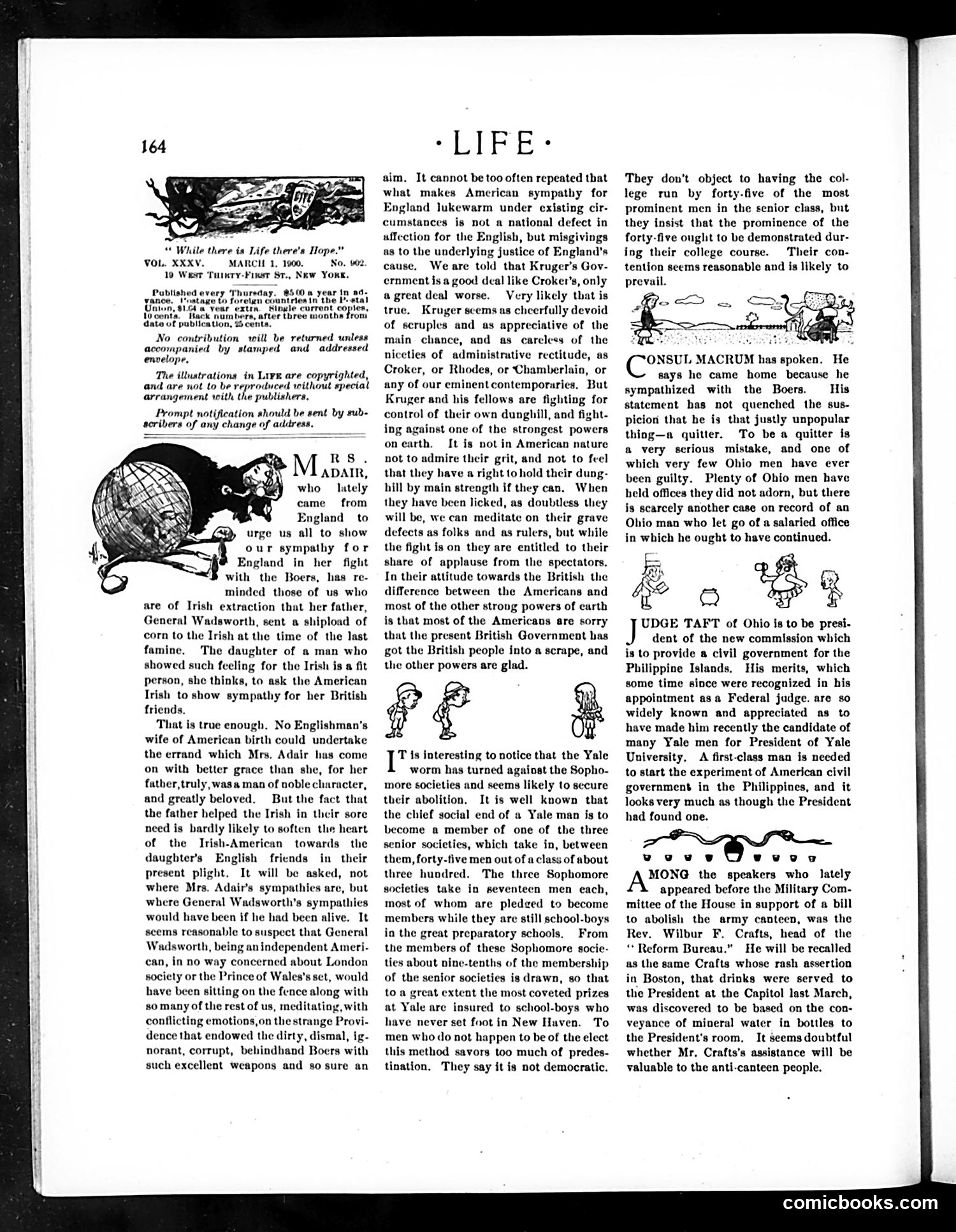
The page contains two distinct editorial cartoons with accompanying text commentary. The first cartoon depicts a figure labeled "MAHATMA" (appears to reference a spiritual or philosophical leader) who "came from England" and is associated with Irish sympathies. The accompanying text discusses English treatment of Ireland and Irish-American sentiment, suggesting the cartoon satirizes conflicting loyalties regarding the Boer War—Americans sympathizing with Irish grievances while British fight in South Africa. The second cartoon section references Yale University's exclusive social societies and their elitist membership practices, mocking how these "three Sophomore societies" select only the most privileged students. The satire critiques the undemocratic nature of these institutional hierarchies among America's social elite. Both pieces exemplify *Life* magazine's early-1900s satirical approach to contemporary social and political tensions.
📄 Transcribed text from this page (OCR, searchable)
Machine-transcribed from the original scan — historical spelling and the odd misread are preserved.
** While there is Life there's Hope.” VOL. XXXV. MARCI 1, 1900. No, 002. 19 West Tuiery-Finst St., New Youn. hed every Voatage to Union, $1.64 a year locent’s. ‘Tack numbers, after three months from dato of publication, % centa. No contribution will be returned unless accompanied by stamped and addressed envelope, Publ vi ‘The illustrations in Live are copyrighted, and are not to be reproduced without special arrangement with the publishers, Prompt notification should be sent by sub- scribers of any change of address. DAIR, who lately came from England to urge us all to show our sympathy for with the Boers, has re- minded those of us who are of Irish extraction that her father, General Wadsworth, sent a shipload of corn to the Irish at the time of the last famine. The daughter of a man who showed such feeling for the Irish is a fit person, she thinks, to ask the American Irish to show sympathy for her British friends, That is true enough. No Englishman's wife of American birth could undertake the errand which Mrs, Adair has come on with better grace than she, for her father, truly, wasa man of noble character, and greatly beloved. But the fact that the father helped the Irish in their sore need is bardly likely to soften the heart of the Irish-American towards the daughters English friends in their present plight. It will be asked, not where Mrs. Adair’s sympathies are, but where General Wadsworth’s sympathies would have been if he had been alive. It seems reasonable to suspect that General Wadsworth, being an independent Ameri- can, in no way concerned about London society or the Prince of Wales's set, would have been sitting on the fence along with so many of the rest of us, meditating, with conflicting emotions,on the strange Provi- dence that endowed the dirty, dismal, ig- norant, corrupt, behindhand Boers with such excellent weapons and so sure an * Le aim. It cannot be too often repeated that what makes American sympathy for England lukewarm under existing cir- cumstances is not a national defect in affection for the English, but misgivings as to the underlying justice of England's cause. Weare told that Kruger’s Gov- ernment is a good deal like Croker’s, only a great deal worse. Very likely that is true. Kruger scems as cheerfully devoid of scruples and as appreciative of the main chance, and as careless of the niceties of administrative rectitude, as Croker, or Rhodes, or Chamberlain, or any of our eminent contemporaries, But Kruger and his fellows are fighting for control of their own dunghill, and fight- ing against one of the strongest powers on earth. It is not in American nature not to admire their grit, and not to feel that they have a right to hold their dung- hill by main strength if they can. When they have been licked, as doubtless they will be, we can meditate on their grave defects as folks and as rulers, but while the fight is on they are entitled to their share of applause from the spectators. In their attitude towards the British the difference between the Americans and most of the other strong powers of earth is that most of the Americans are sorry that the present British Government has got the British people into a scrape, and the other powers are glad. a T 1s interesting to notice that the Yale worm has turned against the Sopho- more societies and seems likely to secure their abolition, It is well known that the chief social end of a Yale man is to become a member of one of the three senior societies, which take in, between them, forty-tive men out of a class of about three hundred. The three Sophomore societies take in seventeen men each, most of whom are pledged to become members while they are still school-boys ia the great preparatory schools. From the members of these Sophomore socie- ties about nine-tenths of the membership of the senior societies is drawn, so that to a great extent the most coveted prizes at Yale are insured to school-boys who have never set foot in New Haven. To men who do not happen to be of the elect this method savors too much of predes- tination. They say it is not democratic. They don’t object to having the col- lege run by forty-five of the most prominent men in the senior class, but they insist that the prominence of the forty-five onglit to be demonstrated dur- ing their college course. Their con- tention seems reasonable and is likely to prevail. ONSUL MACRUM has spoken. He says he came home because he sympathized with the Boers. His statement has not quenched the sus- picion that he is that justly unpopular thing—a quitter. To be a quitter is a very scrious mistake, and one of which very few Ohio men have ever been guilty. Plenty of Ohio men have held offices they did not adorn, but there is scarcely another case on record of an Ohio man who let go of a salaried office in which he ought to have continued. bE By UDGE TAFT of Ohio is to be presi- dent of the new commission which is to provide a civil government for the Philippine Islands. His merits, which some time since were recognized in his appointment asa Federal judge. are so widely known and appreciated as to have made him recently the candidate of many Yale men for President of Yale University, A first-class man is needed to start the experiment of American civil government in the Philippines, and it looks very much as though the President had found one. Aone the speakers who lately appeared before the Military Com. mittee of the House in support of a bill to abolish the army canteen, was the Rev. Wilbur F. Crafts, head of the “Reform Bureau,” He will be recalled as the same Crafts whose rash assertion in Boston, that drinks were served to the President at the Capitol last March, was discovered to be based on the con- veyance of mineral water in bottles to the President's room, It seems doubtful whether Mr. Crafts’s assistance will be valuable to the anti-canteen people. comicbooks.com