
Life, 1900-03-01 · page 6 of 20
Life — March 1, 1900 — page 6: what you’re looking at
What you’re looking at
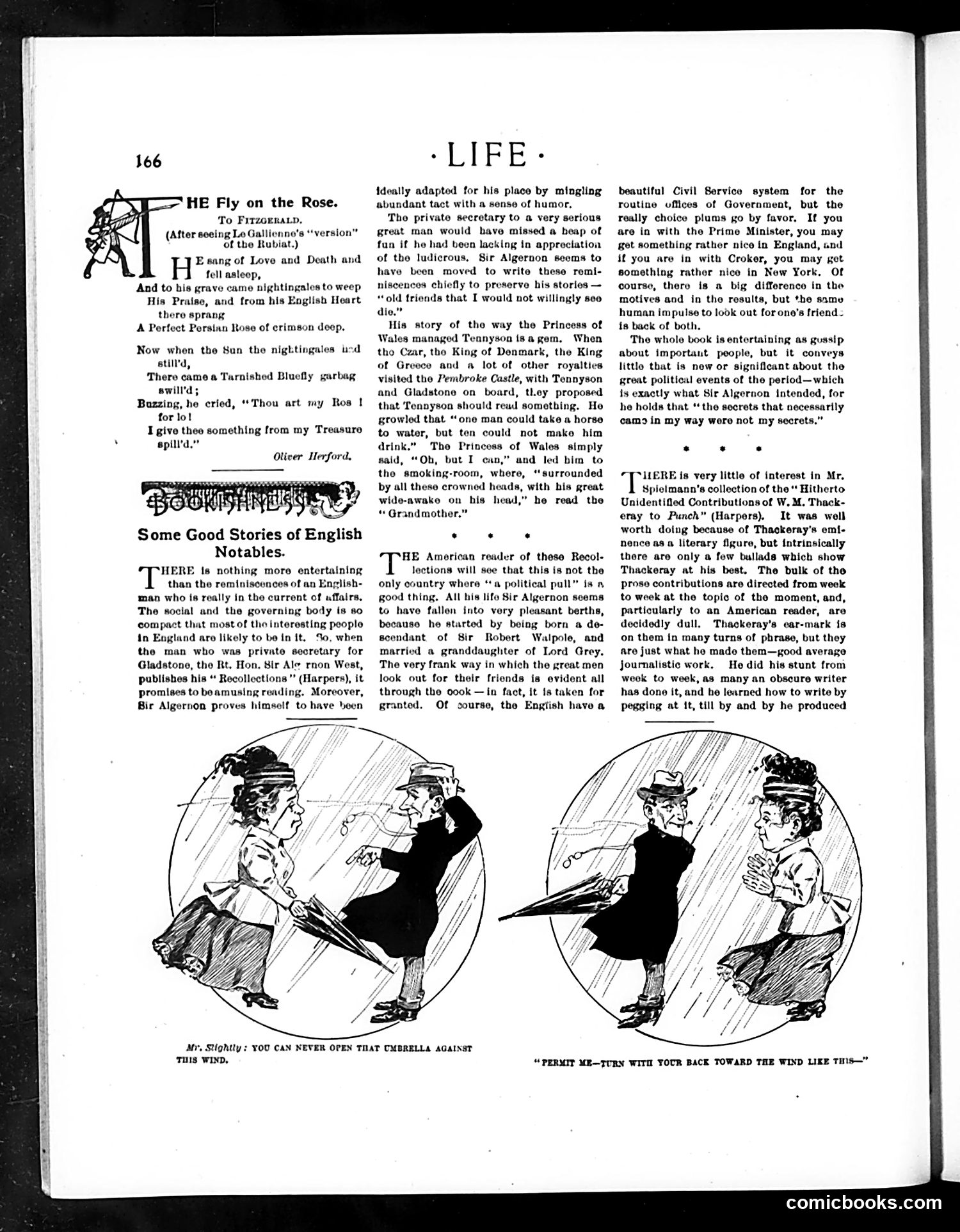
This page contains two umbrella-related cartoon vignettes satirizing romantic or social dynamics. Both depict a man and woman struggling with an umbrella in windy rain. In the left cartoon, the man says "Mr. Slightly: you can never open that umbrella against this wind" — suggesting masculine incompetence or futility. The right cartoon shows the man saying "Permit me—turn with your back toward the wind like this" — implying the man is offering practical advice or attempting to assert authority. The humor likely plays on gender dynamics and courtship rituals of the early 20th century: either mocking male pretension to usefulness, or depicting common romantic scenarios where men try to impress women with gallantry. The umbrella serves as a prop for examining social interaction between the sexes.
📄 Transcribed text from this page (OCR, searchable)
Machine-transcribed from the original scan — historical spelling and the odd misread are preserved.
HE Fly on the Rose. To Fitzorna.p, (After seeing Lo Gallienno’s “version” of the Rubiat.) E sang of Love and Death and fell asleop, And to his grave came nightingales to weep His Praise, and from his English Heart thero sprang A Perfect Porsinn Rose of crimson deep. Now when the Sun the nightingales usd still'd, There came a Tarnished Bluefly garbag will’ ; Buzzing, he cried, “Thou art my Ros ! for lo! I givo theo something from my Treasuro Oliver Herford, Some Good Stories of English Notables. HERE {8 nothing moro entertaining than the reminiscences of an English- man who is really in the current of affairs, Tho social and the governing body ts so compact that most of tho interesting peoplo in England aro likely to be in tt. 0, when the man who was private secretary for Gladstone, tho Rt. Hon, Sir Ale rnon West, publishes his “ Recollections" (Harpers), it promises to boamusing reading. Moreover, Bir Algernon proves himself to have been «LIFE - {deally adapted for his place by mingling abundant tact with a sense of humor, Tho private secretary to a very serious great man would bave missed a heap of fun if he had been lacking in appreciation of the ludicrous, Sir Algernon seems to have been moved to write these remi- niscences chiefly to preserve his stories — “old friends that I would not willingly seo dio.” His story of tho way the Princess of Wales managed Tennyson is agem. When tho Czar, tho King of Denmark, the King of Greece and a lot of other royalties visited the Pembroke Castle, with Tennyson and Gladstone on board, they proposed that Tennyson should read something. Ho growled that “one man could take a horse to water, but ten could not mako him drink.” The Princess of Wales simply said, “Oh, but I can,” and led bim to tho smoking-room, where, “surrounded by all these crowned heads, with bis great wide-awake on his head,” he read the “ Grandmother.” HE American reader of these Recol- lections will see that this is not the only country where *a political pull” is 9 good thing. All his lifo Sir Algernon seems to have fallen into very pleasant berths, because he started by being born a de- scendant of Sir Robert Walpole, and married a granddaughter of Lord Grey, ‘The very frank way in which the great men look out for their friends is evident all through the cook —in fact, it is taken for granted. Of course, the English have a Afr, SUghtly : YOU CAN NEVER OPEN THAT UMBRELLA Against ‘TUS WIND, beautiful Civil Service system for the routine offices of Government, but the really choice plums go by favor. If you are in with tho Prime Minister, you may get something rather nico in England, and if you are in with Croker, you may got something rather nico in New York. Of course, there is a big difference in the motives and in tho results, but the same human impulse to lodk out for one’s friend = fs back of both, The whole book is entertaining as gossip about important people, but it conveys little that is new or significant about the great political events of the period—which 1s exactly what Sir Algernon intended, for he holds that “the secrets that necessarily camo in my way were not my secrets.” Tee is very little of interest in Mr. Spielmann's collection of the * Hitherto Unidentifled Contributions of W. M. Thack- eray to Punch” (Harpors). It was well worth doing because of Thackeray's em{- nence as a literary figure, but intrinsically there are only a few bullads which show Thackeray at his best. The bulk of the Prose contributions are directed from week to week at the topic of the moment, and, particularly to an American reader, aro decidedly dull. Thackeray's ear-mark {8 on them in many turns of phrase, but they aro just what ho made them—good averago Journalistic work. He did his stunt from weok to week, as many an obscure writer has done it, and he learned how to write by pegging at ft, till by and by he produced “ PERMIT ME—TURN WITH YOUR BACK TOWARD THE WIND LIKE THIS—" comicbooks.com