
Life, 1900-03-01 · page 12 of 20
Life — March 1, 1900 — page 12: what you’re looking at
What you’re looking at
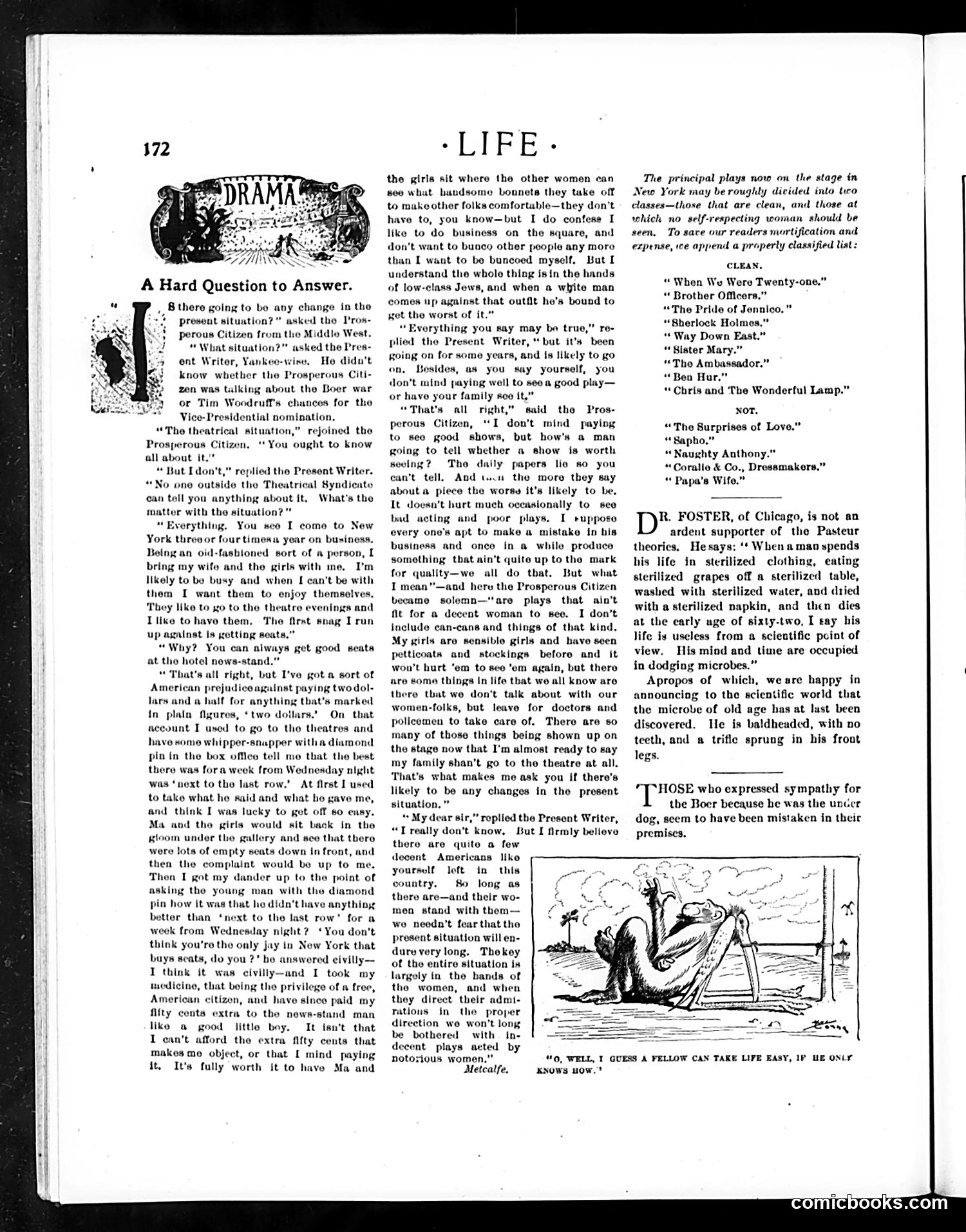
This page contains two distinct sections: **"A Hard Question to Answer"** is a debate piece where a "Prosperous Citizen" questions whether theatrical syndicate monopolies harm theater access. The citizen argues that theater tickets are expensive and that families cannot afford frequent attendance—a genuine economic complaint about early 20th-century entertainment industry consolidation. **The cartoon at bottom right** depicts a man being thrown from a horse into water. The caption reads: "O Well, I guess a fellow can take life easy, if he only knows how." This appears to be ironic commentary on the difficulty of leisure and relaxation—the figure's predicament contradicts the caption's claim about taking life easily. The page reflects concerns about corporate monopolies in theater and the illusion of easy living during this period.
📄 Transcribed text from this page (OCR, searchable)
Machine-transcribed from the original scan — historical spelling and the odd misread are preserved.
A Hard Question to Answer. B there going to bo any change in tho present situation?” asked the Pros- perous Citizen from the Middle West. “What situation?” asked the Pres- ent Writer, Yankeo-w Ho did't know whether the Prosperous Citi- zen was talking about the Boor war or Tim Wondruff's chances for tho Vice-Presidential nomination. ‘Tho theatrical situation,” rejoined the Prosperous Citizen, “You ought to know all about it.” “ But [don't,” replied the Presont Writer. “No ono outside the Theatrical Syndicate can tell you anything about it. What's the matter with tho situation?" “Everything. You see I como to New York threoor four timesa year on business, Being an old-fashioned sort of a person, I bring my wife and tho girls with ne. I'm likely to be busy and when I can't be with them I want them to enjoy themselves. ‘They like to xo to the theatre evenings and I like to havo them, The frst snag I run up against is getting seats,” “Why? You can always get good seata at tho hotel nows-stand.” “ That's all right, but I'vo got a sort of American projudicoagainst paying twodol- Jars and a half for anything that's marked in plain figures, ‘two dottars.! On that account I used to go to tho theatres and have some whipper-snupper witha diamond pin in the box office tell mo that the best there was fora week from Wednesday night was ‘next to tho last row.’ At first I used to take what he said and what be gave me, and think I was lucky to got off #0 easy. Ma and tho girls would sit back in the gloom under the gallery and sce that there were lots of empty seats down in front, and then the complaint would be up to me. Thon T got my dander up to the point of asking the young man with the diamond pin how it was that he didn’t have anything better than ‘next to the last row’ for a week from Wednesday night? ‘You don't think you'ro tho only jay in New York that buys seats, do you ?* he answered eivilly— I think it was civilly—and I took my medicine, that being the privilege of a free, American citizen, and have since paid my fifty conts extra to the news-stand man like a good little boy. It isn't that I can’t afford the extra fifty cents that makes mo object, or that [ mind paying it, It's fully worth it to have Ma and ‘LIFE - the girls sit where the other women can see what bundsome bonnets they take off to makeother folks comfortable—they don't have to, you know—but I do contese I like to do business on the square, and don’t want to buaco other people any moro than I want to be buncoed myself, But I understand the whole thing isin the hands of low-class Jows, and when a white man comes up against that outfit he’s bound to get the worst of it.” vorything you say may be true,” re- plied the Present Writer, * but it’s been going on for some years, and Is likely to go on, Besides, as you say yourself, you don't mind paying well to see a good play— or have your family foo it,” “That's all right,” said tho Pros- perous Citizen, “I don't mind paying to seo good shows, but how's a man going to tell whether a show is worth seeing? Tho daily papers lie so you can't tell, And iucu the more they say about a piece the worse it's likely to be. It dovsn’t hurt much occasionally to seo bad acting and poor plays. I suppose every one’s apt to make a mistake in his business and onco in a while produce somothing tbat ain't quite up to the mark for quality—we all do tbat. But what I mean"—and here the Prosperous Citizen became solemn—are plays that ain't fit for a decent woman to see. I don’t include can-cans and things of that kind, My girls aro sensible girls and havo seen petticoats and stockings before and it wou't hurt ‘em to see ‘em again, but thero are some things In life that we all know aro there that we don't talk about with our women-folks, but leave for doctors and policemen to take care of. There are so many of those things being shown up on the stage now that I'm almost ready to say my family shan’t go to tho theatre at all. That’s what makes me ask you if there's likely to be any changes in the present situation,” « My dear sir,” replied the Presont Writer, “T really don't know, But I firmly believe there are quite a few decent Americans liko The principal plays now on the stage in New York may be roughly dicided into two classes—thorse that are clean, and those at which no self-respecting woman should be To save our readers mortification and expense, ice append a properly classified list: seen, CLEAN, “When We Were Twenty-one.” “ Brother Officers.” “The Pride of Jennico.” “Sherlock Holmes.” “ Way Down East.” “Sister Mary.” “Tho Ambassador.” “Beu Hur.” “Chris and The Wonderful Lamp.” Nor. “The Surprises of Love.” “Sapho.” “Naughty Anthony.” “Coralle & Co., Dressmakers,” “ Papa's Wife. R. FOSTER, of Chicago, is not an ardent supporter of the Pasteur theories, He says: ‘¢ When a mao spends his life in sterilized clothing, eating sterilized grapes off a sterilized table, washed with sterilized water, and dried with a sterilized napkin, and then dies at the early uge of sixty-two, I say his life is useless from a scientific point of view. His mind and time are occupied in dodging microbes.” Apropos of which, we are happy in announcing to the scientific world that the microbe of old age has at last been discovered. He is baldheaded, with no teeth, and a trifle sprung in his froot legs. *L BOs who expressed sympathy for the Boer because he was the uncer dog, seem to have been mistaken in theic yourself left in this country, 80 long as there are—and their wo- men stand with them— wo needn't fear that tho present situation will en- dure very long. Thekey of tho entire situation ix largely in the bands of the women, and when thoy direct their admi- rations in the proper direction wo won't long be bothered with In- decent plays acted by notorious women,” Metcalfe. KNOWS HOW.” “0, WELL, 1 GUESS A FELLOW CAN TAKE LIFE EASY, 1P ME ONLY