
Life, 1900-03-01 · page 8 of 20
Life — March 1, 1900 — page 8: what you’re looking at
What you’re looking at
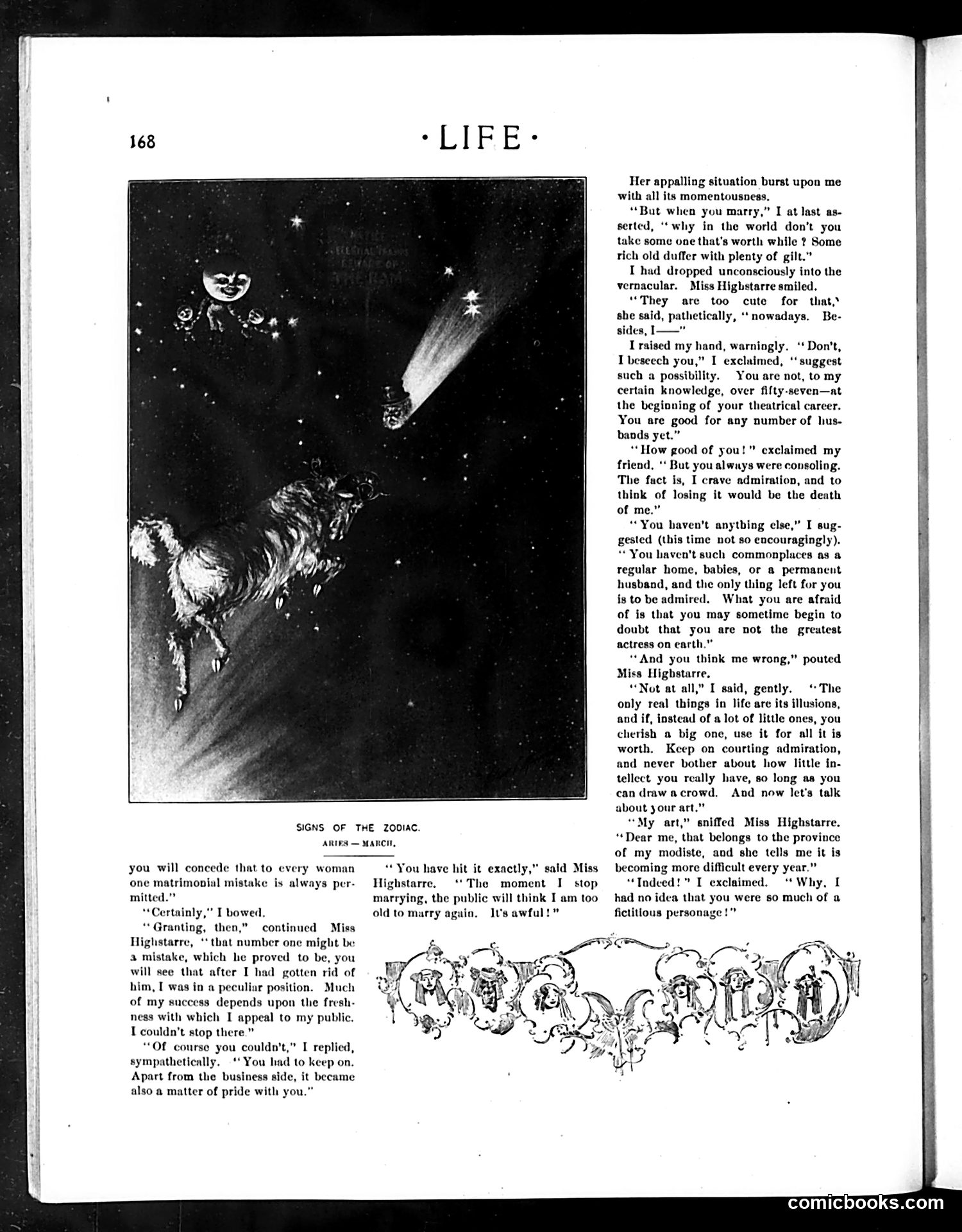
**Main Illustration**: "Signs of the Zodiac: Aries—March" depicts astrological imagery—a ram's head and celestial bodies—typical of early 20th-century satirical decoration. **Content**: The page features dialogue between two women (one identified as "Miss Highstarre") discussing marriage and women's careers in theater. Miss Highstarre defends her choice to remain unmarried, arguing that marriage would end her theatrical career and public appeal. Her companion counters that she risks becoming a cautionary tale—a woman who didn't marry. **Social Satire**: The piece satirizes early 20th-century tensions between women's professional ambitions and marriage expectations. It mocks both society's pressure on unmarried women and the genuine career penalties actresses faced if they married. **Decorative Footer**: Small illustrated vignettes depict various romantic or domestic scenes, reinforcing the marriage theme.
📄 Transcribed text from this page (OCR, searchable)
Machine-transcribed from the original scan — historical spelling and the odd misread are preserved.
SIGNS OF THE ZODIAC. you will concede that to every woman one matrimoniul mistake is always per- mitted. “Certainly,” I bowed, ‘Granting, then,” continued Miss Highstarre, ‘that number one might be a mistake, which he proved to be, you will see that after I had gotten rid of him, I was in a peculiar position. Much of my success depends upon the fresh- neas with which I appeal to my public. I couldn't stop there.” “Of course you couldn't,” I replied, sympathetically.‘ You had to keep on. Apart from the business side, it became also a matter of pride with you.” ARIES — MARCH, “You have hit it exactly,” sald Miss Highstarre. ‘The moment J stop marrying, the public will think I am too old to marry again, It's awful!” Her appalling situation burst upon me with all its momentousness, “But when you marry,” I at last as- serted, ‘why in the world don’t you take some one that’s worth while ? Some rich old duffer with plenty of gilt.” I had dropped unconsciously into the vernacular. Miss Highstarre smiled. “They are too cute for that, she said, pathetically, ‘‘ nowadays. Be- sides, I——" I raised my hand, warningly. ‘* Don't, I beseech you,” I exclaimed, “suggest such a possibility. You are not, tomy certain knowledge, over fifty-seven—at the beginning of your theatrical career. You are good for any number of hus- bands yet.” ‘How good of you!” exclaimed my friend, *‘ But you always were consoling. The fact is, I crave admiration, and to think of losing it would be the death of me.” “You haven't anything else,” I sug- gested (this time not so encouragingly). “You haven't such commonplaces as a regular home, babies, or a permanent husband, and the only thing left for you is to be admired. What you are afraid of is that you may sometime begin to doubt that you are not the greatest actress on earth.” ‘*And you think me wrong,” pouted Miss Highstarre. “Not at all,” I said, gently. ‘The only real things in life are its illusions, and if, instead of a lot of little ones, you cherish a big one, use it for all it is worth. Keep on courting admiration, and never bother about how little in- tellect you really have, so long as you can draw acrowd. And now let's talk about your art.” “My art,” sniffed Miss Highstarre. ‘Dear me, that belongs to the province of my modiste, and she tells me it is becoming more difficult every year.” “Indeed!” I exclaimed. “* Why, I had no idea that you were so much of a fictitious personage !" comicbooks.com