
A complete issue · 44 pages · 1899
Life — December 2, 1899
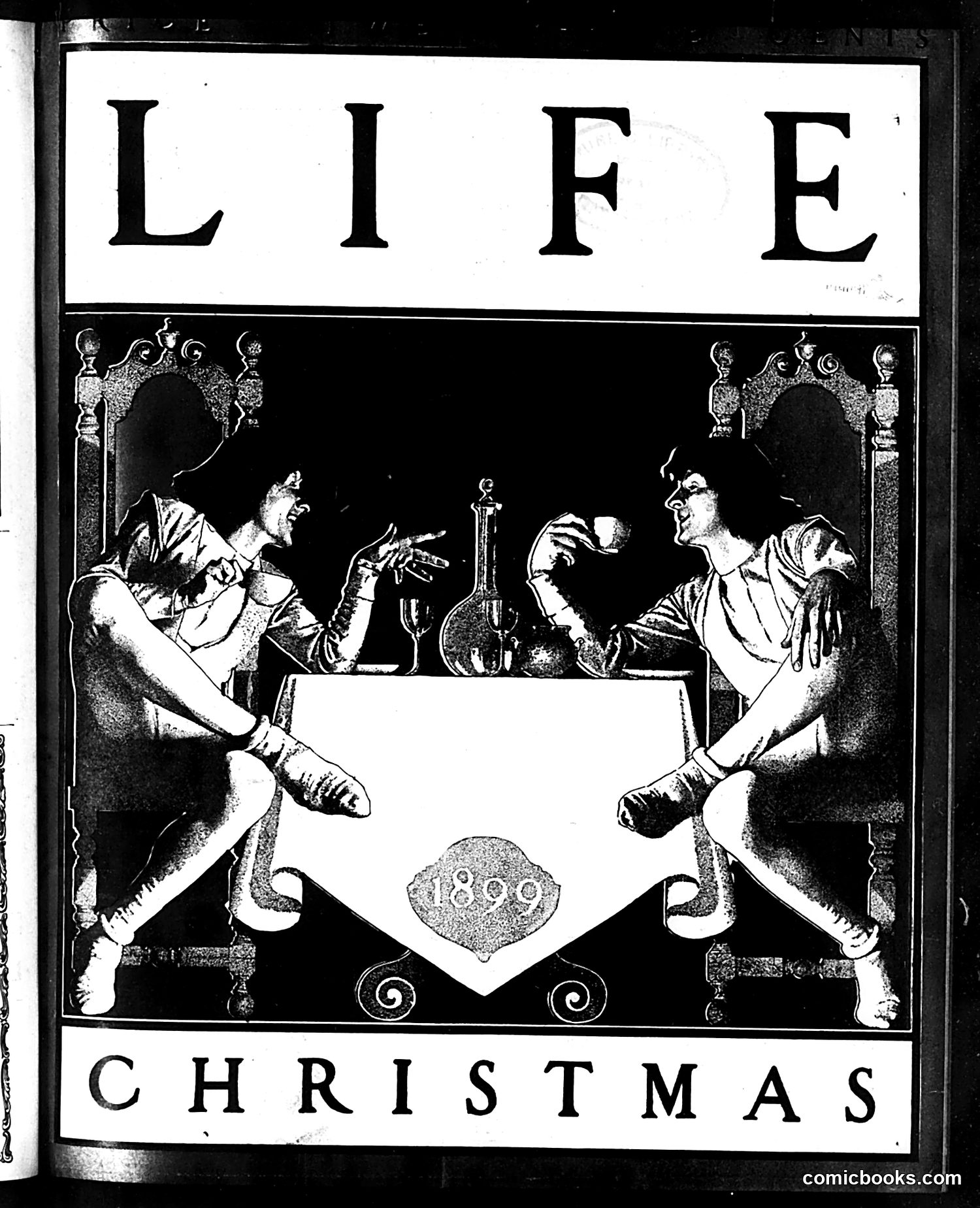
This is a cover from Life's Christmas 1899 issue. The illustration depicts two identical figures (likely representing America or the American public in dual aspects) seated at a table in luxurious surroundings, dining and drinking together in convivial celebration. The ornate decorative frames and classical architectural elements suggest wealth and sophistication. The satire appears commentary on American prosperity and self-indulgence at the turn of the century. The mirror-image composition and festive tone suggest irony about excess or moral contradiction—possibly critiquing America's wealth disparity, imperial ambitions, or social hypocrisy during this gilded age period. The specific 1899 date places this amid American expansion (Spanish-American War aftermath) and rapid industrialization, though the exact satirical target remains unclear without additional context from the magazine's accompanying articles.
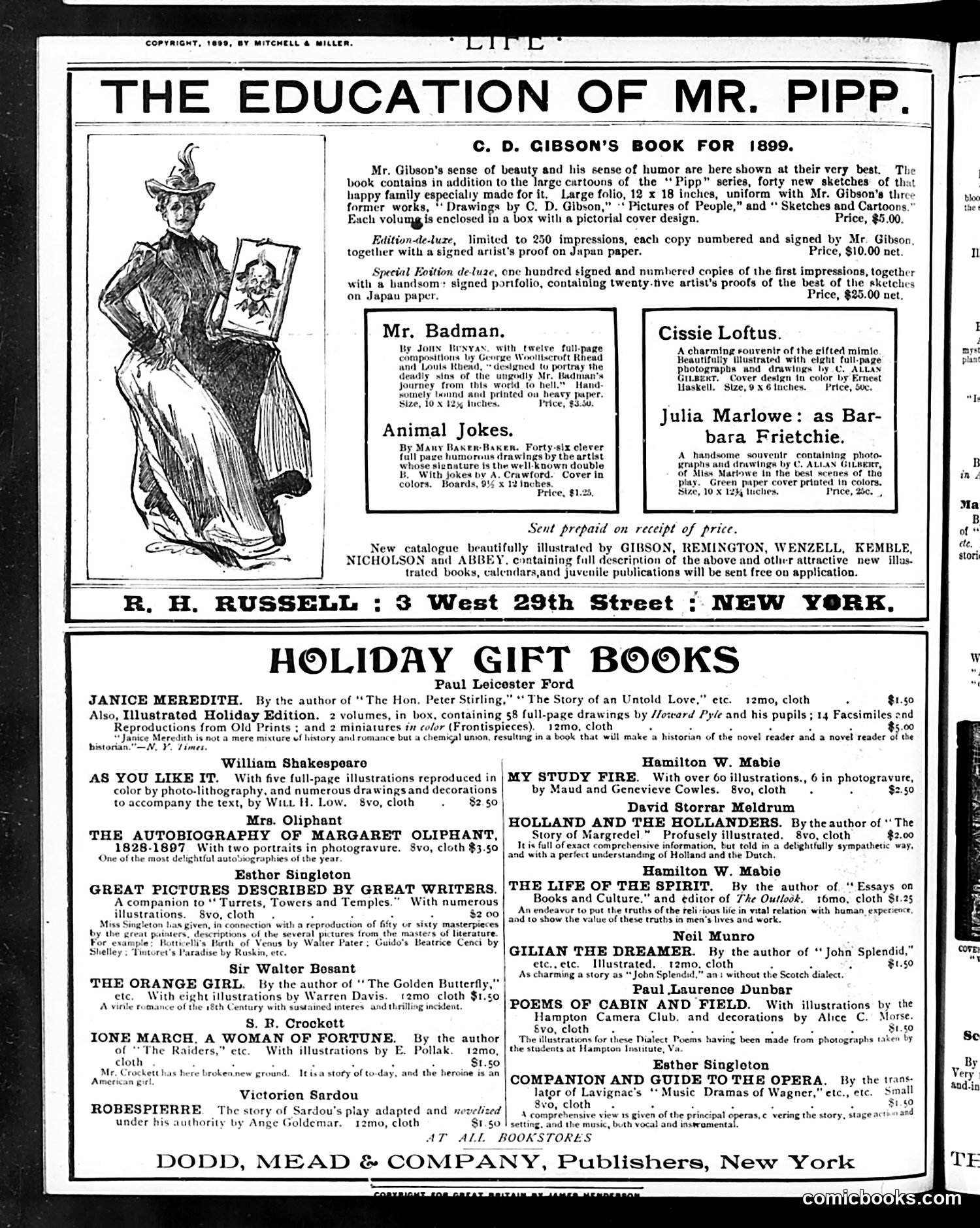
This page is primarily **advertising for books and publications** from 1899. The main cartoon shows a disheveled figure holding artwork, illustrating C.D. Gibson's 1899 book collection featuring "Pipp" series sketches. The character appears to represent an everyman being "educated" through Gibson's humorous illustrations. The satire likely mocks pretentious art education or self-improvement through popular culture—Gibson's cartoons were known for commentary on American social types. The figure's wild hair and cluttered appearance suggest chaos created by attempting cultural refinement through mass-market illustrations. However, without clearer context about who "Mr. Pipp" specifically was, the exact satirical target remains **unclear**. The page functions primarily as promotional material for Gibson's illustrated works and competing holiday gift books from various publishers.
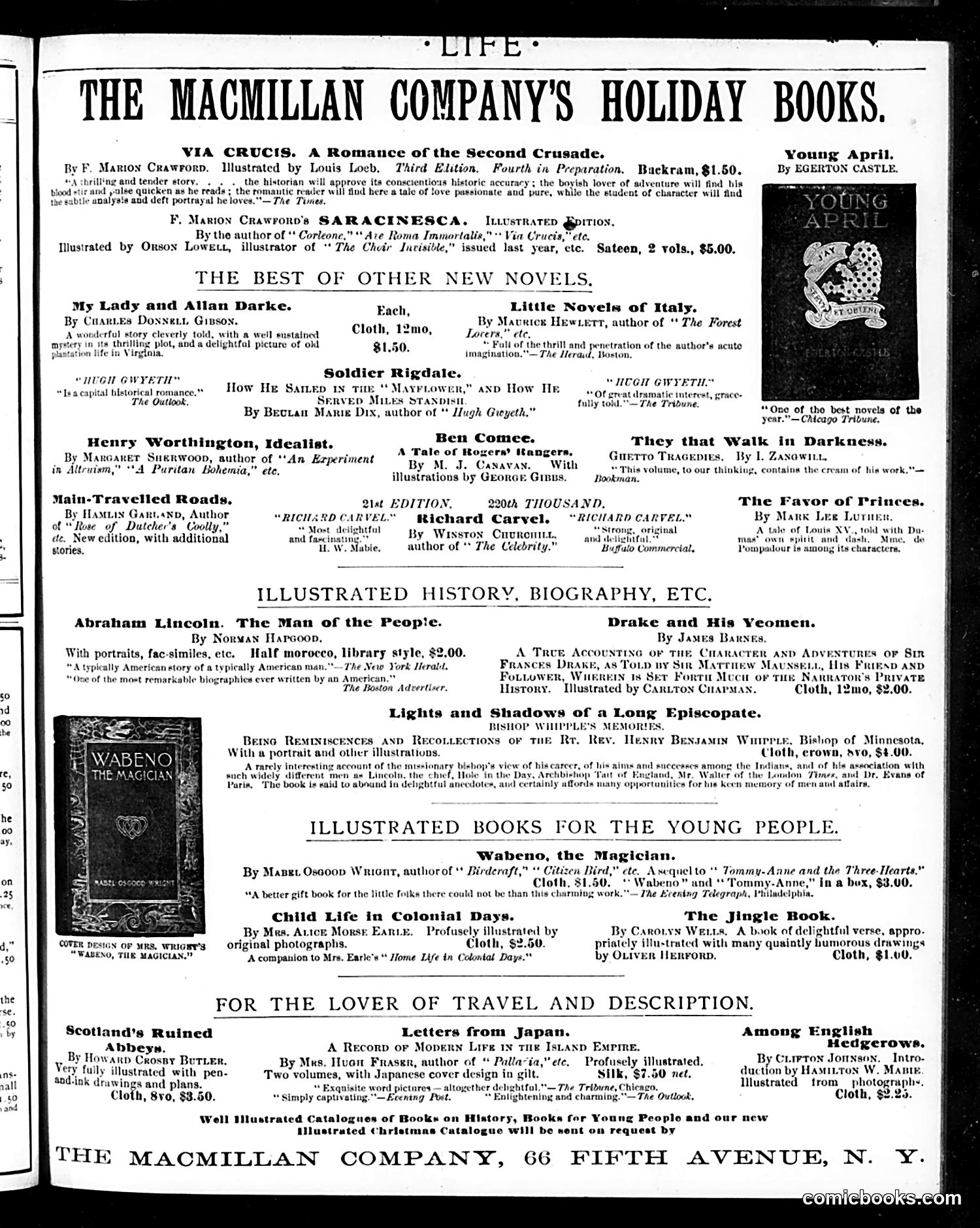
This page is **primarily advertising**, not political satire or cartoons. It's a book catalog from The Macmillan Company showcasing holiday books and literary releases for various audiences. The only illustrated element is a book cover for *"Wabeno, the Magician"* by Mabel Oswood Wright. The image shows a figure in dark robes—appearing to be a magician or mystical character—which is simply the book's cover art, not political commentary. The page lists novels, historical biographies, and children's literature available for purchase, with prices and brief descriptions. There is no political cartoon, no satirical commentary, and no historical references requiring decoding for modern readers—just commercial book promotion typical of early 20th-century magazine advertising.
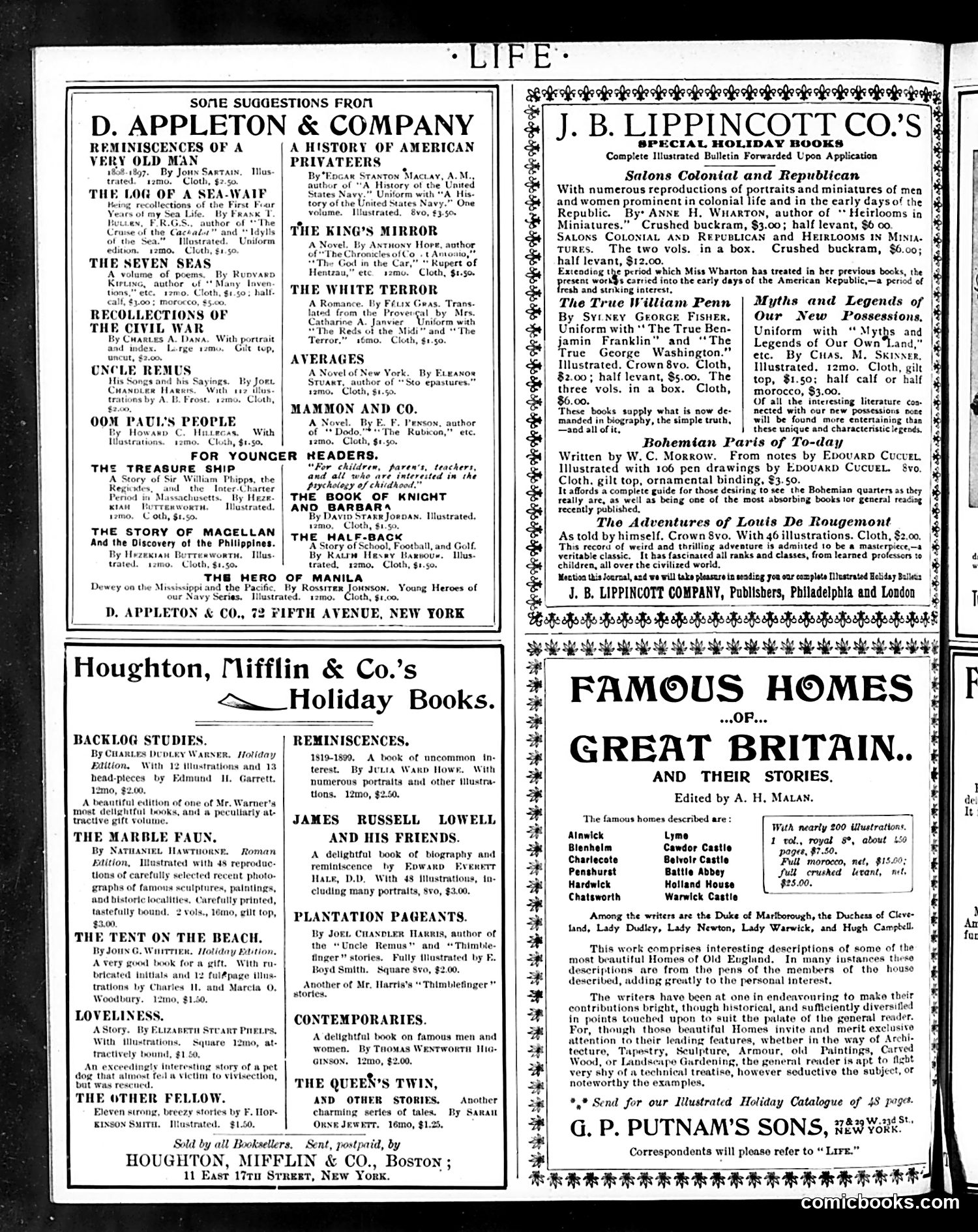
This page is **primarily advertising**, not satirical content. It contains book advertisements from four major publishers of the era: - **D. Appleton & Company** (top left): promoting books like "Reminiscences of a Very Idle Man" and "The Seven Seas" - **J.B. Lippincott Co.** (top right): holiday books including colonial and Revolutionary War histories - **Houghton, Mifflin & Co.** (bottom left): various titles like "Backlog Studies" and "The Tent on the Beach" - **G.P. Putnam's Sons** (bottom right): "Famous Homes of Great Britain and Their Stories" The advertisements emphasize gift-giving for the holiday season, featuring illustrated cloth-bound volumes typical of late 19th-century publishing. No political satire or cartoon commentary is present on this page.
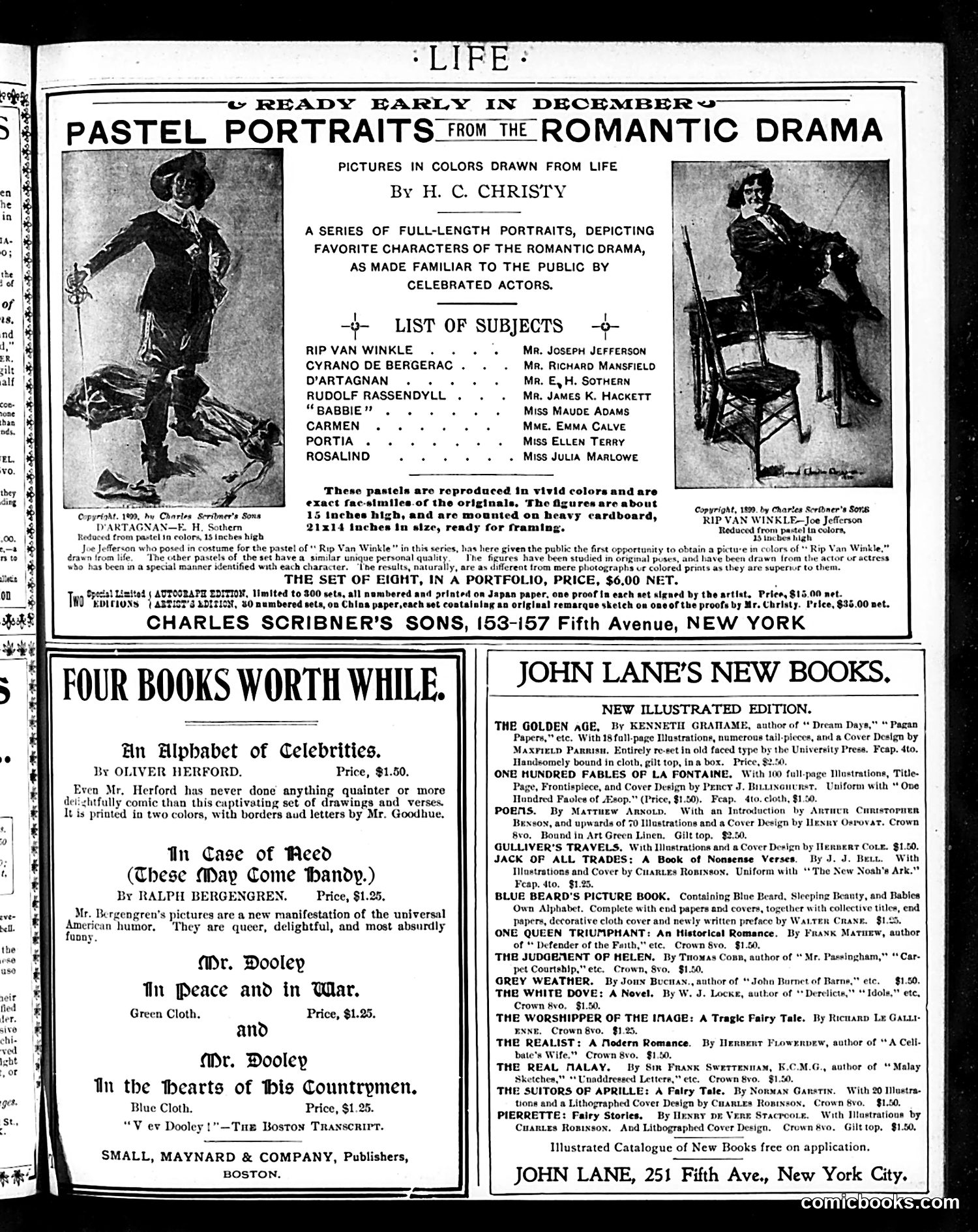
This page is primarily **advertising and promotional material**, not political satire. The top section advertises "Pastel Portraits from the Romantic Drama" by artist H.C. Christy—a series of full-length character portraits depicting roles from romantic theatrical productions, performed by celebrated actors of the era. The portraits shown are theatrical character studies rather than political commentary. The lower half contains book advertisements from publishers Small, Maynard & Company (Boston) and John Lane (New York), promoting illustrated editions and new releases including works on celebrities, humor, and romantic fiction. There is no political cartoon or satirical commentary visible on this page—it functions as a commercial advertising section typical of early 20th-century magazine layouts.
This page is primarily **advertising**, not satirical content. The top half features ads for art prints from Curtis & Cameron (Boston), and a competitive advertisement for the New York Evening Post newspaper, claiming it publishes "more live, reliable news each day than any other New York evening paper." The lower half announces **Pearson's Magazine's Christmas issue**, featuring: - An article on Queen Victoria ("Empress of India") - "My First Check" by various authors including Conan Doyle - "A Christmas Ghost Story" by J. Frankfort Moore - Content on the South African War - 112 pages and 100 pictures for 10 cents This represents typical early 1900s magazine promotion and commercial publishing competition rather than political satire.
This page is primarily **advertising and book promotions**, not political satire or cartoons. The upper section advertises four Christmas gift books from Harper & Brother Publishers, including "The Golfer's Alphabet" and "Peter Newell's Pictures and Rhymes." Below that is a promotion for "Sports and Games in the Open," a portfolio of drawings by A.B. Frost. The lower half contains Herbert S. Stone & Co.'s book list and Whiting Paper Company's stationery advertisement, emphasizing that "Whiting's Papers" represent "the standard of excellence" in stationery. **No political cartoons or satirical commentary appear on this page.** It's a commercial publication page typical of early 20th-century magazines, mixing editorial book reviews with advertising.
This is primarily a **Christmas advertising page** from Scribner's Magazine (published November 24th), not a political cartoon. The page promotes holiday books available from Charles Scribner's Sons publishers in New York City. The left side features **illustrated promotional content** including a sketch of a woman in Victorian-era dress (credited to C.D. Gibson) and mentions of contributing illustrators like Walter Appleton Clark and W. Glackens. The right side lists **book titles and authors**, including works by Robert Louis Stevenson, Thomas Nelson Page, and others—typical holiday gift suggestions for wealthy readers of the era. **No political satire is present.** This is straightforward commercial publishing promotion aimed at the holiday gift market.
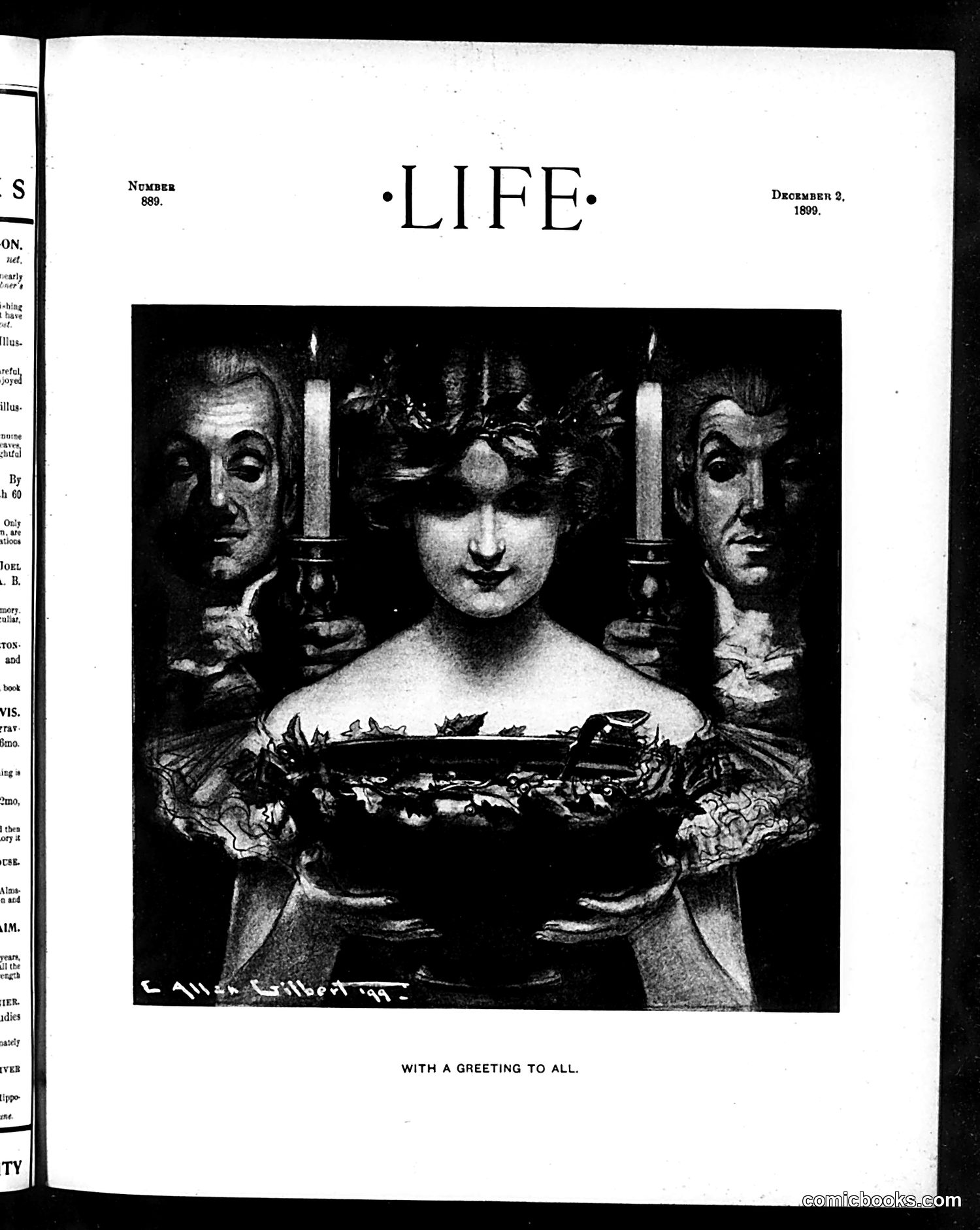
This is the cover of *Life* magazine (Number 689, December 2, 1899). The image shows a woman in the center, flanked by two male busts and holding what appears to be a wreath or garland, with candles on either side. The caption reads "WITH A GREETING TO ALL." Without additional context from the magazine's interior text, the specific identity of the woman and the satirical intent remain unclear from the image alone. The classical aesthetic—busts, candles, wreath—suggests either a holiday greeting or commentary on artistic/social matters typical of *Life*'s satirical coverage. The composition and formal presentation indicate this was likely a significant seasonal or cultural reference for 1899 readers, but the exact subject requires additional supporting information to identify with certainty.
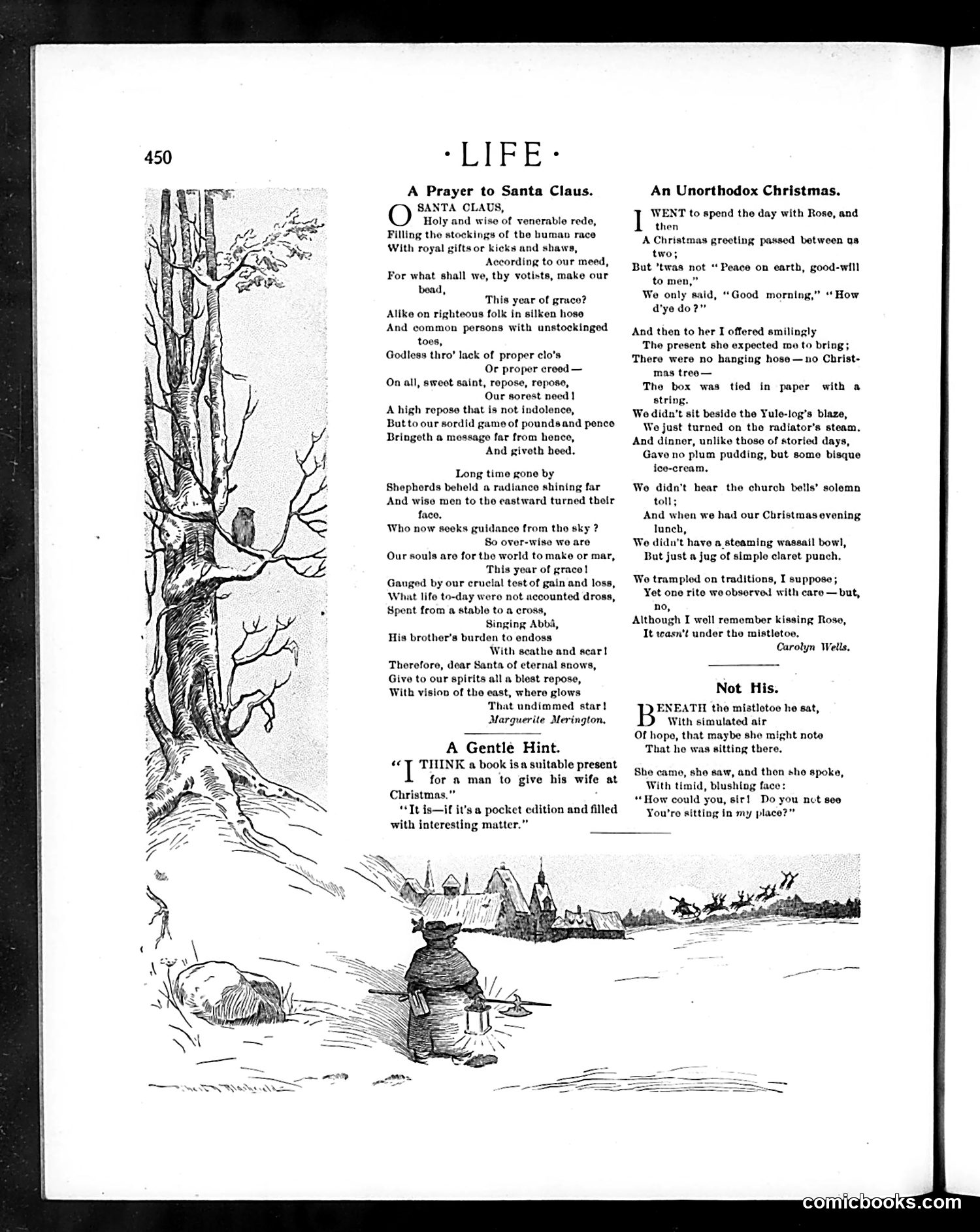
This page contains three separate pieces of Christmas-themed poetry and humor, not political cartoons: 1. **"A Prayer to Santa Claus"** by Marguerite Merington—a poem requesting Santa provide peace, righteousness, and spiritual guidance rather than material goods. 2. **"An Unorthodox Christmas"** by Carolyn Wells—a humorous poem describing a modest, secular Christmas celebration (no church, no fancy foods, no tree decorations) spent with someone named Rose. 3. **"A Gentle Hint"** and **"Not His"**—brief humorous prose pieces about gift-giving and mistletoe encounters. The illustrations are decorative: a bare winter tree and a snowman in a snowy landscape. The content reflects early-20th-century American Christmas customs and gentle domestic humor rather than political satire.
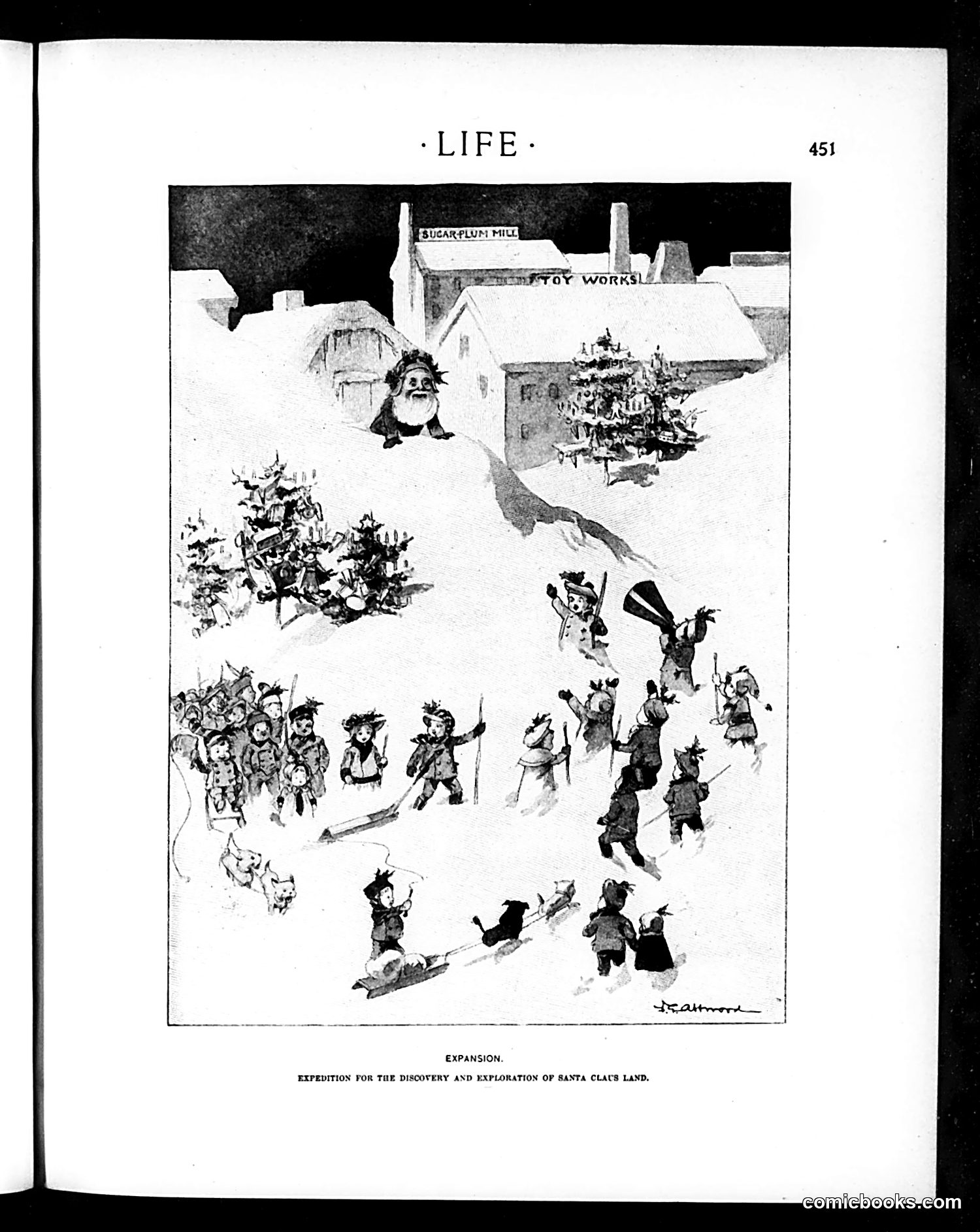
This satirical cartoon depicts an expedition into a snowy landscape with industrial buildings labeled "Sugar Plum Mill" and "Toy Works." Santa Claus appears as a large bearded head in the background, observing the scene below. The satire targets American expansionism by reimagining it as an "expedition" to colonize Santa's magical realm. Groups of figures—likely representing politicians, businessmen, or colonizers—trudge through snow with various implements, suggesting they're claiming or industrializing this fantastical territory. The joke critiques how American industrial expansion and imperial ambitions treat distant lands as resources to be discovered and exploited, even applying this logic to the mythical North Pole itself. It's political commentary disguised as whimsical holiday humor.
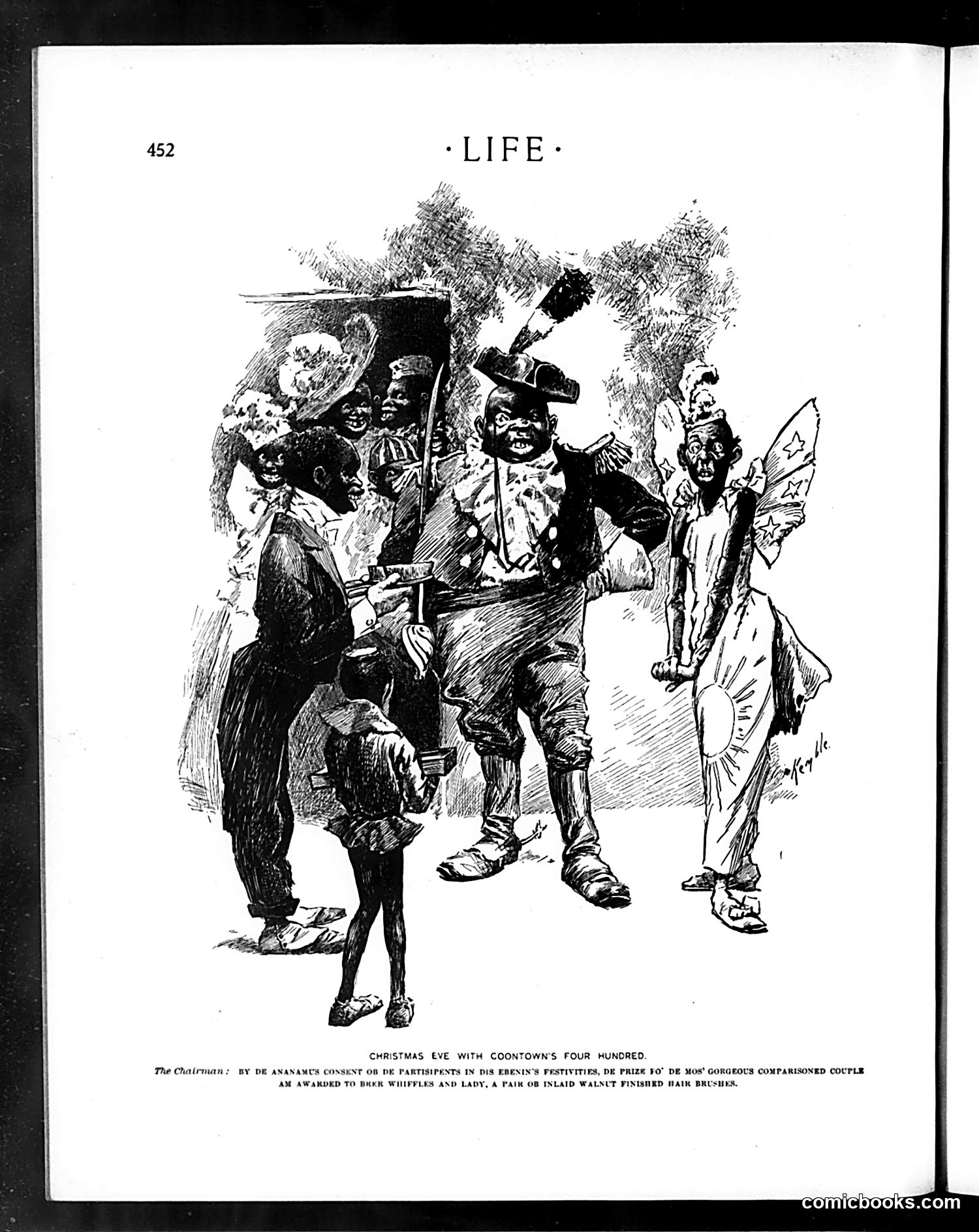
This is a satirical illustration titled "Christmas Eve with Coontown's Four Hundred," depicting a parade of caricatured Black figures in exaggerated dress and poses. The caption identifies "The Chairman" and references "de Anana's consent or de partisipants in dis ebonics festibities," employing racist dialect humor typical of early 20th-century American satire. The cartoon mocks Black high society and aspirations to respectability through grotesque caricature. The marching figures wear formal military uniforms and fancy clothing, which the illustration presents as ridiculous pretension. The work exemplifies the deeply racist humor that Life magazine published, using dehumanizing imagery and dialect to demean Black Americans' social gatherings and status-seeking.
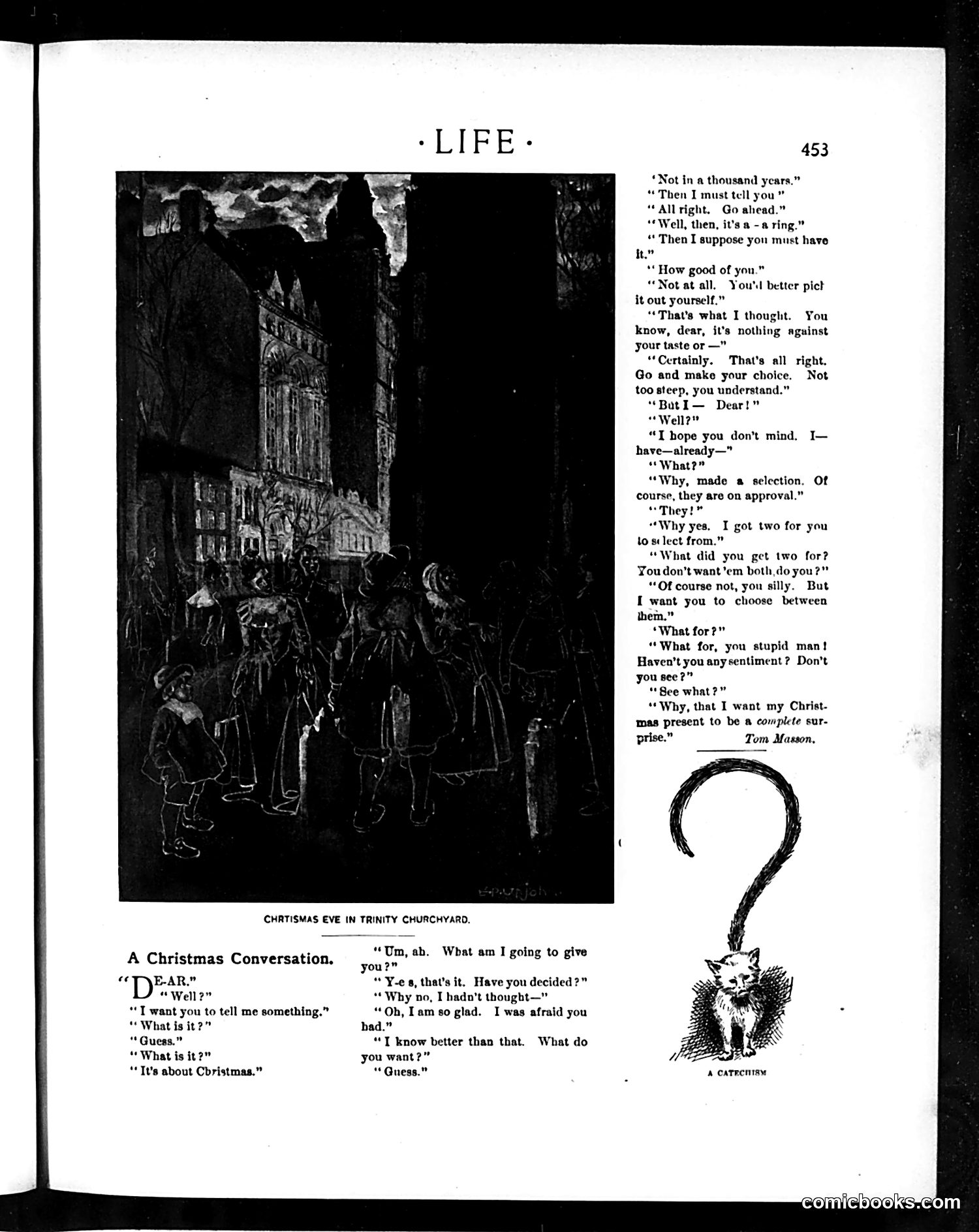
This page presents a satirical dialogue about Christmas gift-giving expectations, likely from the early 20th century. The conversation depicts a woman who has already selected *two* engagement rings for her boyfriend to choose from—framing his selection as his "gift" to her while maintaining the fiction that *she* is surprising *him*. The humor satirizes: 1. **Gender dynamics in courtship**: The woman controls the entire process while the man passively complies, despite his bewilderment ("What for, you stupid man!") 2. **Commercial Christmas**: The exchange reduces romance to purchased goods, with the woman's desire for a "complete surprise" being contradictory and absurd—she's orchestrating everything. 3. **Relationship power imbalances**: Her confident manipulation suggests women's strategic use of sentiment and gift-giving rituals to achieve desired outcomes. The accompanying illustration of Trinity Churchyard provides festive context. Tom Masson is credited as the author. The tone is gently mocking toward both parties—her transparent scheming and his resigned acceptance.
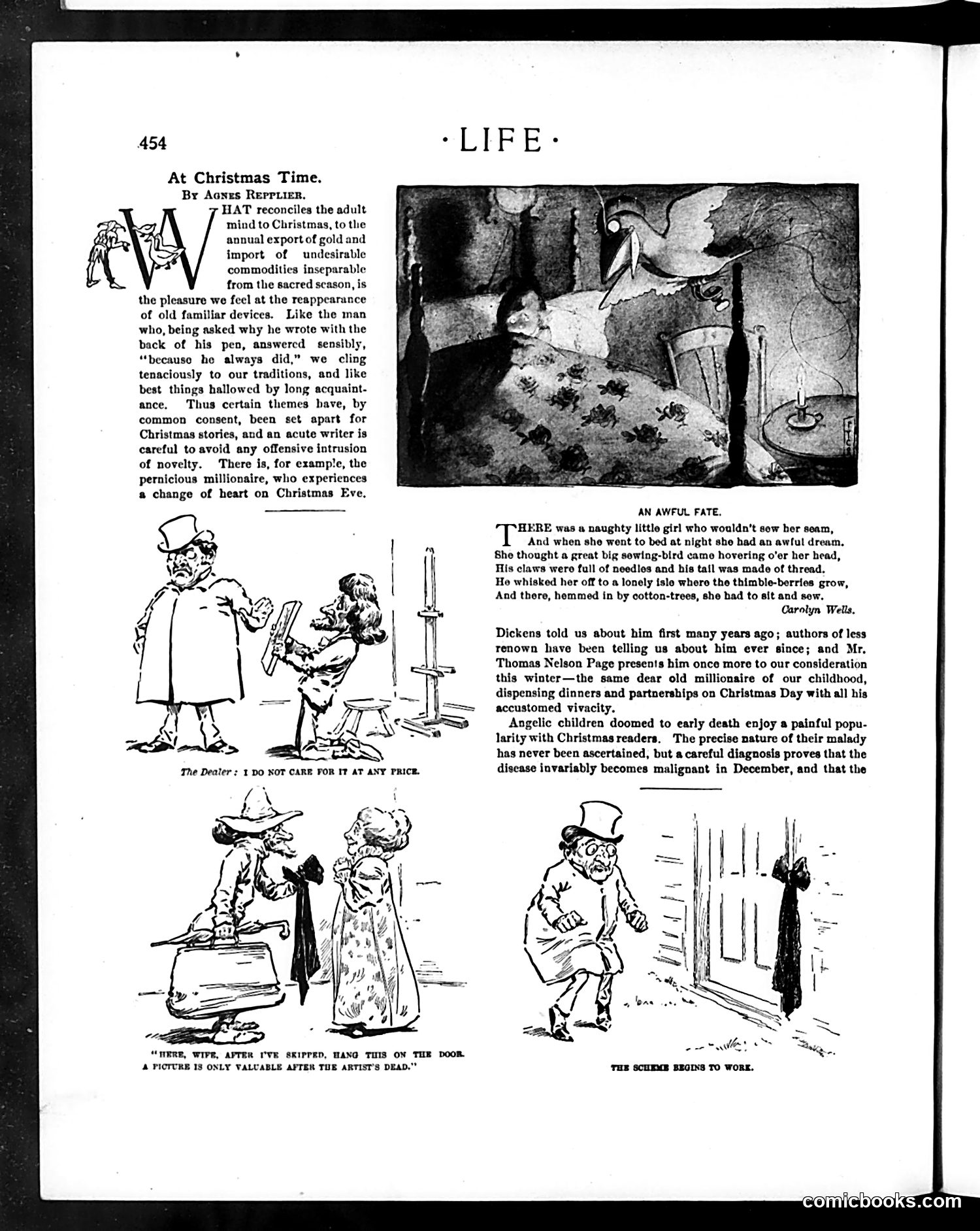
This is a satirical article about Christmas literary conventions by Agnes Repplier. She mocks how writers predictably recycle the same tired Christmas story tropes: the wealthy miser who experiences a sudden moral reformation on Christmas Eve (a reference to Dickens's *A Christmas Carol*), and sickly angelic children who conveniently die around December to maximize pathos. The accompanying illustrations are humorous social commentary. One shows a wealthy man ("The Dealer") indifferent to art's value during life. Another depicts the absurd children's poem "An Awful Fate"—a girl punished in a dream for not sewing, trapped on an island hemmed by cotton-trees, forced to sew endlessly. The satire works on two levels: Repplier criticizes both authors' lazy reliance on formulaic Christmas sentimentality, and the illustrations mock bourgeois values (treating art as mere investment, enforcing rigid gender roles through children's literature). The overall message: Christmas fiction had become exhaustingly predictable and moralistic.
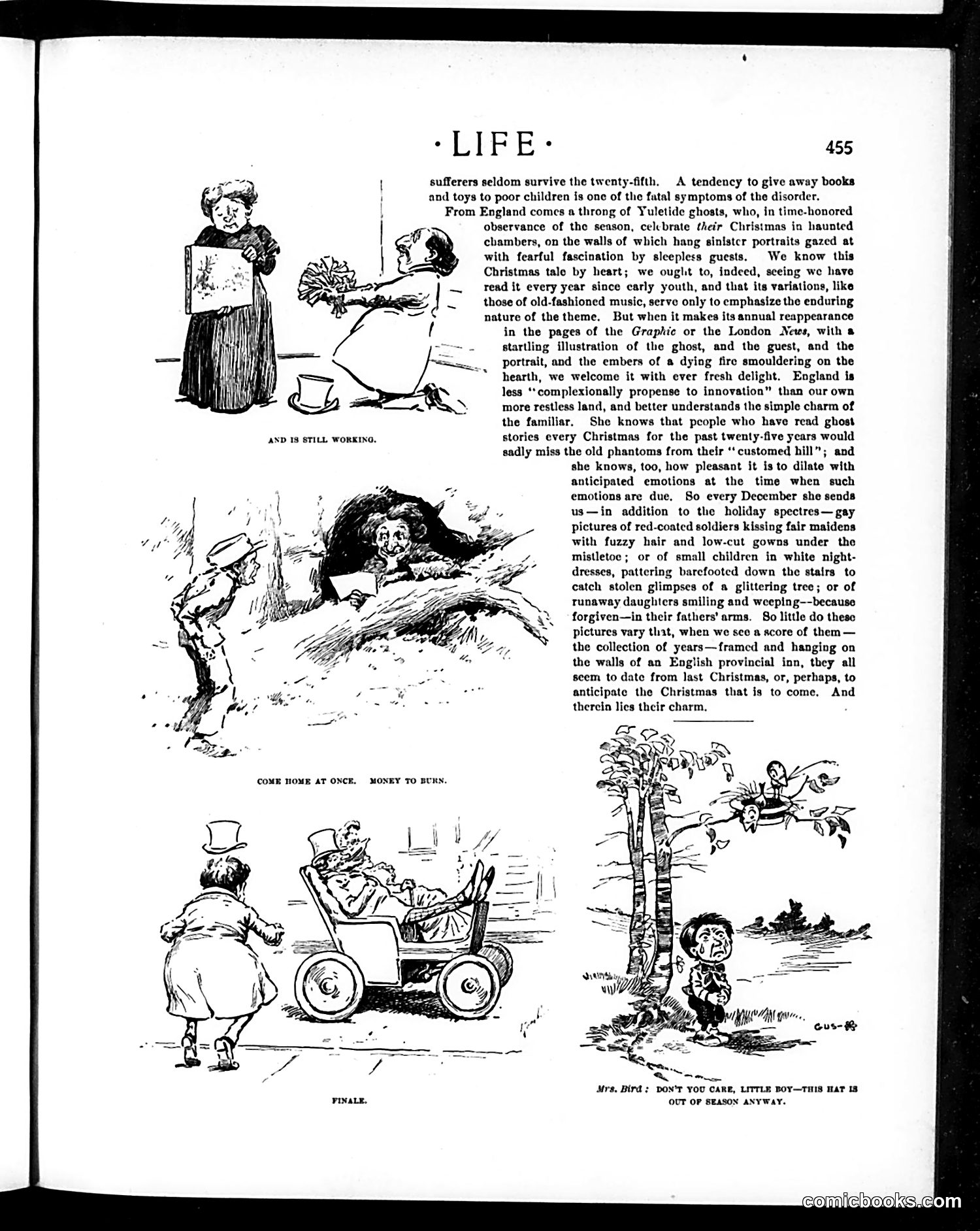
This page celebrates English Christmas traditions and sentimentality. The text praises how England annually reprints familiar Victorian ghost stories and holiday illustrations—despite their predictability, readers welcome the repetition because it's comforting and tradition-bound. The main cartoons illustrate Christmas themes: the top image shows "And Is Still Working" (a ghost or supernatural figure); the middle depicts "Come Home at Once" and "Money to Burn" (scenes of domestic holiday activity); and the bottom shows "Finale" with what appears to be a well-dressed man and carriage, plus a separate scene labeled "Mrs. Bird: Don't You Care, Little Boy—This Hat Is Out of Season Anyway" showing social commentary on class and propriety. The overall satire gently mocks England's preference for predictable, sentimental holiday traditions over American restlessness for novelty—suggesting that familiarity and repetition are features, not bugs, of English cultural life.
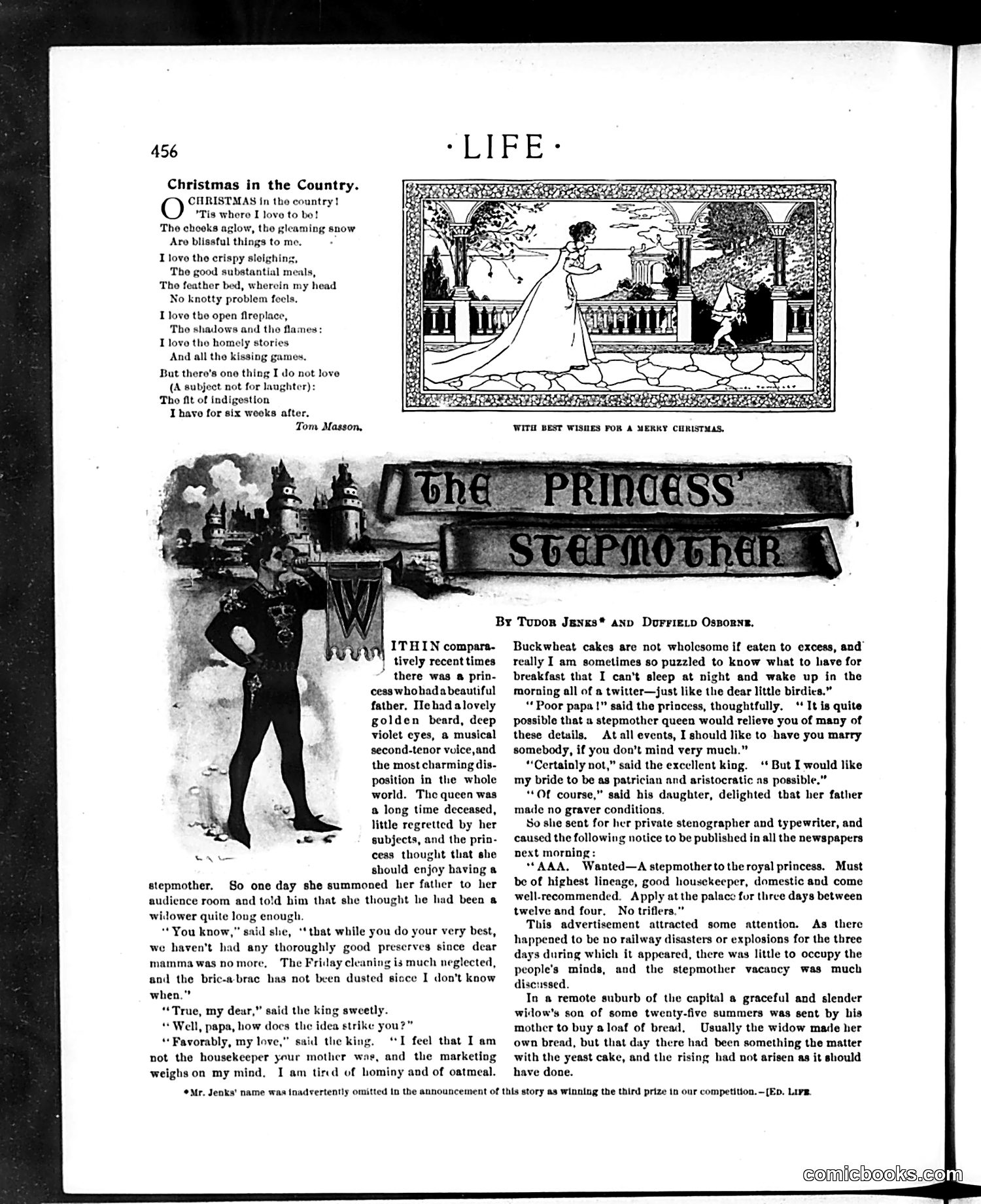
This page contains two separate pieces of satirical content: **Top: "Christmas in the Country"** — A humorous poem by Tom Masson that romanticizes rural Christmas (sleighing, fireplaces, home cooking) but reveals the joke in the final lines: the narrator suffers six weeks of indigestion afterward. The satire mocks sentimental nostalgia for country life while acknowledging its physical toll. **Below: "The Princess and Stepmother"** — A serialized fairy tale parody by Tudor Jenks and Duffield Osborne. The story inverts traditional stepmother narratives: here, a *princess* actively recruits a stepmother to relieve her widowed father of domestic burdens (preserves, cleaning, marketing). The opening establishes a beautiful, beloved king and suggests the tale will mock either romantic expectations or class pretensions—the narrative begins introducing a widow's son, likely foreshadowing an unconventional resolution to the "stepmother" search. Both pieces employ gentle satire typical of *Life* magazine's humor.
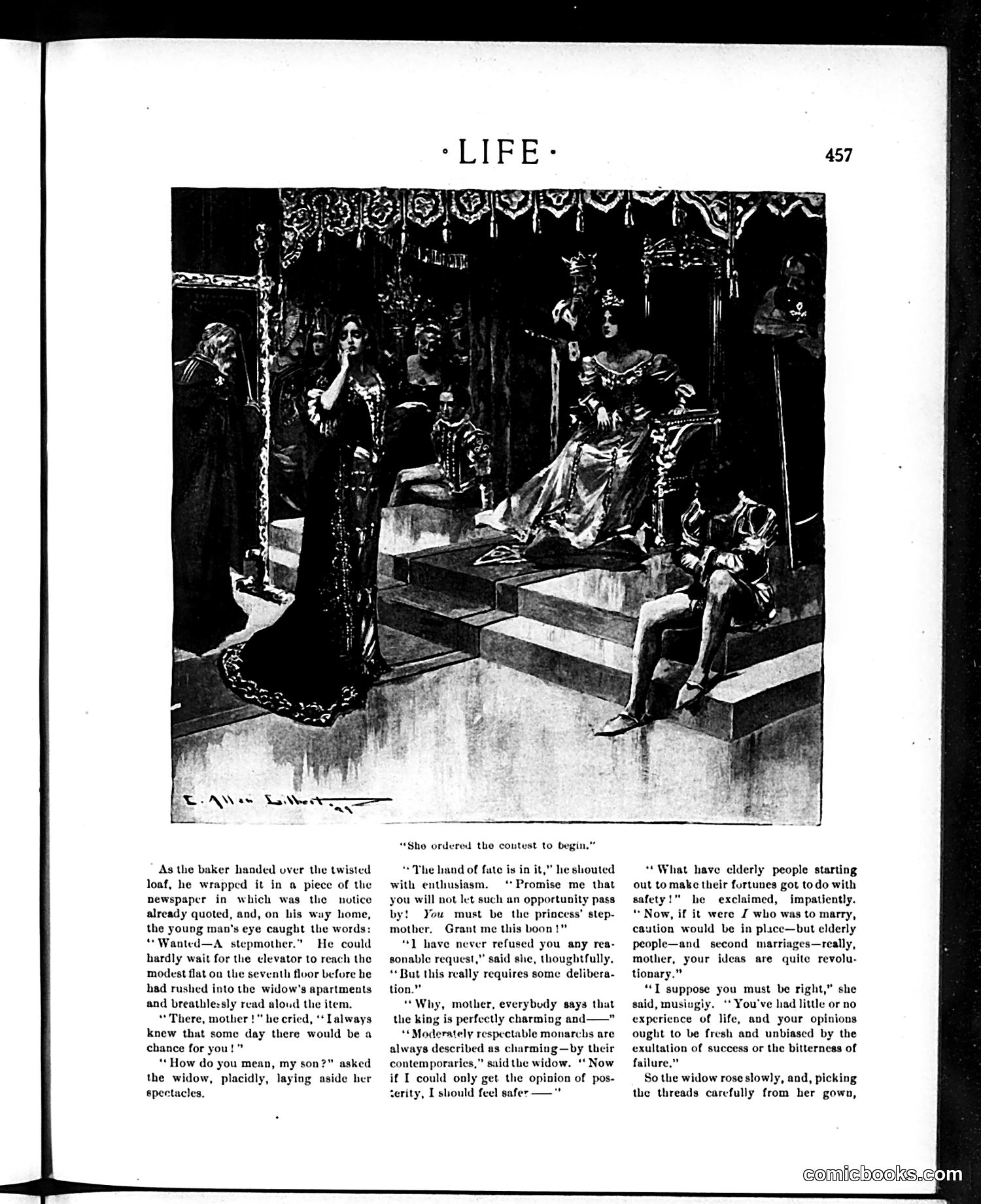
This is a satirical domestic comedy scene depicting a young man urging his widowed mother to enter a "contest" to become a princess's stepmother after seeing a newspaper advertisement. The humor operates on multiple levels: **The Setup:** A baker's casual newspaper wrapping becomes the catalyst for the son's scheme—a classic device mocking how ordinary people chase unlikely opportunities. **The Satire:** The widow's cautious, sardonic responses mock both her son's naive enthusiasm and society's attitudes toward remarriage. Her quip about needing "posterity's opinion" before marrying a monarch satirizes how people seek external validation for major life decisions. **The Social Commentary:** The piece gently ridicules class ambitions—the idea that a modest widow might become a princess through marriage—while also poking fun at elderly women's actual limited life choices and society's dismissal of their perspectives as irrelevant ("your ideas are quite revolutionary"). The artwork shows an ornate royal throne room, visually contrasting the widow's humble circumstances with this fantastical aspiration, emphasizing the absurdity of the scenario.
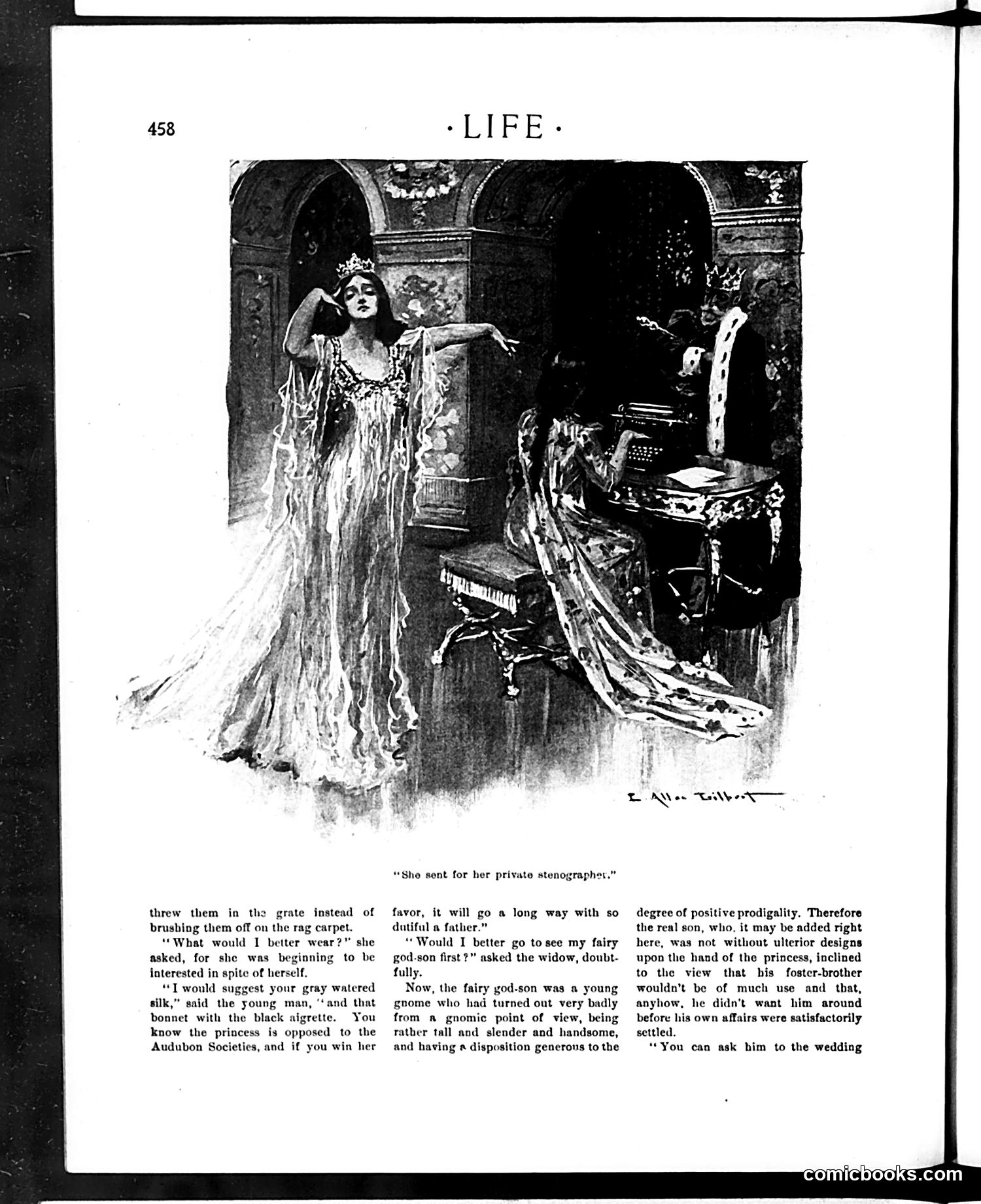
This page presents a serialized story (likely fairy-tale inspired) rather than political satire. The illustration shows a woman in an elaborate gown consulting with a young man about her appearance for an important social engagement—apparently meeting a princess. The narrative concerns a widow preparing to win favor with a princess by wearing specific attire (gray silk and a feathered bonnet). A key detail reveals satire of the **Audubon Societies**—conservation groups protecting birds. The young man suggests the princess opposes them, implying the princess would favor someone wearing bird feathers (an aigrette), mocking both the princess's apparent hypocrisy and the fashion industry's conflict with bird conservation. The subplot involves a "fairy god-son" (a gnome character) whose generosity makes him a liability to the widow's biological son, who has romantic designs on the princess and wants to keep his rival away during courtship negotiations. The tone is light domestic comedy with gentle social commentary on fashion, conservation, and family scheming.
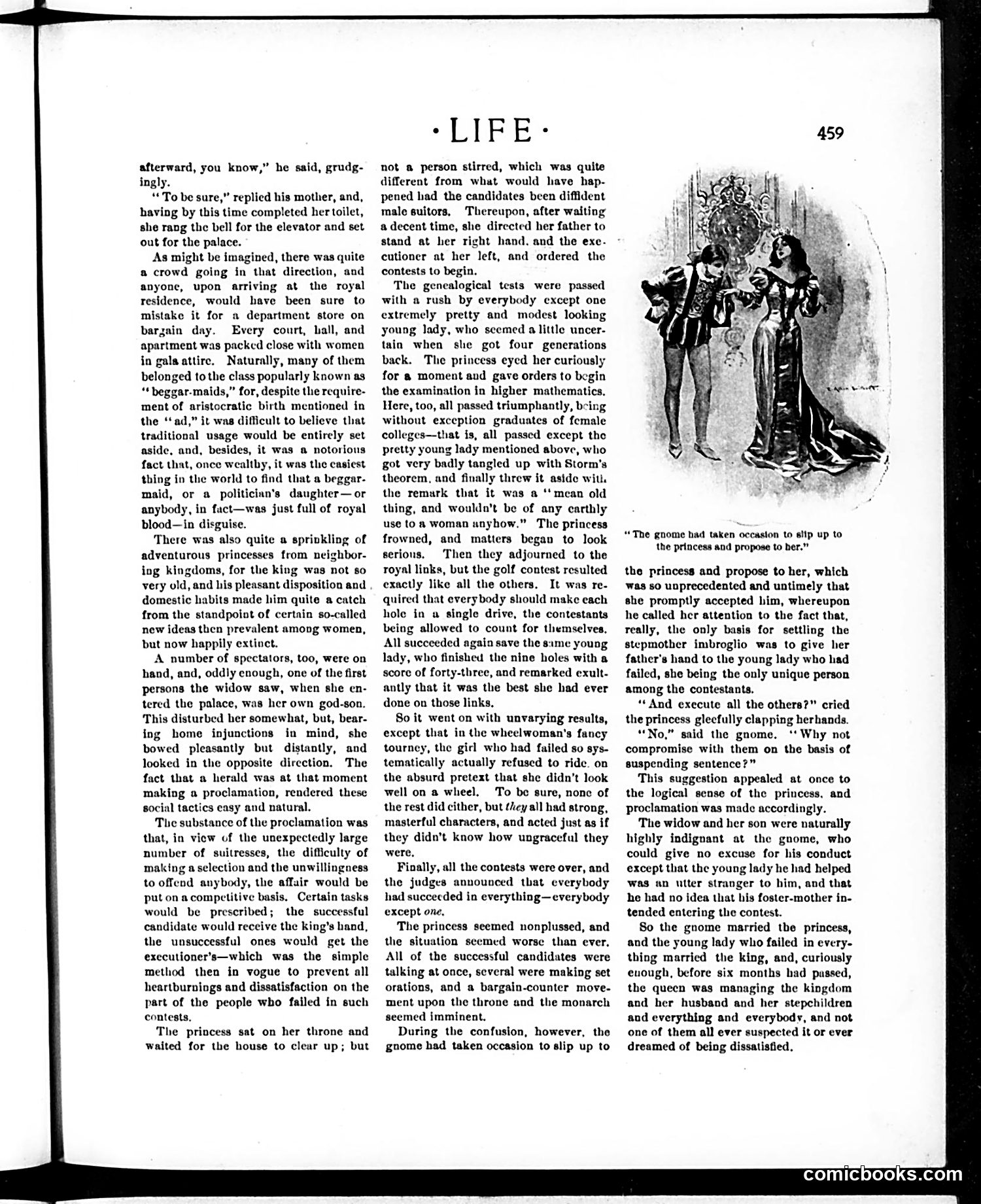
This page from *Life* magazine presents a fairy-tale satire mocking women's education and suffrage debates of the early 20th century. The story describes a princess holding contests to select a husband, with female candidates competing in genealogy tests, mathematics (referencing "Storm's theorem"), and golf. One "pretty and modest" young woman consistently fails—unable to trace her ancestry properly, struggling with mathematics, and scoring poorly at golf. The satire targets contemporary arguments about women's intellectual capacity. By having the princess's contests expose gaps in women's education (particularly the beautiful but unprepared candidate), the story likely ridicules both: 1. **Anti-suffrage arguments** claiming women lacked education for civic participation 2. **Pro-suffrage rhetoric** emphasizing women's college education as proof of capability The absurdist setup (execution as penalty for losing) exaggerates the stakes of these debates, suggesting the deadly seriousness with which society viewed women's educational and political roles during this era.
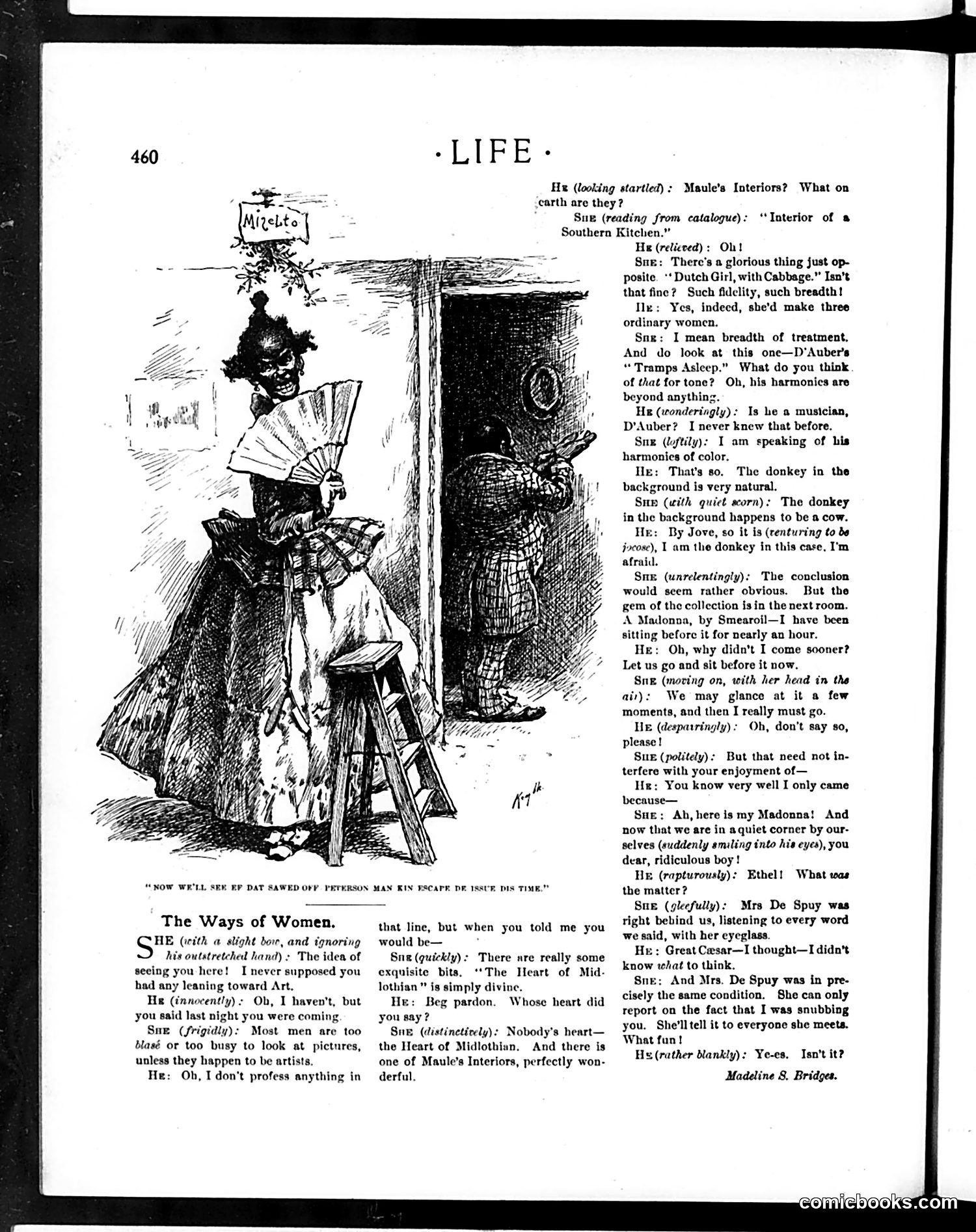
This comic dialogue satirizes both artistic pretension and female duplicity. A man attends an art exhibition with a woman named Sue, who deliberately affects sophisticated knowledge of paintings—discussing "harmonies of color" and works like "The Heart of Midlothian"—while the man reveals his ignorance (confusing a cow with a donkey, not recognizing artistic terms). The joke's twist: Sue has orchestrated the entire encounter to publicly *snub* him in front of Mrs. De Spuy, a gossip with an eyeglass. She pretended romantic interest solely to humiliate him socially, then gloats about the deception when they're briefly alone. The man's bewildered final response suggests he's been thoroughly manipulated. The satire targets both Gilded Age artistic snobbery and the era's anxieties about female social scheming—portraying women as calculating manipulators beneath their refined exteriors.
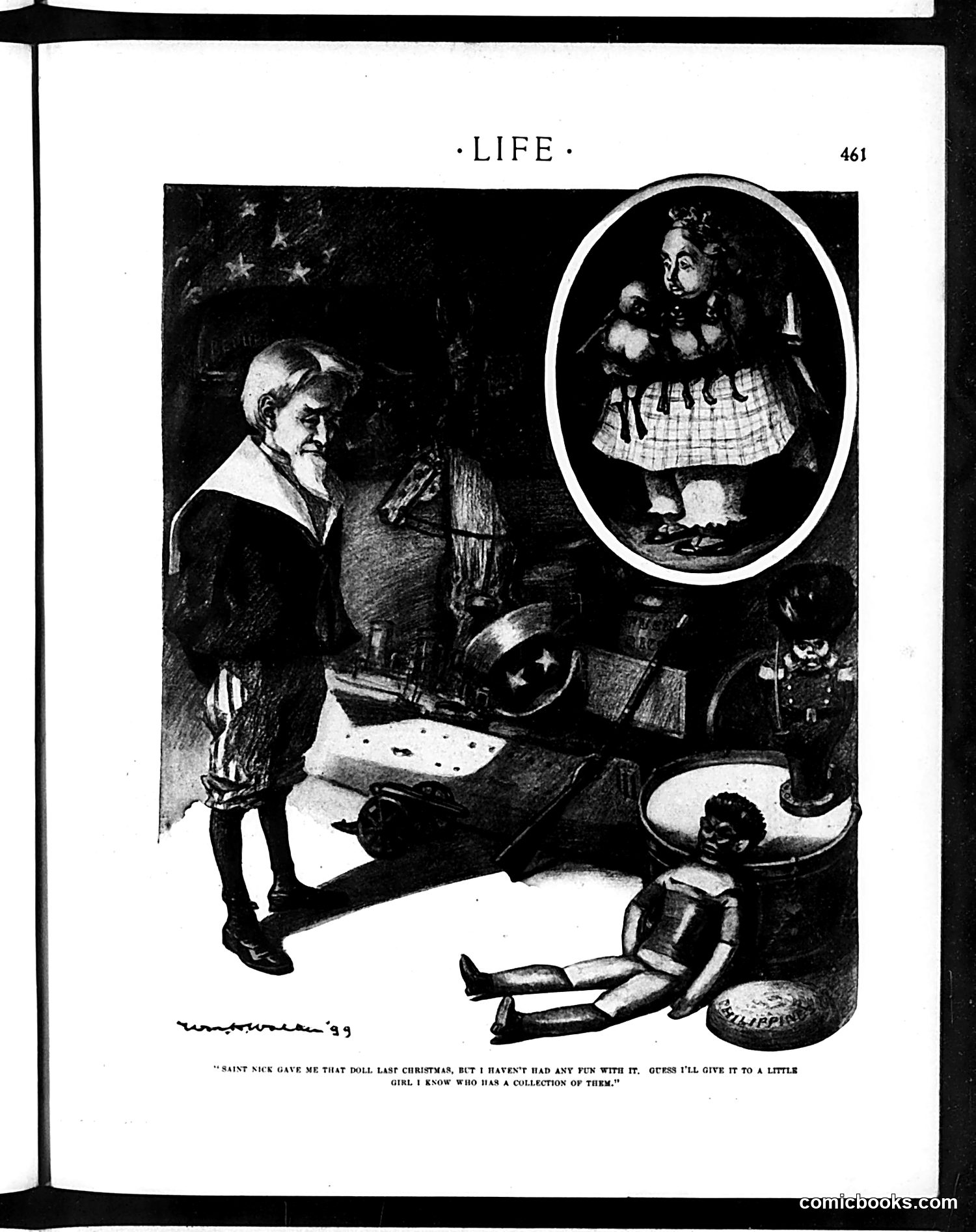
This is a Christmas-themed satirical cartoon showing a wealthy boy (left) discussing giving away a doll to a poor girl who collects them. The boy, surrounded by expensive toys and luxuries (evident from his well-appointed setting), casually mentions passing along last year's gift because he hasn't played with it. The satire targets class disparity and childhood privilege: the boy's casual disregard for a gift that would be treasured reflects upper-class indifference to material abundance, while the poor girl's "collection" of dolls—likely cast-offs—represents making do with others' discards. The cartoon critiques both the wasteful consumption of wealthy children and the stark economic inequality of the era, where one child's surplus becomes another's prized possessions.
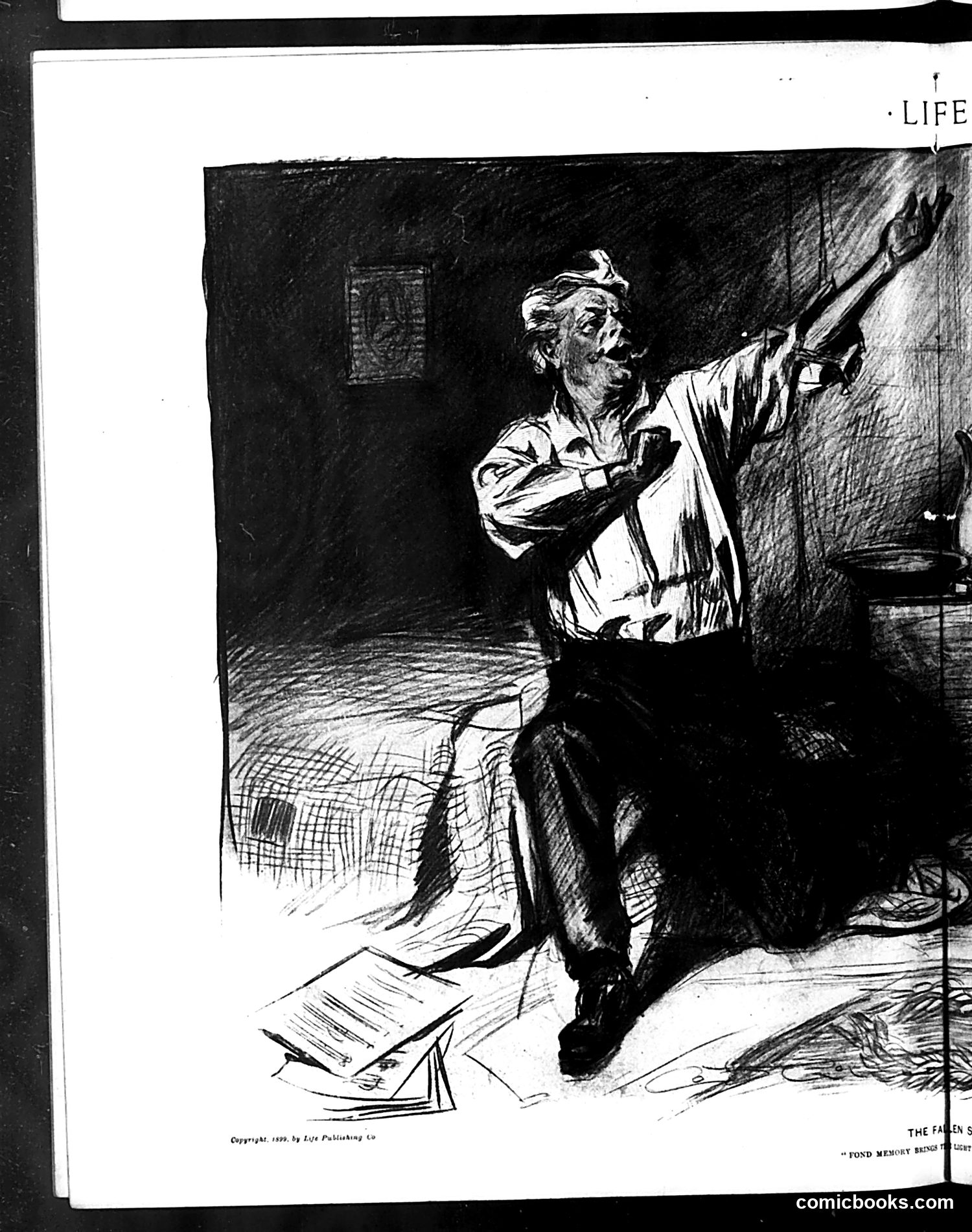
This is a satirical illustration from *Life* magazine showing an older man in work clothes, kneeling or crouching in what appears to be a sparse room. He's gesturing upward expressively while papers lie scattered on the floor before him. The caption reads "FOND MEMORY" (partially visible as "FOND MEMORY B)"), suggesting this depicts someone nostalgically recalling the past. The man's posture and animated gesture suggest he's reminiscing—perhaps about better times or past accomplishments. The sparse setting and worn appearance suggest themes common to *Life's* social satire: economic hardship, aging, or the gap between past aspirations and present circumstances. Without the full context or visible date, the specific historical reference remains unclear, though the style suggests early-to-mid 20th century publication.
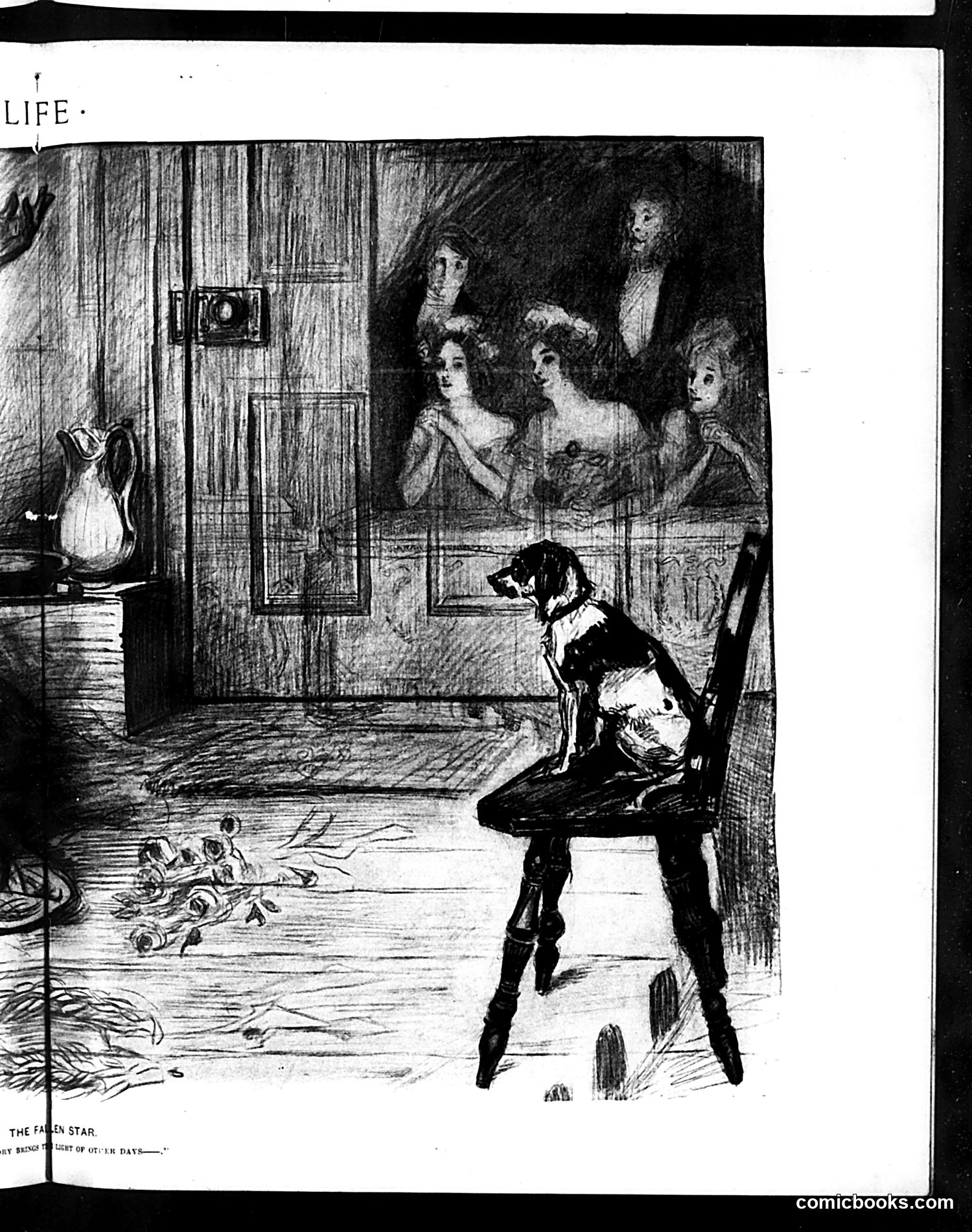
This appears to be a satirical illustration from Life magazine titled "The Fallen Star." The image shows a well-dressed man sitting on a chair, observed by several fashionably-dressed women visible through a doorway or window behind him. A dog sits nearby on the floor, along with scattered flowers. The cartoon likely satirizes a once-famous entertainer or public figure whose career has declined ("fallen"). The contrast between the women's interest in observing him and his diminished circumstances—reduced to being watched like a curiosity—suggests mockery of faded celebrity or lost social status. The dog's presence alongside the flowers may emphasize his reduced dignity. However, without additional context or identifying captions, I cannot specify which historical figure this references.
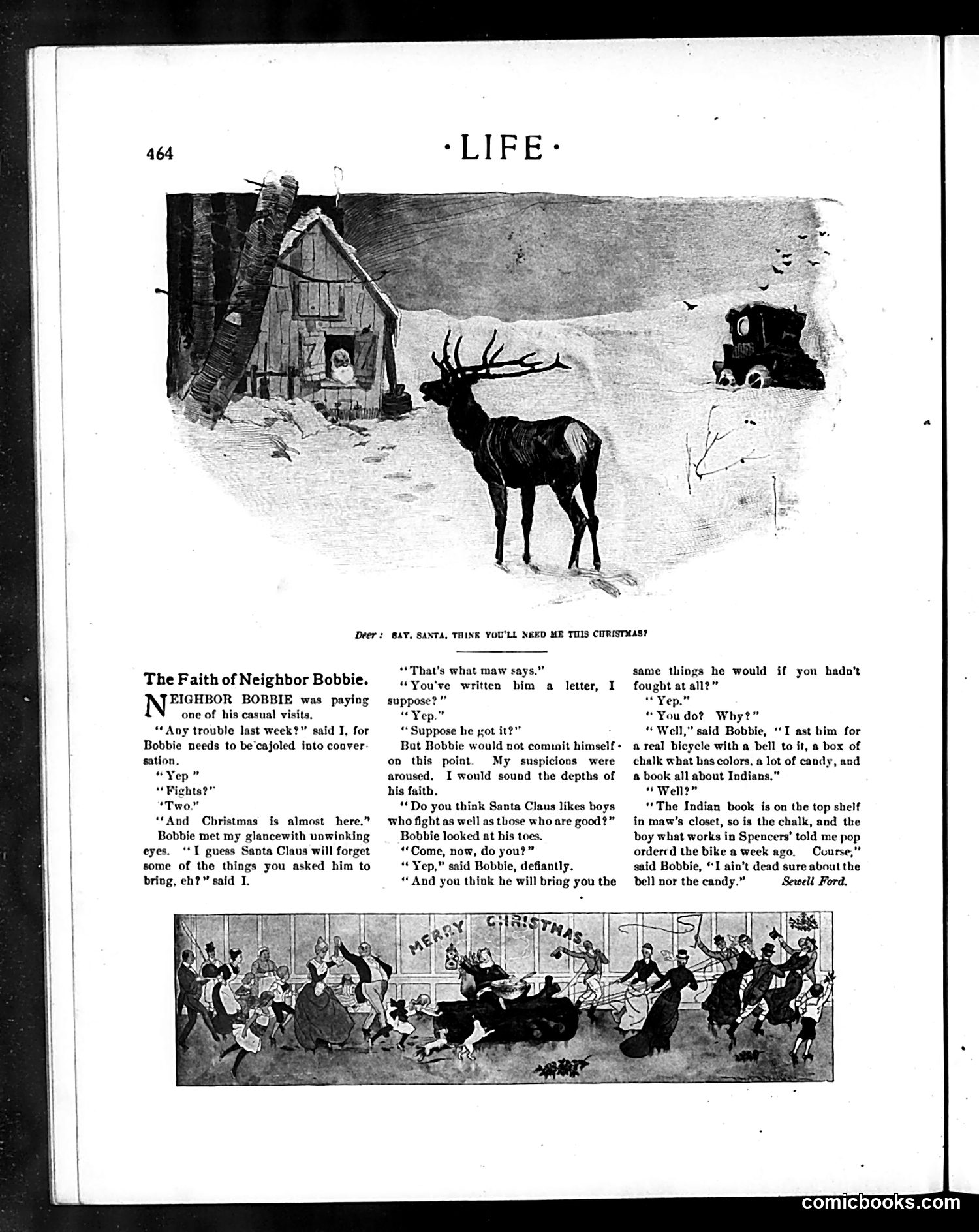
This is a humorous dialogue story about a tough neighborhood boy named Bobbie who has been fighting but still expects Santa Claus to bring him Christmas gifts. The narrator tests Bobbie's faith by asking whether Santa rewards good behavior, implying that fighting might disqualify him. The joke's punchline reveals Bobbie's shrewd, unsentimental pragmatism: he's already discovered that his parents have purchased most of his requested gifts (the bicycle, Indian book, and colored chalk are already hidden or ordered). He remains only uncertain about minor items like the bell and candy—the things genuinely dependent on Santa's goodwill. The satire gently mocks both childish naïveté about Santa and working-class children's street-smart awareness. The two illustrations show snowy rural/small-town Christmas scenes. The humor lies in Bobbie's faith being less about Santa's moral judgment and more about his practical knowledge that adults, not magic, provide gifts.
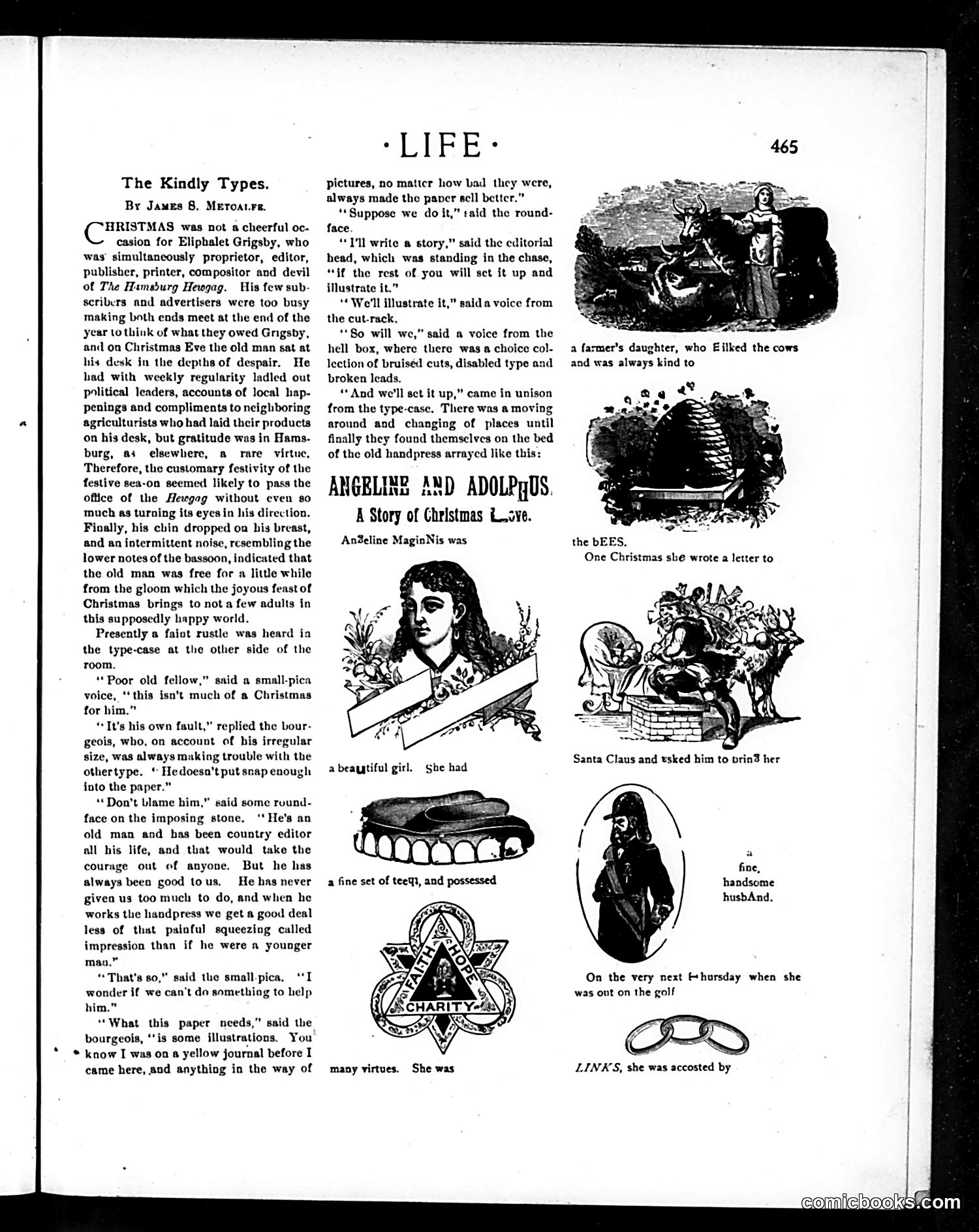
This is a satirical story about personified printing type rallying to help their struggling employer, a country newspaper editor named Eliphalet Grigsby. The narrative conceit is that different pieces of type—the bourgeois, small-pica, and type from the hellbox—gain consciousness and decide to boost morale by creating an illustrated story called "Angeline and Adolphus: A Story of Christmas Love." The satire targets the newspaper industry's struggles and sentimentality. The various illustrations accompanying the narrative (a farmer's daughter, Santa Claus, a gentleman caller with "links") depict the melodramatic story the type collectively manufactures. The joke critiques both the desperation of small-town journalism and the formulaic, sentimental fiction considered "good for circulation"—the bourgeois type explicitly notes that illustrations and stories "always made the paper sell better," regardless of quality.
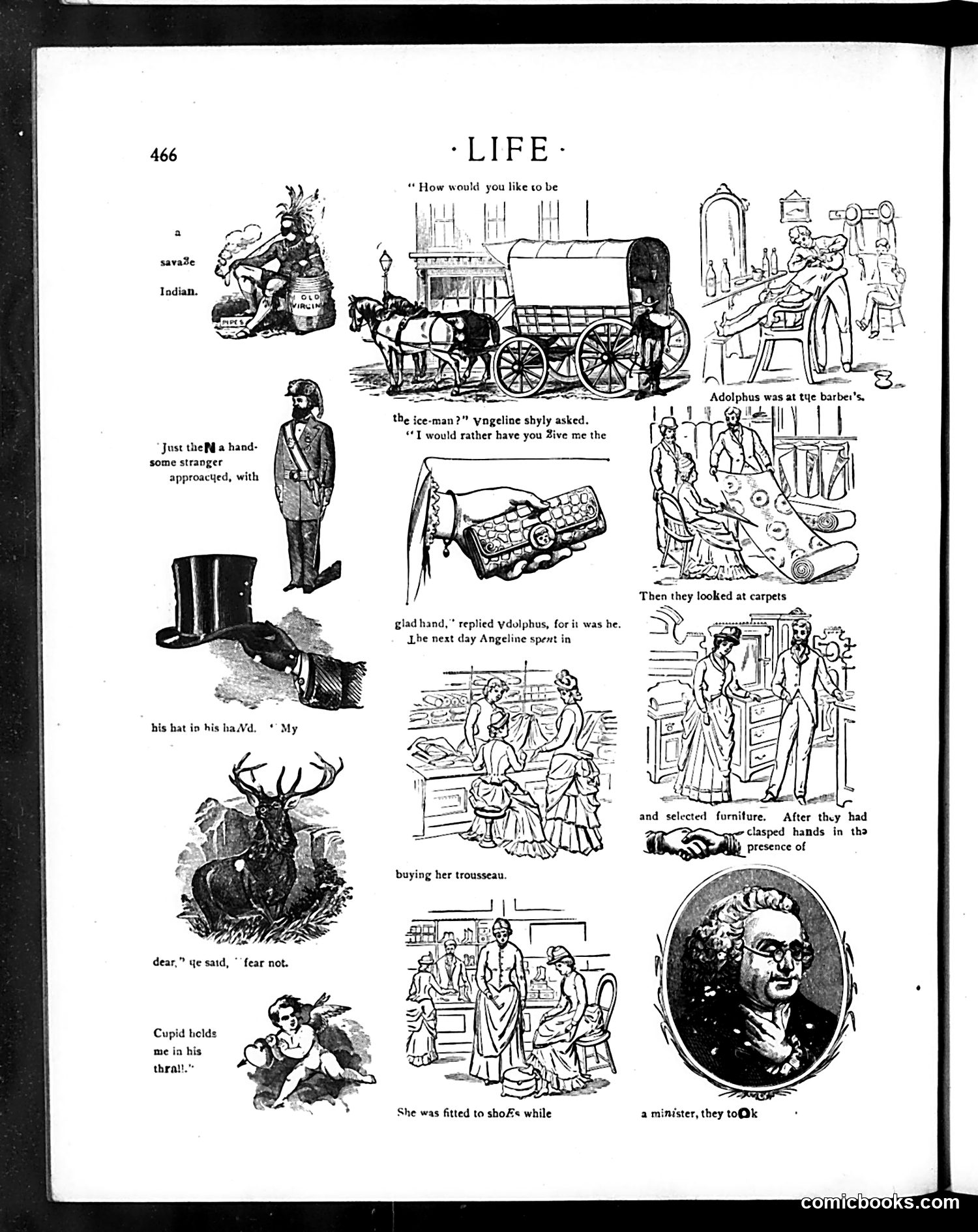
This page presents a serialized romantic comedy strip titled "How would you like to be the ice-man?" The narrative follows a courtship: Angeline shyly proposes to a handsome stranger named Adolphus, who agrees to marry her. The couple then engages in typical Victorian-era preparations—shopping for carpets, furniture, and clothing—before a minister conducts their wedding ceremony. The satire targets romantic fiction conventions and the materialism surrounding marriage. The "ice-man" opening suggests Angeline is proposing unconventional life scenarios, while the subsequent scenes mock the emphasis on acquiring possessions and formal procedures that supposedly constitute happiness. The illustrative vignettes on the left (a "savage Indian," a well-dressed gentleman, a stag, and Cupid) appear to reference classical romantic archetypes, further satirizing sentimental storytelling traditions popular in the era.
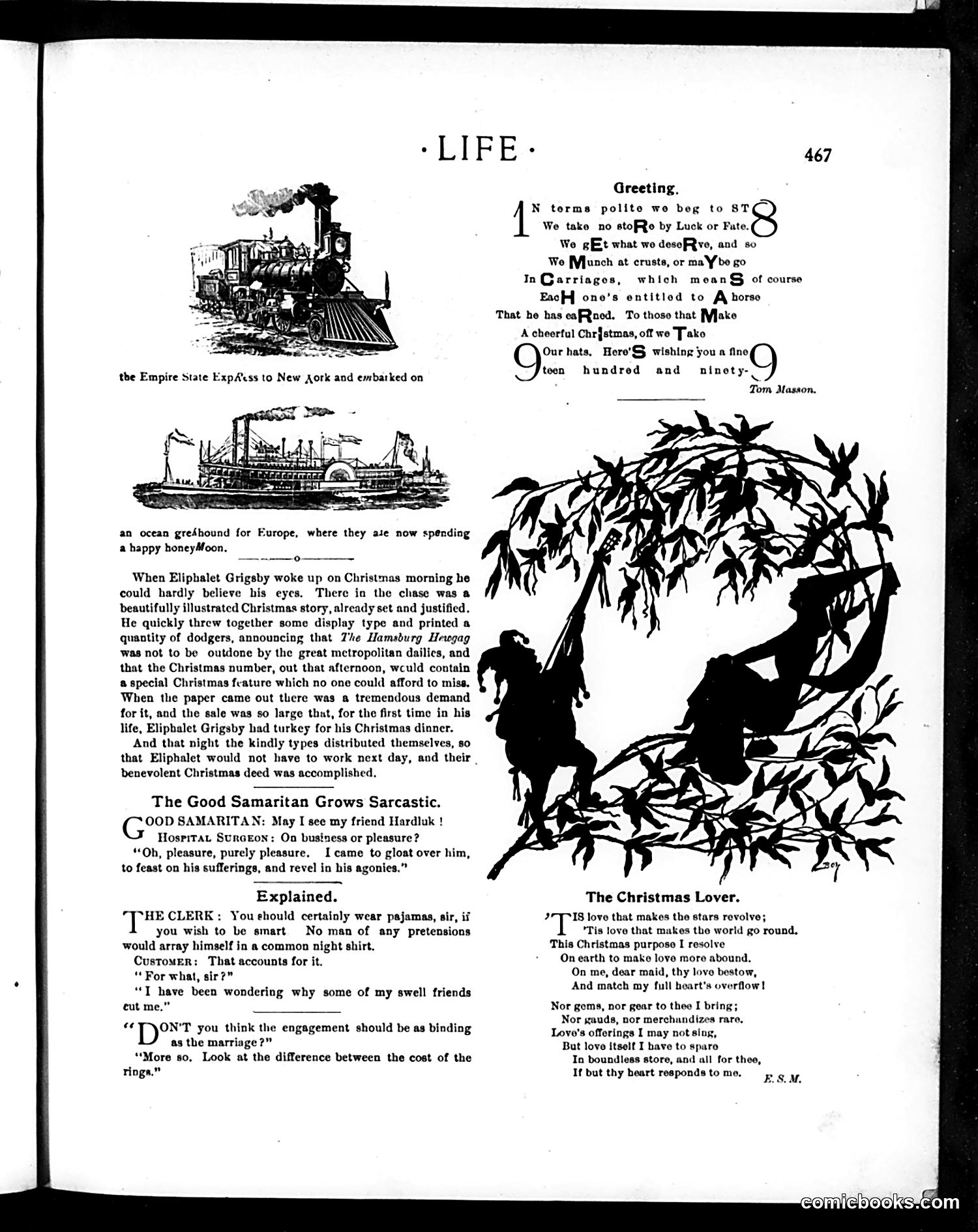
This page from *Life* magazine contains several satirical pieces and illustrations typical of early 20th-century American humor: **Top section:** A greeting poem mocking social pretension—the joke being that people claim to earn their luxuries through merit ("what we deserve") while actually relying on luck and circumstance. **Middle story:** "Eliphalet Grigsby" is a satirical tale about a small-town newspaper editor who prints a Christmas story and suddenly becomes successful and prosperous. It mocks provincial ambitions and suggests that even humble editors desire the metropolitan dailies' success. **"Good Samaritan" joke:** A sarcastic critique of false charity—the "Good Samaritan" visits a sick friend purely to enjoy his misery, inverting the biblical concept of compassion. **"Explained" section:** Jokes about class consciousness: pajamas signify wealth; engagement rings cost more than wedding rings (suggesting marriage is cheaper than courtship). **Poems:** Sentimental Christmas verses about love, contrasting with the page's overall cynical tone. The page's satire targets social climbing, false virtue, and materialistic values in Gilded Age America.
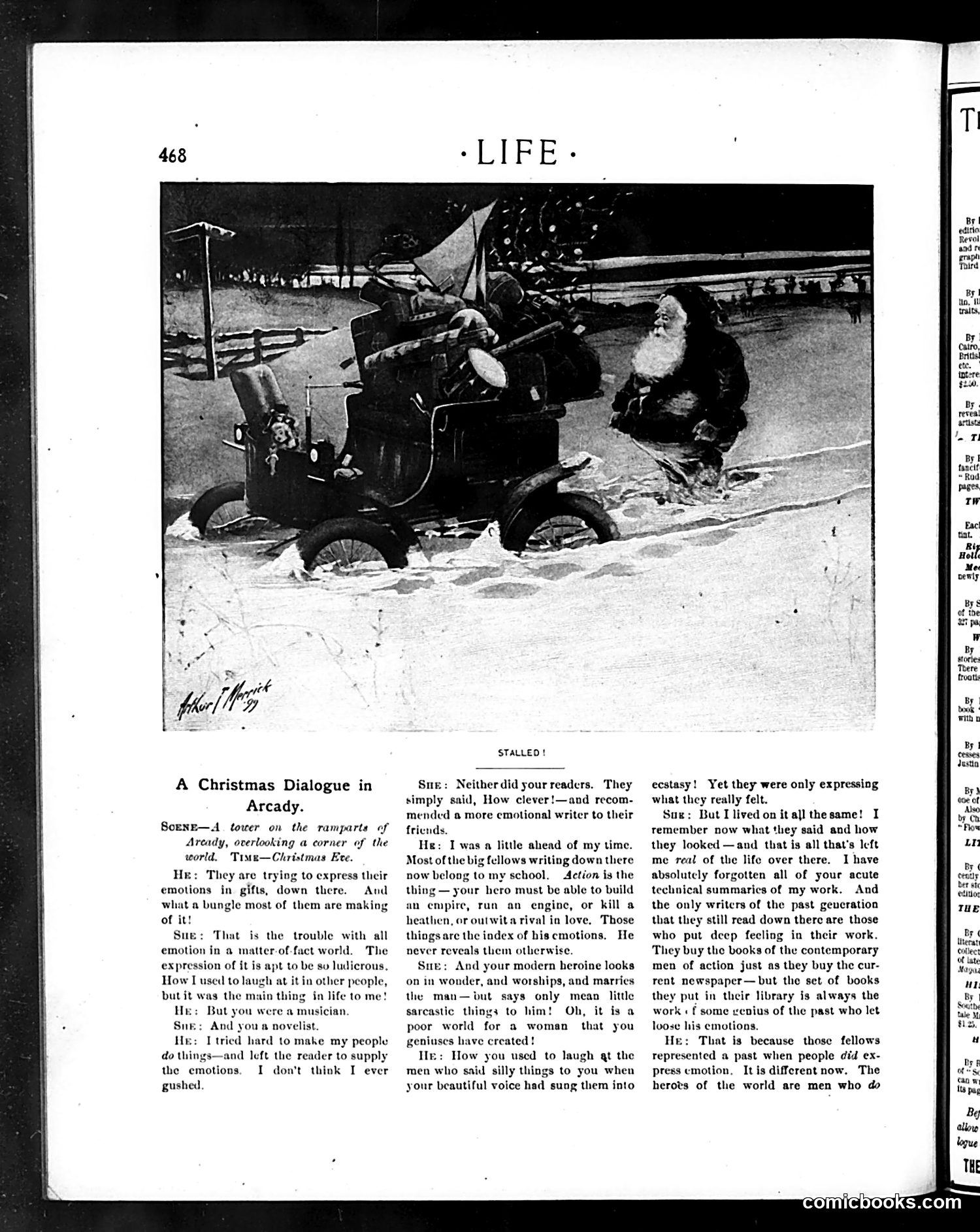
This page presents "A Christmas Dialogue in Arcady"—a satirical debate between two dead artists (a musician and a novelist) observing Christmas gift-giving below on Earth. **The satire's point**: The two characters represent an older literary/artistic tradition emphasizing emotional authenticity and expression. They lament that modern writers (their contemporaries in early 20th-century Life magazine) have abandoned emotion for "action"—depicting heroes who build empires, run engines, or win rivals through deed rather than feeling. **The critique**: Modern literature supposedly produces emotionally constipated characters. A contemporary heroine merely "worships" and speaks "sarcastic things" rather than genuinely emote. Readers praise such work as "clever" but ultimately prefer older works with "deep feeling." **The joke**: The irony that the two artists—who prided themselves on *restraint* and never "gushed"—now recognize their detachment cost them readership. Emotion, they realize too late, moves people more than technical sophistication. This reflects early-20th-century literary debates about Realism versus Romanticism, satirizing the era's emphasis on action-driven narrative over psychological depth.
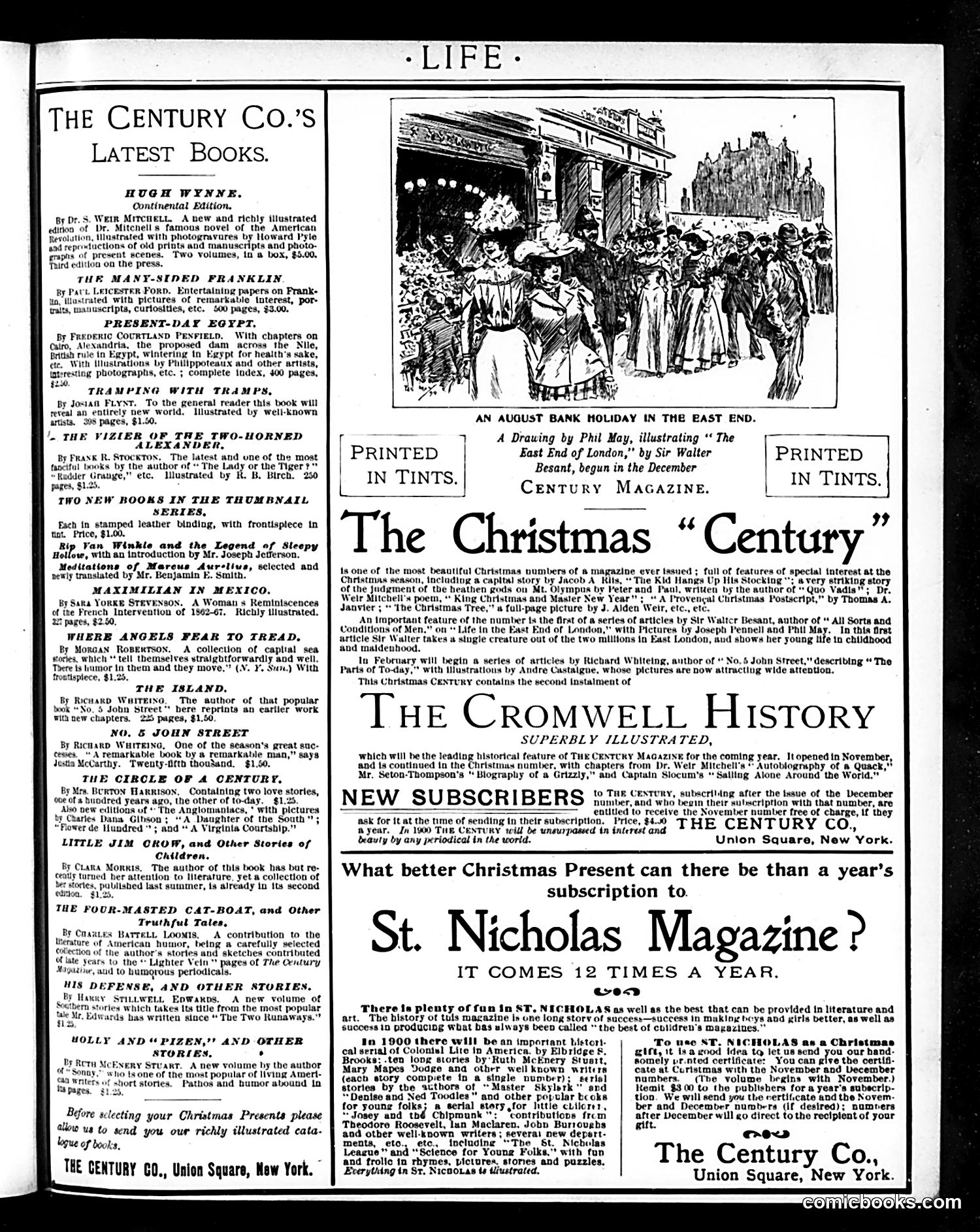
This page is primarily **advertising and promotional content**, not political satire. It consists of: 1. **Book advertisements** (left column): The Century Company promotes newly published novels and collections, including works by S. Weir Mitchell, Frank Stockton, and others—typical late 19th/early 20th-century literary offerings. 2. **Magazine promotions** (center and right): The Century Magazine itself advertises its Christmas issue, featuring an illustration titled "An August Bank Holiday in the East End" by Sir Walter Besant. Below this are promotions for *St. Nicholas Magazine* as a Christmas gift subscription. 3. **The only visual element** is the street scene sketch showing what appears to be a crowded London working-class neighborhood, illustrating Besant's article about East End life. The page serves as a **period document of holiday marketing** rather than containing political commentary or satire. It reflects turn-of-the-century publishing industry priorities and consumer culture around Christmas gift-giving.
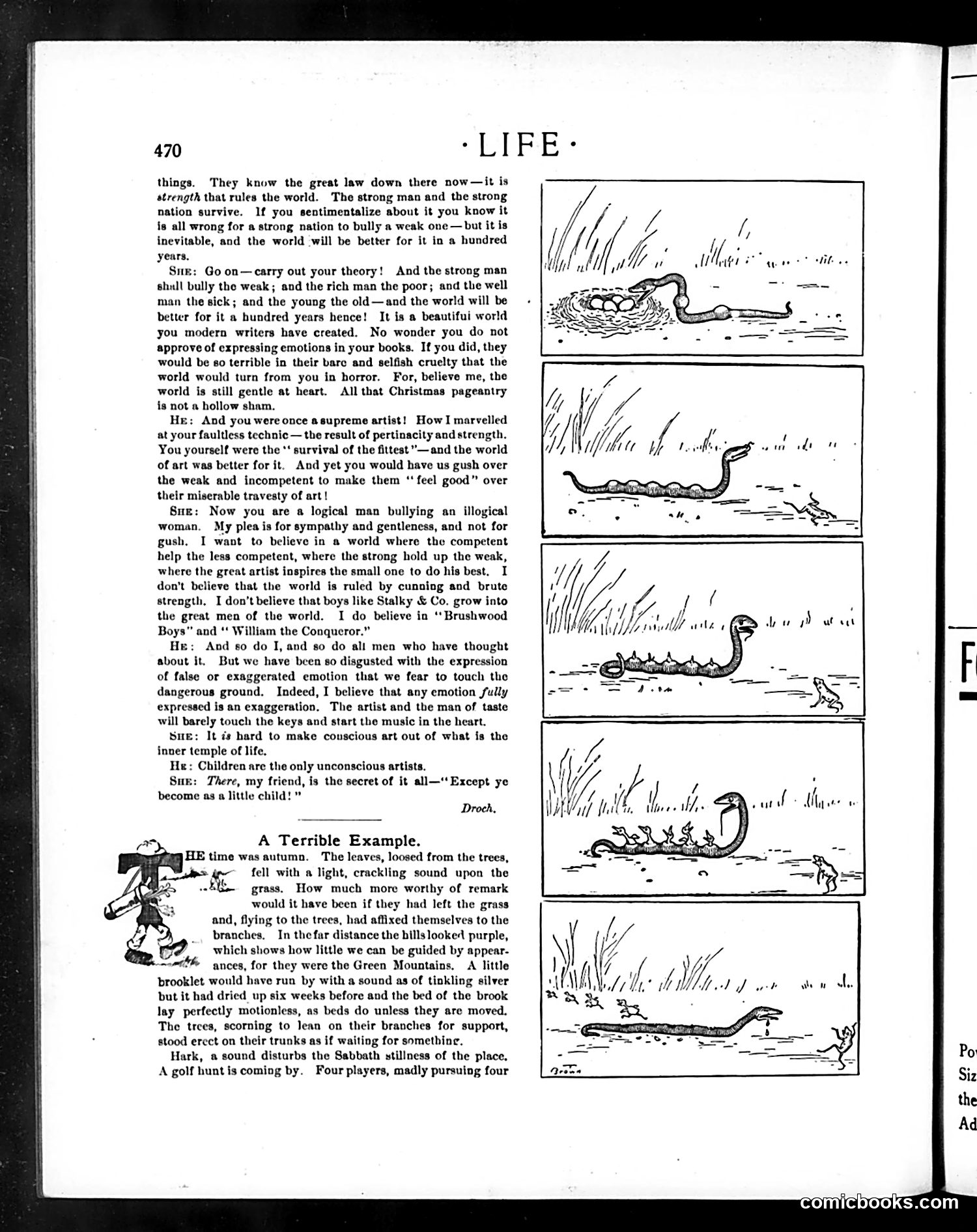
This page presents two distinct pieces: **Upper Section**: A dialogue between "He" and "She" (likely representing male and female perspectives) debates Social Darwinism—the fashionable late-19th/early-20th-century theory that "survival of the fittest" should govern society. He advocates for this brutal philosophy; She argues for compassion, gentleness, and artistic inspiration of the weak by the strong. The satire critiques intellectuals who embrace harsh "strength rules all" ideology while simultaneously enjoying sentimental Christmas traditions—exposing their hypocrisy. **Lower Section**: "A Terrible Example" satirizes overwrought, artificially "literary" prose. It mocks writers who describe autumn leaves falling (natural) while mockingly suggesting they might instead ascend back to trees (absurd), or who describe dried brooks as "perfectly motionless" with pseudo-philosophical commentary. The approaching golf hunt interrupts this purple prose, suggesting real life disrupts pretentious writing. Together, these pieces critique both dangerous philosophical trends and affected literary style among the educated classes.
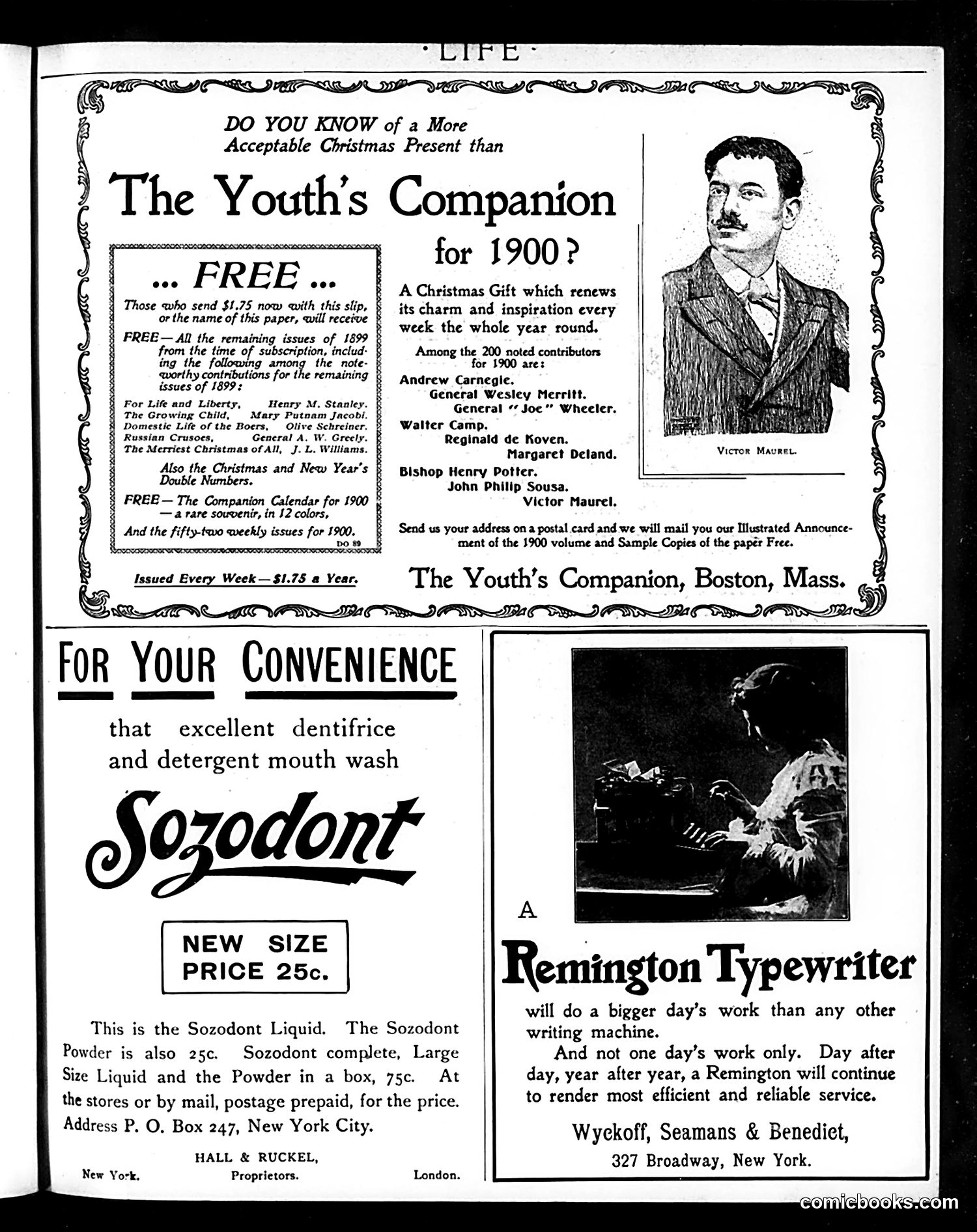
This page is primarily **advertising with no political cartoons or satire**. It consists of four commercial advertisements: 1. **The Youth's Companion** (top): A subscription promotion offering the magazine for $1.75, highlighting prominent 1899-1900 contributors including Andrew Carnegie, John Philip Sousa, and General Wheeler. The appeal targets gift-givers seeking "acceptable Christmas presents." 2. **Sozodont** (bottom left): A dental product advertisement promoting liquid and powder formulations at 25 cents each. 3. **Remington Typewriter** (bottom right): A durability-focused pitch emphasizing long-term reliability and efficiency. The page reflects turn-of-the-century consumer culture and marketing strategies. The Youth's Companion advertisement notably includes a portrait labeled "Victor Maurel" (likely the famous French baritone), lending celebrity endorsement value typical of period advertising. **There is no satirical content to decode here**—this is a straightforward commercial page.
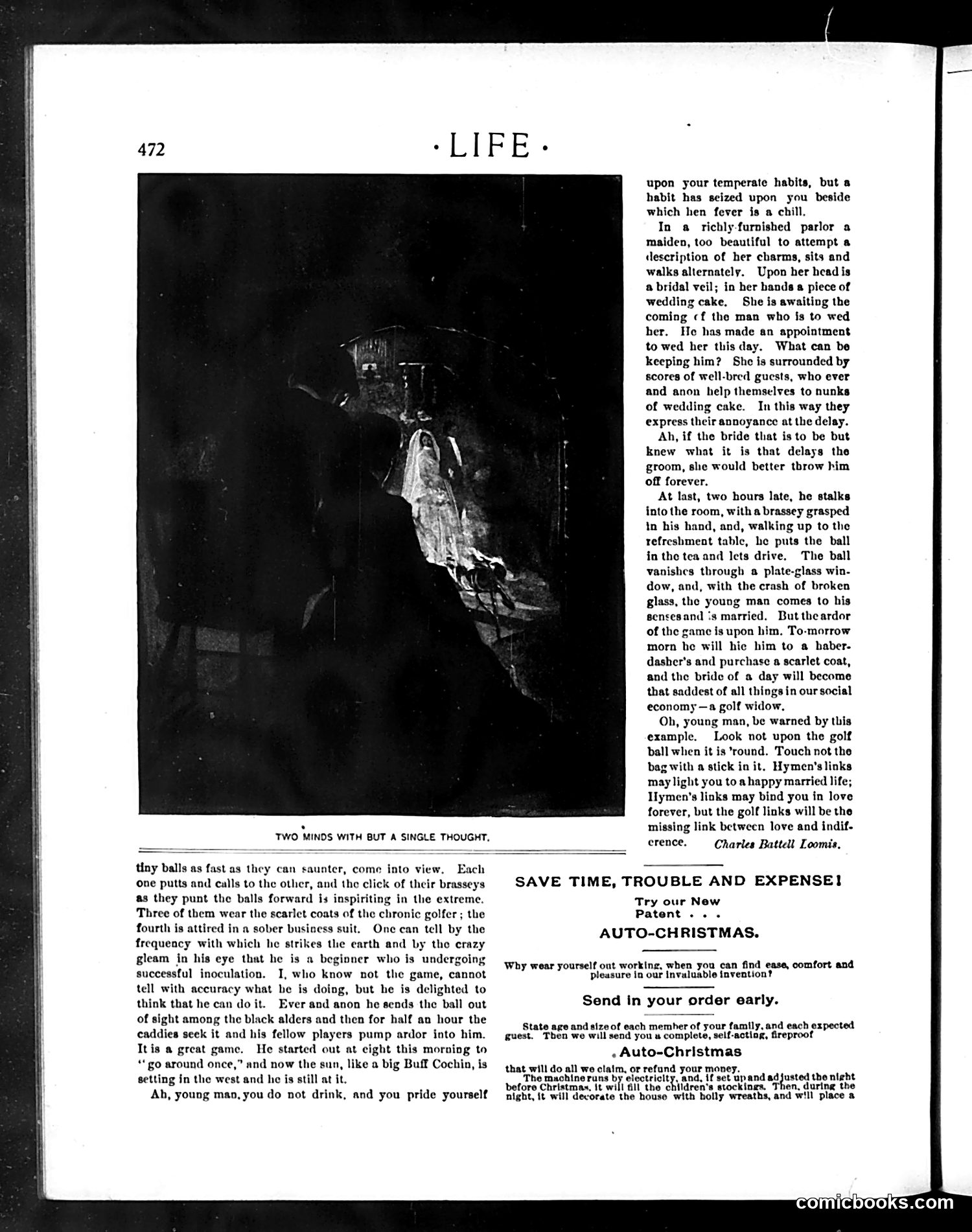
This page contains two satirical pieces about early 1900s leisure activities and their social consequences. **"Two Minds with But a Single Thought"** (the illustration and main story by Charles Battell Loomis) mocks the newly fashionable golf craze and its grip on men. A groom arrives two hours late to his own wedding—still holding a golf club—to putt a golf ball through the refreshment table window. The satire warns that golf obsession will make him a neglectful husband, turning his bride into a "golf widow." The piece ridicules golf's addictive power over even beginners and criticizes golfers' scarlet coats as markers of obsession. **"Auto-Christmas"** advertisement (bottom) offers tongue-in-cheek satire on labor-saving modern inventions. It humorously "sells" an automatic machine that will decorate homes and fill stockings on Christmas Eve—mocking both the era's enthusiasm for electric gadgets and the desire to outsource family traditions. Both pieces reflect early 20th-century anxieties about technology and leisure reshaping social life and domestic relationships.
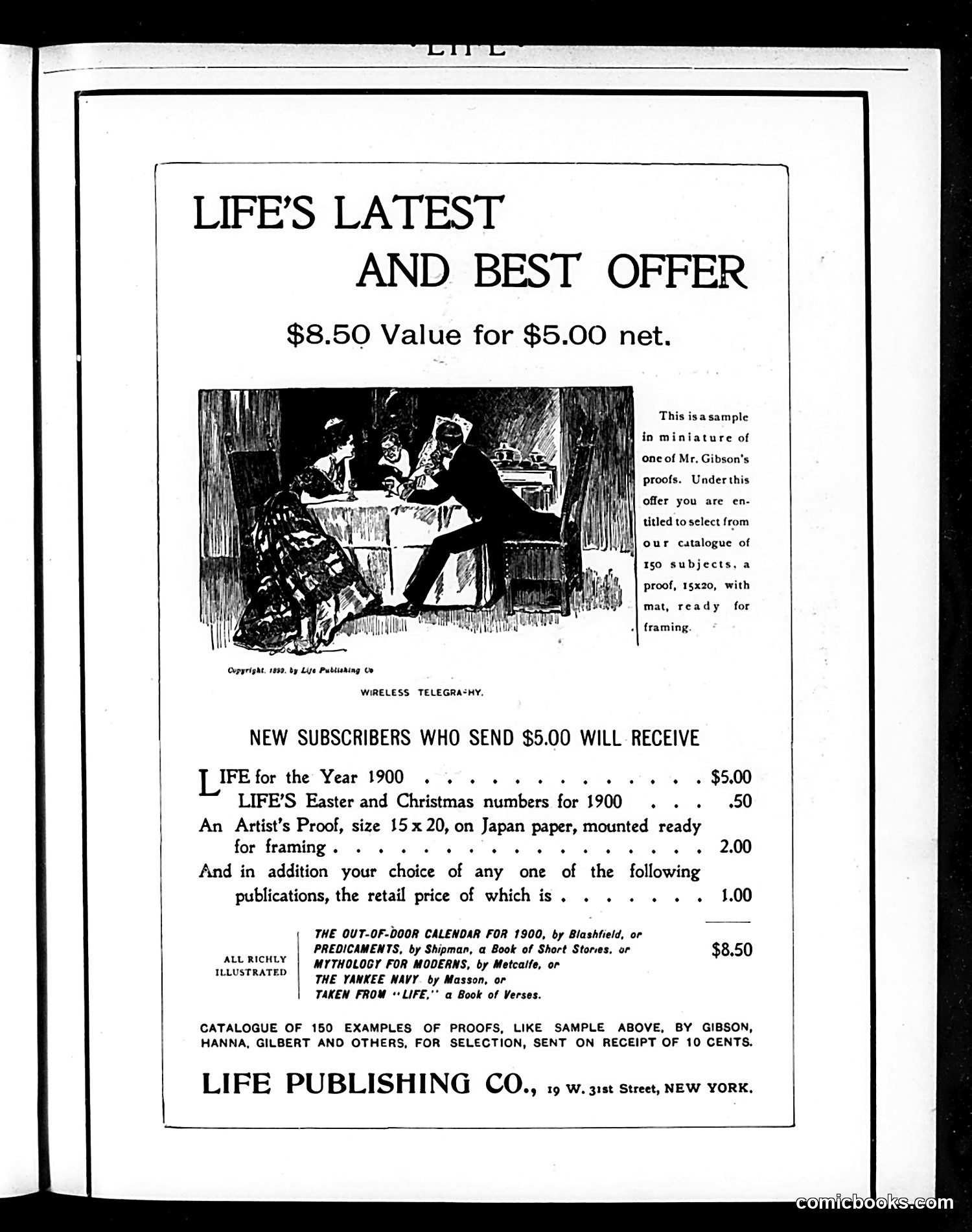
This is primarily a **subscription advertisement**, not a political cartoon. The page promotes Life magazine's New Year 1900 offer to new subscribers. The illustration labeled "Wireless Telegraphy" appears to show a social scene—likely a Victorian-era gathering where figures interact around a table. The caption's reference to "wireless" is somewhat unclear without additional context, but may be a period joke about social communication or modern technology. The main content is a promotional offer: for $5.00, new subscribers receive a year's subscription to Life, holiday issues, an artist's proof (by Gibson or other illustrators), plus one book. Gibson was Life's famous illustrator known for satirical social commentary. The page reflects **turn-of-the-century publishing culture**—offering bound proofs and books as incentives, reflecting when such items held significant value for middle-class consumers. The "10 cents" catalogue offer shows how publishers used promotional materials to drive subscriptions.
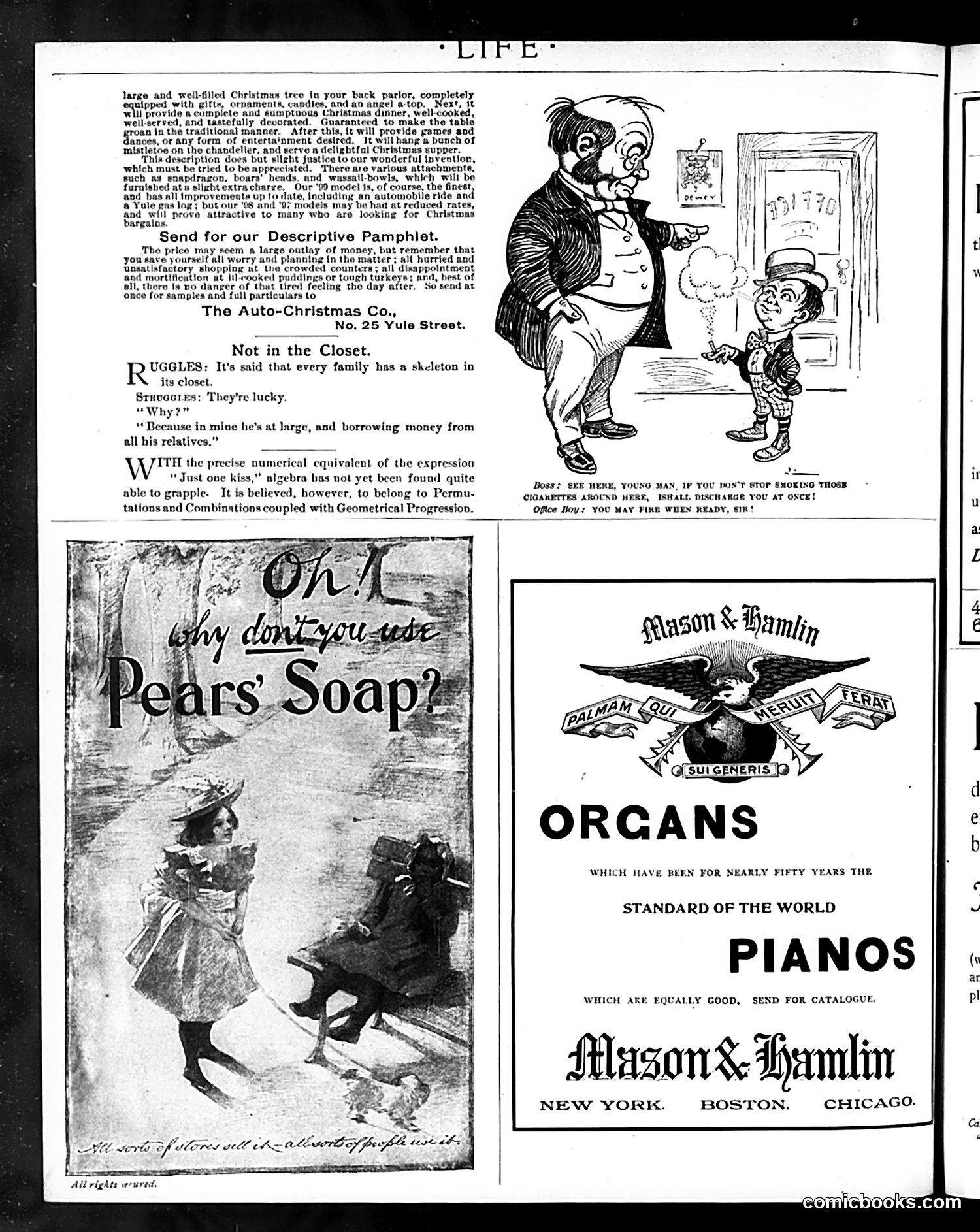
This page combines satirical humor with period advertisements. The main cartoon depicts an "Auto-Christmas Co." offering a mechanical device that promises to eliminate all Christmas planning—providing a decorated tree, dinner, entertainment, and festive atmosphere automatically. The satire targets the era's growing consumerism and automation obsession, mocking the impulse to outsource human effort and family tradition to labor-saving gadgets. Below is a brief joke about family secrets ("skeletons in the closet"), a mathematical gag about quantifying "just one kiss," and an office-boy dialogue where a boss threatens to fire the boy for smoking, and the boy quips he'll be ready to be dismissed—suggesting young workers' cavalier attitude toward employment. The advertisements for Pears' Soap and Mason & Hamlin organs/pianos are standard period marketing. Overall, the page satirizes fin-de-siècle American anxieties about modernization and consumption.
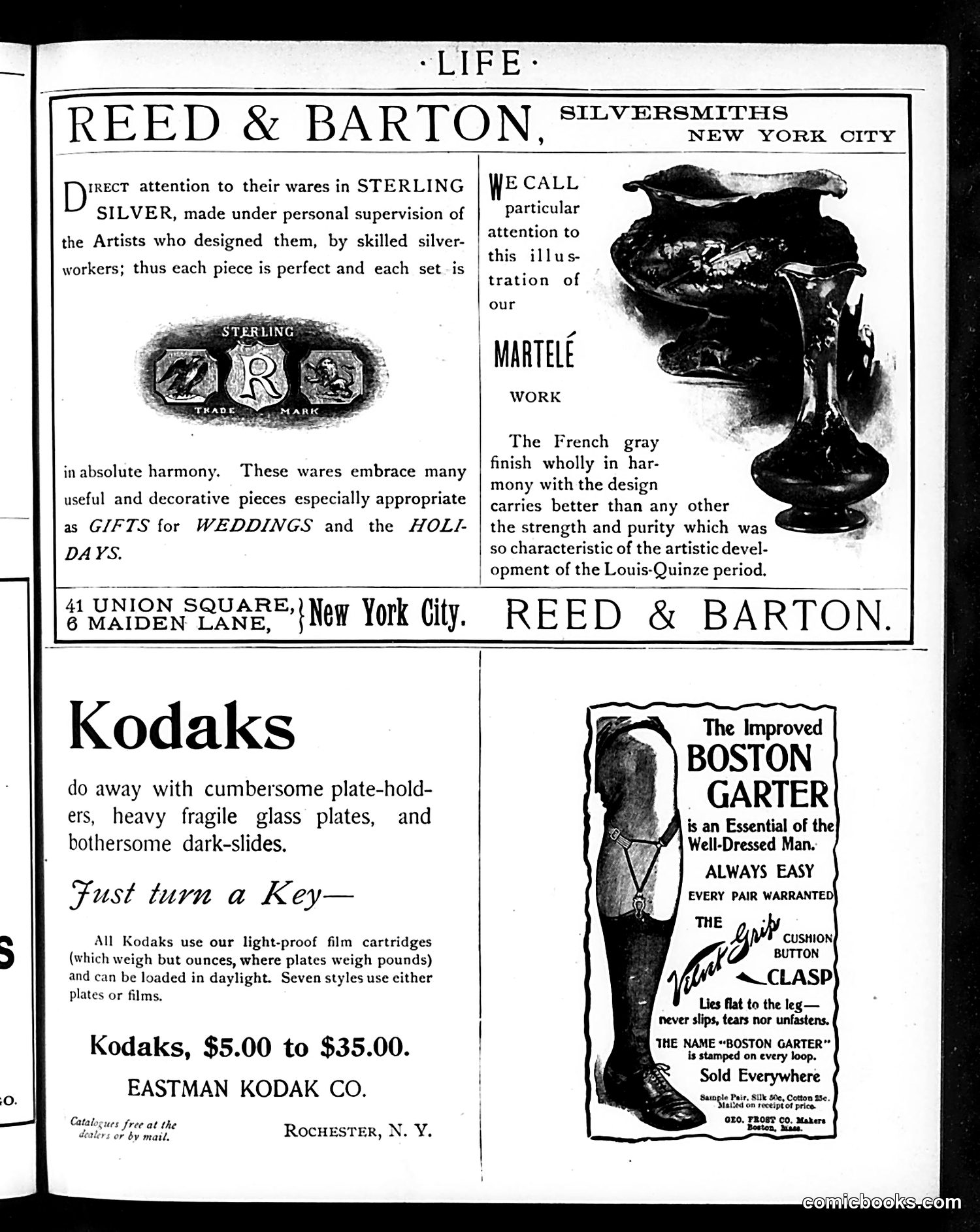
This page contains **no political cartoons or satire**—it is purely **commercial advertising** from an early 1900s issue of *Life* magazine. The ads promote luxury goods and new technology: - **Reed & Barton** (top): Sterling silver serving pieces styled after French Louis XV design, marketed for weddings and holidays - **Kodak** (left): The revolutionary handheld camera using film cartridges instead of heavy glass plates—positioning photography as convenient and accessible ("Just turn a Key") - **Boston Garter** (right): Men's leg garters, emphasizing reliability and respectability as an essential accessory for the well-dressed man These ads reflect early 20th-century consumer culture: aspiration toward refined taste (fine silver), enthusiasm for new technology (cameras), and attention to gentlemanly grooming standards. The page documents what affluent American readers considered desirable purchases of the era.
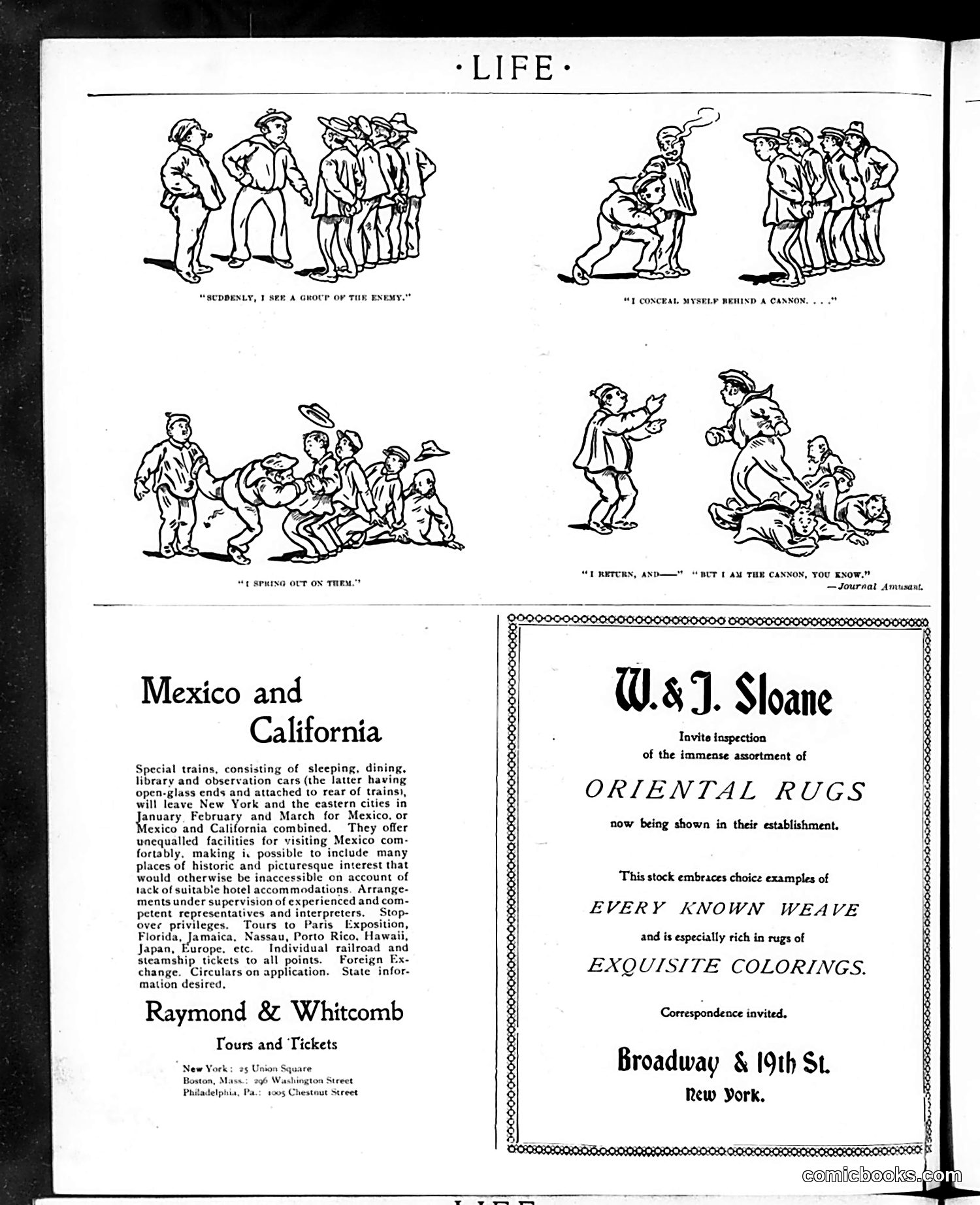
This page contains **four comic panels** (top half) depicting a military scenario, likely satirizing war or military tactics. The sequence shows a soldier spotting enemies, launching an attack, and retreating—with the final panel's punchline revealing "I am the cannon, you know," suggesting the joke involves mistaken identity or an absurd revelation about who/what is actually involved in combat. The humor appears to be slapstick or absurdist in nature, credited to "Journal Amusant" (a French satirical publication). The **bottom half is advertising**: Raymond & Whitcomb promotes luxury train tours to Mexico and California (January-March), and W. & J. Sloane advertises Oriental rugs at their Broadway location in New York. This is a typical Life magazine page mixing satirical comics with period advertising.
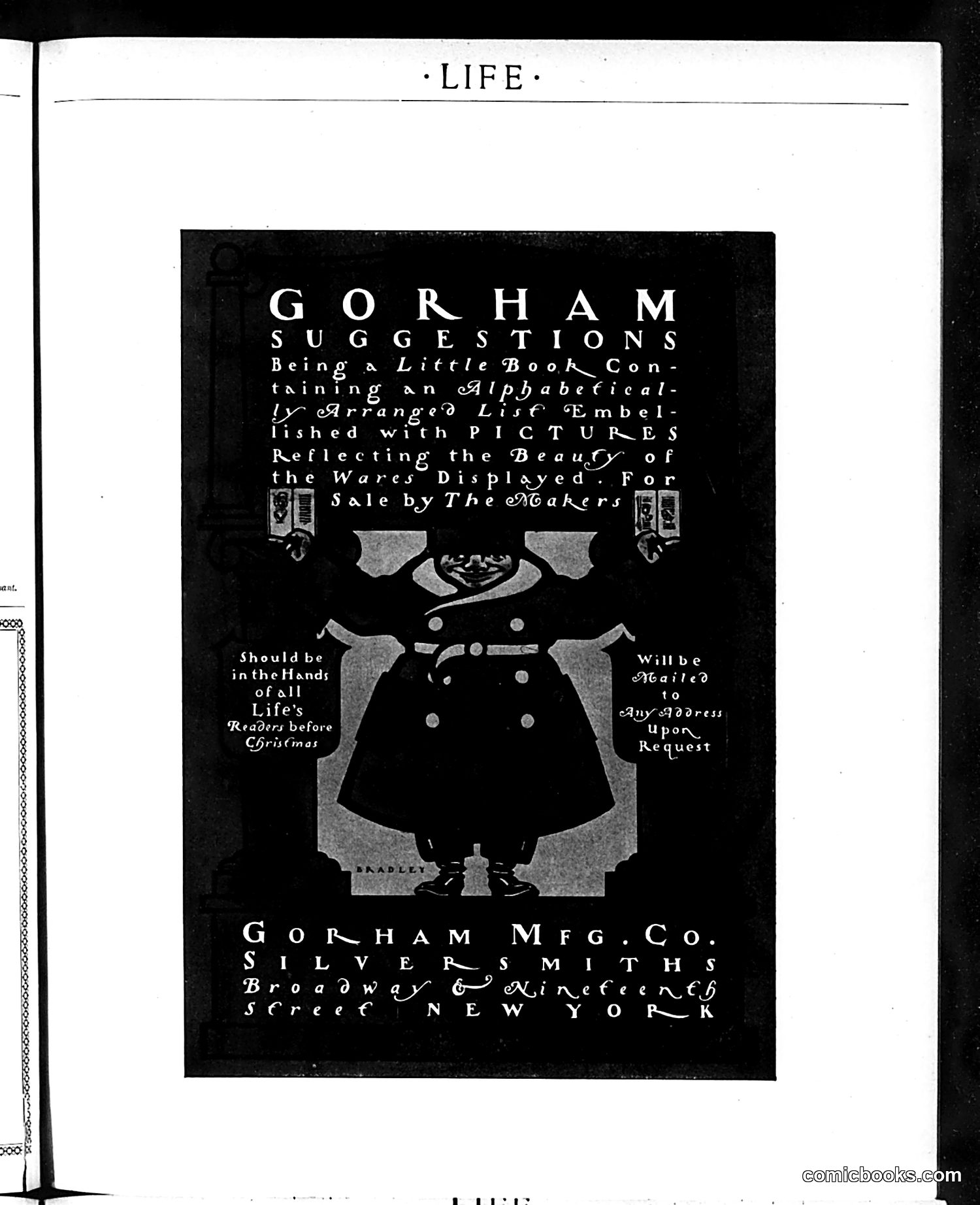
This is primarily a **product advertisement** rather than political satire. It promotes "Gorham Suggestions," a gift book published by Gorham Mfg. Co. (a prominent American silverware manufacturer based in New York). The ad features an illustrated silhouette of a woman in an elegant dark dress, positioned centrally as a decorative element. The text describes the book as containing alphabetically arranged items with pictures showcasing Gorham's wares—essentially a catalog designed as a gift. The marketing pitch emphasizes that this book "should be in the hands of all Life's Readers before Christmas" and "will be mailed to any address upon request." This is a straightforward holiday shopping advertisement targeting Life magazine's readership, suggesting Gorham products as appropriate Christmas gifts. There is no apparent political commentary or satire on this page.
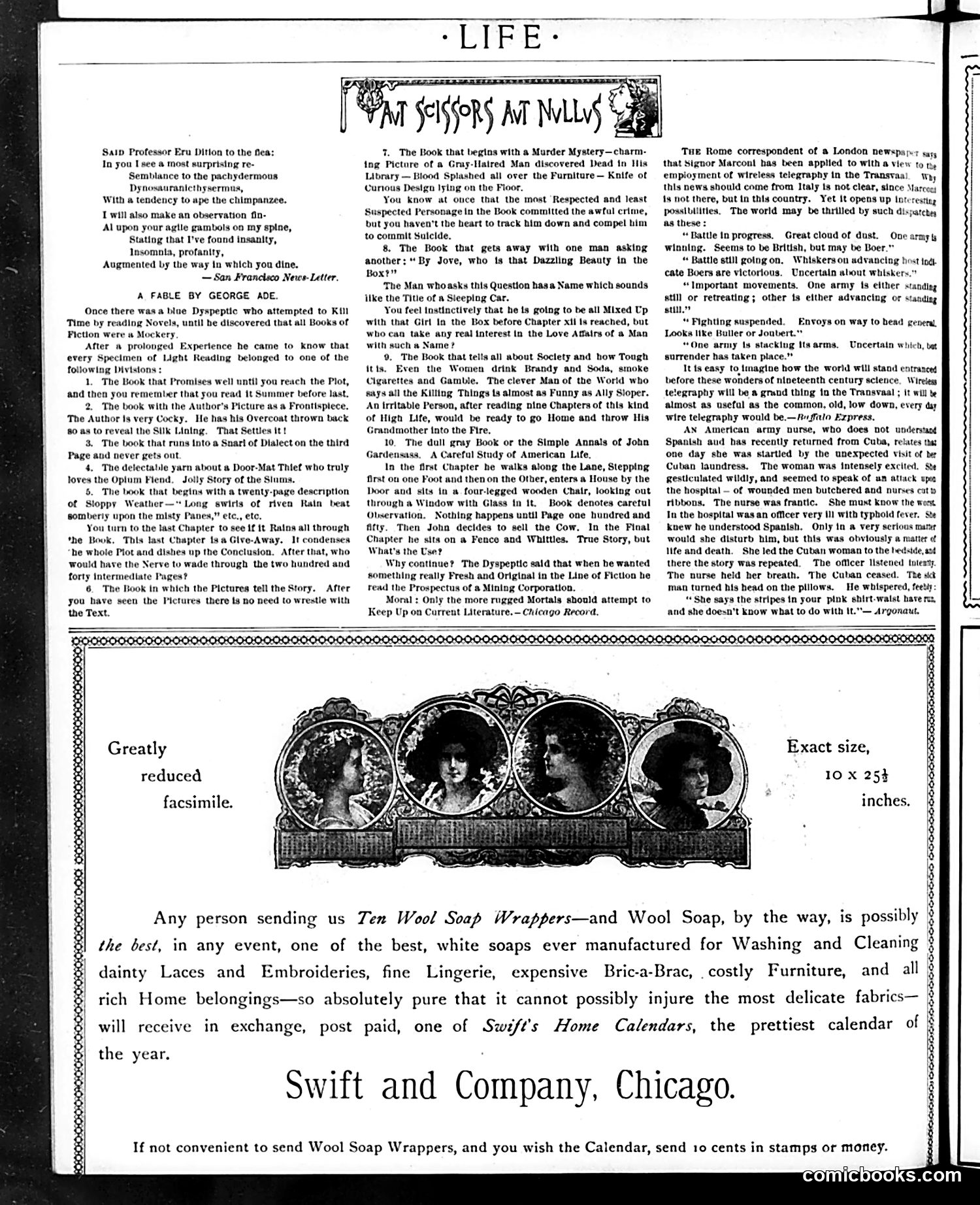
This page contains two distinct pieces of humor: **Top section**: "Scissors at Nullus" presents a mock-serious professorial insult comparing someone to a "pachydermous Dynosauranicthysermus" (a made-up prehistoric creature) who "ape[s] the chimpanzee." It's absurdist humor using pseudoscientific jargon to humorously mock someone's behavior and table manners. **Main content**: George Ade's fable satirizes predictable fiction formulas of the era. Ade catalogs ten types of tedious novels: books with obvious plots, authors' vanity photos, dialect-heavy narratives, melodramatic murder mysteries, endless weather descriptions, plot-spoiling pictures, and dull "realistic" stories. The punchline: a dyspeptic reader finds genuine originality only in mining prospectus advertisements—implying contemporary fiction is less honest than corporate promotions. The satire mocks both formulaic writing and readers' frustration with it. The accompanying Swift & Company soap advertisement exploits the page's appeal to literate, middle-class readers.
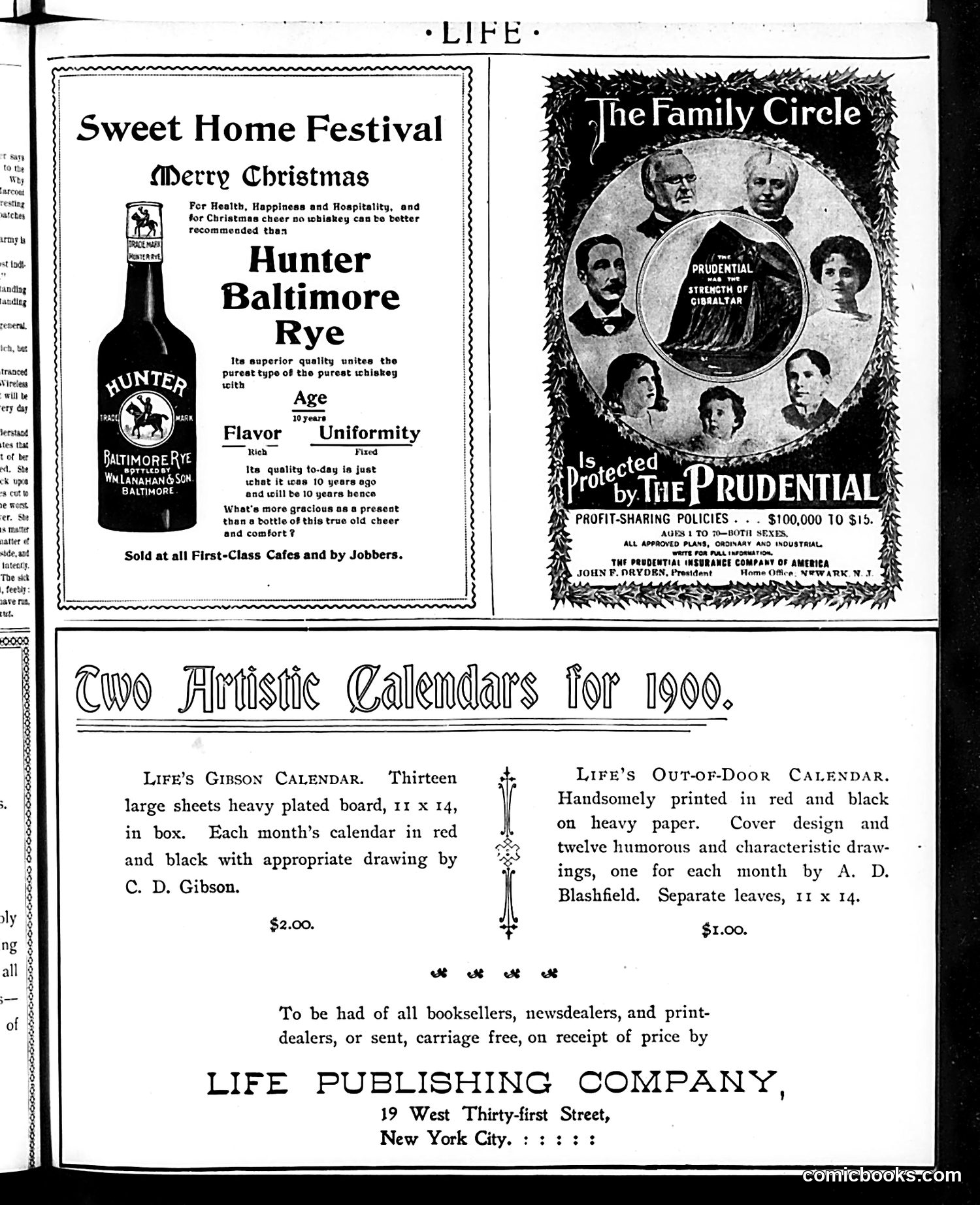
This is primarily an **advertising page** from Life magazine (circa 1900), not satirical content. It contains three distinct advertisements: 1. **Hunter Baltimore Rye whiskey**: A Christmas spirits ad emphasizing the product's consistency ("quality to-day is just what it was 10 years ago") and positioning it as an appropriate holiday gift for "Health, Happiness and Hospitality." 2. **Prudential Insurance**: Features a circular "Family Circle" design with portraits surrounding a central shield labeled "Strength of Gibraltar"—Prudential's famous corporate symbol. Advertises profit-sharing policies ranging $100,000 to $15, targeting ages 1-70. 3. **Two 1900 Calendars**: Life Publishing Company promotes artistic calendars featuring drawings by C.D. Gibson and A.D. Blashfield, priced at $2.00 and $1.00 respectively. The page reflects turn-of-century American consumer culture: whiskey as respectable holiday commerce, life insurance as modern financial security, and decorative calendars as desirable gifts.
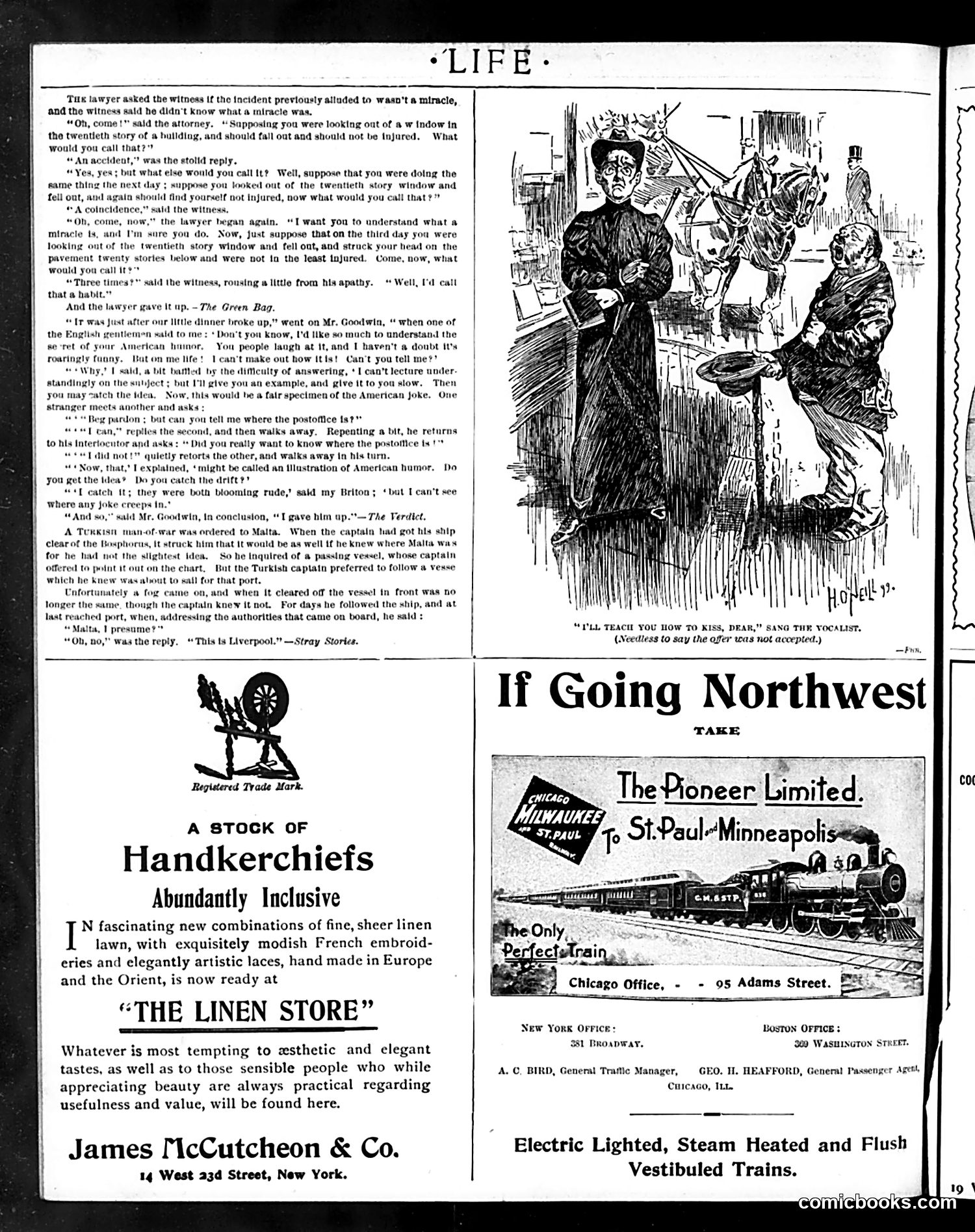
This page contains several humor pieces typical of early Life magazine, which specialized in literary jokes and satire. The main cartoon shows a vocal performance, illustrating a story where an English gentleman asks an American to explain American humor. The American illustrates his point by recounting an absurd anecdote: two men asking directions to the post office in a deliberately roundabout, rude manner that technically has no punchline—just rudeness. The English visitor fails to find this funny, finding it merely impolite. The joke satirizes the American tendency toward pranks and seemingly pointless rudeness disguised as humor, contrasting it with British sensibilities about propriety. Additional jokes include a legal anecdote about a witness calling repeated miraculous survivals a "habit," and a story about a Turkish ship captain blindly following another vessel, ending up in Liverpool instead of Malta. The page also contains advertisements for handkerchiefs and railroad service, typical of the era's magazine format mixing editorial and advertising content.
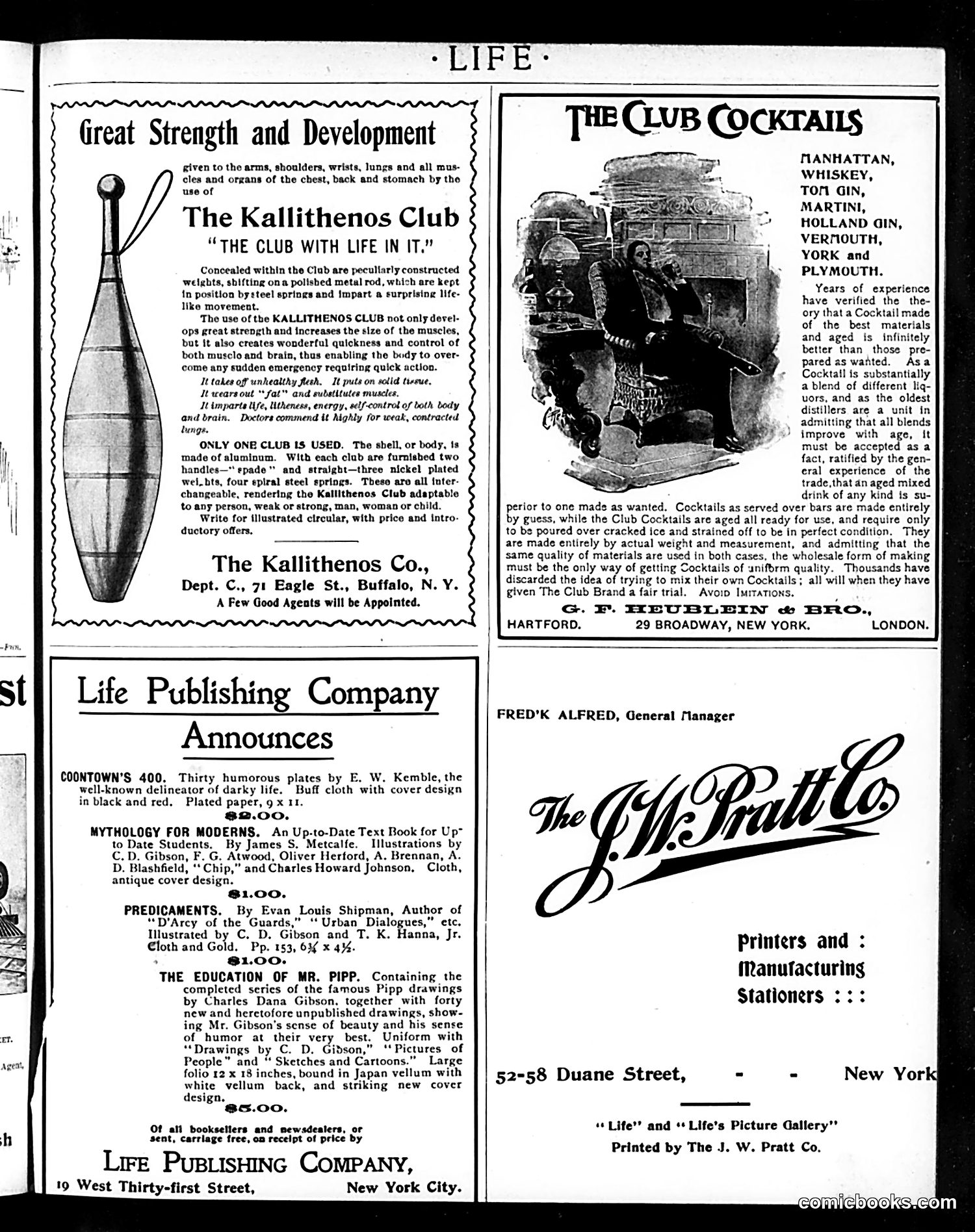
This page is primarily **advertising and book announcements** from Life Publishing Company, not political satire. The content includes ads for: 1. **The Kallithenos Club** — an exercise device with weights on a spring-loaded rod, marketed for muscle development and fitness 2. **The Club Cocktails** by Heublein & Bro. — pre-mixed, aged cocktails (Manhattan, martini, etc.), positioned as superior to bar-made drinks because they're uniform and scientifically measured 3. **Life Publishing Company announcements** for four books, including "Coontown's 400" by E.W. Kemble The phrase "Coontown's 400" reflects period racist nomenclature (referencing both minstrelsy and the "400" social elite), indicating this 1900s-era Life magazine contained offensive racial content alongside general advertisements. There is **no political cartoon or satire visible** on this page — it's a straightforward advertising section typical of early 20th-century magazines.
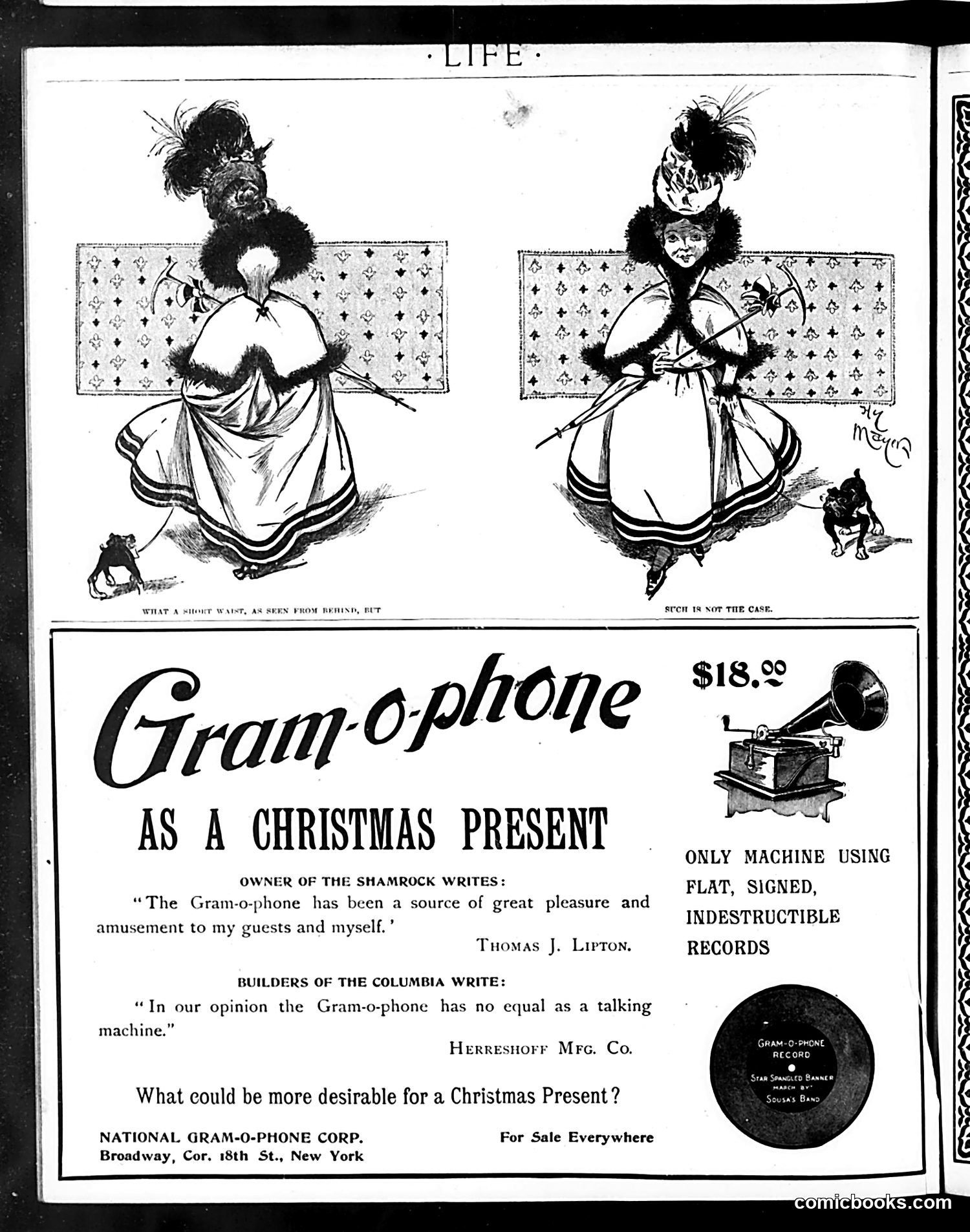
This is primarily an **advertisement for the Gram-o-phone** (an early phonograph), not political satire. The page uses humor to promote the product as a luxury Christmas gift. The cartoon above shows two wealthy women viewed from behind, wearing elaborate feathered hats and full skirts. The captions read "What a short waist, as seen from behind, eft" and "Such is not the case." This is fashion humor—satirizing the silhouette created by corsetry and padding of the Edwardian era, where women's rear ends appear exaggerated from behind but are actually shaped artificially. The advertisement leverages endorsements from Thomas J. Lipton (Irish businessman, visible name association) and Columbia/Herreshoff manufacturers to tout the Gram-o-phone as superior to competitors, emphasizing its use of "flat, signed, indestructible records." The satire is gentle and commercial: using fashionable women and humor to sell a new consumer technology to wealthy households as an impressive entertainment investment.
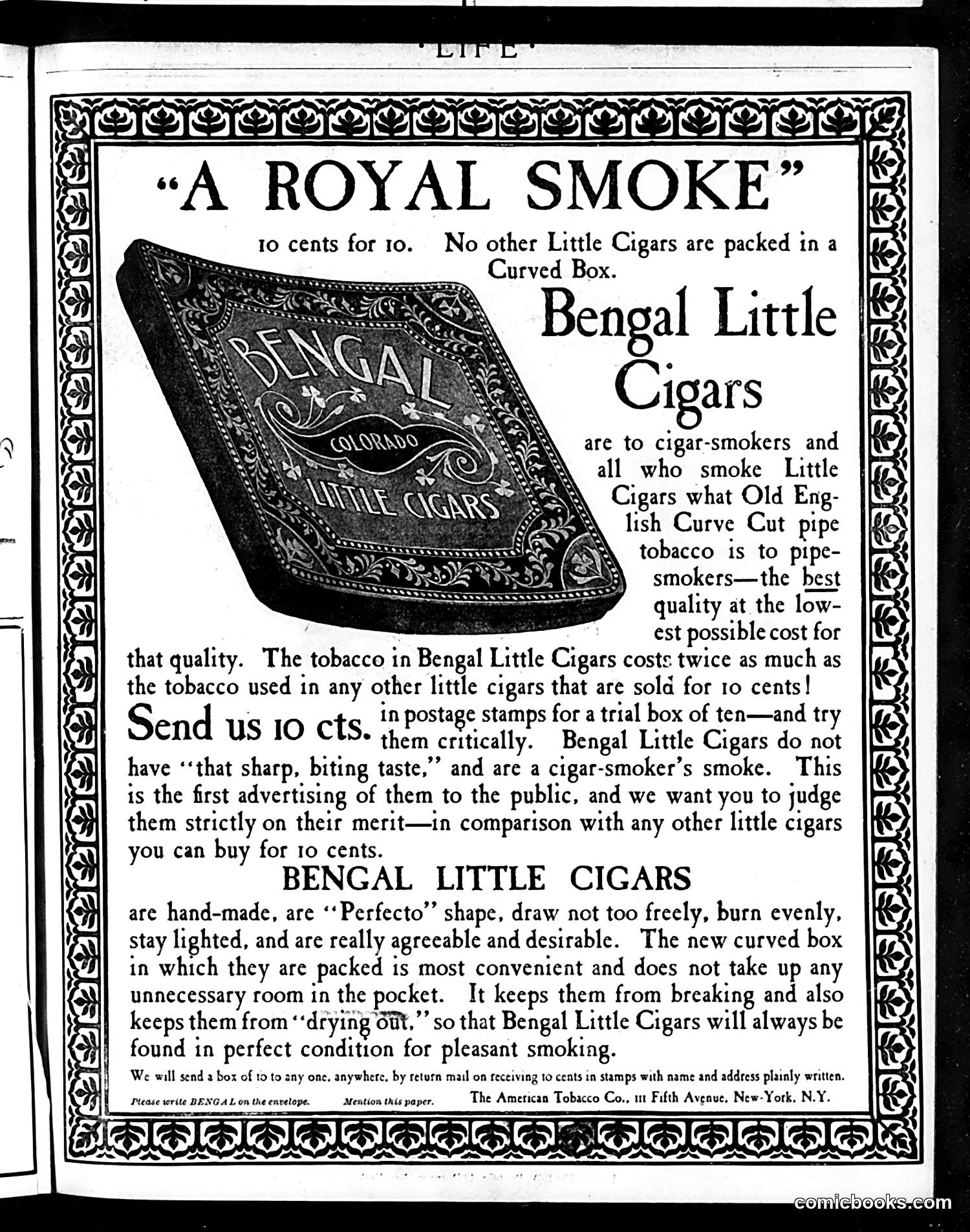
This is a **tobacco advertisement**, not political satire. The American Tobacco Company promotes Bengal Little Cigars to early 20th-century readers, emphasizing their superiority through several marketing claims: **Key selling points:** - Priced at 10 cents for 10 cigars (competitive pricing) - Hand-made with superior tobacco (claimed to cost twice as much as competitors) - Distinctive curved packaging that fits pockets and prevents damage - "Perfecto" shape that burns evenly and stays lit - Lacks the "sharp, biting taste" of cheaper alternatives **The call-to-action:** Readers could mail 10 cents in stamps for a trial box, a common mail-order sales method of the era. The ad positions Bengal cigars as a quality product at an affordable price point, targeting cigar-smokers seeking better tobacco without premium pricing. There is no cartoon, satire, or political content—this is straightforward product promotion from Life magazine's advertising section.
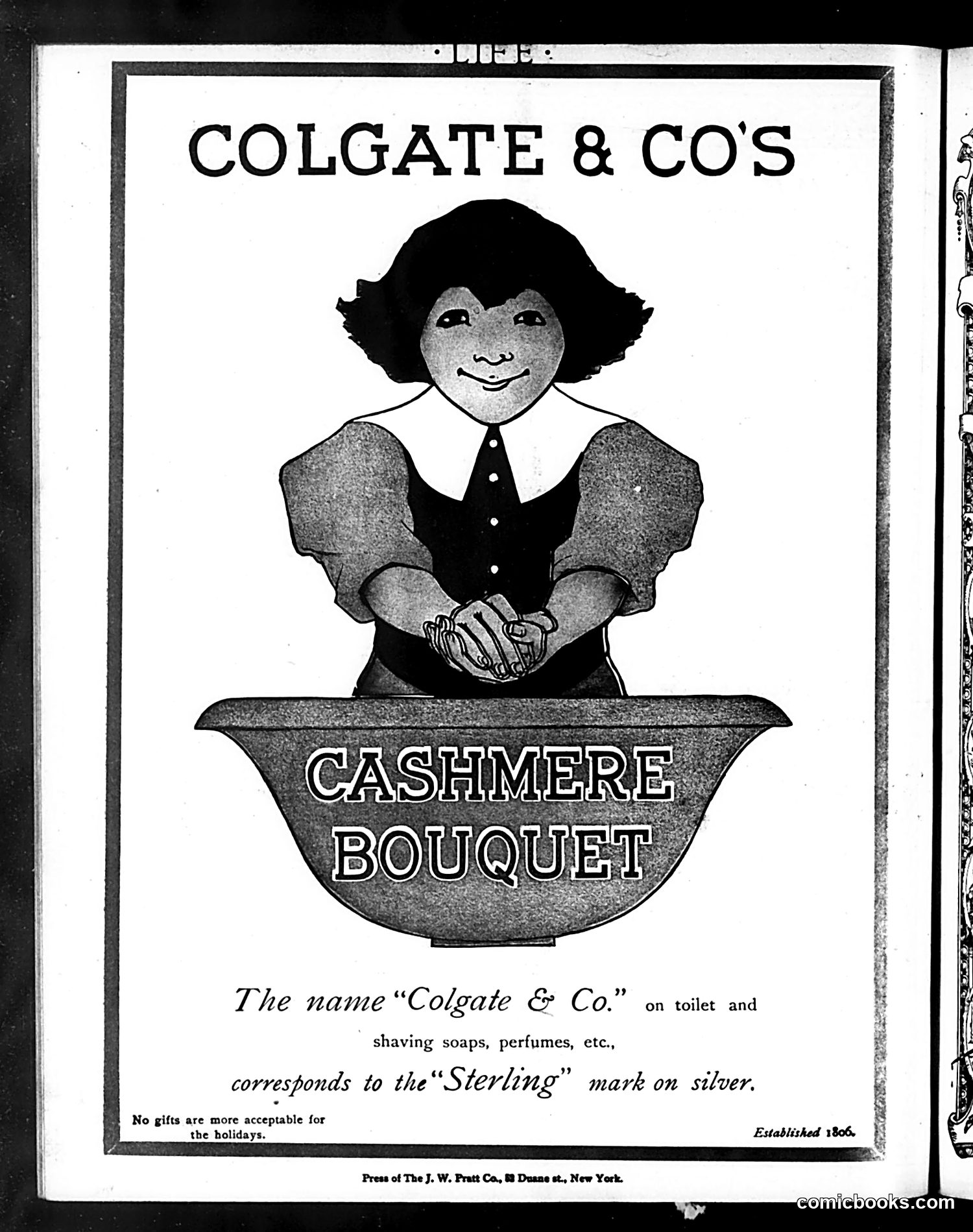
This is a **product advertisement**, not a political cartoon. It promotes Colgate & Co.'s toiletries and personal care products. The image features a smiling woman with short dark hair emerging from or positioned within a large bowl or vessel labeled "CASHMERE BOUQUET"—apparently a Colgate product line. The woman's friendly expression and welcoming pose are designed to make the product appealing. The advertisement's key argument appears in the text: the Colgate & Co. name serves as a "mark" of quality comparable to "Sterling" on silver—establishing brand trust and premium positioning for holiday gift-giving. The phrase "No gifts are more acceptable for the holidays" emphasizes these products as suitable luxury gifts. The establishment date of 1866 reinforces the company's longstanding reputation and reliability.