
Life, 1899-12-02 · page 15 of 44
Life — December 2, 1899 — page 15: what you’re looking at
What you’re looking at
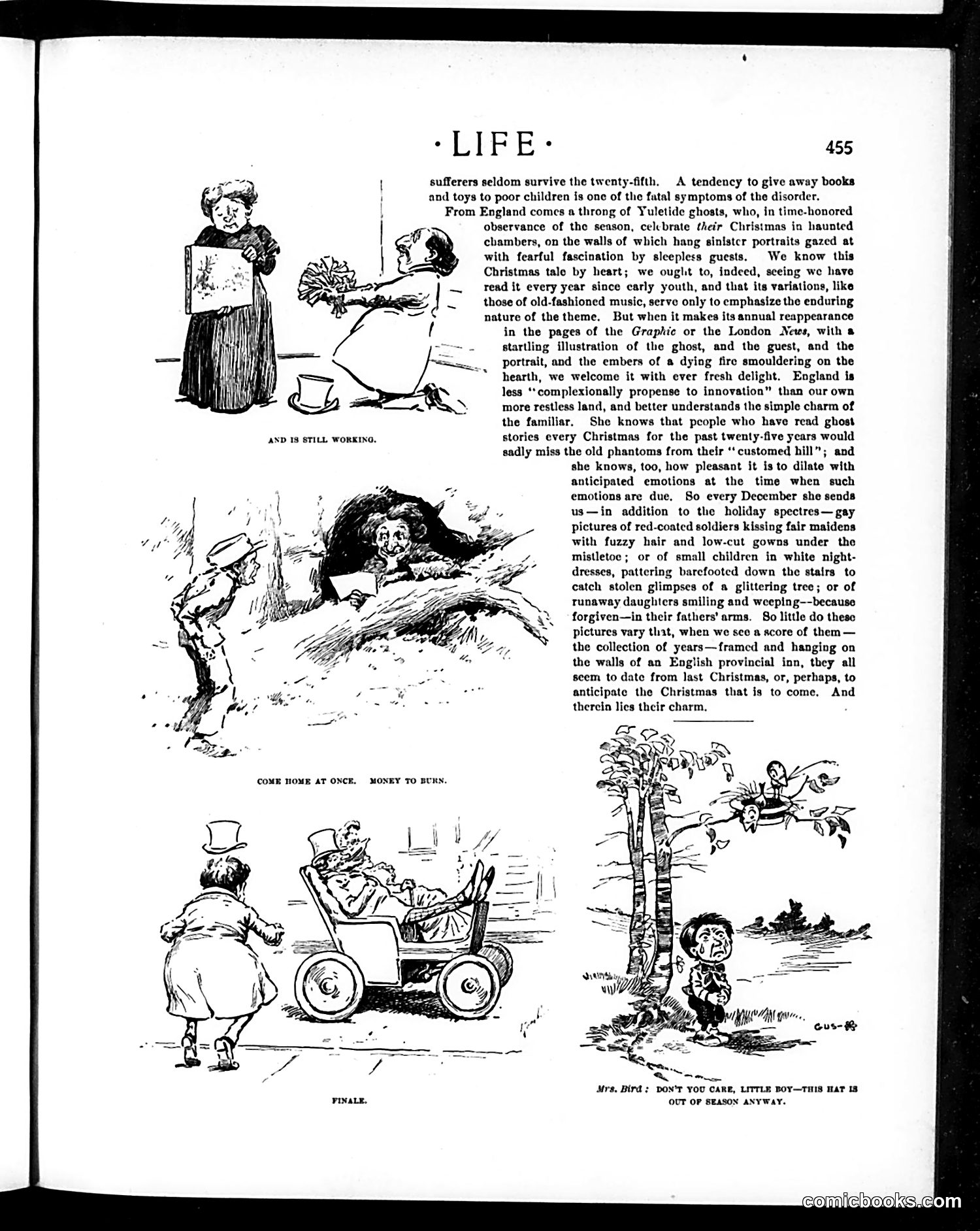
This page celebrates English Christmas traditions and sentimentality. The text praises how England annually reprints familiar Victorian ghost stories and holiday illustrations—despite their predictability, readers welcome the repetition because it's comforting and tradition-bound. The main cartoons illustrate Christmas themes: the top image shows "And Is Still Working" (a ghost or supernatural figure); the middle depicts "Come Home at Once" and "Money to Burn" (scenes of domestic holiday activity); and the bottom shows "Finale" with what appears to be a well-dressed man and carriage, plus a separate scene labeled "Mrs. Bird: Don't You Care, Little Boy—This Hat Is Out of Season Anyway" showing social commentary on class and propriety. The overall satire gently mocks England's preference for predictable, sentimental holiday traditions over American restlessness for novelty—suggesting that familiarity and repetition are features, not bugs, of English cultural life.
📄 Transcribed text from this page (OCR, searchable)
Machine-transcribed from the original scan — historical spelling and the odd misread are preserved.
-LIFE: 455 sufferers seldom survive the twenty-fifth. A tendency to give away books and toys to poor children is one of the fatal symptoms of the disorder. From England comes a throng of Yuletide ghosts, who, in time-honored observance of the season, celebrate their Christmas in haunted chambers, on the walls of which hang sinistcr portraits gazed at with fearful fascination by sleepless guests. We know this Christmas tale by heart; we ought to, indeed, seeing we have read it every year since carly youth, and that its variations, like those of old-fashioned music, serve only to emphasize the enduring nature of the theme. But when it makes its annual reappearance in the pages of the Graphic or the London News, with a startling illustration of the ghost, and the guest, and the portrait, and the embers of a dying fire smouldering on the hearth, we welcome it with ever fresh delight. England is less ‘“‘complexionally propense to innovation” than our own more restless land, and better understands the simple charm of the familiar, She knows that people who have read ghost stories every Christmas for the past twenty-five years would sadly miss the old phantoms from their ‘ customed hill”; and she knows, too, how pleasant it isto dilate with anticipated emotions at the time when such emotions are due, So every December she sends us—in addition to the holiday spectres—gay pictures of red-coated soldiers kissing fair maidens with fuzzy hair and low-cut gowns under the mistletoe ; or of small children in white night- dresses, pattering barcfooted down the stairs to catch stolen glimpses of a glittering tree; or of runaway daughters smiling and weeping--because forgiven—in their fathers’ arms. So little do these pictures vary that, when we sce a score of them — the collection of years—framcd and hanging on the walls of an English provincial inn, they all seem to date from last Christmas, or, perhaps, to anticipate the Christmas that is to come, And therein lies their charm, . COME HOME AT ONCE. MONEY TO BURN. Mrs, Bird ; DON'T YOU CARE, LITTLE BOY—THIS HAT 18 OUT OP SEASON ANYWay.