
A complete issue · 20 pages · 1897
Life — February 18, 1897
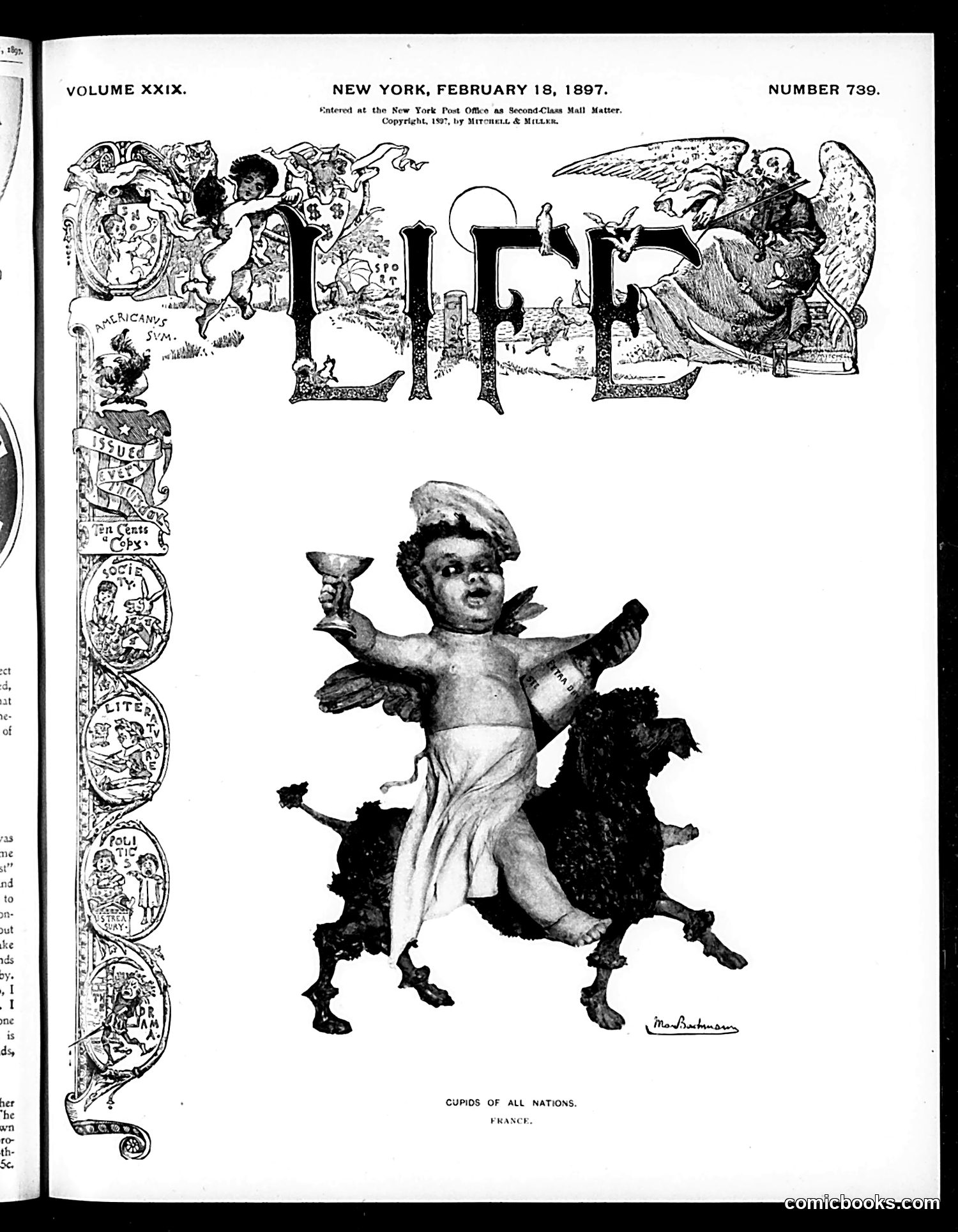
This is the cover of Life magazine's issue #739, featuring an illustration titled "Cupids of All Nations: France." The image depicts a cherubic, well-fed cupid figure riding a black goat or similar creature, holding a wine goblet aloft. The cupid wears a French beret and appears jolly and indulgent. The ornate left border contains classical medallions with zodiacal or allegorical imagery. The satire appears to characterize France through the stereotype of indulgence, hedonism, and love of wine—common late-19th-century American caricatures of French culture. The "Cupids of All Nations" series likely presented humorous national character stereotypes. The elaborate decorative border suggests this was Life's premium cover art for the issue. The artwork is signed by what appears to be the illustrator's name.
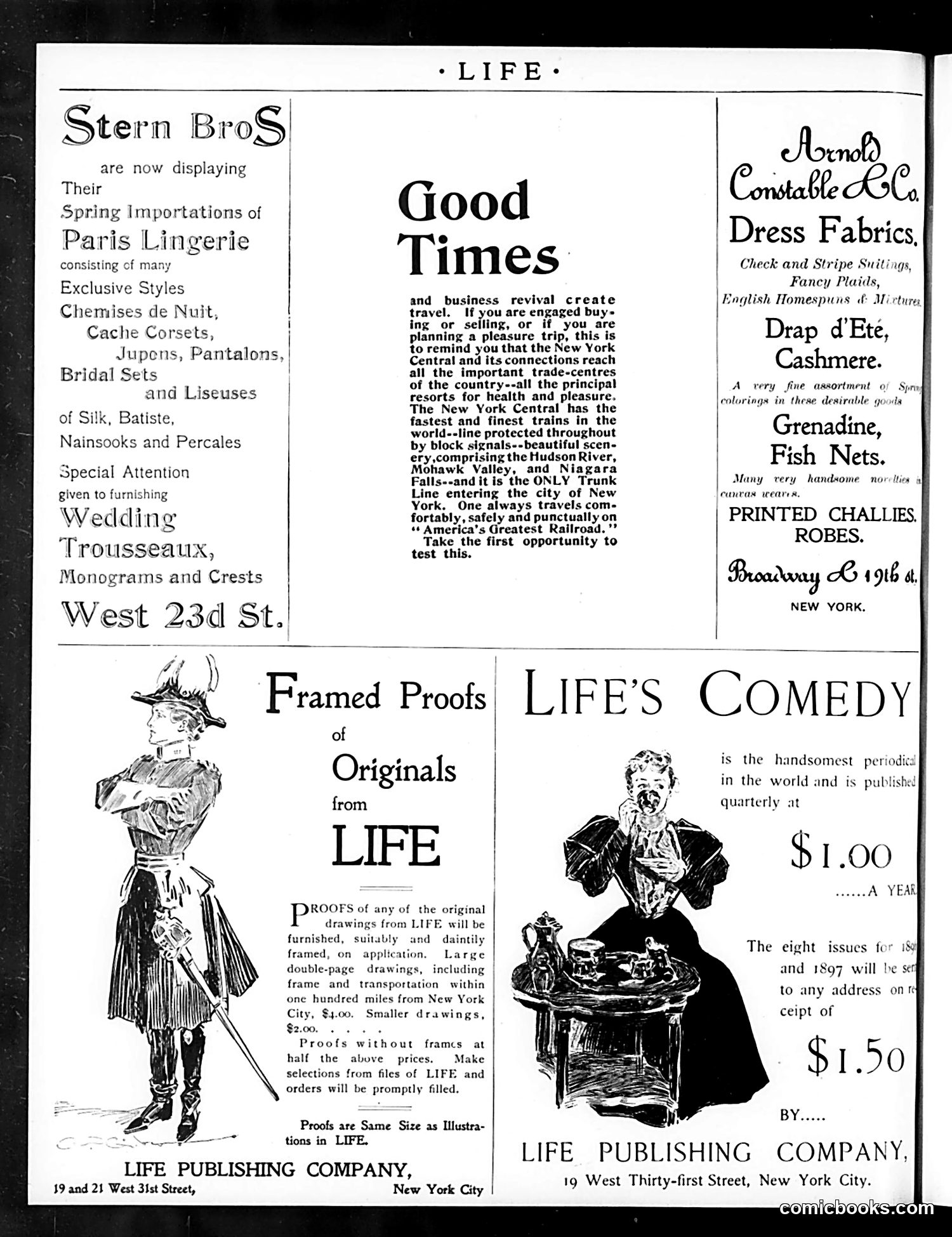
This page is primarily **advertising**, not political satire. It contains commercial notices for: - **Stern Bros.** (clothing/lingerie retailer on West 23rd St.) - **Arnold Constable & Co.** (dress fabrics and materials) - **Life Publishing Company** (offering framed proofs of original drawings and subscription sales) The two illustrated figures appear to be **generic Victorian-era fashion sketches** rather than caricatures of identifiable people. The left figure depicts formal military or aristocratic dress; the right shows a woman in 1890s fashion at a dining table. The only non-commercial content is a brief "Good Times" article about business revival and New York Central Railroad travel, suggesting optimistic economic conditions. This is a **commercial page with no discernible political satire or social commentary**—typical of Life magazine's dual role as both humor publication and advertising vehicle.
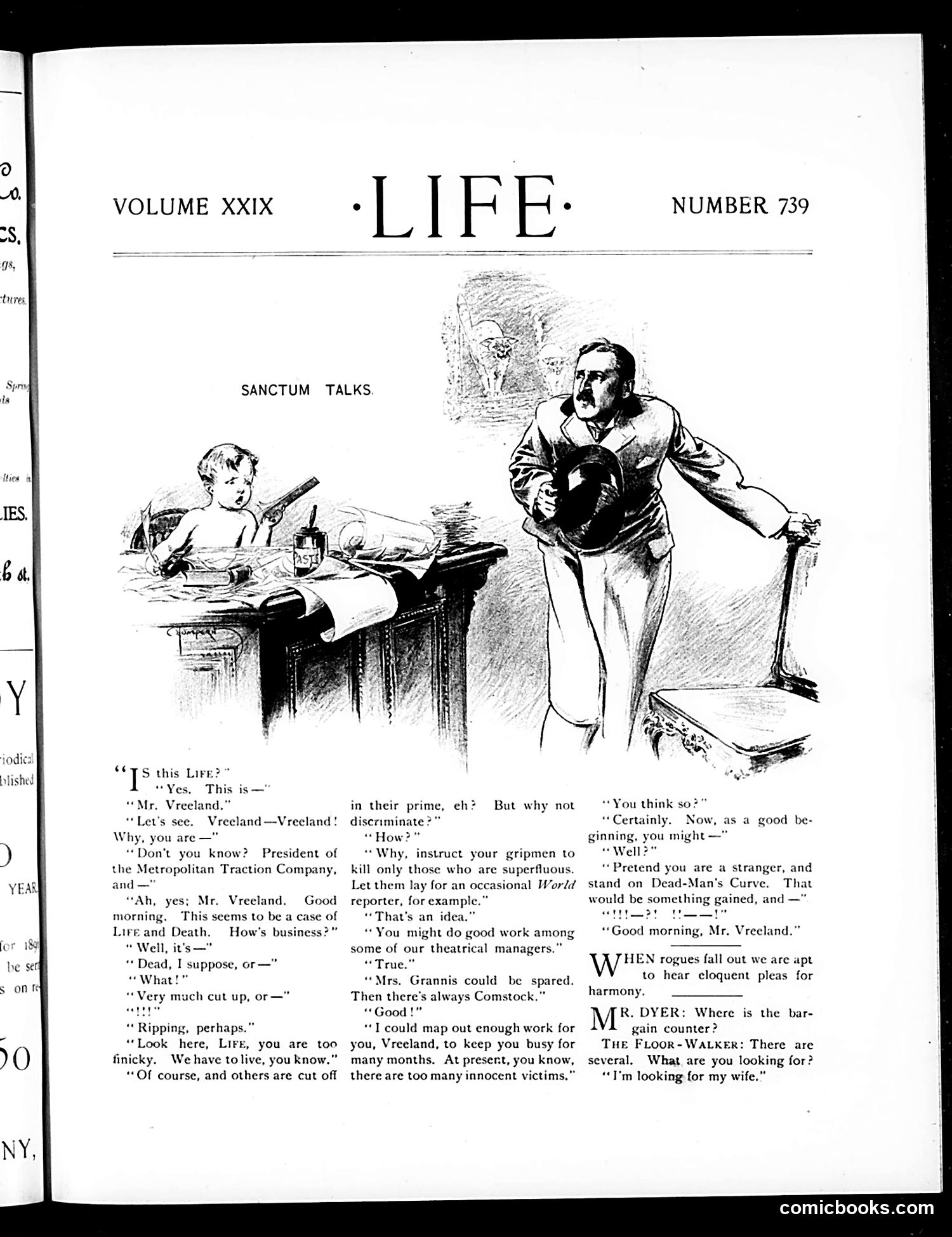
This cartoon depicts a conversation between two men in what appears to be a newspaper office (the "Sanctum" refers to editorial offices). The older man on the right, identified as "Mr. Vreeland," appears to be a newspaper publisher or editor lecturing a younger colleague about journalistic ethics and business practices. The satire addresses the tension between ethical journalism and commercial survival. Vreeland cynically advises discriminating in whom to harm for stories, suggests making work for reporters among theatrical managers, and casually references that "innocent victims" must sometimes be sacrificed. The cartoon mocks how newspapers rationalize sensationalism and unethical practices as necessary business operations, presenting moral compromise as pragmatic necessity.
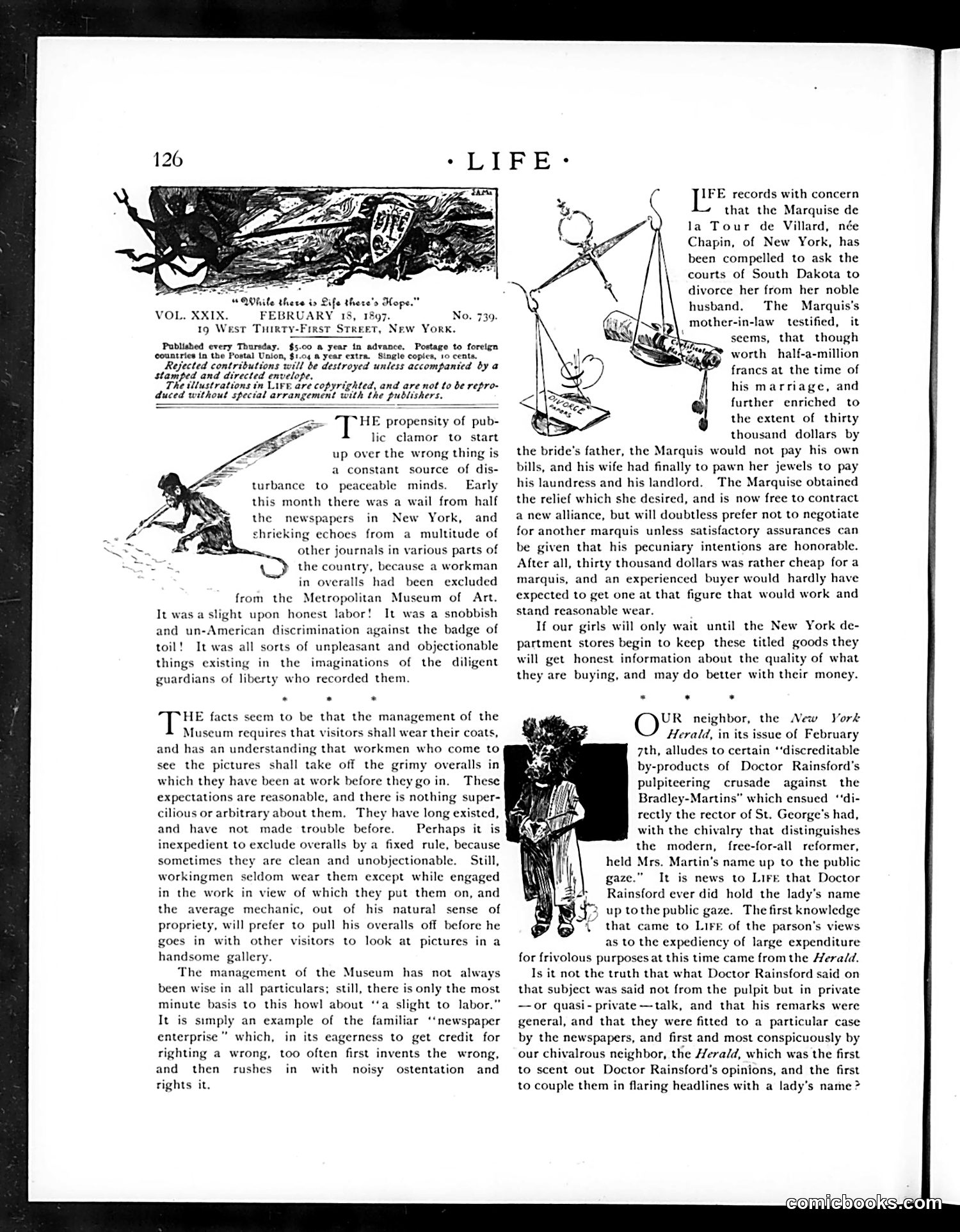
This page critiques the Metropolitan Museum of Art's policy requiring visitors to wear coats and excludes workmen in work overalls. The satirical point: the Museum's management imposes arbitrary, class-based dress codes while claiming to serve the public. The cartoons illustrate the absurdity—showing a workman excluded despite honest labor. The page also discusses the Marquise de Villard's divorce case in South Dakota, mocking her family's mercenary approach: her mother-in-law values a potential new marquis based on whether he'll pay her bills. Life satirizes both Old World aristocratic greed and the nouveau-riche American obsession with European titles. The Doctor Rainsford controversy references a clergyman's anti-poverty crusade being sensationalized by newspapers, particularly the *New York Herald*.
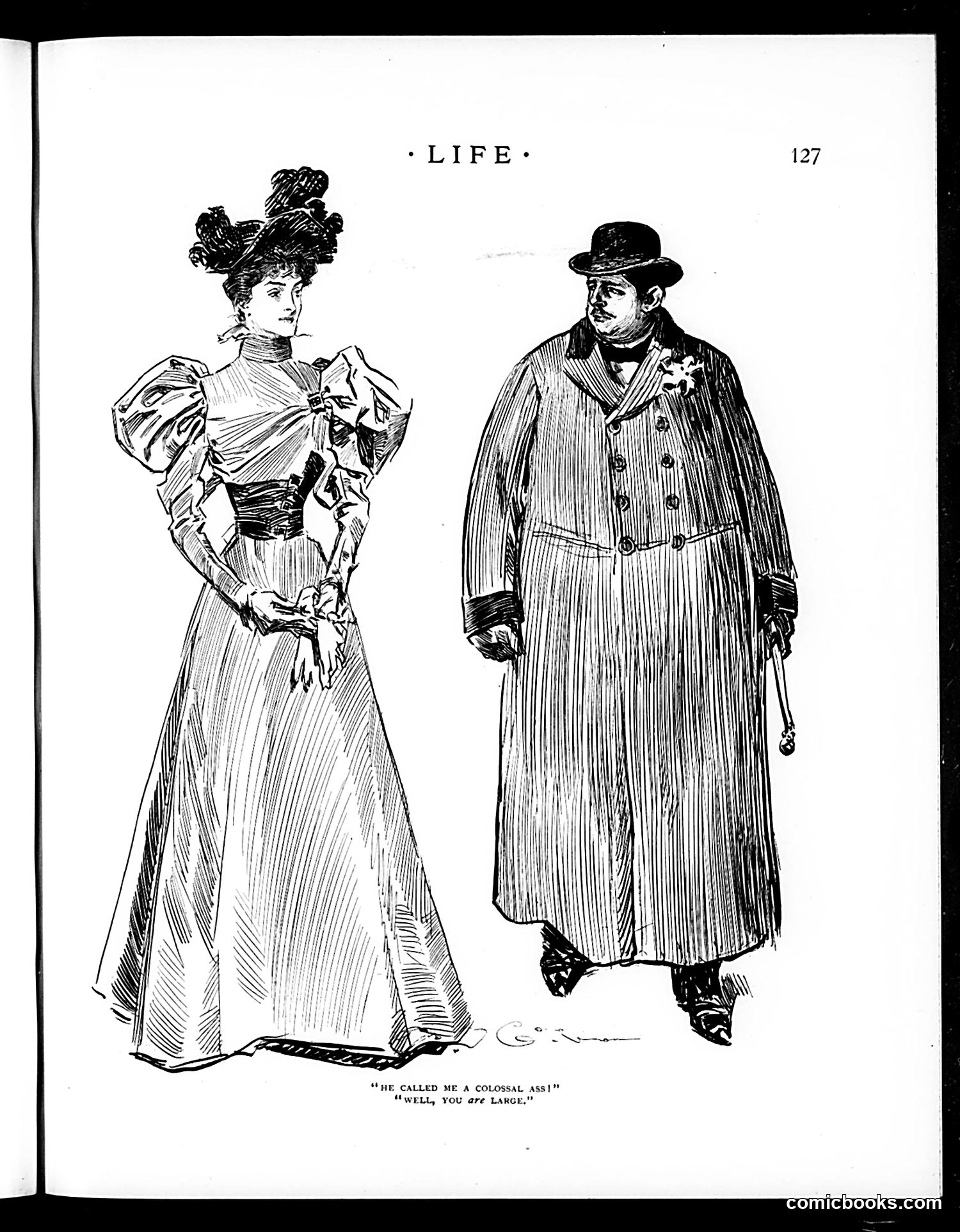
This cartoon depicts a humorous exchange between a well-dressed woman and a man in an overcoat and bowler hat. The caption reads: "HE CALLED ME A COLOSSAL ASS!" / "WELL, YOU ARE LARGE." The joke plays on a double meaning of "ass"—both as an insult and as a literal donkey. The woman interprets the man's insult literally, suggesting he called her large-bodied rather than foolish. It's a simple pun-based gag typical of early 1900s satirical humor in *Life* magazine. Without additional context clues identifying these as specific public figures, this appears to be a generic domestic or social comedy rather than political satire—the kind of witty dialogue humor that filled *Life*'s pages during this period.
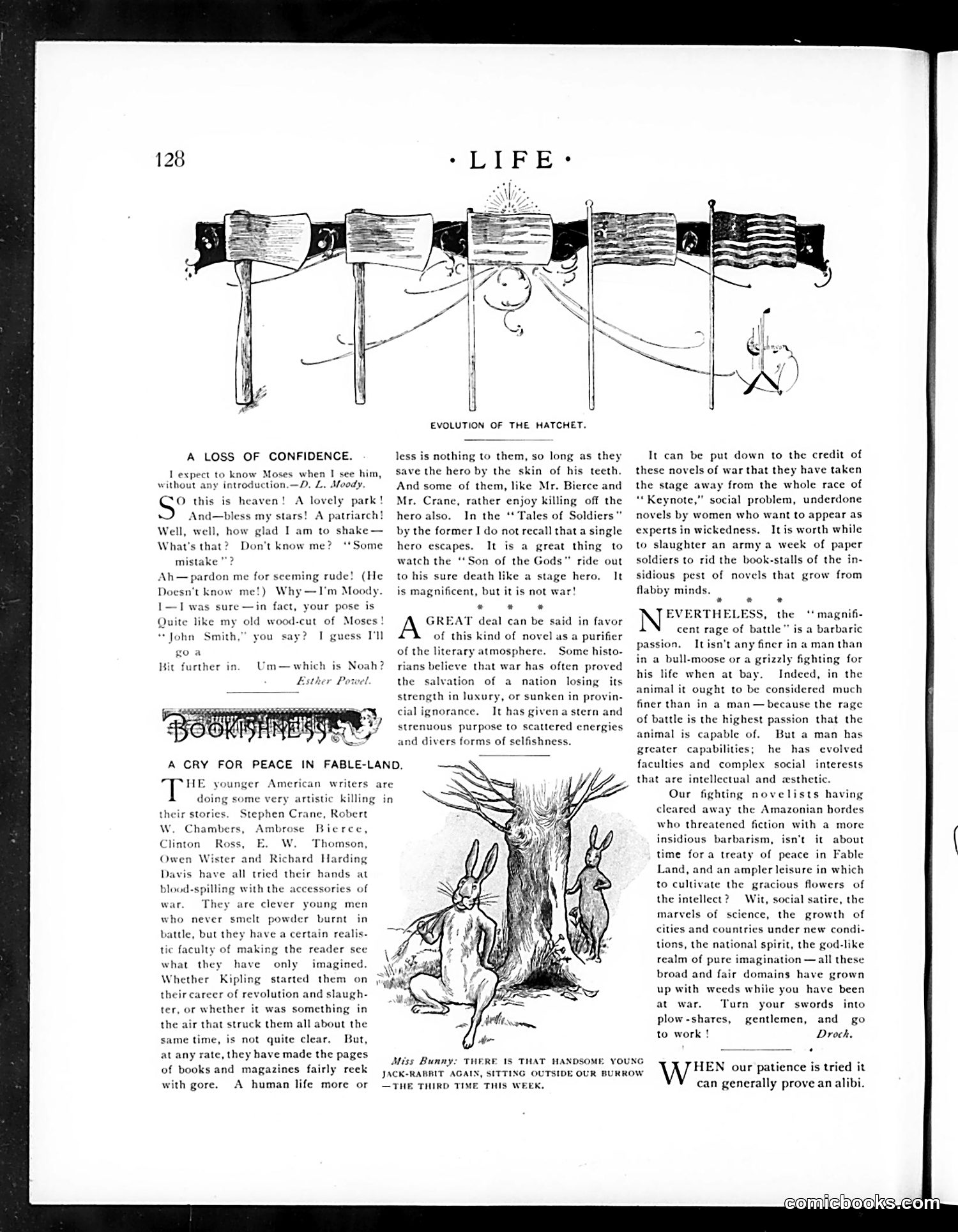
The page contains three distinct sections: **"Evolution of the Hatchet"** (top illustration): A satirical series showing five increasingly stylized representations of a hatchet atop poles, with small figures interacting with them. This appears to comment on how symbols or political tools evolve or become distorted through repeated use—likely referencing contemporary political rhetoric or nationalism. **"A Loss of Confidence"** (left column): A humorous dialogue poking fun at patriotic fervor and inconsistent logic, with characters named Moody challenging overly enthusiastic declarations of patriotism. **"A Great Deal Can Be Said"** and related sections: Literary criticism discussing war novels and their cultural value, critiquing both sensationalism and the emerging genre of combat fiction. **"A Cry for Peace in Fable-Land"** (with rabbit illustration): Satirizes younger American writers tackling war narratives, suggesting they prioritize entertainment over substance. The overall page critiques both patriotic excess and literary trends of the era.
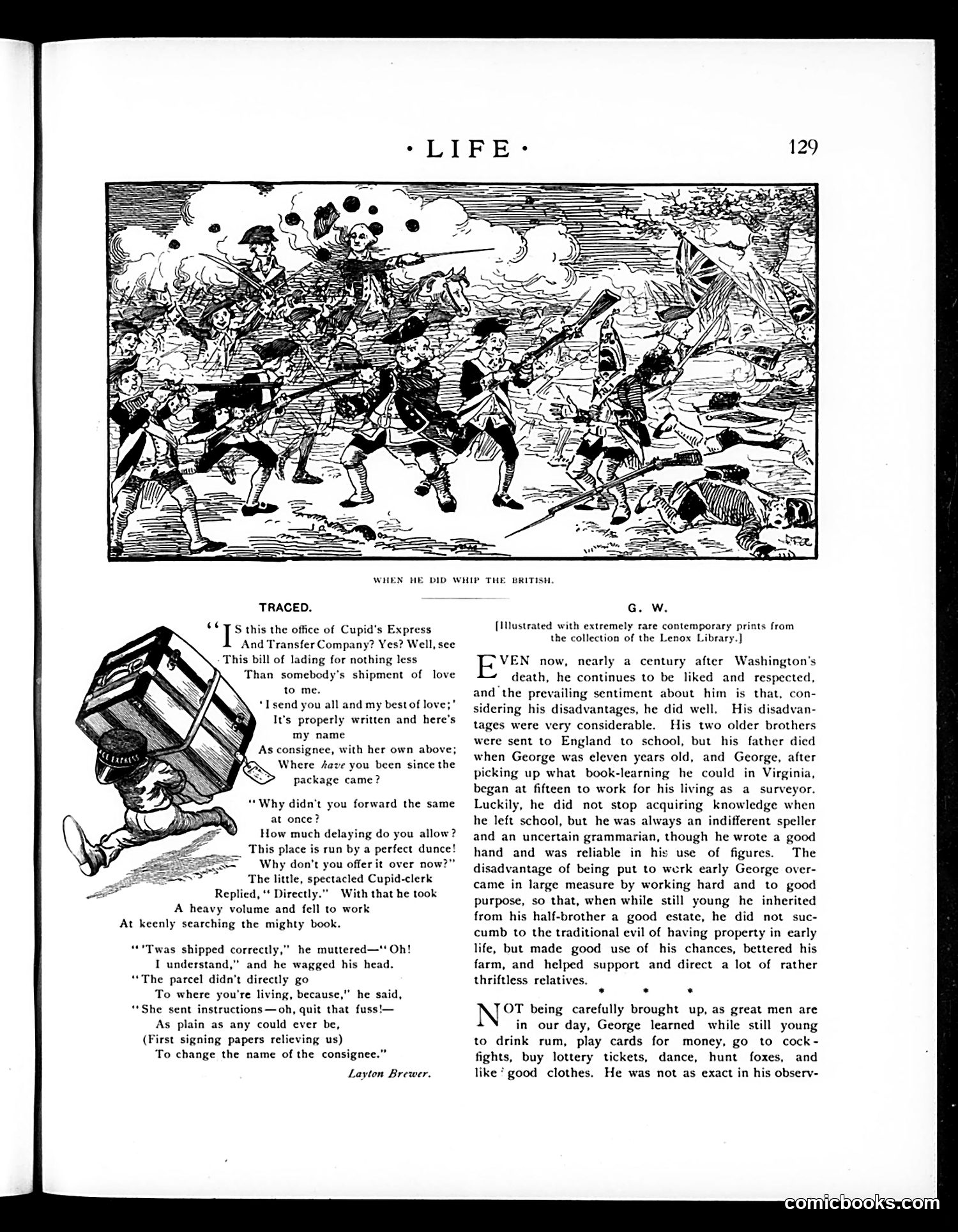
The top illustration titled "When He Did Whip the British" depicts a chaotic battle scene, apparently satirizing American Revolutionary War imagery. Below, the "Traced" section presents a humorous poem about Cupid's Express and Transfer Company—a mock shipping business for love letters. The illustration shows a cherubic figure carrying an oversized package, satirizing the romantic postal service conceit. The right column ("G.W.") discusses George Washington nearly a century after his death, noting his continued respect despite disadvantages. The text describes his humble upbringing, lack of formal education, and early work as a surveyor, contrasting his eventual success with his difficult circumstances. The overall page appears to blend Revolutionary War nostalgia with contemporary social commentary about class mobility and American historical reverence.
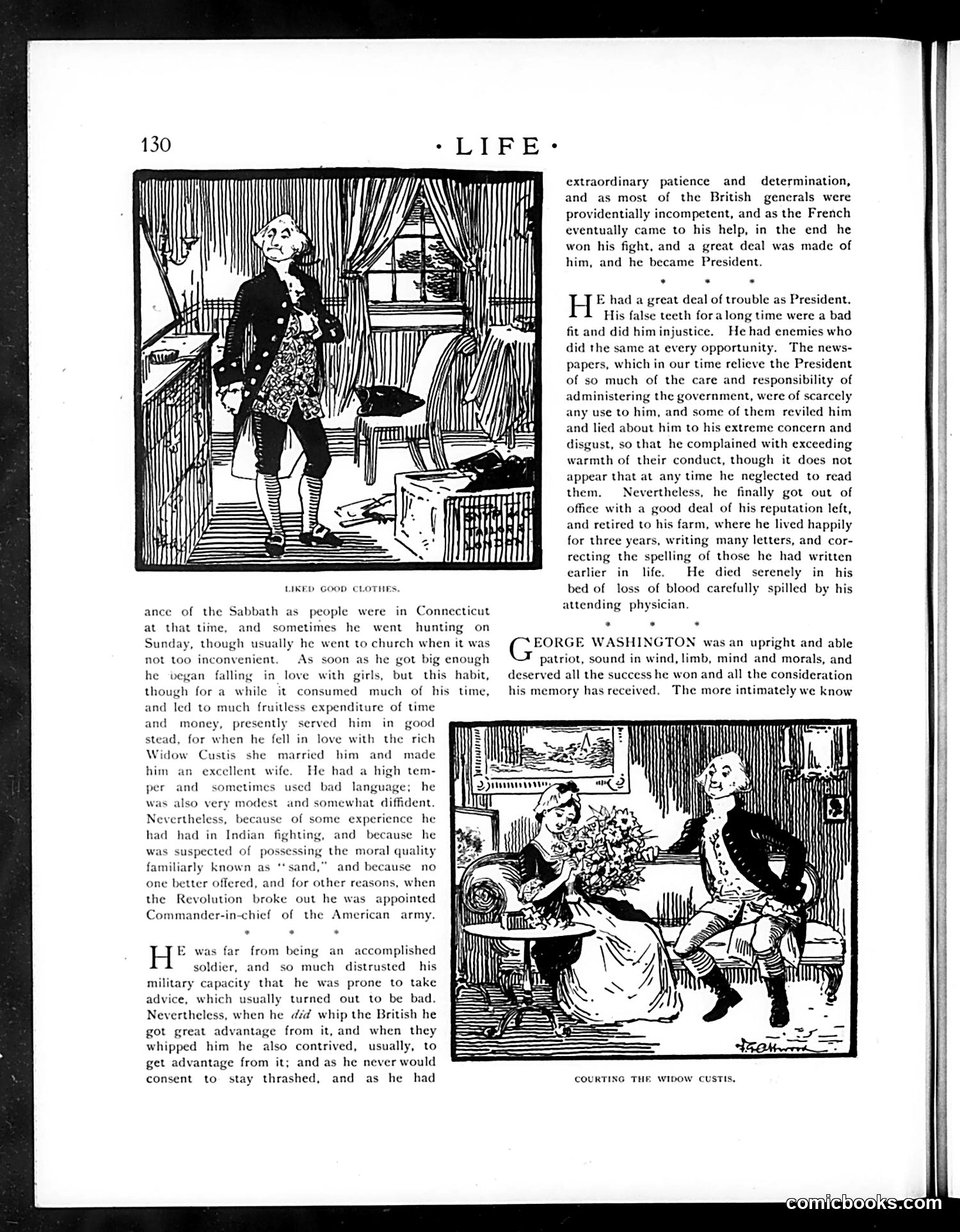
This page contains biographical anecdotes about George Washington, the first U.S. President. The text describes his military struggles during the Revolutionary War, his difficulties as President (including false teeth, incompetent generals, and a hostile press), and his eventual retirement to his farm. **Top illustration** ("Liked Good Clothes"): Shows Washington in formal 18th-century dress, apparently referencing his vanity or fashionable appearance—presented as a humanizing character detail. **Bottom illustration** ("Courting the Widow Curtis"): Depicts Washington's courtship of the wealthy widow Martha Custis, whom he married. This romanticizes his personal life and explains how he gained financial security. The satire gently humanizes Washington by emphasizing his flaws, vanity, romantic interests, and struggles—deflating the marble-statue mythology around the founding father.
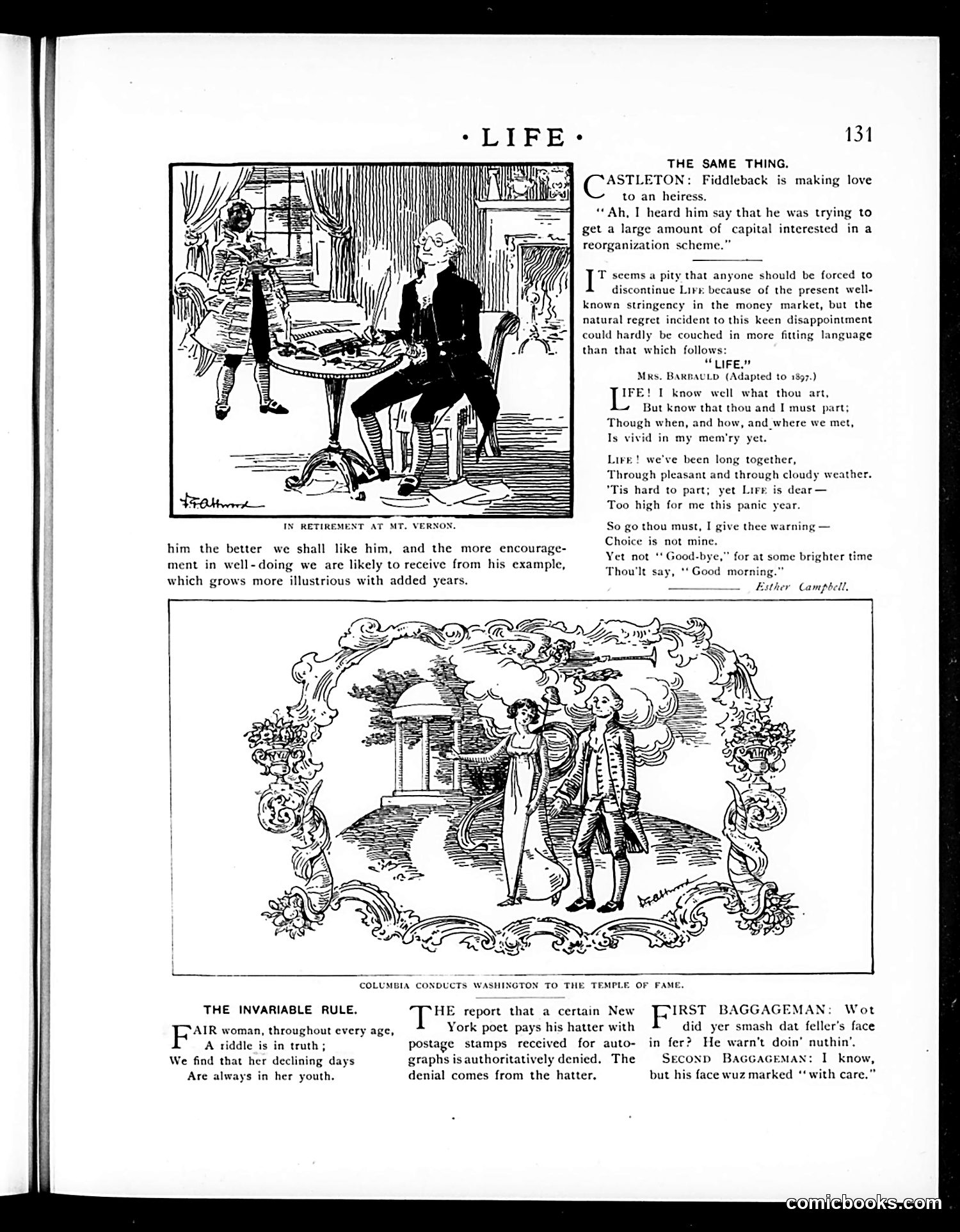
The top cartoon, titled "In Retirement at Mt. Vernon," depicts two men in 18th-century dress at what appears to be George Washington's estate. The dialogue mentions "Fiddleback" making love to "an heiress" and seeking capital for a "reorganization scheme"—satirizing wealthy individuals using romantic relationships for financial gain. The page includes a poem titled "Life" (adapted from 1897) about parting lovers, and three brief humorous anecdotes: "The Invariable Rule" about women's declining beauty with age, a joke about a New York poet paying postage with autographed stamps, and a baggageman's quip about a passenger's marked face. The classical engraving below shows "Columbia Conducts Washington to the Temple of Fame," evoking American patriotic imagery.
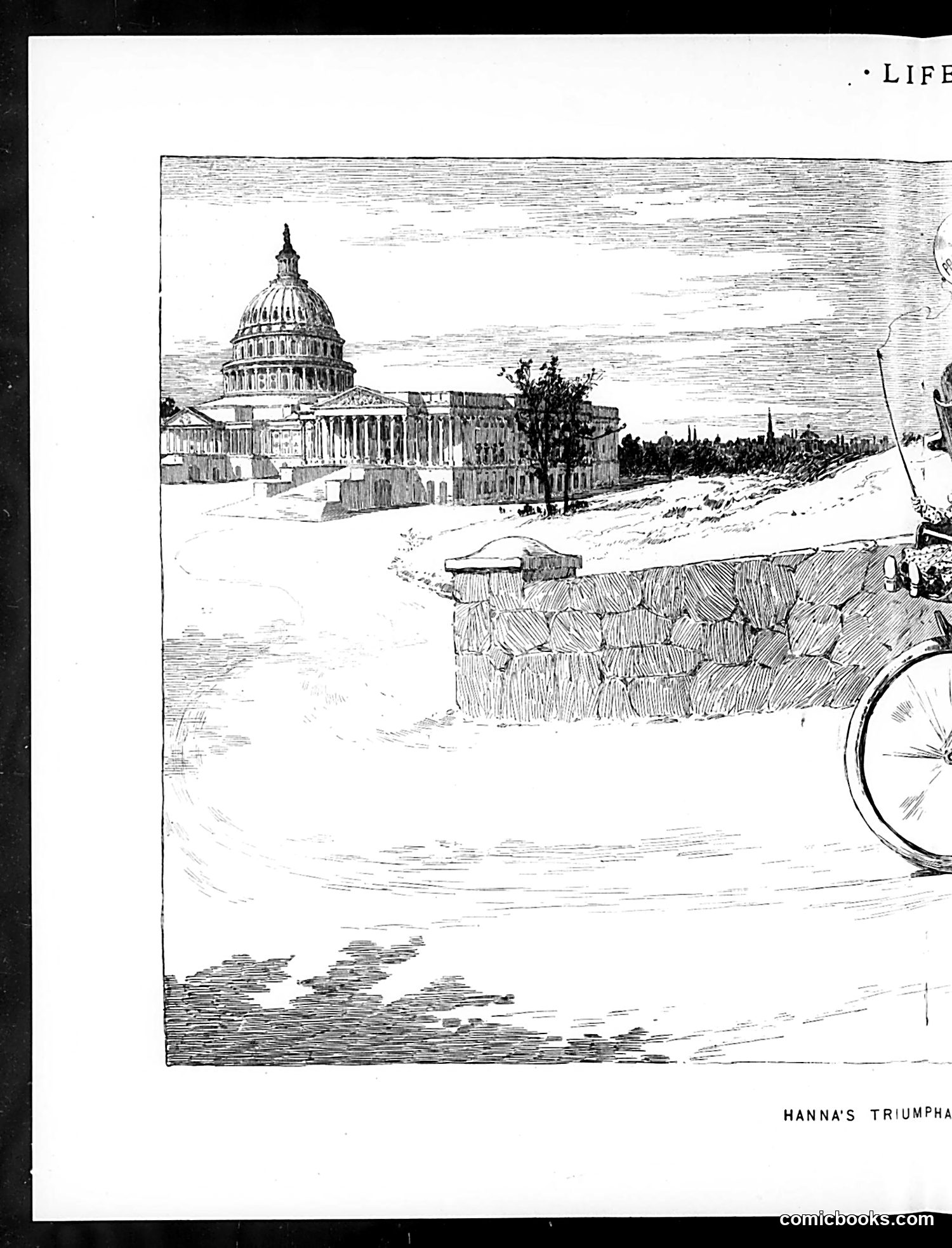
This political cartoon depicts the U.S. Capitol building in a landscape that appears scarred or damaged, with what looks like fortifications or earthworks in the foreground. The caption reads "HANNA'S TRIUMPH," referring to Mark Hanna, a prominent Republican political operative and businessman of the Gilded Age. The satirical point appears critical: the damaged landscape and military-style fortifications suggest that Hanna's political machinations or business interests have left the nation's capital metaphorically "fortified" or under siege. The cartoon likely criticizes Hanna's substantial influence over Republican politics and policy, suggesting his control came at a cost to the democratic landscape. However, without additional context from surrounding articles, the specific event being mocked remains unclear.
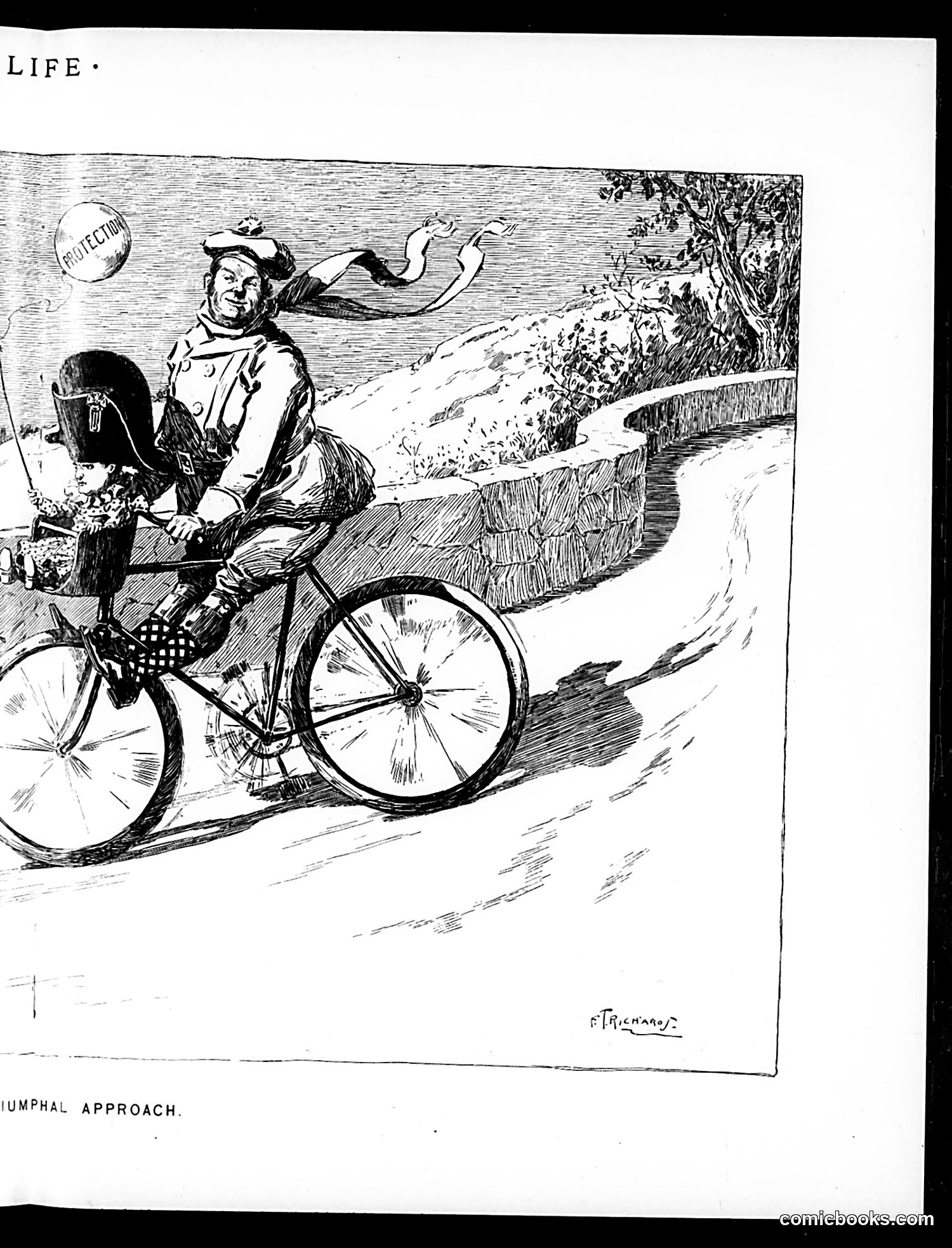
This black and white cartoon depicts a cyclist riding along a scenic country road. The rider appears to be a jovial, caricatured figure in period clothing (suggesting early 20th century), cheerfully pedaling with ribbons or scarves streaming behind. A "Protection" shield or emblem appears in the upper left. The title "Triumphal Approach" suggests satirical commentary on protectionist economic policies—likely referencing American tariffs or trade legislation of the era. The bicycle, simple and homely, may represent ordinary Americans or domestic industry, while the "triumphal" language ironically contrasts the modest reality with grandiose political claims. The cartoonist appears to be mocking overconfident or misleading rhetoric around protective trade policies. The artist's signature reads "F. Kirchmayer" or similar.
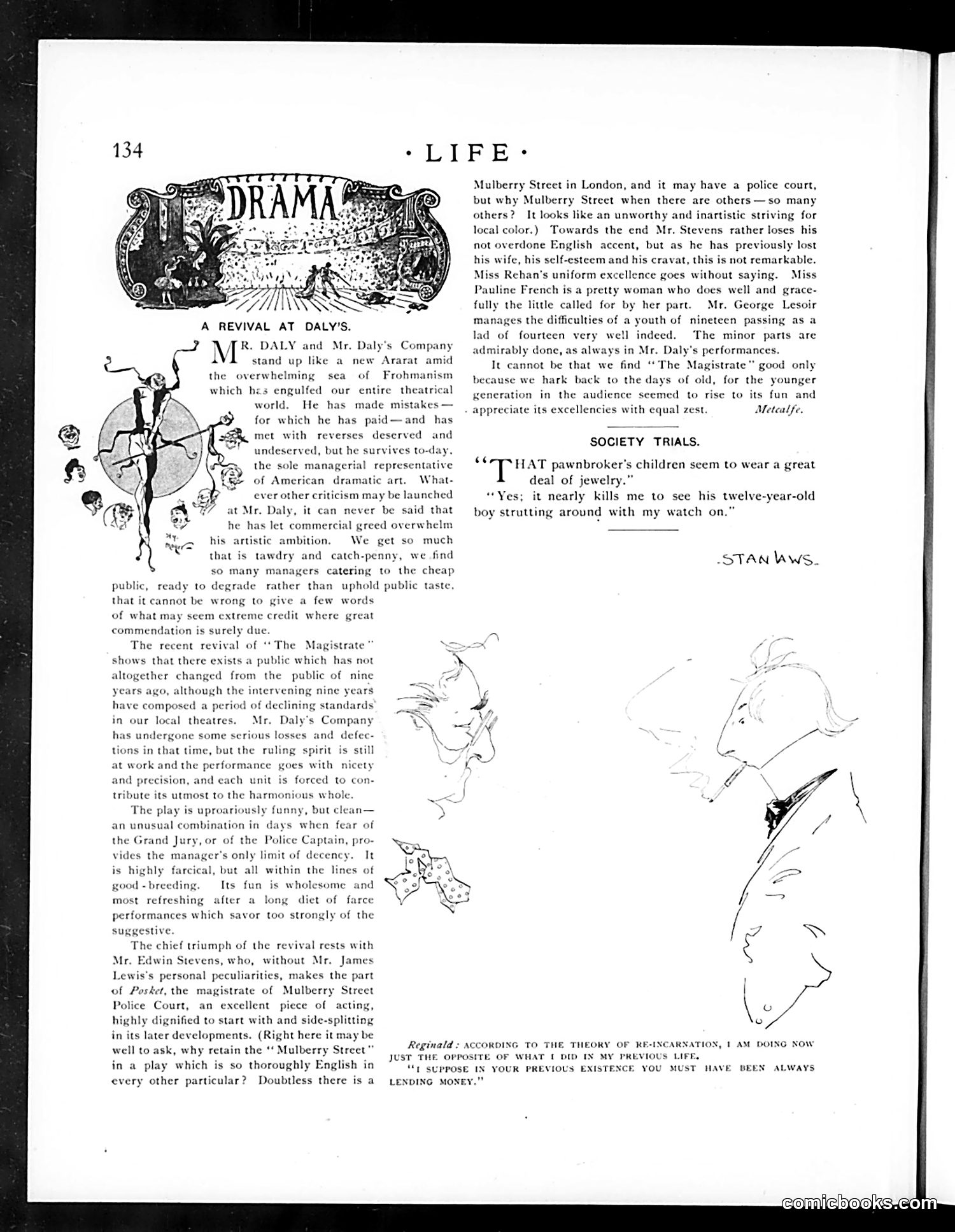
This page reviews a theatrical revival of "The Magistrate," praising Mr. Daly's Company for maintaining artistic standards against commercial pressures to degrade public taste. The critic credits actor Edwin Stevens with a particularly excellent performance as the magistrate of Mulberry Street Police Court. The cartoon labeled "Reginald" (by Stanislaus, signed "-STAN LAWS") depicts a figure apparently referencing reincarnation theory—the caption jokes that based on his current wealth-lending activities, he must have "always [been] lending money" in previous lives. The "Society Trials" section presents a brief humorous exchange about a pawnbroker's child ostentatiously displaying jewelry. Overall, the page mixes theatrical criticism with social satire typical of Life magazine's satirical approach.
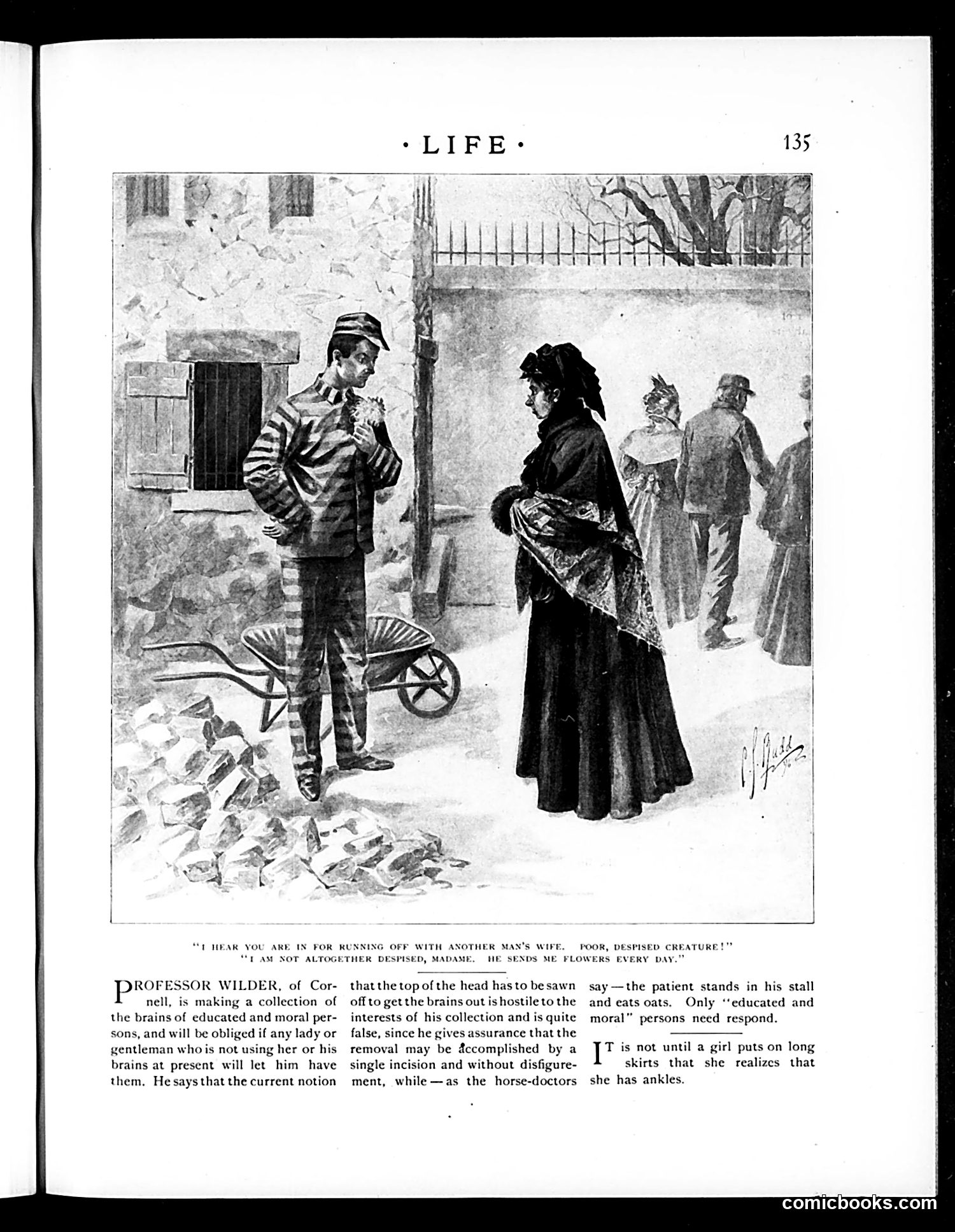
The cartoon depicts a humorous social commentary on romantic scandal and class attitudes. A working-class man (indicated by his striped uniform, likely a street worker or laborer) is confronted by a well-dressed woman about an alleged affair with another man's wife. The satire works on multiple levels: the man defends himself by noting he receives flowers daily—suggesting even "despised creatures" can be objects of affection, which undercuts the woman's moral condemnation. The accompanying text about "Professor Wilder" collecting brains from educated people appears to be absurdist satire, implying that moral judgment of others' romantic conduct requires intelligence the critic may not possess. The joke relies on period class attitudes: a working man's romantic entanglement is treated as scandalous by supposedly more "moral" upper-class observers, yet he demonstrates he's valued despite his station. The final aphorism about girls discovering ankles through long skirts is separate observational humor about fashion and self-awareness.
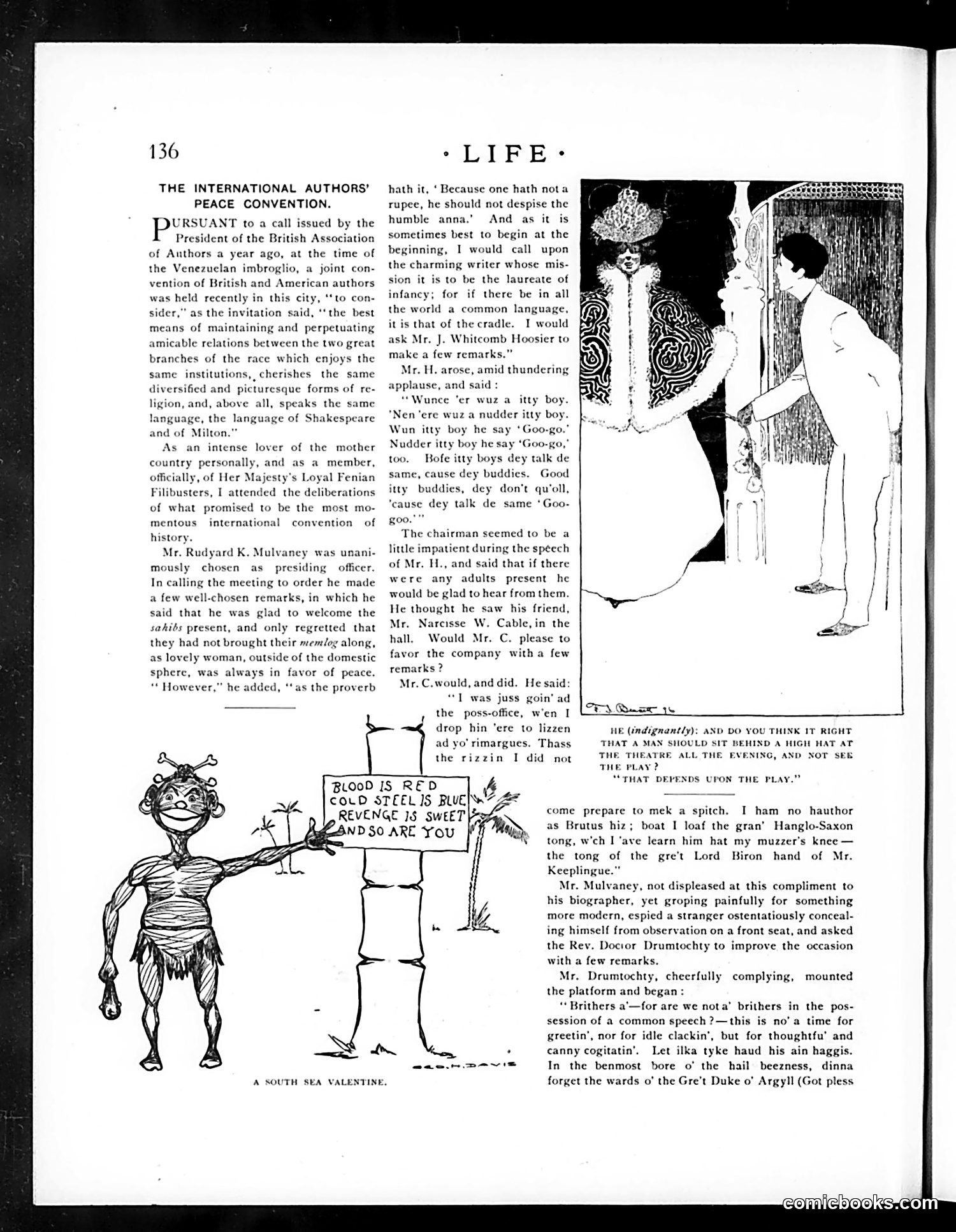
This page mocks a real 1896 convention of British and American authors convened to strengthen relations between the nations. The satire targets the pretension of treating literature as a bridge between peoples. The cartoon ridicules speakers' attempts at profundity. "Mr. H." (likely James Whitcomb Riley, an American dialect poet) delivers infantile baby-talk ("Wunce 'er wuz a itty boy"), presented as profound. Subsequent speakers lapse into exaggerated dialect—crude phonetic representations of Scottish and other speech patterns—undermining the convention's stated goal of celebrating shared language and civilization. The accompanying "South Sea Valentine" cartoon (bottom left) appears unrelated satirical content. The humor lies in exposing the gap between the authors' high-minded rhetoric about peace and their actual literary output: sentimental, folksy, or regionally-specific writing presented as universal truth. The convention becomes absurd theater rather than meaningful cultural dialogue.
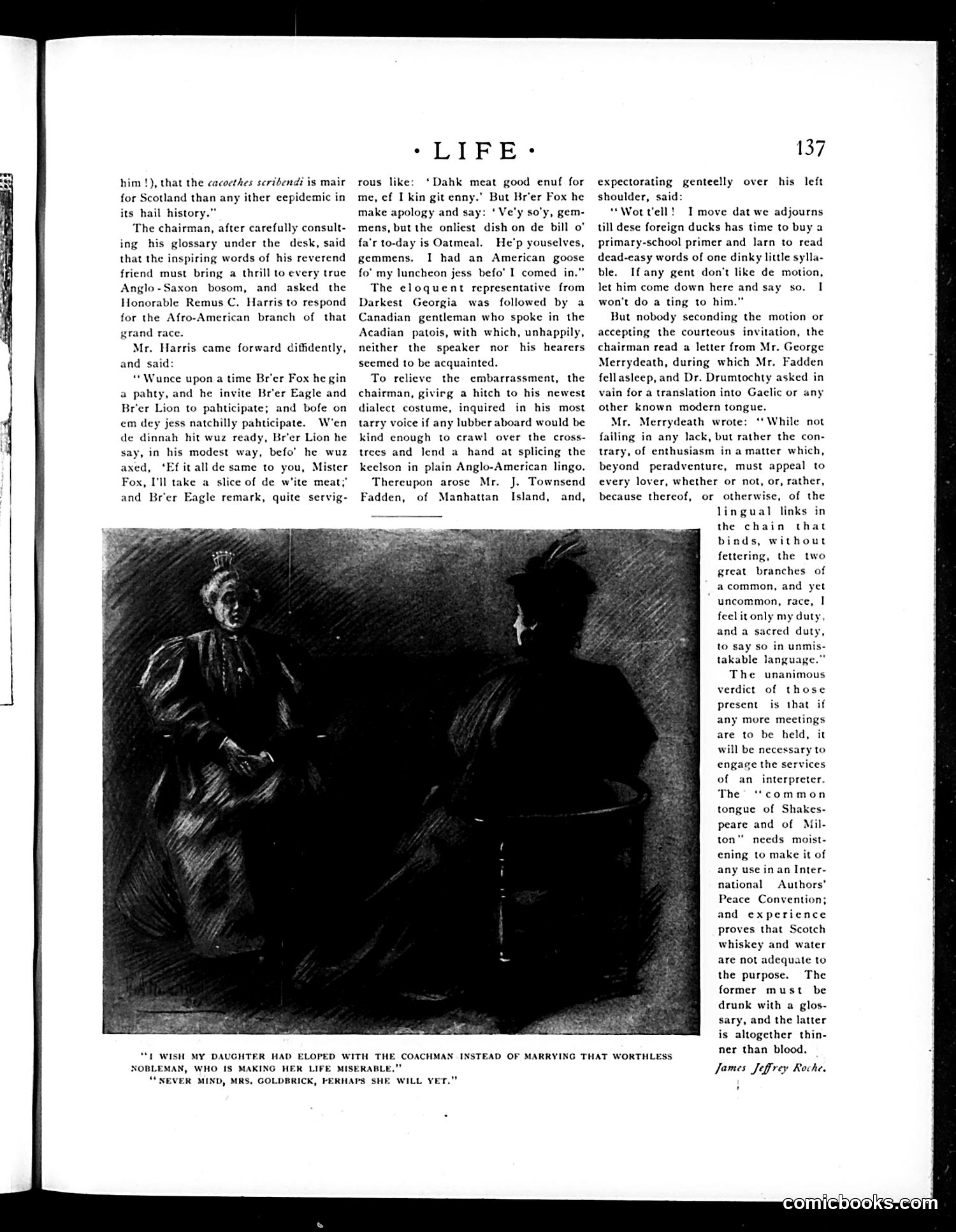
This 1890s satirical piece mocks an "International Authors' Peace Convention" where speakers attempt to communicate across linguistic and cultural divides—and fail spectacularly. The cartoon illustrates the central joke: despite claims of shared "Anglo-Saxon" brotherhood, various speakers represent incompatible dialects and languages. A Scottish chairman consults a glossary; an African-American speaker (Remus C. Harris) uses heavy dialect; a Canadian speaks Acadian French; and a New York character (Mr. Fadden) uses incomprehensible slang. The satire targets the era's naive universalism—the notion that English-speaking peoples could easily unite around common literature and values. The punchline appears in Mr. Merrydeath's letter: overwrought, grammatically tortured prose that's simultaneously pompous and meaningless. The author (James Jeffrey Roche) suggests that neither "Scotch whiskey and water" nor noble literary intentions can overcome actual linguistic chaos. The piece satirizes both the pretension of international peace conferences and period attitudes about dialect and class as markers of incompatibility.
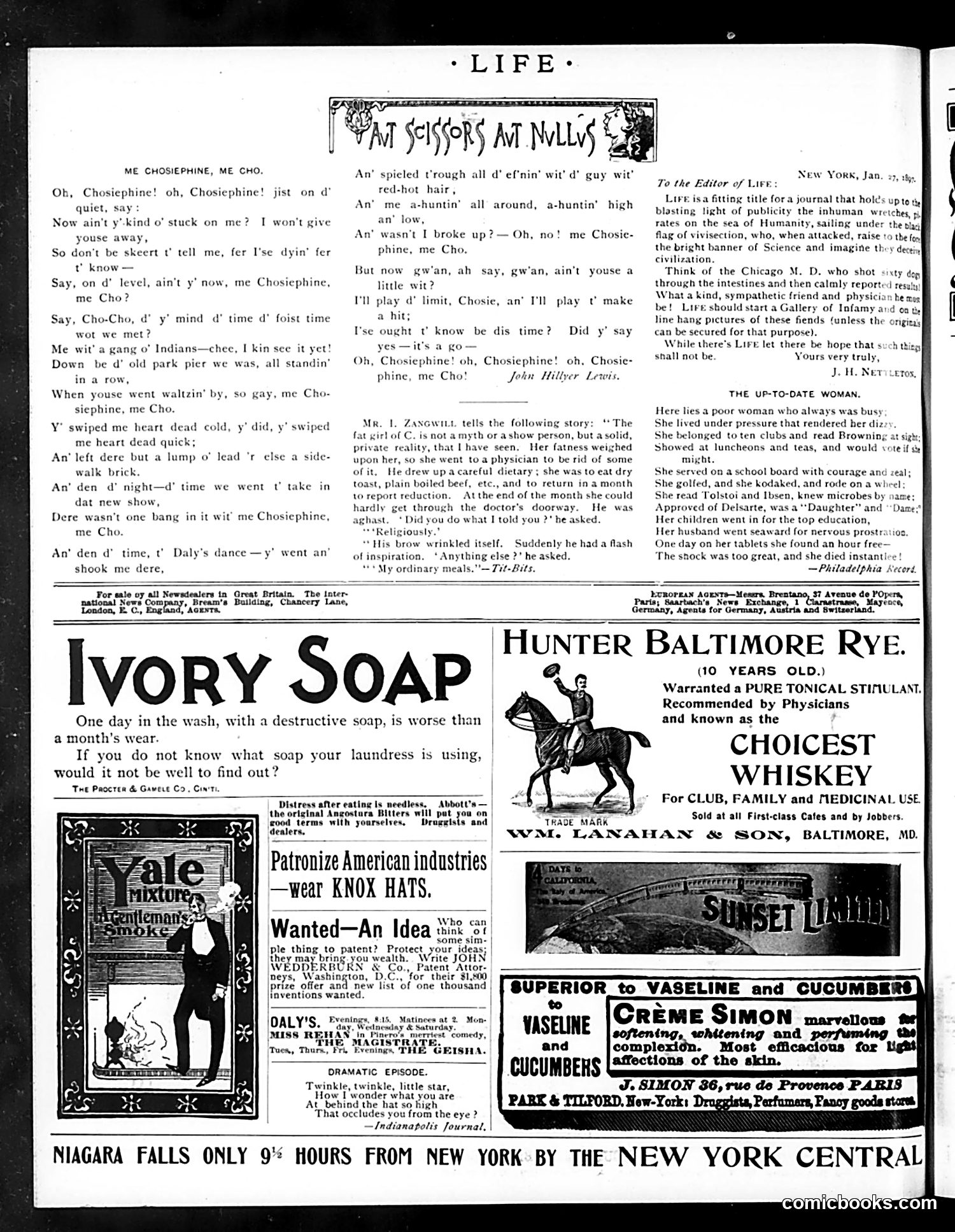
This page's main content is a humorous monologue in heavy dialect, likely meant to represent African American speech patterns of the era. The speaker (appearing to address "Chosiephine") recounts romantic encounters—meeting "a gang o' Indians," attending shows and dances, and reminiscing about a lost love who "swiped me heart dead cold." The humor relies on exaggerated dialect, malapropisms, and sentimental romance—typical of early 20th-century vaudeville comedy. The piece titled "Scissors at Nulls" (unclear meaning) was written by John Hilbert Lewis. The page also includes period advertisements (Ivory Soap, whiskey, cosmetics) and letters to the editor criticizing vivisection and discussing the "modern woman." **Note:** This represents outdated comedic conventions that relied on ethnic caricature and dialect mockery—content modern readers would recognize as offensive stereotyping rather than genuine humor.
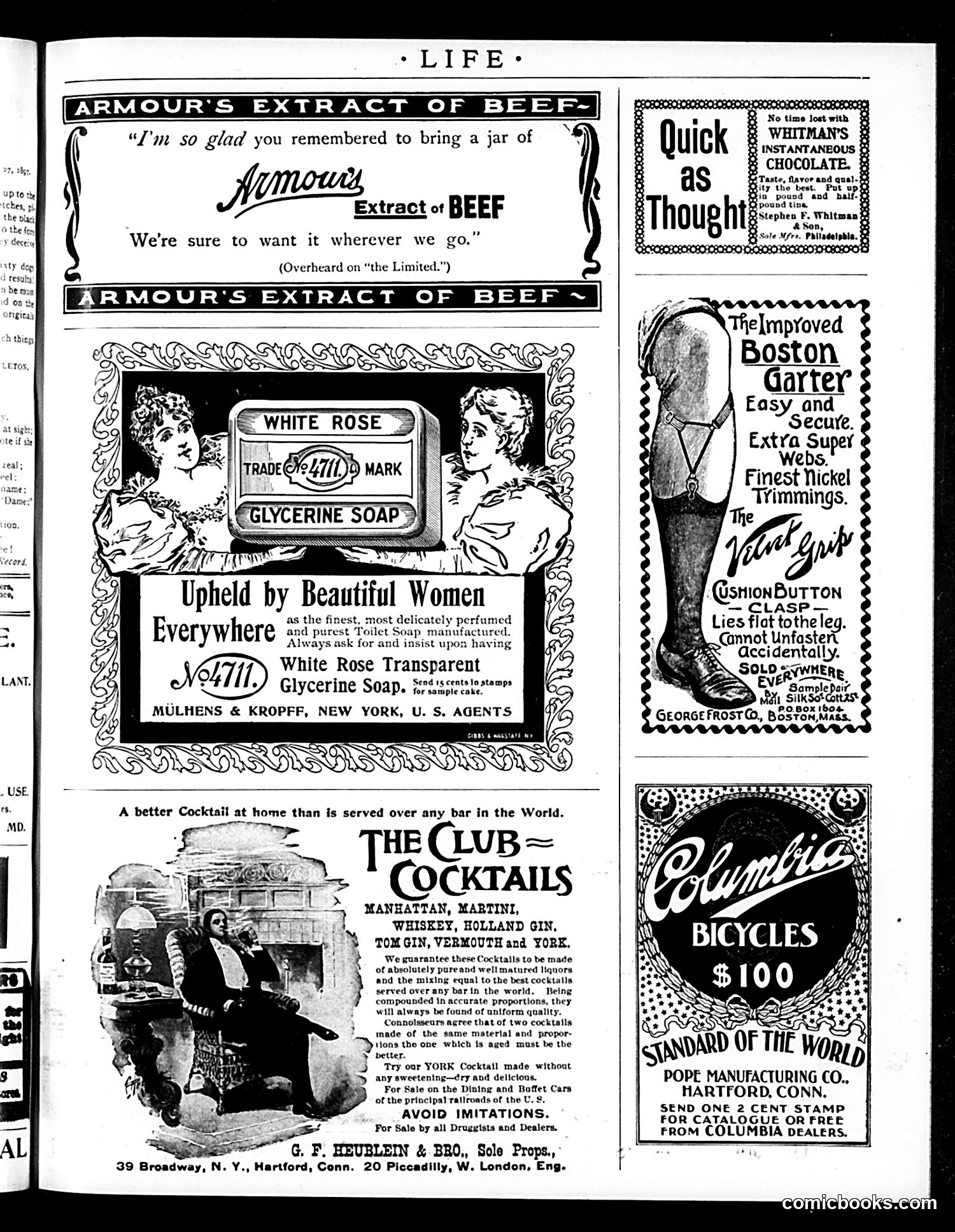
This page is primarily **advertising** rather than satirical content. It contains four commercial advertisements from the early 1900s: 1. **Armour's Extract of Beef** – A meat product advertised with a conversation snippet about travelers on "the Limited" (a luxury train), suggesting the extract's portability and usefulness for travelers. 2. **White Rose Glycerine Soap** – Marketed as an upscale toiletry "upheld by beautiful women everywhere," with decorative Art Nouveau framing. 3. **The Club Cocktails** – Promoting ready-made cocktail mixers (Manhattan, Martini, etc.) guaranteed to use pure liquors and proper proportions, sold by druggists. 4. **Columbia Bicycles** and **Boston Garter** – Featured in smaller advertisements highlighting product features. The page reflects **early 1900s consumer culture**, emphasizing quality, portability, and modern convenience products. There is no political satire or social commentary visible—it's a straightforward advertising layout typical of Life's revenue model during this era.
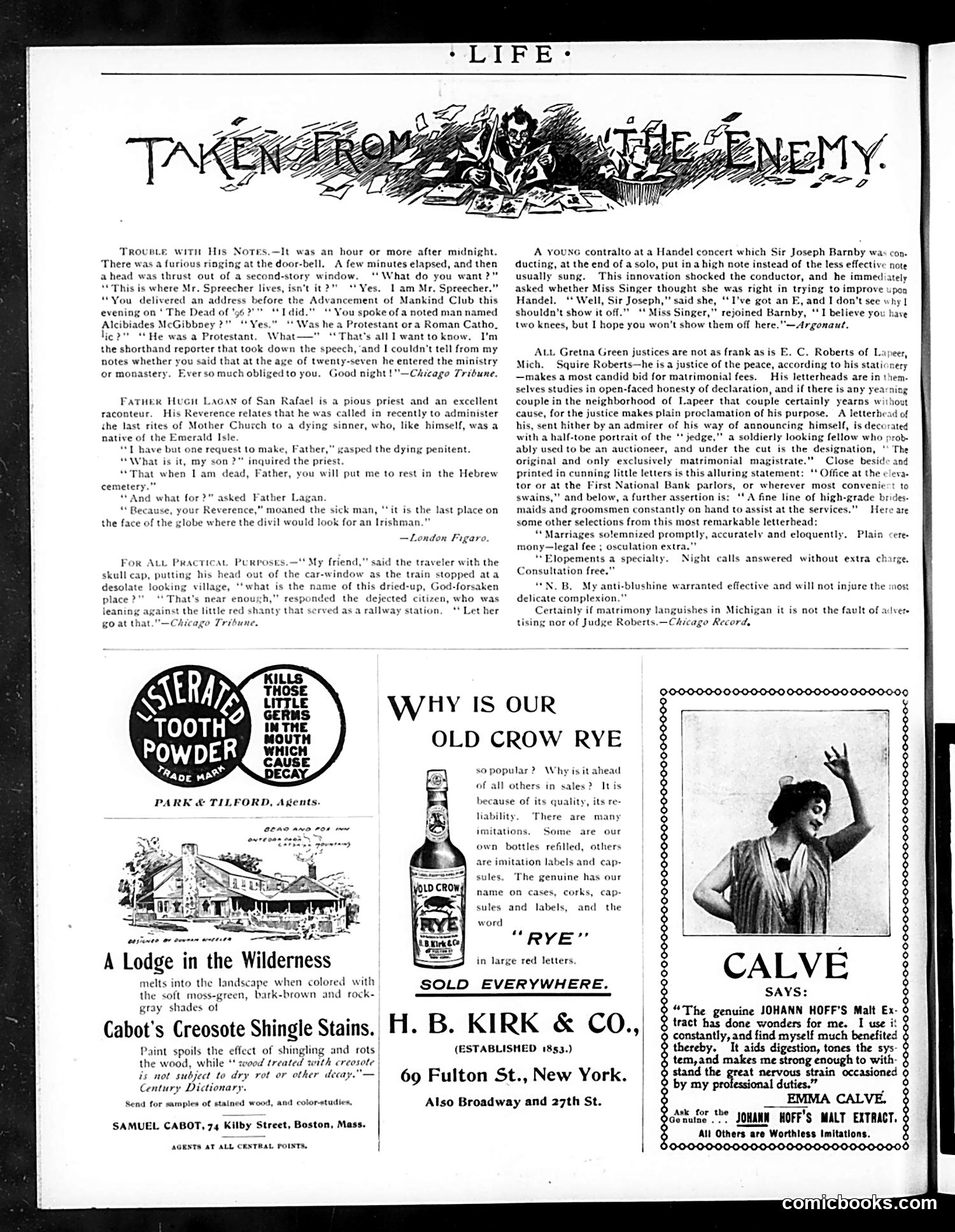
This page from *Life* magazine consists primarily of **humorous anecdotes** rather than political cartoons. The jokes satirize everyday social situations: 1. **"Trouble with His Notes"**: A shorthand reporter interrupts a speaker at midnight, unable to determine from his notes whether the subject entered a "ministry" or "monastery"—a gentle jab at unclear public speaking. 2. **"Father Hugh Lagan"**: An Irish priest's dark humor about wanting to be buried in a Hebrew cemetery so "the devil" won't find him there—playing on Irish-Catholic stereotypes and irreverent wit. 3. **"For All Practical Purposes"**: A traveler asks a villager the name of their "God-forsaken place," and the villager matter-of-factly responds the name doesn't matter—satirizing small-town insignificance. The page also contains **period advertisements** (tooth powder, shingle stains, malt extract) and promotional content for Old Crow Rye whiskey. The anecdotes reflect *Life*'s early 20th-century humor style: gentle, domestic satire rather than sharp political commentary.
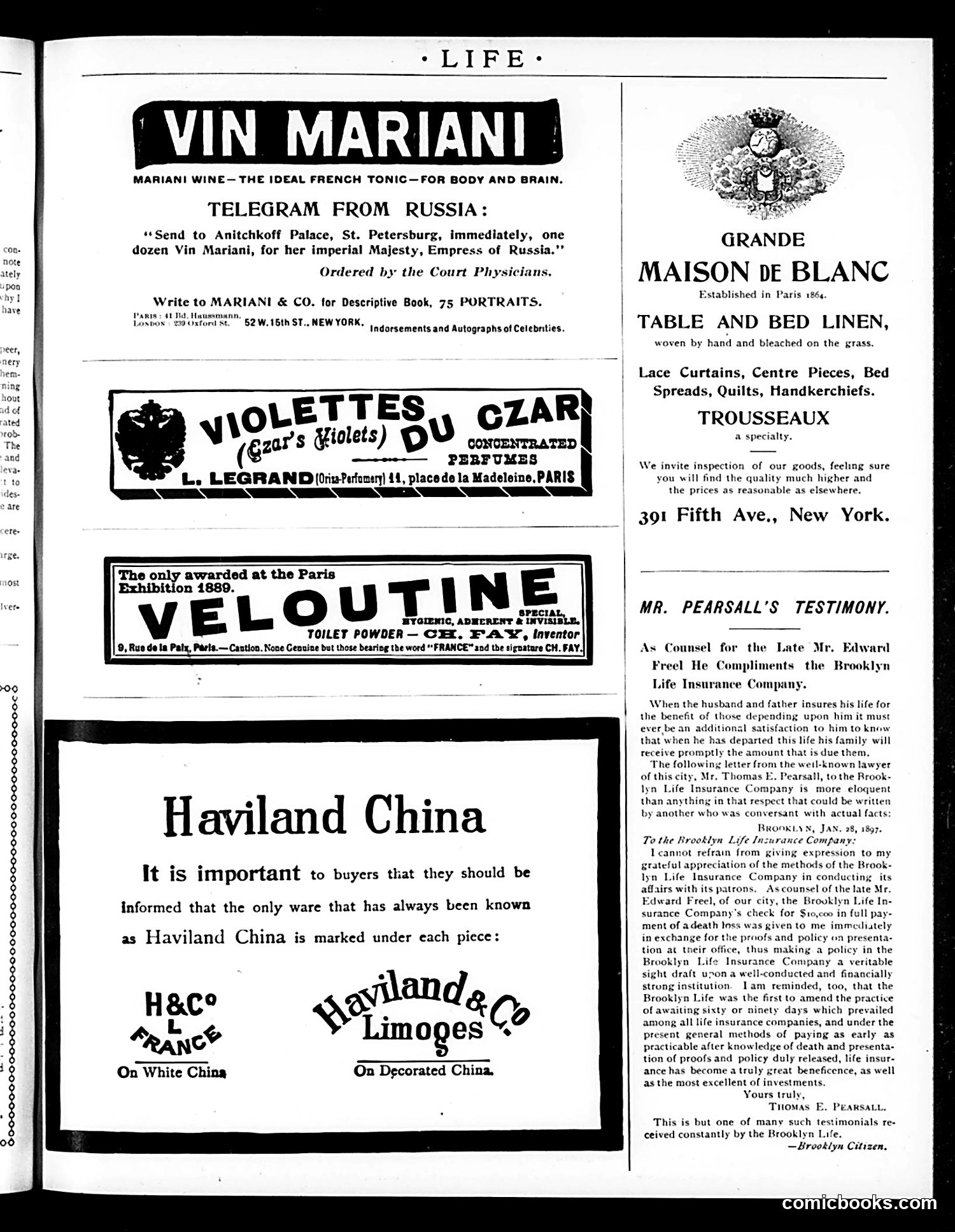
This page is primarily **advertisements**, not satirical content. It features luxury goods marketed to wealthy American consumers circa 1890s: **Key Ads:** - **Vin Mariani**: A French wine tonic claiming health benefits, advertised via a fake "telegram from Russia" claiming the Empress ordered it—a fabricated celebrity endorsement common in this era - **Violettes du Czar** and **Veloutin**: French perfumes and cosmetics - **Haviland China**: Porcelain dinnerware, with a notice warning against counterfeits - **Maison de Blanc**: Parisian linens and luxury textiles **The testimonial** praising Brooklyn Life Insurance appears alongside these ads, using a lawyer's letter as social proof—another common advertising tactic of the period. **For modern readers:** This reflects the Gilded Age fascination with French luxury goods and the era's unregulated advertising practices, including invented endorsements and minimal consumer protection against fraud or false health claims.
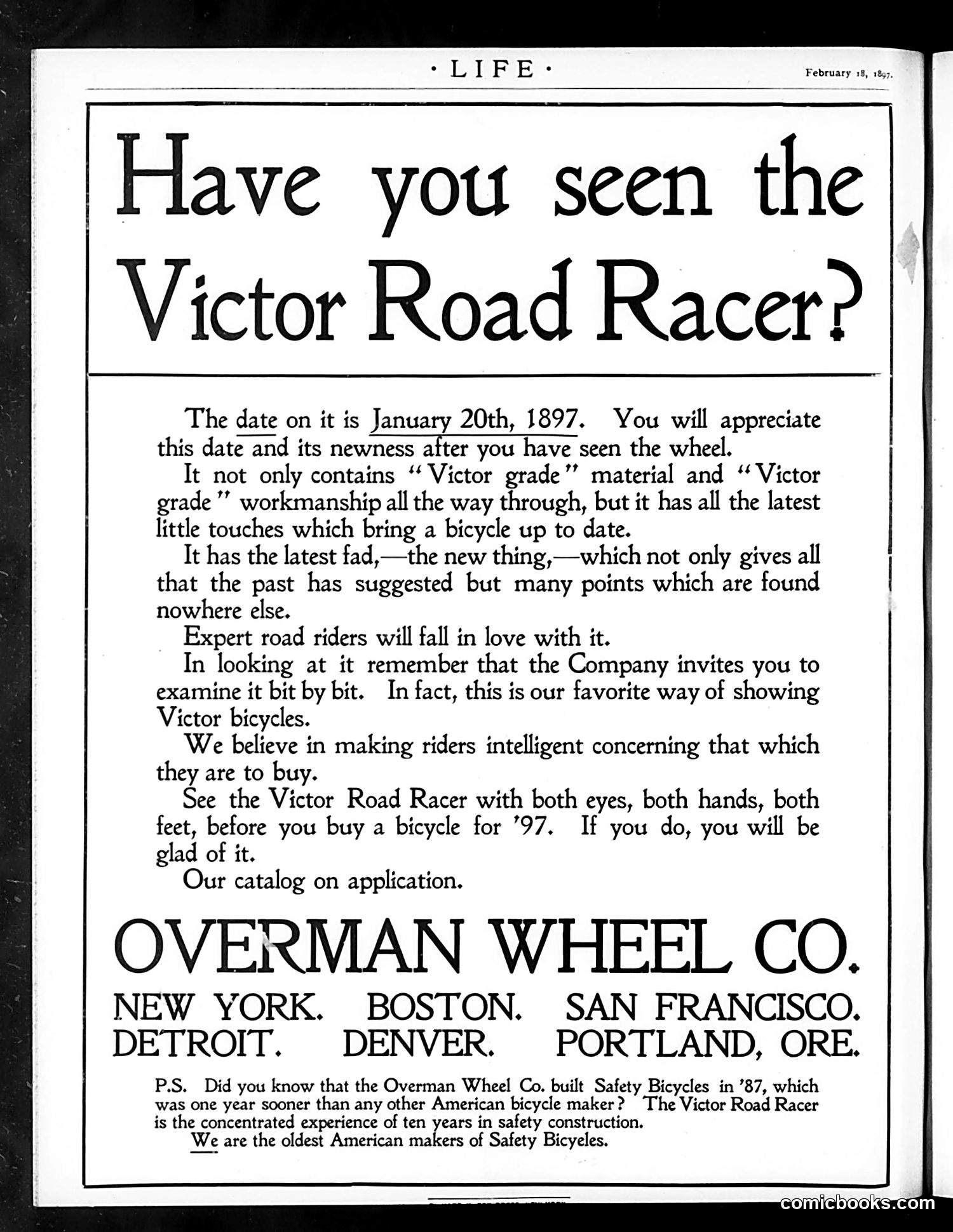
This is not a cartoon or satire—it's a **straightforward advertisement** for the Victor Road Racer bicycle, manufactured by the Overman Wheel Company. **Context for modern readers:** In 1897, bicycles were cutting-edge consumer technology and a major status symbol. The "safety bicycle" (with two equal-sized wheels and a chain drive) was relatively new, having replaced the dangerous "penny-farthing" design. The ad emphasizes the bicycle's 1897 date to stress its modernity and latest features. It appeals to "expert road riders" and promises quality craftsmanship. The company claims leadership in safety bicycle manufacturing since 1887. The rhetorical strategy—inviting customers to examine the bike "bit by bit" with "both eyes, both hands, both feet"—reflects how consumers shopped for expensive, technical goods before mass production standardization. The ad ran in *Life* magazine, which mixed satire with advertisements.