
Life, 1897-02-18 · page 7 of 20
Life — February 18, 1897 — page 7: what you’re looking at
What you’re looking at
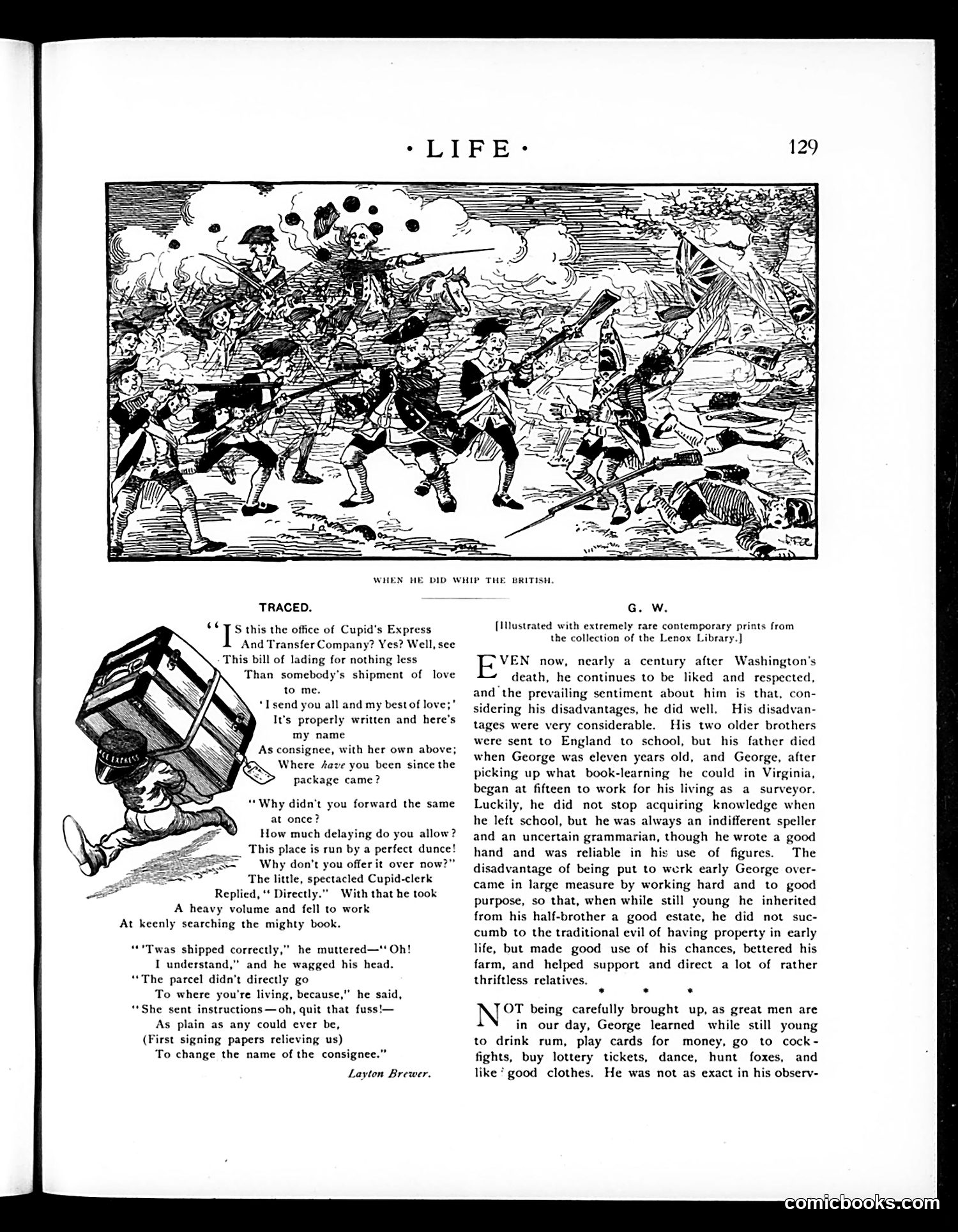
The top illustration titled "When He Did Whip the British" depicts a chaotic battle scene, apparently satirizing American Revolutionary War imagery. Below, the "Traced" section presents a humorous poem about Cupid's Express and Transfer Company—a mock shipping business for love letters. The illustration shows a cherubic figure carrying an oversized package, satirizing the romantic postal service conceit. The right column ("G.W.") discusses George Washington nearly a century after his death, noting his continued respect despite disadvantages. The text describes his humble upbringing, lack of formal education, and early work as a surveyor, contrasting his eventual success with his difficult circumstances. The overall page appears to blend Revolutionary War nostalgia with contemporary social commentary about class mobility and American historical reverence.
📄 Transcribed text from this page (OCR, searchable)
Machine-transcribed from the original scan — historical spelling and the odd misread are preserved.
WHEN HE DID WHIP TRACED. 67S this the office of Cupid's Express And Transfer Company? Yes? Well, see This bill of lading for nothing less Than somebody's shipment of love to me. *Isend you all and my bestof love;’ It’s properly written and here's my name As consignee, with her own above; Where fave you been since the package came? “Why didn’t you forward the same at once? How much delaying do you allow? This place is run by a perfect dunce! "Why don't you offer it over now?” The little, spectacled Cupid-clerk Replied, “ Directly." With that he took A heavy volume and fell to work At keenly searching the mighty book. ““'Twas shipped correctly,” he muttered—"* Oh! I understand," and he wagged his head. “The parcel didn’t directly go To where you're living, because," he said, “She sent instructions—oh, quit that fuss!— As plain as any could ever be, (First signing papers relieving us) To change the name of the consignee.” Layton Brewer. THE BRITISH. [IMustrated with extremely rare contemporary prints from the collection of the Lenox Library.] VEN now, nearly a century after Washington's death, he continues to be liked and respected, and ‘the prevailing sentiment about him is that, con- sidering his disadvantages, he did well. His disadvan- tages were very considerable. His two older brothers were sent to England to school, but his father died when George was eleven years old, and George, after picking up what book-learning he could in Virginia, began at fifteen to work for his living as a surveyor. Luckily, he did not stop acquiring knowledge when he left school, but he was always an indifferent speller and an uncertain grammarian, though he wrote a good hand and was reliable in his use of figures. The disadvantage of being put to werk early George over- came in large measure by working hard and to good purpose, so that, when while still young he inherited from his half-brother a good estate, he did not suc- cumb to the traditional evil of having property in early life, but made good use of his chances, bettered his farm, and helped support and direct a lot of rather thriftless relatives. N2& being carefully brought up, as great men are in our day, George learned while still young to drink rum, play cards for money, go to cock- fights, buy lottery tickets, dance, hunt foxes, and like‘ good clothes. He was not as exact in his observ- . .