
Life, 1897-02-18 · page 6 of 20
Life — February 18, 1897 — page 6: what you’re looking at
What you’re looking at
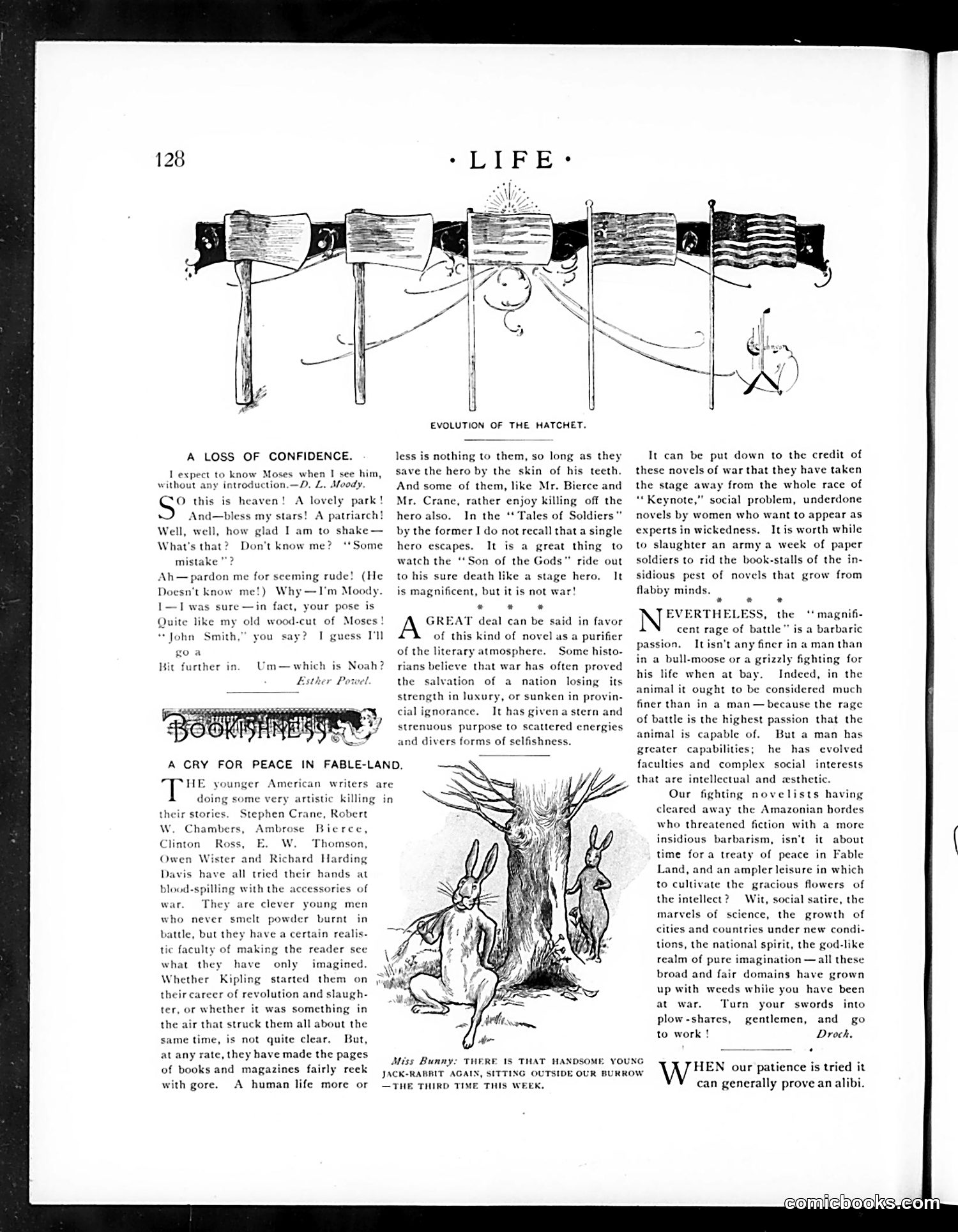
The page contains three distinct sections: **"Evolution of the Hatchet"** (top illustration): A satirical series showing five increasingly stylized representations of a hatchet atop poles, with small figures interacting with them. This appears to comment on how symbols or political tools evolve or become distorted through repeated use—likely referencing contemporary political rhetoric or nationalism. **"A Loss of Confidence"** (left column): A humorous dialogue poking fun at patriotic fervor and inconsistent logic, with characters named Moody challenging overly enthusiastic declarations of patriotism. **"A Great Deal Can Be Said"** and related sections: Literary criticism discussing war novels and their cultural value, critiquing both sensationalism and the emerging genre of combat fiction. **"A Cry for Peace in Fable-Land"** (with rabbit illustration): Satirizes younger American writers tackling war narratives, suggesting they prioritize entertainment over substance. The overall page critiques both patriotic excess and literary trends of the era.
📄 Transcribed text from this page (OCR, searchable)
Machine-transcribed from the original scan — historical spelling and the odd misread are preserved.
A LOSS OF CONFIDENCE. > know Moses when I se: troduction.—D, L. Moody I expect him, without any S° this is heaven! A lovely park! And—bless my stars! A patriarch! Well, well, how glad I am to sha What's that? Don't know me? “Some mistake "? Ah—pardon me for sceming rude! (He Doesn't know me!) Why—I'm Moody. 1—I was sure —in fact, your pose is Quite lik ‘John my old wood-cut of Mos I guess I'l Smith,” you s goa Kit further in. A CRY FOR PEACE HE doing some very a younger American their stories. Stephen Crane, Robert W. Chambers, Ambrose Clinton Ross, E. W. Owen Wister and Richard Harding Davis have all tried their hands at Bierce, Thomson, blood-spilling with the accessories of They who never smelt powder burnt in battle, but they have a certain realis- tic faculty of making the reader see what they have only imagined. Whether Kipling started them on their career of revolution and slaugh- ter, or whether it was something in the airt struck them all about the same time, is not quite clear, But, at any rate, they have made the pages of books and magazines fairly reek with gore. A human life more or war. are clever young men EVOLUTION OF THE HATCHET. less is nothing to them, so long as they save the hero by the skin of his teeth. And some of them, like Mr. Bierce and Mr. Crane, rather enjoy killing off the hero also. In the ‘Tales of Soldiers” by the former I do not recall that a single hero escape: It is great thing to watch the ‘Son of the Gods" ride out to his sure death like a stage hero. It is magnificent, but it is not war! e 8 @ A GREAT deal can be said in favor of this kind of novel as a purifier of the literary atmosphere. Some histo- rians believe that war has often proved the salvation of a nation its strength in luxury, or sunken in provin- cial ignorance. It has given a stern and strenuous purpose to scattered energies d divers forms of selfishness. losing IN FABLE-LAND. writers are tic killing in Miss Bunny: THERE 1S THAT HANDSOME YOUNG JACK-RABBIT AGAIN, SITTING OU —THE THIRD TIME THIS WEEK. SIDE OUR BURROW It can be put down to the credit of these novels of war that they have taken the stage away from the whole race of “Keynote,” social problem, underdone novels by women who want to appear as experts in wickedness. Itis worth while to slaughter an army a week of paper soldiers to rid the book-stalls of the in- sidious pest of novels that grow from flabby minds. ° * 8 f EVERTHELESS, the cent rage of battle’ passion. It isn't any finer in aman than in a bull-moose or a grizzly fighting for his life when at bay. Indeed, in the animal it ought to be considered much finer than in a man—because the rage of battle is the highest passion that the animal is capable of. But a man has greater capabilities; he “ magnifi- a barbaric has evolved faculties and complex social interests that are intellectual and aesthetic. Our fighting novelists having cleared away the Amazonian hordes who threatened fiction with a more insidious barbarism, isn't it about time fora treaty of peace in ble Land, and an ampler leisure in which to cultivate the gracious flowers of the intellect? Wit, social satire, the marvels of science, the growth of cities and countries under new condi- tions, the national spirit, the god-like realm of pure imagination —all these broad and fair domains have grown up with weeds while you have been at Turn your swords into plow-shares, gentlemen, and go to work ! Droch, wa HEN our patience is tried it can generally prove an alibi.