
Life, 1897-02-18 · page 4 of 20
Life — February 18, 1897 — page 4: what you’re looking at
What you’re looking at
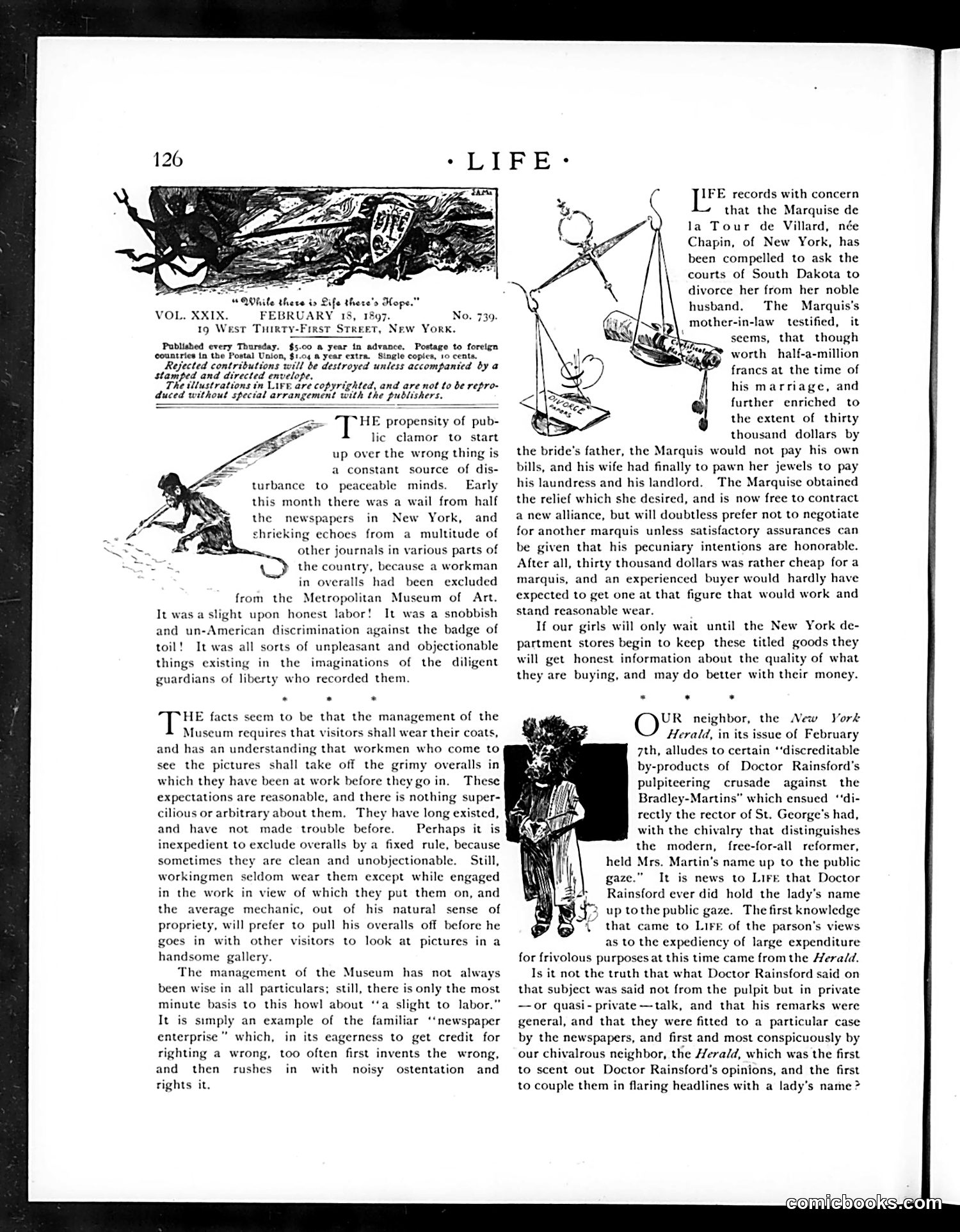
This page critiques the Metropolitan Museum of Art's policy requiring visitors to wear coats and excludes workmen in work overalls. The satirical point: the Museum's management imposes arbitrary, class-based dress codes while claiming to serve the public. The cartoons illustrate the absurdity—showing a workman excluded despite honest labor. The page also discusses the Marquise de Villard's divorce case in South Dakota, mocking her family's mercenary approach: her mother-in-law values a potential new marquis based on whether he'll pay her bills. Life satirizes both Old World aristocratic greed and the nouveau-riche American obsession with European titles. The Doctor Rainsford controversy references a clergyman's anti-poverty crusade being sensationalized by newspapers, particularly the *New York Herald*.
📄 Transcribed text from this page (OCR, searchable)
Machine-transcribed from the original scan — historical spelling and the odd misread are preserved.
While there is Life there's Hope.” XXIX. FEBRUARY 19 West Tuirty-First STREET, New York. Published every Thursday. $5.00 a year in advance. countries in the Postal Union, $1.04 a year extra. Sing! VOL. Postage to foreign sopies, 10 cents, Rejected contributions will be destroyed unless accompanied by a Stamped and directed envelope. The illustrations in Live. are copyrighted, and are not to be repro- duced without special arrangement with the publishers. ~HE propensity of pub- lic clamor to start up over the wrong thing is a constant source of dis- to peaceable minds. Early this month there was a wail from half the newspapers in New York, and shrieking echoes from a multitude of other journals in various parts of the country, because a workman in overalls had been excluded from the Metropolitan Museum of Art. It was a slight upon honest labor! It was a snobbish and un-American discrimination against the badge of toil! It was all sorts of unpleasant and objectionable things existing in the imaginations of the diligent guardians of liberty who recorded them, turbance HE facts seem to be that the management of the Museum requires that visitors shall wear their coats, and has an understanding that workmen who come to see the pictures shall take off the grimy overalls in which they have been at work before they go in. These expectations are reasonable, and there is nothing super- cilious or arbitrary about them. They have long existed, and have not made trouble before. Perhaps it is inexpedient to exclude overalls by a fixed rule, because sometimes they are clean and unobjectionable. Still, workingmen seldom wear them except while engaged in the work in view of which they put them on, and the average mechanic, out of his natural sense of propriety, will prefer to pull his overalls off before he goes in with other visitors to look at pictures in a handsome gallery. The management of the Museum has not alw: been wise in all particulars; still, there is only the mo: minute basis to this howl about ‘‘a slight to labor. It is simply an example of the familiar ‘‘newspaper enterprise” which, in its eagerness to get credit for righting a wrong, too often first invents the wrong, and then rushes in with noisy ostentation and rights it. [re records with concern that the Marquise de la Tour de Villard, née Chapin, of New York, has been compelled to ask the courts of South Dakota to divorce her from her noble husband. The Marqui: mother-in-law testified, it : seems, that though worth half-a-million francs at the time of his marriage, and further enriched to the extent of thirty thousand dollars by the bride's father, the Marquis would not pay h bills, and his wife had finally to pawn her jewels to pay his laundress and his landlord. The Marquise obtained the relief which she desired, and is now free to contract a new alliance, but will doubtless prefer not to negotiate for another marquis unless satisfactory assurances can be given that his pecuniary intentions are honorable. After all, thirty thousand dollars was rather cheap fora marquis, and an experienced buyer would hardly have expected to get one at that figure that would work and stand reasonable wear. If our girls will only wait until the New York de- partment stores begin to keep these titled goods they will get honest information about the quality of what they are buying, and may do better with their money. . . . UR neighbor, the New York Herald, in its issue of February 7th, alludes to certain ‘‘discreditable by-products of Doctor Rainsford's pulpiteering crusade against the Bradley-Martins” which ensued ‘‘di- rectly the rector of St. George's had, with the chivalry that distinguishes the modern, free-for-all reformer, held Mrs. Martin's name up to the public gaze.” It is news to Lirr that Doctor Rainsford ever did hold the lady's name > up tothe public gaze. The first knowledge that came to Lire of the parson's views as to the expediency of large expenditure for frivolous purposes at this time came from the Herald. Is it not the truth that what Doctor Rainsford said on that subject was said not from the pulpit but in private —or quasi- private —talk, and that his remarks were general, and that they were fitted to a particular case by the newspapers, and first and most conspicuously by our chivalrous neighbor, the Herald, which was the first to scent out Doctor Rainsford’s opinions, and the first to couple them in flaring headlines with a lady's name >