
A complete issue · 51 pages · 1890
Life — December 25, 1890
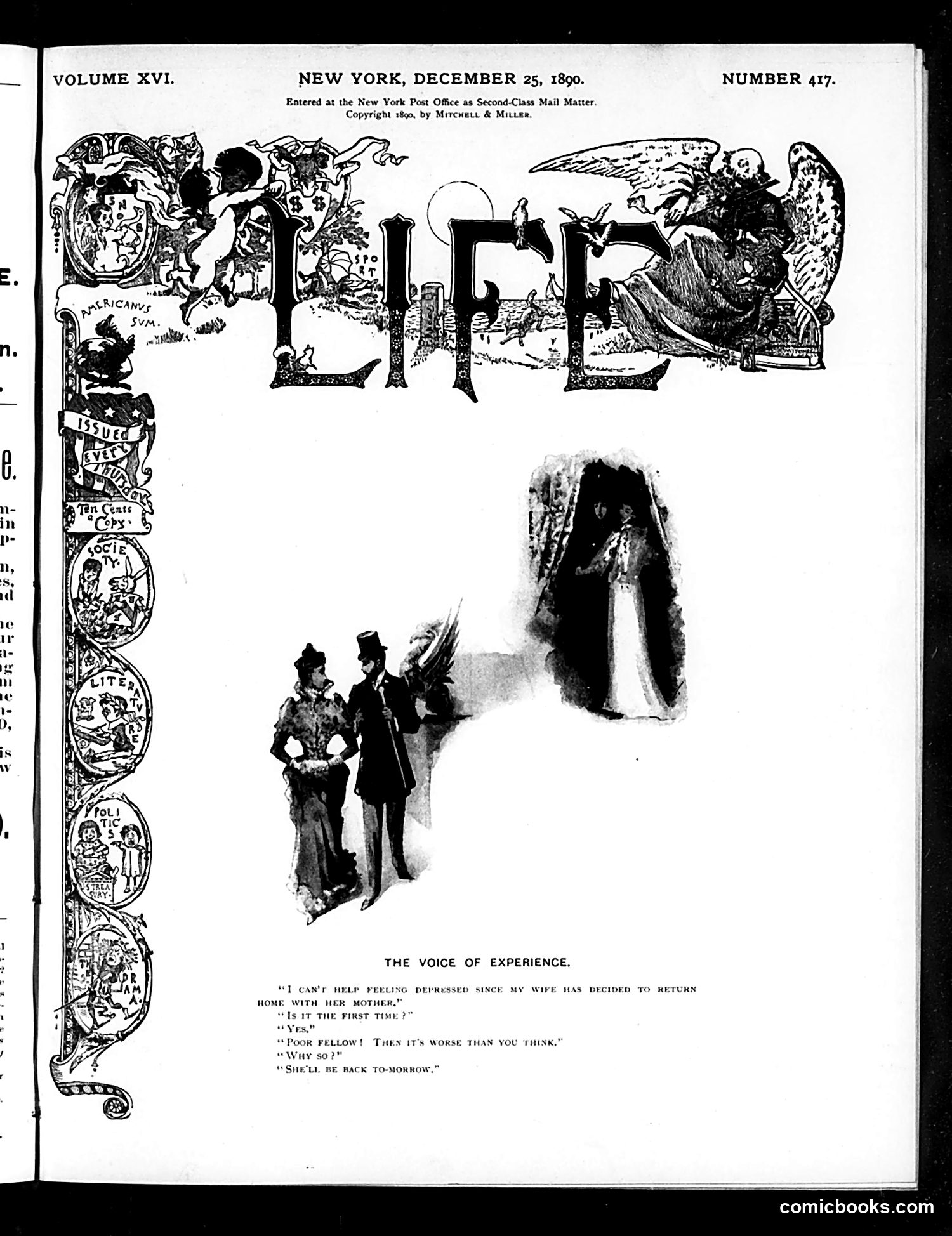
This satirical cartoon from *Life* magazine (December 25, 1900) depicts a domestic scene titled "The Voice of Experience." The illustration shows a man speaking with what appears to be a younger couple, with a woman in dark clothing (possibly a mother-in-law figure) looming in the background. The dialogue reveals the satirical point: an experienced man warns a newlywed about marital difficulties, noting that his wife has decided to return to her mother's house. He cynically advises the younger man that such separations are "worse than you think" and predicts the wife will "be back to-morrow"—suggesting a pattern of temporary domestic quarrels common in marriage. The humor targets the inevitable conflicts and cyclical nature of married life, presented as inevitable wisdom from someone who's "been there."
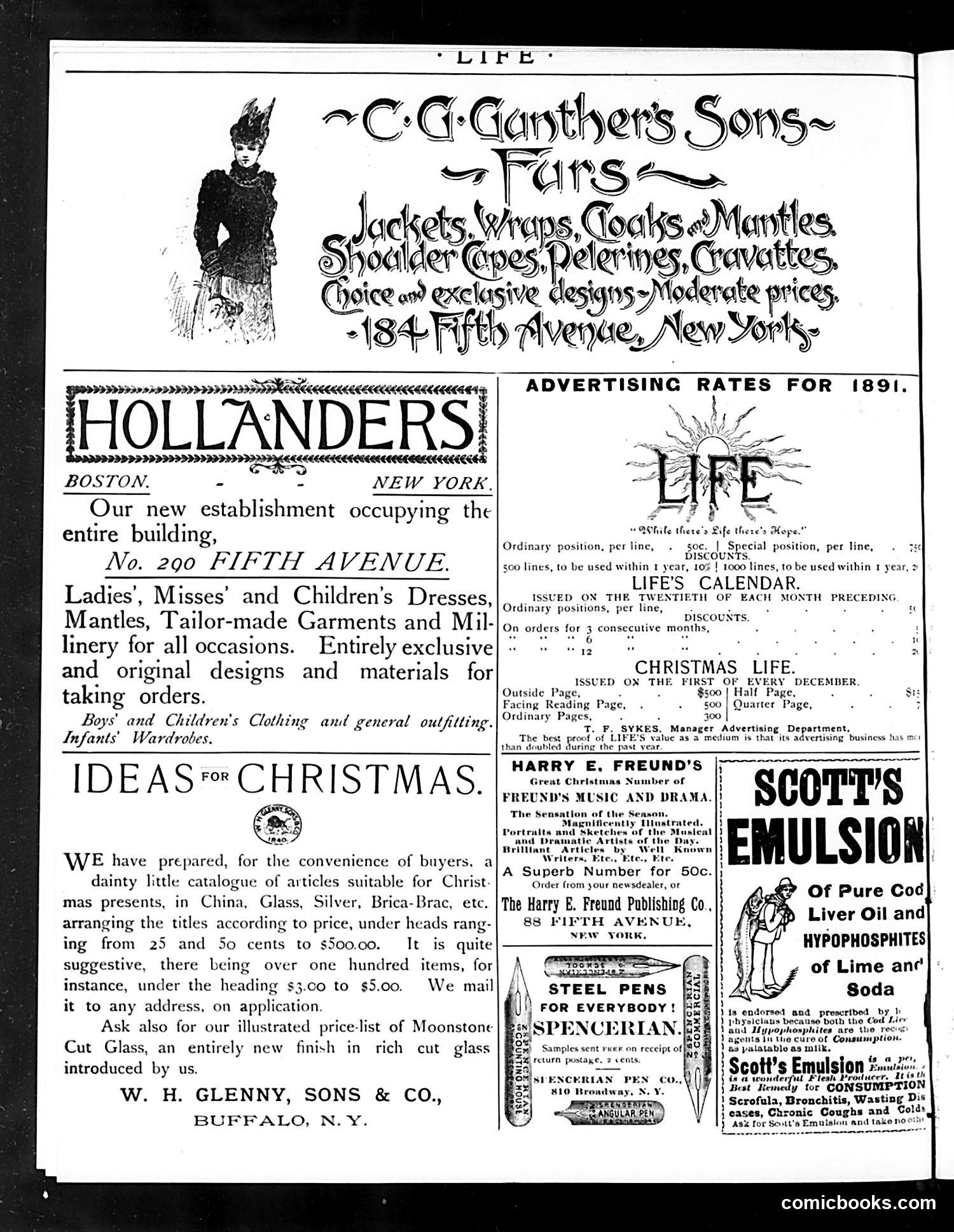
This page is **primarily advertising**, not satire or political commentary. It contains: 1. **C.G. Ganthers Sons** - fur fashion advertisement (top) 2. **Hollanders** - Boston/New York dress shop for women and children 3. **W.H. Glenny, Sons & Co.** - Buffalo company advertising Christmas gift ideas 4. **Harry E. Freund Publishing Co.** - promoting music and drama publications 5. **Scott's Emulsion** - cod liver oil product advertisement 6. **Steel pen and pencil advertisements** The page also includes **Life Magazine's 1891 advertising rates** (top right), showing what businesses paid for different ad placements and sizes. There is **no political cartoon or satire visible**. This is a standard late-19th-century magazine page mixing editorial space with commercial advertisements typical of the period.
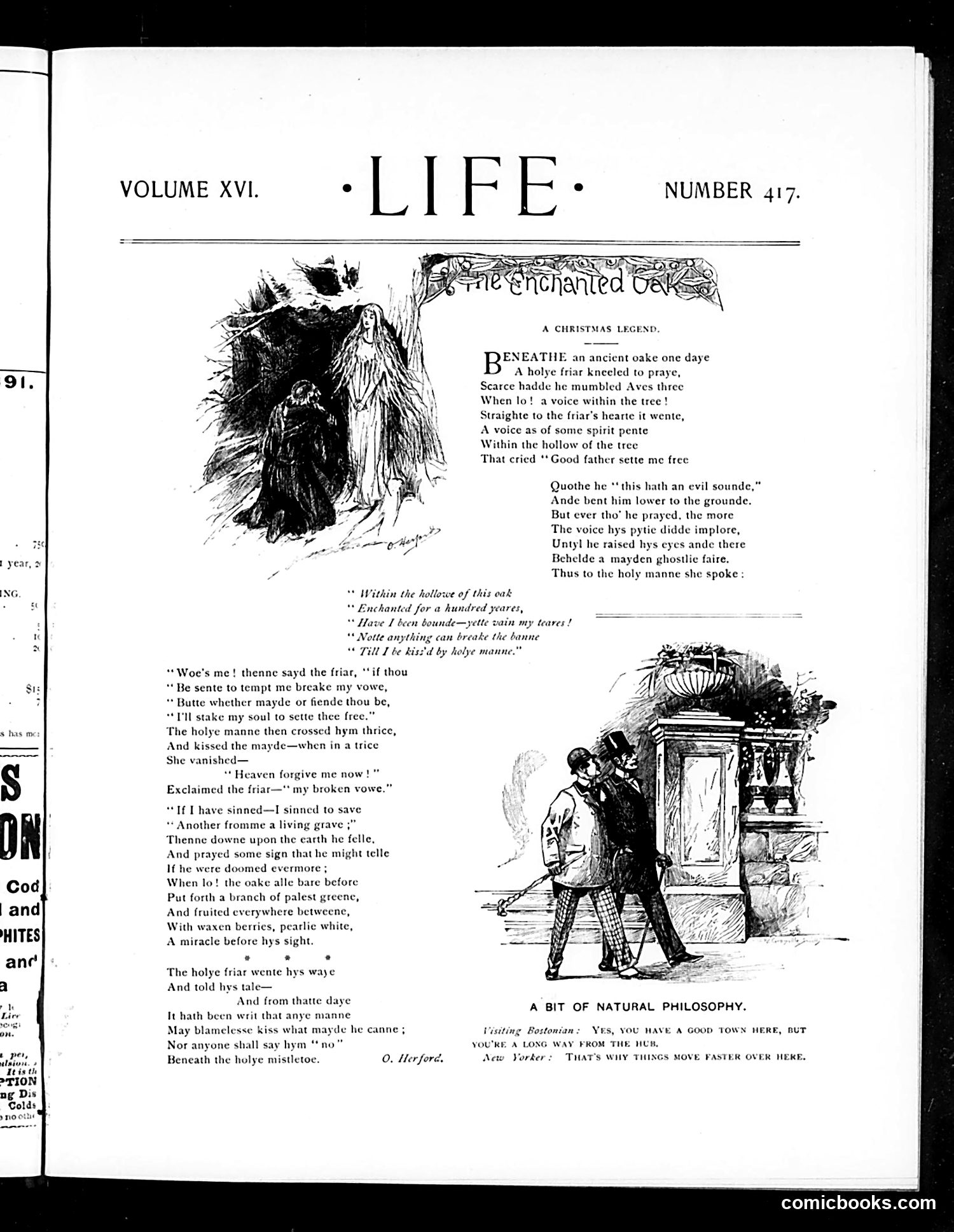
This page presents two distinct pieces: **Upper Left:** A Christmas legend poem ("The Enchanted Oak") illustrated with a sketch of a friar and ghostly apparition within a hollow tree. The narrative describes a holy friar's encounter with an enchanted oak tree where a spirit's voice emerges, leading to a supernatural resolution involving divine intervention. This is a straightforward literary feature, not satire. **Lower Right:** A cartoon titled "A Bit of Natural Philosophy" showing two working-class men examining a building. One remarks the town has good roads but they're "a long way from the hub," to which the other replies that's why "things move faster over here." This appears to be gentle satire on rural versus urban perceptions of progress and economic activity, suggesting provincial skepticism about development.
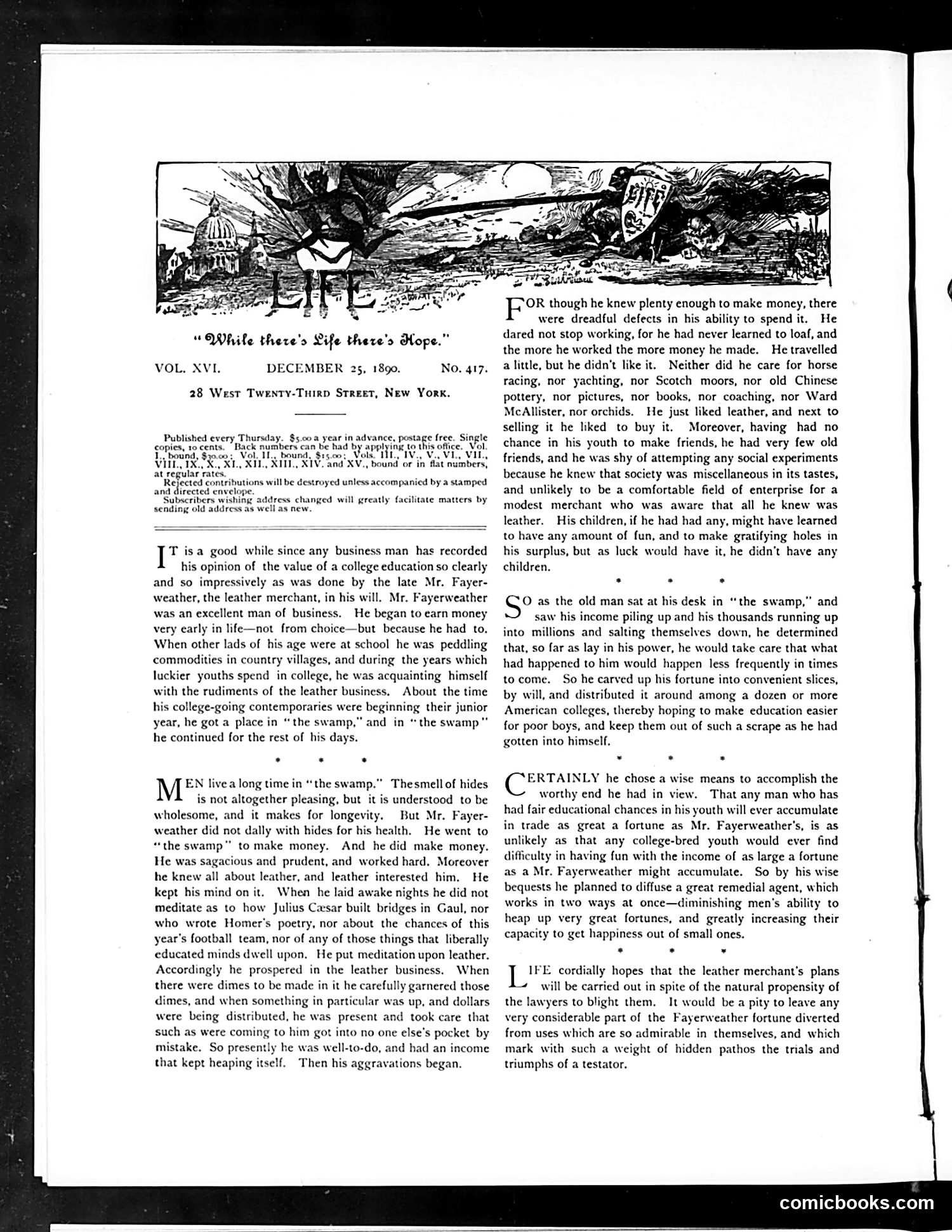
The page contains an illustrated article about a wealthy leather merchant (likely based on a real contemporary figure, though not named here). The cartoon at top shows an idealized landscape with "While there's Life there's Hope" as its motto. The article's satire targets a self-made businessman who accumulated enormous wealth but remained emotionally impoverished—unable to enjoy leisure, relationships, or culture. He avoided social circles, had no friends, and couldn't spend his fortune on normal pleasures (horses, books, art, coaching). The satire critiques Gilded Age excess: his solution to hoarding wealth is philanthropy (funding college scholarships), presenting it as moral redemption. The piece mocks both his joyless accumulation and the inadequacy of charitable giving as a substitute for actually living.
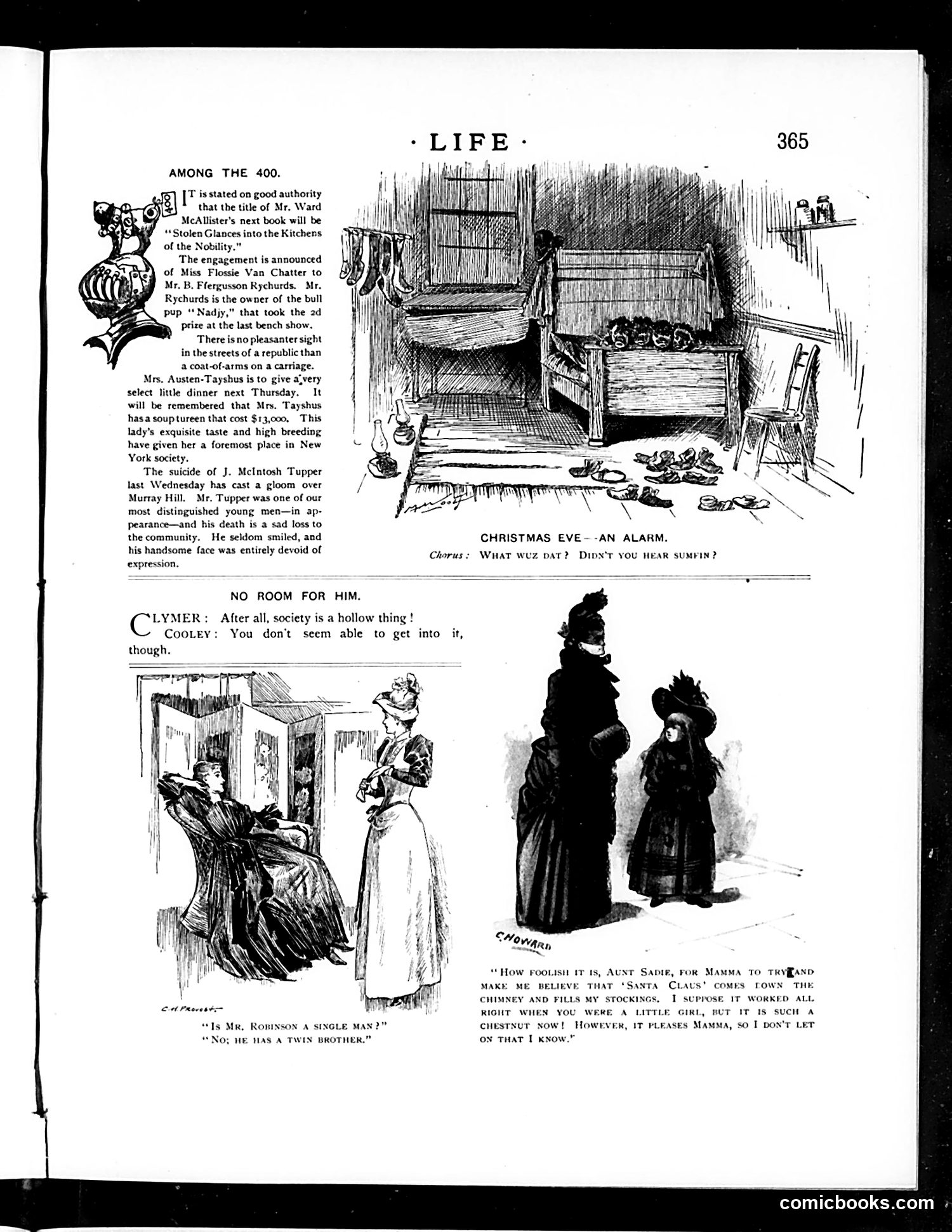
This page contains three separate cartoons satirizing early 20th-century American society: 1. **"Christmas Eve - An Alarm"**: A sketch of a messy room with the caption questioning what disturbed someone on Christmas Eve, likely mocking holiday domestic chaos. 2. **"No Room for Him"**: A dialogue between characters named Clymer and Cooley about society being "hollow" and exclusive. The cartoon shows someone being turned away, satirizing social exclusion and class barriers. 3. **"Is Mr. Robinson a Single Man?"**: Depicts a servant or attendant responding "No; he has a twin brother," humorously suggesting identical twins cause social confusion. 4. **The bottom cartoon** shows two women discussing how foolish it is to make children believe in Santa Claus, referencing changing attitudes toward childhood traditions. The page overall satirizes social pretension, class divisions, and domestic life among the wealthy.
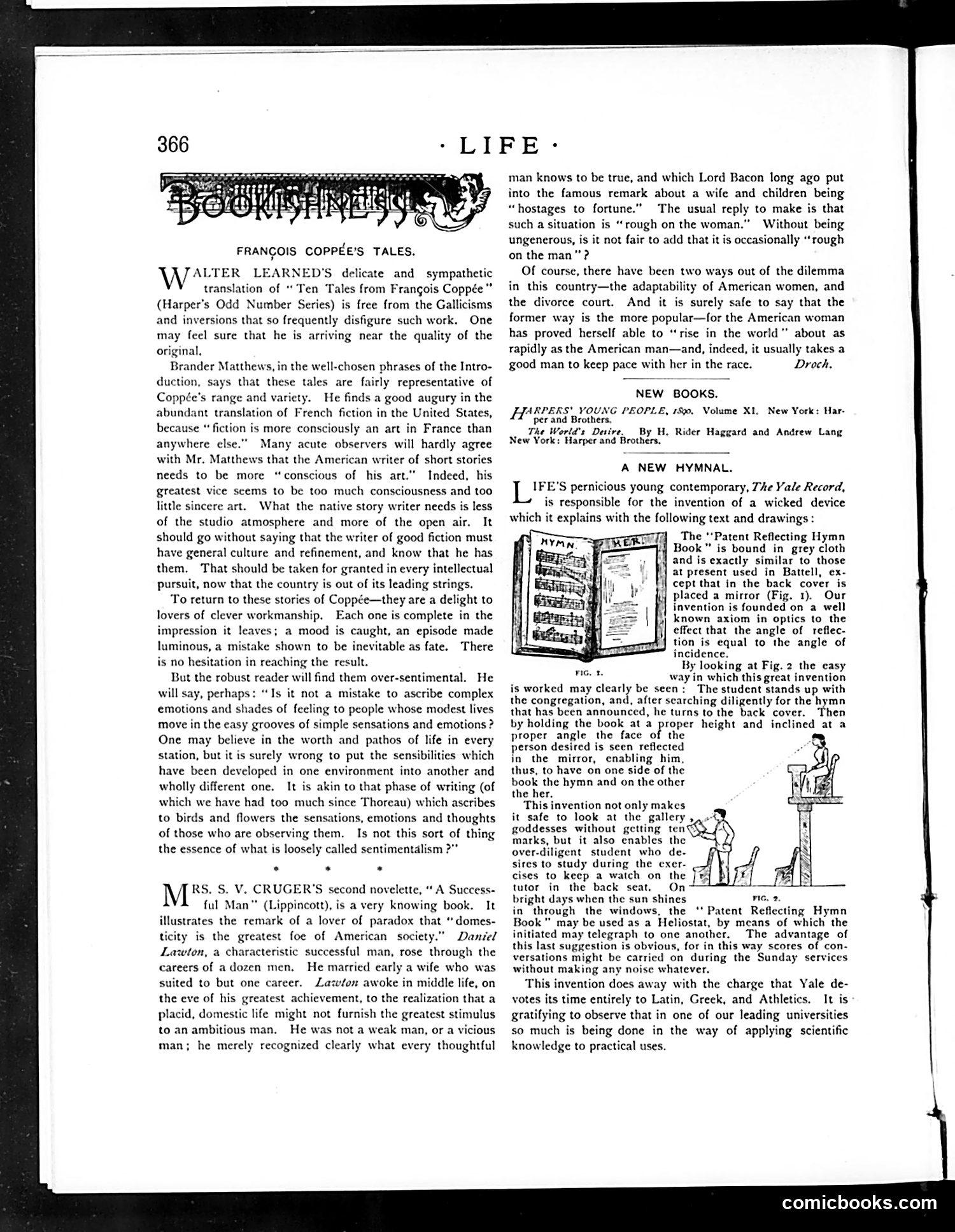
This page contains literary reviews rather than political cartoons. The main content discusses François Coppée's translated French tales, reviewed by Brander Matthews, and S.V. Cruger's novel "A Successful Man." The only illustrations are diagrams for "A New Hymnal"—a Yale invention showing a "Patent Reflecting Hymn Book" with a mirror mechanism (Figures 1-2). This allows church congregants to view hymn lyrics reflected in a mirror while maintaining proper posture and sight lines during services. The satirical thrust appears mild: the invention gently mocks academic over-engineering of simple problems, poking fun at Yale's tendency to apply scientific solutions to mundane religious practices. It's social satire about institutional pretension rather than political commentary.
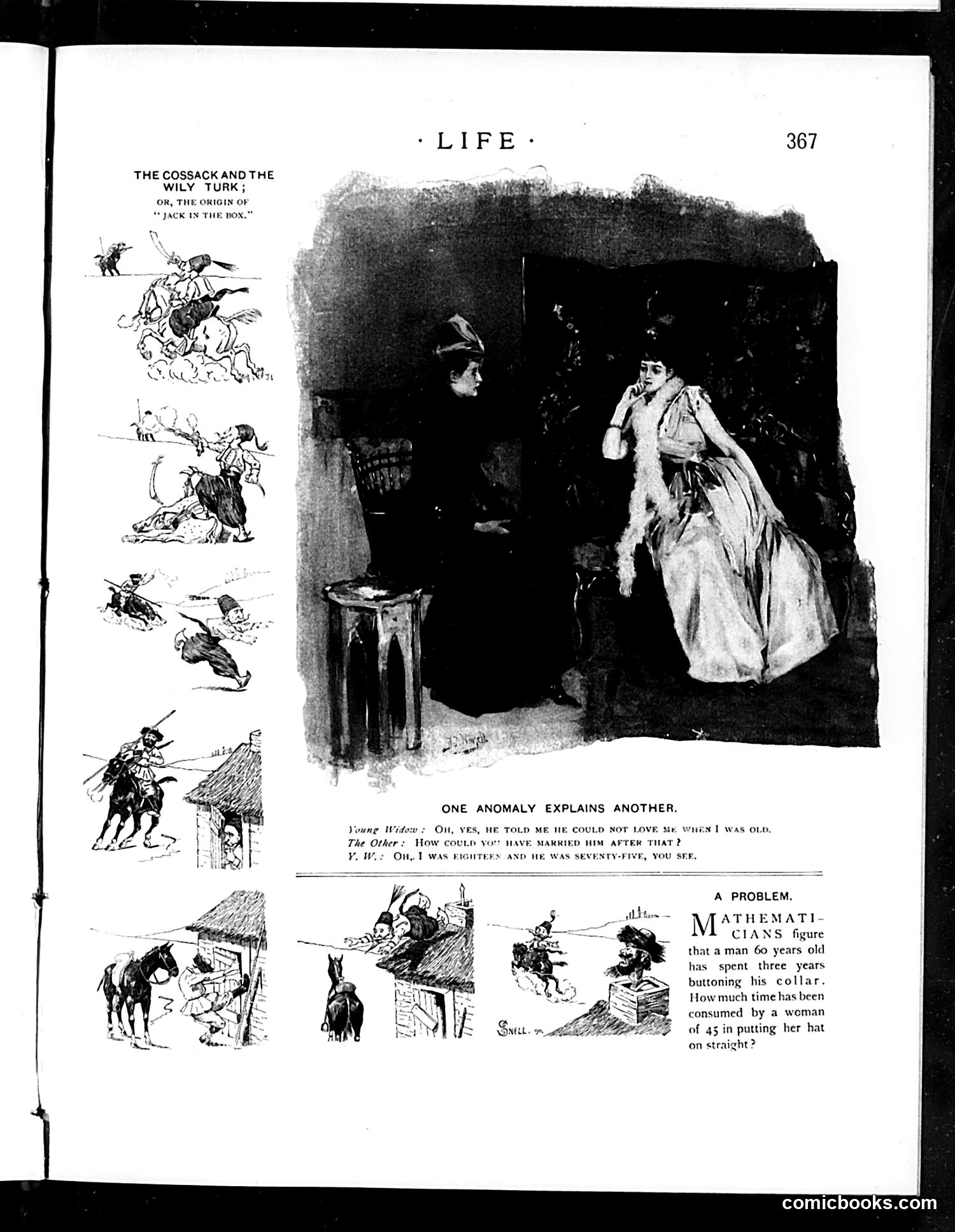
**Top Section - "The Cossack and the Willow":** This appears to be a visual joke sequence showing a Cossack (Russian cavalryman) interacting with a willow tree, playing on the phrase "jack in the box." The sketches depict slapstick physical comedy typical of early 20th-century humor. **Middle Section - "One Anomaly Explains Another":** A domestic dispute scene where a young widow explains her remarriage to an elderly man (eighty-something) by claiming he promised to love her when young—now she's old, so he logically cannot. The satire mocks both May-December marriages and circular logic used to justify romantic choices. **Bottom Section - "A Problem":** A mathematical puzzle about time consumption—how long a woman aged 45 takes to put on her hat, satirizing women's notoriously lengthy preparation times, a common period stereotype.
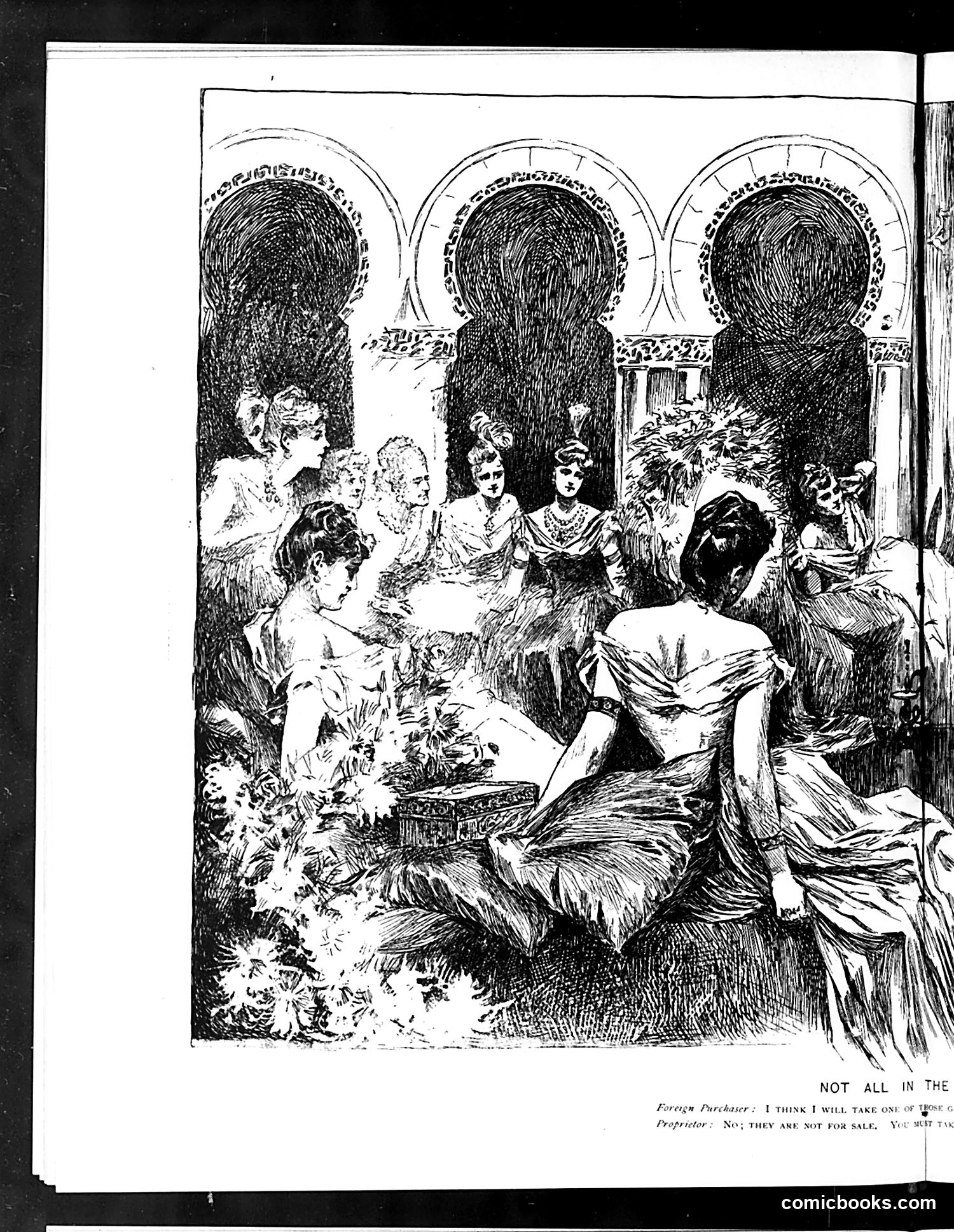
This is a satirical cartoon titled "NOT ALL IN THE" (title appears cut off). The scene depicts an interior with three arched doorways, populated by elegantly dressed women in early 20th-century fashion. The dialogue at bottom reads: - **Foreign Purchaser**: "I think I will take one of these o[—]" - **Proprietor**: "No; they are not for sale. You must ta[—]" The cartoon satirizes the commodification of women, likely critiquing either the marriage market or human trafficking. The "foreign purchaser" treats women as merchandise for purchase, while the "proprietor" refuses to sell—though his incomplete response suggests a moral objection or perhaps that these women have different purposes. The luxurious setting and fashionable dress underscore the irony of treating refined women as goods, making this social commentary on women's status and international commerce in human beings.
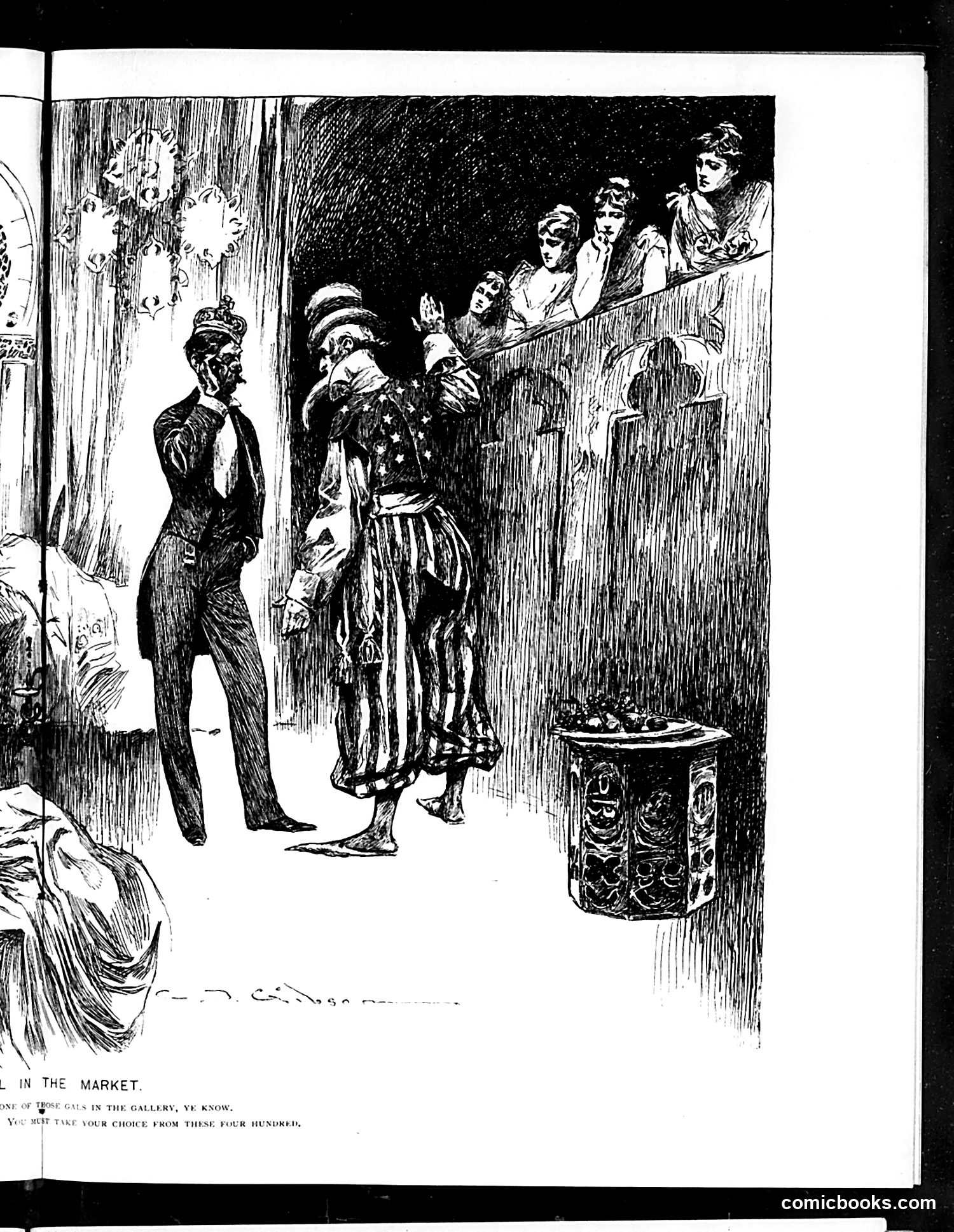
This appears to be a satirical illustration titled "In the Market" from Life magazine. The scene depicts an indoor setting where a man in formal dress (left) and a military officer (center) are being presented to elegantly-dressed women in a gallery or balcony (upper right). The partially-legible caption suggests this is social satire about "the gals in the gallery" and choosing from "four hundred"—likely mocking the marriage market or social matchmaking rituals of the upper classes. The military officer's uniform suggests this may reference wartime or post-war courtship dynamics. The humor appears to target how wealthy women were displayed and "shopped for" like commodities in fashionable society, with the military gentleman as a prize catch.
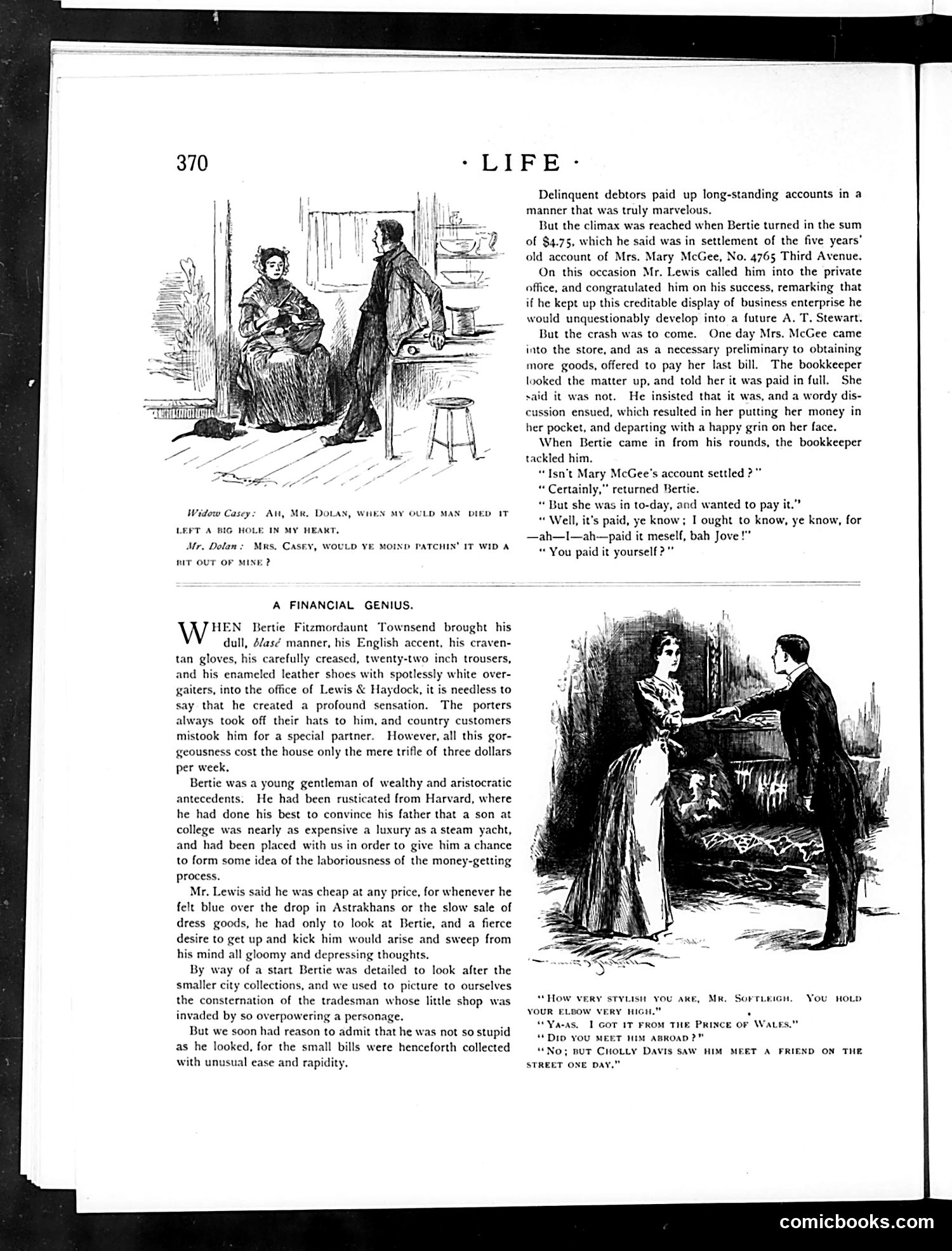
This page from *Life* magazine contains two satirical pieces about financial sharp-dealing: **Upper section**: A dialogue where a bookkeeper admits he paid Mrs. McGee's account himself rather than from her money—pocketing her cash while falsely claiming the debt settled. The satire mocks dishonest accounting practices. **Lower section**: "A Financial Genius" follows Bertie Fitzmordaunt Townsend, a wealthy but idle young man placed in a job at Lewis & Haylock office to learn business. Despite appearing incompetent, he collects outstanding debts with "unusual ease and rapidity"—implying he's either corrupt or uses privileged charm rather than legitimate skill. The accompanying illustration shows him in conversation, suggesting social manipulation as business method. Both pieces satirize financial dishonesty and the assumption that wealthy men could succeed in business through methods other than honest work.
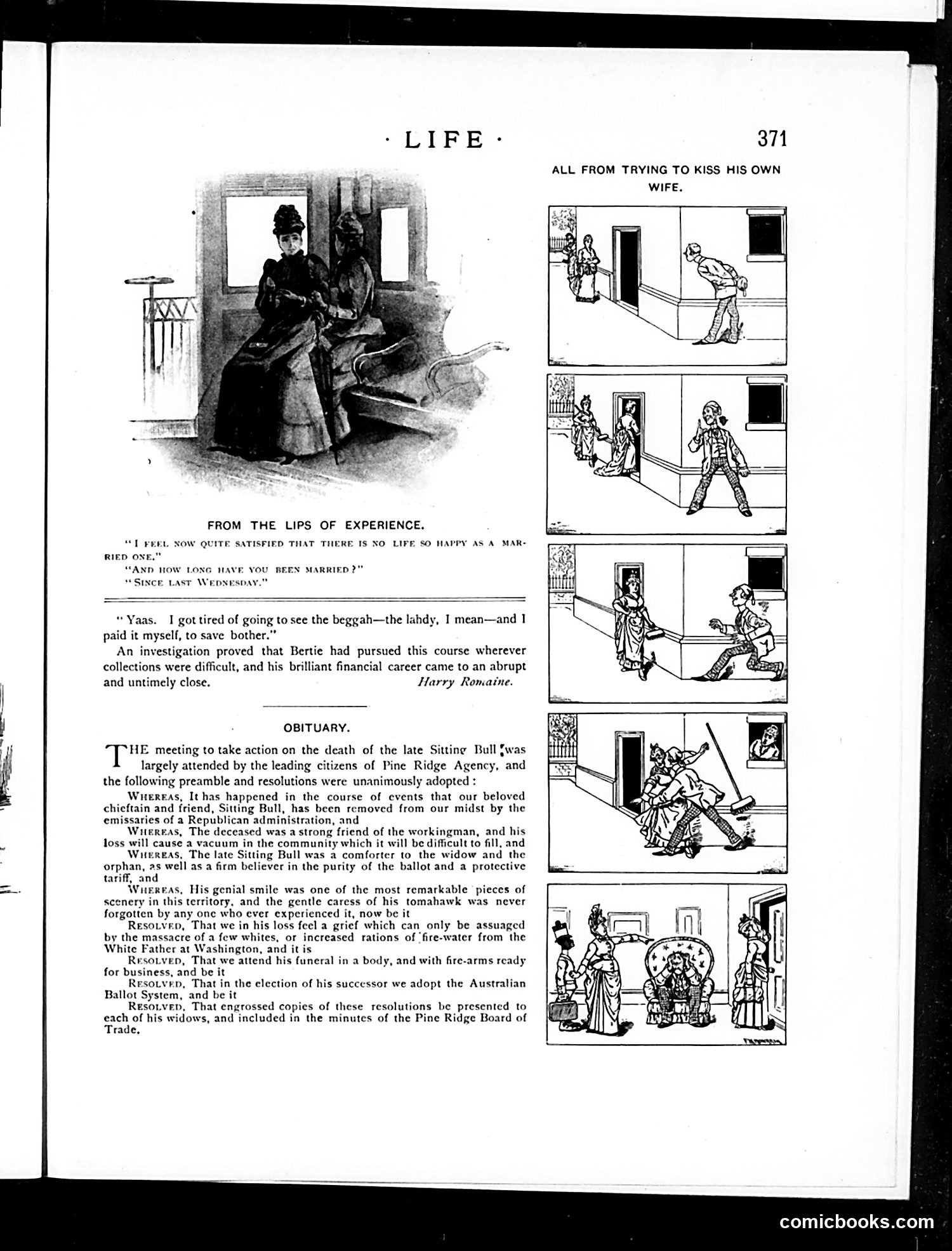
This page contains two distinct sections: **Left side:** A Victorian-era illustration titled "From the Lips of Experience" depicting a married woman advising another about marriage satisfaction. A quote from "Harry Ronaine" follows about a man who paid himself to avoid the "beggar" lifestyle. **Right side:** A sequential comic strip titled "All From Trying to Kiss His Own Wife" showing a domestic comedy scenario where a husband repeatedly attempts to kiss his wife but keeps getting physically blocked or interrupted by various household obstacles and situations, ending with slapstick chaos. **Center:** An "Obituary" section honoring "Sitting Bull" with formal resolutions adopted by the Pine Ridge Agency, praising his character and peaceful nature. The humor relies on early 20th-century domestic comedy tropes about marital awkwardness.
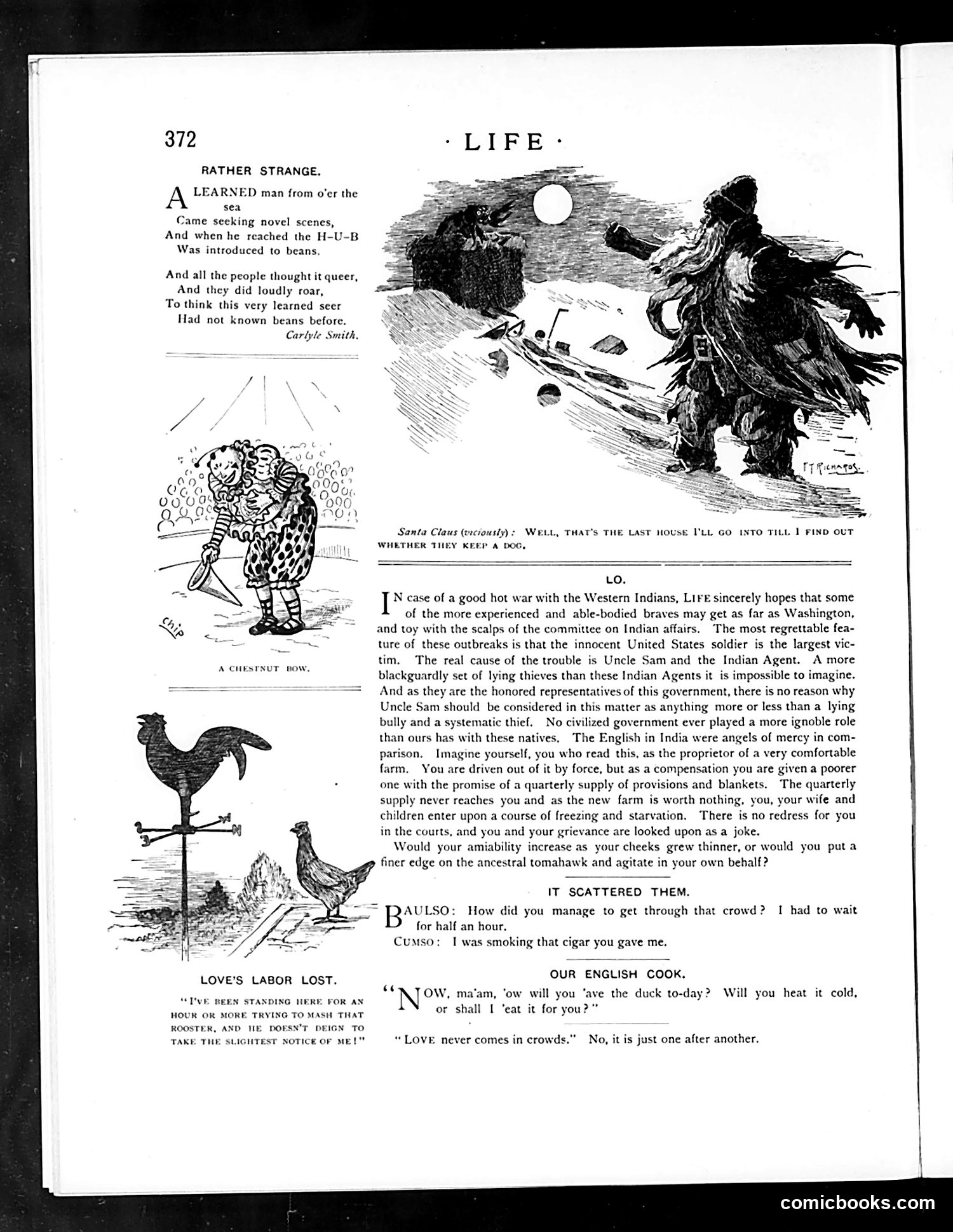
This page contains several satirical pieces typical of 19th-century Life magazine humor: **"Rather Strange"** mocks a learned European visiting Boston ("the H-U-B") who is ignorant of beans—likely referencing Boston's famous baked beans and suggesting that intellectual pretension masks practical ignorance. **Santa Claus cartoon**: A bitter commentary showing Santa vowing to avoid homes with dogs after being attacked, satirizing the disconnect between Christmas ideals and harsh reality. **"Lo" section**: A scathing political critique of U.S. Indian policy, directly blaming the federal government and Indian Agents for mistreating Native Americans through broken promises and land theft. Life argues the government bears moral responsibility equivalent to Indian violence—a remarkably progressive stance for the era. The remaining items are brief comedic vignettes about a cigar's odor clearing crowds, failed romantic pursuit, and a British cook's malapropism. Together, the page mixes light humor with pointed social criticism, particularly regarding government corruption and Native American injustice.
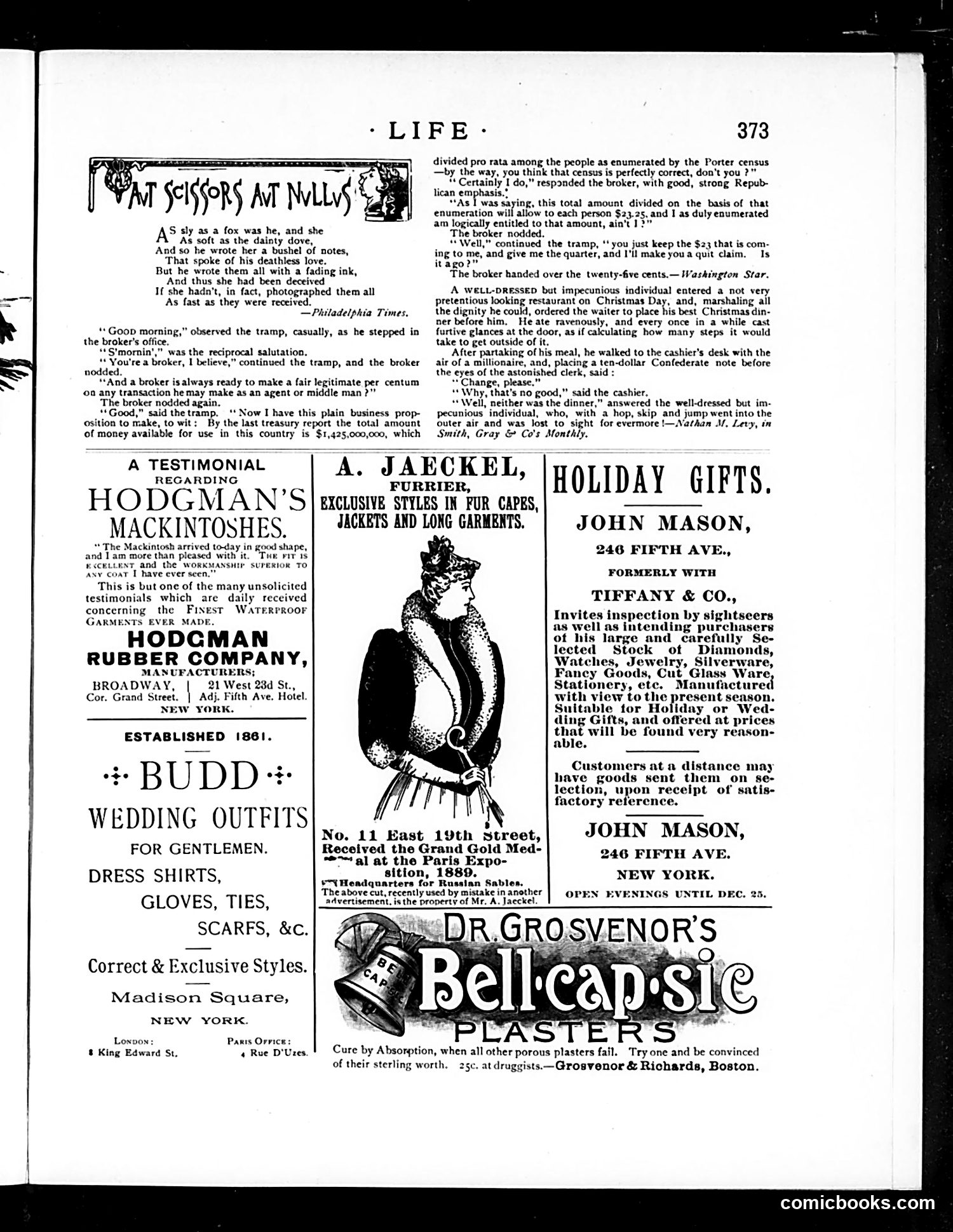
**Main Cartoons/Humor Pieces:** 1. **"Scissors at Nulls"** (poem): A cautionary tale about a fox deceiving a dove through love notes written in fading ink—which the dove photographs. The satire targets romantic deception using obsolete technology. 2. **Broker's Proposition**: A tramp enters a broker's office and proposes converting his mathematical "share" of national currency ($23.25, based on census data and total money supply of $1.425 billion) into cash. The broker accepts a quarter for the tramp's claim. The joke satirizes both financial markets' superficiality and the arbitrariness of economic value. 3. **Confederate Note Restaurant Scheme**: A well-dressed but broke man orders Christmas dinner, then attempts to pay with a worthless Confederate banknote. He escapes before confrontation. This satirizes post-Civil War economic anxiety and fraud. **Advertisements** dominate the lower half (Hodgman raincoats, Jaeckel furs, John Mason jewelry, Dr. Grosvenor's plasters). The cartoons share a theme: exploiting loopholes, deception, and misrepresentation in economic transactions.
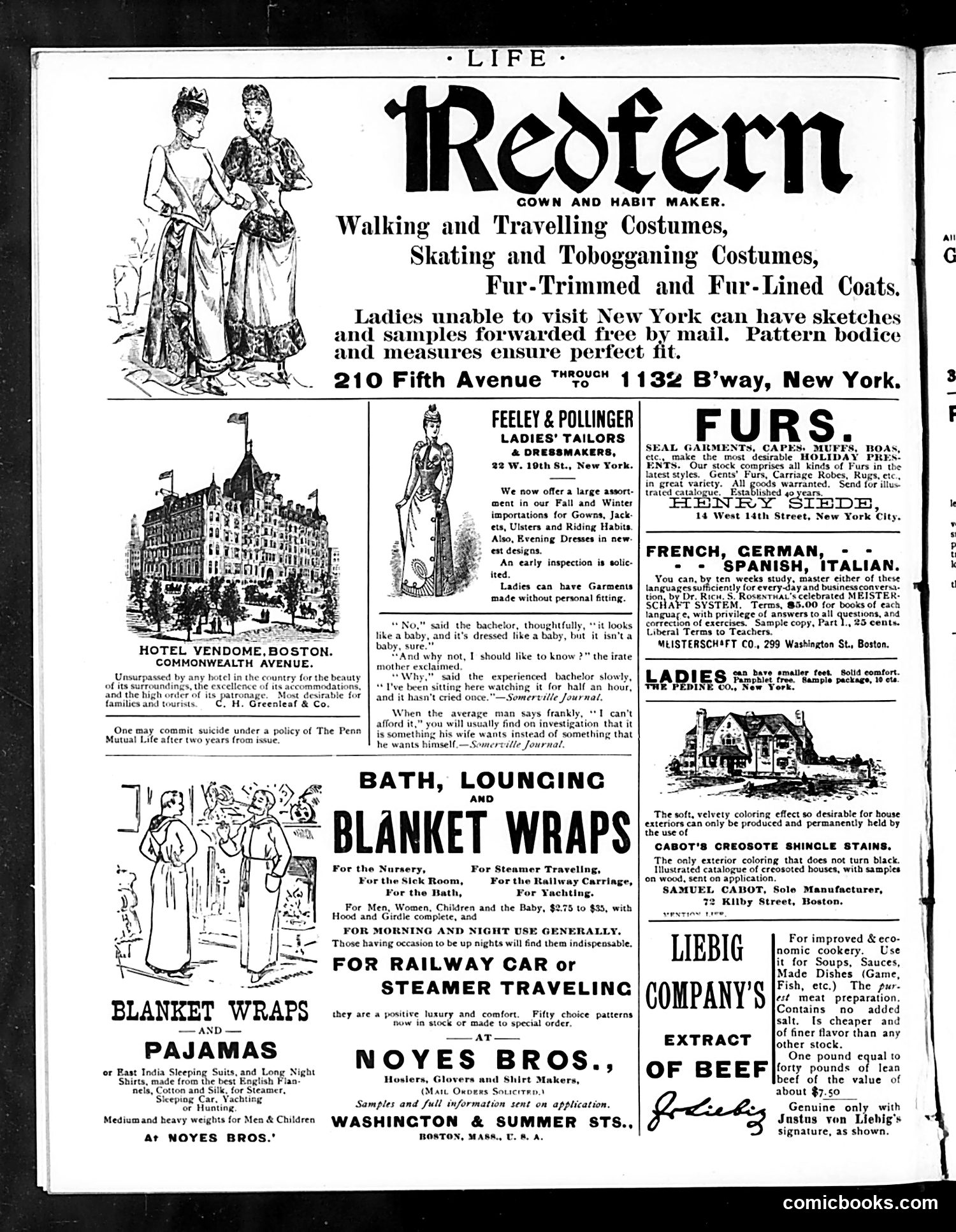
This page is primarily **advertising**, not political satire. It's from Life magazine's commercial section, featuring Victorian-era product advertisements and services. The one satirical element is a **brief humorous anecdote** about a bachelor observing a baby that "looks like a baby" and "is dressed like a baby," but he concludes it isn't one because "it hasn't cried once" in half an hour. This is gentle domestic humor mocking either the baby's unusual quietness or, more likely, poking fun at bachelors' ignorance about infants. The surrounding content advertises women's clothing (Redfern gowns, tailoring services), travel accessories (blanket wraps, pajamas for steamers and railways), furs, language instruction, and food products—typical upper-class consumer goods of the period. The Hotel Vendome advertisement and insurance reference suggest this targets affluent readers planning leisure travel.
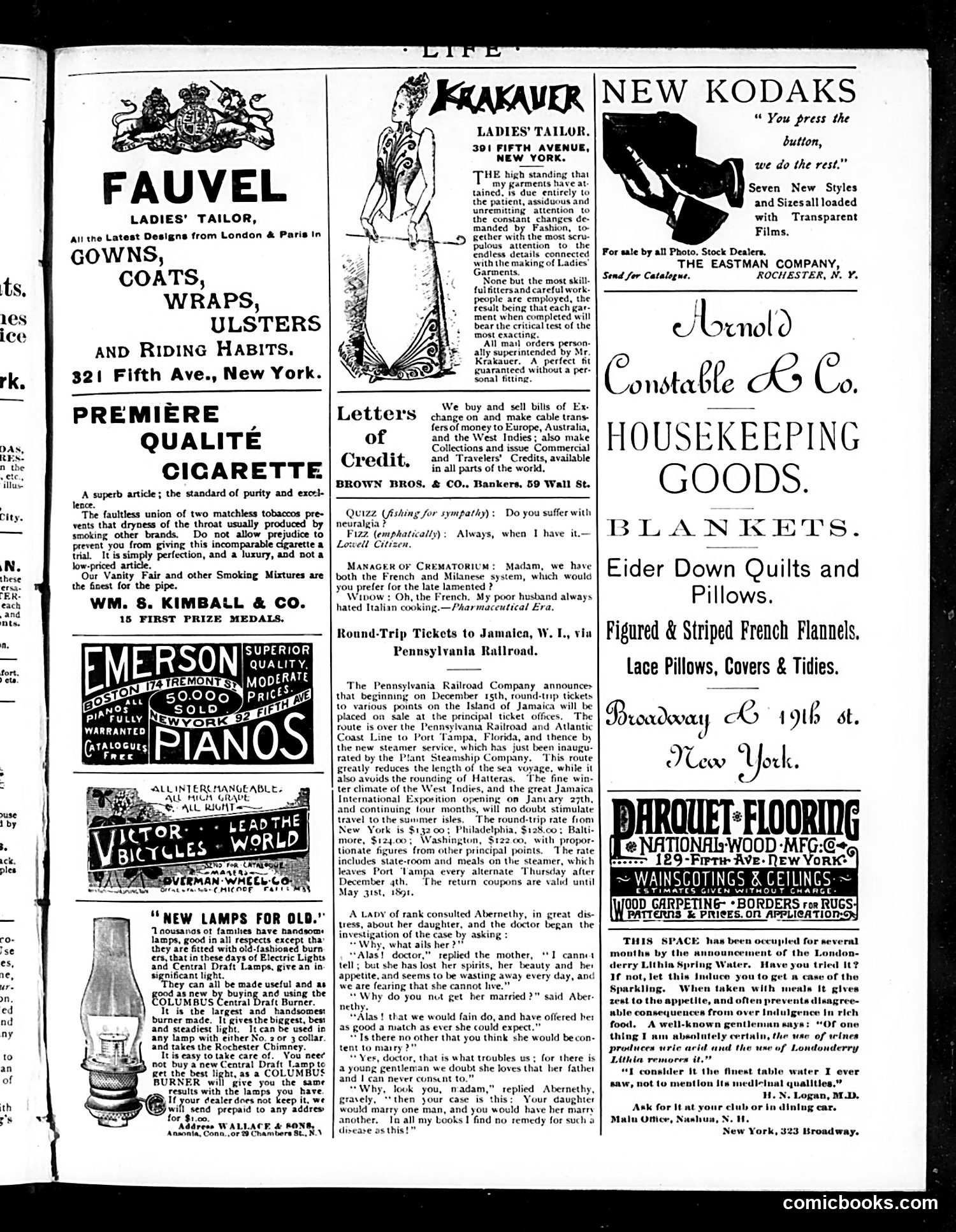
This page is primarily **advertising**, not political satire. The dominant visual content is a large advertisement for Columbus Central Draft Burners, illustrated with a lamp. The ad's headline references the fairy tale "Aladdin" (where a magic lamp grants wishes). The joke is literalized: families with old-fashioned oil lamps can make them "new" by purchasing a Columbus burner upgrade rather than buying entirely new electric lamps. The appeal targets **middle-class households** in the early electric age. While wealthy homes adopted new electric lighting, many families retained old oil lamps. This product offers a budget-friendly transition: keep your existing lamp but modernize its performance. The ad emphasizes the Columbus burner gives "the biggest, best and steadiest light" and works with existing equipment. The surrounding advertisements for ladies' tailors, cigarettes, and piano dealers reflect the magazine's audience of affluent urban readers. The Jamaica railroad promotion indicates this is a pre-WWI publication marketing leisure travel.
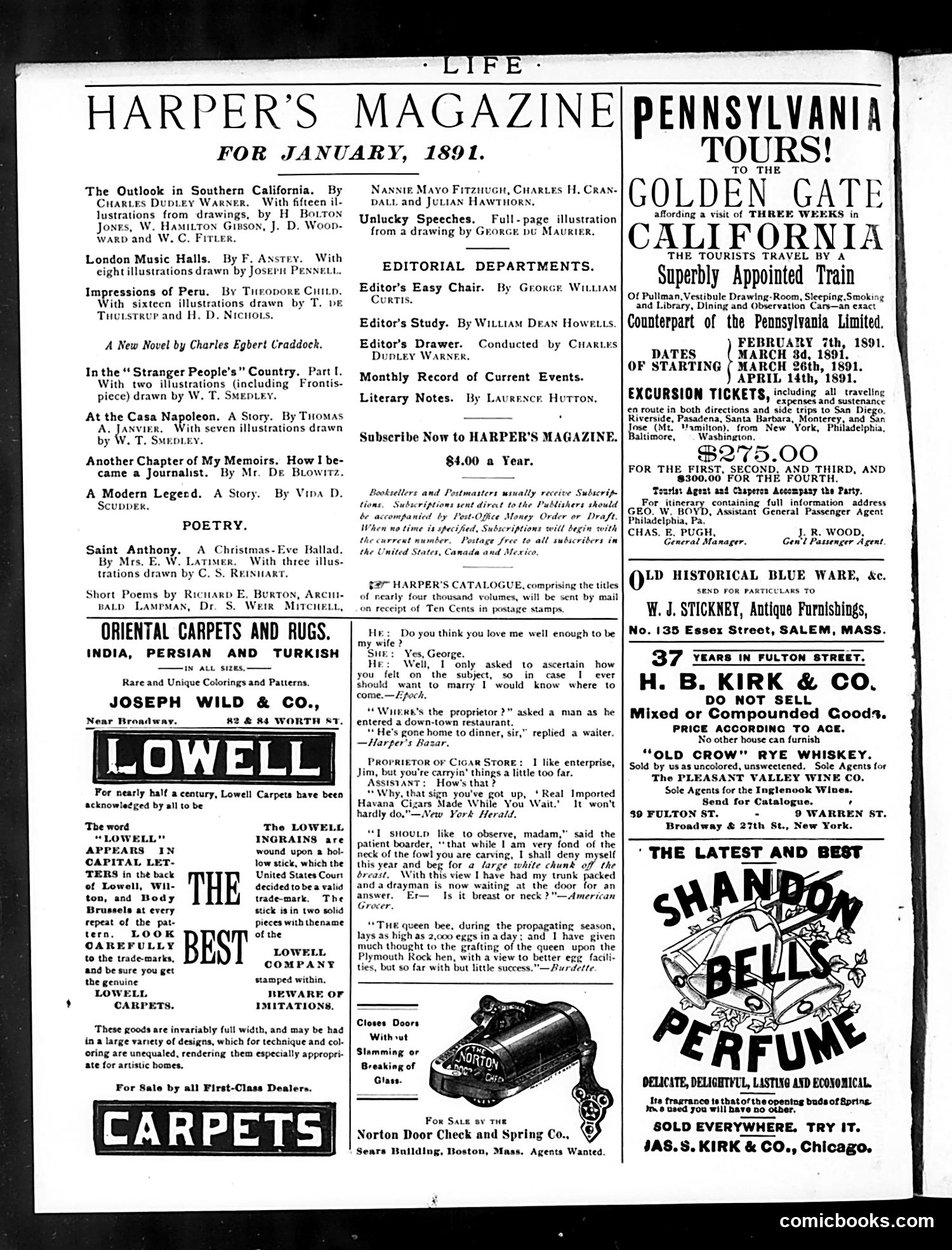
This page is primarily a **table of contents and advertising** for Harper's Magazine, not a satirical cartoon page. The few humorous items present are brief **joke exchanges** typical of the era's magazine humor sections: 1. A romantic joke about a man proposing conditionally—he wants to know if she loves him "in case I ever should want to marry"—mocking insincere courtship. 2. Restaurant humor about a proprietor complaining that his assistant's sign ("Real Imported Havana Cigars Made While You Wait") is too brazen—absurdly claiming cigars are manufactured on-site. 3. A cigar-shop joke about aggressive business tactics taken too far. These are **mild social satire** poking fun at everyday situations: dishonest romance, false advertising, and commercial over-enthusiasm. The humor relies on recognizing the absurdity in ordinary human behavior rather than political commentary. The page is dominated by **advertisements for carpets, perfume, and travel tours**—the magazine's actual revenue source.
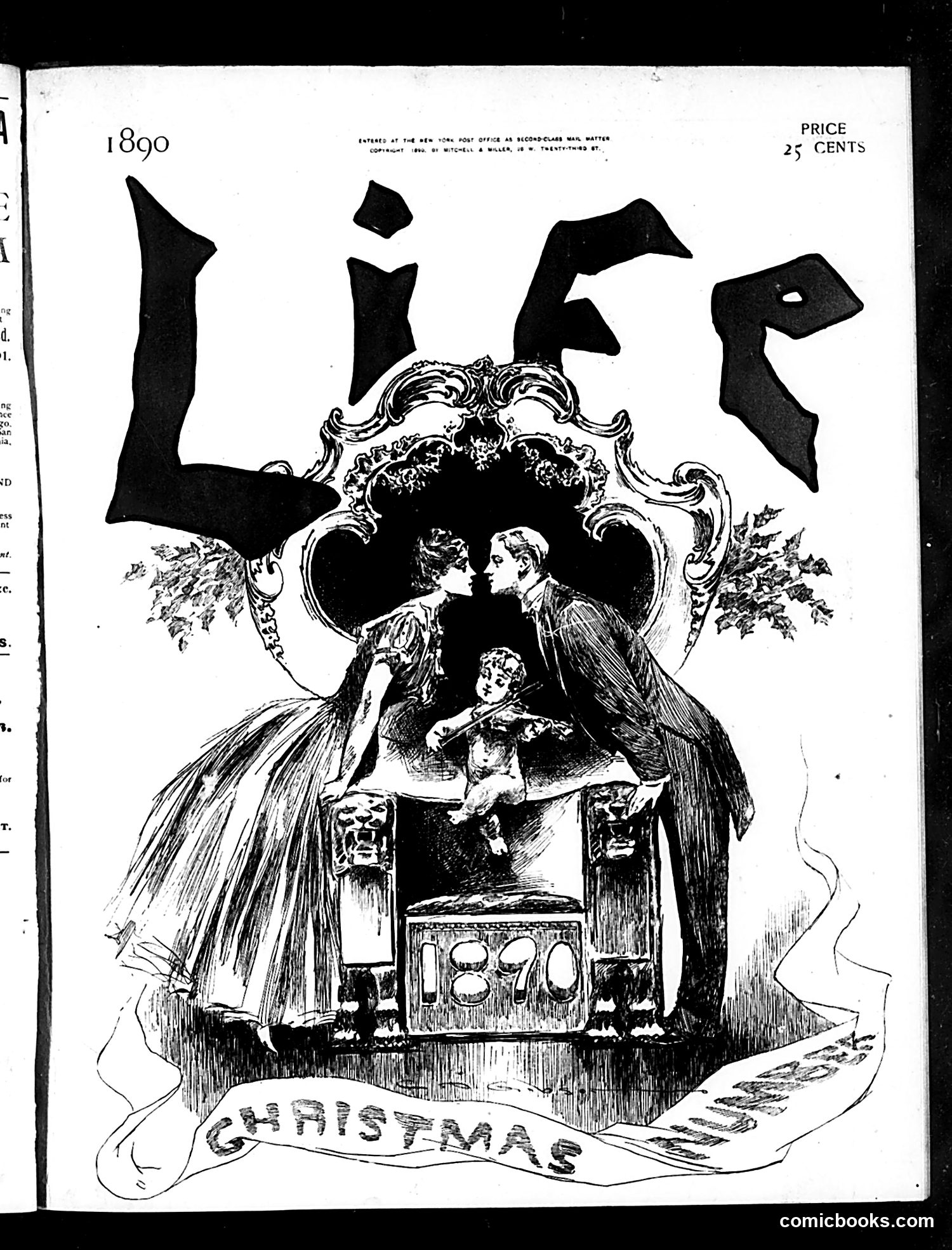
This is a Christmas-themed cover illustration from *Life* magazine's 1890 issue. The image depicts a domestic holiday scene: a well-dressed couple and two children gather around a fireplace, exchanging gifts. The ornate mantelpiece and formal Victorian furnishings suggest middle or upper-class prosperity. The large letters "LIFE" integrated into the composition form the cover's title. The word "CHRISTMAS" appears on a banner at the bottom. The satirical intent is unclear from the image alone—it may celebrate consumer culture and holiday materialism, or simply present an idealized domestic scene. The 25-cent price indicates this was premium holiday merchandise. Without additional OCR text or context, the specific social commentary remains uncertain.
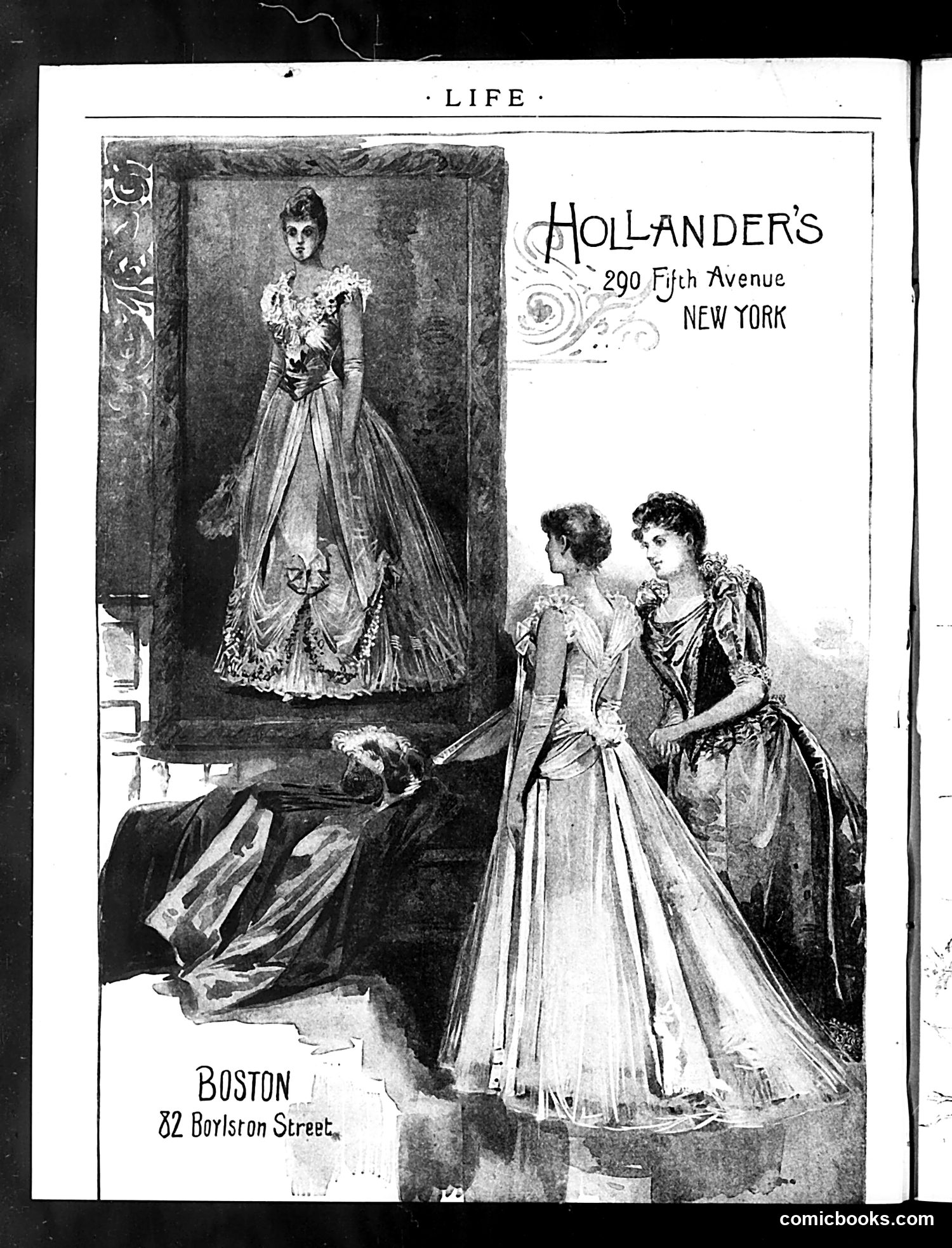
This is primarily an **advertisement page** for Hollander's, a clothing/fashion retailer with locations in New York (290 Fifth Avenue) and Boston (82 Boylston Street). The image depicts an **elegant woman in an elaborate formal gown** displayed on a pedestal or in a window display, while two fashionably-dressed women examine it below. The composition satirizes **high-fashion retail culture** — treating the dress (and implicitly, the ideal woman wearing it) as a luxury object to be admired and purchased. The satire likely mocks the **aspirational nature of fashion advertising** and women's consumer culture of the era, suggesting that Hollander's sells not just clothing but an idealized lifestyle and appearance to wealthy clientele.
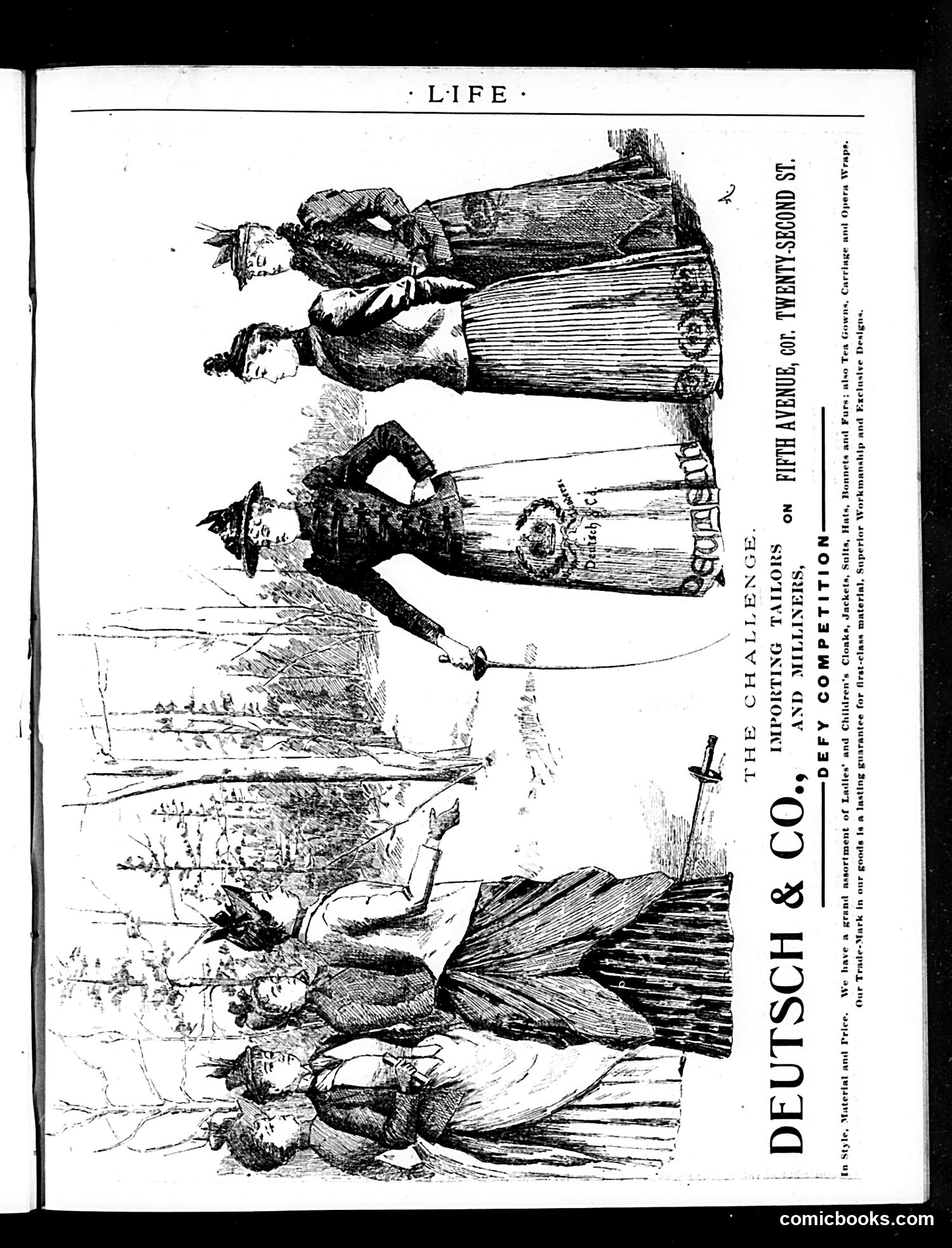
This appears to be a satirical advertisement or cartoon from *Life* magazine depicting the German firm "Deutsch & Co." The image shows figures in period dress (likely late 19th/early 20th century) arranged vertically, suggesting a hierarchy or business structure. The OCR text is severely corrupted and largely unreadable, making precise interpretation difficult. However, the heading references "importing, exporting milliners" and "competition on Fifth Avenue, or Twenty-second St.," suggesting this satirizes a German import business, possibly mocking their commercial practices or pretensions in New York's fashion district. Without clearer text, the specific satirical target—whether German business practices, immigrant merchants, or commercial competition—remains unclear. The vertical arrangement of figures may suggest social climbing or business hierarchy being mocked.
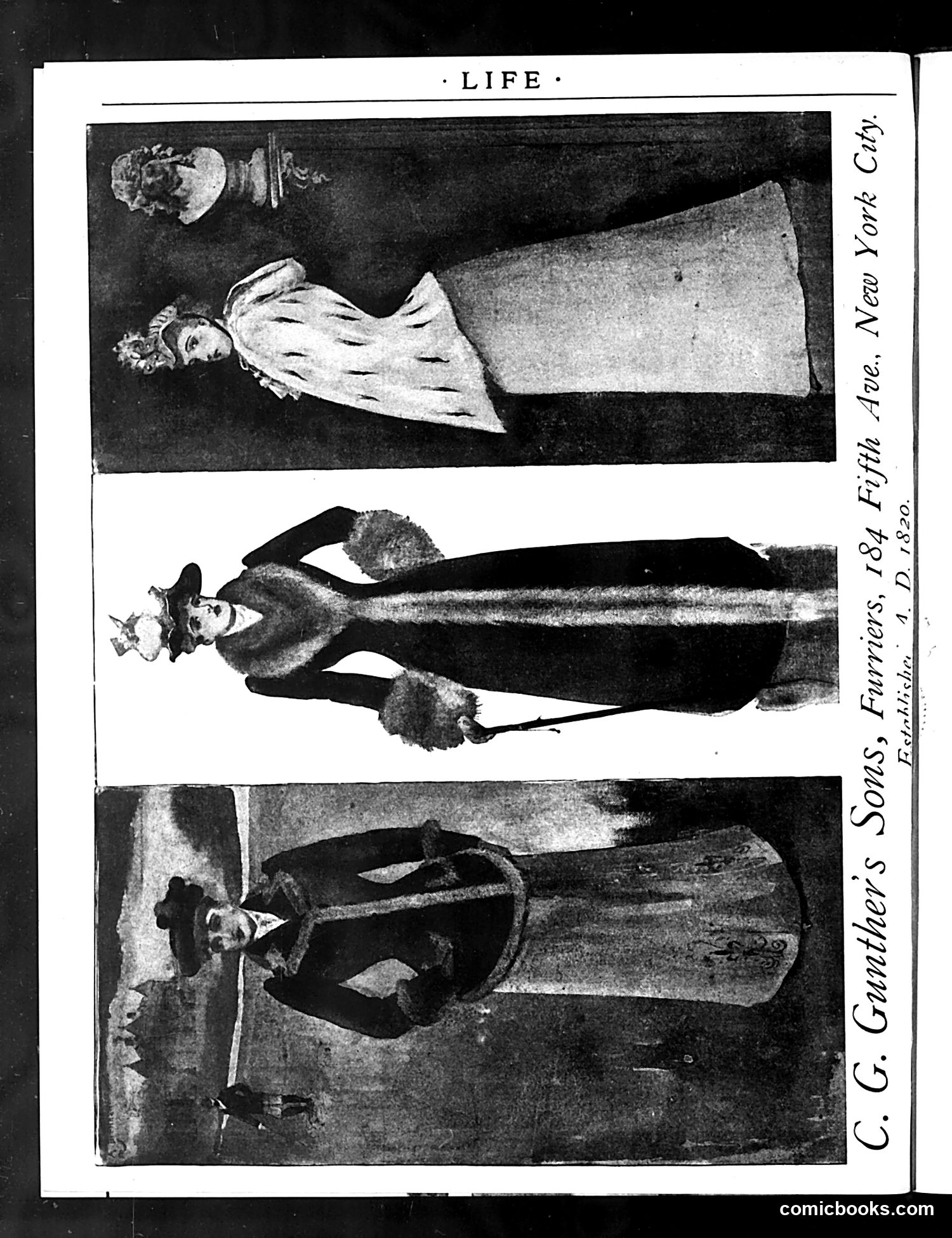
This page shows three fashion photographs or illustrations featuring women in 1920s "flapper" style clothing. The caption identifies these as "Gumbler's Solos" documenting the flapper trend on Fifth Avenue in New York City during 1924. The satire likely mocks the flapper phenomenon—the modern, scandalously dressed young women of the Jazz Age who wore short skirts, dropped waistlines, and bobbed hair. Fifth Avenue was an upscale shopping district, suggesting this is satirizing how even high-society women adopted this supposedly rebellious youth fashion. The "solos" framing presents these as individual fashion statements, poking fun at both the women's self-presentation and society's reactions to their liberalized dress and behavior during the Roaring Twenties.
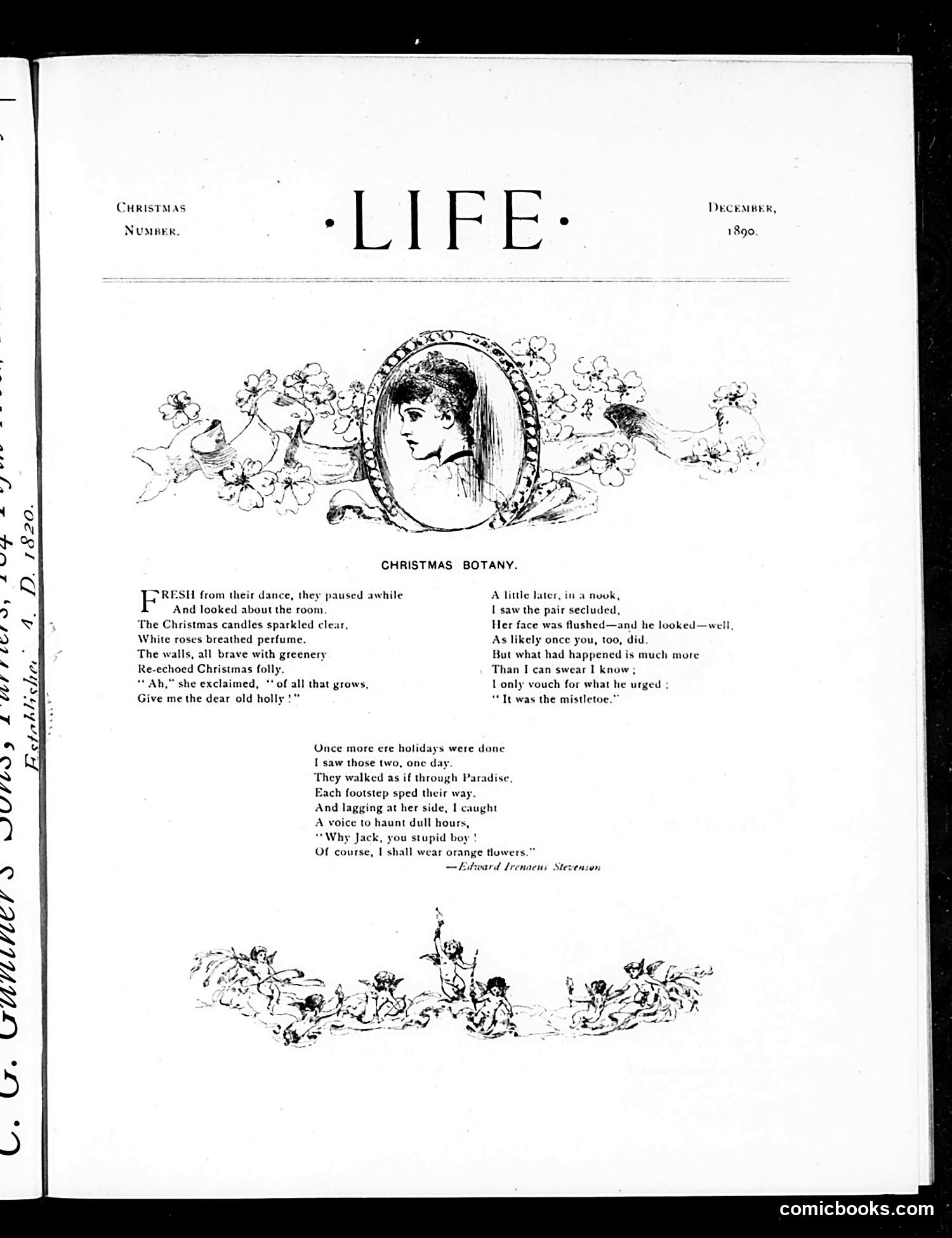
This is a romantic humorous poem illustrated with decorative sketches. The piece plays on Victorian courtship customs around Christmas greenery. The narrative follows a young couple at a holiday party. The woman admires the holly decorations; the man uses the mistletoe (a traditional Christmas kissing plant) as an opportunity to kiss her. Later, the speaker observes them walking together "as if through Paradise," seemingly now a couple. The joke culminates in the woman's final line—she scolds her boyfriend Jack for being "stupid" and insists she'll wear orange flowers (not traditional bridal flowers), suggesting either she's playing hard-to-get or the relationship isn't as serious as it appeared. The poem gently satirizes Victorian romance conventions: the use of holiday plants as romantic pretexts, the coy behavior of courtship, and the uncertainty of whether a single kiss means genuine attachment. The author is credited as Edward Irenaeus Stevenson.
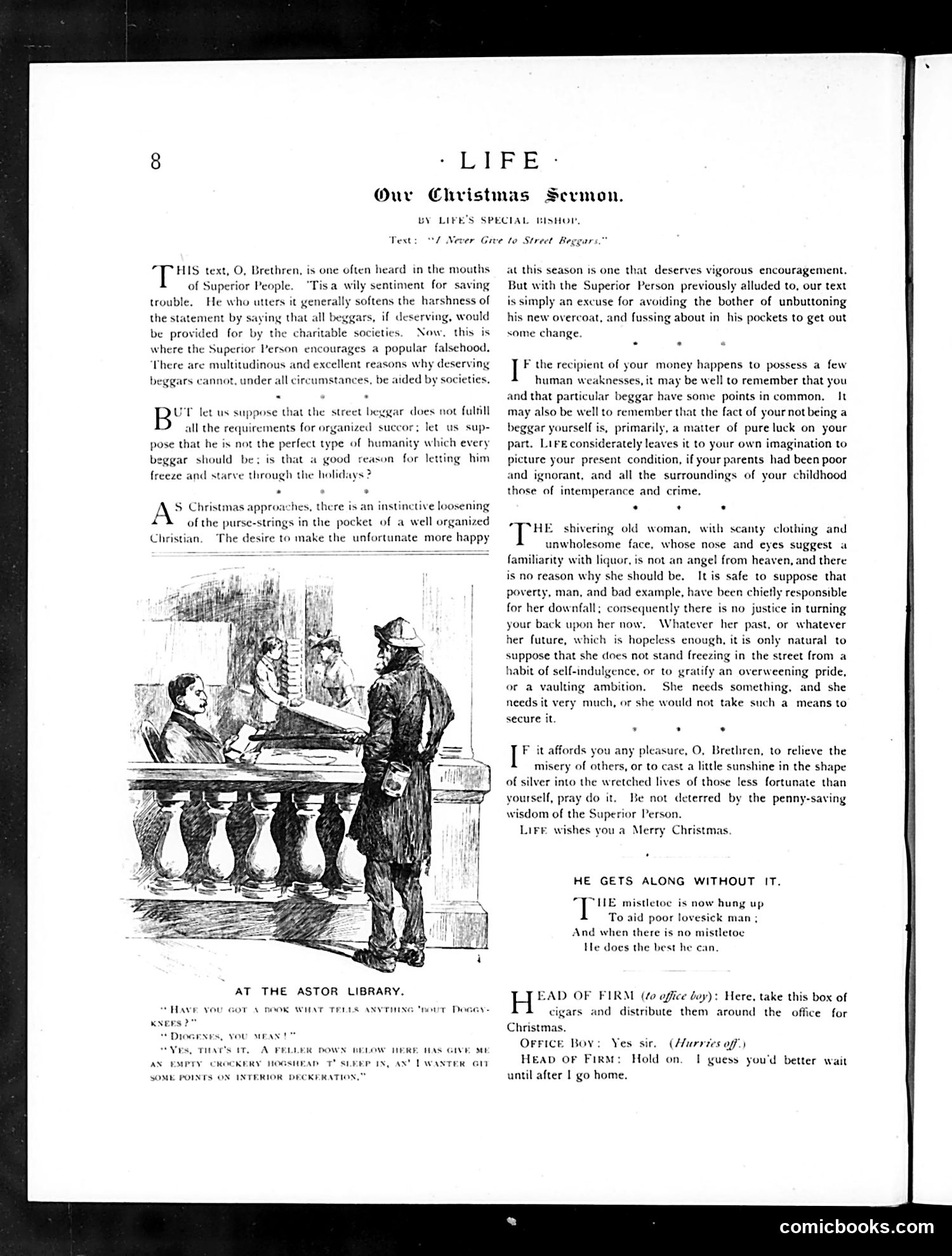
This page contains a Christmas-themed moral essay satirizing wealthy "Superior People" who refuse charity to street beggars by claiming "Never Give to Street Beggars." **The Main Cartoon** ("At the Astor Library") depicts a conversation between a well-dressed man and a beggar at the public library—a space where the poor sought warmth and shelter. The dialogue mocks the disconnect between charitable sentiment and actual help. **The Sermon's Point**: Life's editor argues that those who cite the "street beggar" excuse are using it to avoid the minor inconvenience of reaching into their pockets during Christmas. The text directly challenges the hypocrisy: the poor aren't morally inferior—they're simply unfortunate. Poverty stems from circumstances (poor parents, bad examples), not character flaws. **The Secondary Joke** ("He Gets Along Without It") trivializes romantic tradition—mistletoe is optional for courtship, just as charity might seem optional to the stingy. The overall satire targets middle-class moral smugness and the rationalization of selfishness during the season explicitly associated with generosity.
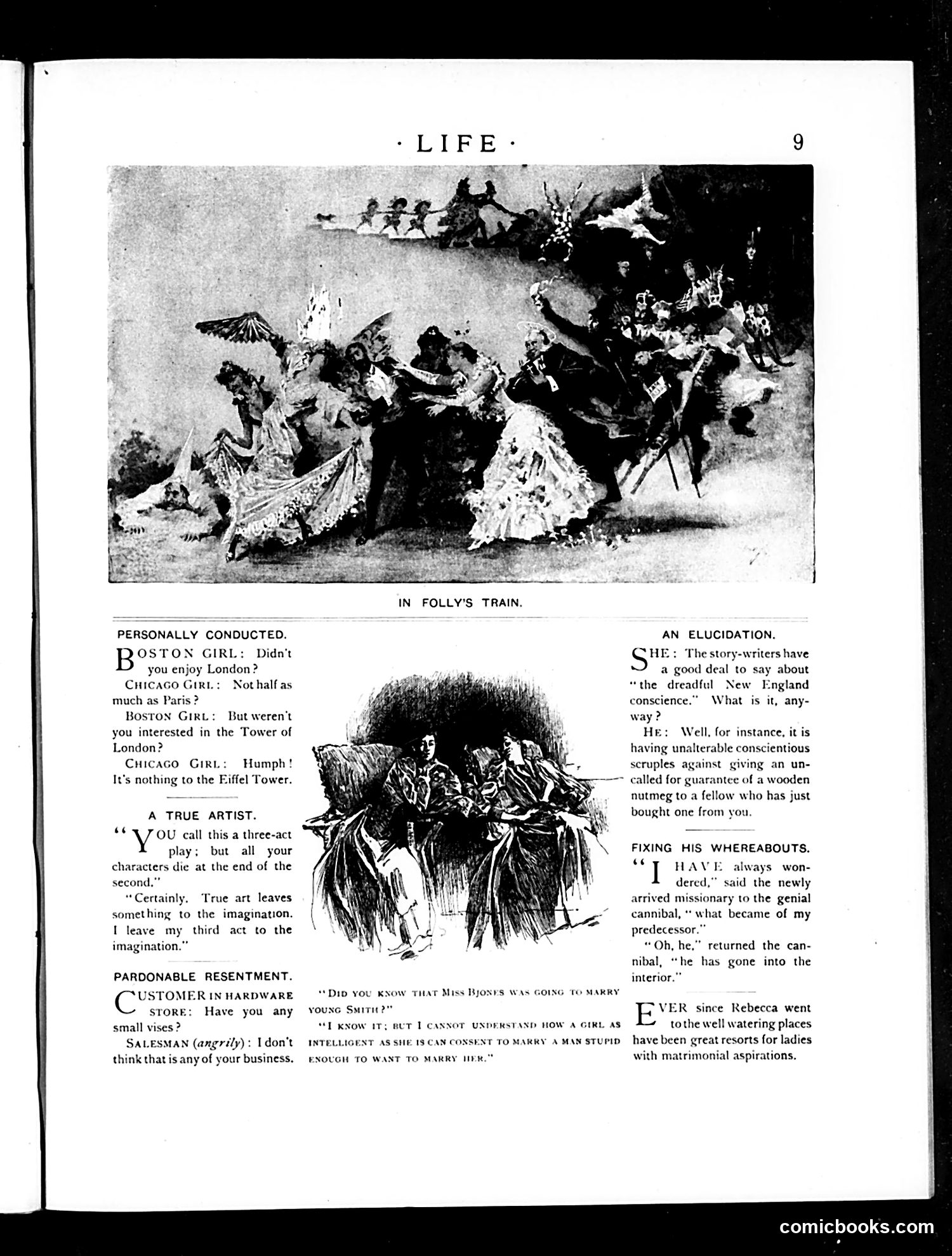
This page contains six separate humorous vignettes satirizing American social behavior and attitudes circa early 1900s: 1. **"Personally Conducted"**: Mocks American tourists, particularly Midwestern women who dismiss iconic London landmarks (Tower of London) as inferior to Paris's Eiffel Tower—poking fun at American provincialism and obsession with French culture. 2. **"A True Artist"**: Satirizes pretentious playwrights who claim leaving the third act to "imagination" is artistic when they've simply failed to write it. 3. **"Pardonable Resentment"**: A hardware store salesman takes offense at being asked about "small vises"—likely a crude pun on "vises" (tools) suggesting something insulting. 4. **"In Folly's Train"**: Ridicules a woman's decision to marry a foolish man, suggesting she's equally foolish for doing so. 5. **"An Elucidation"**: Satirizes the "New England conscience"—moral rigidity so extreme it permits selling defective wooden nutmegs (a historical scam) without guilt. 6. **"Fixing His Whereabouts"**: Dark humor: a cannibal's predecessor has "gone into the interior"—implying he was eaten.
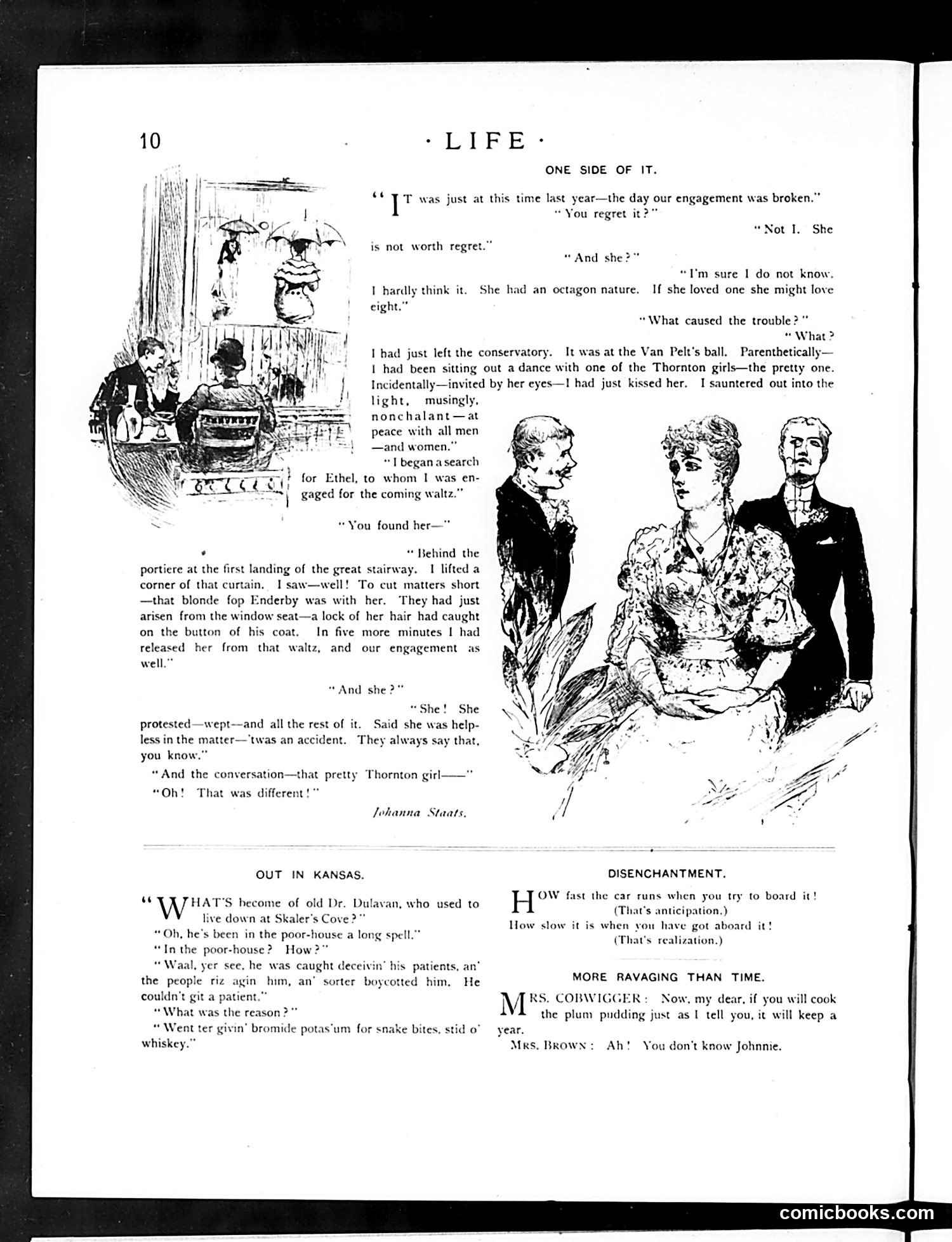
This satirical piece by Johanna Staats exposes male hypocrisy in courtship and engagement. A man recounts breaking his engagement to Ethel after discovering her in a compromising position with another man at a ball. However, the satire cuts deeper: he casually admits to kissing a different woman (a Thornton girl) moments before—yet sees no contradiction in condemning Ethel's behavior as grounds for ending their engagement. The joke is the man's obliviousness to his own duplicity. He considers his own indiscretion harmless ("nonchalant—at peace with all men—and women") while treating Ethel's similar lapse as unforgivable betrayal. The "octagon nature" quip—suggesting she might love multiple people—ironically describes his own behavior. The piece mocks Victorian-era sexual double standards where men's romantic transgressions were dismissed as natural, while women faced social ruin for equivalent conduct.
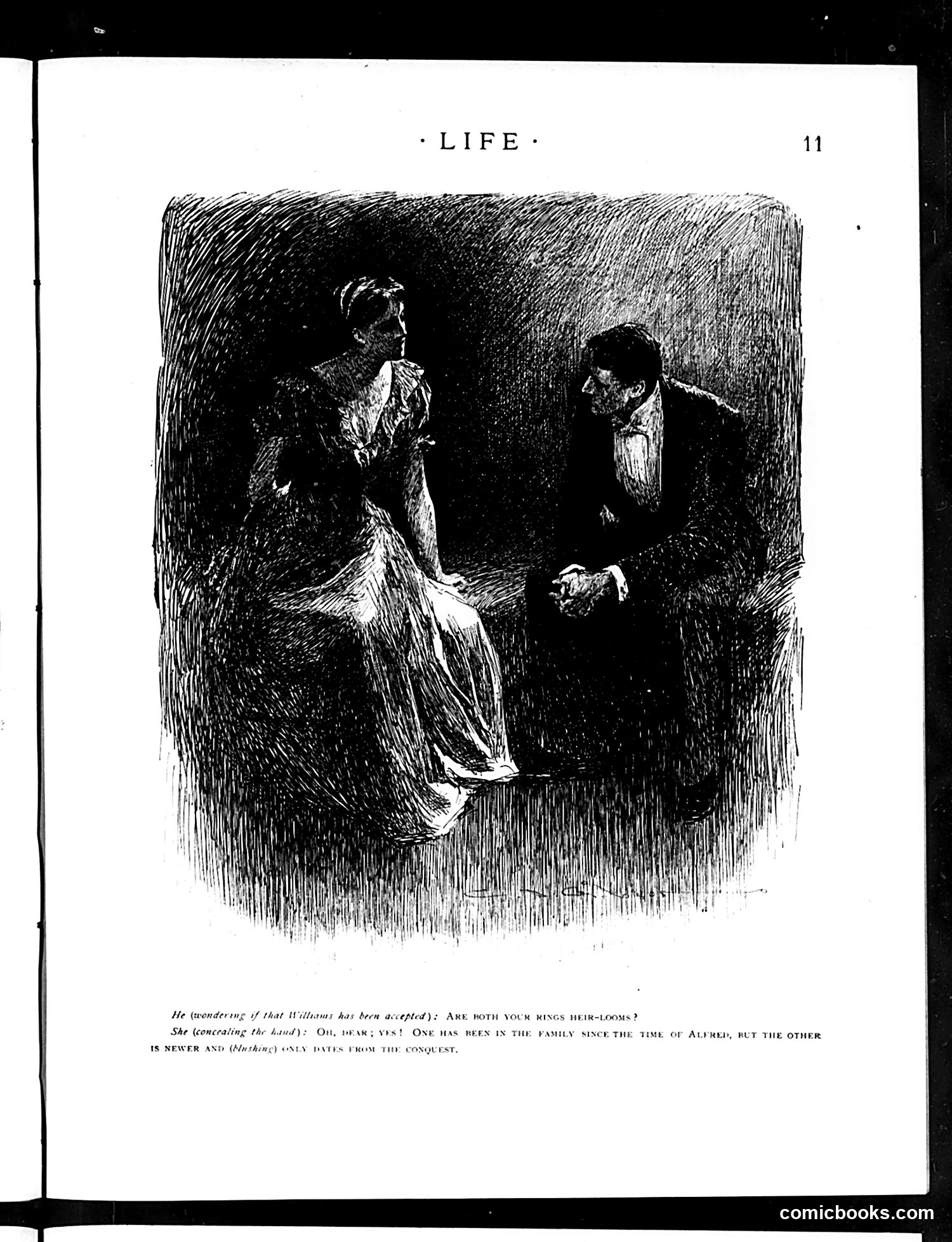
This is a satirical cartoon about English class anxiety and family heritage. A woman conceals her hand while discussing her rings with a man, claiming one dates back to King Alfred (9th century), establishing ancient aristocratic lineage. However, she blushes while admitting the other ring is "newer" and only dates from "the Conquest"—referring to the Norman Conquest of 1066, which was actually medieval but relatively recent compared to Alfred. The satire mocks her pretentious attempt to establish noble credentials while simultaneously revealing insecurity about the newer ring's origins, possibly suggesting a less-than-respectable acquisition (perhaps a marriage outside her class, or worse). The humor lies in her contradictory pride and embarrassment about her family's actual social status.
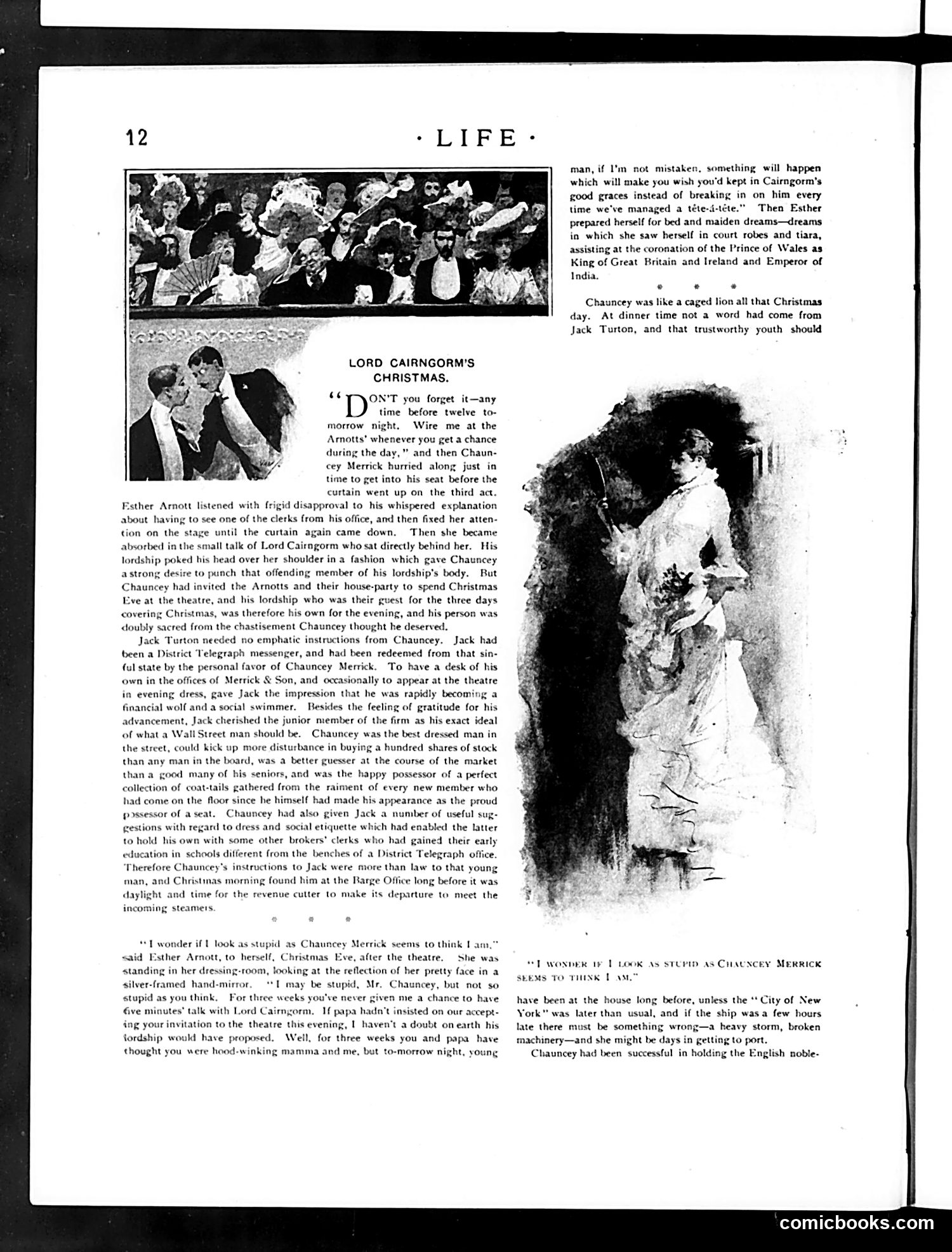
This appears to be a serialized story rather than political satire. The narrative follows Chauncey Merrick, a successful Wall Street broker, during Christmas. The plot involves romantic tension: Chauncey is distracted by business obligations while attending the theatre with Esther Arnott, who is instead charmed by "Lord Cairngorm," a British aristocrat also present. The social commentary reflects Gilded Age anxieties: Chauncey represents the nouveau riche financier obsessed with appearances and status-climbing. Jack Turton, his protégé, embodies social mobility through patronage—elevated from telegraph messenger to office clerk through Chauncey's favor. The humor derives from Esther's daydream of marrying into British nobility (imagining herself at a royal coronation) and her subtle resentment of Chauncey's divided attention. The "caged lion" metaphor suggests masculine frustration when status and romance conflict.
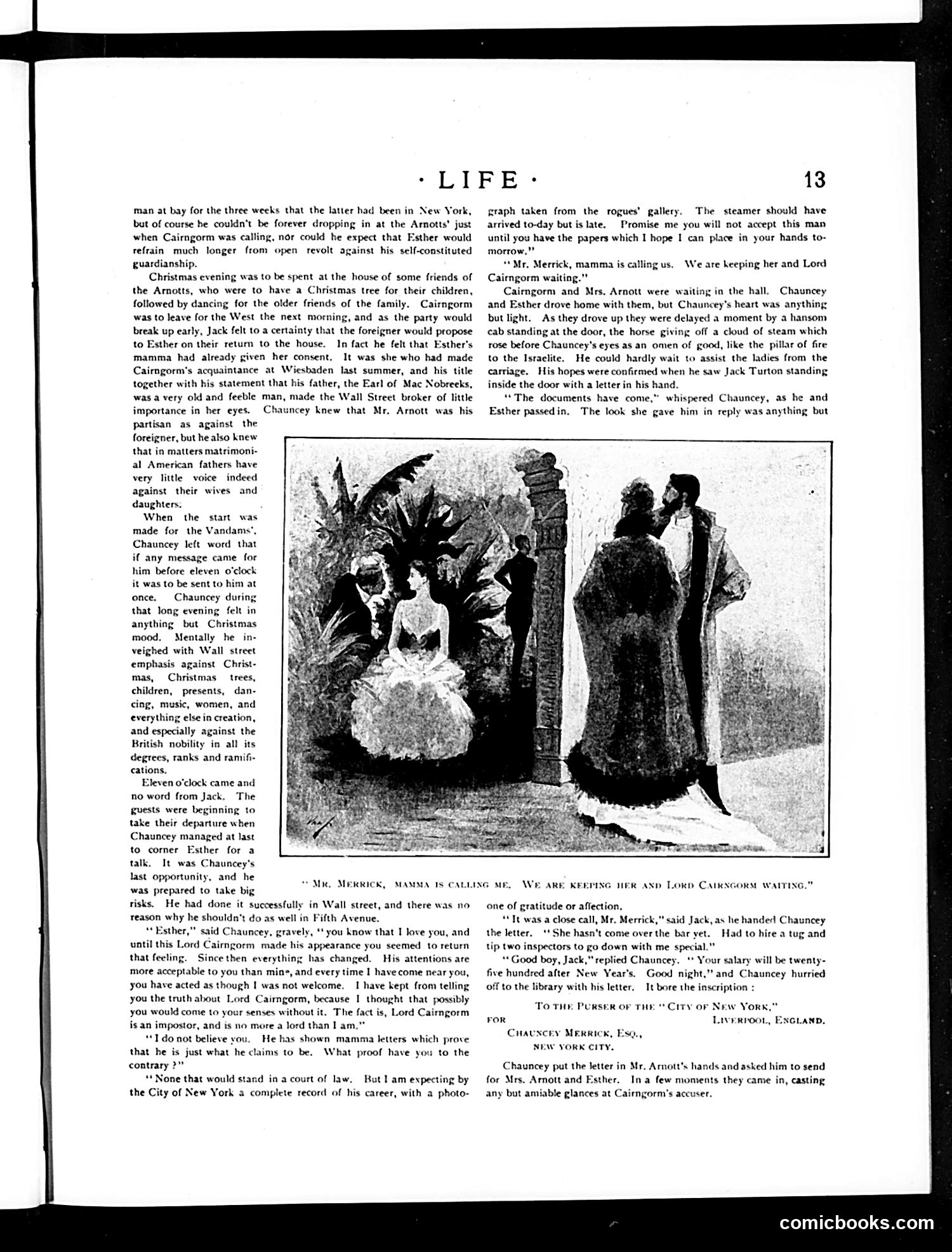
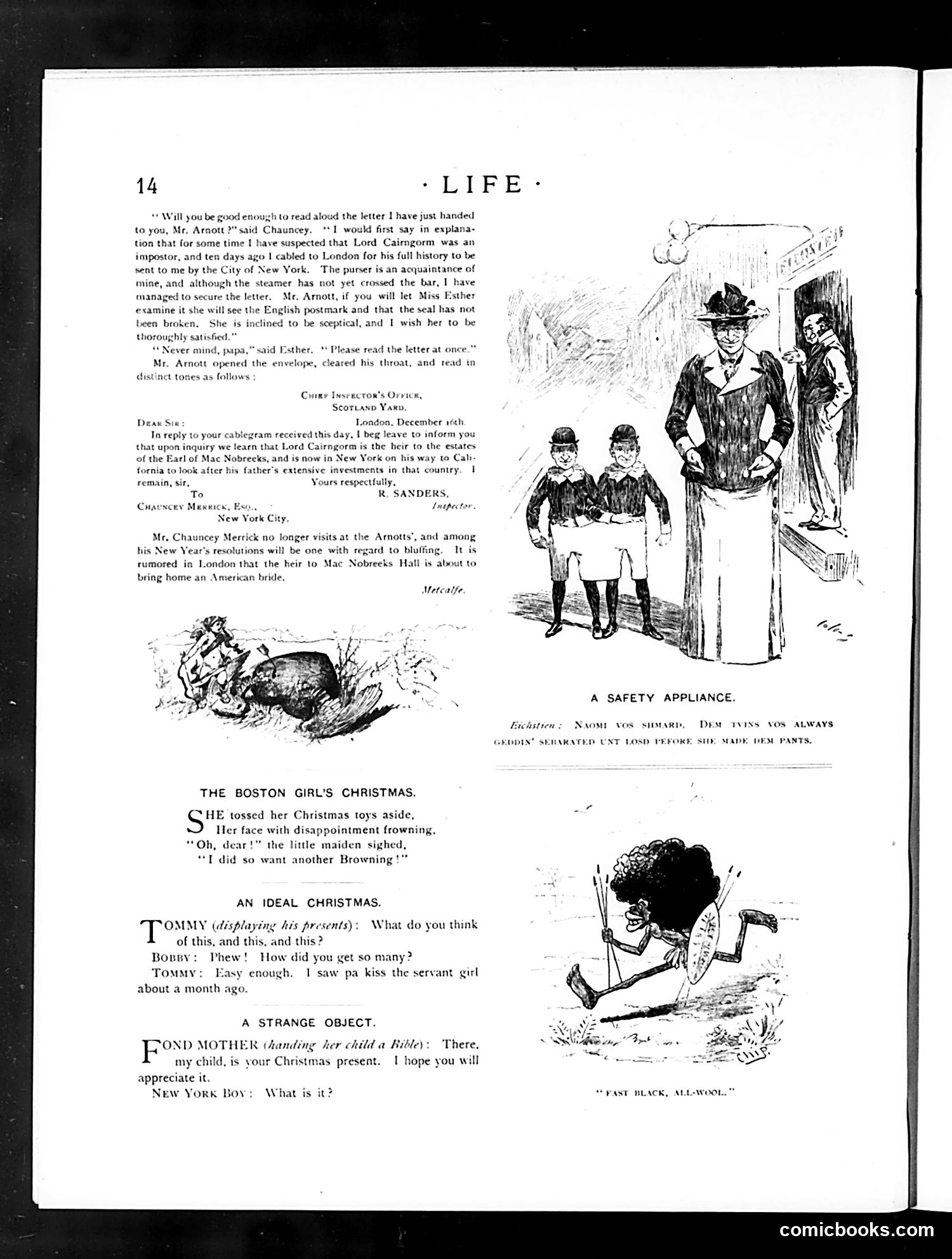
This page contains multiple unrelated satirical pieces typical of Life magazine's humor. The main story involves a confidence scheme: Chauncey Merrick, apparently a social climber, has been courting the Arnott family while claiming to know "Lord Cairngorm," whom he suspects is a fraud. To impress Miss Esther Arnott, Chauncey produces a letter (suspiciously obtained before the ship crossed the bar) "verifying" Cairngorm's legitimacy. The joke is that Chauncey has been caught bluffing—the letter actually confirms Cairngorm's credentials, undermining his scheme. The three smaller comedic sketches mock contemporary manners: a Boston girl disappointed to receive toys instead of a *Browning* (the popular poet); a child bragging about abundant Christmas gifts through an inappropriate "arrangement" with a servant girl; and a New York boy's bafflement at receiving a Bible as a Christmas present. The illustrations satirize upper-class pretension, materialism, and the gap between respectable society and actual behavior.
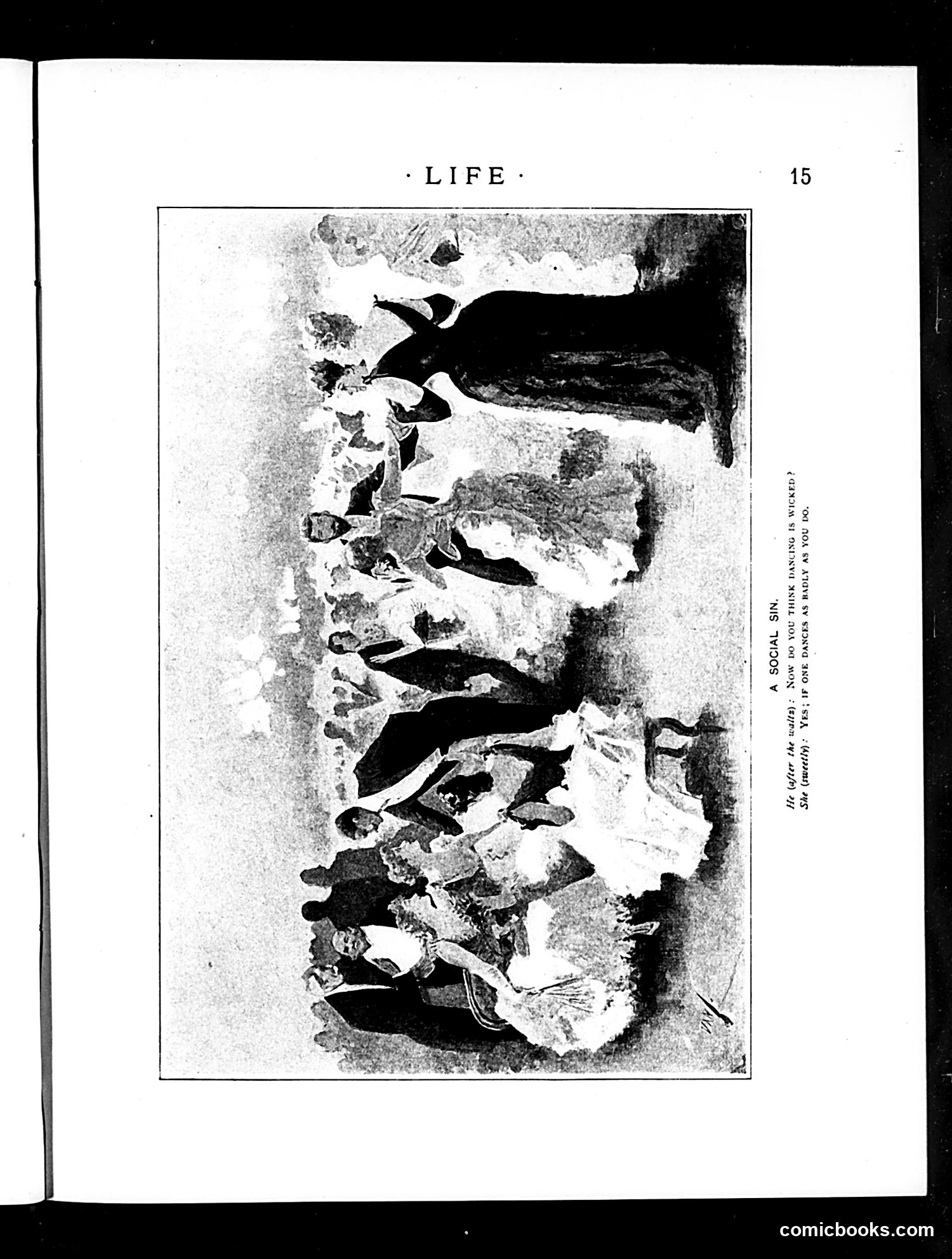
I cannot reliably read the OCR text on this page—it appears heavily corrupted or inverted. From the IMAGE alone, I can see this is a satirical illustration showing multiple figures arranged vertically in what appears to be a social or political hierarchy or commentary. The figures are rendered in black and white with varying levels of detail and prominence. The style is consistent with early 20th-century American political cartooning. However, without legible caption text identifying the specific figures, events, or social commentary being depicted, I cannot accurately explain what this cartoon means or who it represents. To provide reliable historical context, I would need either clearer OCR text or additional publication information (date, title, artist).
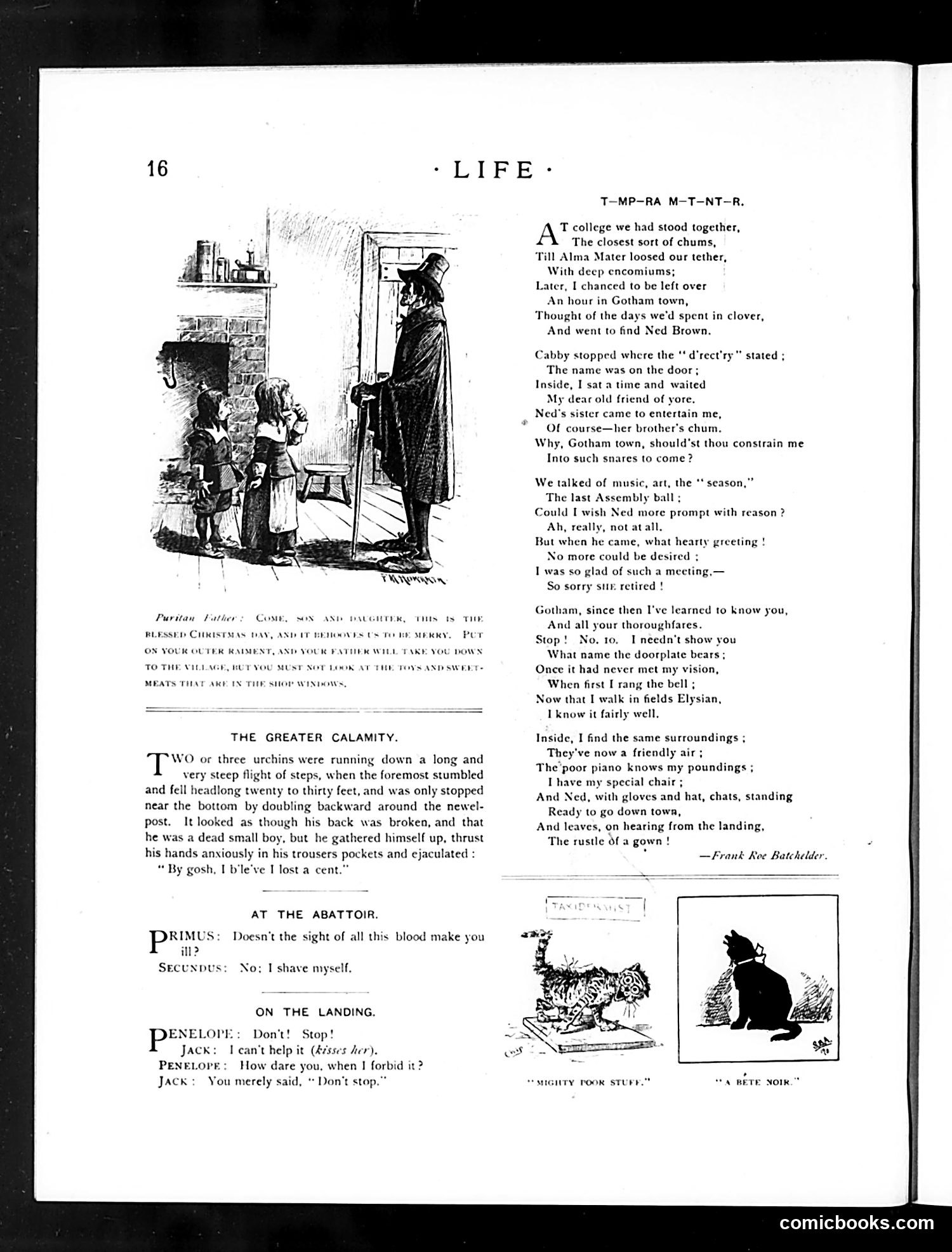
This page contains several satirical pieces typical of late 19th-century American humor: **"Puritan Father"** mocks strict religious observance by showing a father forbidding his children from even *looking* at shop window displays on Christmas—the ultimate denial of joy on a supposedly joyful day. **"The Greater Calamity"** is a humorous anecdote: a boy survives a terrible fall down stairs but his only concern is losing a cent from his pocket—inverting what readers would expect to matter most. **"At the Abattoir"** uses a crude joke: one man asks if the sight of blood bothers the other; the response that shaving oneself is worse suggests casual indifference to violence, typical of period "shock humor." **"On the Landing"** plays on ambiguous phrasing—Penelope forbids Jack to "stop," but he claims he merely obeyed her words literally, creating a flirtation joke. **"Tempo Matters"** (the longer poem by Frank Roe Batchelder) is sentimental verse about reconnecting with a college friend in New York City and discovering romance with his sister—typical period romantic fiction content.
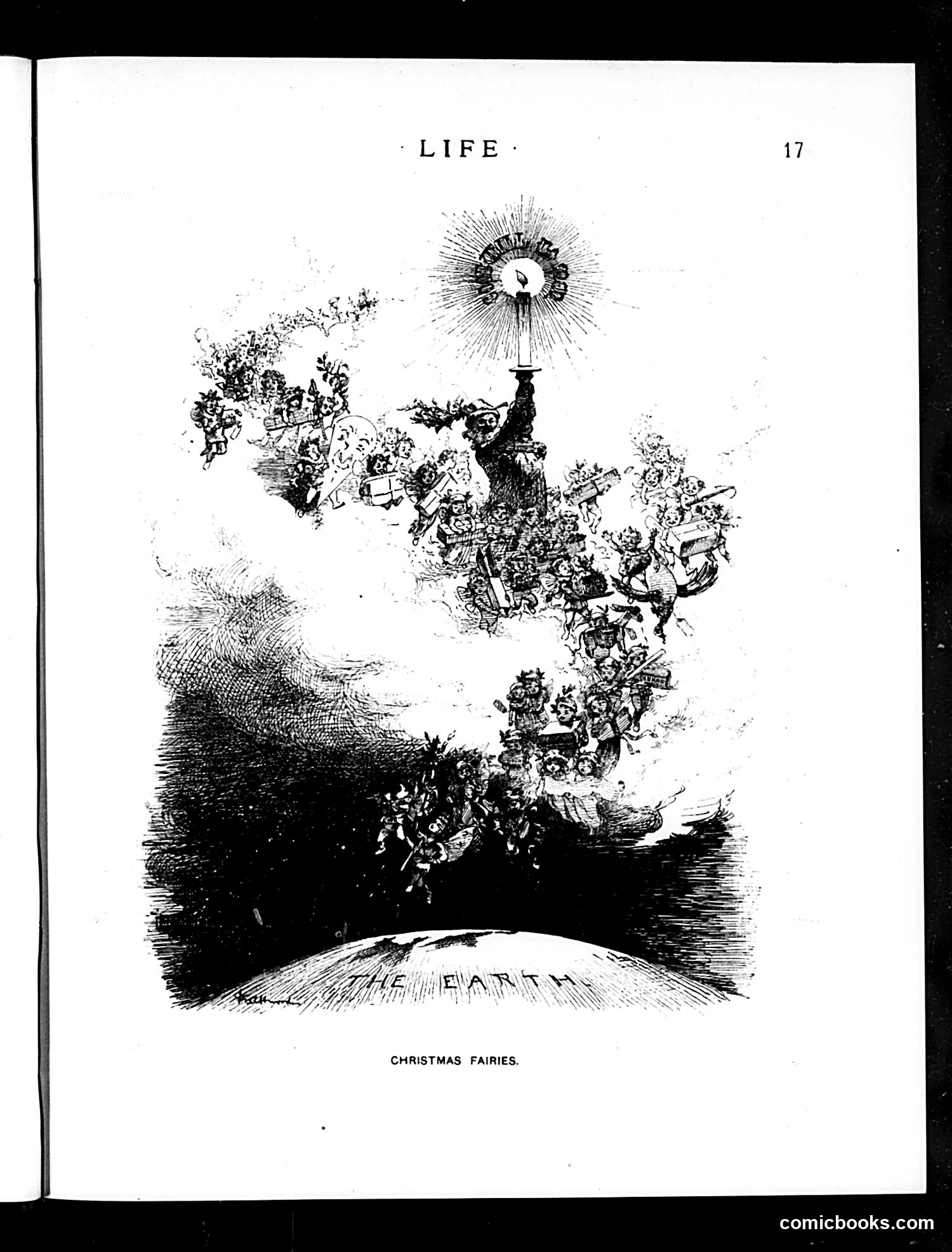
This satirical illustration depicts a whimsical scene titled "Christmas Fairies," showing a mass of tiny figures emanating from Earth toward a radiant celestial light above. The composition appears to be social commentary rendered as magical fantasy. The swirling crowd of small figures rising from the planet likely represents humanity or society, while the glowing orb above suggests divine or idealistic aspiration. The "fairies" framing appears ironic—presenting ordinary people engaged in chaotic, earthly pursuits as ethereal beings transcending worldly concerns. Without additional context from the magazine's date and contemporary events, the specific target of satire remains unclear, though it likely mocks either unrealistic Christmas sentimentality, social aspirations, or perhaps religious hypocrisy—a common target for Life magazine's satirists during the Gilded Age.
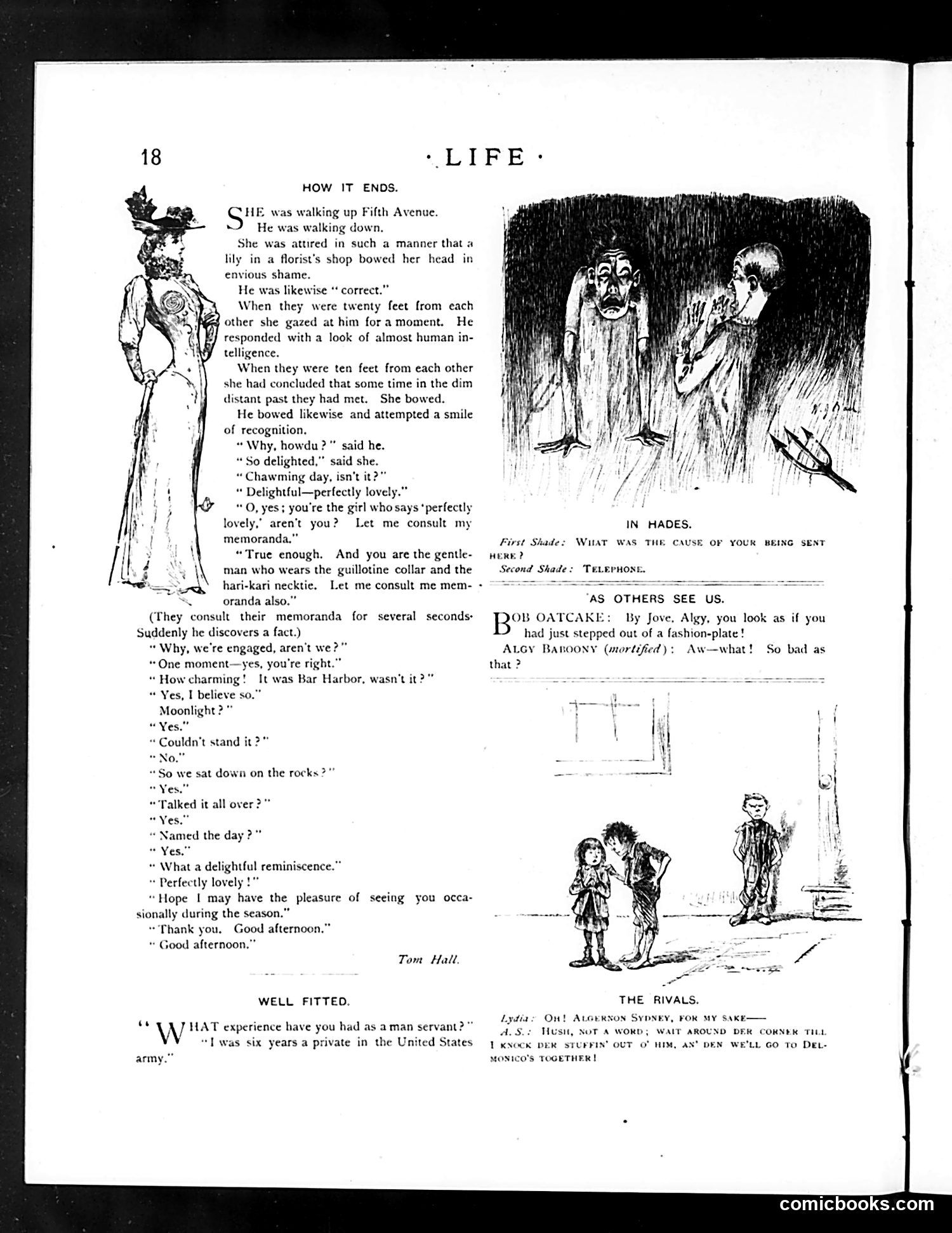
This page contains multiple satirical sketches mocking upper-class social pretension and fashionable affectation. **"How It Ends"** depicts two fashionably dressed New Yorkers on Fifth Avenue who, after exchanging pleasantries, suddenly realize they're engaged—despite having only vague, memorandum-dependent recollections of their romance (Bar Harbor, moonlight, rocks). The satire targets the superficiality and mechanical nature of high-society courtship, where wealthy individuals operate from social scripts rather than genuine feeling. **"In Hades"** and **"As Others See Us"** continue mocking fashion-obsessed dandies. "Algy Baroony" is criticized for his exaggerated fashionable appearance, while a rival threatens violence over romantic competition, planning afterward to dine at Delmonico's (an exclusive restaurant). **"Well Fitted"** jokes that a man-servant's military experience qualifies him for domestic service. The overarching theme: satirizing the artificiality, vanity, and hollow conventions governing Gilded Age upper-class life, where appearance and memorized social protocols matter more than authentic emotion or character.
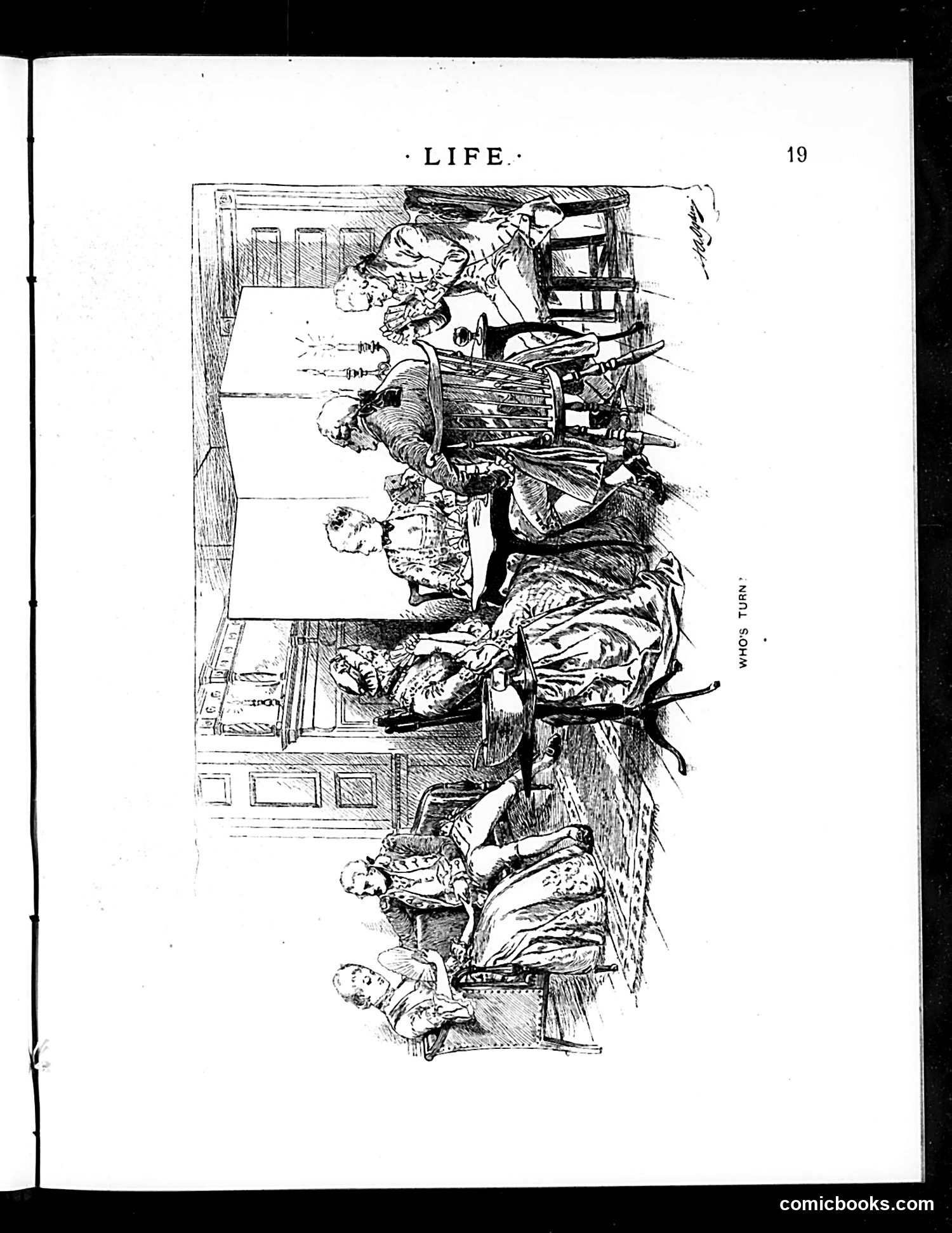
This page appears to be a single satirical illustration (rotated 90 degrees) depicting a domestic scene. The sketch shows what appears to be a father figure in a chair being attended to by multiple figures in what looks like a bedroom or parlor setting. The style suggests turn-of-the-century American humor. The caption reads "WHO'S TURN" (or similar), suggesting the cartoon comments on domestic responsibilities or caretaking duties. Without clearer text or dating information, the specific political or social satire remains unclear, though the composition suggests commentary on family dynamics or domestic labor divisions—common themes in Life's satirical content during the early 20th century.
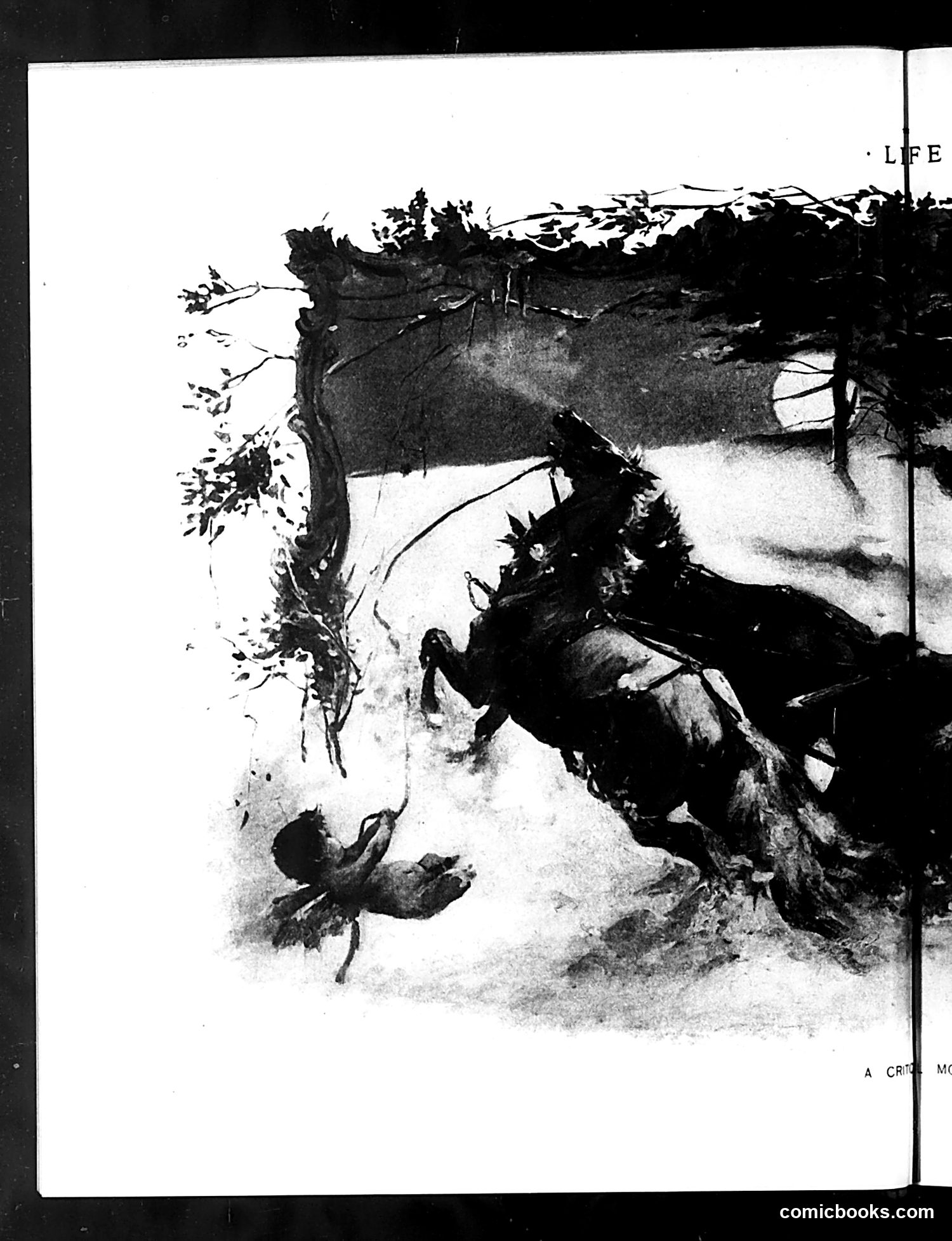
This appears to be a satirical cartoon from *Life* magazine, though the OCR text is too degraded to read. The black and white illustration shows a dramatic scene: a figure in dark clothing (possibly representing a threat or villain) confronts or menaces a smaller figure below near what appears to be a curved structure or shelter. Tree branches and foliage frame the scene at top and sides. Without legible text, I cannot identify the specific figures, political context, or intended satire with certainty. The composition suggests conflict or danger, typical of early 20th-century *Life* editorial cartoons addressing social or political issues. The style and subject matter indicate social commentary, but determining the precise target requires readable OCR text or additional context.
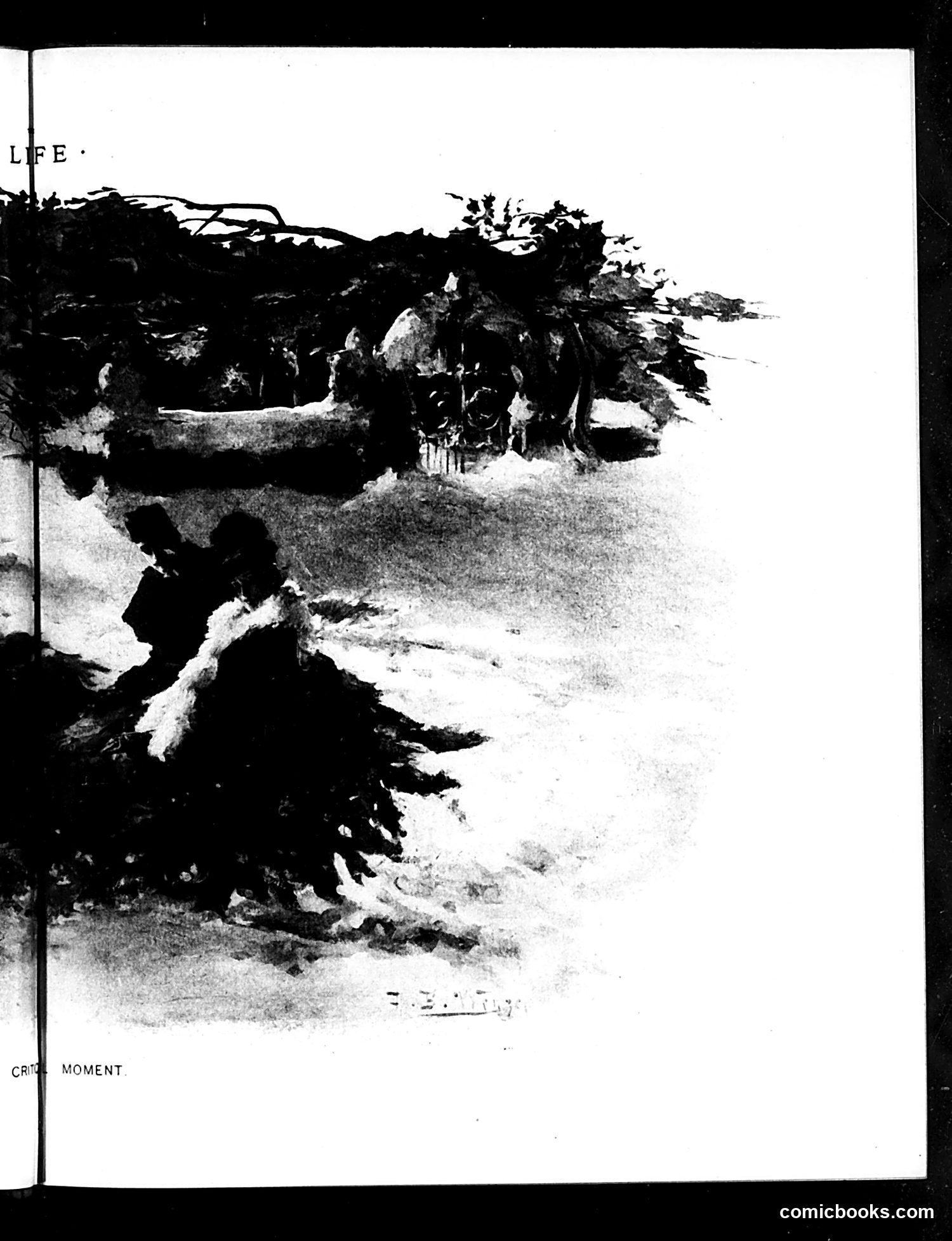
This appears to be a satirical illustration from *Life* magazine showing a dramatic coastal or seaside scene. The image depicts figures in what seems to be a precarious or tense situation near rocky terrain and vegetation by the water's edge. The title "Critical Moment" suggests the cartoon is commenting on some contemporary political or social crisis, though without additional context or clearer visual details, the specific historical reference is unclear. The stark black-and-white contrast and dramatic composition emphasize urgency or danger. The publication details and OCR text provide minimal additional information to identify the exact subject, date, or figures involved in this satire.
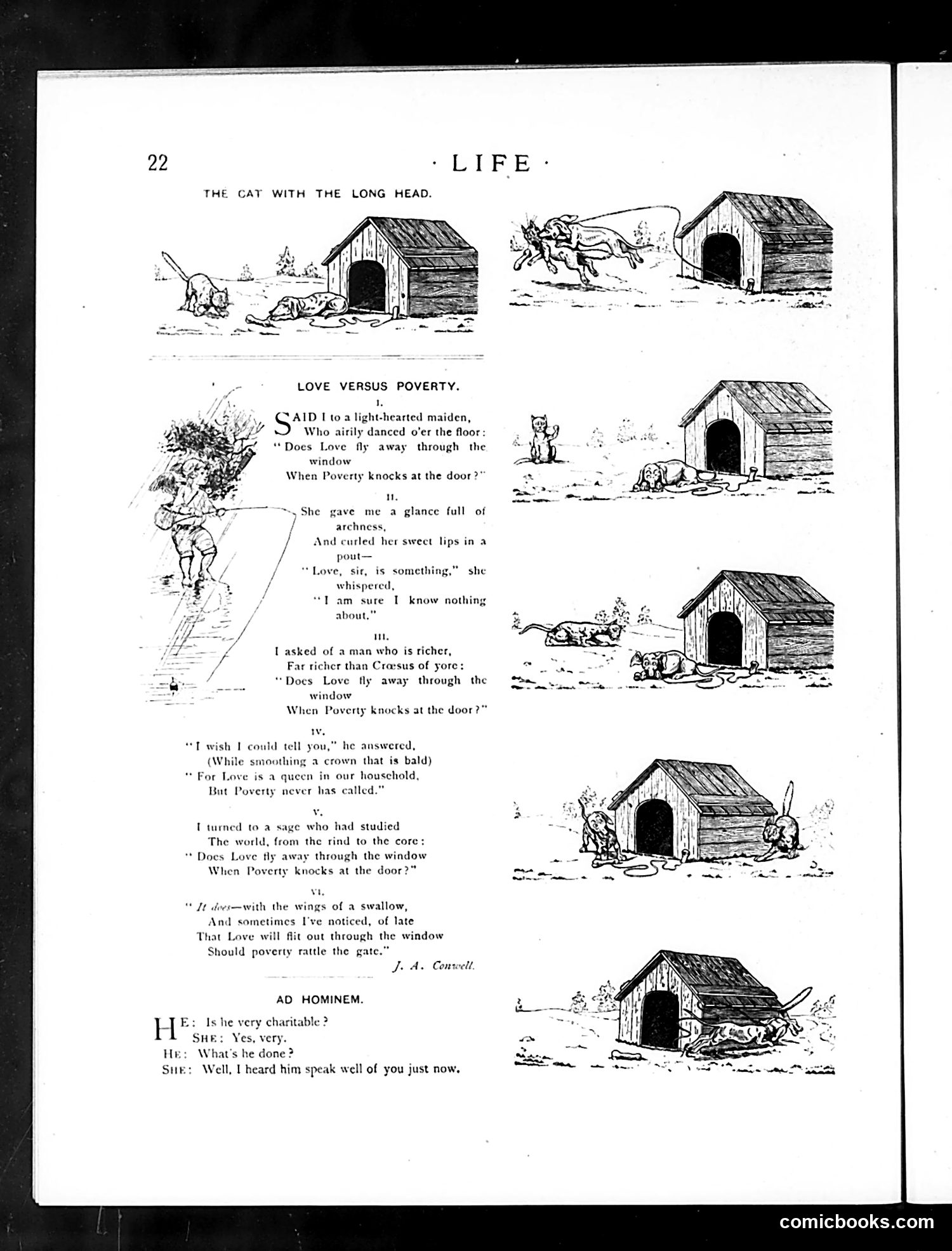
This page contains two distinct satirical pieces from *Life*, an American humor magazine. **"The Cat with the Long Head"** (top): A series of humorous illustrations showing a cat repeatedly interacting with a doghouse, suggesting physical comedy or slapstick humor about persistence and conflict. **"Love Versus Poverty"** (center): A philosophical poem posing the question whether romantic love survives when poverty arrives. Three respondents offer contrasting answers: a light-hearted maiden claims ignorance of love; a wealthy man reports love thriving in his household (never having met poverty); and a wise sage confirms love flees poverty "with the wings of a swallow." The satire mocks how wealth insulates people from understanding love's fragility under economic hardship. **"Ad Hominem"** (bottom): A brief joke playing on the term "charitable." When asked what charitable acts someone performed, the woman reveals he merely "spoke well of you"—satirizing empty praise as the cheapest form of supposed kindness. The page exemplifies *Life*'s satirical approach to social and economic realities of the era.
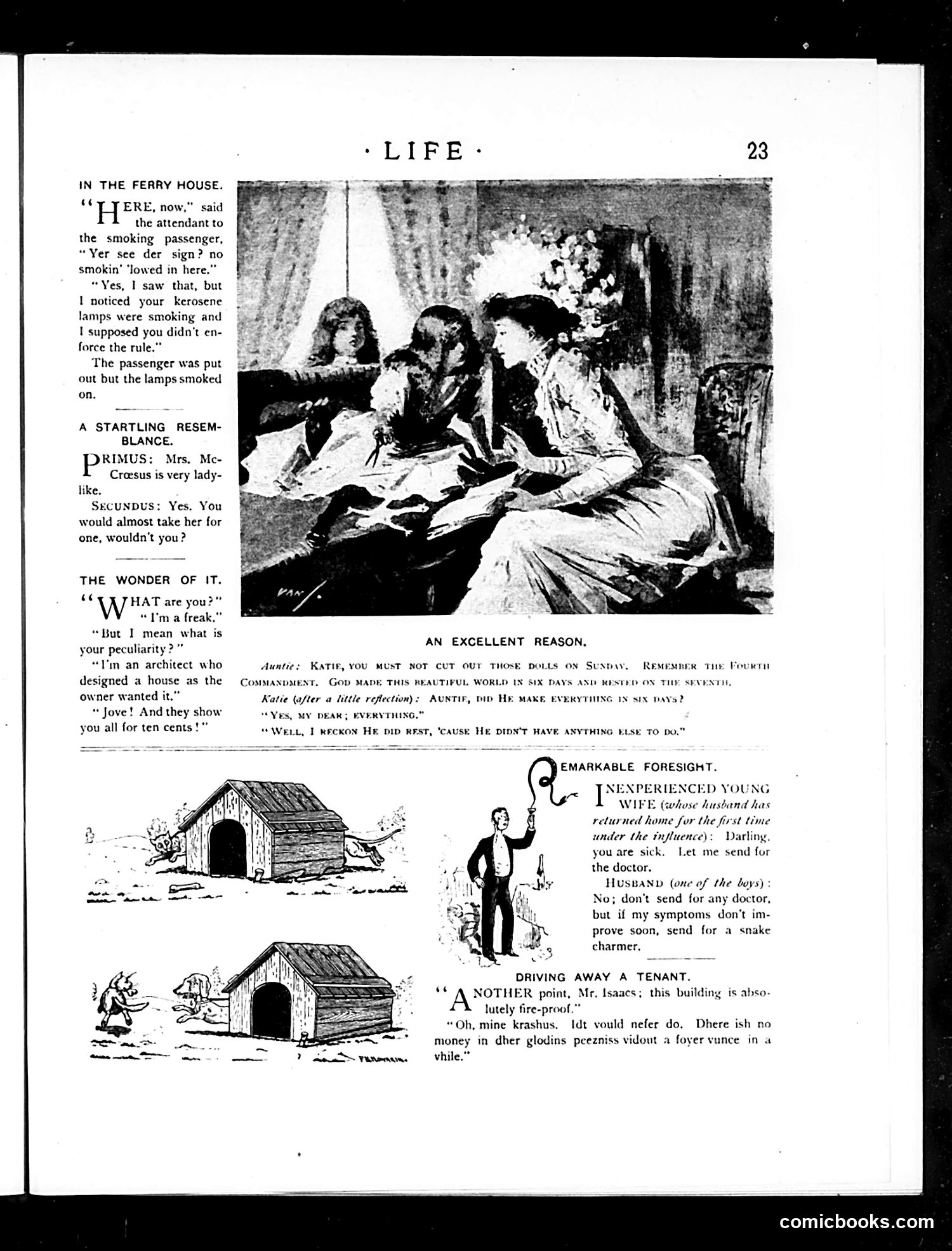
This page contains six brief satirical jokes typical of *Life* magazine's social commentary: 1. **Ferry House**: A passenger caught smoking points out the hypocrisy—kerosene lamps (fire hazard) are allowed while smoking isn't. 2. **Mrs. McCroesus**: A wealthy woman is so artificial she barely resembles an actual lady. 3. **The Architect**: Satirizes clients who demand impractical designs; an architect who actually builds what owners want is presented as a curiosity worth paying to see. 4. **Katie's Logic**: A child's innocent but pointed observation: God rested on the seventh day because He had "nothing else to do"—implying His work was finished, undermining the moral lesson about Sabbath observance. 5. **Drunk Husband**: A humorous double-meaning: "snake charmer" as folk remedy for drunkenness (implied snake-like delirium). 6. **Tenant/Landlord**: A Yiddish-accented character refuses a fire-proof building because slumlords profit from periodic fires (insurance fraud/arson).
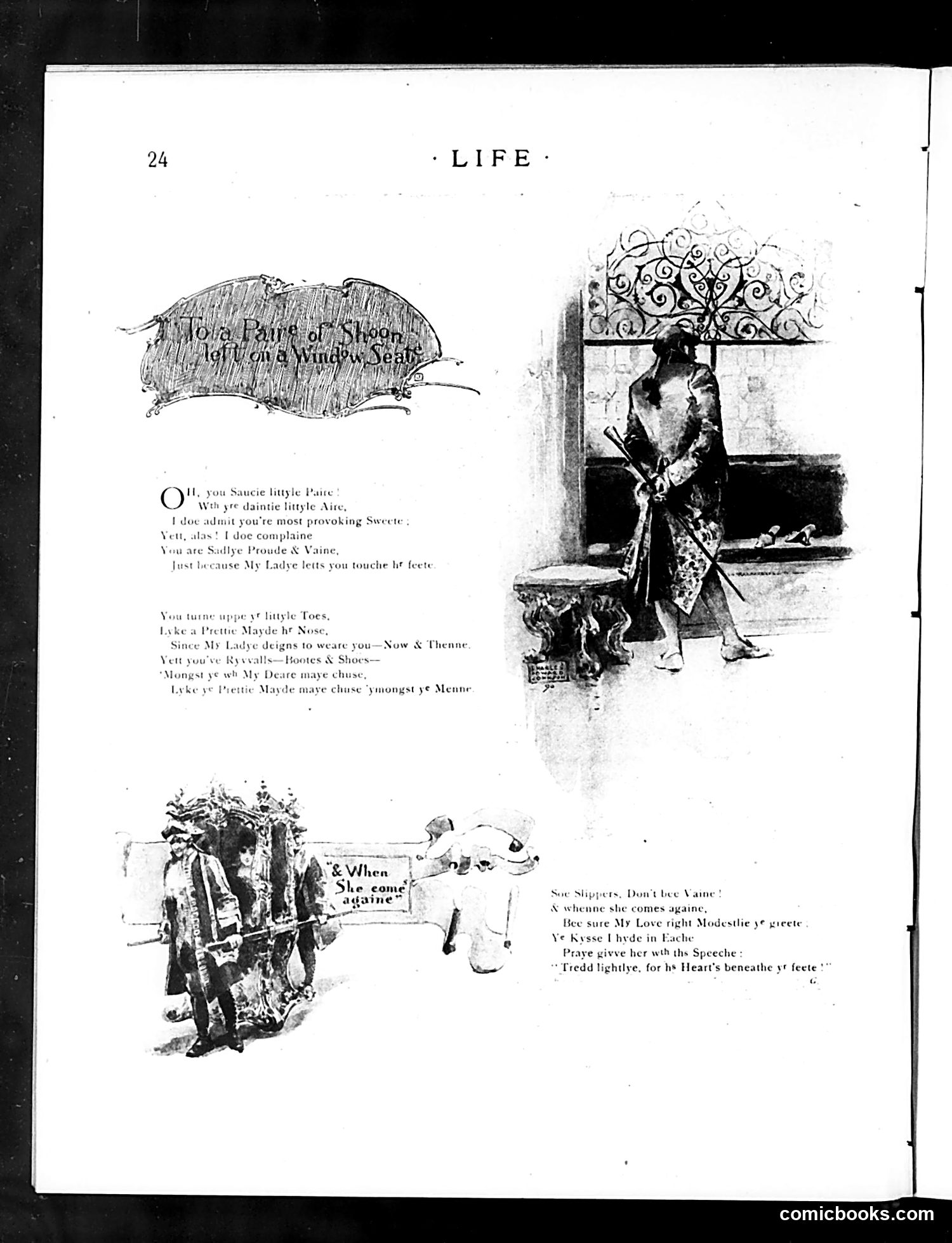
This page features mock-serious romantic verse addressed to a pair of slippers, written in deliberately archaic spellings ("ye," "Ladye"). The satire mocks both courtly love poetry and the vanity of fashionable accessories. The poem personifies slippers as a jealous suitor, complaining that they've grown proud simply because a lady wears them. It warns them not to be vain and advises them to remain modest when their wearer returns. The final lines—asking the slippers to tell her "tread lightly, for his Heart's beneath yt feet"—reveal this is actually a lover's indirect confession of devotion. The accompanying illustrations show period-dressed figures and decorative elements. The humor lies in elevating trivial domestic objects and romantic jealousy to the level of flowery poetic language, a common technique in early 20th-century satirical magazines like *Life* to mock sentimental excess and social pretension.
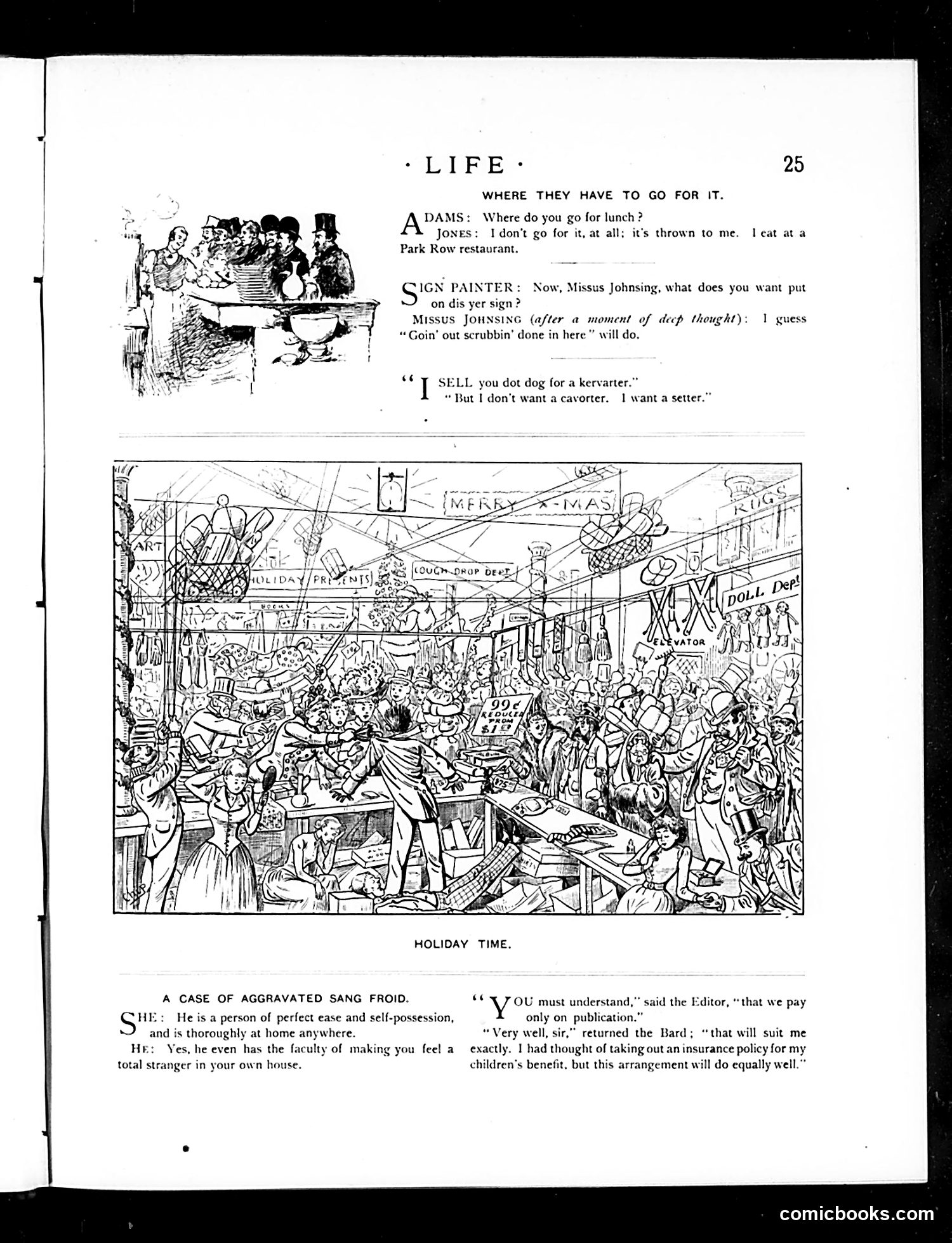
This page contains three separate satirical jokes typical of early 20th-century American humor: 1. **"Where They Have to Go for It"**: A joke about class differences. A wealthy man claims his lunch is "thrown to me" at a Park Row restaurant, implying he's so important he's served without asking. The humor mocks pretentiousness. 2. **"Holiday Time"**: A detailed crowd scene showing a chaotic public gathering (likely a holiday shopping or entertainment venue), satirizing holiday excess and urban congestion. 3. **"A Case of Aggravated Sang Froid"**: A dialogue joke about a houseguest so composed and confident that he makes the host feel uncomfortable in his own home—the ironic definition of "sang froid" (cool composure) taken to absurd extremes. 4. **Bottom section**: A joke about a struggling writer negotiating with an editor who pays only "on publication." The writer sarcastically accepts, joking he'll skip life insurance for his children since he apparently won't earn money anyway. It satirizes the financial precarity of writers and publishers' exploitative practices.
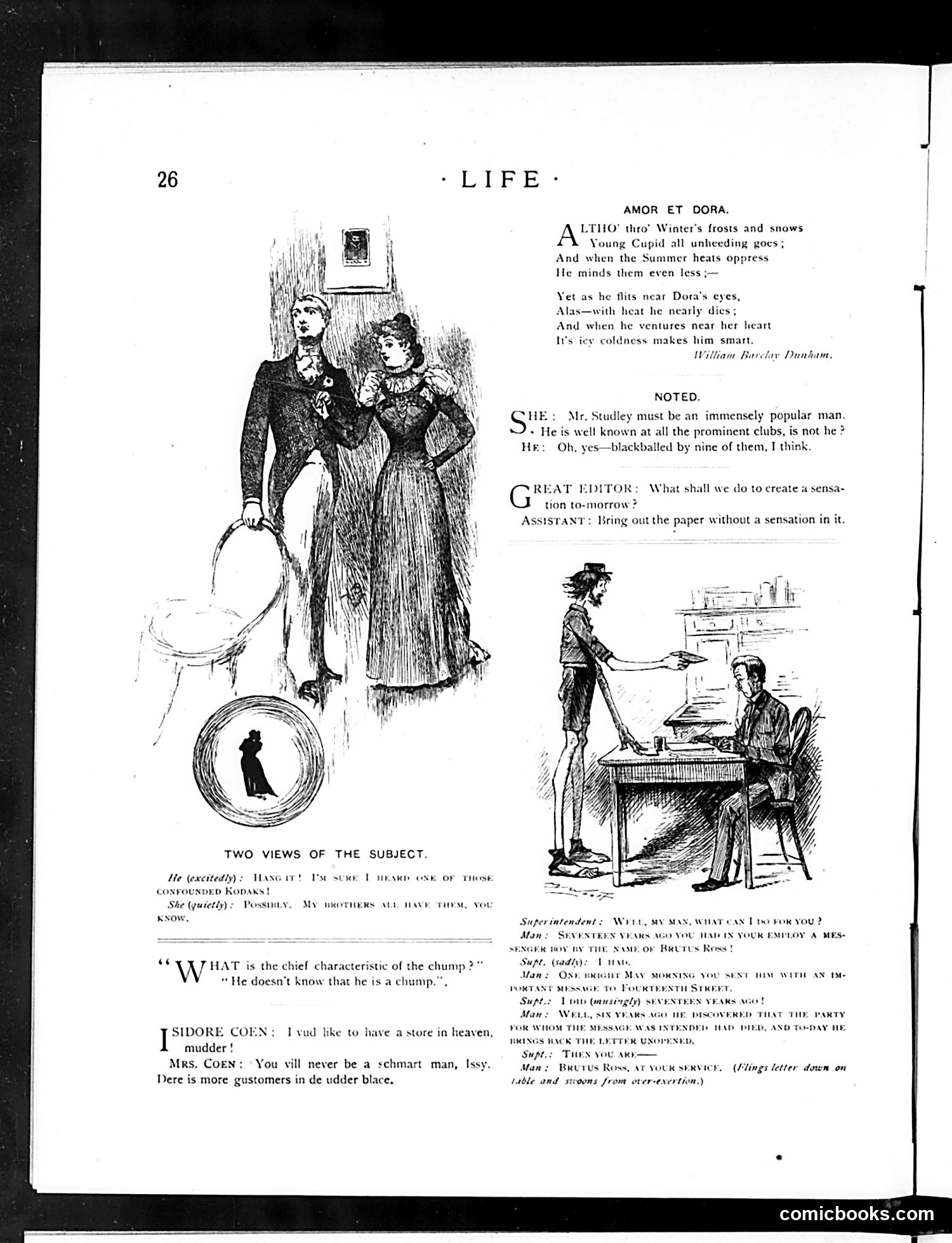
This page contains multiple satirical vignettes typical of early 20th-century American humor: **"Two Views of the Subject"** shows a couple discussing Kodak cameras—he's excitedly praising them while she pragmatically notes her brothers already own them, satirizing consumer culture and gender differences in enthusiasm for new technology. **"Amor et Dora"** is a romantic poem mocking the paradox of Cupid being unaffected by winter/summer but rendered helpless near a woman's eyes and cold heart—conventional love poetry satire. **"The Chump"** is a one-liner joke about self-awareness. **The Coen dialogue** uses Yiddish-inflected English to humorously portray working-class immigrant characters discussing retail business. **"Noted"** jokes that Mr. Studley is unpopular despite club membership—he's been blackballed by nine clubs. **The Editor exchange** ironically suggests the paper's "sensation" is printing without sensations. **The final anecdote** tells of a messenger boy finally delivering a 17-year-old unopened letter, discovering the recipient died six years prior—absurdist humor about bureaucratic incompetence.
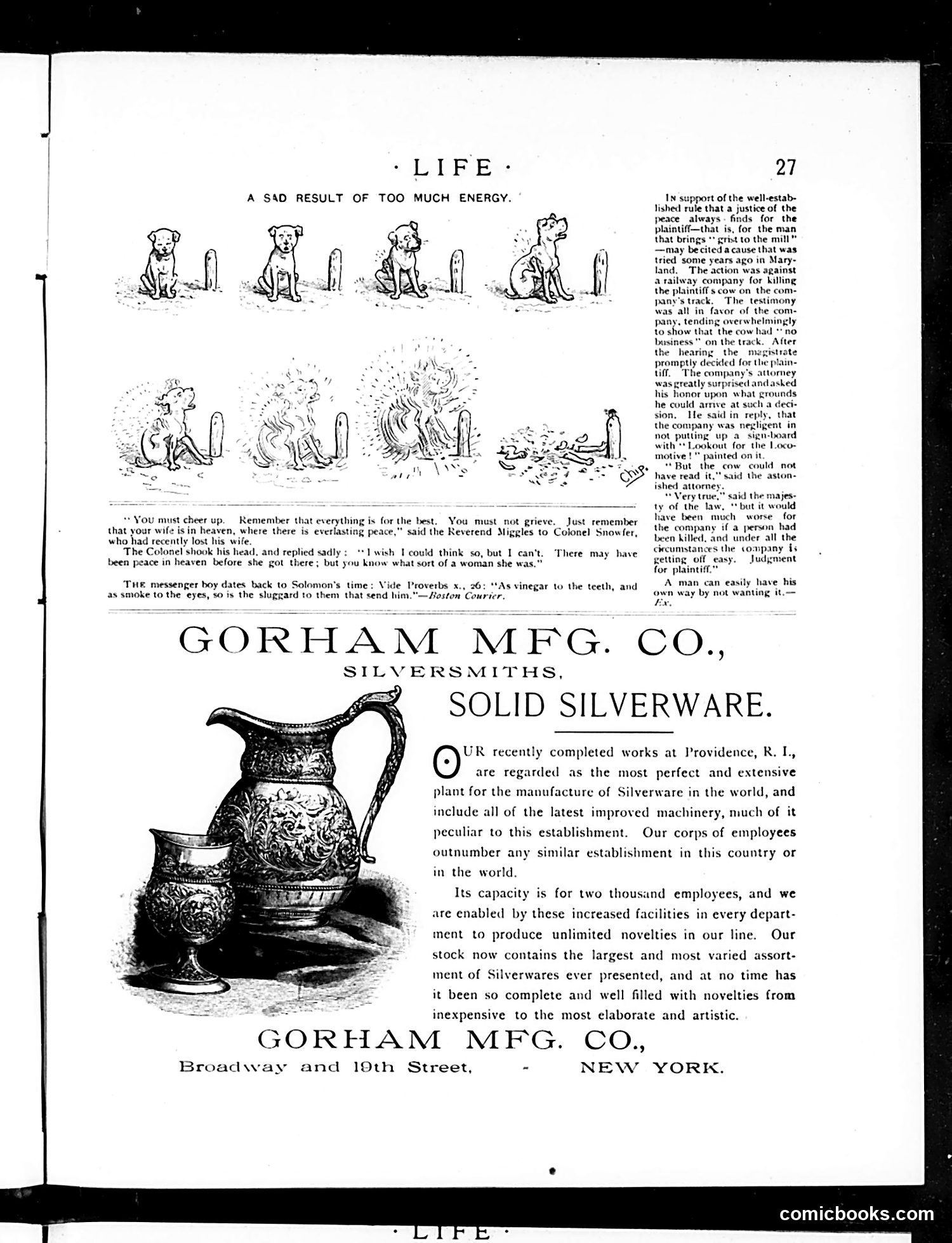
The cartoon depicts a dog progressively expending energy against a post or pole—sitting calmly, then increasingly agitated, until finally exploding in a burst of frantic activity. The title suggests the joke: excessive exertion leads to comic exhaustion or self-destruction. The accompanying text presents three anecdotes mocking incompetence and absurdity: 1. **The Justice of the Peace story**: A corrupt rural magistrate awards damages against a railroad for killing a cow, despite evidence the cow trespassed. When questioned, he admits he sided with the plaintiff because the company should have posted a warning sign—even though cows can't read. This satirizes judicial corruption and rural logic. 2. **The Reverend and Colonel**: Dark humor about a widow so difficult that even heaven would suffer her presence. 3. **The Messenger Boy**: A biblical reference comparing lazy messengers to vinegar and smoke. The page primarily functions as a **satirical humor magazine**, with the Gorham silverware advertisement as secondary commercial content. The satire targets rural justice systems, corrupt officials, and social pretension.
This page from *Life* magazine contains several short humorous anecdotes typical of early American satirical humor, plus book advertisements. The cartoon/text pieces are brief jokes poking fun at literal-mindedness and absurd logic: - A Sunday school teacher asks what a Bible story about bears eating mocking children teaches—a boy answers it demonstrates how many children a bear can hold (missing the moral lesson entirely). - A man offers to kill rats in a saloon for food and drink. After eating an enormous meal, he simply sits in a chair and demands the rats be brought to him, apparently expecting them to obey—a joke about con artists or delusional drifters. - A woman asks where cows get milk; the answer "where do you get your tears?" is a sarcastic non-answer. The humor relies on unexpected logical twists, misunderstandings, and the gap between what's implied versus what's literally stated. These are gentle, family-appropriate jokes typical of *Life's* satirical but not overtly political content from this era.
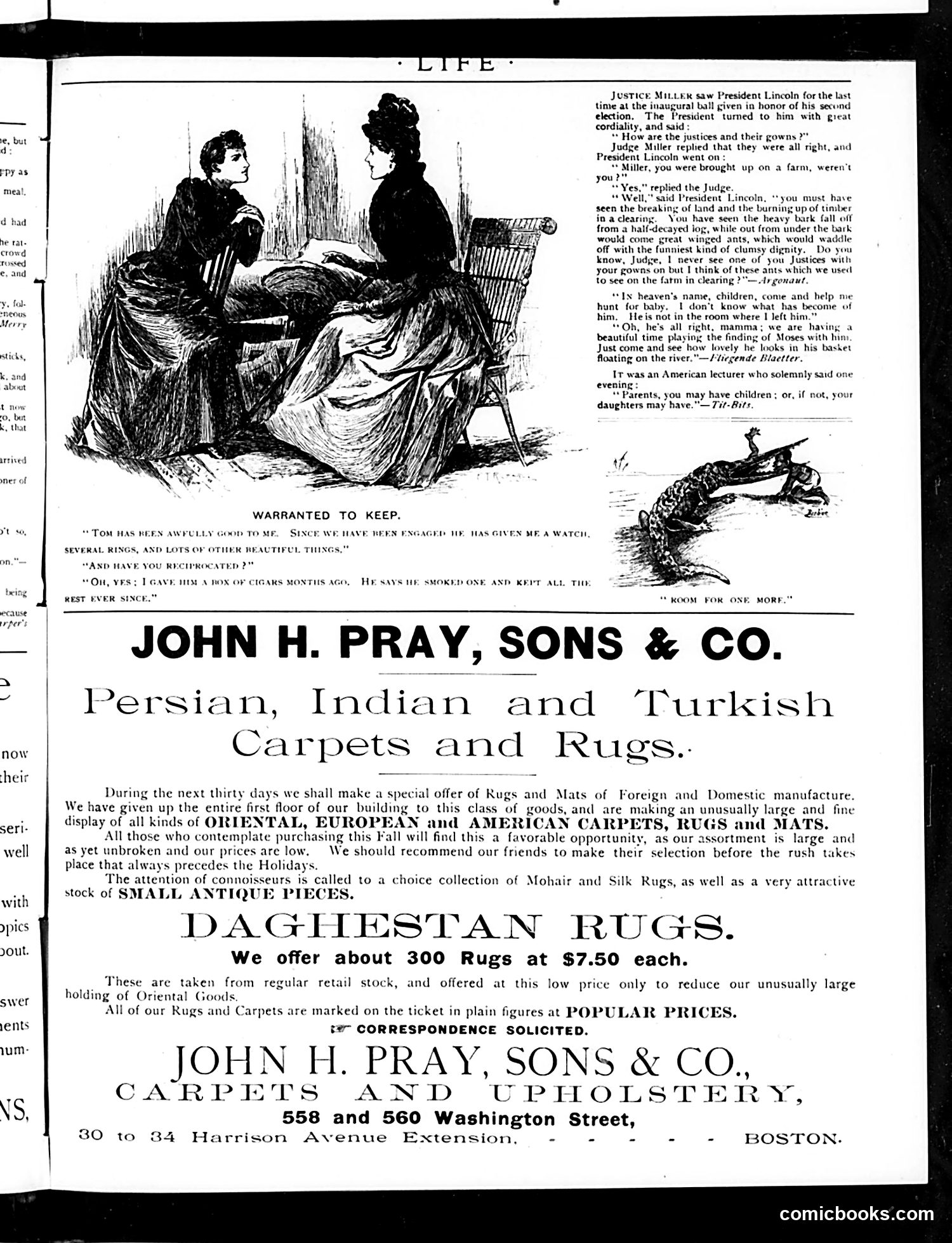
This page contains multiple satirical items typical of *Life* magazine's humor section. **Top Cartoon:** Shows an anecdote where President Lincoln (identifiable by context and the caption) compares Supreme Court justices in their formal robes to wingless ants he observed on his childhood farm—suggesting they waddle about with "clumsy dignity." The humor mocks judicial pomposity through Lincoln's folksy, deflating comparison. **Middle Jokes:** Brief humorous anecdotes, including one where a mother searches for her baby, only to learn her children are playing "finding of Moses" with him in a basket (referencing the Biblical story). The humor relies on children's literal misinterpretation of religious narratives. Another quip jokes about reciprocal gift-giving in courtship—a woman gave her fiancé cigars months ago; he claims he smoked one and saved the rest, implying either stinginess or that the relationship's ardor has cooled. **Lower Section:** Primarily a department store advertisement for John H. Pray, Sons & Co., selling Persian, Indian, and Turkish carpets and rugs—not satirical content.
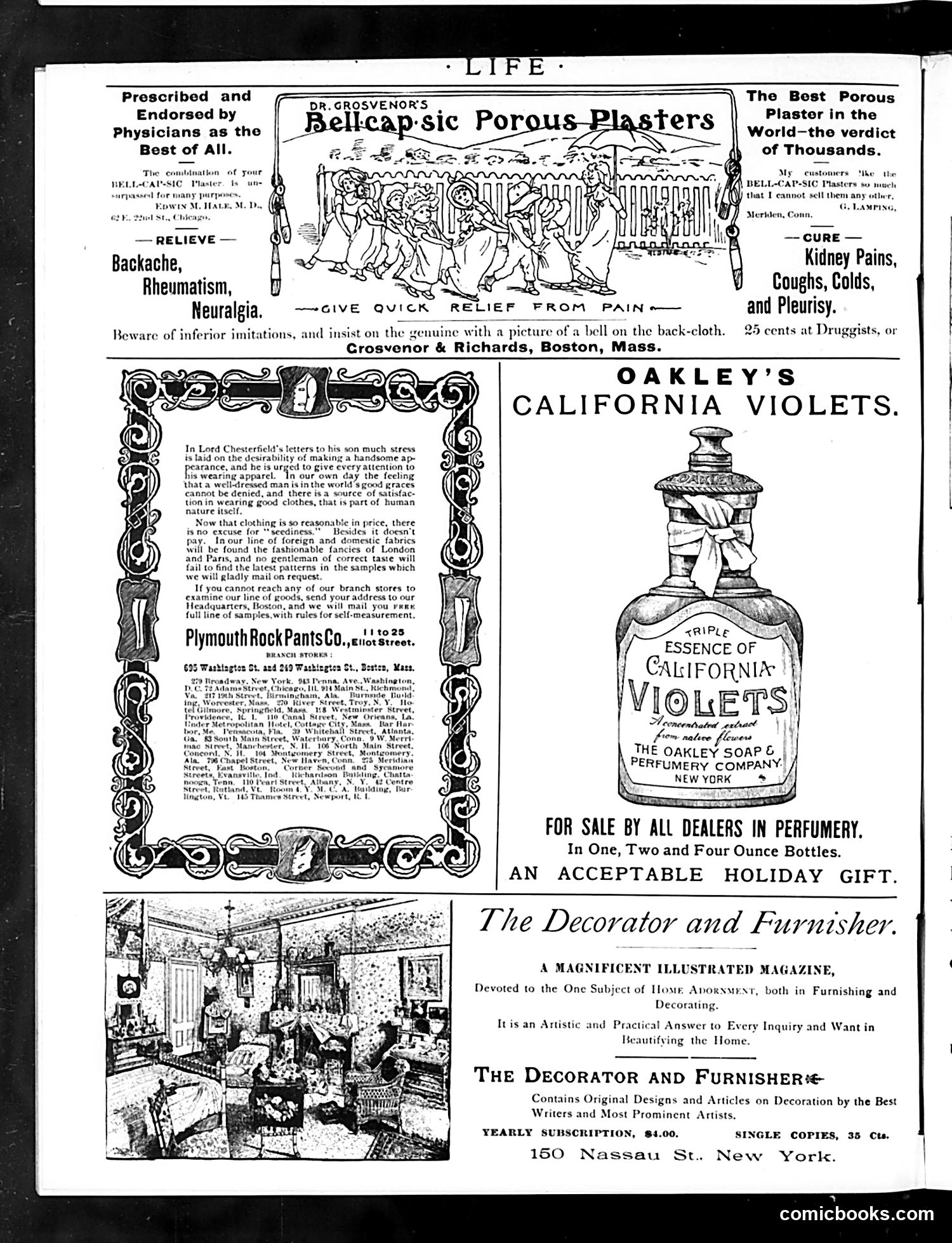
This page is **primarily advertising**, not satire or political commentary. It contains five distinct product advertisements typical of late 19th-century American magazines: 1. **Dr. Grosvenor's Bellcapsic Porous Plasters** — a pain-relief medical product claiming physician endorsement, positioned against "inferior imitations" 2. **Plymouth Rock Pants Co.** — fabric/clothing retailer emphasizing gentlemanly appearance, referencing Lord Chesterfield's advice on dress 3. **Oakley's California Violets** — perfume/essence marketed as "an acceptable holiday gift" 4. **The Decorator and Furnisher** — a home design magazine subscription 5. **An interior design photograph** illustrating decorated rooms There are no identifiable political figures, satirical cartoons, or social commentary. The page reflects period consumer culture: medical patent medicines (often of dubious efficacy), aspirational messaging about gentlemanly appearance, and luxury goods marketed as holiday gifts. The elaborate decorative borders and typography are typical of the era's commercial design.
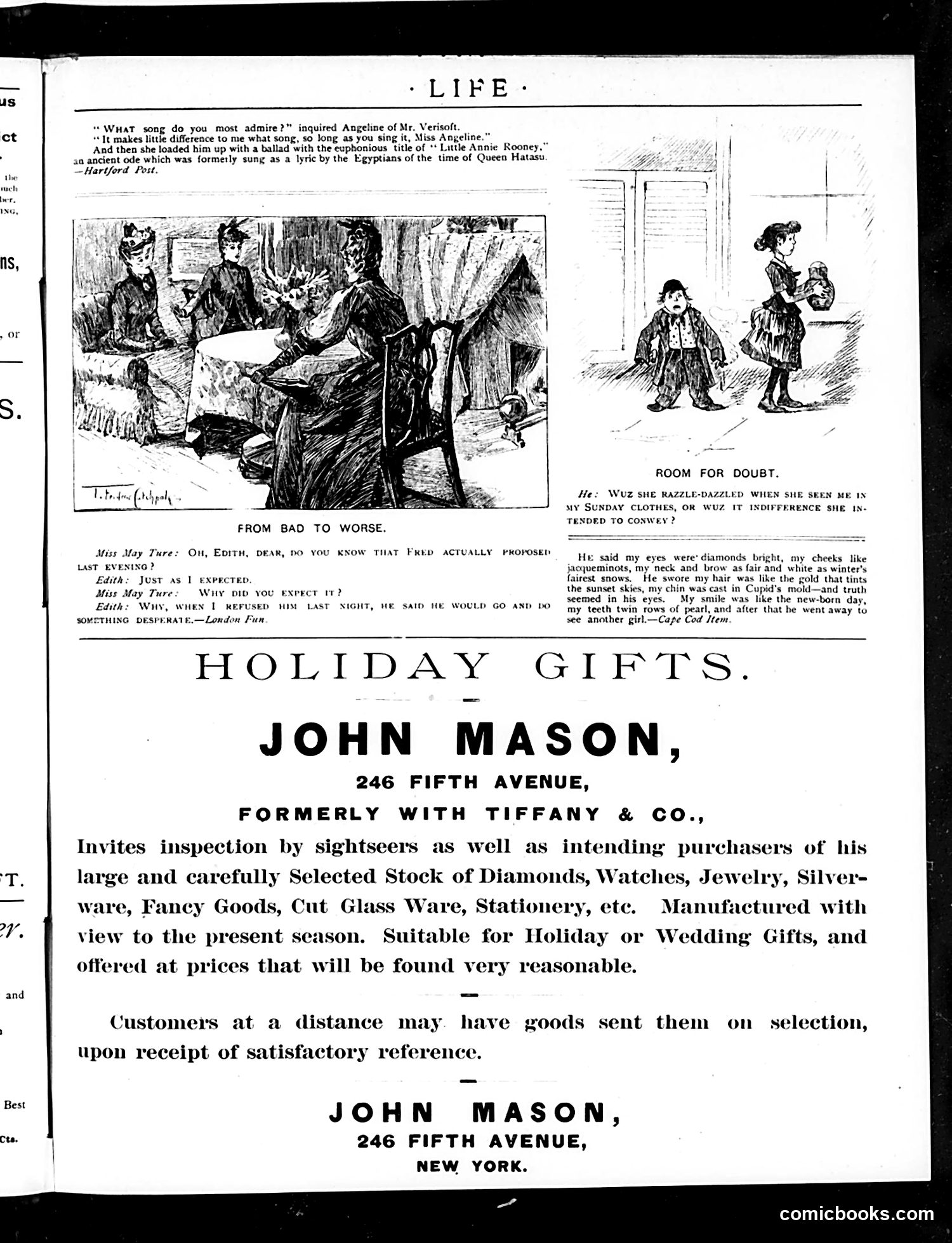
This page combines humor comics with period advertising. The three brief comedic sketches mock romantic conventions: **"From Bad to Worse"** satirizes male flattery—a suitor showers a woman with hyperbolic compliments (eyes like diamonds, hair like gold sunset), then abandons her for another girl, suggesting his declarations were insincere performance rather than genuine affection. **"Room for Doubt"** jokes about a woman uncertain whether her suitor was attracted to her or merely indifferent, playing on anxieties about reading male intentions. The third sketch involves a woman (Angeline) flattered when a man claims her singing voice matters more than the song choice—then she burdens him with an ancient, tedious ballad, subverting his flattery through her own poor judgment. All three comics mock the era's elaborate romantic rhetoric and gender dynamics—men's empty flattery, women's insecurity and vanity. The bottom half is a full-page **advertisement** for jeweler John Mason (formerly of Tiffany & Co.), promoting holiday gifts at "reasonable prices" with mail-order options.
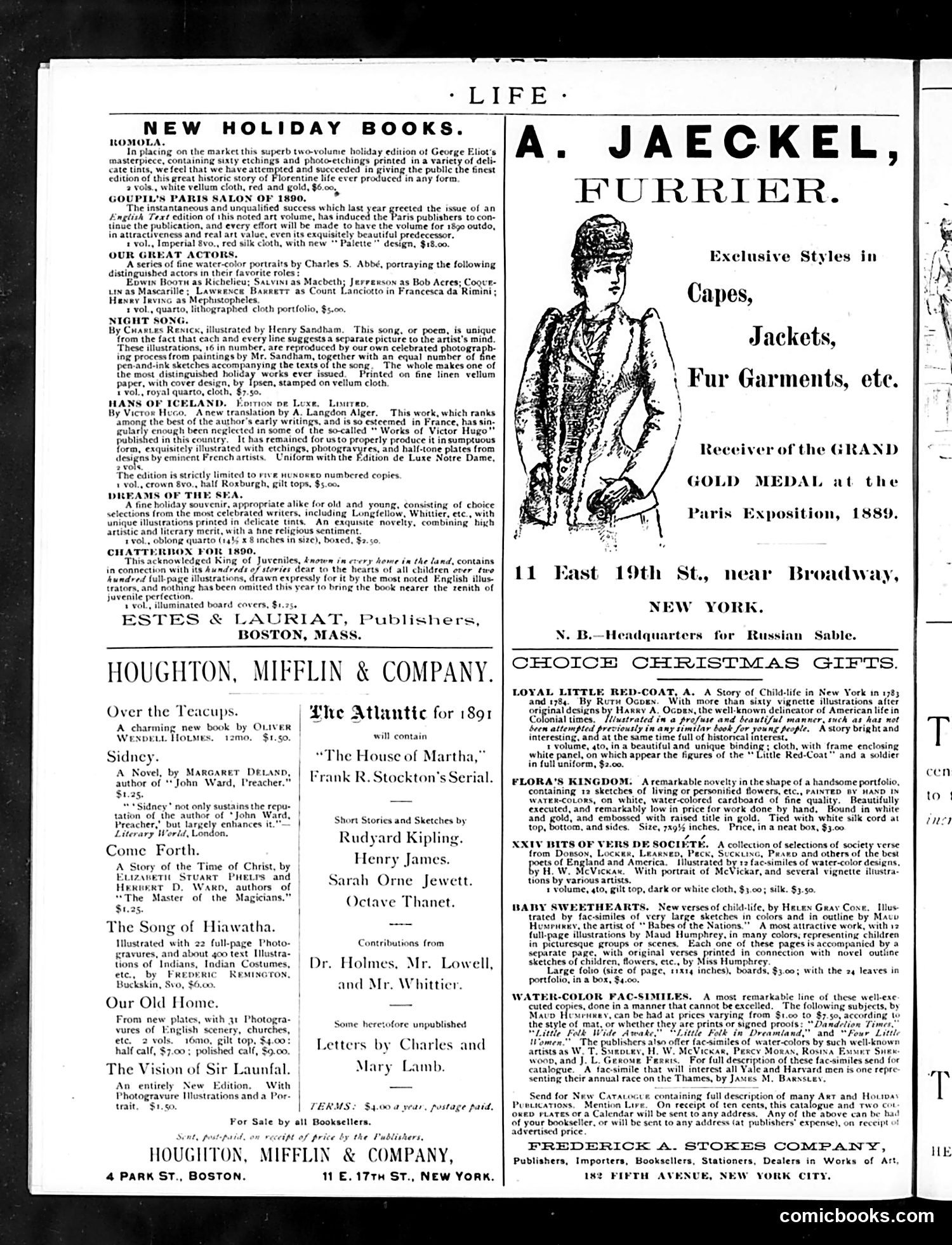
This page is primarily **advertising and book announcements**, not political satire or comics. The left side features holiday book announcements from publishers like Houghton, Mifflin & Company and Estes & Lauriat, promoting titles like George Eliot's *Romola*, Victor Hugo's *Hans of Iceland*, and *Chatterbox for 1890*. The right side contains an advertisement for **A. Jaeckel, a New York furrier and clothing retailer** located at 11 East 19th Street. The illustration shows a fashionable woman modeling the furrier's wares—likely a cape or jacket—typical of 1890s high-fashion advertising. Jaeckel promoted himself as a "Receiver of the GRAND GOLD MEDAL at the Paris Exposition, 1889," establishing prestige through international recognition. This is a *Life* magazine advertisement page, not satirical content. The only "humor" is the implicit satire in luxury advertising itself—marketing expensive fashions to wealthy readers.
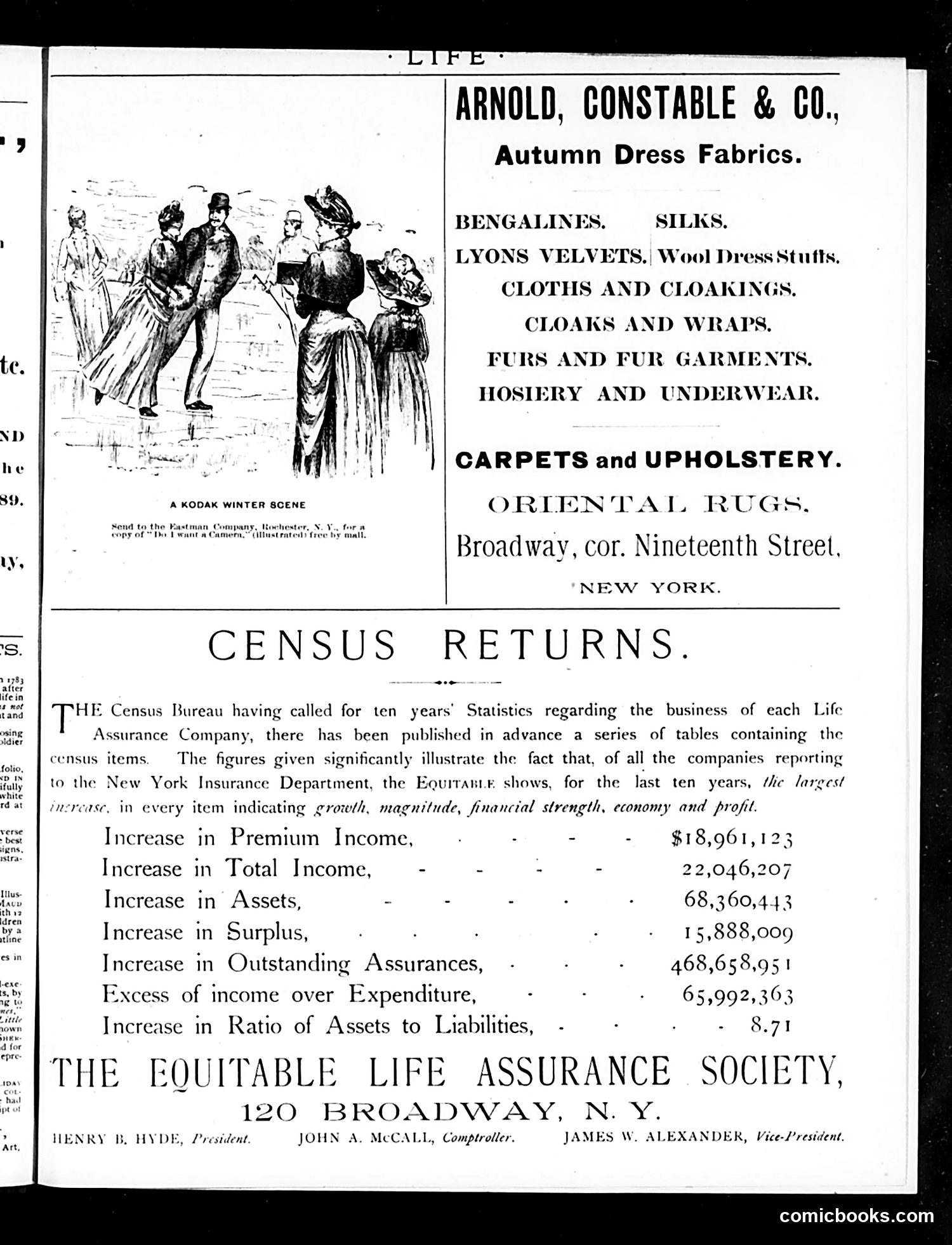
This page is primarily **advertising**, not satire or political commentary. The top half features an Arnold, Constable & Co. advertisement for autumn dress fabrics and clothing, accompanied by a sketch labeled "A Kodak Winter Scene" showing Victorian-era figures in winter dress. The bottom half is an advertisement for The Equitable Life Assurance Society, presenting census data on the company's financial growth over ten years. The company claims the "largest increase" in all metrics—premium income, assets, surplus, outstanding assurances, and profit—compared to competitors reporting to the New York Insurance Department. There is no cartoon, satire, or political commentary visible. This is a straightforward commercial page from *Life* magazine showcasing two major advertisers' accomplishments and offerings to contemporary readers.
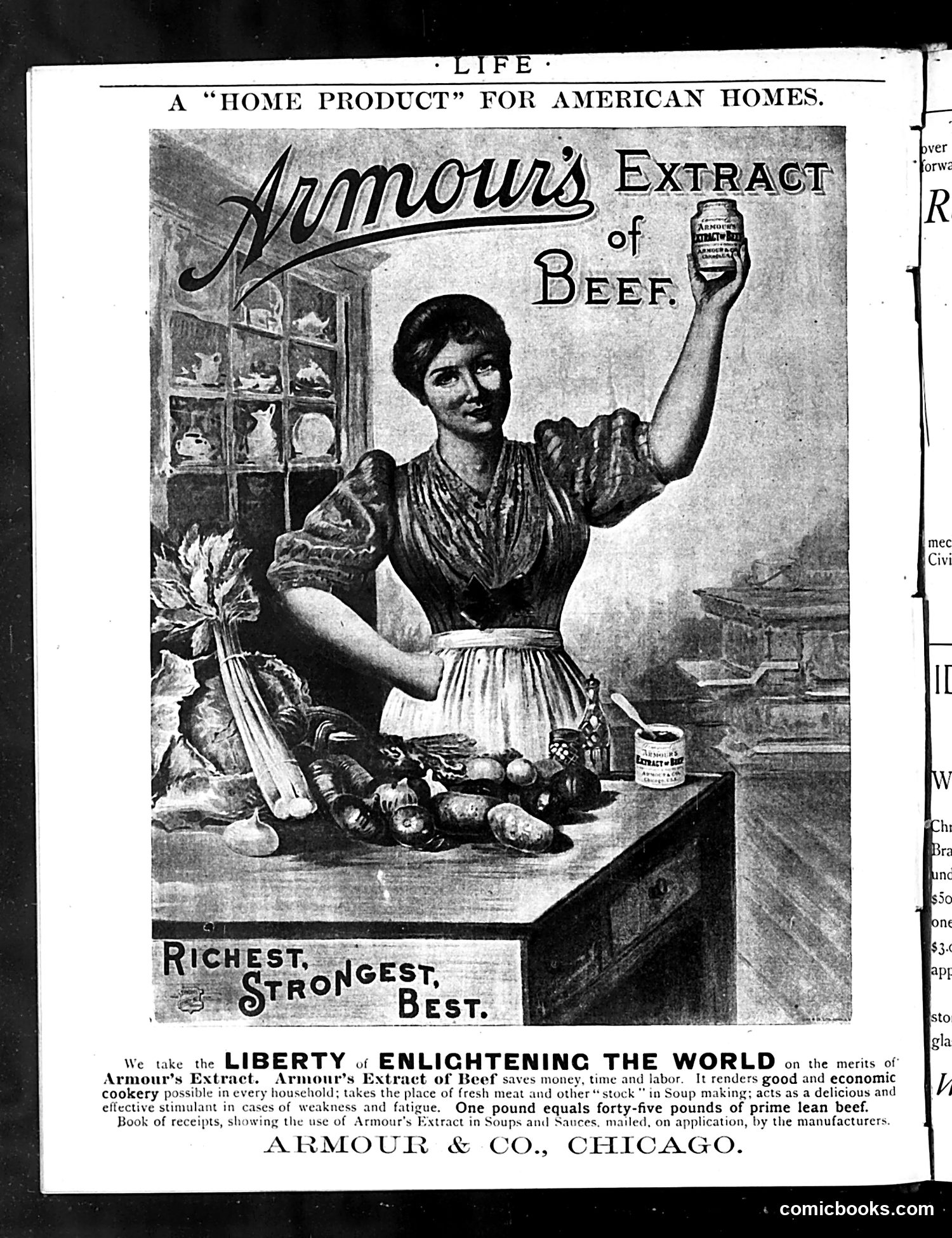
This is a **product advertisement**, not political satire. It features a woman in a kitchen holding aloft a bottle of Armour's Extract of Beef, with vegetables and cooking implements visible. The tagline "Richest, Strongest, Best" emphasizes product superiority. The ad invokes "Liberty Enlightening the World" (the Statue of Liberty) to position the beef extract as an American patriotic product—a "home product for American homes." The copy claims one pound of extract equals forty-five pounds of beef, making it economical for household cooking. The appeal targets domestic efficiency: the product "saves money, time and labor" and works as a substitute for fresh meat in soups. This reflects early-20th-century interest in modern, convenient cooking solutions. The reference to treating "weakness and fatigue" suggests health benefits. This is straightforward commercial messaging, using nationalism and domestic economics to market a convenience food.
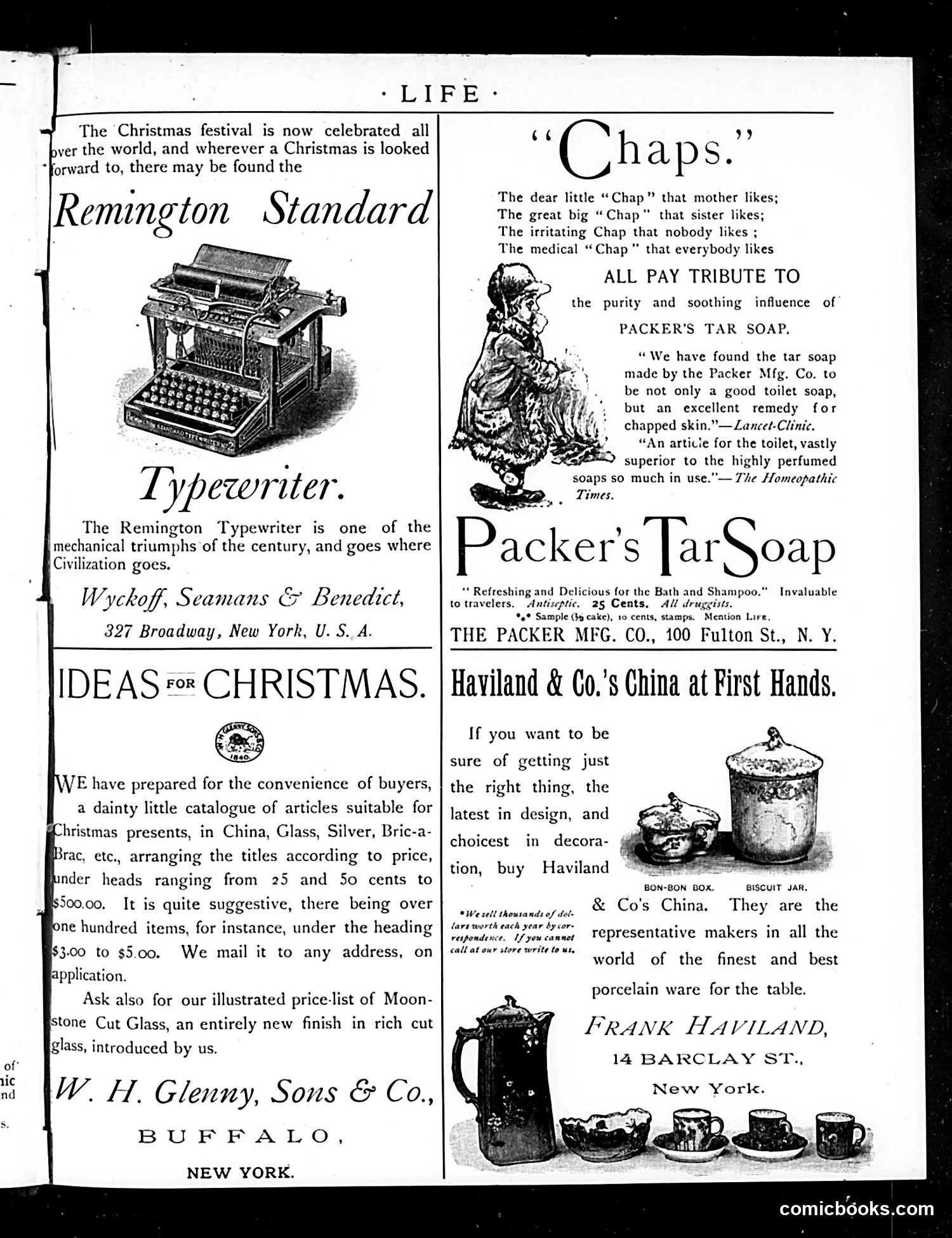
This is primarily a **Christmas gift advertising page** from an early Life magazine (likely late 1800s), not a political cartoon. It contains four separate commercial advertisements: 1. **Remington Typewriter** — positions the typewriter as a marker of civilization and modernity, suitable as a prestigious gift 2. **Packer's Tar Soap** — uses a clever wordplay on "Chaps" (referring to both types of people and chapped skin conditions) to market soap as a remedy. The illustration shows a figure with visible skin irritation 3. **Haviland & Co. China** — sells fine porcelain dinnerware, emphasizing quality and design 4. **W.H. Glenny Gift Catalog** — offers a wide price range of luxury items from 25 cents to $500 The page reflects **turn-of-the-century consumer culture**: Christmas gift-giving is treated as an economic activity, with advertisements targeting middle and upper-class readers seeking status items. The humor is mild and commercial rather than satirical.
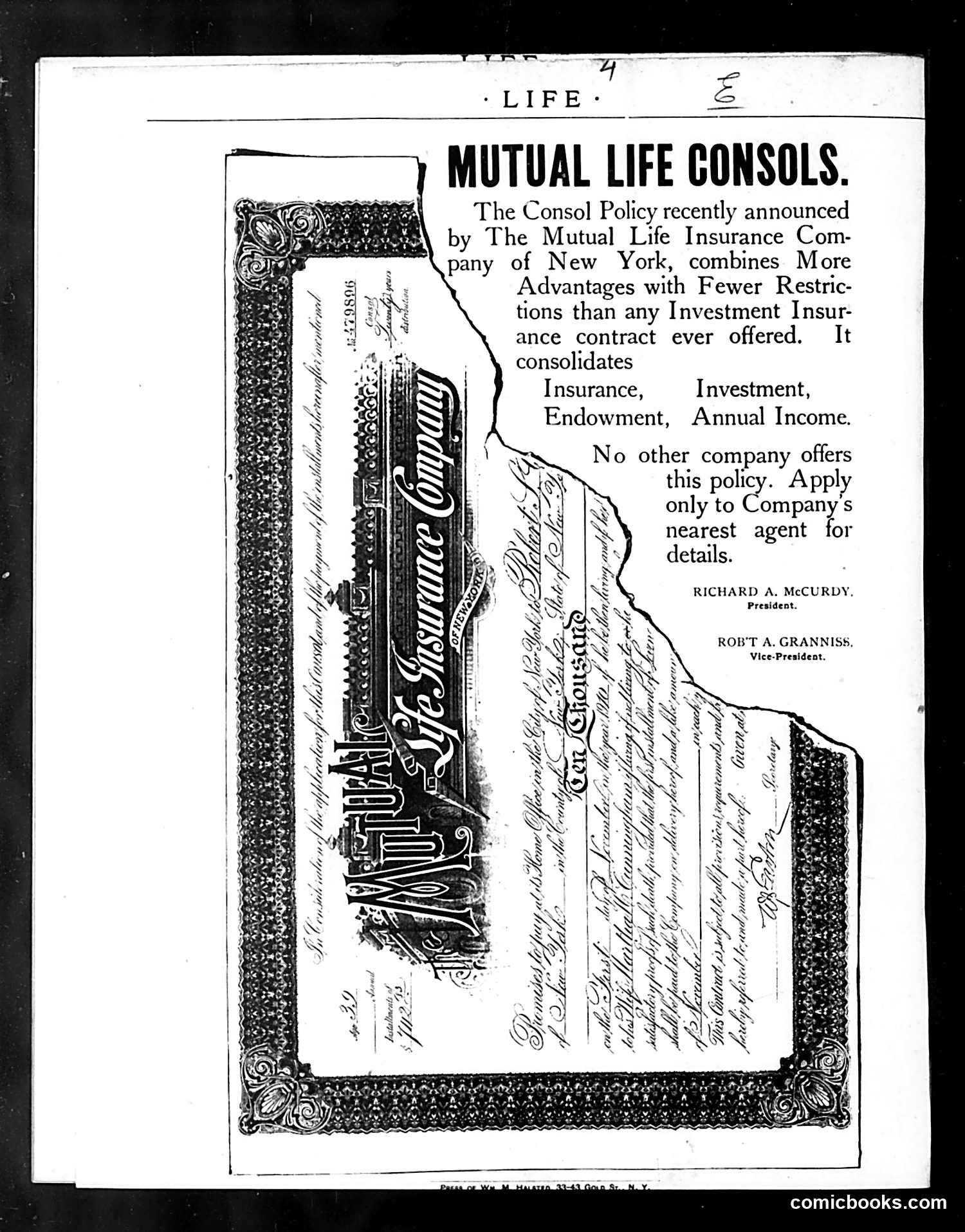
This is **primarily an insurance advertisement**, not a political cartoon. It promotes The Mutual Life Insurance Company of New York's new "Consul Policy," announced by President Richard A. McCurdy and Vice-President Robt A. Granniss. The ad claims this policy uniquely consolidates four financial products—Insurance, Investment, Endowment, and Annual Income—with fewer restrictions than competitors offer. The decorative border frames an ornate stock certificate or policy document image on the left side. **No satire is evident here.** This appears to be a straightforward commercial advertisement from Life magazine's advertising pages, likely from the early 1900s. The page serves as a sales pitch rather than editorial commentary. The ornate design and prominent positioning reflect the importance of insurance marketing during this era of American financial services expansion.

I'm unable to provide a meaningful analysis of this page. The image is almost entirely black with only minimal visible content—a small white mark near the center and a white border on the left edge. The OCR text provides only a watermark ("comicbooks.com") with no article text, headlines, captions, or identifying information. To properly analyze a Life magazine page as a political cartoon or satirical content, I would need legible imagery and accompanying text. If this is a scan issue, a clearer version of the page would be necessary to identify figures, historical references, and the intended satire or humor for modern readers.