
Life, 1890-12-25 · page 4 of 51
Life — December 25, 1890 — page 4: what you’re looking at
What you’re looking at
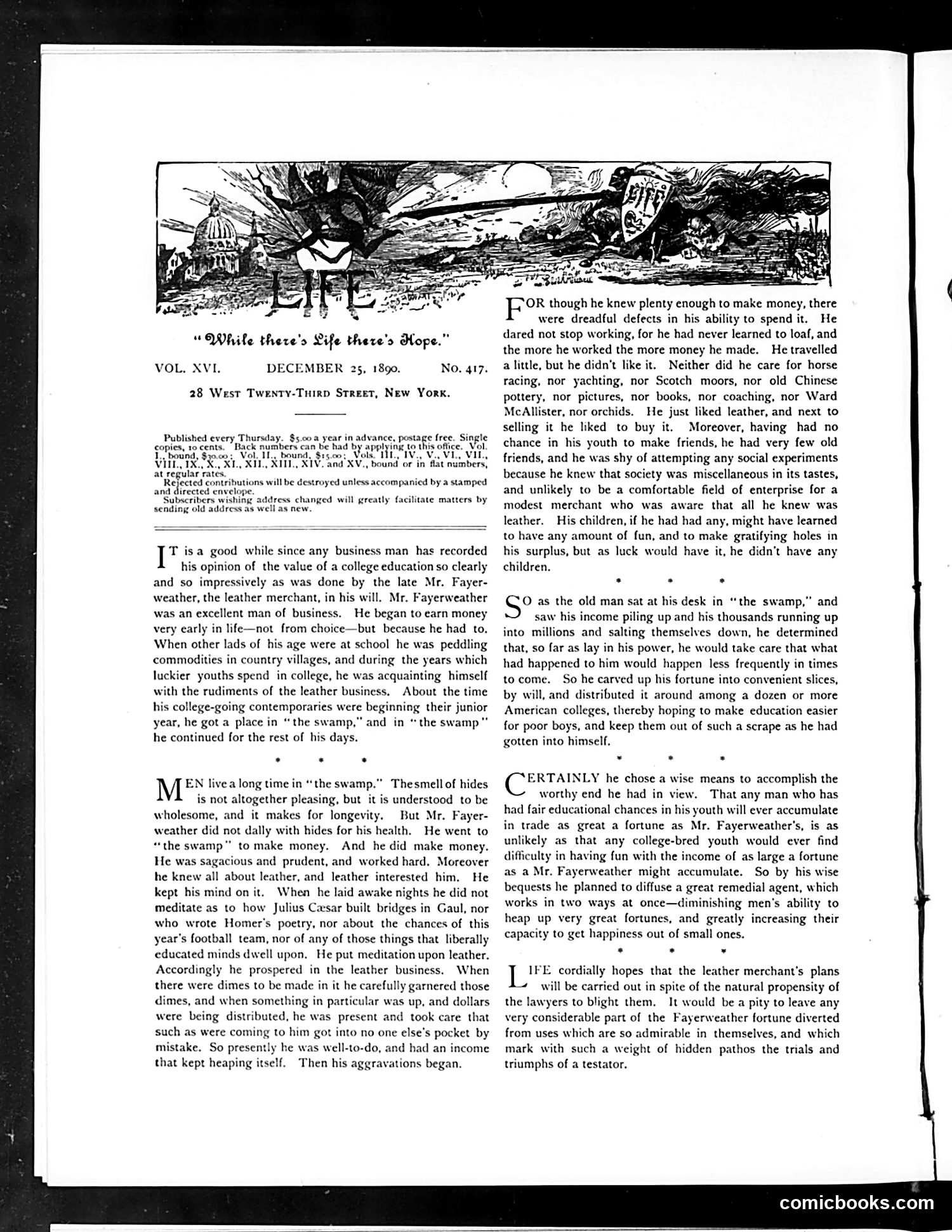
The page contains an illustrated article about a wealthy leather merchant (likely based on a real contemporary figure, though not named here). The cartoon at top shows an idealized landscape with "While there's Life there's Hope" as its motto. The article's satire targets a self-made businessman who accumulated enormous wealth but remained emotionally impoverished—unable to enjoy leisure, relationships, or culture. He avoided social circles, had no friends, and couldn't spend his fortune on normal pleasures (horses, books, art, coaching). The satire critiques Gilded Age excess: his solution to hoarding wealth is philanthropy (funding college scholarships), presenting it as moral redemption. The piece mocks both his joyless accumulation and the inadequacy of charitable giving as a substitute for actually living.
📄 Transcribed text from this page (OCR, searchable)
Machine-transcribed from the original scan — historical spelling and the odd misread are preserved.
“While there's Life there's Hope.” VOL. XVI. DECEMBER 25, 1890. No. 417. 28 West Twenty-Tuirp Street, New York. Published every Thursday. $5.00 a year in advance, postage free. Single copies, to cents. “Back numbers can be had by applying to this office, Vol 1. bound, $30.00; Vol. If., bound, $15, Is HE, TV., VV, VIL, VIL, IX.,X., XL, XIL, XIIL, XIV. and XV,, bound or in flat numbers, at regular rates. Rejected cont and directed envel Subscribers wis! sending old addre Ns will be destroyed unless accompanied by a stamped address changed will greatly facilitate matters by as ew. T isa good while since any business man has recorded his opinion of the value of a college education so clearly and so impressively as was done by the late Mr. Fayer- weather, the leather merchant, in his will. Mr. Fayerweather was an excellent man of business. He began to earn money very early in life—not from choice—but because he had to, When other lads of his age were at school he was peddling commodities in country villages, and during the years which luckier youths spend in college, he was acquainting himself with the rudiments of the leather business, About the time his college-going contemporaries were beginning their junior year, he got a place in “the swamp,” and in “the swamp" he continued for the rest of his days. N livea long time in “the swamp.” Thesmell of hides is not altogether pleasing, but it is understood to be wholesome, and it makes for longevity, But Mr. Fayer- weather did not dally with hides for his health. He went to “the swamp” to make money. And he did make money. He was sagacious and prudent, and worked hard. Moreover he knew all about leather, and leather interested him. He kept his mind on it. When he laid awake nights he did not meditate as to how Julius Casar built bridges in Gaul, nor who wrote Homer's poetry, nor about the chances of this year's football team, nor of any of those things that liberally educated minds dwell upon. He put meditation upon leather. Accordingly he prospered in the leather business. When there were dimes to be made in it he carefully garnered those dimes, and when something in particular was up, and dollars were being distributed, he was present and took care that such as were coming to him got into no one else's pocket by mistake. So presently he was well-to-do, and had an income that kept heaping itself. Then his aggravations began. R though he knew plenty enough to make money, there were dreadful defects in his ability to spend it. He dared not stop working, for he had never learned to loaf, and the more he worked the more money he made. He travelled a little, but he didn’t like it. Neither did he care for horse racing, nor yachting, nor Scotch moors, nor old Chinese pottery, nor pictures, nor books, nor coaching, nor Ward McAllister, nor orchids. He just liked leather, and next to selling it he liked to buy it. Moreover, having had no chance in his youth to make friends, he had very few old friends, and he was shy of attempting any social experiments because he knew that society was miscellaneous in its tastes, and unlikely to be a comfortable field of enterprise for a modest merchant who was aware that all he knew was leather. His children, if he had had any, might have learned to have any amount of fun, and to make gratifying holes in his surplus, but as luck would have it, he didn’t have any children. O as the old man sat at his desk in “the swamp,” and saw his income piling up and his thousands running up into millions and salting themselves down, he determined that, so far as lay in his power, he would take care that what had happened to him would happen less frequently in times to come. So he carved up his fortune into convenient slices, by will, and distributed it around among a dozen or more American colleges, thereby hoping to make education easier for poor boys, and keep them out of such a scrape as he had gotten into himself, ERTAINLY he chose a wise means to accomplish the worthy end he had in view. That any man who has had fair educational chances in his youth will ever accumulate in trade as great a fortune as Mr. Fayerweather's, is as unlikely as that any college-bred youth would ever find difficulty in having fun with the income of as large a fortune as a Mr. Fayerweather might accumulate. So by his wise bequests he planned to diffuse a great remedial agent, which works in two ways at once—diminishing men’s ability to heap up very great fortunes, and greatly increasing their capacity to get happiness out of small ones, I IFE cordially hopes that the leather merchant's plans —~ will be carried out in spite of the natural propensity of the lawyers to blight them. It would be a pity to leave any very considerable part of the Fayerweather fortune diverted from uses which are so admirable in themselves, and which mark with such a weight of hidden pathos the trials and triumphs of a testator. comicbooks.com