
Life, 1890-12-25 · page 6 of 51
Life — December 25, 1890 — page 6: what you’re looking at
What you’re looking at
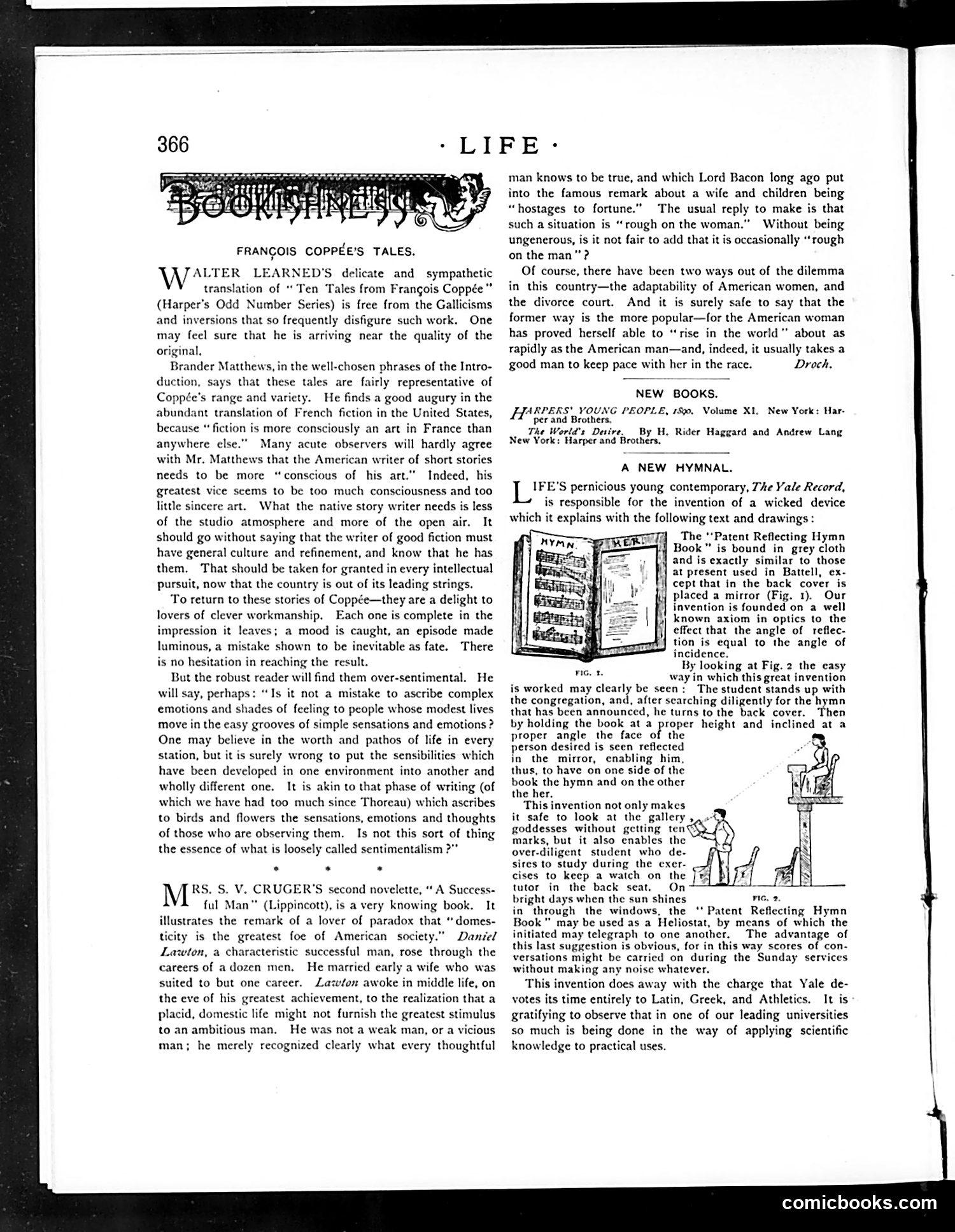
This page contains literary reviews rather than political cartoons. The main content discusses François Coppée's translated French tales, reviewed by Brander Matthews, and S.V. Cruger's novel "A Successful Man." The only illustrations are diagrams for "A New Hymnal"—a Yale invention showing a "Patent Reflecting Hymn Book" with a mirror mechanism (Figures 1-2). This allows church congregants to view hymn lyrics reflected in a mirror while maintaining proper posture and sight lines during services. The satirical thrust appears mild: the invention gently mocks academic over-engineering of simple problems, poking fun at Yale's tendency to apply scientific solutions to mundane religious practices. It's social satire about institutional pretension rather than political commentary.
📄 Transcribed text from this page (OCR, searchable)
Machine-transcribed from the original scan — historical spelling and the odd misread are preserved.
* LIFE: FRANCOIS COPPEE’S TALES. AA SETER LEARNED’S delicate and sympathetic translation of “Ten Tales from Frangois Coppée” (Harper's Odd Number Series) is free from the Gallicisms and inversions that so frequently disfigure such work. One may feel sure that he is arriving near the quality of the original, Brander Matthews, in the well-chosen phrases of the Intro- duction, says that these tales are fairly representative of Coppée’s range and variety. He finds a good augury in the abundant translation of French fiction in the United States, because “ fiction is more consciously an art in France than anywhere else." Many acute observers will hardly agree with Mr. Matthews that the American writer of short stories needs to be more “conscious of his art.” Indeed, his greatest vice seems to be too much consciousness and too little sincere art. What the native story writer needs is less of the studio atmosphere and more of the open air. It should go without saying that the writer of good fiction must have general culture and refinement, and know that he has them. That should be taken for granted in every intellectual pursuit, now that the country is out of its leading strings. To return to these stories of Coppée—they are a delight to lovers of clever workmanship. Each one is complete in the impression it leav a mood is caught, an episode made shown to be inevitable as fate. There is no hesitation in reaching the result. But the robust reader will find them over-sentimental. He will say, perhaps : it not a mistake to ascribe complex emotions and shades of feeling to people whose modest lives move in the easy grooves of simple sensations and emotions ? One may believe in the worth and pathos of life in every station, but it is surely wrong to put the sensibilities which have been developed in one environment into another and wholly different one. It is akin to that phase of writing (of which we have had too much since Thoreau) which ascribes to birds and flowers the sensations, emotions and thoughts of those who are observing them. Is not this sort of thing the essence of what is loosely called sentimentalism ?”" RS, S. V. CRUGER’S second novelette, ‘A Success- ful Man" (Lippincott), is a very knowing book. It illustrates the remark of a lover of paradox that “ domes- ticity is the greatest foe of American society.” Daniel Lawton, a characteristic successful man, rose through the careers of adozen men. He married early a wife who was suited to but one career. Law/on awoke in middle life, on the eve of his greatest achievement, to the realization that a placid, domestic life might not furnish the greatest stimulus to an ambitious man. He was not a weak man, or a vicious man; he merely recognized clearly what every thoughtful man knows to be true, and which Lord Bacon long ago put into the famous remark about a wife and children being “hostages to fortune.” The usual reply to make is that such a situation is “rough on the womai Without being ungenerous, is it not fair to add that it is occasionally “rough on the man”? Of course, there have been two ways out of the dilemma in this country—the adaptability of American women, and the divorce court. And it is surely safe to say that the former way is the more popular—for the American woman has proved herself able to “rise in the world” about as rapidly as the American man—and, indeed, it usually takes a good man to keep pace with her in the race. Droch. NEW BOOKS. IA RPERS' YOUNG PEOPLE, 18. Volume X1. per and Brothers, The World's Desire. By H. Rider Haggard and Andrew Lang New York: Harper and Brothers, New York: Har- A NEW HYMNAL. IFE’S pernicious young contemporary, 7/e Yale Record, is responsible for the invention of a wicked device which it explains with the following text and drawings : The ‘'Patent Reflecting Hymn Book” is bound in grey cloth and is exactly similar to those at present used in Battell, ex- cept that in the back cover is placed a mirror (Fig. 1). Our invention is founded on a well known axiom in optics to the effect that the angle of reflec- tion is equal to the angle of incidence. By looking at Fig. 2 the casy way in which this great invention is worked may clearly be seen: The student stands up with the congregation, and, after scarching diligently for the hymn that has been announced, he turns to the back cover. Then by holding the book at a proper height and inclined at a proper angle the face of the person desired is seen reflected in the mirror, enabling him, thus, to have on one side of the book the hymn and on the other the her, This invention not only makes it safe to look at the gallery goddesses without getting ten marks, but it also enables the over-diligent student who de- sires to study during the exer- cises to keep a watch on the tutor in the back seat. On bright days when the sun shines rIG. 2. in through the windows, the ‘Patent Reflecting Hymn Book" may be used as a Heliostat, by means of which the initiated may telegraph to one another. The advantage of this last suggestion is obvious, for in this way scores of con- versations might be carried on during the Sunday services without making any noise whatever. This invention does away with the charge that Yale de- votes its time entirely to Latin, Greek, and Athletics. It is gratifying to observe that in one of our leading universities so much is being done in the way of applying scientific knowledge to practical uses. comicbooks.com