
Life, 1890-12-25 · page 30 of 51
Life — December 25, 1890 — page 30: what you’re looking at
What you’re looking at
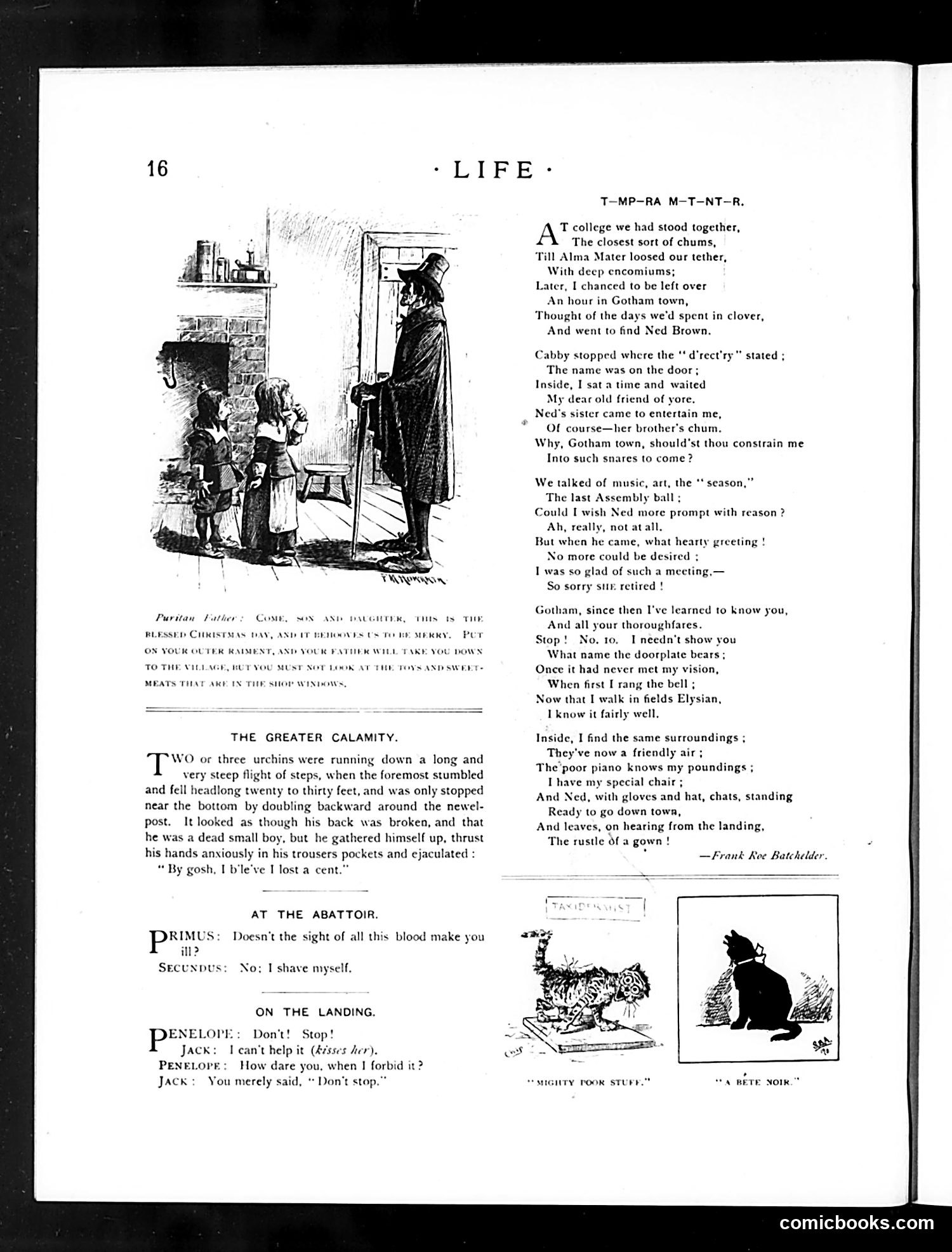
This page contains several satirical pieces typical of late 19th-century American humor: **"Puritan Father"** mocks strict religious observance by showing a father forbidding his children from even *looking* at shop window displays on Christmas—the ultimate denial of joy on a supposedly joyful day. **"The Greater Calamity"** is a humorous anecdote: a boy survives a terrible fall down stairs but his only concern is losing a cent from his pocket—inverting what readers would expect to matter most. **"At the Abattoir"** uses a crude joke: one man asks if the sight of blood bothers the other; the response that shaving oneself is worse suggests casual indifference to violence, typical of period "shock humor." **"On the Landing"** plays on ambiguous phrasing—Penelope forbids Jack to "stop," but he claims he merely obeyed her words literally, creating a flirtation joke. **"Tempo Matters"** (the longer poem by Frank Roe Batchelder) is sentimental verse about reconnecting with a college friend in New York City and discovering romance with his sister—typical period romantic fiction content.
📄 Transcribed text from this page (OCR, searchable)
Machine-transcribed from the original scan — historical spelling and the odd misread are preserved.
TREO, Puritan Pather : Come, soX ASD DAUGHTER, THIS is THe BLESSED CHKISTIAS DAY, AND ET BENOOVES Os To ne HRRRY. POT ON YOUR OUTER RAIMENT, AND YOUR FATHER WILL TARE YOU DOWN TO THE VILLAGE, BUT YOU MUST NOT LOOK AT THE TOYS AND SWEET MEATS THAT AKE IN THE SHOP WINDOWS, THE GREATER CALAMITY. WO or three urchins were running down a long and very steep flight of steps, when the foremost stumbled and fell headlong twenty to thirty feet, and was only stopped near the bottom by doubling backward around the newel- post. It looked as though his back was broken, and that he was a dead small boy, but he gathered himself up, thrust his hands anxiously in his trousers pockets and ejaculated : * By gosh, I b'le've I lost a cent.” AT THE ABATTOIR. RIMUS: Doesn't the sight of all this blood make you ill? SecUNDUS: No; I shave myself. ON THE LANDING. ENELOPE: Don't! Stop! Jack: [can't help it (esses Aer). PENELOPE: How dare you, when I forbid it? Jack: You merely said, * Don't stop.” “MIGHTY POOR STUFF.” T—MP-RA M-T-NT-R. T college we had stood together, The closest sort of chums, Till Alma Mater loosed our tether, h deep encomiums; Later, I chanced to be left over An hour in Gotham town, Thought of the days we'd spent in clover, And went to find Ned Brown. Cabby stopped where the ‘*d'rect'ry" stated ; The name was on the door; Inside, I sata time and waited My dear old friend of yore. Ned's sister came to entertain me, Of course—her brother's chum, Why, Gotham town, should’st thou constrain me Into such snares to come? We talked of music, art, the ** season,” The last Assembly ball ; Could I wish Ned more prompt with reason ? Ah, really, not at all. But when he came, what hearty greeting ! No more could be desired I was so glad of such a meeting,— So sorry sux retired ! Gotham, since then I've learned to know you, And all your thoroughfares. Stop! No. 10. [needn't show you What name the doorplate bears ; Once it had never met my vision, When first I rang the bell ; Now that I walk in fields Elysian, I know it fairly well, Inside, I find the same surroundings ; They've now a friendly air; The'poor piano knows my poundings ; Ihave my special chair ; And Ned, with gloves and hat, chats, standing Ready to go down town, And leaves, on hearing from the landing, The rustle of a gown ! . —Frank Roe Batchelder. “a RETE NoIk.” comicbooks.com