
A complete issue · 16 pages · 1885
Life — July 2, 1885
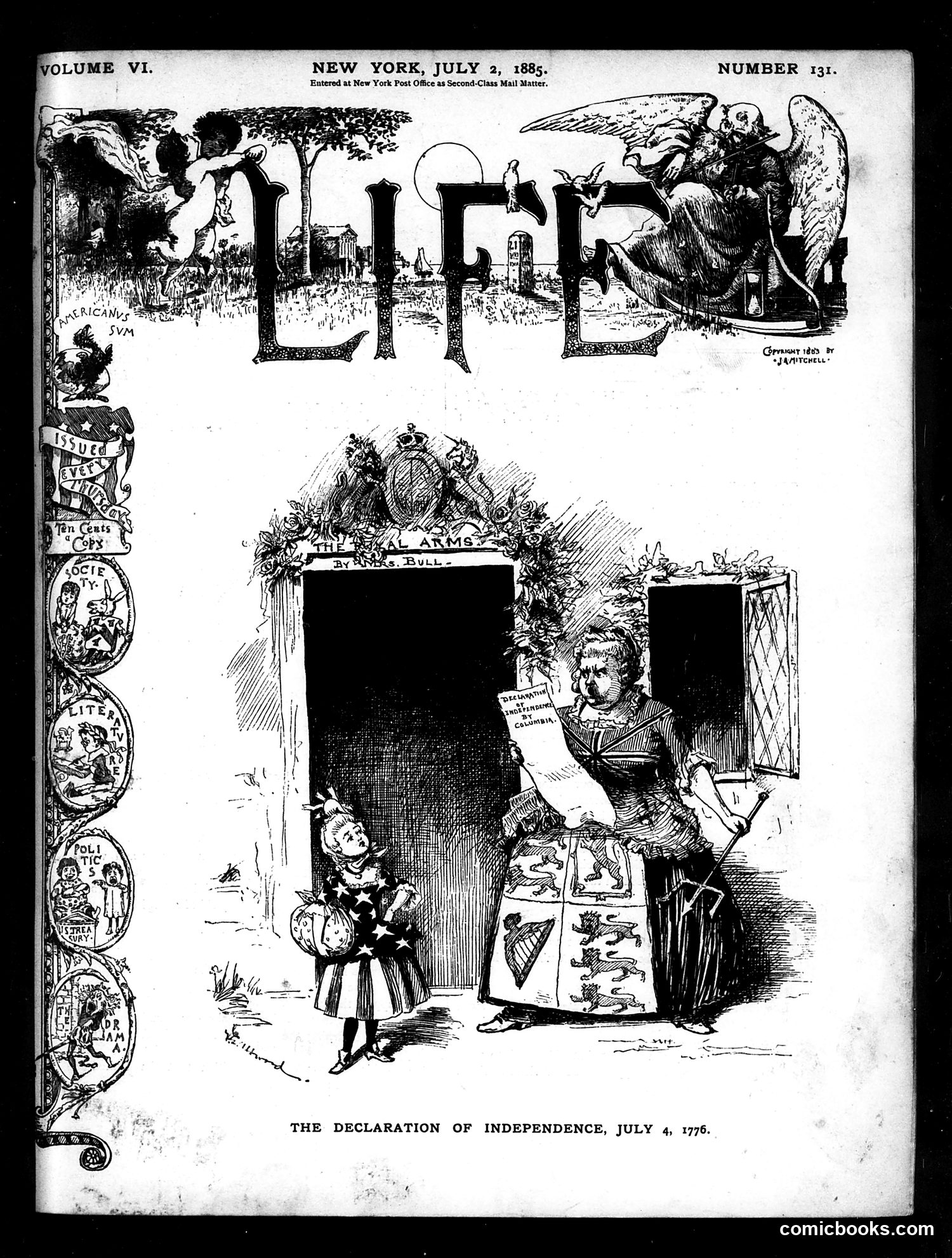
This is the cover of *Life* magazine from July 2, 1885, commemorating the Declaration of Independence (July 4, 1776). The main illustration shows an adult woman displaying a document—presumably the Declaration—to a young child, with heraldic arms above labeled "by Kings Bull." The woman appears to be teaching or instructing the child about American independence. The satire likely critiques how the Declaration's ideals are presented to new generations. The left margin features decorative medallions with various allegorical figures. The overall composition suggests irony about the gap between America's founding principles and contemporary realities in 1885—a century after independence. The specific political message remains unclear without additional context about 1885 events.
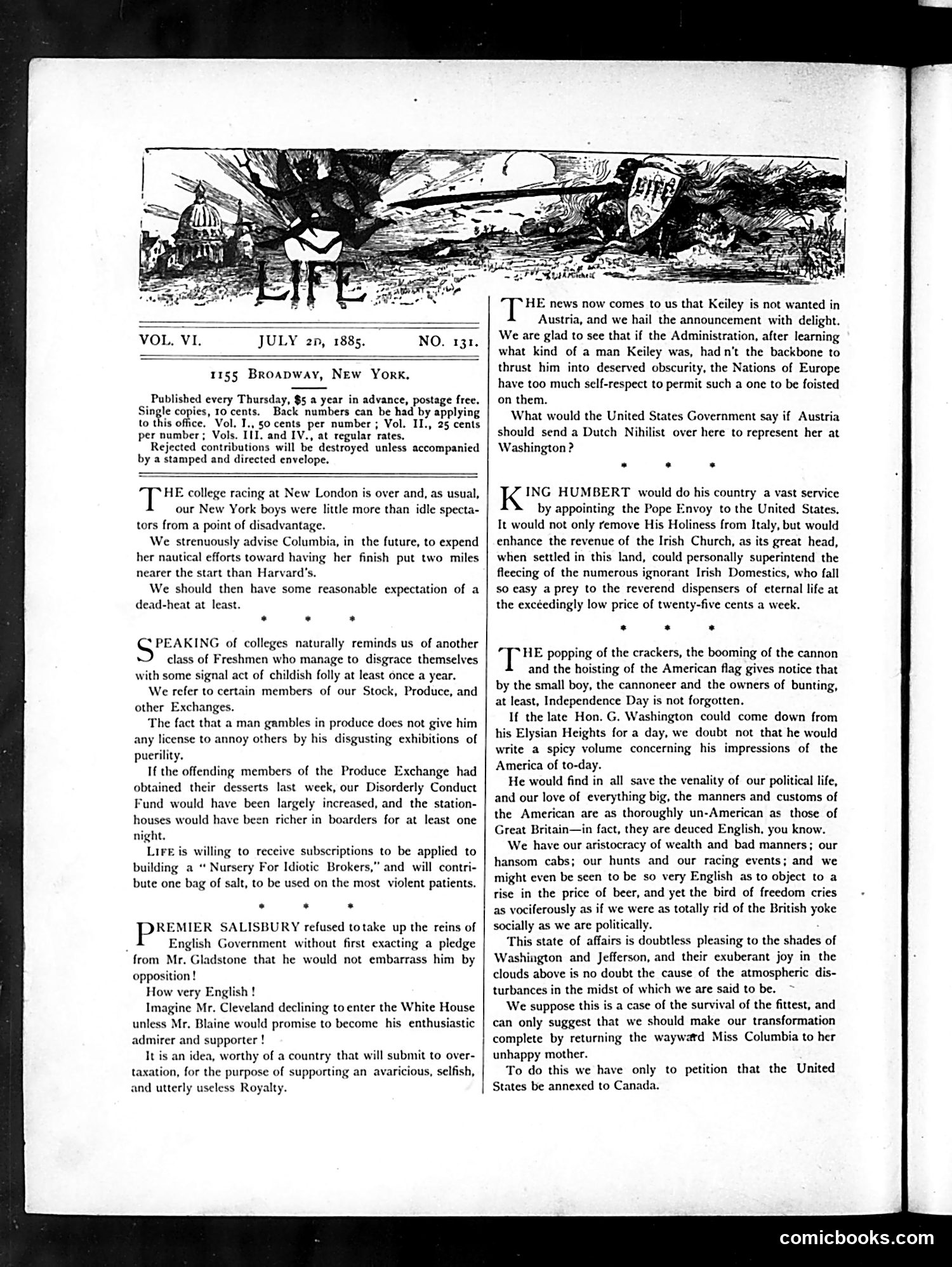
The masthead illustration shows a figure labeled "LIFE" seated beneath a gnarled tree, overlooking a landscape with a domed building (likely the U.S. Capitol). The text discusses several satirical topics: 1. **Austria/Keiley**: Celebrates that a man named Keiley is "not wanted in Austria," mocking Austria's rejection while questioning why the U.S. would accept a Dutch Nihilist as an Austrian representative. 2. **King Humbert and the Pope**: Suggests King Humbert appoint the Pope as U.S. envoy—a provocative suggestion given 19th-century church-state tensions. 3. **American character**: Critiques American society as having English mannerisms and attitudes despite claims of freedom, comparing Americans unfavorably to the British. 4. **Closing joke**: Sarcastically proposes annexing the U.S. to Canada as a solution to American problems. The tone is characteristic satirical commentary on diplomacy, American identity, and social hypocrisy.
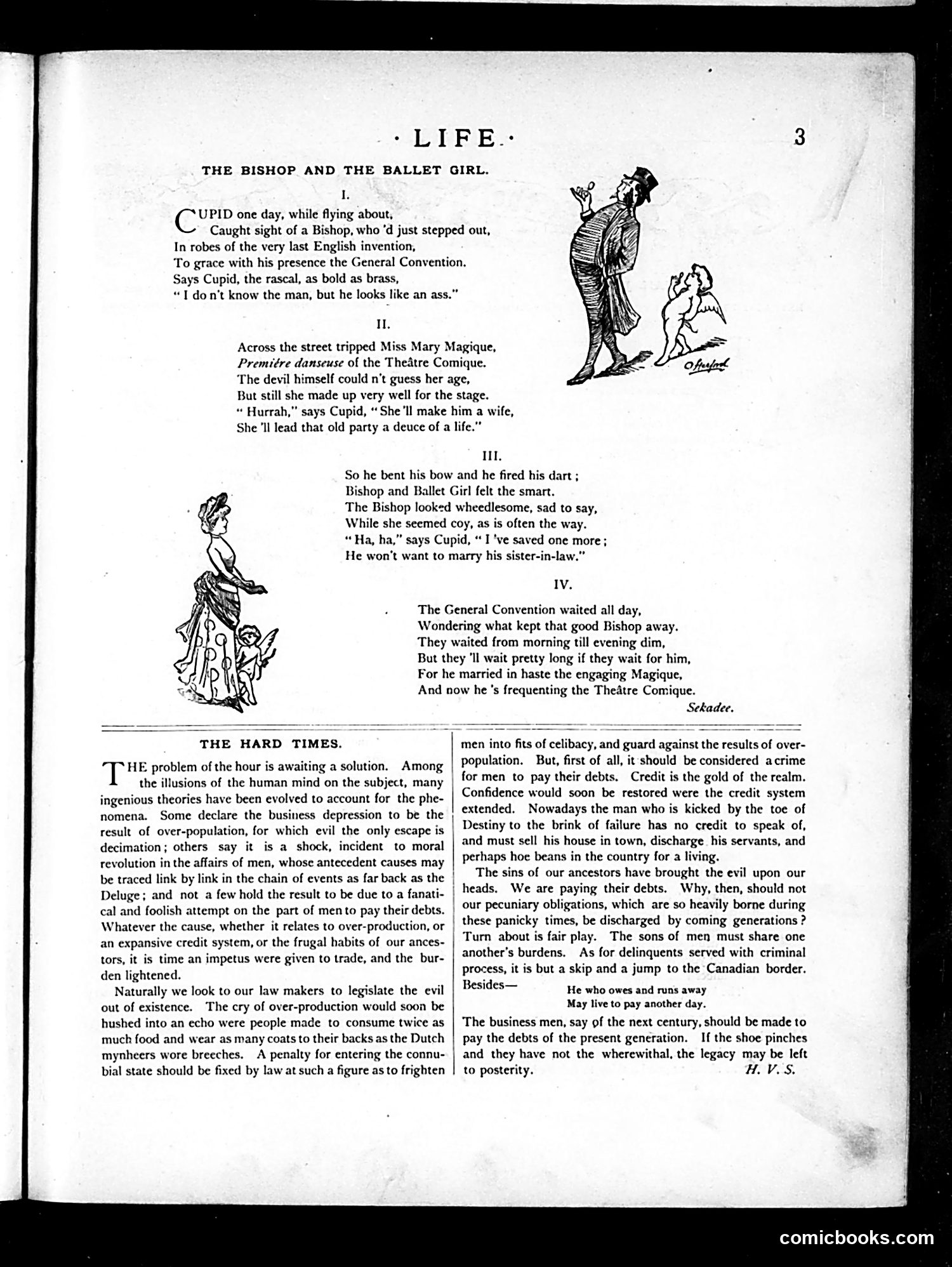
This satirical poem mocks a clergyman's hypocrisy. Cupid observes a Bishop attending a General Convention (likely ecclesiastical), then spots a ballet dancer (Miss Mary Magique) crossing the street. Cupid shoots the Bishop with his arrow, causing him to abandon his religious duties to pursue the dancer. The satire targets the contrast between clerical propriety and actual behavior—the Bishop's supposed moral authority crumbles when confronted with temptation. The punchline reveals he married the actress hastily and now frequents the Theatre Comique rather than attending his convention. The accompanying article "The Hard Times" discusses economic depression and debt, suggesting this issue addresses both moral and financial failings of the era's institutions and leaders.
This page contains a poem titled "Hail July" attributed to Barren Tennyson's "Post-Humorous Pigeon-Hole," followed by brief satirical commentary items. The poem humorously depicts a small boy's summer activities—seeking fountains, chasing girls on beaches, and causing mischief. It's a lighthearted parody of Romantic poetry applied to mundane childhood behavior. The right column contains gossip-style commentary on current events: criticism of a new Minister to Turkey, Italian glass vessels, Recorder Smyth's tenure, Dutch news coverage, English bankers' concerns about currency circulation, and contemporary political figures (Duke of Salisbury, Beaconsfield). The overall tone is satirical mockery of politics, society, and pretension. Without dates visible, specific references remain unclear, though the content targets 19th-century British public figures and institutions.
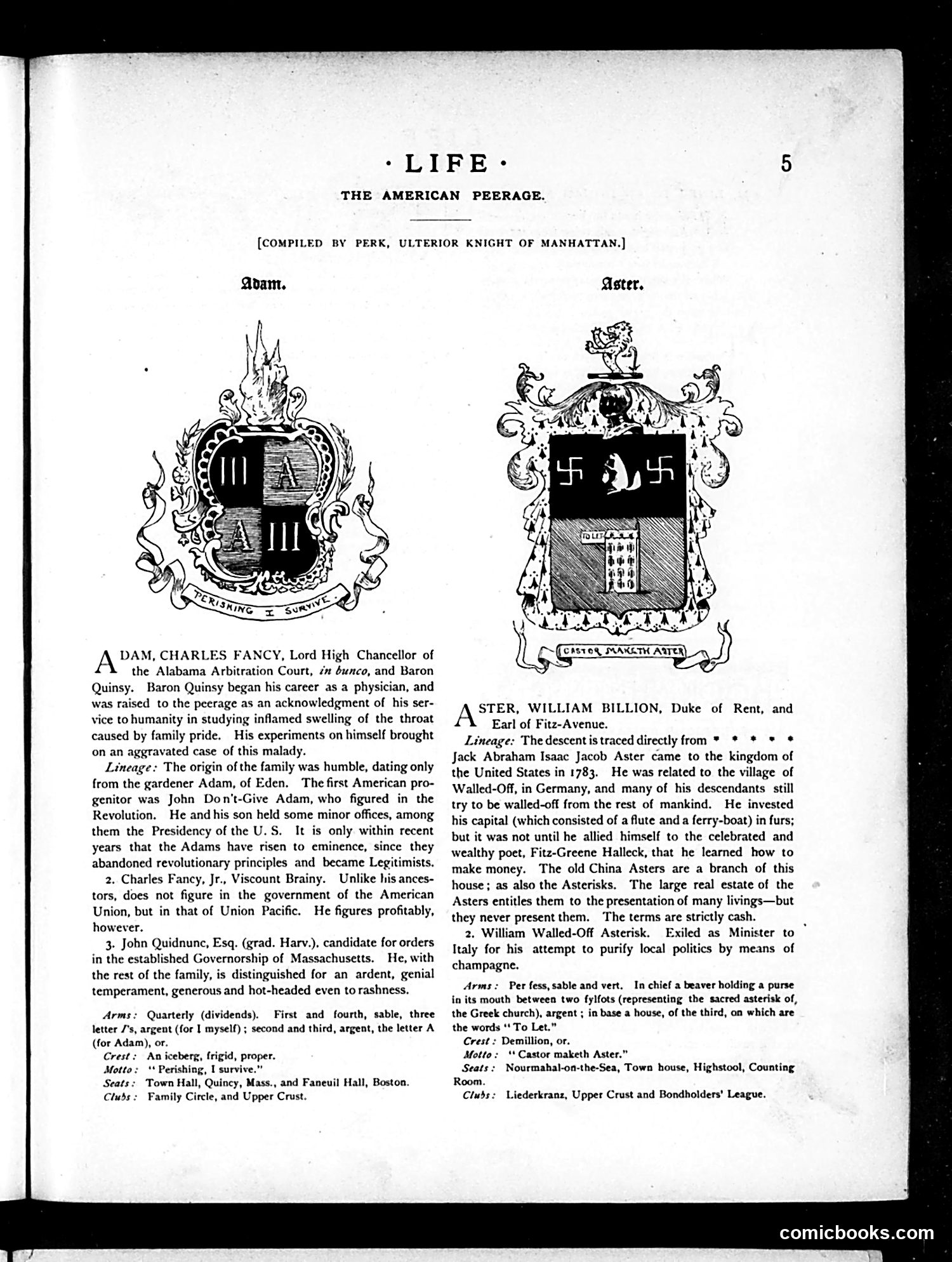
This satirical page from *Life* magazine mocks American social pretension by creating fake aristocratic lineages for prominent Americans. The two coats of arms represent fictional "Adam" and "Aster" family lines. **Adam** (Charles Fancy) is humorously traced to "the gardener Adam, of Eden"—the biblical first man—satirizing claims of distinguished ancestry. The text notes his family's actual humble origins among American servants and revolutionary figures. **Aster** (William Billion) similarly ridicules the wealthy Astor family's pretensions to nobility. The satire emphasizes their recent immigrant origins (1783) and mercenary focus on wealth accumulation, mocking their invented aristocratic airs. The page lampoons American fascination with European nobility and genealogical snobbery among the newly rich, suggesting authentic American achievement matters more than manufactured pedigrees.
This page contains literary criticism and book reviews rather than political cartoons. The main content discusses Professor John Hack McMaster's "History of the People of the United States," praised for presenting popular history rather than just politicians and statesmen. The text criticizes the work's lack of central organizing design—it reads like randomly assembled gems rather than a coherent narrative. There's also a section titled "A Diabolical Outrage" attacking Mark Twain and Mr. Webster for publishing sensational newspaper extracts from General Grant's memoirs, which the author views as exploitative and disrespectful to Grant's dignity. A brief "Musical Item" mentions the Paris College of Musicians changing pitch standards. No political cartoons appear on this page.
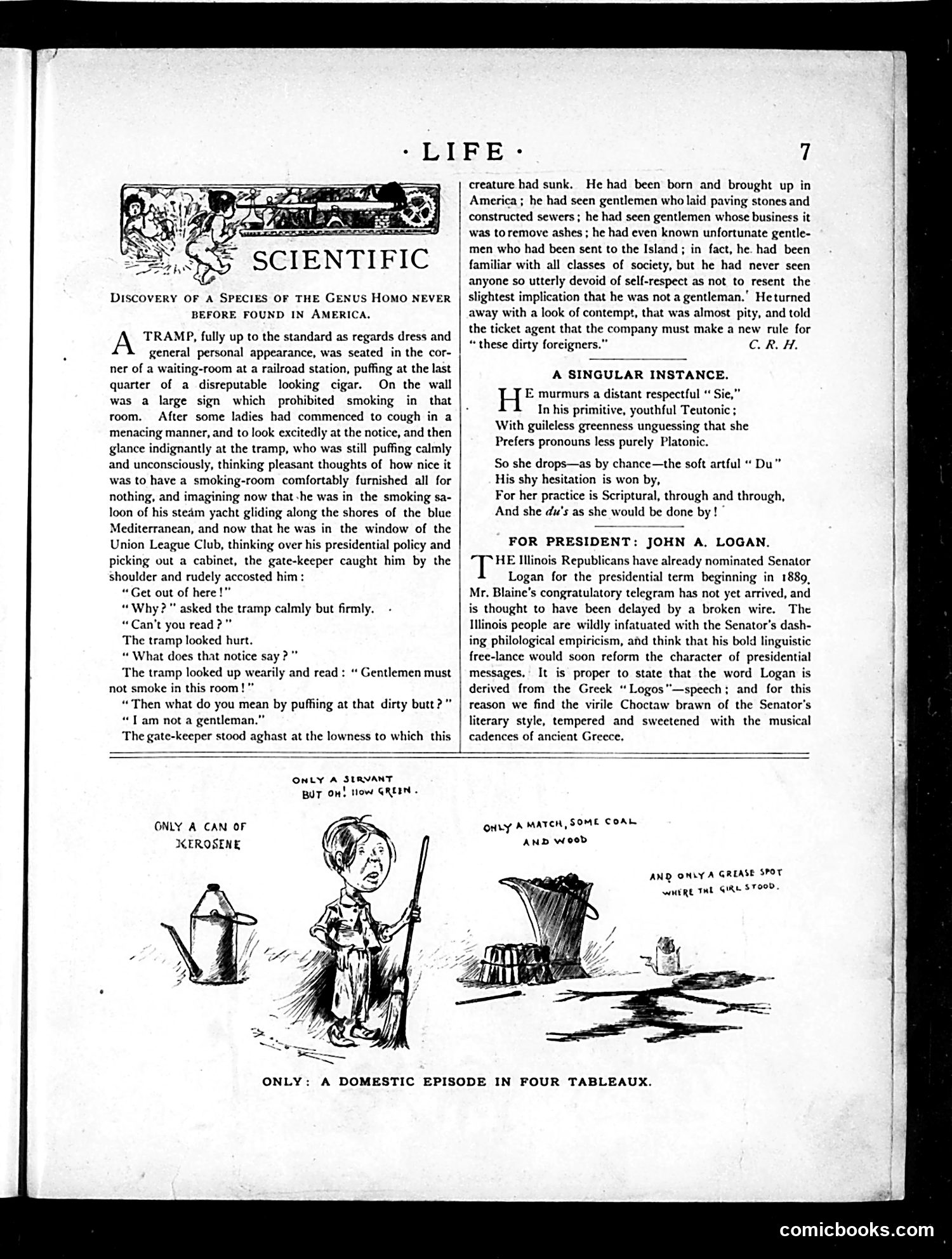
This page contains two distinct satirical pieces from *Life* magazine: **"Scientific Discovery"** (top): A humorous story mocking a poorly-dressed man in a railway station smoking room who is scorned as a "dirty foreigner" by gentlemen. The satire critiques American class prejudice and xenophobia—the irony being that this supposedly refined man has actually worked various respectable jobs in America, yet faces contempt solely based on appearance and accent. The piece attacks snobbish attitudes toward immigrants. **"A Domestic Episode in Four Tableaux"** (bottom): A cartoon series depicting a wife's frustrations with household management—showing the minimal resources (kerosene can, match and coal, grease spot) available for domestic work. This satirizes the difficulty and drudgery of housekeeping with limited means, likely appealing to *Life*'s middle-class female readership. Both pieces use humor to critique social inequities of their era.
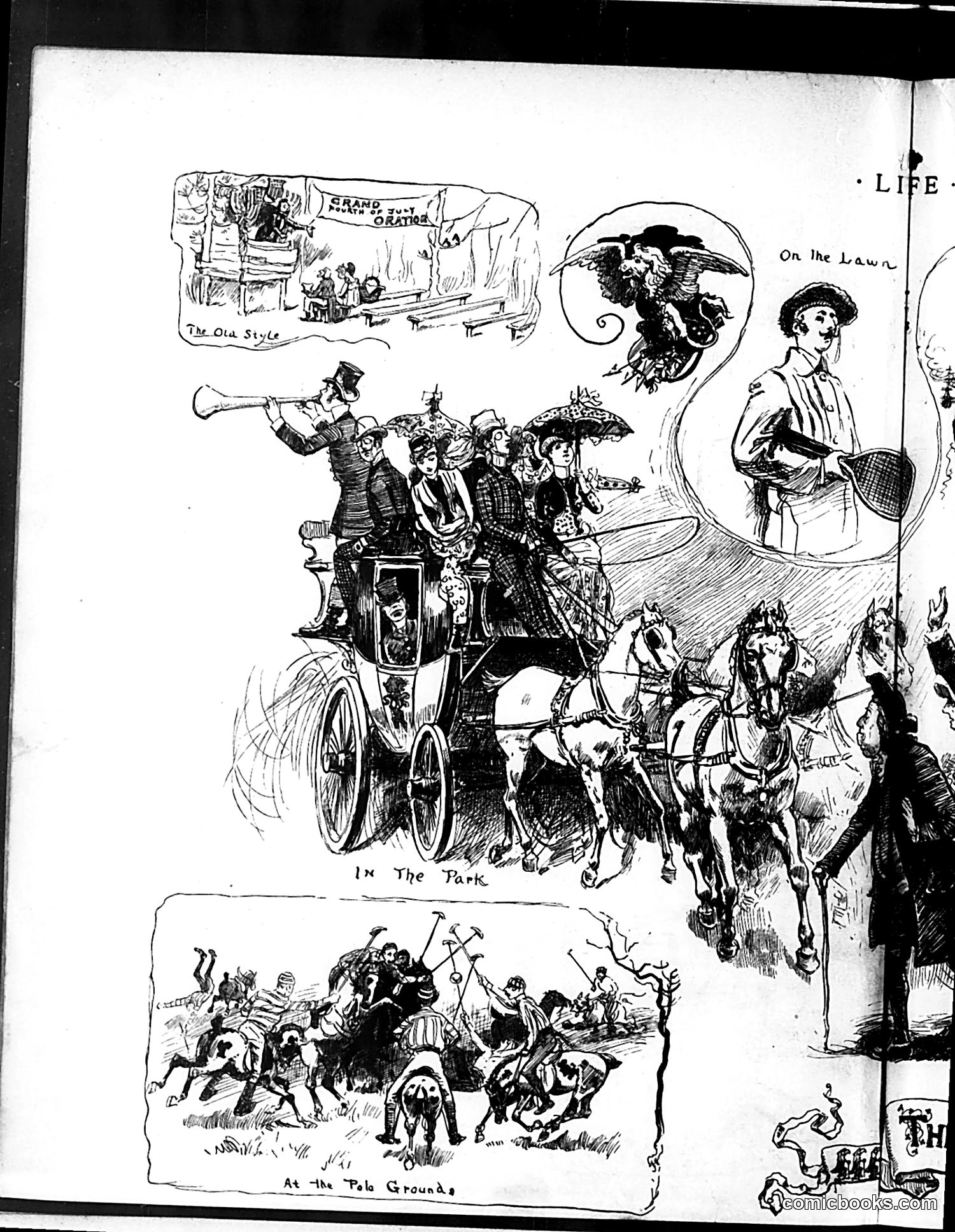
This satirical page titled "LIFE" depicts upper-class social activities through four vignettes: "The Old Style" (interior scene), "On the Lawn" (individual figure), "In the Park" (elaborate horse-drawn carriage procession), and "At the Polo Grounds" (sporting scene). The satire targets wealthy leisure pursuits and ostentatious display. The elaborate carriage scene with multiple horses, formally dressed passengers, and a trumpet-playing attendant mocks the excessive pageantry of high-society outings. "In the Park" appears to ridicule the pretentious rituals of the privileged class—their carriages, fashion, and public performances of wealth. The page satirizes how the wealthy structured their days around conspicuous leisure activities, treating parks and public spaces as stages for displaying social status.
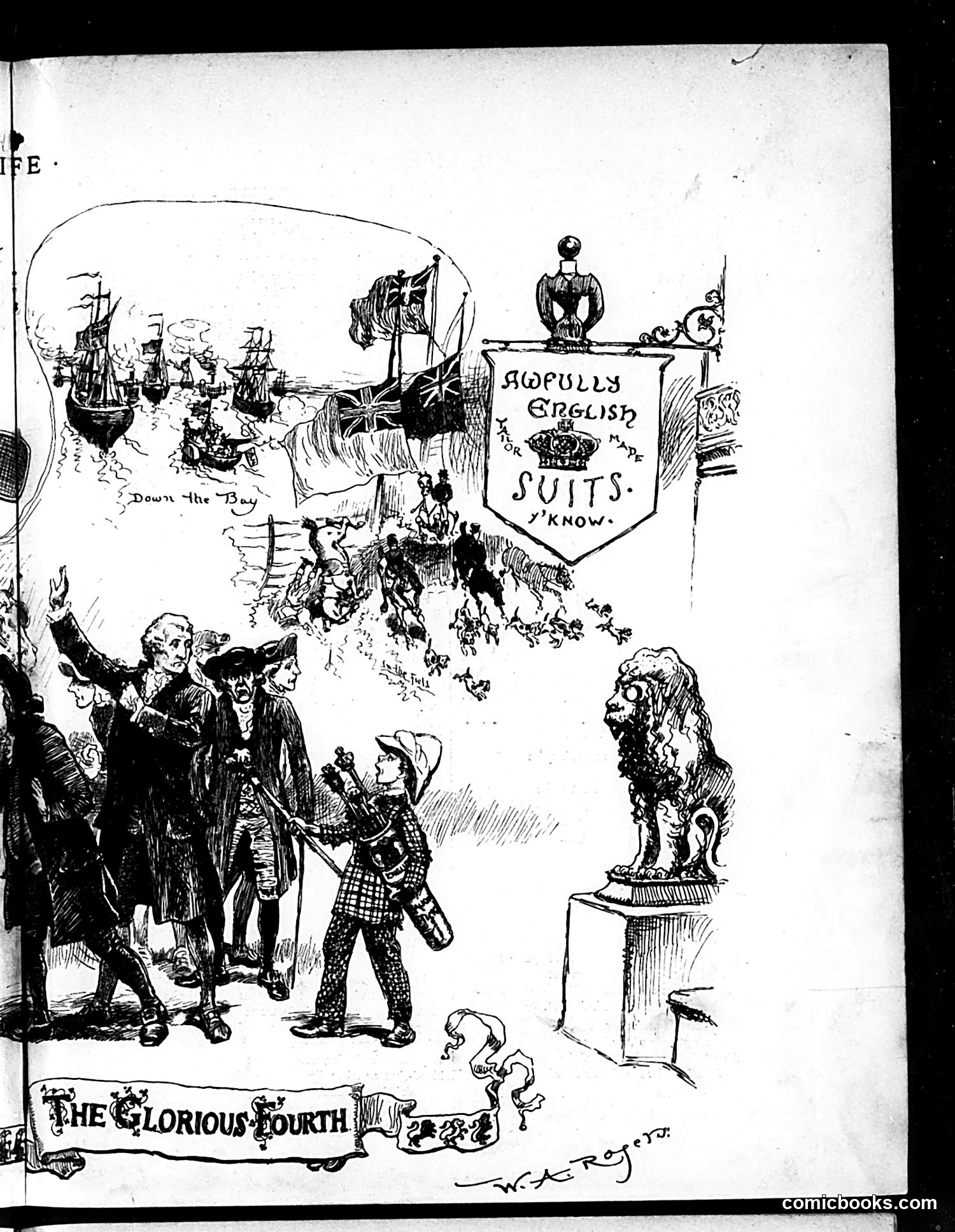
This satirical cartoon mocks British naval power and American independence. The central banner reads "Awfully English Suits I Know," likely ridiculing British fashion pretensions or cultural snobbery. The image shows: - **Left side**: American figures (including what appears to be sailors and civilians) celebrating defiantly - **Top**: British naval ships labeled "Down the Bay" - **Right side**: A leonine British lion statue on a pedestal, representing British imperial power - **Overall composition**: Americans celebrating independence ("The Glorious Fourth" — July 4th) while British naval forces withdraw The joke satirizes British pride and naval dominance being challenged or mocked by American independence celebrations. The "English suits" phrase suggests contempt for affected British superiority, making this a patriotic jab at British pretension during an era of Anglo-American tension.
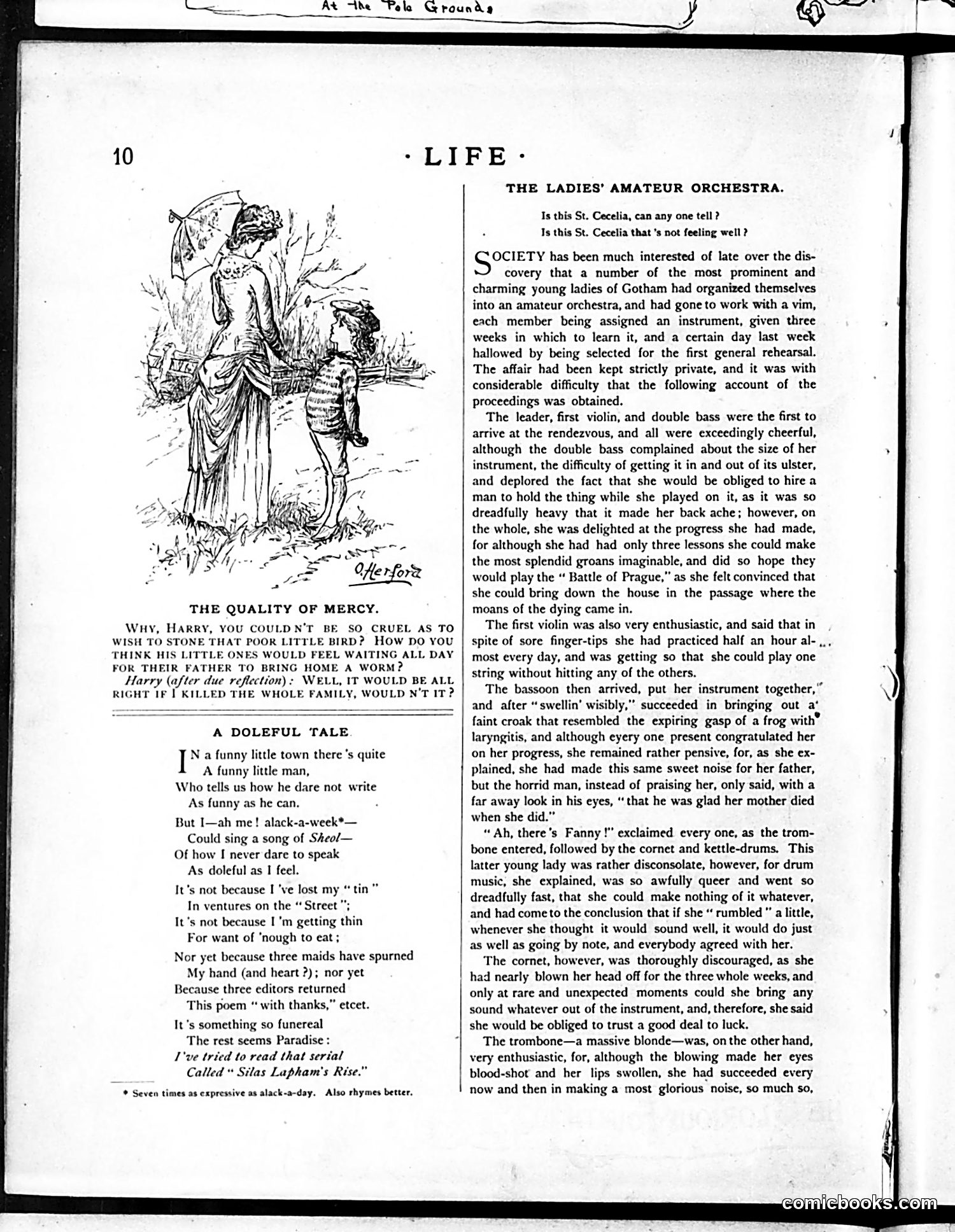
This page contains satirical commentary on late 19th-century American society, primarily through three pieces: **"The Quality of Mercy"** depicts a child's logical but darkly humorous response to a moral lesson—if killing one bird is cruel, wouldn't killing the whole family be more "efficient"? The satire mocks simplistic moral instruction. **"A Doleful Tale"** is meta-commentary: a poet complains he cannot write as darkly as he feels, citing his inability to finish reading the serialized novel "Silas Lapham's Rise" (William Dean Howells' contemporary work). The satire targets both overly cheerful writers and tedious serialized literature. **"The Ladies' Amateur Orchestra"** is the main attraction—a humorous account of wealthy Gotham society women forming an amateur orchestra. The satire gently mocks their musical incompetence despite enthusiastic effort: a double-bass player with three lessons making "splendid groans," a violinist learning to play one string without hitting others, a bassoonist producing frog-like croaks. The piece satirizes both the pretensions of amateur musicianship and the indulgent leisure activities of the wealthy.
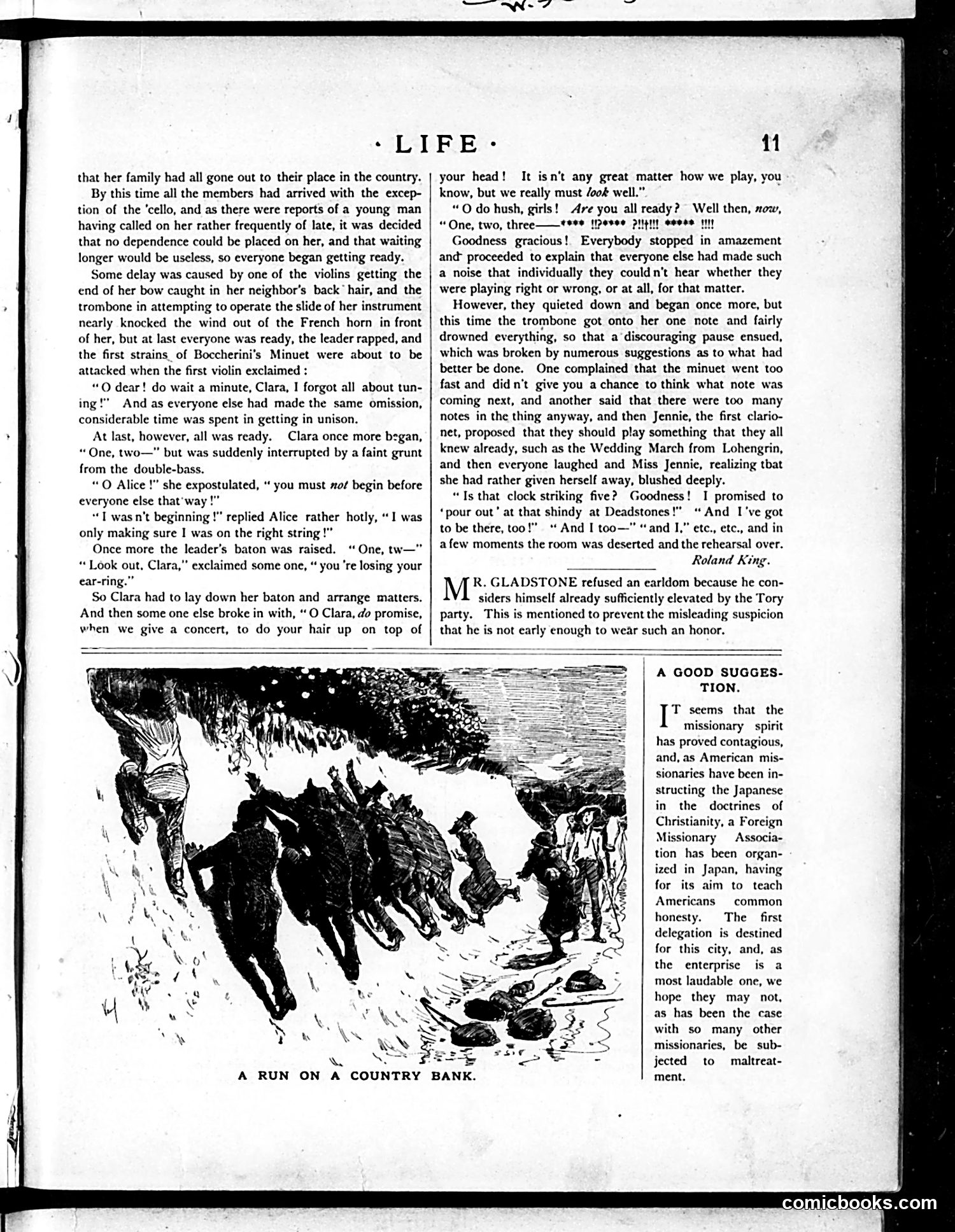
This page contains two distinct pieces: **Main Story (top two-thirds):** A humorous narrative about an amateur women's orchestra attempting to rehearse Boccherini's Minuet. The satire mocks their incompetence and distraction—they can't tune properly, lose ear-rings, worry about appearance over musical ability, can't hear themselves play, and abandon rehearsal when social engagements call. It's gentle social satire on dilettante musicians and women's frivolous priorities. **Cartoon ("A Run on a Country Bank"):** The illustration shows panicked figures rushing, apparently depicting a bank run—a financial crisis where depositors demand withdrawals simultaneously. The caption's visual metaphor suggests chaos and disorder. **Brief Items (right column):** A satirical note about Mr. Gladstone refusing an earldom, and a joke about Japanese missionaries coming to America to teach Americans "common honesty"—clearly mocking American dishonesty or corruption of the era. The page reflects turn-of-century American humor mixing domestic comedy with political and social commentary.
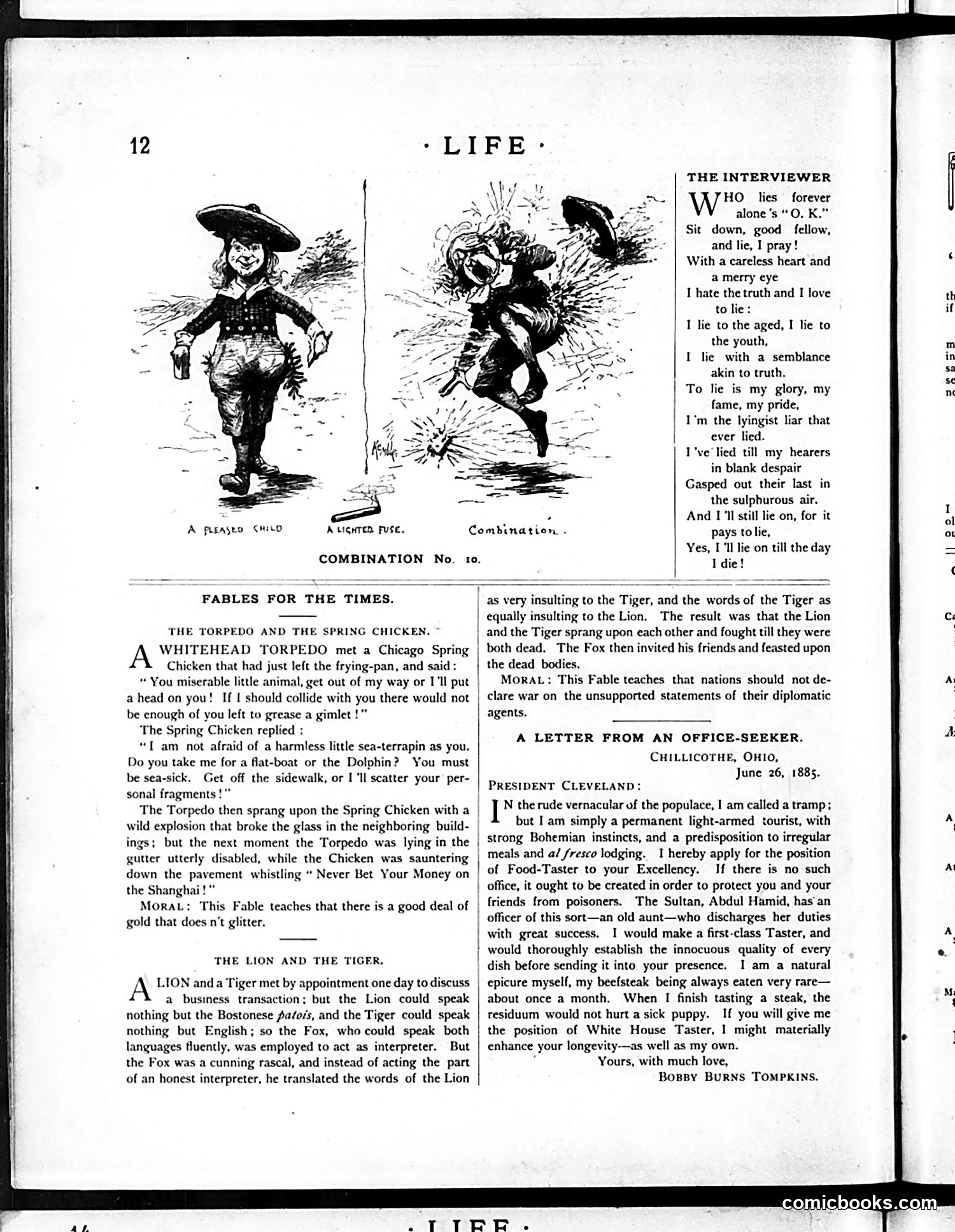
This satirical page contains three distinct pieces mocking American society and politics: **"Combination No. 10"** (cartoons): Two sketches depicting a "pleased child" and "lighted fuse"—visual puns about dangerous combinations, likely social commentary on reckless behavior. **"The Interviewer" (poem)**: A self-aware confession by a professional liar who boasts of deceiving people across all ages. This appears to mock journalists or politicians who fabricate stories for profit and fame. **Fables for the Times**: - *Torpedo and Spring Chicken*: Two boastful combatants destroy each other—satirizing mutual destruction through arrogance - *Lion and Tiger*: A dishonest Fox interpreter deliberately mistranslates, causing a war. The moral explicitly criticizes diplomats who lie to start wars—likely referencing contemporary diplomatic failures. **Office-Seeker's Letter**: A humorous petition to President Cleveland (1885 dating confirms this) from a self-described "tramp" applying to be White House Food-Taster. It satirizes both the pretensions of office-seekers and the paranoia about presidential poisoning. The unifying theme: Life critiques dishonesty in American public life—journalism, diplomacy, and patronage politics.
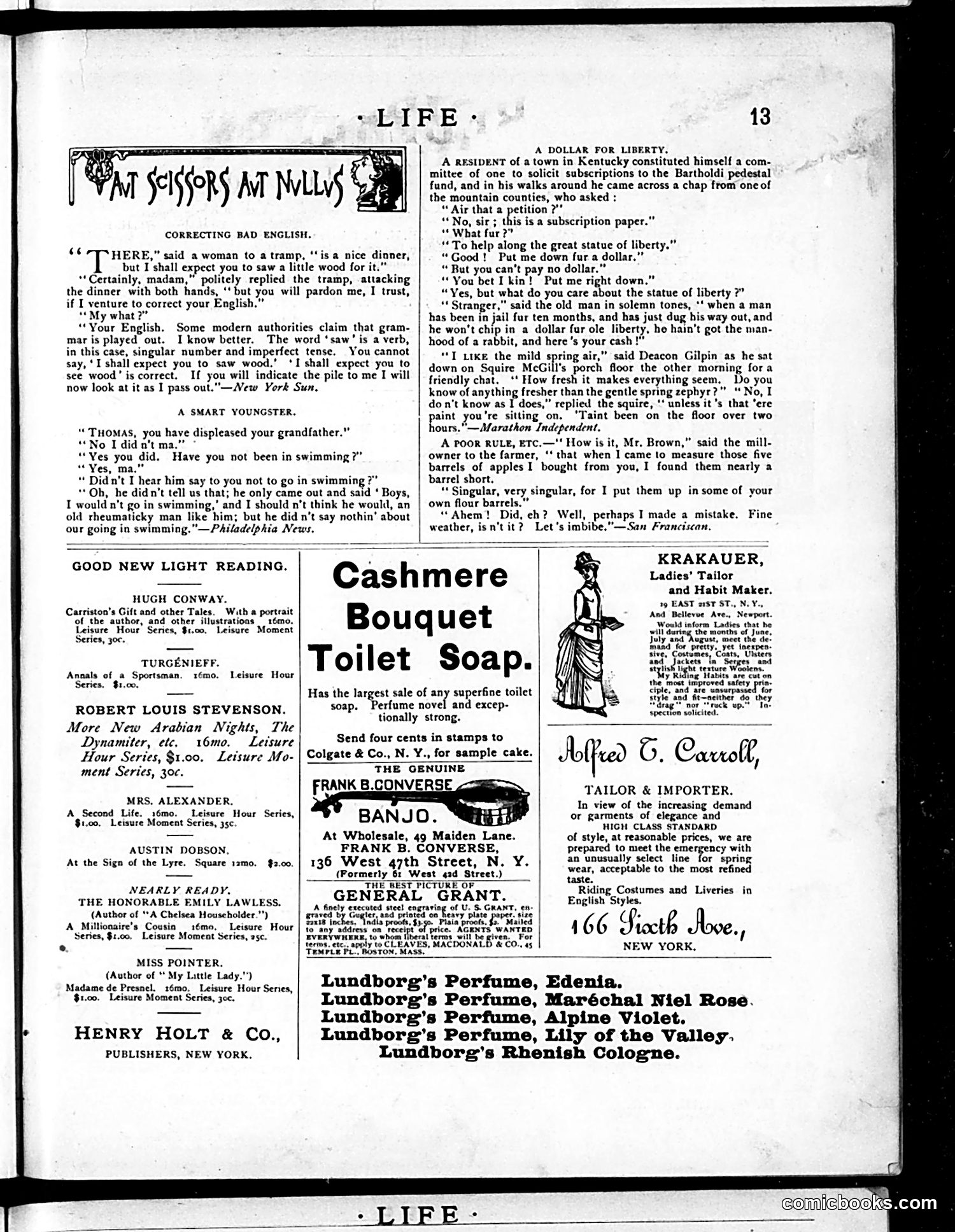
This page consists primarily of **humorous anecdotes and advertisements** rather than political cartoons. The three main jokes satirize **class pretension and hypocrisy**: 1. **"A Scissors at Will's"**: A tramp corrects a woman's grammar while accepting her charity—mocking both the tramp's absurd pedantry and the woman's condescension toward the poor. 2. **"A Smart Youngster"**: A boy exploits literal interpretation of his grandfather's words to justify swimming anyway—lampooning Victorian adults' expectations of obedience from children. 3. **"A Dollar for Liberty"**: A recently escaped convict donates to the Statue of Liberty pedestal fund, claiming moral superiority over free men—satire on how former criminals can paradoxically display virtue-signaling patriotism. The remaining anecdotes mock rural farmers and business disputes through similar logic-twisting wordplay. The advertisements (Cashmere Bouquet Soap, banjo sales, tailoring services, perfumes) occupy the right column—typical of Life's revenue model.
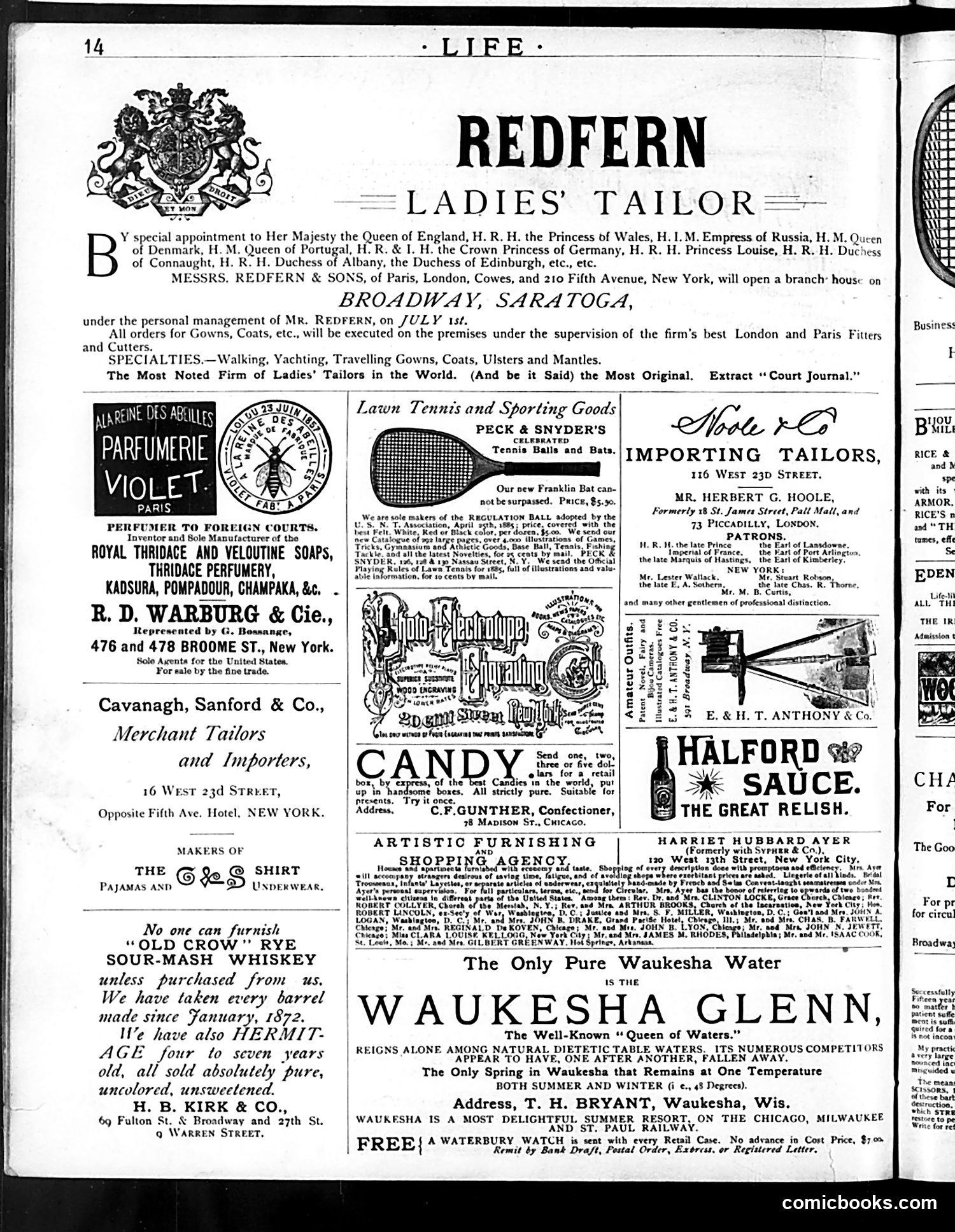
This page is primarily **advertising**, not political satire. It's from *Life* magazine and showcases luxury goods and services from the late 19th century. The dominant feature is the **Redfern Ladies' Tailor advertisement**, announcing a new Broadway location serving European royalty (Queen of England, Empress of Russia, etc.). This appeals to wealthy American women seeking fashionable European tailoring. The remaining ads promote luxury items: French perfumes, premium whiskey ("Old Crow" since 1872), tennis equipment, imported tailors, fountain pens, candy, and "Waukesha Glenn" spring water—all targeting the affluent. **No political cartoon or satire is present here.** This is a status-conscious commercial page reflecting Gilded Age consumer culture where European-branded goods and royal patronage signaled wealth and sophistication to American elites.
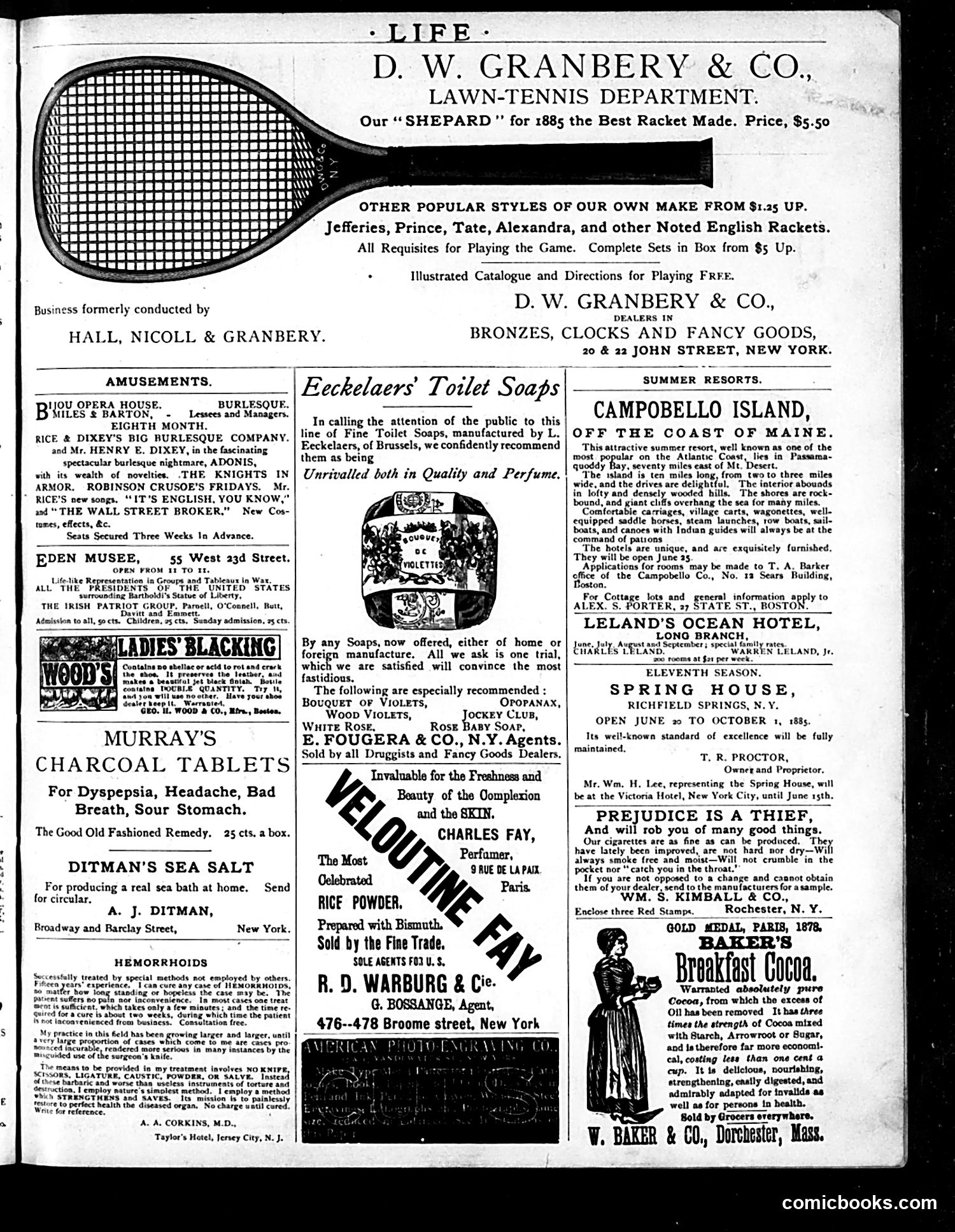
This page is **primarily advertising** with no political cartoons or satirical commentary visible. It consists of commercial notices for various products and services typical of 1880s American life. The content includes ads for: - Tennis equipment (D.W. Granbery & Co.'s "Shepard" racket for $5.50) - Theater performances (burlesque shows, museums) - Patent medicines (charcoal tablets for dyspepsia, sea salt) - Medical services (hemorrhoid treatment) - Cosmetics and toiletries (Belgian toilet soaps, rice powder, perfume) - Summer resort accommodations (Campobello Island) The page reflects 1880s consumer culture and advertising practices. No identifiable political figures, social satire, or cartoon humor is present—this appears to be a standard commercial advertisement section from Life magazine's early publication period.
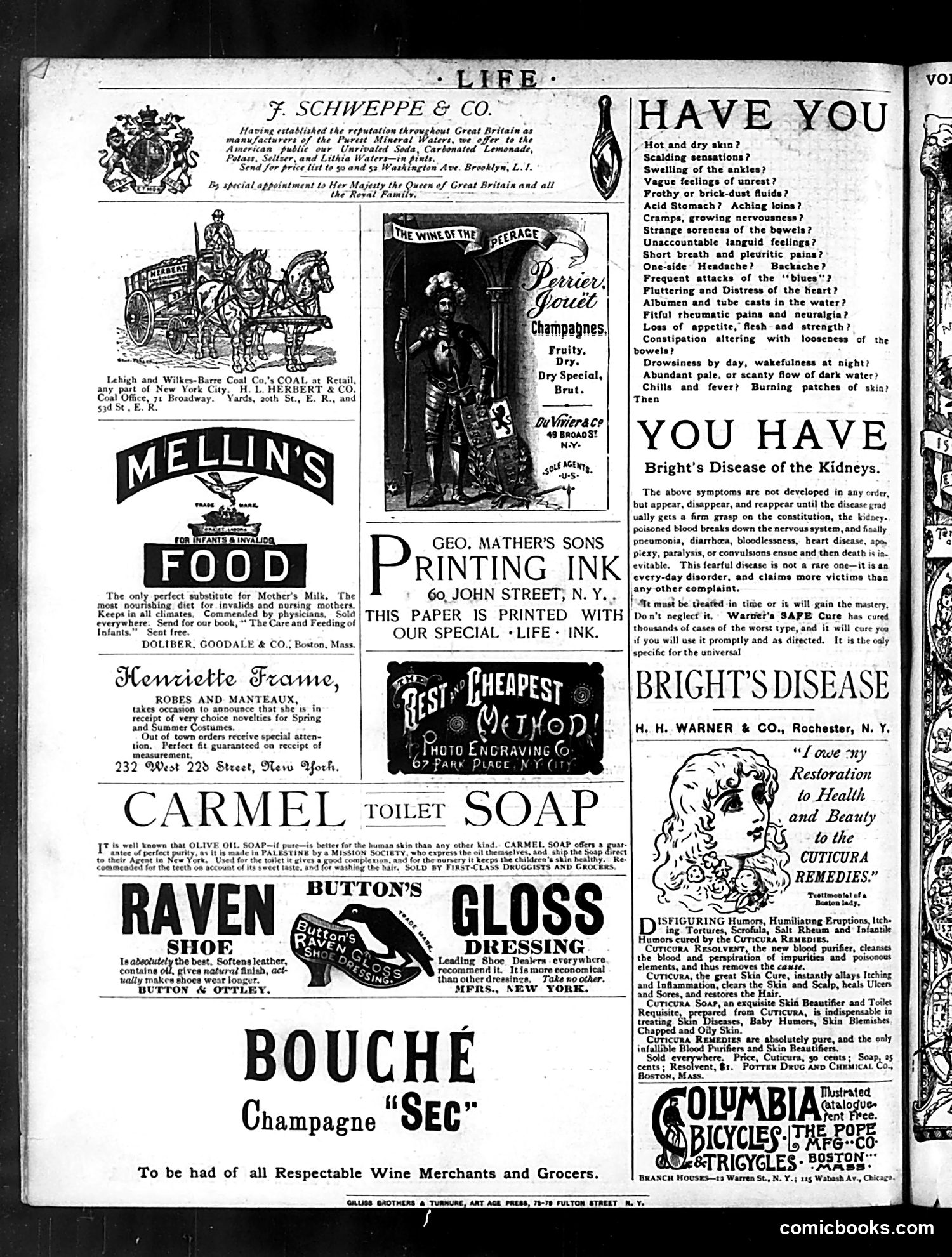
This page is primarily **advertising**, not editorial or satirical content. It consists of late 19th-century product advertisements including mineral waters, infant food, clothing, soap, shoe polish, printing ink, champagne, and notably a medical "cure." The most striking element is a large advertisement for H.H. Warner & Co.'s "Safe Cure" for Bright's Disease (kidney disease). It lists extensive symptoms—from hot skin to convulsions—claiming the cure treats this "fearful disease" that "claims more victims than any other complaint." This represents the era's patent medicine industry, which made expansive health claims without modern FDA regulation. The ad exemplifies how Life magazine monetized advertising from dubious remedies alongside legitimate products, reflecting Gilded Age medicine's credibility crisis that modern readers would recognize as quackery.