
Life, 1885-07-02 · page 3 of 16
Life — July 2, 1885 — page 3: what you’re looking at
What you’re looking at
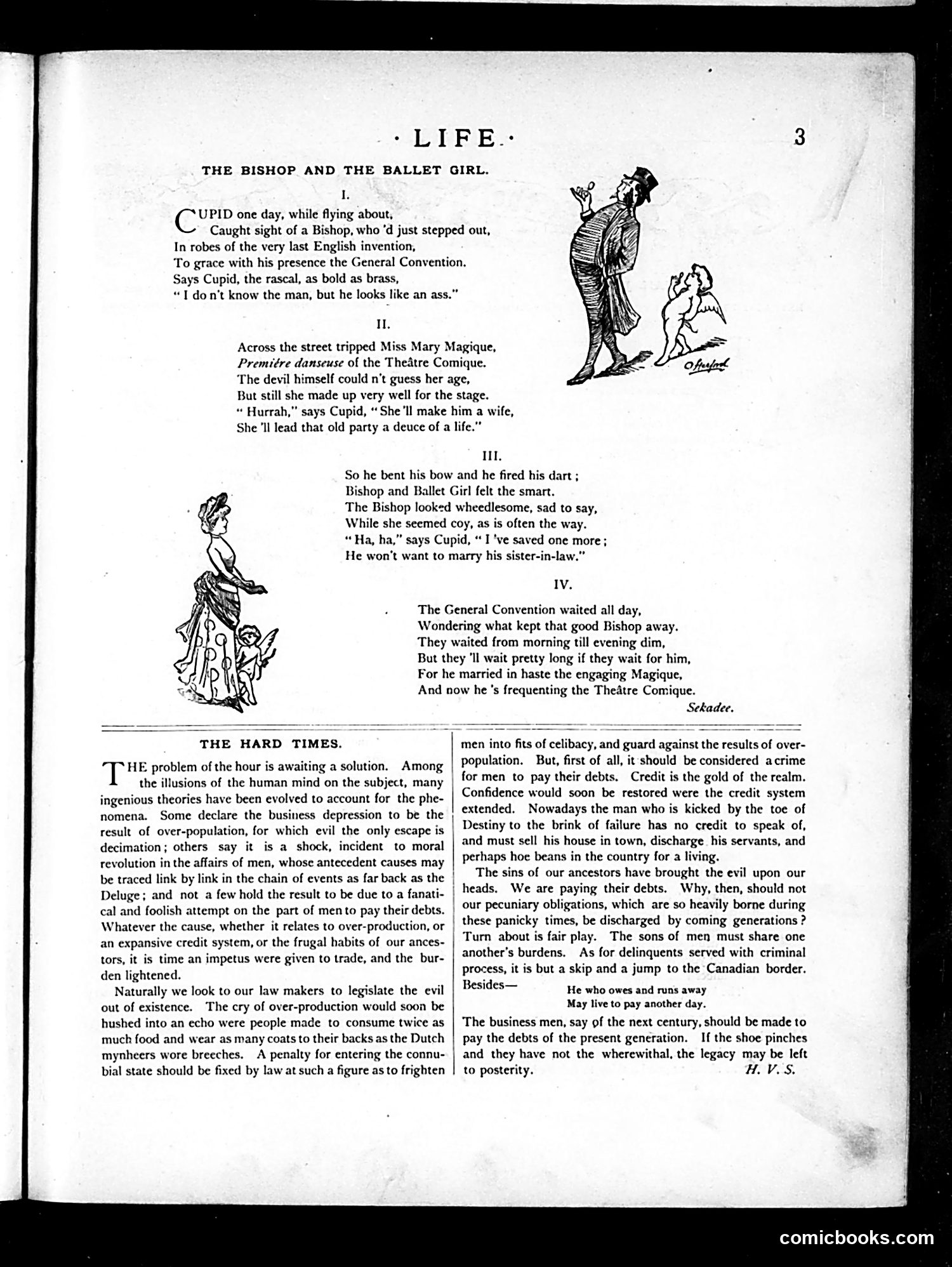
This satirical poem mocks a clergyman's hypocrisy. Cupid observes a Bishop attending a General Convention (likely ecclesiastical), then spots a ballet dancer (Miss Mary Magique) crossing the street. Cupid shoots the Bishop with his arrow, causing him to abandon his religious duties to pursue the dancer. The satire targets the contrast between clerical propriety and actual behavior—the Bishop's supposed moral authority crumbles when confronted with temptation. The punchline reveals he married the actress hastily and now frequents the Theatre Comique rather than attending his convention. The accompanying article "The Hard Times" discusses economic depression and debt, suggesting this issue addresses both moral and financial failings of the era's institutions and leaders.
📄 Transcribed text from this page (OCR, searchable)
Machine-transcribed from the original scan — historical spelling and the odd misread are preserved.
> LIFE.: THE BISHOP AND THE BALLET GIRL. lL UPID one day, while flying about, Caught sight of a Bishop, who ‘d just stepped out, In robes of the very last English invention, To grace with his presence the General Convention. Says Cupid, the rascal, as bold as brass, “1 don't know the man, but he looks like an ass.” I. Across the street tripped Miss Mary Magique, Premitre danseuse of the Theatre Comique. The devil himself could n't guess her age, But still she made up very well for the stage. “ Hurrah,” says Cupid, “She'll make him a wife, She ‘ll lead that old party a deuce of a life.” Ill, So he bent his bow and he fired his dart ; Bishop and Ballet Girl felt the smart. The Bishop looked wheedlesome, sad to say, While she seemed coy, as is often the way. “ Ha, ha,” says Cupid, “I 've saved one more; He won't want to marry his sister-in-law.” Iv. The General Convention waited all day, Wondering what kept that good Bishop away. They waited from morning till evening dim, But they ‘Il wait pretty long if they wait for him, For he married in haste the engaging Magique, And now he's frequenting the Theatre Comique. THE HARD TIMES. HE problem of the hour is awaiting a solution. Among the illusions of the human mind on the subject, many ingenious theories have been evolved to account for the phe- nomena. Some declare the business depression to be the result of over-population, for which evil the only escape is decimation; others say it is a shock, incident to moral revolution in the affairs of men, whose antecedent causes may be traced link by link in the chain of events as far back as the Deluge; and not a few hold the result to be due to a fanati- cal and foolish attempt on the part of mento pay their debts. Whatever the cause, whether it relates to over-production, or an expansive credit system, or the frugal habits of our ances- tors, it is time an impetus were given to trade, and the bur- den lightened. Naturally we look to our law makers to legislate the evil out of existence. The cry of over-production would soon be hushed into an echo were people made to consume twice as much food and wear as many coats to their backs as the Dutch mynheers wore breeches. A penalty for entering the connu- bial state should be fixed by law at such a figure as to frighten | heads. We are paying their debts. men into fits of celibacy, and guard against the results of over- population. But, first of all, it should be considered acrime for men to pay their debts. Credit is the gold of the realm. Confidence would soon be restored were the credit system extended. Nowadays the man who is kicked by the toe of | Destiny to the brink of failure has no credit to speak of, and must sell his house in town, discharge his servants, and perhaps hoe beans in the country for a living. The sins of our ancestors have brought the evil upon our Why, then, should not our pecuniary obligations, which are so heavily borne during | these panicky times, be discharged by coming generations ? Turn about is fair play. The sons of men must share one another's burdens. As for delinquents served with criminal process, it is but a skip and a jump to the Canadian border. Besides— He who owes and runs away May live to pay another day. The business men, say of the next century, should be made to pay the debts of the present generation. If the shoe pinches and they have not the wherewithal, the legacy may be left to posterity. AVAS. comicbooks.com