
Life, 1885-07-02 · page 6 of 16
Life — July 2, 1885 — page 6: what you’re looking at
What you’re looking at
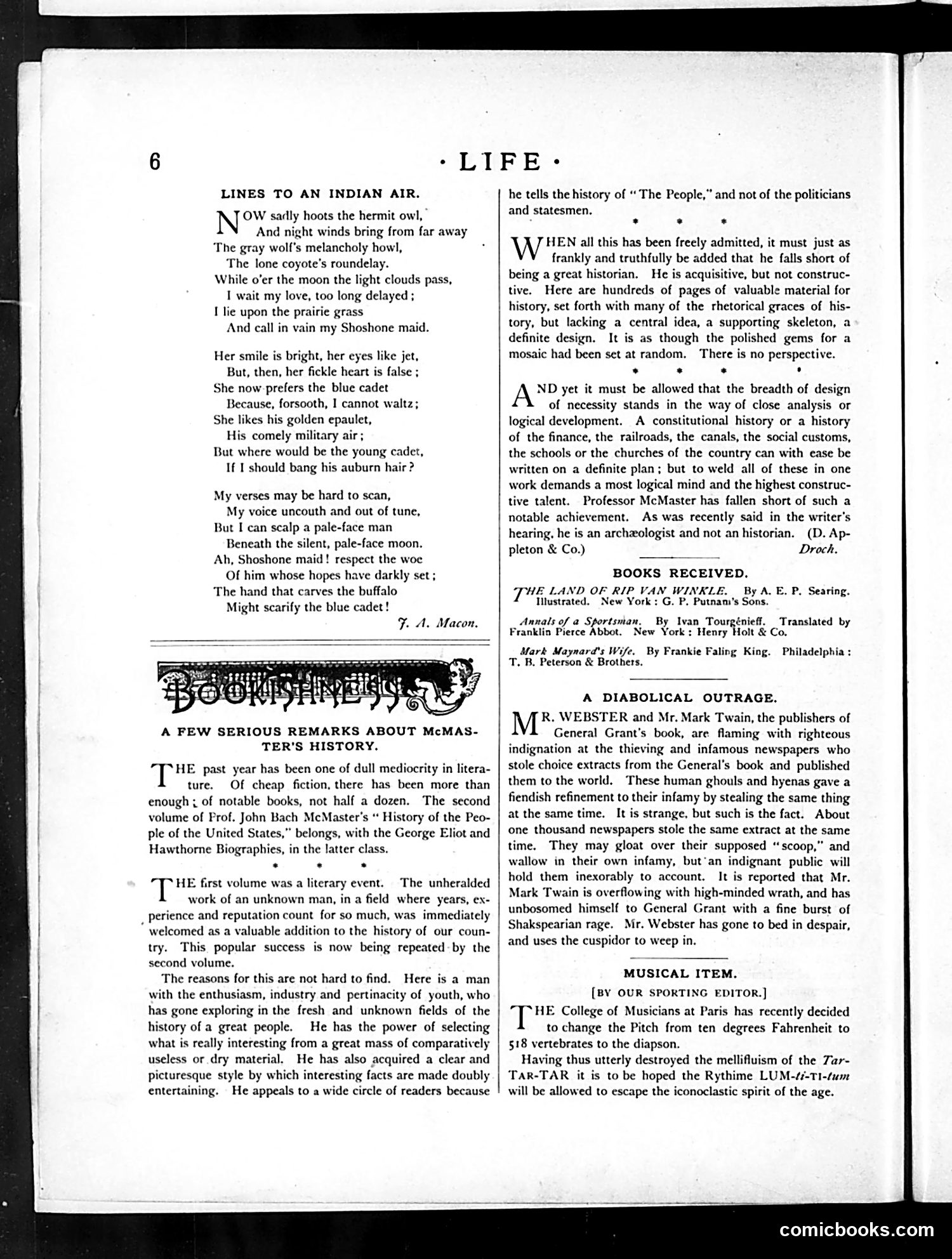
This page contains literary criticism and book reviews rather than political cartoons. The main content discusses Professor John Hack McMaster's "History of the People of the United States," praised for presenting popular history rather than just politicians and statesmen. The text criticizes the work's lack of central organizing design—it reads like randomly assembled gems rather than a coherent narrative. There's also a section titled "A Diabolical Outrage" attacking Mark Twain and Mr. Webster for publishing sensational newspaper extracts from General Grant's memoirs, which the author views as exploitative and disrespectful to Grant's dignity. A brief "Musical Item" mentions the Paris College of Musicians changing pitch standards. No political cartoons appear on this page.
📄 Transcribed text from this page (OCR, searchable)
Machine-transcribed from the original scan — historical spelling and the odd misread are preserved.
-LIFE: LINES TO AN INDIAN AIR. OW sadly hoots the hermit owl, And night winds bring from far away The gray wolf's melancholy howl, The lone coyote’s roundelay. While o’er the moon the light clouds pass, I wait my love, too long delayed ; I lie upon the prairie grass And call in vain my Shoshone maid. Her smile is bright, her eyes like jet, But, then, her fickle heart is false ; She now-prefers the blue cadet Because, forsooth, I cannot waltz; She likes his golden epaulet, His comely military air; But where would be the young cadet, If I should bang his auburn hair ? My verses may be hard to scan, My voice uncouth and out of tune, But I can scalp a pale-face man Beneath the silent, pale-face moon. Ah, Shoshone maid! respect the woe Of him whose hopes have darkly set ; The hand that carves the buffalo Might scarify the blue cadet! F. A. Macon. A FEW SERIOUS REMARKS ABOUT McMAS- TER'S HISTORY. HE past year has been one of dull mediocrity in litera- ture. Of cheap fiction, there has been more than enough ; of notable books, not half a dozen. The second volume of Prof. John Bach McMaster’s “ History of the Peo- ple of the United States,” belongs, with the George Eliot and Hawthorne Biographies, in the latter class. . . . HE first volume was a literary event. The unheralded work of an unknown man, in a field where years, ex- perience and reputation count for so much, was immediately “ welcomed as a valuable addition to the history of our coun- try. This popular success is now being repeated-by the second volume. The reasons for this are not hard to find. Here is a man with the enthusiasm, industry and pertinacity of youth, who has gone exploring in the fresh and unknown fields of the history of a great people. He has the power of selecting what is really interesting from a great mass of comparatively useless or dry material. He has also acquired a clear and picturesque style by which interesting facts are made doubly entertaining. He appeals to a wide circle of readers because he tells the history of “The People,” and not of the politicians and statesmen, * . * HEN all this has been freely admitted, it must just as frankly and truthfully be added that he falls short of being a great historian. He is acquisitive, but not construc- tive. Here are hundreds of pages of valuable material for history, set forth with many of the rhetorical graces of his- tory, but lacking a central idea, a supporting skeleton, a definite design. It is as though the polished gems for a mosaic had been set at random. There is no perspective. . . . . Ave yet it must be allowed that the breadth of design of necessity stands in the way of close analysis or logical development. A constitutional history or a history of the finance, the railroads, the canals, the social customs, the schools or the churches of the country can with ease be written on a definite plan; but to weld all of these in one work demands a most logical mind and the highest construc- tive talent. Professor McMaster has fallen short of such a notable achievement. As was recently said in the writer's hearing, he is an archeologist and not an historian. (D. Ap- pleton & Co.) Droch, BOOKS RECEIVED. 1E LAND OF RIP VAN WINKLE. By A. E. P, Searing. Illustrated. New York: G. P, Putnam's Sons. Annals of a Sportsman. Franklin Pierce Abbot. Mark Maynard's Wife. T. B. Peterson & Brothers. By Iwan Tourgéniefl. Translated by New York: Henry Holt & Co, By Frankie Faling King. Philadelphia: A DIABOLICAL OUTRAGE. R. WEBSTER and Mr. Mark Twain, the publishers of General Grant's book, are flaming with righteous indignation at the thieving and infamous newspapers who stole choice extracts from the General's book and published them to the world. These human ghouls and hyenas gave a fiendish refinement to their infamy by stealing the same thing at the same time. It is strange, but such is the fact. About one thousand newspapers stole the same extract at the same time. They may gloat over their supposed “scoop,” and wallow in their own infamy, but’an indignant public will hold them inexorably to account. It is reported that Mr. Mark Twain is overflowing with high-minded wrath, and has unbosomed himself to General Grant with a fine burst of Shakspearian rage. Mr. Webster has gone to bed in despair, and uses the cuspidor to weep in. MUSICAL ITEM. [BY OUR SPORTING EDITOR.] HE College of Musicians at Paris has recently decided to change the Pitch from ten degrees Fahrenheit to 518 vertebrates to the diapson. Having thus utterly destroyed the mellifluism of the Zar- TAR-TAR it is to be hoped the Rythime LUM-és-T1-¢um will be allowed to escape the iconoclastic spirit of the age. comicbooks.com