
Life, 1885-07-02 · page 10 of 16
Life — July 2, 1885 — page 10: what you’re looking at
What you’re looking at
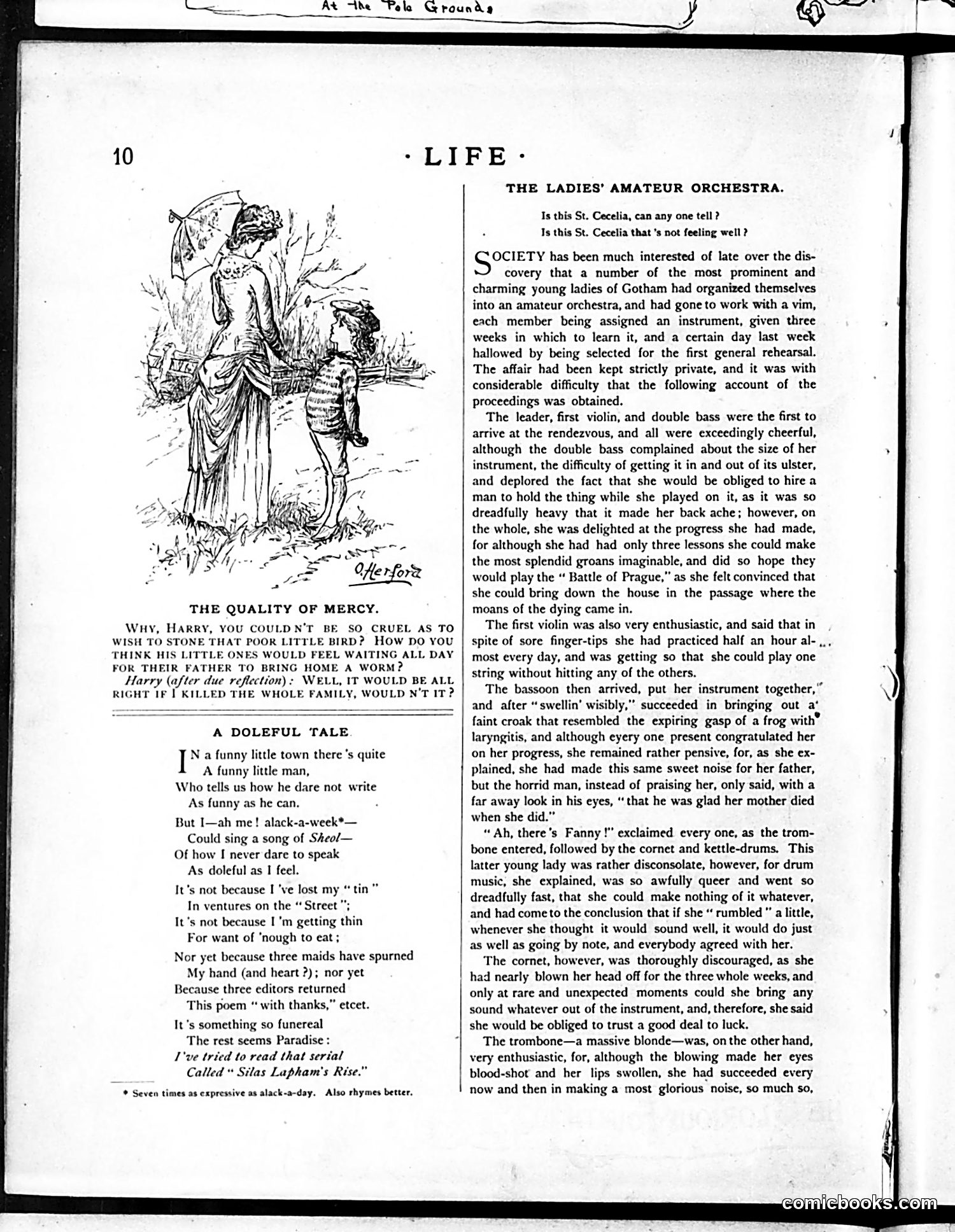
This page contains satirical commentary on late 19th-century American society, primarily through three pieces: **"The Quality of Mercy"** depicts a child's logical but darkly humorous response to a moral lesson—if killing one bird is cruel, wouldn't killing the whole family be more "efficient"? The satire mocks simplistic moral instruction. **"A Doleful Tale"** is meta-commentary: a poet complains he cannot write as darkly as he feels, citing his inability to finish reading the serialized novel "Silas Lapham's Rise" (William Dean Howells' contemporary work). The satire targets both overly cheerful writers and tedious serialized literature. **"The Ladies' Amateur Orchestra"** is the main attraction—a humorous account of wealthy Gotham society women forming an amateur orchestra. The satire gently mocks their musical incompetence despite enthusiastic effort: a double-bass player with three lessons making "splendid groans," a violinist learning to play one string without hitting others, a bassoonist producing frog-like croaks. The piece satirizes both the pretensions of amateur musicianship and the indulgent leisure activities of the wealthy.
📄 Transcribed text from this page (OCR, searchable)
Machine-transcribed from the original scan — historical spelling and the odd misread are preserved.
= At “he Vole Grounds oy, - LIFE: THE QUALITY OF MERCY. Wuy, HARRY, YOU COULDN'T BE SO CRUEL AS TO WISH TO STONE THAT POOR LITTLE BIRD? HOW DO you THINK HIS LITTLE ONES WOULD FEEL WAITING ALL DAY FOR THEIR FATHER TO BRING HOME A WORM? Harry (after due reflection): WELL, 1T WOULD BE ALL RIGHT IF I KILLED THE WHOLE FAMILY, WOULD N’T IT? A DOLEFUL TALE I N a funny little town there's quite A funny little man, Who tells us how he dare not write As funny as he can. But I—ah me! alack-a-week*— Could sing a song of Sheo/— Of how I never dare to speak As doleful as I feel. It’s not because I 've lost my “ tin” In ventures on the “ Street "; It's not because I''m getting thin For want of ‘nough to eat ; Nor yet because three maids have spurned My hand (and heart ?); nor yet Because three editors returned This poem “ with thanks,” etcet. It's something so funereal The rest seems Paradise : I've tried to read that serial Called * Silas Lapham's Rise.” * Seven times as expressive as alack-a-day. Also rhymes better, THE LADIES’ AMATEUR ORCHESTRA. Is this St. Cecelia, can any one tell? Is this St. Cecelia that 's not feeling well ? OCIETY has been much interested of late over the dis- covery that a number of the most prominent and charming young ladies of Gotham had organized themselves into an amateur orchestra, and had gone to work with a vim, each member being assigned an instrument, given three weeks in which to learn it, and a certain day last week hallowed by being selected for the first general rehearsal. The affair had been kept strictly private, and it was with considerable difficulty that the following account of the proceedings was obtained. The leader, first violin, and double bass were the first to arrive at the rendezvous, and all were exceedingly cheerful, although the double bass complained about the size of her instrument, the difficulty of getting it in and out of its ulster, and deplored the fact that she would be obliged to hire a man to hold the thing while she played on it, as it was so dreadfully heavy that it made her back ache; however, on the whole, she was delighted at the progress she had made, for although she had had only three lessons she could make the most splendid groans imaginable, and did so hope they would play the “ Battle of Prague,” as she felt convinced that she could bring down the house in the passage where the moans of the dying came in. The first violin was also very enthusiastic, and said that in spite of sore finger-tips she had practiced half an hour al- ,., most every day, and was getting so that she could play one string without hitting any of the others. The bassoon then arrived, put her instrument together,” and after “ swellin’ wisibly,” succeeded in bringing out a‘ faint croak that resembled the expiring gasp of a frog with” laryngitis, and although eyery one present congratulated her on her progress, she remained rather pensive, for, as she ex- plained, she had made this same sweet noise for her father, but the horrid man, instead of praising her, only said, with a far away look in his eyes, “ that he was glad her mother died when she did.” “ Ah, there's Fanny !" exclaimed every one, as the trom- bone entered, followed by the cornet and kettle-drums. This latter young lady was rather disconsolate, however, for drum music, she explained, was so awfully queer and went so dreadfully fast, that she could make nothing of it whatever, and had cometo the conclusion that if she “ rumbled ” a little, whenever she thought it would sound well, it would do just as well as going by note, and everybody agreed with her. The cornet, however, was thoroughly discouraged, as she had nearly blown her head off for the three whole weeks, and only at rare and unexpected moments could she bring any sound whatever out of the instrument, and, therefore, she said she would be obliged to trust a good deal to luck. The trombone—a massive blonde—was, on the other hand, very enthusiastic, for, although the blowing made her eyes blood-shot and her lips swollen, she had succeeded every now and then in making a most glorious noise, so much so,