A complete issue · 37 pages · 1937
Judge — August 1937
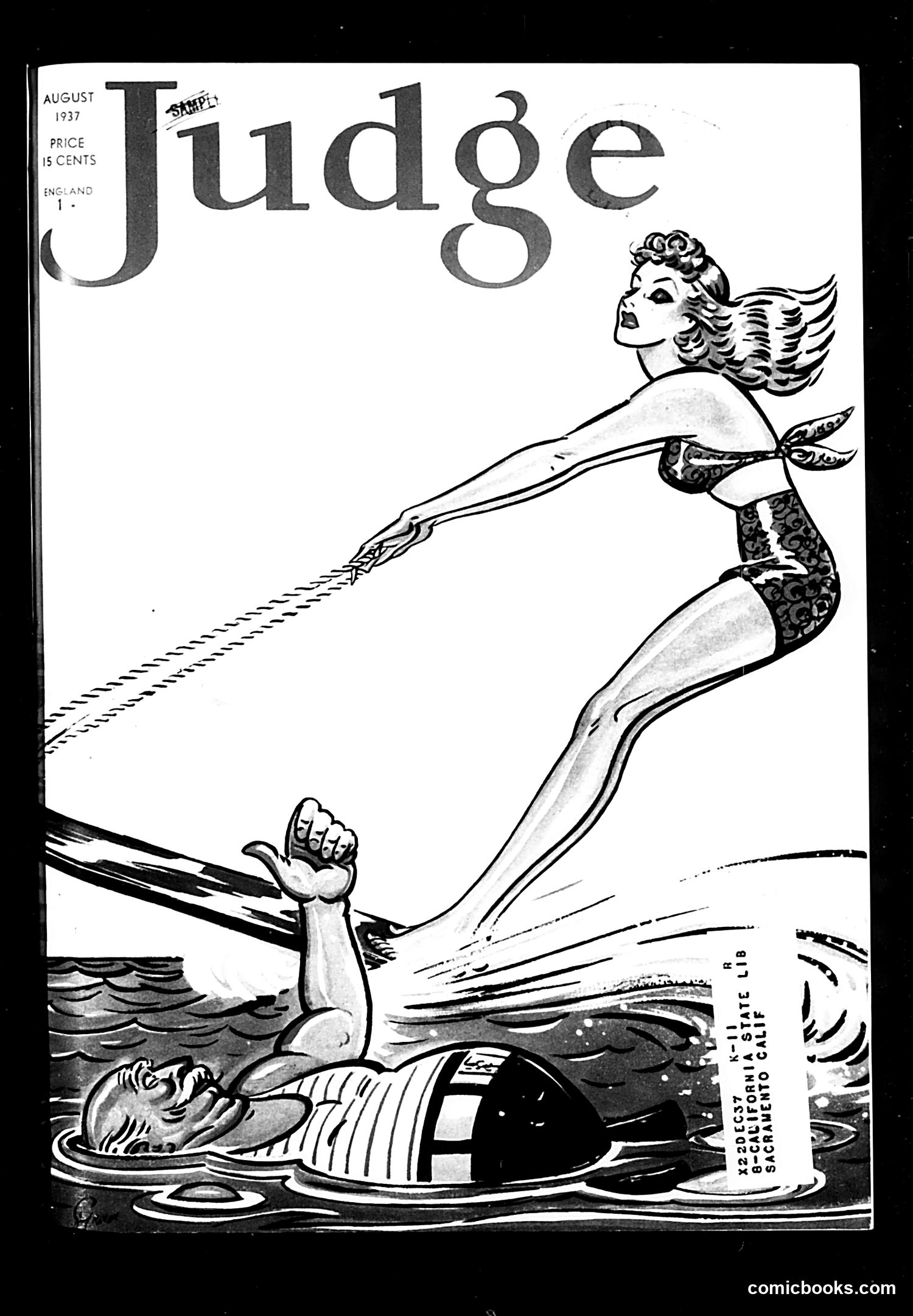
# Judge Magazine Cover Analysis - August 1937 This cover depicts a woman in a bathing suit pulling a rope attached to a drowning man in the water below. The imagery appears to be a satirical commentary on rescue or intervention, likely political in nature given Judge's satirical focus. The specific political reference is unclear without additional context from the magazine's contents. However, the 1937 date suggests it may relate to contemporary events—possibly Depression-era politics, international conflicts, or American domestic policy debates of that period. The drowning figure could represent a political faction, nation, or ideology, with the woman symbolizing American policy or a political figure intervening (or failing to intervene) appropriately. Without the accompanying article text, the precise target of satire cannot be definitively determined.
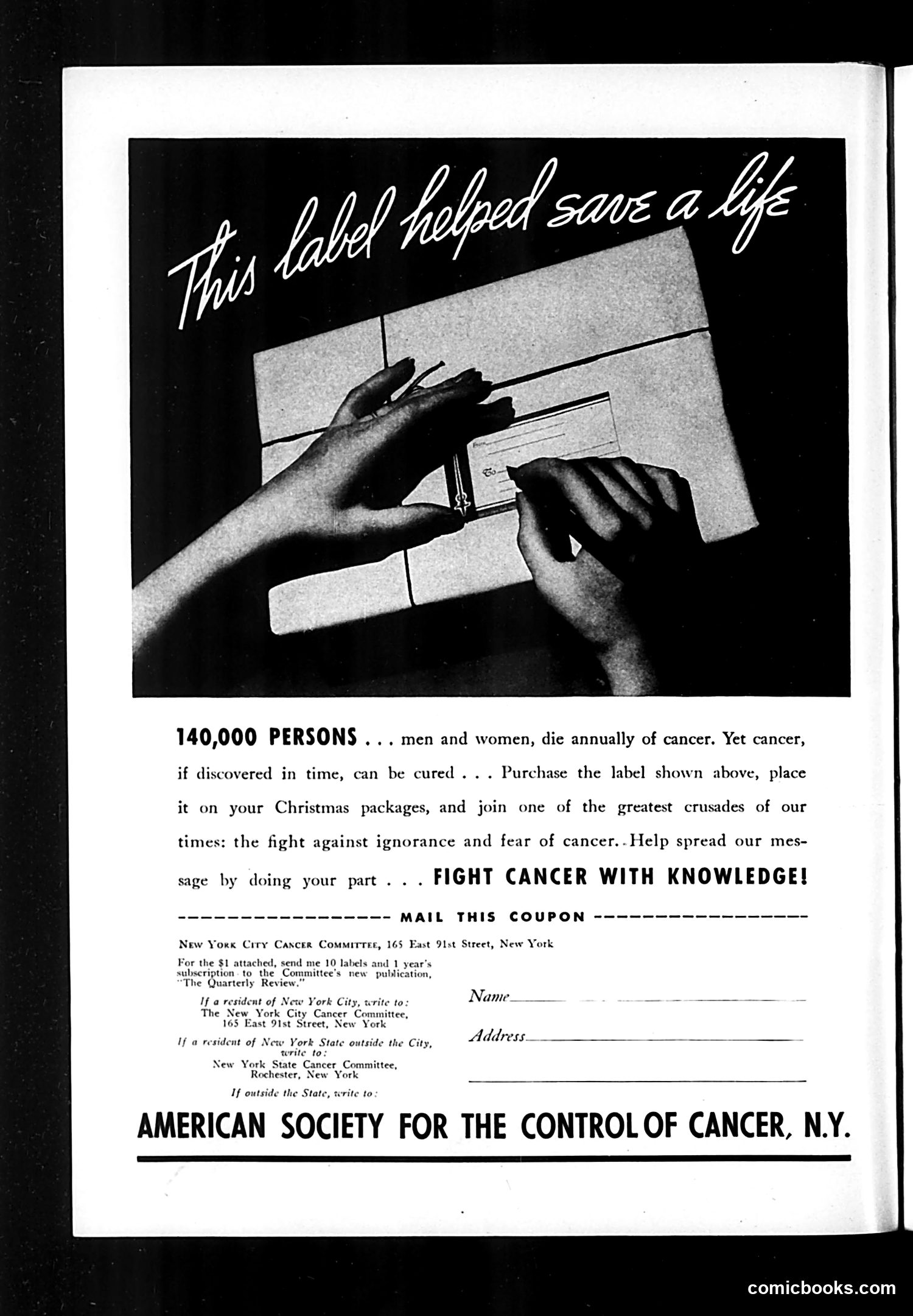
# Analysis This is primarily a **public service advertisement**, not satire or political cartoon. The American Society for the Control of Cancer (now the American Cancer Society) ran this campaign to promote cancer awareness and fundraising. The image shows **hands applying a label to a wrapped package**, visualizing the campaign's core message: purchasers should buy special labels ($1) to attach to Christmas gifts. This fundraising mechanism simultaneously spread cancer awareness and education. The headline "This label helped save a life" emphasizes early detection's importance—a revolutionary message for the era, when cancer was often discussed in whispers. The statistics cite 140,000 annual cancer deaths, positioning knowledge as the antidote to "ignorance and fear." This represents **mid-20th century health activism** through consumer participation.
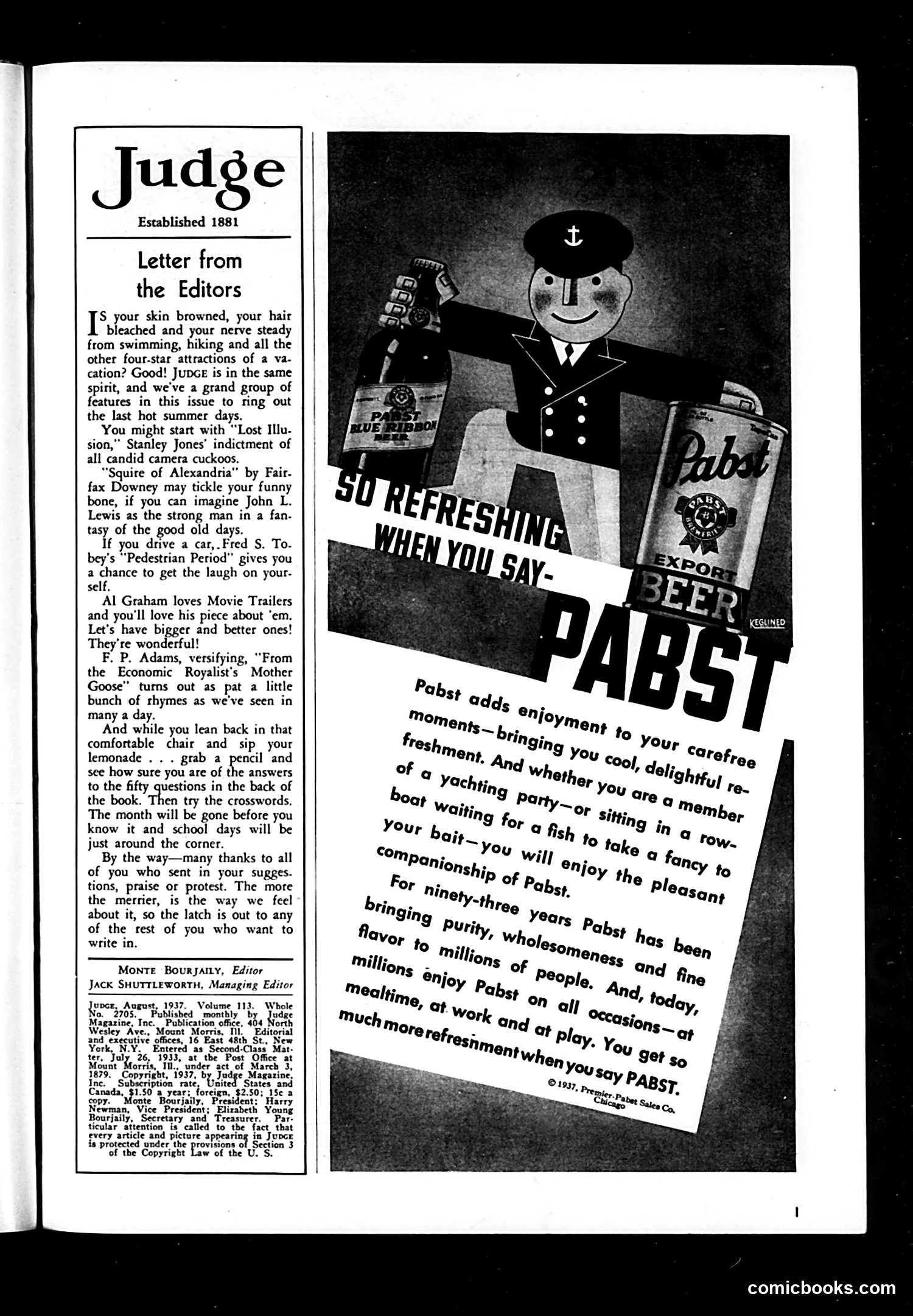
# Pabst Beer Advertisement This page is primarily a **Pabst beer advertisement**, not satirical content. The right side features a cheerful, anthropomorphized sailor character promoting Pabst Export Beer. The illustration shows him holding beer bottles with text reading "So Refreshing When You Say—PABST." The advertisement emphasizes Pabst's 93-year history, claiming it brings "purity, wholesomeness and fine flavor" to social occasions—whether at work, play, or leisure activities like boating and fishing. The left side contains Judge magazine's standard "Letter from the Editors," discussing summer activities and various entertainment features (movies, radio shows, crosswords), which is typical editorial content rather than satire.
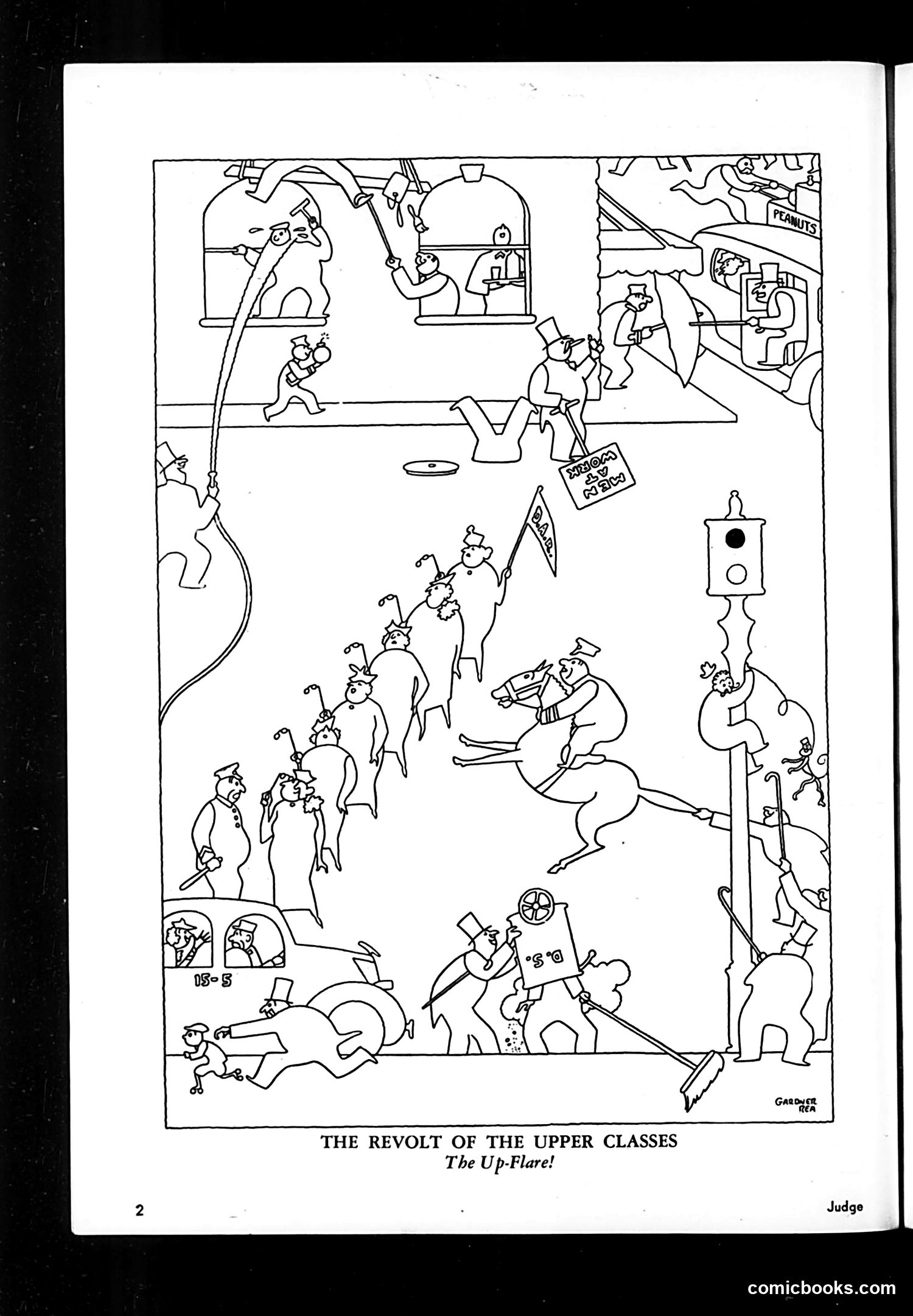
# "The Revolt of the Upper Classes: The Up-Flare!" This Judge cartoon satirizes class conflict and social upheaval, likely from the early 20th century. The title's pun "Up-Flare" suggests an uprising or explosion among the wealthy elite ("upper classes"). The illustration depicts chaos in what appears to be an upscale urban setting: well-dressed figures with top hats flee, fight, and climb buildings while ordinary people (some appearing to be workers or revolutionaries) swarm through the streets below, some carrying flags or weapons. The juxtaposition suggests satirical commentary on fears of revolution or class warfare—mocking either the upper classes' paranoia about their safety or the actual threat of organized labor movements and socialist agitation popular in this era. The cartoon's humor lies in depicting the privileged literally driven upward by social unrest.
# Cross Currents Column - August 1937 This page contains a satirical column rather than a political cartoon. The "Cross Currents" column critiques various contemporary issues through anecdotes: 1. **Steel strikes and Ohio politics**: Mocks Governor Martin Davey's handling of labor unrest at Youngstown Sheet and Tube Company, suggesting his response was inadequate. 2. **Kansas anti-snake law**: Ridicules a Kansas Assembly law prohibiting eating snakes, lizards, and spiders—satirizing legislative overreach into private life. 3. **The alligator story**: A humorous account of a Florida headline writer who, after witnessing an alligator in a swamp, becomes obsessed with writing an alligator story, eventually descending into despair over the animal's indifference to human drama. The column uses these anecdotes to satirize government ineffectiveness, absurd legislation, and the desperation of journalists seeking sensational stories.
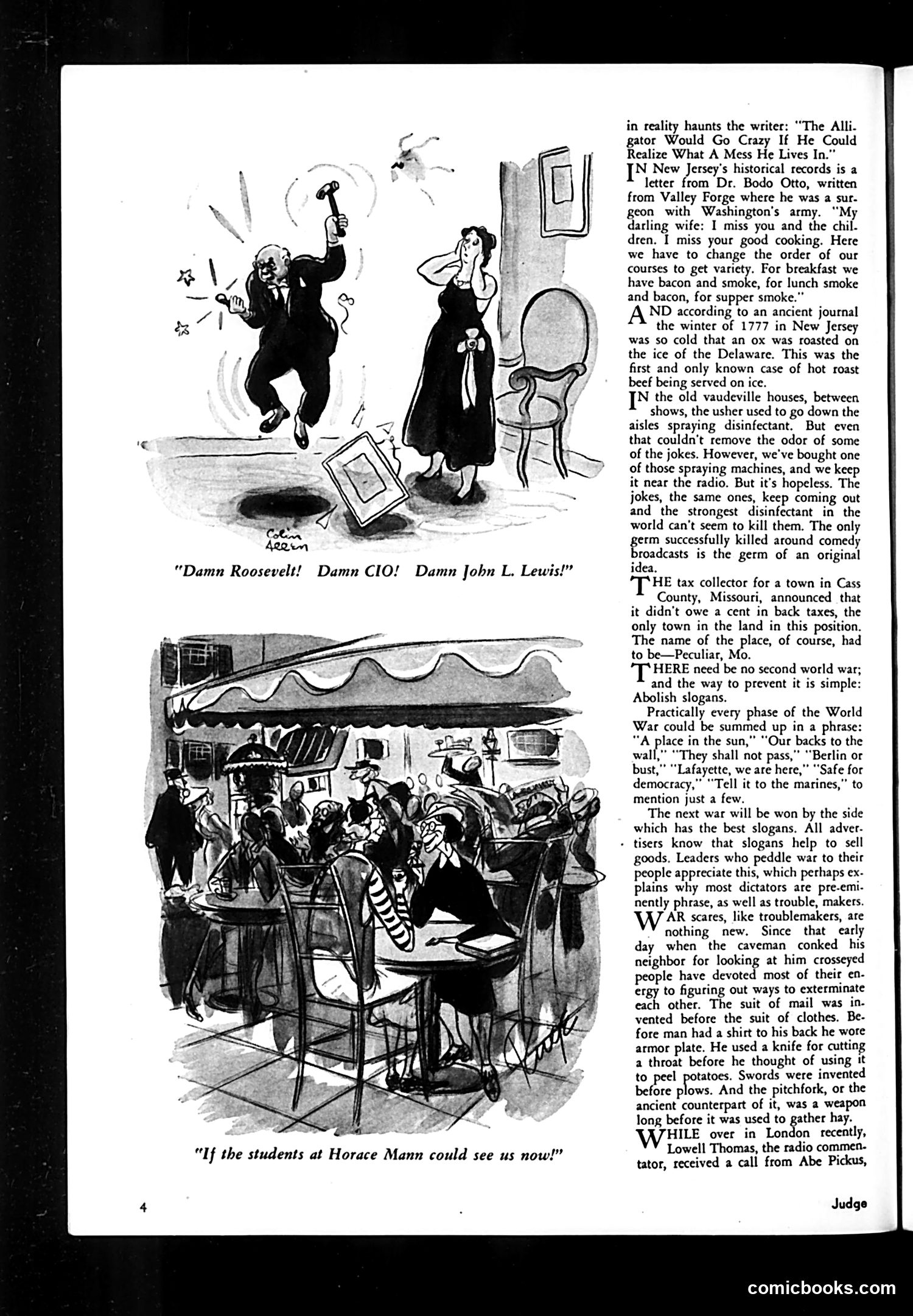
# Analysis of Judge Magazine Page The top cartoon depicts a man frantically swinging a hammer while a woman covers her ears, captioned "Damn Roosevelt! Damn CIO! Damn John L. Lewis!" This satirizes labor tensions of the 1930s-40s, mocking someone driven to fury by President Franklin D. Roosevelt's pro-labor policies, the Congress of Industrial Organizations (CIO), and labor leader John L. Lewis—all associated with union organizing that disrupted traditional management power. The lower cartoon shows a crowded wartime scene with the caption "If the students at Horace Mann could see us now!" This appears to reference WWII-era social disruption, sarcastically suggesting that pre-war civilian life at the prestigious Horace Mann School contrasts sharply with current wartime chaos and crowding. Both cartoons use exaggeration and irony to comment on contemporary anxieties about labor activism and wartime upheaval.
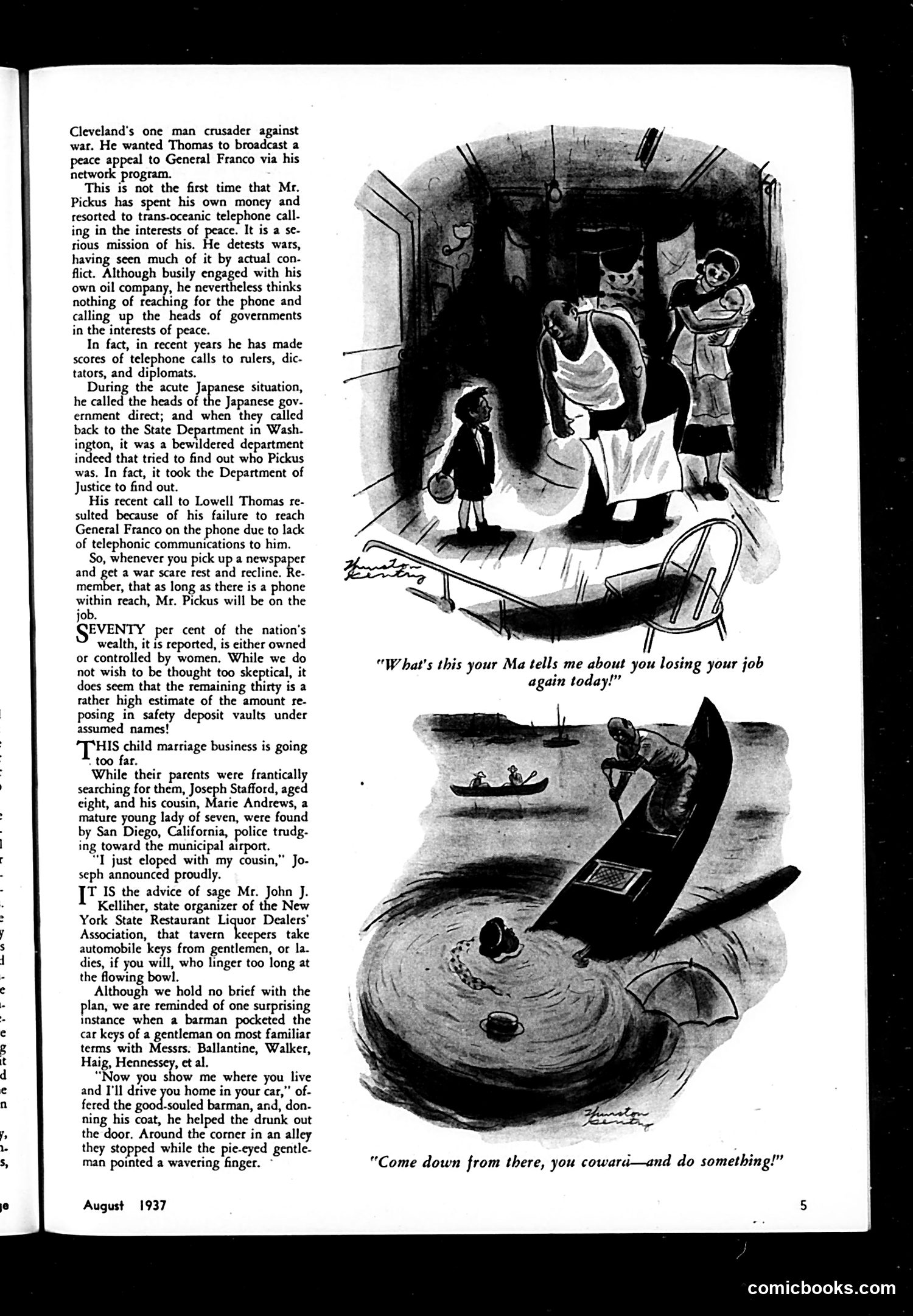
# Analysis of Judge Magazine Page (August 1937) The page contains two cartoons satirizing social issues of the Depression era: **Top cartoon**: Shows a woman confronting a man about job loss, captioned "What's this your Ma tells me about you losing your job again today!" This satirizes widespread unemployment and men's difficulty maintaining steady work during the economic crisis. **Bottom cartoon**: Depicts a figure in a rowboat telling someone on a cliff to "Come down from here, you coward—and do something!" This appears to reference suicide, likely commenting on the desperation some faced during the Depression. The accompanying text discusses Cleveland businessman Pickus's peace advocacy efforts and includes an anecdote about a tavern keeper helping a drunk man. The cartoons illustrate the period's economic hardship and its psychological toll on American families.
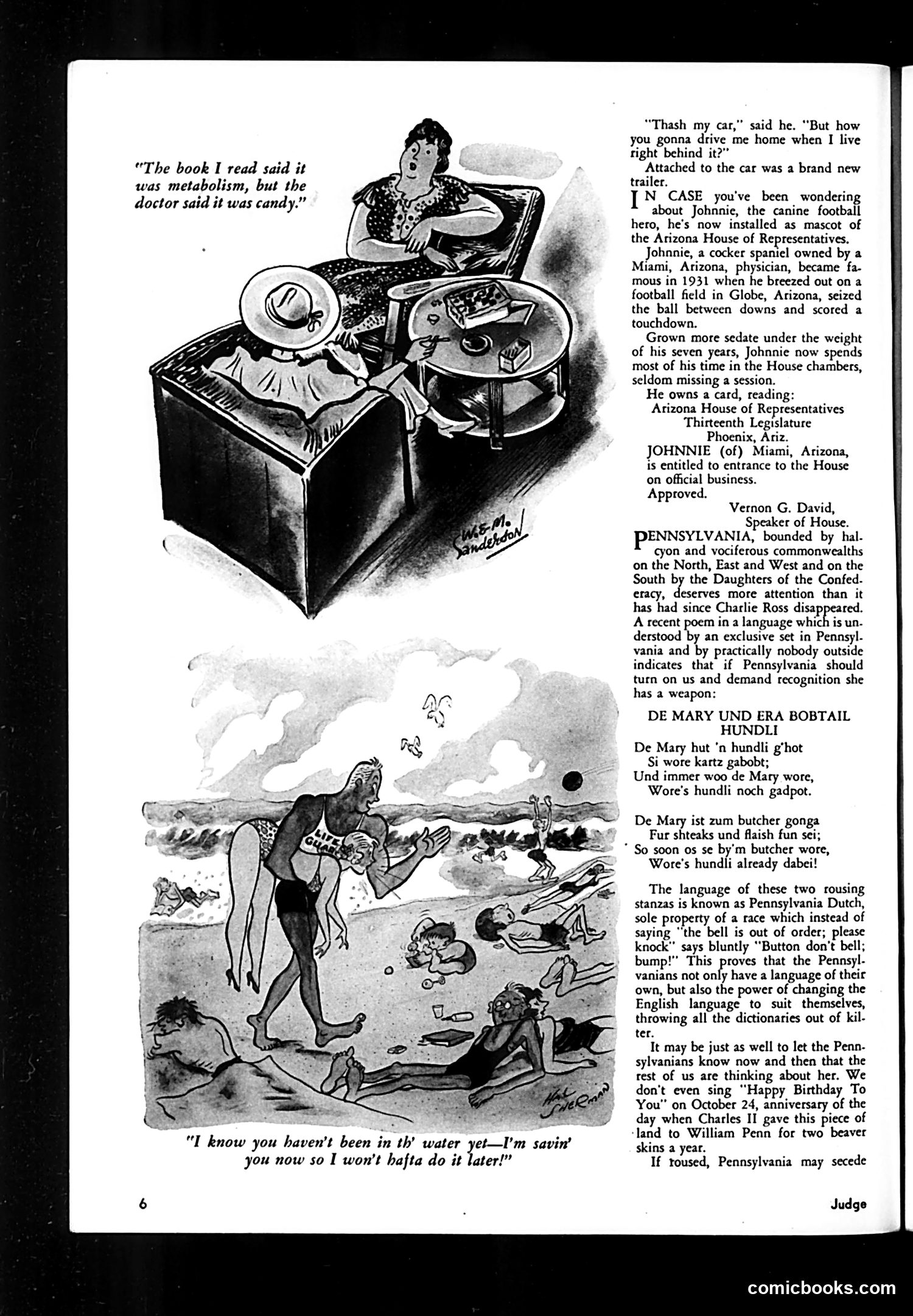
# Judge Magazine Page Analysis This page contains two cartoons and cultural commentary from Judge magazine. The **top cartoon** depicts a woman in a car with a confused male driver, satirizing the newly licensed female motorist—a social novelty in the early 20th century. The woman's quote about the book and doctor referencing candy suggests confusion or unreliability as a driver, playing on contemporary stereotypes about women drivers. The **bottom cartoon** illustrates Pennsylvania Dutch culture, accompanying an article about the Pennsylvania Dutch language and their distinctive dialect. The beach scene appears to satirize cultural practices or social customs of this Pennsylvania community. The page also includes a biographical note about **Johnnie, a cocker spaniel mascot** of the Arizona House of Representatives—an unusual honor for a dog who famously scored a touchdown in 1931.
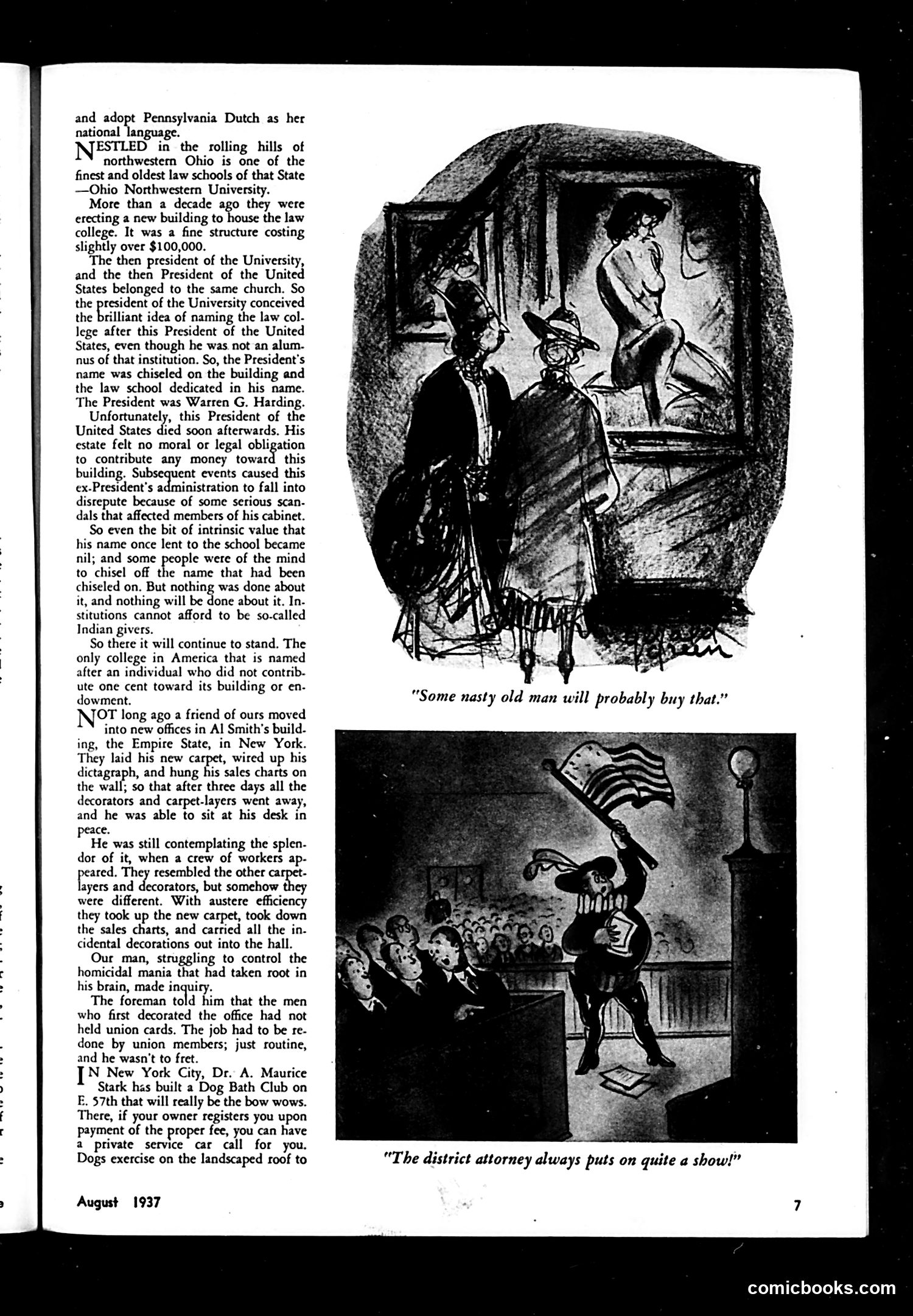
# Analysis of Judge Magazine Page, August 1937 This page contains two satirical cartoons commenting on 1930s American life and labor relations. The **top cartoon** depicts an antique dealer or shop owner showing a customer an old, worn item, with the caption "Some nasty old man will probably buy that." The satire appears to mock both wealthy collectors of worthless antiques and the salesmanship tactics used to move merchandise. The **bottom cartoon**, captioned "The district attorney always puts on quite a show!" shows what appears to be a theatrical court scene with an American flag, suggesting satire about prosecutorial grandstanding or performative justice—implying district attorneys prioritize public spectacle over genuine legal process. Both cartoons reflect 1930s skepticism toward institutions and commercialism, typical of Judge magazine's satirical approach to contemporary social issues.
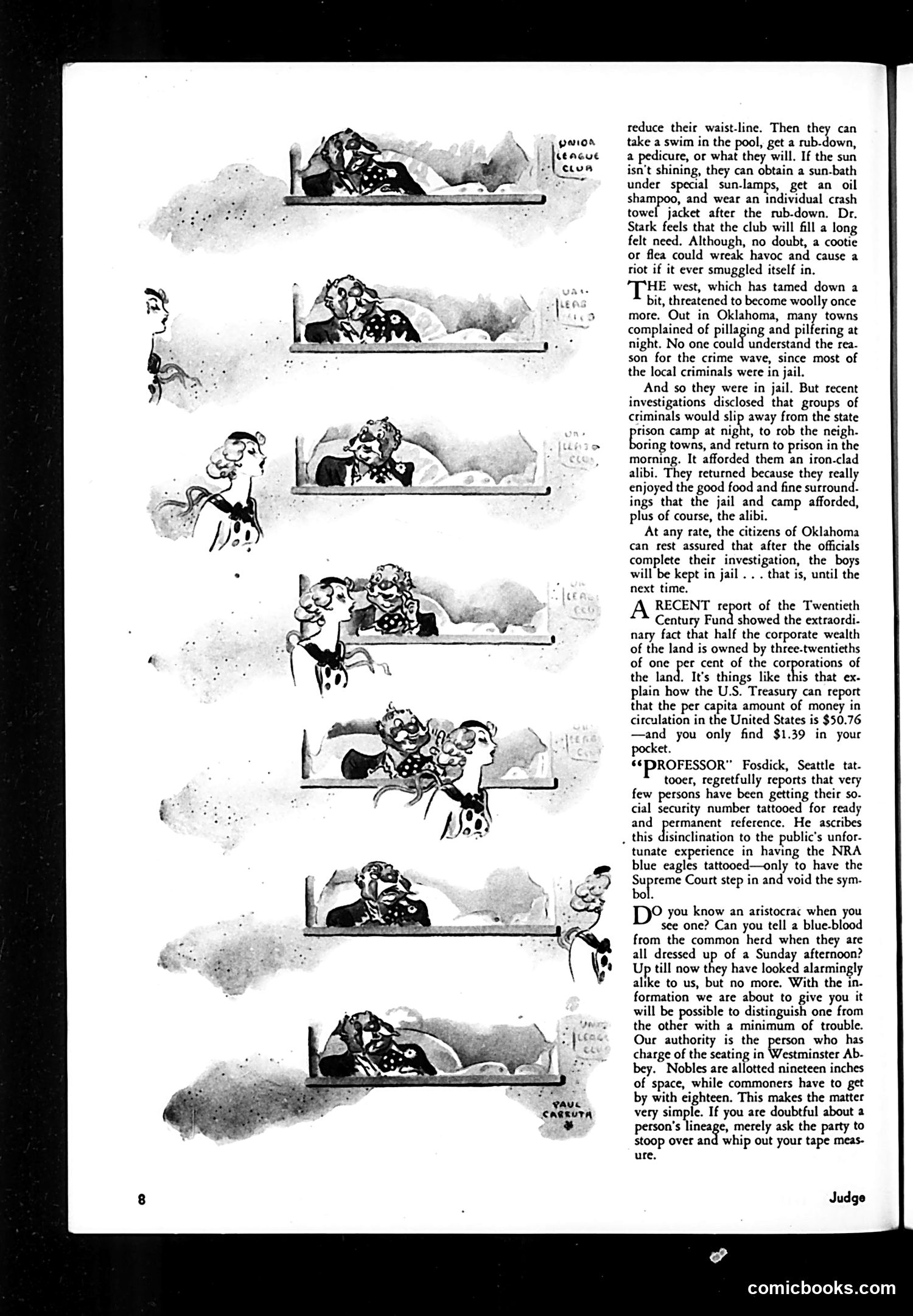
# Analysis The left side contains a visual comic strip (credited to Paul Kearney) showing progressive crowding of people in bed—beginning with one couple and ending with many figures squeezed together. This illustrates a space-saving or overcrowding joke, likely mocking apartment living or resource scarcity. The text covers several satirical items: 1. **A health club** promoting luxury amenities (pools, sun-lamps, massages)—social commentary on leisure spending. 2. **Oklahoma crime wave**: A darkly comic piece about criminals escaping from a prison camp at night to rob neighboring towns, then returning to enjoy the jail's superior food and amenities. The satire targets both criminal absurdity and possibly Depression-era prison conditions being better than outside poverty. 3. **Wealth inequality**: References a Twentieth Century Fund report showing extreme corporate wealth concentration, contrasting the nation's reported per-capita circulation ($50.76) against ordinary people's actual cash ($1.39)—mocking economic statistics' disconnect from reality. 4. **Social Security tattoos and NRA**: Notes reluctance to tattoo social security numbers, attributed to public distrust following the NRA symbol being voided by the Supreme Court. 5. **Class distinction**: Humorously proposes measuring Westminster Abbey seating (19 inches for nobles, 18 for commoners) as a method to identify aristocrats—satirizing class pretension.
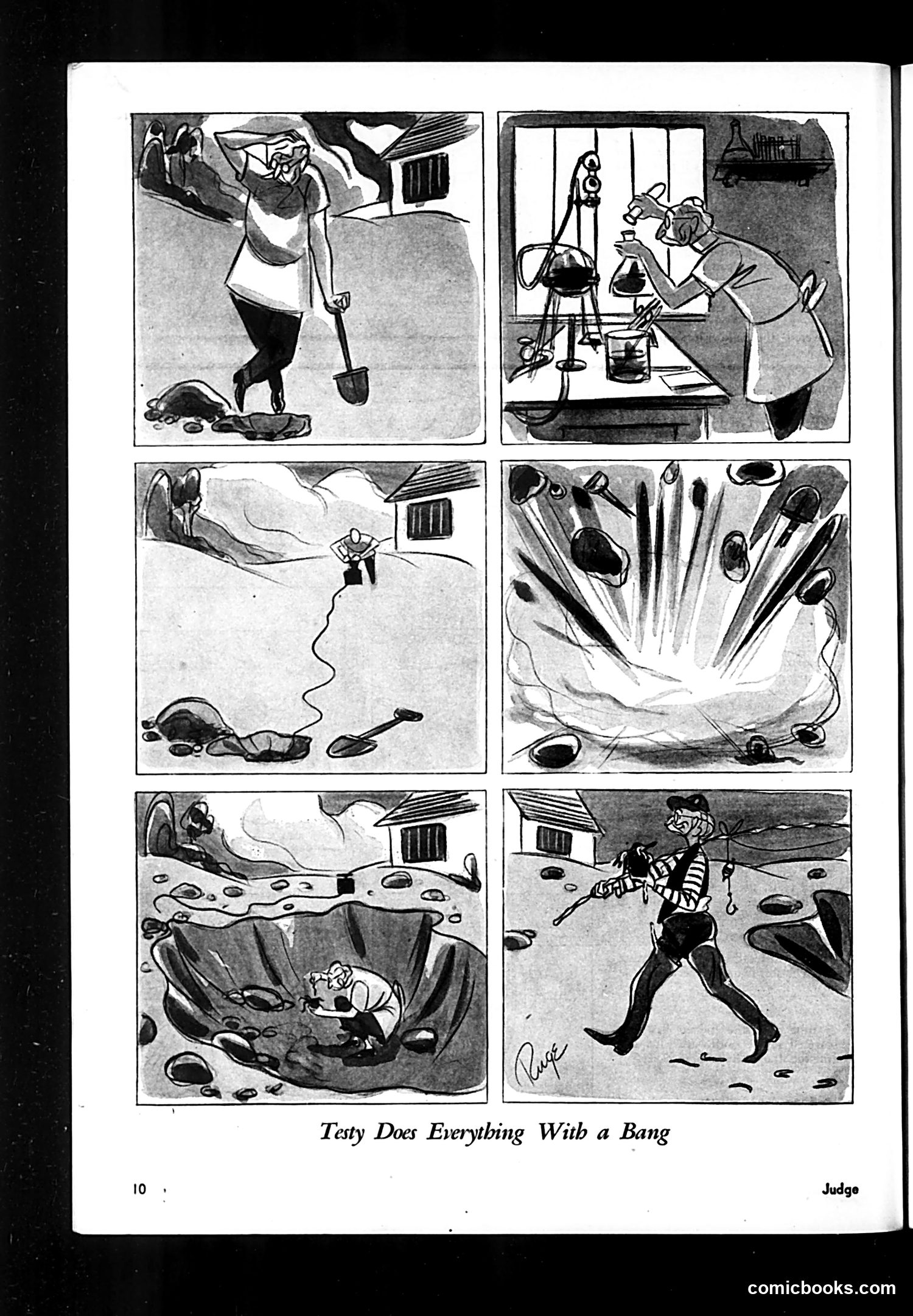
# Analysis This is a six-panel comic strip titled "Testy Does Everything With a Bang." The humor derives from a character named Testy who approaches mundane tasks with exaggerated, explosive violence: 1. **Panel 1**: Testy digs with a shovel using explosive force 2. **Panel 2**: He conducts a chemistry experiment with dramatic explosions 3. **Panel 3**: His thoughts manifest as chaotic, explosive imagery 4. **Panel 4**: Tools and objects explode outward violently 5. **Panel 5**: He creates a crater or pit with explosive digging 6. **Panel 6**: He appears to be running or fleeing from the chaos The satire mocks temperamental or irritable people who tackle ordinary activities with unnecessary aggression and drama. "Testy" (meaning irritable or quarrelsome) is the character's personality trait, visualized literally through destructive, explosive behavior. The joke is that this personality type turns simple tasks into catastrophic events.
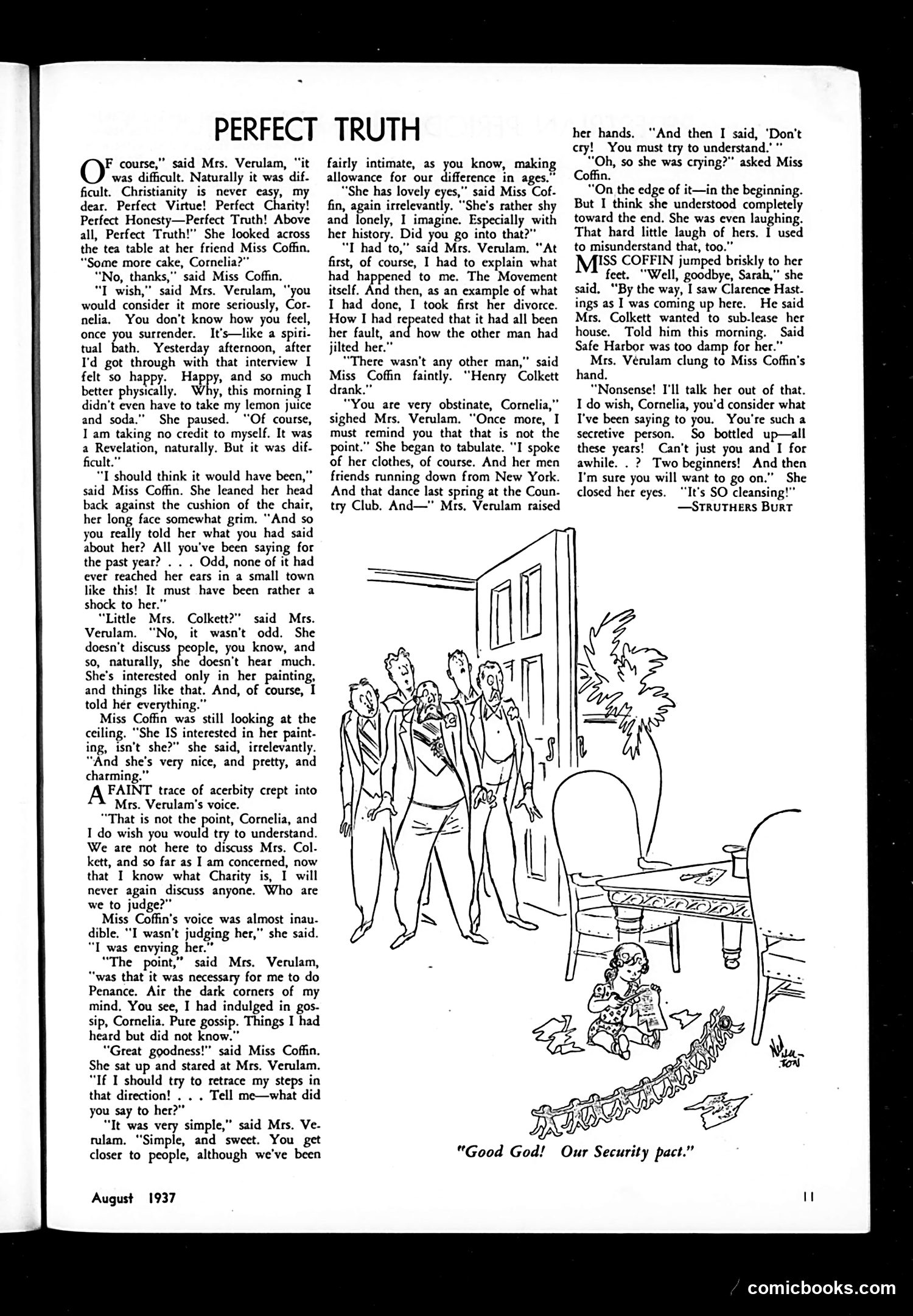
# Analysis of "Perfect Truth" This satirical short story mocks self-righteous hypocrisy disguised as religious virtue. Mrs. Verulam represents a common social type: the sanctimonious gossip who convinces herself that spreading rumors and invading others' privacy is actually *charitable penance*. The humor lies in the contradiction: Mrs. Verulam claims to have achieved "Perfect Truth" and "Perfect Charity" through Christianity, yet she's actually engaged in vicious gossip about her neighbor Mrs. Colkett—fabricating details (a supposed affair and divorce) that are demonstrably false (Miss Coffin reveals the real issue was her husband's alcoholism). Miss Coffin serves as the moral counterpoint, quietly pointing out Mrs. Verulam's self-deception with devastating understatement ("I was envying her" about the virtuous Mrs. Colkett). The cartoon below shows people reacting with alarm to what appears to be a security threat, likely commenting on contemporary 1937 anxieties about social disorder or invasion of privacy—echoing the story's theme about breaches of personal boundaries. The satire targets middle-class moral self-delusion and how religious language enables cruelty.