
Judge, 1937-08 · page 5 of 37
Judge — August 1937 — page 5: what you’re looking at
What you’re looking at
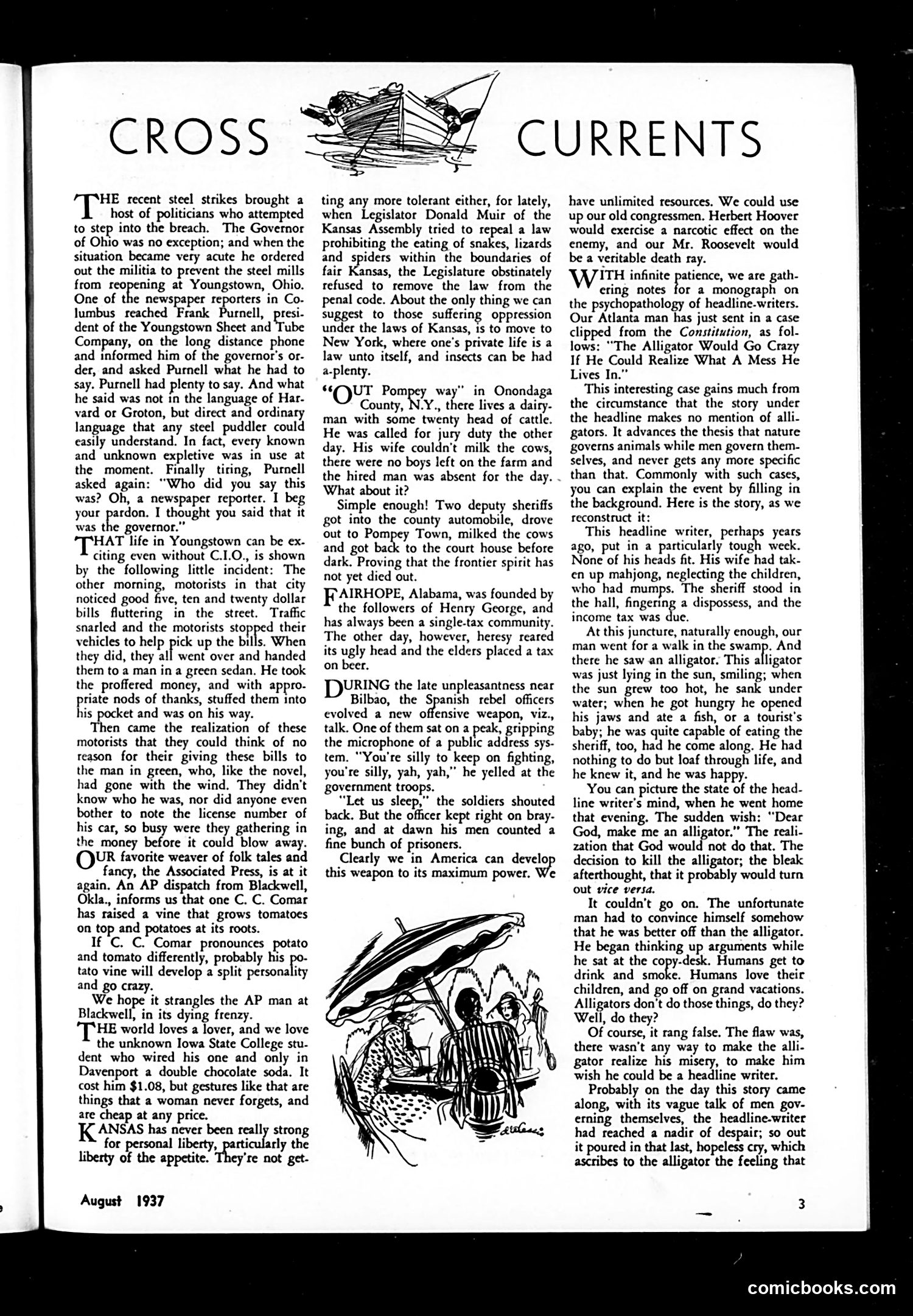
# Cross Currents Column - August 1937 This page contains a satirical column rather than a political cartoon. The "Cross Currents" column critiques various contemporary issues through anecdotes: 1. **Steel strikes and Ohio politics**: Mocks Governor Martin Davey's handling of labor unrest at Youngstown Sheet and Tube Company, suggesting his response was inadequate. 2. **Kansas anti-snake law**: Ridicules a Kansas Assembly law prohibiting eating snakes, lizards, and spiders—satirizing legislative overreach into private life. 3. **The alligator story**: A humorous account of a Florida headline writer who, after witnessing an alligator in a swamp, becomes obsessed with writing an alligator story, eventually descending into despair over the animal's indifference to human drama. The column uses these anecdotes to satirize government ineffectiveness, absurd legislation, and the desperation of journalists seeking sensational stories.
📄 Transcribed text from this page (OCR, searchable)
Machine-transcribed from the original scan — historical spelling and the odd misread are preserved.
"Tse recent steel strikes brought a host of politicians who attempted to step into the breach. The Governor of Ohio was no exception; and when the situation became very acute he ordered out the militia to prevent the steel mills from reopening at Youngstown, Ohio. One of the newspaper reporters in Co- lumbus reached Frank Purnell, presi- dent of the Youngstown Sheet and Tube Company, on the long distance phone and informed him of the governor's or- der, and asked Purnell what he had to say. Purnell had plenty to say. And what he said was not in the language of Har- vard or Groton, but direct and ordinary language that any steel puddler could easily understand. In fact, every known and unknown expletive was in use at the moment. Finally tiring, Purnell asked again: “Who did you say this was? Oh, a newspaper reporter. I beg your person: I thought you said that it was the governor.” ‘THAT life in Youngstown can be ex- citing even without C.1.0., is shown by the following little incident: The other morning, motorists in that city noticed good five, ten and twenty dollar bills fluttering in the street. Traffic snarled and the motorists stopped their vehicles to help pick up the bills. When they did, they all went over and handed them to a man in a green sedan. He took the proffered money, and with appro. priate nods of thanks, stuffed them into his pocket and was on his way. Then came the realization of these motorists that they could think of no reason for their giving these bills to the man in green, who, like the novel, had gone with the wind. They didn’t know who he was, nor did anyone even bother to note the license number of his car, so busy were they gathering in the money before it could blow away. UR favorite weaver of folk tales and fancy, the Associated Press, is at it again. An AP dispatch from Blackwell, Okla., informs us that one C. C. Comar has raised a vine that grows tomatoes on top and potatoes at its roots. If C. C. Comar pronounces potato and tomato differently, probably his po- tato vine will develop a split personality and go crazy. We hope it strangles the AP man at Blackwell, in its dying frenzy. ‘THE world loves a lover, and we love the unknown Iowa State College stu- dent who wired his one and only in Davenport a double chocolate soda. It cost him $1.08, but gestures like that are things that a woman never forgets, and are cheap at any price. ANSAS. has pores been really strong for personal lil , particularly the liberty of the appetite. ‘They're not get August 1937 CURRENTS ting any more tolerant either, for lately, when Legislator Donald Muir of the Kansas Assembly tried to repeal a law prohibiting the eating of snakes, lizards and spiders within the boundaries of fair Kansas, the Legislature obstinately refused to remove the law from the penal code. About the only thing we can suggest to those suffering oppression under the laws of Kansas, is to move to New York, where one’s private life is a law unto itself, and insects can be had * in Onondaga », there lives a dairy- man with some twenty head of cattle. He was called for jury duty the other day. His wife couldn't milk the cows, there were no boys left on the farm and the hired man was absent for the day. What about it? Simple enough! Two deputy sheriffs got into the county automobile, drove out to Pompey Town, milked the cows and got back to the court house before dark. Proving that the frontier spirit has not yet died out. FAIRHOPE, Alabama, was founded by the followers of Henry George, and has always been a single-tax community. The other day, however, heresy reared its ugly head and the elders placed a tax on beer. DURING the late unpleasantness near Bilbao, the Spanish rebel officers evolved a new offensive weapon, viz., talk. One of them sat on a peak, gripping the microphone of a public address sys- tem. “You're silly to keep on fighting, you're silly, yah, yah,” he yelled at the government troops. “Let us sleep,” the soldiers shouted back. But the officer kept right on bray- ing, and at dawn his men counted a fine bunch of prisoners. Clearly we in America can develo} this weapon to its maximum power. We have unlimited resources. We could use up our old congressmen. Herbert Hoover would exercise a narcotic effect on the enemy, and our Mr. Roosevelt would be a veritable death ray. WH infinite patience, we are gath- ering notes for a monograph on the psychopathology of headline-writers. Our Atlanta man has just sent in a case clipped from the Constitution, as fol- lows: “The Alligator Would Go Crazy If He Could Realize What A Mess He Lives In.” This interesting case gains much from the circumstance that the story under the headline makes no mention of alli- gators. It advances the thesis that nature governs animals while men govern them. selves, and never gets any more specific than that. Commonly with such cases, you can explain the event by filling in the background. Here is the story, as we reconstruct it: This headline writer, perhaps years ago, put in a particularly tough week. None of his heads fit. His wife had tak- en up mahjong, neglecting the children, who had mumps. The sheriff stood in the hall, fingering a dispossess, and the income tax was duc. At this juncture, naturally enough, our man went for a walk in the swamp. And there he saw an alligator. This alligator was just lying in the sun, smiling; when the sun grew too hot, he sank under water; when he got hungry he opened his jaws and ate a fish, or a tourist's baby; he was quite capable of eating the sheriff, too, had he come along. He had nothing to do but loaf through life, and he knew it, and he was happy. You can picture the state of the head- line writer's mind, when he went home that evening. The sudden wish: “Dear God, make me an alligator.” The reali- zation that God would not do that. The decision to kill the alligator; the bleak afterthought, that it probably would turn out vice versa. It couldn't go on. The unfortunate man had to convince himself somehow that he was better off than the alligator. He began thinking up arguments while he sat at the copy-desk. Humans get to drink and smoke. Humans love their children, and go off on grand vacations. Alligators don’t do those things, do they? Well, do they? Of course, it rang false. The flaw was, there wasn’t any way to make the alli- gator realize his misery, to make him wish he could be a headline writer. Probably on the day this story came along, with its vague talk of men gov- erning themselves, the headline-writer had reached a nadir of despair; so out it poured in that last, hopeless cry, which ascribes to the alligator the feeling that comicbooks.com