
Judge, 1937-08 · page 24 of 37
Judge — August 1937 — page 24: what you’re looking at
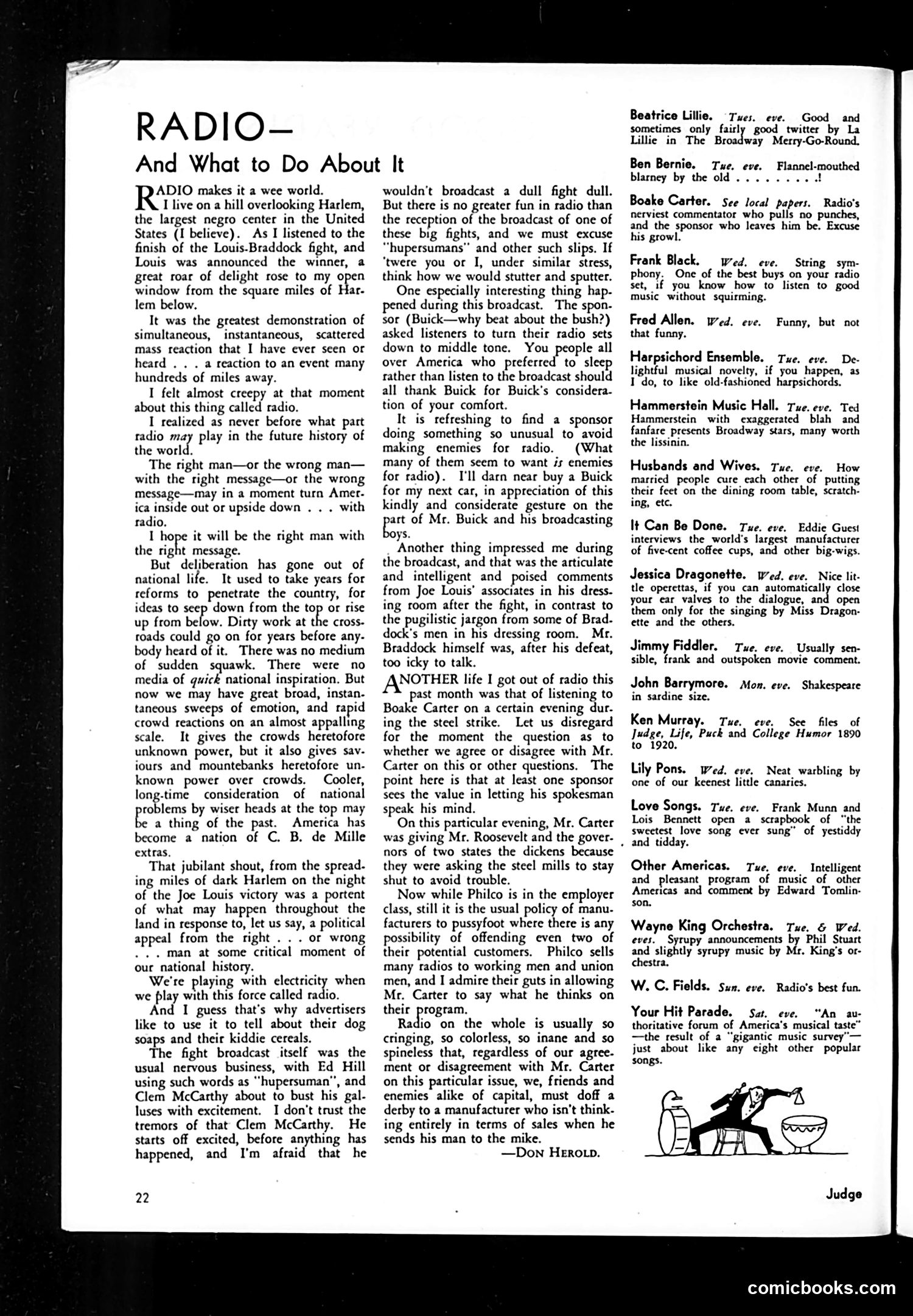
A restored page from Judge, 1937-08. Page through the whole issue in the reader above.
📄 Transcribed text from this page (OCR, searchable)
Machine-transcribed from the original scan — historical spelling and the odd misread are preserved.
RADIO— And What to Do About It ADIO makes it a wee world. 1 live on a hill overlooking Harlem, the largest negro center in the United States (I believe). As I listened to the finish of the Louis-Braddock fight, and Louis was announced the winner, a great roar of delight rose to my open window from the square miles of Har. lem below. It was the greatest demonstration of simultaneous, instantaneous, scattered mass reaction that I have ever seen or heard . . . a reaction to an event many hundreds of miles away. I felt almost creepy at that moment about this thing called radio. I realized as never before what part radio may play in the future history of the world. The right man—or the wrong man— with the right message—or the wrong message—may in a moment turn Amer- ica inside out or upside down . . . with radio. I hope it will be the right man with the right message. But deliberation has gone out of national life. It used to take years for reforms to penetrate the country, for ideas to seep down from the top or rise up from below. Dirty work at the cross- toads could go on for years before any- body heard of it. There was no medium of sudden squawk. There were no media of quick national inspiration. But now we may have great broad, instan- taneous sweeps of emotion, and rapid crowd reactions on an almost appalling scale. It gives the crowds heretofore unknown power, but it also gives sav- iours and mountebanks heretofore un- known power over crowds. Cooler, long-time consideration of national roblems by wiser heads at the top may EB a thing of the past. America has become a nation of C. B. de Mille extras. That jubilant shout, from the spread- ing miles of dark Harlem on the night of the Joe Louis victory was a portent of what may happen throughout the land in response to, let us say, a political appeal from the right . . . or wrong . man at some critical moment of our national history. We're playing with electricity when we play with this force called radio. And I guess that's why advertisers like to use it to tell about their dog soaps and their kiddie cereals. The fight broadcast itself was the usual nervous business, with Ed Hill using such words as “hupersuman”, and Clem McCarthy about to bust his gal- luses with excitement. I don’t trust the tremors of that Clem McCarthy. He starts off excited, before anything has happened, and I'm afraid that he 22 wouldn't broadcast a dull fight dull. But there is no greater fun in radio than the reception of the broadcast of one of these big fights, and we must excuse “hupersumans” and other such slips. If ‘twere you or I, under similar stress, think how we would stutter and sputter. One especially interesting thing hap- pened during this broadcast. The spon- sor (Buick—why beat about the bush?) asked listeners to turn their radio sets down to middle tone. You people all over America who preferred to sleep rather than listen to the broadcast should all thank Buick for Buick's considera- tion of your comfort. It is refreshing to find a sponsor doing something so unusual to avoid making enemies for radio. (What many of them seem to want is enemies for radio). I'll darn near buy a Buick for my next car, in appreciation of this kindly and considerate gesture on the pt of Mr. Buick and his broadcasting ys. ‘nother thing impressed me during the broadcast, and that was the articulate and intelligent and poised comments from Joe Louis’ associates in his dress- ing room after the fight, in contrast to the pugilistic jargon from some of Brad- dock’s men in his dressing room. Mr. Braddock himself was, after his defeat, too icky to talk. ANOTHER life I got out of radio this past month was that of listening to Boake Carter on a certain evening dur. ing the steel strike. Let us disregard for the moment the question as to whether we agree or disagree with Mr. Carter on this or other questions. The point here is that at least one sponsor sees the value in letting his spokesman speak his mind. On this particular evening, Mr. Carter was giving Mr. Roosevelt and the gover- nors of two states the dickens because they were asking the steel mills to stay shut to avoid trouble. Now while Philco is in the employer class, still it is the usual policy of manu- facturers to pussyfoot where there is any possibility of offending even two of their potential customers. Philco sells many radios to working men and union men, and I admire their guts in allowing Mr. Carter to say what he thinks on their program. Radio on the whole is usually so cringing, so colorless, so inane and so spineless that, regardless of our agree- ment or disagreement with Mr. Carter on this particular issue, we, friends and enemies alike of capital, must doff a derby to a manufacturer who isn’t think. ing entirely in terms of sales when he sends his man to the mike. —Don Hero.p. Beatrice Lillie. Tues. eve. Good and sometimes only fairly good twitter by La Lillie in The Broadway Merry-Go-Round. Ben Bernie. Tue. eve. blarney by the old Boake Carter. See local papers. Radio's nerviest commentator who pulls no punches, and the sponsor who leaves him be. Excuse his growl. Frank Black. wed. eve. String sym- phony. One of the best buys on your radio set, if you know how to listen to good music without squirming. Fred Allen. that funny. Wed. eve. Funny, but not Harpsichord Ensemble. Tue. eve. De- lightful musical novelty, if you happen, as I do, to like old-fashioned harpsichords. Hammerstein Music Hall. Tue. eve. Ted Hammerstein with exaggerated blah and fanfare presents Broadway stars, many worth the lissinin. Husbands and Wives. Twe. eve. How married people cure each other of putting their feet on the dining room table, scratch- ing, etc. It Can Be Done. Twe. eve. Eddie Guest interviews the world’s largest manufacturer of five-cent coffee cups, and other big-wigs. Jessica Dragonette. wed. eve. Nice lit- tle operettas, if you can automatically close your ear valves to the dialogue, and open them only for the singing by Miss Dragon- ette and the others. Jimmy Fiddler. Tue. eve. Usually sen- sible, frank and outspoken movie comment. John Barrymore. Mon. eve. Shakespeare in sardine size. Ken Murray. Tue. eve. See files of Judge, Life, Puck and College Humor 1890 to 1920. Lily Pons. wed. eve, Neat. warbling by one of our keenest little canaries. Love Songs. Twe. eve. Frank Munn and Lois Bennett open a scrapbook of “the sweetest love song ever sung” of yestiddy . and tidday. Other Americas. Tue, eve. Intelligent and pleasant program of music of other Americas and comment by Edward Tomlin- son, Wayne King Orchestra. Tue. & Wed. eves. Syrupy announcements by Phil Stuart and slightly syrupy music by Mr. King’s or- chestra, W. C. Fields. Sun. eve, Radio's best fun. Your Hit Parade. Sat. eve. “An au- thoritative forum of America’s musical taste” —the result of a “gigantic music survey"— just about like any eight other popular comicbooks.com