
Judge, 1937-08 · page 25 of 37
Judge — August 1937 — page 25: what you’re looking at
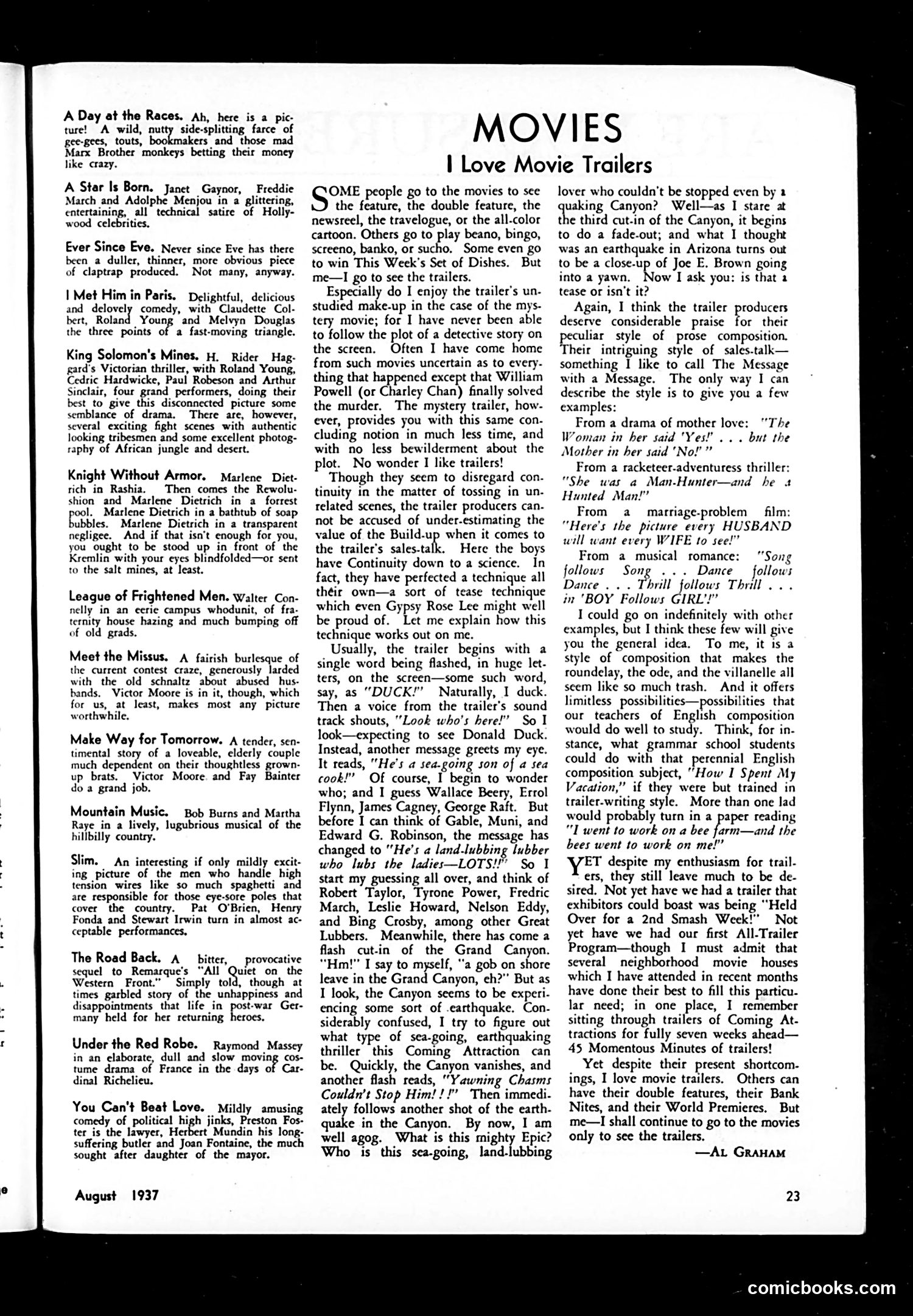
A restored page from Judge, 1937-08. Page through the whole issue in the reader above.
📄 Transcribed text from this page (OCR, searchable)
Machine-transcribed from the original scan — historical spelling and the odd misread are preserved.
A Day at the Races. Ah, here is a pic- ture! A wild, nutty side-splitting farce of gee-gees, touts, makers and those mad Marx Brother ‘monkeys betting their money like crazy. A Star Is Born. Janet Gaynor, Freddie March and Adolphe Menjou in a glittering, entertaining, all technical satire of Holly- wood celebrities. Ever Since Eve. Never since Eve has there been a duller, thinner, more obvious piece of claptrap produced. Not many, anyway. | Met Him in Paris. Delightful, delicious and delovely comedy, with Claudette Col- bert, Roland Young and Melvyn Douglas the three points fa fast-moving triangle. King Solomon's Mines. H. Rider Hag- gard’s Victorian thriller, with Roland Young, Cedric Hardwicke, Paul Robeson and Arthur Sinclair, four grand performers, doing their best to give this disconnected picture some semblance of drama. There are, however, several exciting fight scenes with authentic looking tribesmen and some excellent photog- raphy of African jungle and desert. Knight Without Armor. Marlene Diet- rich in Rashia. Then comes the Rewolu- shion and Marlene Dietrich in a forrest ool. Marlene Dietrich in a bathtub of soap ubbles. Marlene Dietrich in a transparent negligee. And if that isn’t enough for you, you ought to be stood up in front of the Kremlin with your eyes blindfolded—or sent to the salt mines, at least. League of Frightened Men. walter Con- nelly in an eerie campus whodunit, of fra- ternity house hazing and much bumping off of old grads. Meet the Missus. A fairish burlesque of the current contest craze, generously with the old schnaltz about abused hus- hands. Victor Moore is in it, though, which for us, at least, makes most any picture worthwhile, jarded Make Way for Tomorrow. A tender, sen- timental story of a loveable, elderly couple much dependent on their thoughtless grown- up brats. Victor Moore. and Fay Bainter doa grand job. Mountain Music. Bob Burns and Martha Raye in a lively, lugubrious musical of the hillbilly country. Slim. An interesting if only mildly excit- ing picture of the men who handle high tension wires like so much spaghetti and are responsible for those eye-sore poles that cover the country. Pat O'Brien, Henry Fonda and Stewart Irwin turn in almost ac- ceptable performances, The Road Back. A bitter, _ provocative sequel to Remarque’s “All ‘Quiet on, the Western Front.” Simply told, though at times garbled story of the unhappiness and disappointments that life in post-war Ger- many held for her returning heroes. Under the Red Robe. Raymond Massey in an elaborate, dull and slow moving cos- tume drama of France in the days of Car- dinal Richelieu. You Can't Beat Love. Mildly amusing comedy of political high jinks, Preston Fos- ter is the lawyer, Herbert Mundin his long- suffering butler and Joan Fontaine, the much sought after daughter of the mayor. August 1937 MOVIES | Love Movie Trailers Sone people go to the movies to see the feature, the double feature, the newsreel, the travelogue, or the all-color cartoon. Others go to play beano, bingo, screeno, banko, or sucho. Some even go to win This Week's Set of Dishes. But me—I go to see the trailers. Especially do I enjoy the trailers un- studied make-up in the case of the mys- tery movie; for I have never been able to follow the plot of a detective story on the screen. Often I have come home from such movies uncertain as to every- thing that happened except that William Powell (or Charley Chan) finally solved the murder. The mystery trailer, how- ever, provides you with this same con. cluding notion in much less time, and with no less bewilderment about the plot. No wonder I like trailers! Though they seem to disregard con. tinuity in the matter of tossing in un- related scenes, the trailer producers can. not be accused of under-estimating the value of the Build-up when it comes to the trailer’s sales-talk. Here the boys have Continuity down to a science. In fact, they have perfected a technique all théir own—a sort of tease technique which even Gypsy Rose Lee might well be proud of. Let me explain how this technique works out on me. Usually, the trailer begins with a single word being flashed, in huge let- ters, on the screen—some such word, say, as “DUCK!” Naturally, I duck. Then a voice from the trailer’s sound track shouts, "Look who's here!” Sol look—expecting to see Donald Duck. Instead, another message greets my eye. It reads, He's a sea.going son of a sea cook!” Of course, I begin to wonder who; and I guess Wallace Beery, Errol Flynn, James Cagney, George Raft. But before I can think of Gable, Muni, and Edward G. Robinson, the message has changed to "He's a land-lubbing lubber who lubs the ladies—LOTS!!" So 1 start my guessing all over, and think of Robert Taylor, Tyrone Power, Fredric March, Leslie Howard, Nelson Eddy, and Bing Crosby, among other Great Lubbers. Meanwhile, there has come a flash cut-in of the Grand Canyon. “Hm!” I say to eel, “a gob on shore leave in the Grand Canyon, eh?" But as I look, the Canyon seems to be experi- encing some sort of .earthquake. Con- siderably confused, I try to figure out what type of sea-going, earthquaking thriller this Coming Attraction can be. Quickly, the Canyon vanishes, and another flash reads, “Yawning Chasms Couldn't Stop Him!!!’ Then immedi. ately follows another shot of the earth- quake in the Canyon. By now, I am well agog. What is this mighty Epic? Who is this sea-going, land-lubbing lover who couldn't be stopped even by 2 aking Canyon? Well—as I stare at the third cut-in of the Canyon, it begins to do a fade-out; and what I thought was an earthquake in Arizona turns out to be a en Oe Joe E. Brown going into a yawn. Now I ask you: is that a tease or isn’t it? Again, I think the trailer producers deserve considerable praise for their peculiar style of prose composition. Their intriguing style of sales-talk— something I like to call The Message with a Message. The only way I can describe the style is to give you a few examples: From a drama of mother love: Woman in her said Yes! Mother in her said "No!’” From a racketeer-adventuress thriller: "She was a Man-Hunter—and he Hunted Man!” From a_ marriage-problem _ film: “Here's the picture every HUSBAN will want every WIFE to see!” From a musical romance: "Song follows Soug «.. Dance follows Dance . . . Thrill follows Thrill... in "BOY Follows GIRL’!” I could go on indefinitely with other examples, but I think these few will give you the general idea. To me, it is a style of composition that makes the roundelay, the ode, and the villanelle all seem like so much trash. And it offers limitless possibilities—possibilities that our teachers of English composition would do well to study. Think, for in- stance, what grammar school students could do with that perennial English composition subject, "How I Spent My Vacation,” if they were but trained in trailer-writing style. More than one lad would probably turn in 2 ta reading “The «+. but the "I went to work on a bee farm—and the bees went to work on me!” yt despite my enthusiasm for trail- ers, they still leave much to be de- sired. Not yet have we had a trailer that exhibitors could boast was being “Held Over for a 2nd Smash Week!" Not yet have we had our first All-Trailer Program—though I must admit that several neighborhood movie houses which I have attended in recent months have done their best to fill this particu. lar need; in one place, I remember sitting through trailers of Coming At- tractions for fully seven weeks ahead— 45 Momentous Minutes of trailers! Yet despite their present shortcom- ings, I love movie trailers. Others can have their double features, their Bank Nites, and their World Premieres. But me—I shall continue to go to the movies only to see the trailers. —AL GRAHAM 23 comicbooks.com