
Judge, 1937-08 · page 23 of 37
Judge — August 1937 — page 23: what you’re looking at
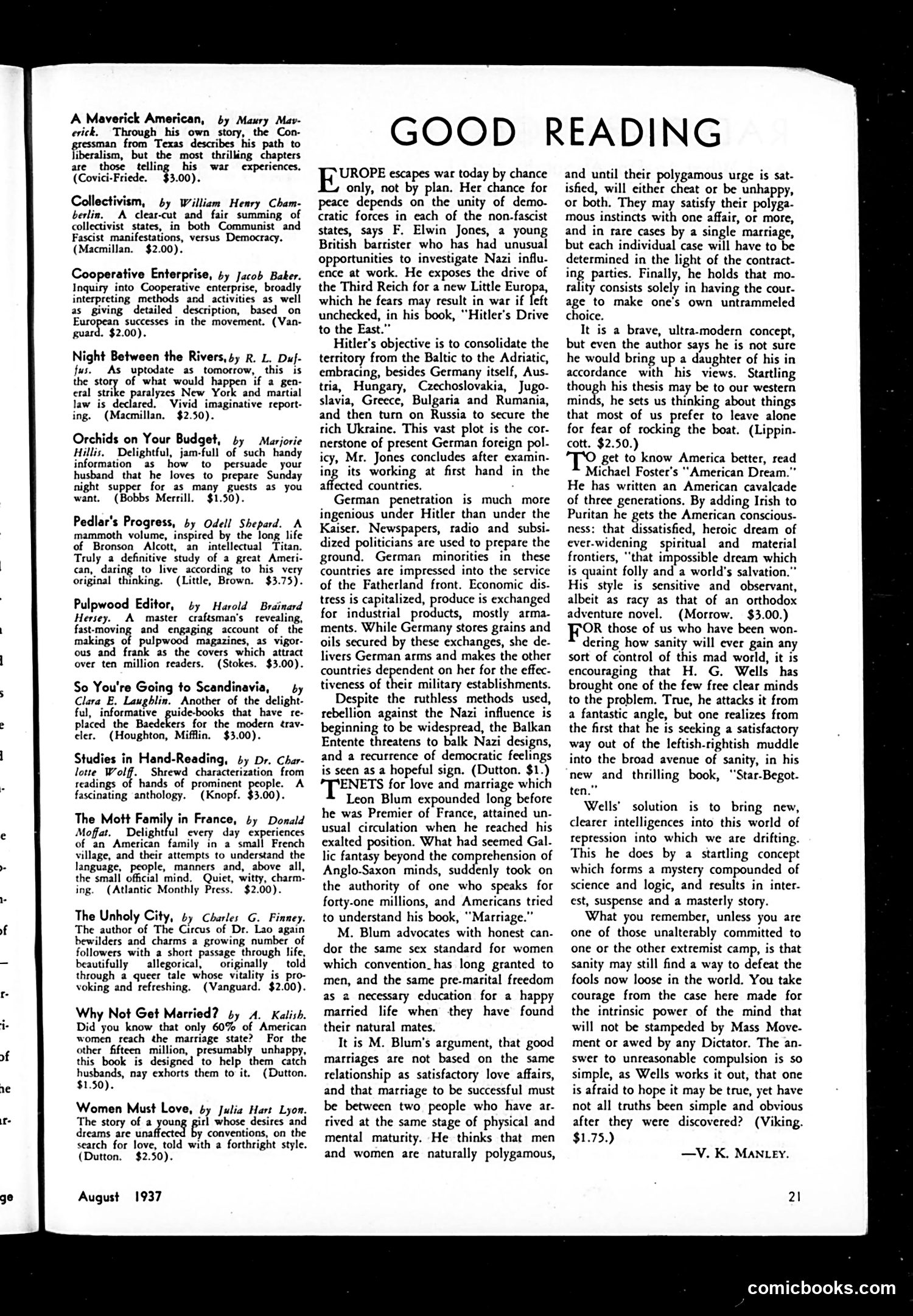
A restored page from Judge, 1937-08. Page through the whole issue in the reader above.
📄 Transcribed text from this page (OCR, searchable)
Machine-transcribed from the original scan — historical spelling and the odd misread are preserved.
A Maverick American, by Maury Mav- erick. Through his own story, the Cor from Texas describes his path to fiberalism, but the most thrilling chapters are those telling his war experiences. (Covici-Friede. Collectivism, by William Henry Cham- berlin. A clear-cut and fair summing of collectivist states, in both Communist and Fascist manifestations, versus Democracy. (Macmillan. $2.00). 3.00). Cooperative Enterprise, by Jacob Baker. Inquiry into Cooperative enterprise, broadly interpreting methods and activities as well as giving detailed description, based on European successes in the movement. (Van- guard. $2.00). Night Between the Rivers,sy R. L. Duf- fus. As uptodate as tomorrow, this is the story of what would hapj if a gen- eral strike paralyzes New York and martial law is declared. Vivid imaginative report- ing. (Macmillan, $2.50). Orchids on Your Budget, sy Marjorie Hillis, Delightful, jam-full of such handy information as how to persuade your husband that he loves to prepare Sunday night supper for as many guests as you want. (Bobbs Merrill. $1.50). Pedlar's Progress, by Odell Shepard. A mammoth volume, inspired by the long life of Bronson Alcott, an intellectual Titan. Truly a definitive study of a great Ameri- can, daring to live according to his very original thinking. (Little, Brown. $3.75). Pulpwood Editor, ty Harold Brainard Hersey. A master craftsman’s revealing, fast-moving and engaging account of the makings of pulpwood magazines, as vigor- ous and frank as the covers which attract over ten million readers. (Stokes. $3.00). So You're Going to Scandinavia, by Clara E. Laughlin. Another of the delight- ful, informative guide-books that have re- placed the Baedekers for the modern ¢rav- cler, (Houghton, Mifflin. $3.00). Studies in Hand-Reading, by Dr. Char- lotte Wolff. Shrewd characterization from readings of hands of prominent ple. A fascinating anthology. (Knopf. $3.00). The Mott Family in France, by Donald Moffat. Delightful every day experiences of an American family in a small French village, and their attempts to understand the language, people, manners and, above all, the small official mind, Quiet, witty, charm- ing. (Atlantic Monthly Press. $2.00). The Unholy City, by Charles G. Finney. The author of The Circus of Dr. Lao again bewilders and charms a growing number of followers with a short passage through life, beautifully allegorical, originally told through a queer tale whose vitality is pro- voking and refreshing. (Vanguard. $2.00). Why Not Get Married? ty A. Kalish. Did you know that only 60% of American women reach the marriage state? For the other fifteen million, presumably unhappy, this book is designed to help them catch husbands, nay exhorts them to it. (Dutton. $1.50). Women Must Love, by Julia Hart Lyon. The story of a oung pt whose desires and dreams are unaffect yy conventions, on the search for love, told with a forthright style. (Dutton. $2.50). August 1937 GOOD READING Fecrore escapes war today by chance only, not by plan. Her chance for peace depends on the unity of demo- cratic forces in each of the non-fascist states, says F, Elwin Jones, a young British barrister who has had unusual opportunities to investigate Nazi influ. ence at work. He exposes the drive of the Third Reich for a new Little Europa, which he fears may result in war if left unchecked, in his book, “Hitler's Drive to the East.”” Hitler's objective is to consolidate the territory from the Baltic to the Adriatic, embracing, besides Germany itself, Aus- tria, Hungary, Czechoslovakia, Jugo- slavia, Greece, Bulgaria and Rumania, and then turn on Russia to secure the tich Ukraine. This vast plot is the cor- nerstone of present German foreign pol- icy, Mr. Jones concludes after examin- ing its working at first hand in the affected countries. German penetration is much more ingenious under Hitler than under the Kaiser. Newspapers, radio and subsi- dized politicians are used to prepare the ground, German minorities in these countries are impressed into the service of the Fatherland front. Economic dis- tress is capitalized, produce is exchanged for industrial products, mostly arma- ments. While Germany stores grains and oils secured by these exchanges, she de- livers German arms and makes the other countries dependent on her for the effec- tiveness of their military establishments. Despite the ruthless methods used, rebellion against the Nazi influence is beginning to be widespread, the Balkan Entente threatens to balk Nazi designs, and a recurrence of democratic feelings is seen as a hopeful sign. (Dutton. $1.) *TENETS for love and marriage which Leon Blum expounded long before he was Premier of France, attained un- usual circulation when he reached his exalted position. What had seemed Gal. lic fantasy beyond the comprehension of Anglo-Saxon minds, suddenly took on the authority of one who speaks for forty-one millions, and Americans tried to understand his book, “Marriage.” M. Blum advocates with honest can. dor the same sex standard for women which convention_has long granted to men, and the same pre-marital freedom as 2 necessary education for a happy married life when they have found their natural mates. It is M. Blum's argument, that good marriages are not based on the same relationship as satisfactory love affairs, and that marriage to be successful must be between two people who have ar- rived at the same stage of physical and mental maturity. He thinks that men and women are naturally polygamous, and until their polygamous urge is sat- isfied, will either cheat or be unhappy, or both. They may satisfy their polyga- mous instincts with one affair, or more, and in rare cases by a single marriage, but each individual case will have to be determined in the light of the contract- ing parties. Finally, he holds that mo. rality consists solely in having the cour- age to make one’s own untrammeled choice. It is a brave, ultra-modern concept, but even the author says he is not sure he would bring up a daughter of his in accordance with his views. Startling though his thesis may be to our western minds, he sets us thinking about things that most of us prefer to leave alone for fear of rocking the boat. (Lippin- cott. $2.50.) Te get to know America better, read Michael Foster's “American Dream.” He has written an American cavalcade of three generations. By adding Irish to Puritan he gets the American conscious- ness: that dissatisfied, heroic dream of ever-widening spiritual and material frontiers, “that impossible dream which is quaint folly and a world’s salvation.” His style is sensitive and observant, albeit as racy as that of an orthodox adventure novel. (Morrow. $3.00.) FOR those of us who have been won- dering how sanity will ever gain any sort of control of this mad world, it is encouraging that H. G. Wells has brought one of the few free clear minds to the problem. True, he attacks it from a fantastic angle, but one realizes from the first that he is seeking a satisfactory way out of the leftish-rightish muddle into the broad avenue of sanity, in his new and thrilling book, “Star-Begot- ten.” Wells’ solution is to bring new, clearer intelligences into this world of repression into which we are drifting. This he does by a startling concept which forms a mystery compounded of science and logic, and results in inter- est, suspense and a masterly story. What you remember, unless you are one of those unalterably committed to one or the other extremist camp, is that sanity may still find a way to defeat the fools now loose in the world. You take courage from the case here made for the intrinsic power of the mind that will not be stampeded by Mass Move- ment or awed by any Dictator. The an- swer to unreasonable compulsion is so simple, as Wells works it out, that one is afraid to hope it may be true, yet have not all truths been simple and obvious after they were discovered? (Viking. $1.75.) —V. K. MANLey. 2i comicbooks.com