
Judge, 1937-08 · page 22 of 37
Judge — August 1937 — page 22: what you’re looking at
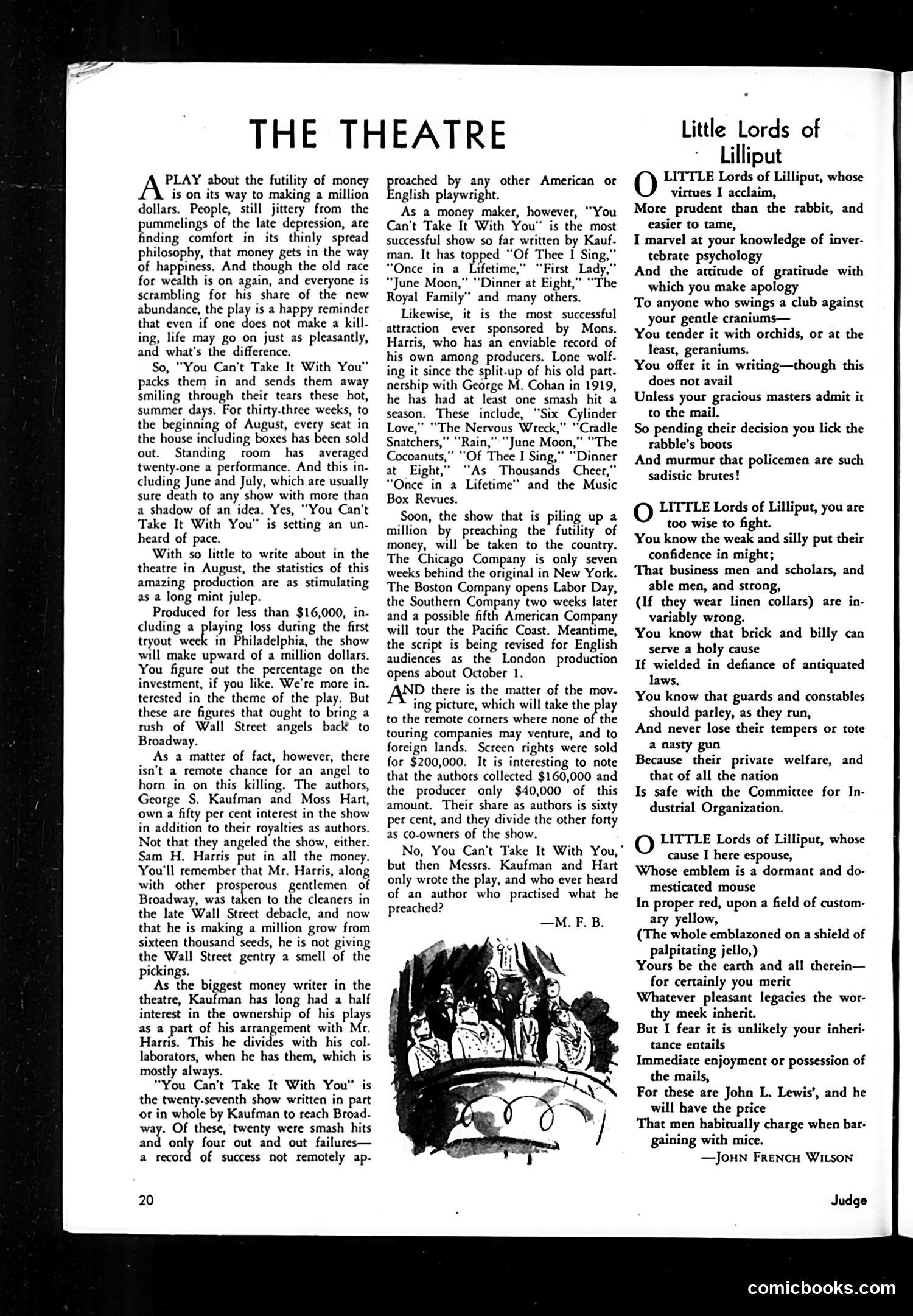
A restored page from Judge, 1937-08. Page through the whole issue in the reader above.
📄 Transcribed text from this page (OCR, searchable)
Machine-transcribed from the original scan — historical spelling and the odd misread are preserved.
THE THEATRE PLAY about the futility of money is on its way to making a million dollars. People, still jittery from the pummelings of the late depression, are finding comfort in its thinly spread philosophy, that money gets in the way of happiness. And though the old race for wealth is on again, and everyone is scrambling for his share of the new abundance, the play is a happy reminder that even if one does not make a kill- ing, life may go on just as pleasantly, and what's the difference. So, “You Can't Take It With You” packs them in and sends them away smiling through their tears these hot, summer days. For thirty-three weeks, to the beginning of August, every seat in the house including boxes has been sold out. Standing room has averaged twenty-one a performance. And this in- cluding June and July, which are usually sure death to any show with more than a shadow of an idea. Yes, “You Can't Take It With You" is setting an un- heard of pace. With so little to write about in the theatre in August, the statistics of this amazing production are as stimulating as a long mint julep. Produced for less than $16,000, in. cluding a playing loss during the first tryout week in Philadelphia, the show will make upward of a million dollars. You figure out the percentage on the investment, if you like. We're more in. terested in the theme of the play. But these are figures that ought to bring a rush of Wall Street angels back to Broadway. As a matter of fact, however, there isn’t a remote chance for an angel to horn in on this killing. The authors, George S. Kaufman and Moss Hart, own a fifty per cent interest in the show in addition to their royalties as authors. Not that they angeled the show, either. Sam H. Harris put in all the money. You'll remember that Mr. Harris, along with other prosperous gentlemen of Broadway, was taken to the cleaners in the late Wall Street debacle, and now that he is making a million grow from sixteen thousand seeds, he is not giving the Wall Street gentry a smell of the pickings. As the biggest money writer in the theatre, Kaufman has long had a half interest in the ownership of his plays as a part of his arrangement with Mr. Harris. This he divides with his col- laborators, when he has them, which is mostly always. “You Can't Take It With You" is the twenty-seventh show written in part or in whole by Kaufman to reach Broad- way. Of these, twenty were smash hits an only four out and out failures— a record of success not remotely ap- 20 proached by any other American or English playwright. As a money maker, however, “You Can't Take It With You" is the most successful show so far written by Kauf- man. It has topped “Of Thee I Sing,” “Once in a Lifetime,” “First Lady,” “June Moon,” “Dinner at Eight,” “The Royal Family” and many others. Likewise, it is the most successful attraction ever sponsored by Mons. Harris, who has an enviable record of his own among producers. Lone wolf- ing it since the split-up of his old part- nership with George M. Cohan in 1919, he has had at least one smash hit a season. These include, “Six Cylinder ** “The Nervous Wreck,” “Cradle Rain,” “June Mo Cocoanuts,” “Of Thee I Sing,” “Dinner at Eight,” “As Thousands Cheer,” “Once in a Lifetime” and the Music Box Revues. Soon, the show that is piling up a million by preaching the futility of money, will be taken to the country. The Chicago Company is only seven weeks behind the original in New York. The Boston Company opens Labor Day, the Southern Company two weeks later and a possible fifth American Company will tour the Pacific Coast. Meantime, the script is being revised for English audiences as the London production opens about October 1. AND there is the matter of the mov- ing picture, which will take the play to the remote corners where none of the touring companies may venture, and to foreign lands. Screen rights were sold for $200,000. It is interesting to note that the authors collected $160,000 and the producer only $40,000 of this amount. Their share as authors is sixty per cent, and they divide the other forty as co-owners of the show. No, You Can't Take It With You,’ but then Messrs. Kaufman and Hart only wrote the play, and who ever heard of an author who practised what he preached? Little Lords of Lilliput LITTLE Lords of Lilliput, whose virtues I acclaim, More prudent than the rabbit, and easier to tame, I marvel at your knowledge of inver- tebrate psychology And the attitude of gratitude with which you make apology To anyone who swings a club against your gentle craniums— You tender it with orchids, or at the least, geraniums. You offer it in writing—though this does not avail Unless your gracious masters admit it to the mail. So pending their decision you lick the rabble’s boots And murmur that policemen are such sadistic brutes! Oo LITTLE Lords of Lilliput, you are too wise to fight. You know the weak and silly put their confidence in might; That business men and scholars, and able men, and strong, (If they wear linen collars) are in- variably wrong. You know that brick and billy can serve a holy cause If wielded in defiance of antiquated laws, You know that guards and constables should parley, as they run, And never lose their tempers or tote a nasty gun Because their private welfare, and that of all the nation Is safe with the Committee for In- dustrial Organization. Oo LITTLE Lords of Lilliput, whose cause I here espouse, ‘Whose emblem is a dormant and do- mesticated mouse In proper red, upon a field of custom- ary yellow, (The whole emblazoned on a shield of palpitating jello,) Yours be the earth and all therein— for certainly you merit ‘Whatever pleasant legacies the wor- thy meek inherit. But I fear it is unlikely your inheri- tance entails Immediate enjoyment or possession of the mails, For these are John L. Lewis’, and he will have the price That men habitually charge when bar- gaining with mice. —JOHN FRENCH WILSON Judge comicbooks.com