
Judge, 1937-08 · page 20 of 37
Judge — August 1937 — page 20: what you’re looking at
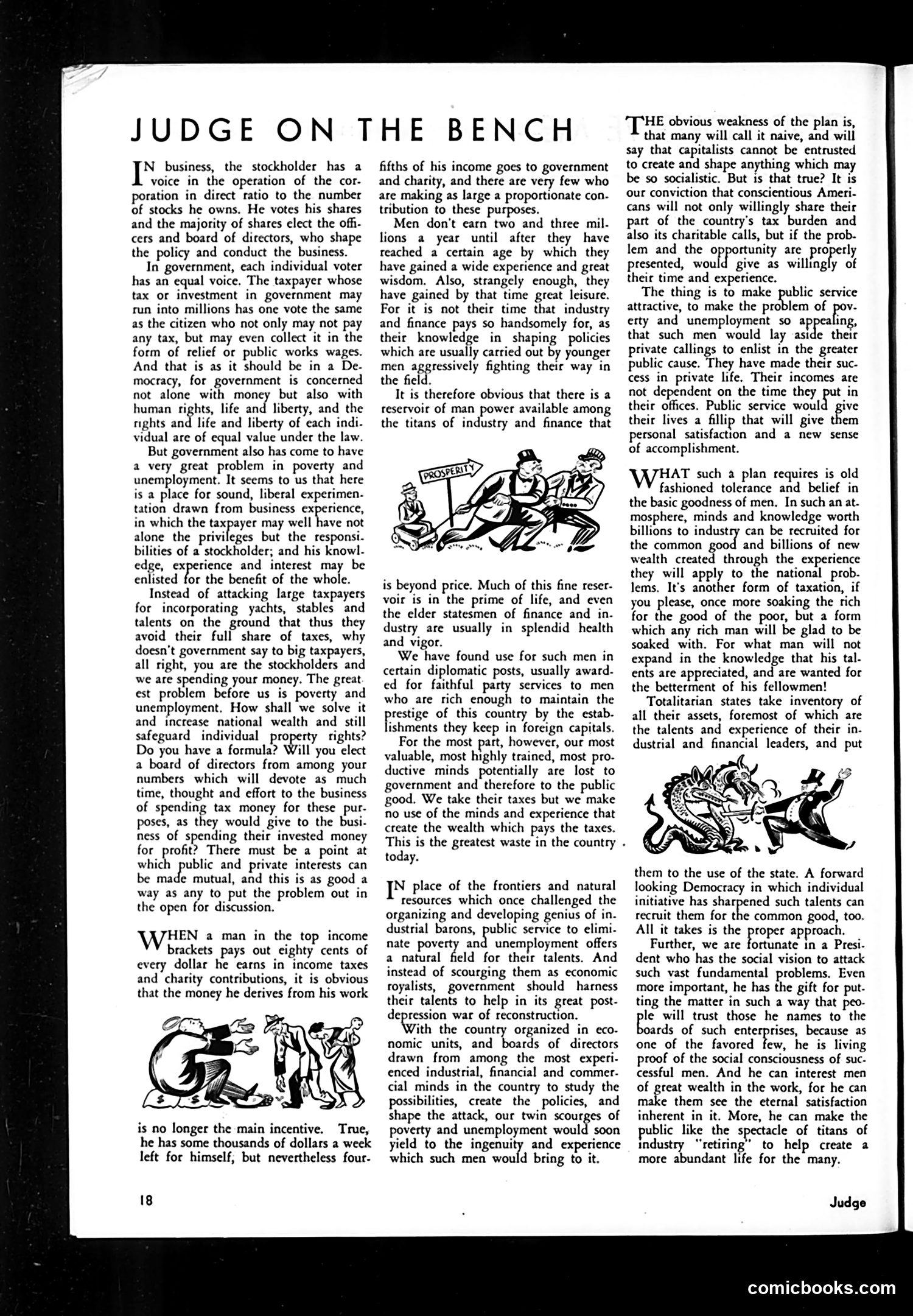
A restored page from Judge, 1937-08. Page through the whole issue in the reader above.
📄 Transcribed text from this page (OCR, searchable)
Machine-transcribed from the original scan — historical spelling and the odd misread are preserved.
JUDGE ON THE BENCH N_ business, the stockholder has a voice in the operation of the cor- poration in direct ratio to the number of stocks he owns. He votes his shares and the majority of shares elect the offi- cers and board of directors, who shape the policy and conduct the business. In government, each individual voter has an equal voice. The taxpayer whose tax or investment in government may run into millions has one vote the same as the citizen who not only may not pay any tax, but may even collect it in the form of relief or public works wages. And that is as it should be in a De- mocracy, for government is concerned not alone with money but also with human rights, life and liberty, and the nights and life and liberty of each indi- vidual are of equal value under the law. But government also has come to have a very great problem in poverty and unemployment. It seems to us that here is a place for sound, liberal experimen- tation drawn from business experience, in which the taxpayer may well have not alone the privileges but the responsi. bilities of a stockholder; and his knowl- edge, experience and interest may be enlisted tor the benefit of the whole. Instead of attacking large taxpayers for incorporating yachts, stables and talents on the ground that thus they avoid their full share of taxes, why doesn’t government say to big taxpayers, all right, you are the stockholders and we are spending your money. The great est problem before us is poverty and unemployment, How shall we solve it and increase national wealth and still safeguard individual property rights? Do you have a formule? Will you elect a board of directors from among your numbers which will devote as much time, thought and effort to the business of spending tax money for these pur- poses, as they would give to the busi- ness of spending their invested money for profit? There must be a point at which public and private interests can be made mutual, and this is as good a way as any to put the problem out in the open for discussion. WHEN a man in the top income brackets pays out eighty cents of every dollar he earns in income taxes and charity contributions, it is obvious that the money he derives from his work is no longer the main incentive. True, he has some thousands of dollars a week left for himself, but nevertheless four- 18 fifths of his income goes to government and charity, and there are very few who are making as large a proportionate con- tribution to these purposes. Men don't earn two and three mil- lions a year until after they have reached a certain age by which they have gained a wide experience and great wisdom. Also, strangely enough, they have gained by that time great leisure. For it is not their time that industry and finance pays so handsomely for, as their knowledge in shaping policies which are usually carried out by younger men aggressively fighting their way in the field It is therefore obvious that there is a reservoir of man power available among the titans of industry and finance that is beyond price. Much of this fine reser- voir is in the prime of life, and even the elder statesmen of finance and in. dustry are usually in splendid health and vigor. We have found use for such men in certain diplomatic posts, usually award- ed for faithful party services to men who are rich enough to maintain the prestige of this country by the estab. ishments they keep in foreign capitals. For the most part, however, our most valuable, most highly trained, most pro- ductive minds potentially are lost to government and therefore to the public good. We take their taxes but we make no use of the minds and experience that create the wealth which pays the taxes. This is the greatest waste in the country . today. IN place of the frontiers and natural resources which once challenged the organizing and developing genius of in. dustrial barons, public service to elimi- nate Poverty and unemployment offers a natural field for their talents. And instead of scourging them as economic royalists, government should harness their talents to help in its great post- depression war of reconstruction. ith the country organized in eco- nomic units, and boards of directors drawn from among the most experi- enced industrial, financial and commer- cial minds in the country to study the possibilities, create the policies, and shape the attack, our twin scourges of poverty and unemployment would soon yield to the ingenuity and experience which such men would bring to it. ‘THE obvious weakness of the plan is, that many will call it naive, and will say that capitalists cannot be entrusted to create and shape anything which may be so socialistic. But is that true? It is our conviction that conscientious Ameri- cans will not only willingly share their part of the country’s tax burden and also its charitable calls, but if the prob- lem and the opportunity are properly presented, would give as willingly of their time and experience. The thing is to make public service attractive, to make the problem of pov. erty and unemployment so ap be, that such men would lay aside their private callings to enlist in the greater public cause. They have made their suc- cess in private life. Their incomes are not dependent on the time they put in their offices. Public service would give their lives a fillip that will give them personal satisfaction and a new sense of accomplishment. wrt such a plan requires is old fashioned tolerance and belief in the basic goodness of men. In such an at. mosphere, minds and knowledge worth billions to industry can be recruited for the common ood and billions of new wealth created through the experience they will apply to the national prob. lems. It's another form of taxation, if you please, once more soaking the rich for the good of the poor, but a form which any rich man will be glad to be soaked with. For what man will not expand in the knowledge that his tal- ents are appreciated, and are wanted for the betterment of his fellowmen! Totalitarian states take inventory of all their assets, foremost of which are the talents and experience of their in- dustrial and financial leaders, and put them to the use of the state. A forward looking Democracy in which individual initiative has sharpened such talents can recruit them for the common good, too. All it takes is the proper approach. Further, we are fortunate in a Presi- dent who has the social vision to attack such vast fundamental problems. Even more important, he has the gift for put- ting the matter in such a way that peo- ple will trust those he names to the tds of such enterprises, because as one of the favored few, he is living proof of the social consciousness of suc- cessful men. And he can interest men of Brea wealth in the work, for he can e them see the eternal satisfaction inherent in it. More, he can make the ublic like the spectacle of titans of industry “retiring” to help create a more abundant life for the many. Judge comicbooks.com