
Judge, 1937-08 · page 6 of 37
Judge — August 1937 — page 6: what you’re looking at
What you’re looking at
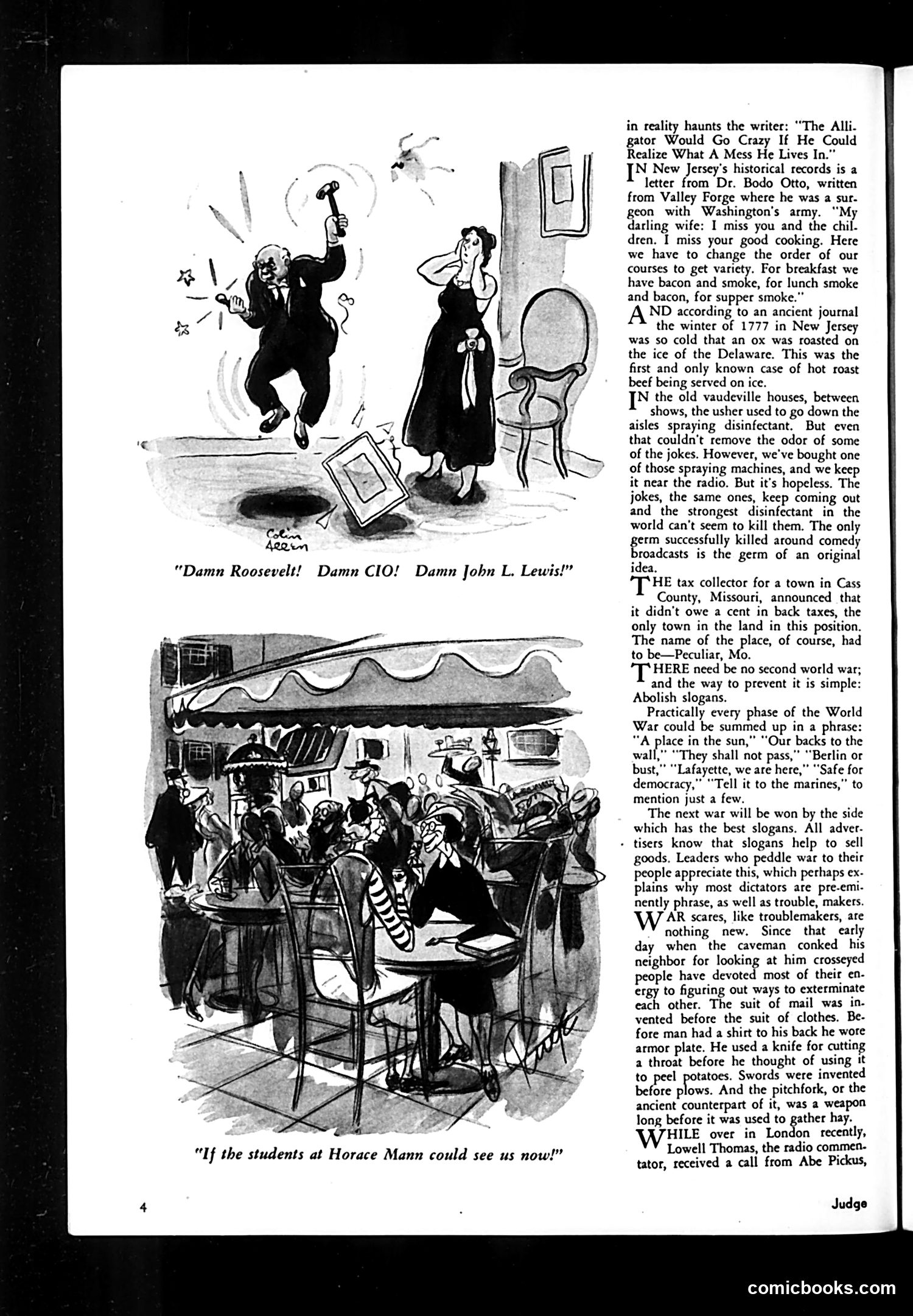
# Analysis of Judge Magazine Page The top cartoon depicts a man frantically swinging a hammer while a woman covers her ears, captioned "Damn Roosevelt! Damn CIO! Damn John L. Lewis!" This satirizes labor tensions of the 1930s-40s, mocking someone driven to fury by President Franklin D. Roosevelt's pro-labor policies, the Congress of Industrial Organizations (CIO), and labor leader John L. Lewis—all associated with union organizing that disrupted traditional management power. The lower cartoon shows a crowded wartime scene with the caption "If the students at Horace Mann could see us now!" This appears to reference WWII-era social disruption, sarcastically suggesting that pre-war civilian life at the prestigious Horace Mann School contrasts sharply with current wartime chaos and crowding. Both cartoons use exaggeration and irony to comment on contemporary anxieties about labor activism and wartime upheaval.
📄 Transcribed text from this page (OCR, searchable)
Machine-transcribed from the original scan — historical spelling and the odd misread are preserved.
in reality haunts the writer: “The Alli. gator Would Go Crazy If He Could Realize What A Mess He Lives In.” IN New Jersey's historical records is a letter from Dr. Bodo Otto, written from Valley Forge where he was a sur. geon with Washington’s army. “My darling wife: I miss you and the chil. dren. I miss your good cooking. Here we have to change the order of our courses to get variety. For breakfast we have bacon and smoke, for lunch smoke and bacon, for supper smoke.” AND according to an ancient journal the winter of 1777 in New Jersey was so cold that an ox was roasted on the ice of the Delaware. This was the first and only known case of hot roast beef being served on ice. JN the old vaudeville houses, between shows, the usher used to go down the aisles spraying disinfectant. But even that couldn't remove the odor of some of the jokes. However, we've bought one of those spraying machines, and we keep it near the radio. But it's hopeless. The jokes, the same ones, keep coming out and the strongest disinfectant in the world can't seem to kill them. The only germ successfully killed around comedy roadcasts is the germ of an original idea. ‘THE tax collector for a town in Cass County, Missouri, announced that it didn’t owe a cent in back taxes, the only town in the land in this position. The name of the place, of course, had to be—Peculiar, Mo. HERE need be no second world war; and the way to prevent it is simple: Abolish slogans. Practically every phase of the World War could be summed up in a phrase: “A place in the sun,” ‘Our backs to the wall,” “They shall not pass,” “Berlin or Lafayette, we are here,” “' democracy,” "Tell it to the marines,” to mention just a few. The next war will be won by the side which has the best slogans. All adver- + tisers know that slogans help to sell goods. Leaders who peddle war to their people appreciate this, which perhaps ex. plains why most dictators are pre-emi- nently phrase, as well as trouble, makers. AR scares, like troublemakers, are nothing new. Since that early day when the caveman conked his neighbor for looking at him crosseyed people have devoted most of their en- ergy to figuring out ways to exterminate each other. The suit of mail was in- vented before the suit of clothes. Be- fore man had a shirt to his back he wore armor plate. He used a knife for cutting a throat before he thought of using tt to peel potatoes. Swords were invented before plows. And the pitchfork, or the ancient counterpart of it, was a weapon long before it was used to gather hay. HILE over in London recently, men- “If the students at Horace Mann could see us now!” tator, aeeived all hem Se Judge comicbooks.com