
Judge, 1937-08 · page 13 of 37
Judge — August 1937 — page 13: what you’re looking at
What you’re looking at
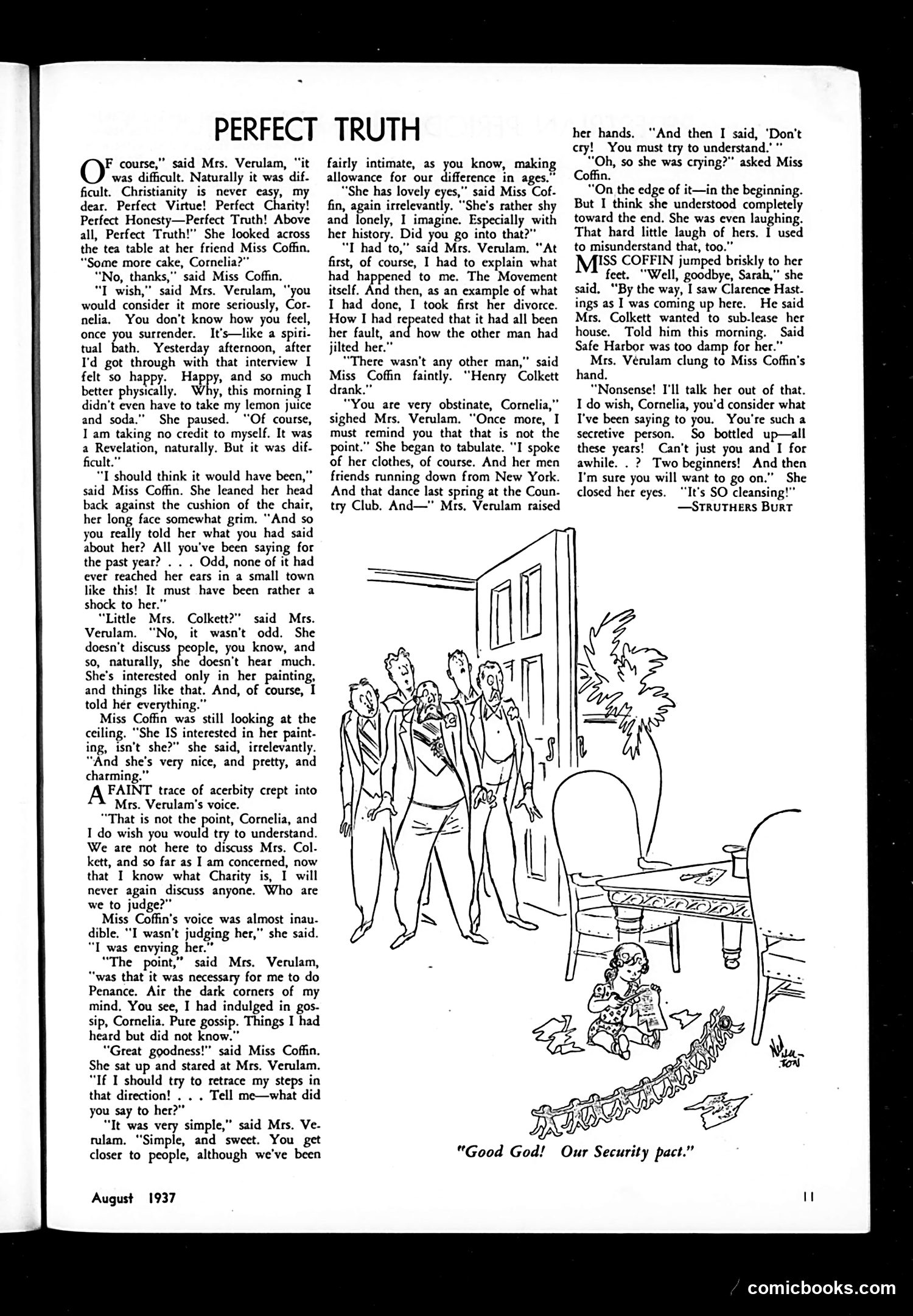
# Analysis of "Perfect Truth" This satirical short story mocks self-righteous hypocrisy disguised as religious virtue. Mrs. Verulam represents a common social type: the sanctimonious gossip who convinces herself that spreading rumors and invading others' privacy is actually *charitable penance*. The humor lies in the contradiction: Mrs. Verulam claims to have achieved "Perfect Truth" and "Perfect Charity" through Christianity, yet she's actually engaged in vicious gossip about her neighbor Mrs. Colkett—fabricating details (a supposed affair and divorce) that are demonstrably false (Miss Coffin reveals the real issue was her husband's alcoholism). Miss Coffin serves as the moral counterpoint, quietly pointing out Mrs. Verulam's self-deception with devastating understatement ("I was envying her" about the virtuous Mrs. Colkett). The cartoon below shows people reacting with alarm to what appears to be a security threat, likely commenting on contemporary 1937 anxieties about social disorder or invasion of privacy—echoing the story's theme about breaches of personal boundaries. The satire targets middle-class moral self-delusion and how religious language enables cruelty.
📄 Transcribed text from this page (OCR, searchable)
Machine-transcribed from the original scan — historical spelling and the odd misread are preserved.
PERFECT TRUTH F course,” said Mrs. Verulam, “it was difficult. Naturally it was dif- ficult. Christianity is never easy, my dear. Perfect Virtue! Perfect Charity! Perfect Honesty—Perfect Truth! Above all, Perfect Truth!” She looked across the tea table at her friend Miss Coffin. “Some more cake, Cornelia?” “No, thanks,” said Miss Coffin. “I wish,” said Mrs. Verulam, “you would consider it more seriously, Cor- nelia, You don’t know how you feel, once you surrender. It's—like a spiri- tual bath. Yesterday afternoon, after I'd got through with that interview I felt so happy. Heppys and so much better physically. Why, this morning I didn’t even have to take my lemon juice and soda.” She paused. “Of course, I am taking no credit to myself. It was a Revelation, naturally. But it was dif- ficult.” “I should think it would have been,” said Miss Coffin. She leaned her head back against the cushion of the chair, her long face somewhat grim. “And so you really told her what you had said about her? All you've been saying for the past year? . . . Odd, none of it had ever reached her ears in a small town like this! It must have been rather a shock to her.” “Little Mrs. Colkett?” Verulam. “No, it said Mrs. wasn't odd. She doesn't discuss ple, you know, and she so, naturally, doesn’t hear much. She's interested only in her painting, and things like that. And, of course, I told hér everything.” Miss Coffin was still looking at the ceiling. “She IS interested in her paint- ing, isn't she?” she said, irrelevantly. “And she’s very nice, and pretty, and charming.” AFAINT trace of acerbity crept into Mrs. Verulam’s voice. “That is not the point, Cornelia, and I do wish you would try to understand. We are not here to discuss Mrs. Col- kett, and so far as I am concerned, now that I know what Charity is, I will never again discuss anyone. Who are we to judge?” Miss Coffin's voice was almost inau- dible. “I wasn’t judging her,” she said. “I was envying her.” “The point,” said Mrs. Verulam, “was that it was necessary for me to do Penance. Air the dark corners of my mind, You see, I had indulged in gos- sip, Cornelia. Pure gossip. Things I had heard but did not know.” “Great goodness!” said Miss Coffin. She sat up and stared at Mrs. Verulam. “If I should try to retrace my steps in that direction! « Tell me—what did you say to her?’ “It was very simple,” said Mrs. Ve- rulam. “Simple, and sweet. You get closer to people, although we've been August 1937 fairly intimate, as you know, making allowance for our difference in ages.” “She has lovely eyes,"’ said Miss Cof- fin, again irrelevantly. “She's rather shy and lonely, I imagine. Especially with her history. Did you go into that?” “T had to,” said Mrs. Verulam. “At first, of course, I had to explain what had happened to me. The Movement itself. And then, as an example of what I had done, I took first her divorce. How I had repeated that it had all been her fault, and how the other man had jilted her.” “There wasn’t any other man,” said Miss Coffin faintly. “Henry Colkett drank.” “You are very obstinate, Cornelia,” sighed Mrs. Verulam. “Once more, I must remind you that that is not the point.” She began to tabulate. “I spoke of her clothes, of course. And her men friends running down from New York. And that dance last spring at the Coun. try Club. And—” Mrs, Verulam raised her hands. ‘And then I said, ‘Don't cry! You must try to understand.’ ” “Oh, so she was crying?” asked Miss Coffin. “On the edge of it—in the beginning. But I think she understood completely toward the end. She was even laughing. That hard little laugh of hers. I used to misunderstand that, too.” Mss COFFIN jumped briskly to her feet. “Well, goodbye, Sarah,” she said, “By the way, I saw Clarence Hast- ings as I was coming up here. He said Mrs. Colkett wanted to sub-lease her house. Told him this morning. Said Safe Harbor was too damp for her.” Mrs. Vérulam clung to Miss Coffin’s hand. “Nonsense! I'll talk her out of that. I do wish, Cornelia, you'd consider what I've been saying to you. You're such a secretive person. So bottled up—all these years! Can't just you and I for awhile. . ? Two beginners! And then I'm sure you will want to go on.” She closed her eyes. “It's SO cleansing!" —STRUTHERS Burt comicbooks.com