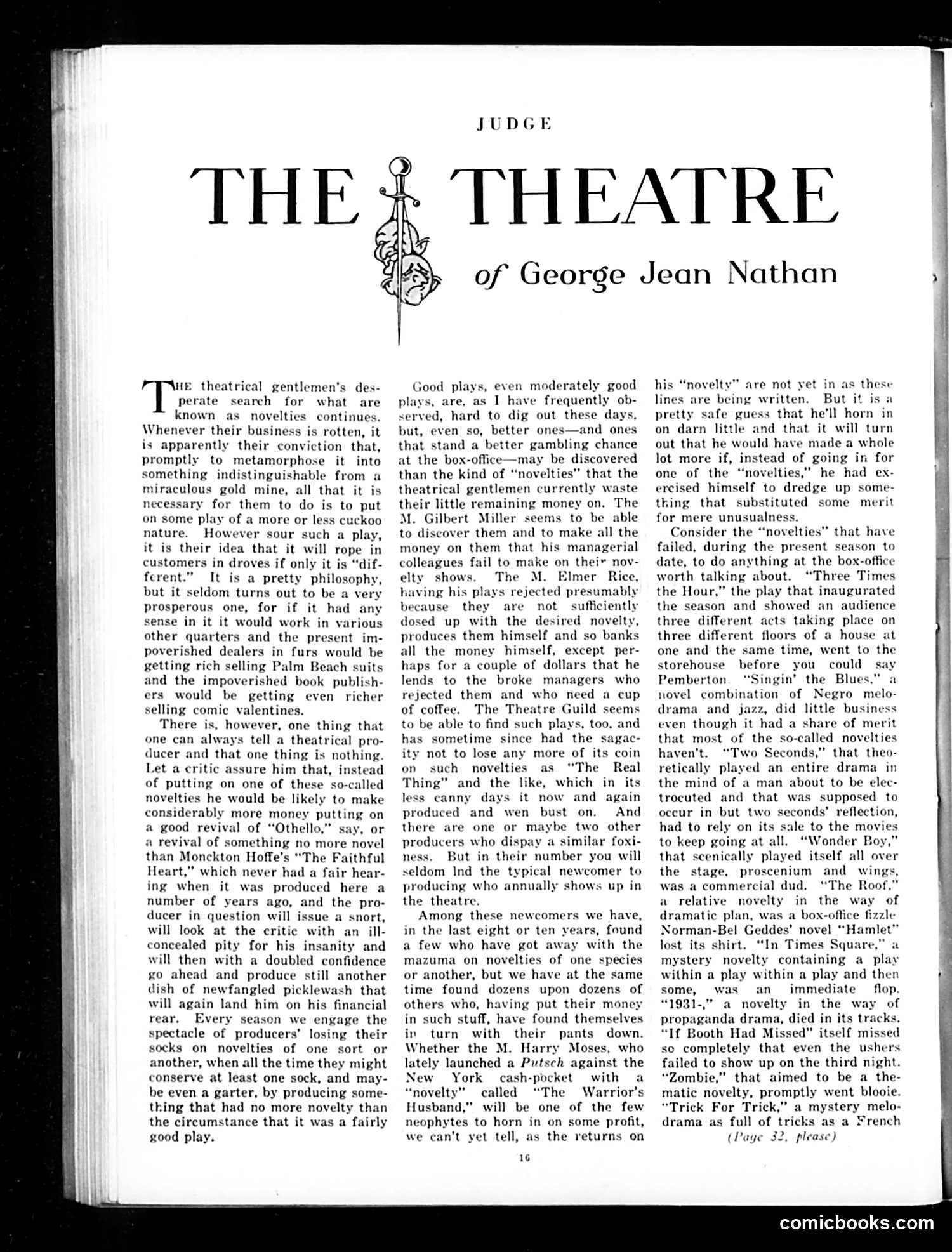
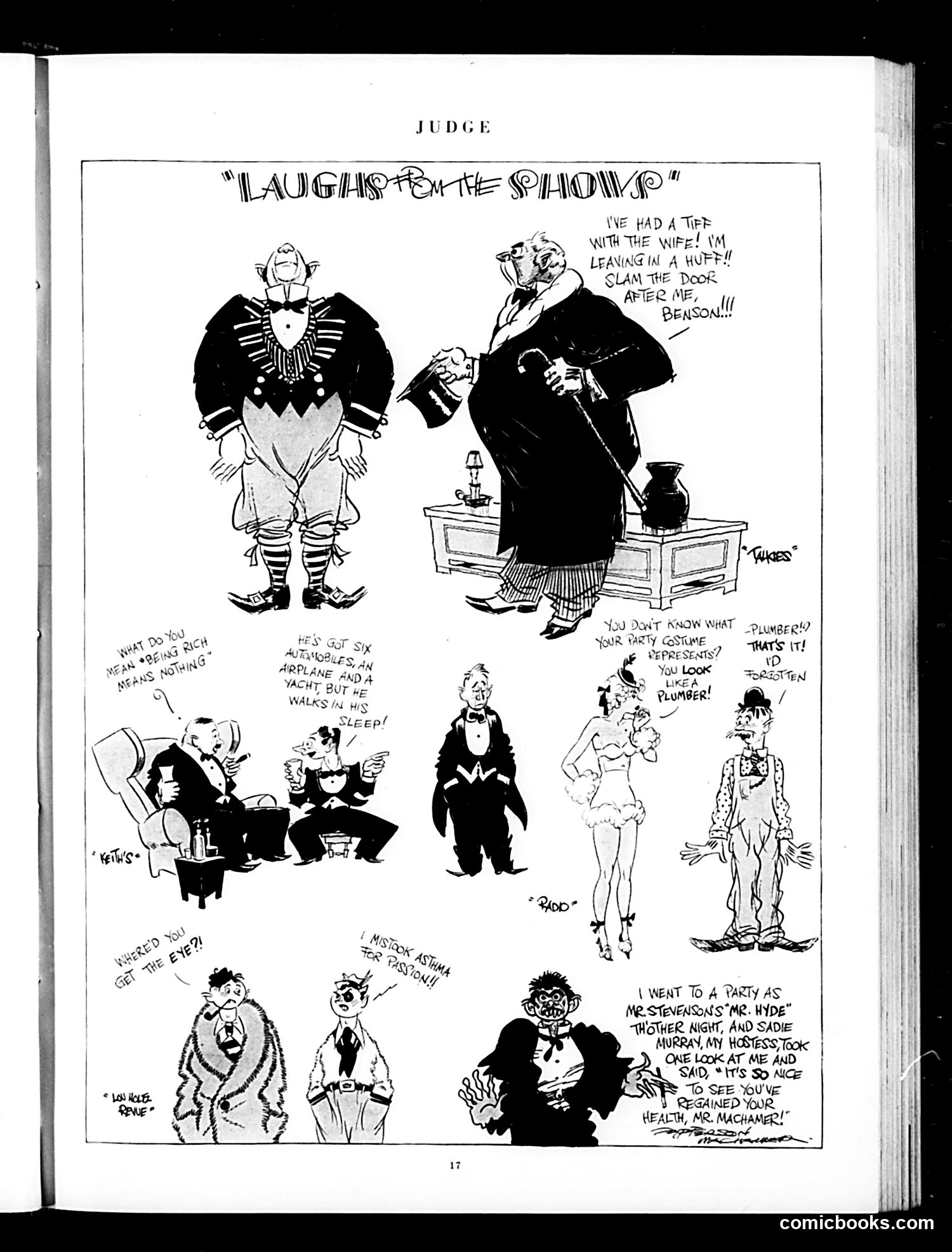
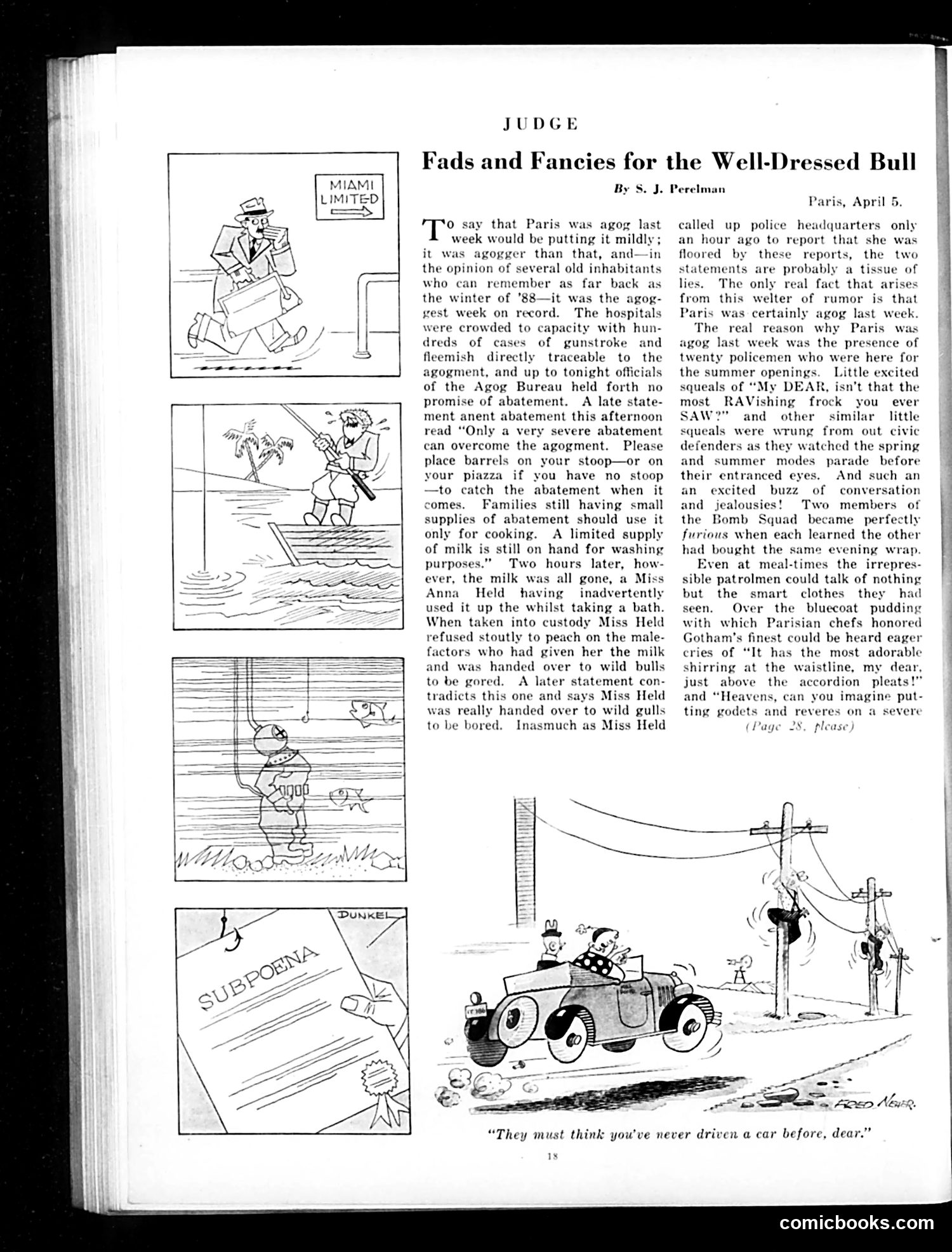
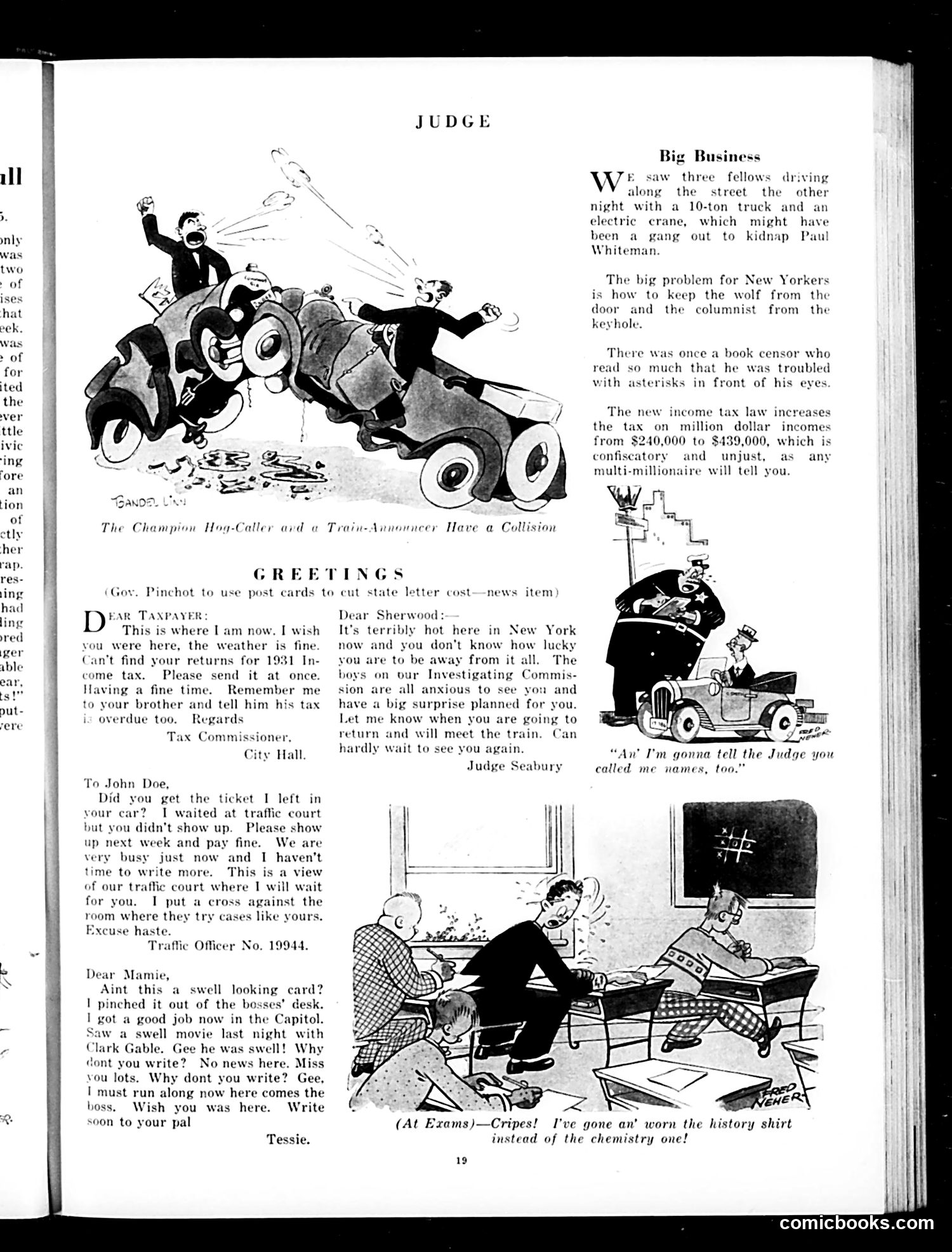
A complete issue · 36 pages · 1932
Judge — April 9, 1932
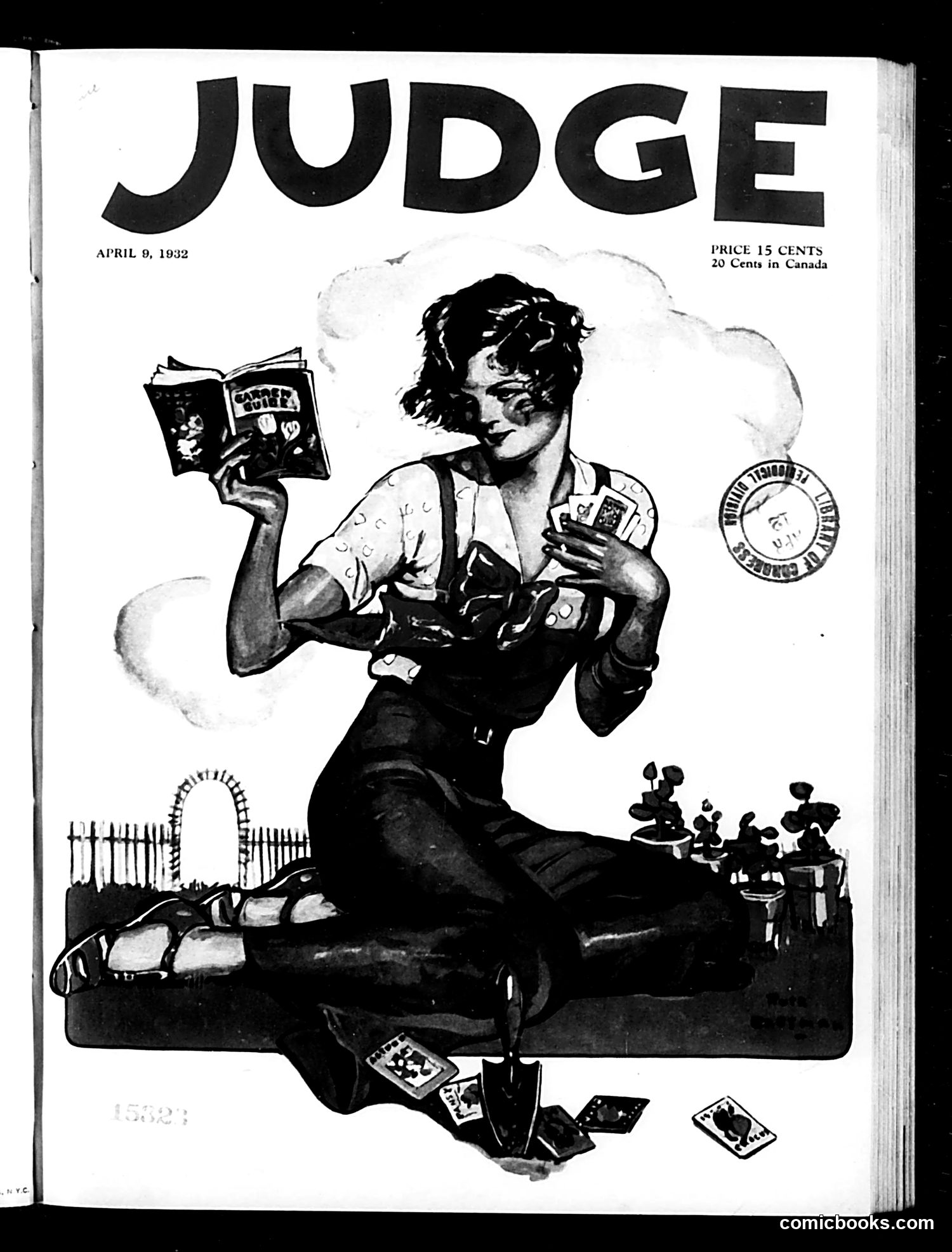
# Analysis of Judge Magazine Cover (April 9, 1932) This cover depicts a young woman in overalls surrounded by toys, games, and entertainment products. She's juggling multiple items while sitting in what appears to be a toy car or vehicle. The satire likely addresses **consumption and childhood play during the Great Depression**. In 1932, Americans faced severe economic hardship, yet this image suggests abundance and commercialism aimed at children. The woman—possibly representing either a child or the "average American consumer"—juggles competing products and pastimes, satirizing either: 1. **Marketing excess** during economic crisis, or 2. **Consumer distraction** from serious economic problems The toys and games scattered around suggest manufacturers' continued aggressive promotion despite widespread poverty. The cover price (15 cents) itself was significant during Depression-era hardship.

# Analysis This page is primarily **advertising**, not satire or political commentary. It promotes "Larry: Thoughts of Youth," a 1920s bestselling book presented as an uncensored diary of a college student's frank thoughts about life, romance, and morality. The marketing emphasizes the book's transgressive appeal: Larry supposedly didn't smoke, drink, or attend church—he was athletic, irreverent, and "gloriously" lived life on his own terms. The ads mock "narrow modernists" who might disapprove. The "Praise from Critics" section uses genuine newspaper endorsements to position the book as essential reading for parents seeking to understand youth culture. The emphasis on it becoming a "national best-seller" suggests genuine commercial success the publishers capitalize on to drive further sales through the order form provided.
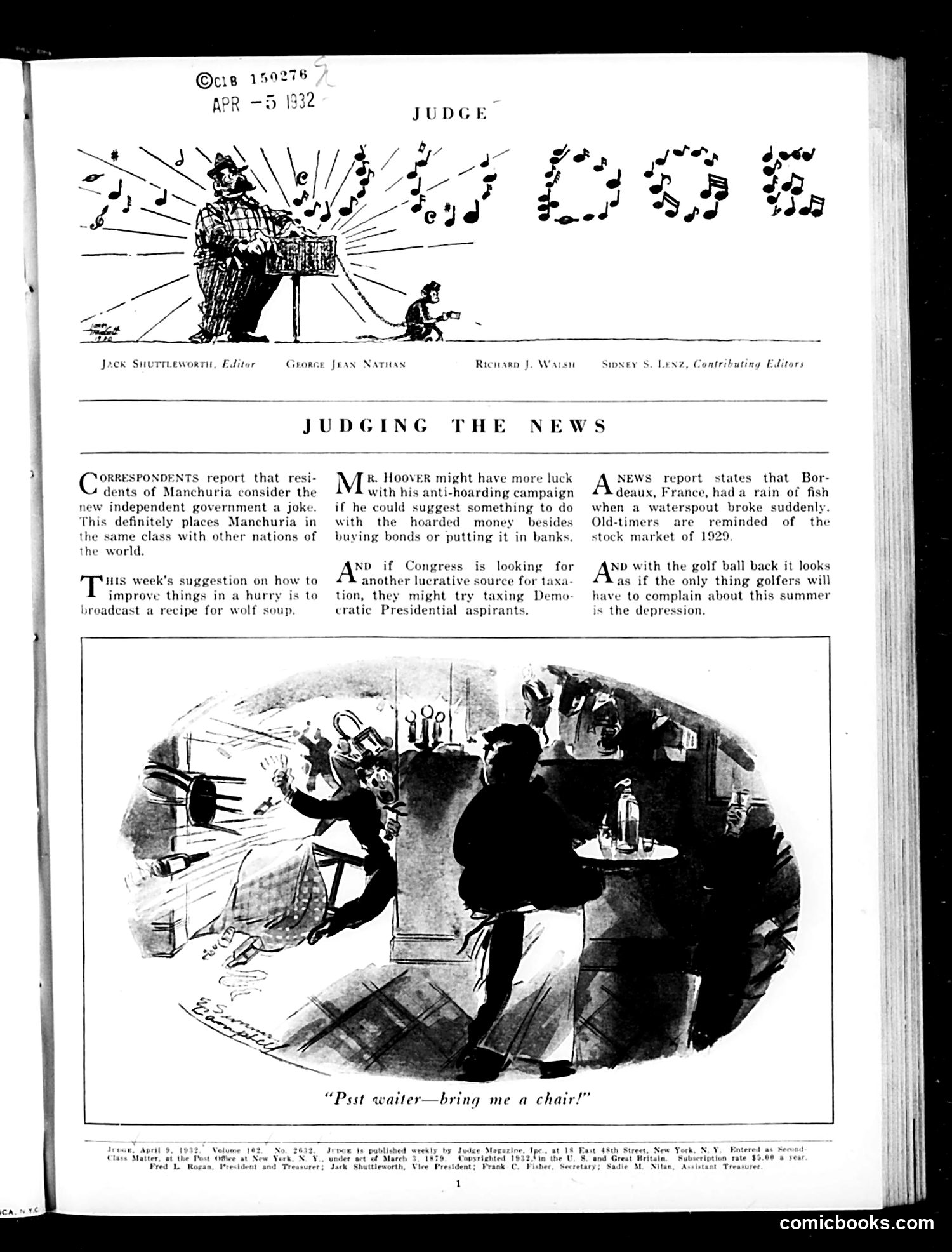
# "Judge" Magazine Satire Analysis This April 1932 page satirizes economic and political conditions during the Great Depression. The main cartoon, captioned "Psst waiter—bring me a chair!", depicts diners at what appears to be an upscale restaurant, with one patron signaling a server. The humor relies on Depression-era scarcity: the joke likely suggests that even chairs are becoming scarce or precious commodities during economic hardship. The text sections mock various political figures and proposals. References to "Mr. Hoover" (President Herbert Hoover) and taxation suggestions for "Democratic Presidential aspirants" indicate frustration with government responses to the economic crisis. The commentary on Bordeaux wine and the stock market collapse suggests satirizing both luxury consumption and financial catastrophe during this period.
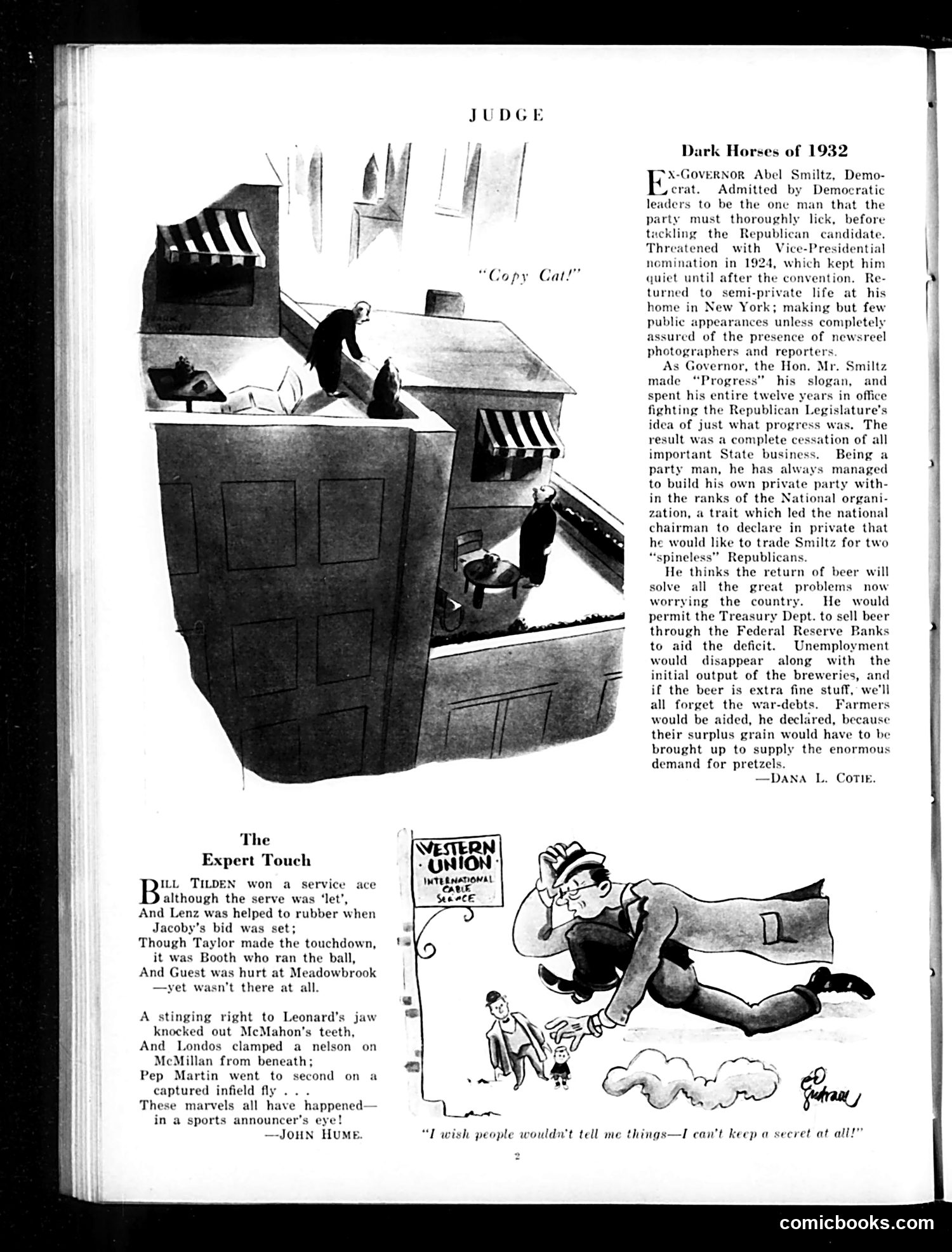
# "Dark Horses of 1932" - Political Cartoon Analysis This page satirizes **Ex-Governor Abel Smiltz**, a Democratic "dark horse" candidate for the 1932 presidential election. The top cartoon depicts him as a "Copy Cat"—literally trapped in a box with a clapperboard, suggesting he's an artificial, stage-managed political creation rather than a genuine candidate. The accompanying text by Dana L. Corie mocks Smiltz's vague platform, particularly his naive belief that **legalizing beer** would solve America's Depression-era economic crisis. The satire suggests he offers nothing substantive—just empty promises about beer, unemployment, and farm relief. The bottom cartoon appears unrelated sports commentary. Overall, Judge uses Smiltz as a vehicle to ridicule superficial political candidates lacking serious policy solutions during the economic crisis.
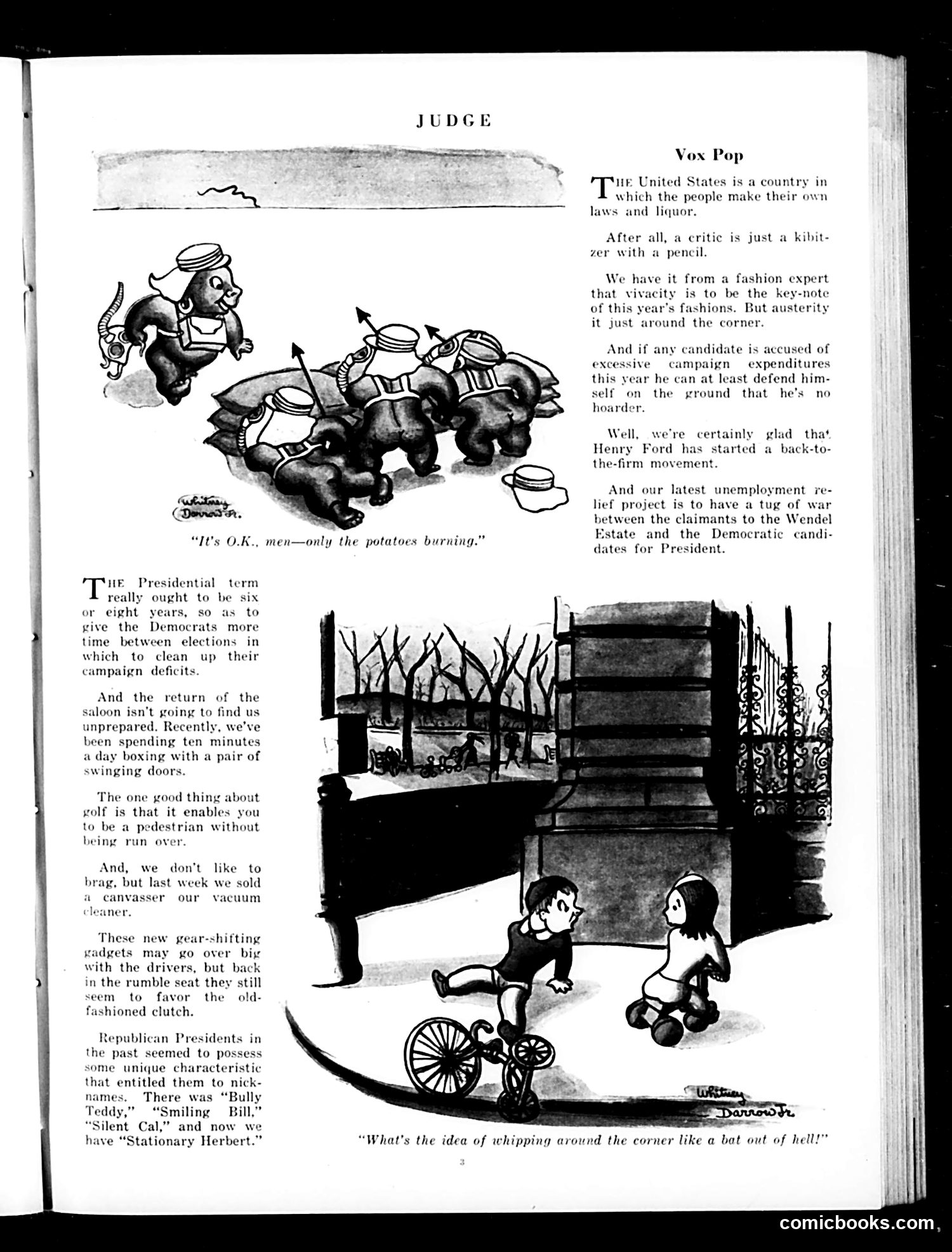
# Analysis of Judge Magazine Page **Top Cartoon**: Depicts a figure (appears to be a political leader) herding donkeys labeled with "potatoes burning," captioned "It's O.K., men—only the potatoes burning." This satirizes someone dismissing serious problems as minor issues—likely referencing a political figure's casual response to economic crisis or hardship during the Great Depression era. **Right Column Commentary ("Vox Pop")**: A series of humorous social observations, including references to Henry Ford's "back-to-the-firm movement" (likely Ford's Depression-era agricultural initiative) and a joke about an "unemployment relief project" involving conflict between wealthy "claimants" and Democratic presidential candidates. **Bottom Cartoon**: Shows children playing dangerously near traffic, captioned about "whipping around the corner like a bat out of hell"—satirizing reckless child behavior or parental negligence in urban settings.
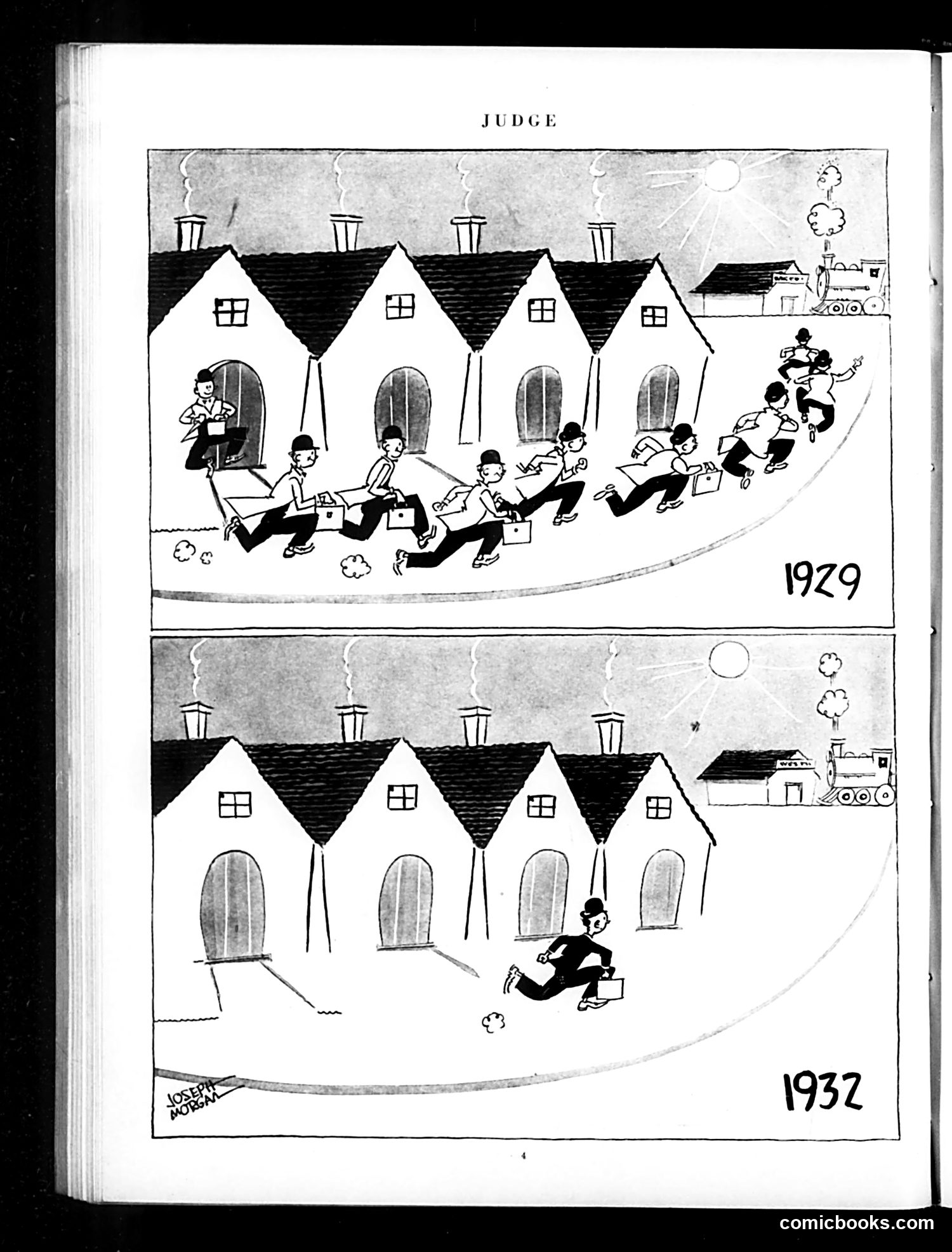
# "Judge" Cartoon Analysis: "Judge" (1929 vs. 1937) This political cartoon compares two time periods through the metaphor of a courthouse building. In **1929**, numerous men in suits rush frantically away from the courthouse, carrying briefcases—likely depicting stockbrokers or businessmen fleeing after the October 1929 stock market crash that triggered the Great Depression. In **1937**, the same courthouse stands nearly empty with a solitary figure walking away slowly, suggesting economic stagnation persisting years into the Depression. The contrast satirizes how the initial panic of 1929 gave way to prolonged economic hardship and unemployment throughout the 1930s. The title "Judge" references the magazine itself, using the courthouse as visual commentary on America's economic crisis and judicial/legal system's inability to resolve it.
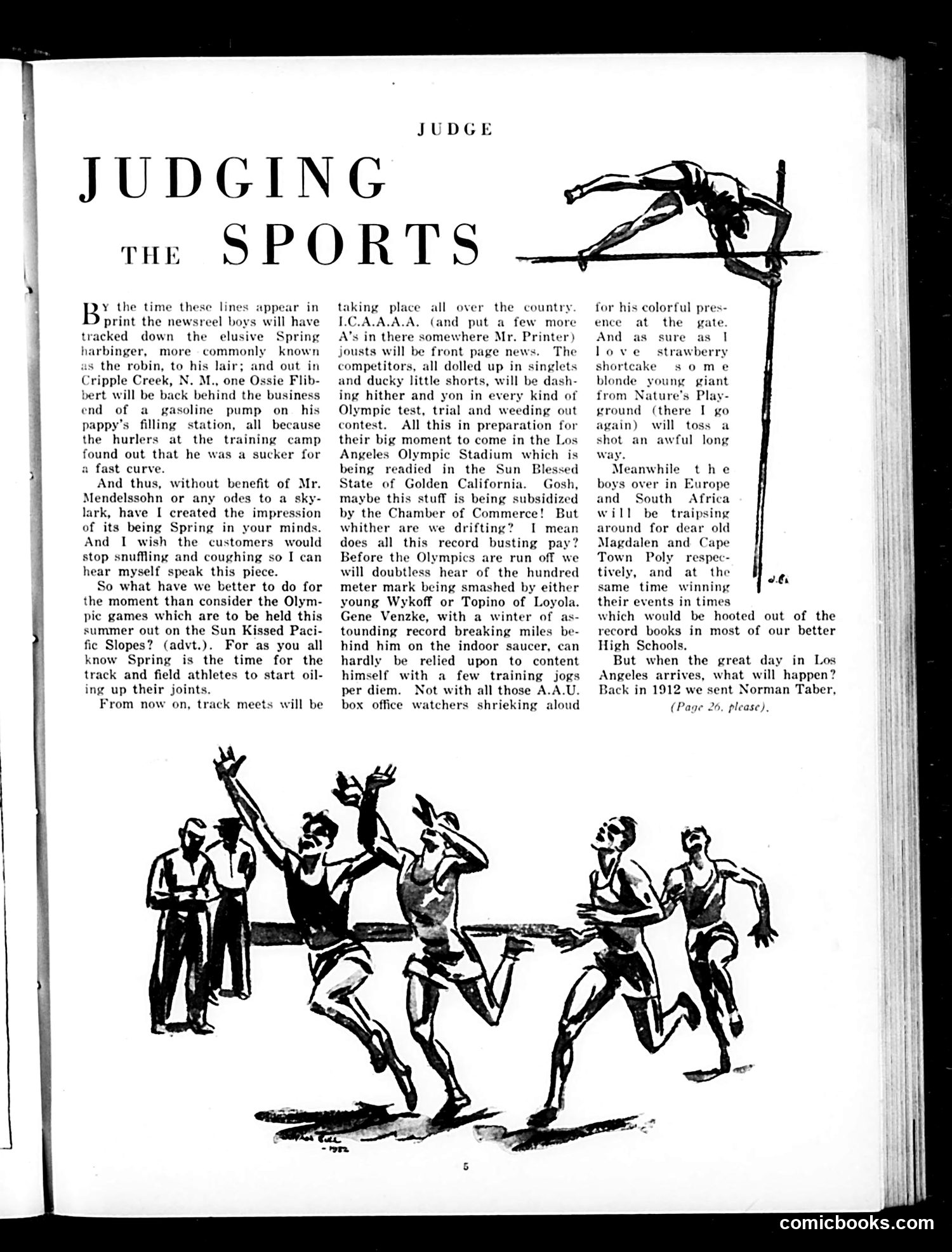
# Analysis of "Judging the Sports" Page This satirical piece mocks the upcoming 1932 Los Angeles Olympics. The author criticizes how the event is being heavily promoted and subsidized by the Chamber of Commerce, suggesting taxpayer money funds unnecessary spectacle. The article references specific athletes—likely Wyckoff and Topino of Loyola, and Gene Venzke—as record-breakers generating hype. It jokes that despite all this promotional machinery, actual performance remains unpredictable. The cartoon below illustrates a track-and-field finish line scene, showing the competitive chaos the article discusses. The piece concludes by noting European athletes (German Taber mentioned) will also compete, adding international dimension to the satirized Olympic machinery. The satire targets Olympic excess and commercialization, questioning whether public investment in such spectacle is justified.
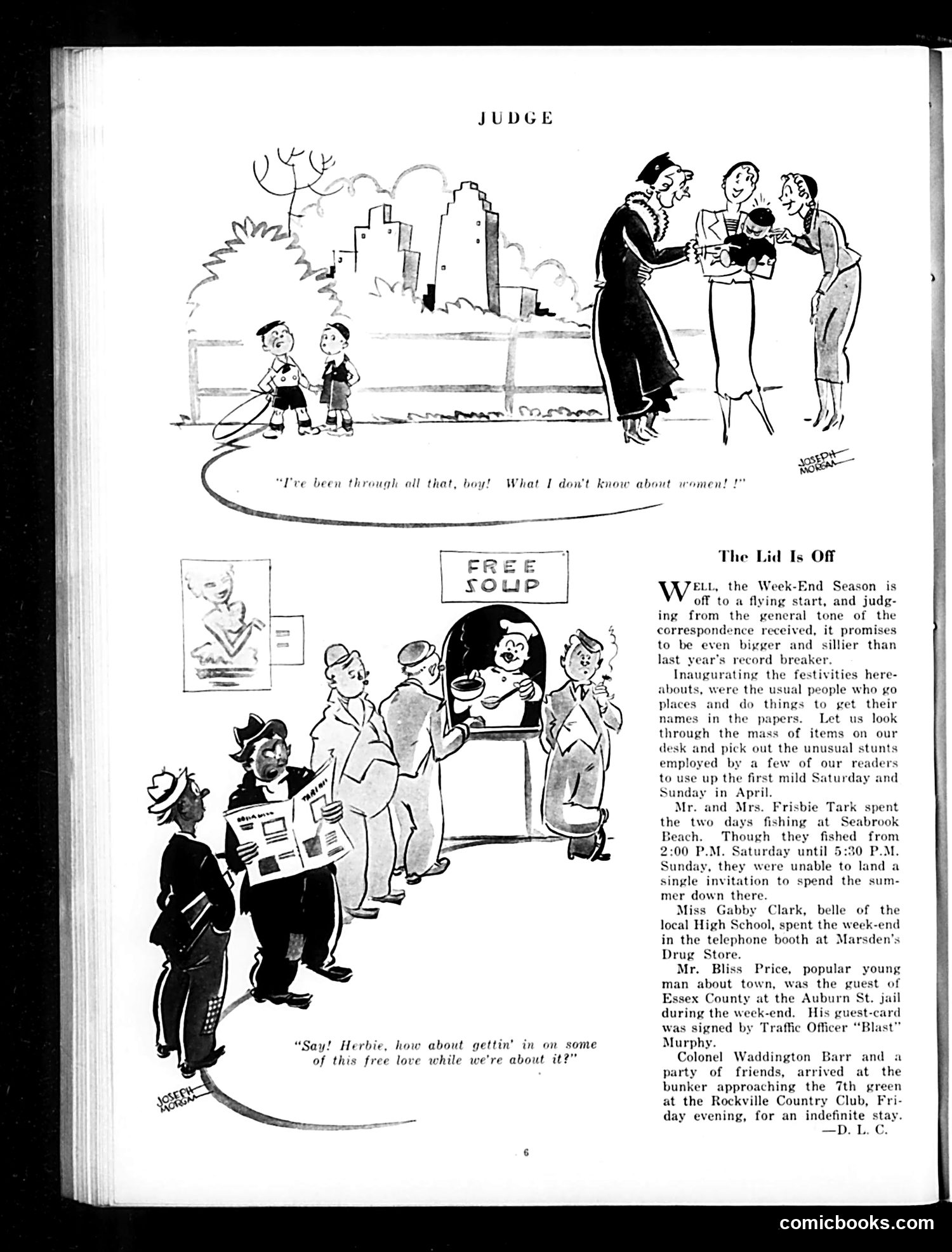
# "Judge" Page Analysis This page contains two cartoons satirizing weekend social activities. The top cartoon, titled "Judge," depicts a man (apparently inexperienced with relationships) boasting to a judge about romantic conquests while admitting ignorance about women—a self-contradictory joke about masculine bravado. The bottom cartoon, "The Lid Is Off," shows people gathered around what appears to be a "Free Soup" station, with the caption suggesting someone is taking advantage of free offerings. The accompanying article, "The Lid Is Off," describes weekend activities of local socialites—fishing trips, country club visits, and jail visits—presenting humorous observations of upper-class leisure activities from early 20th-century America. Both cartoons mock pretension and social absurdities of the era.
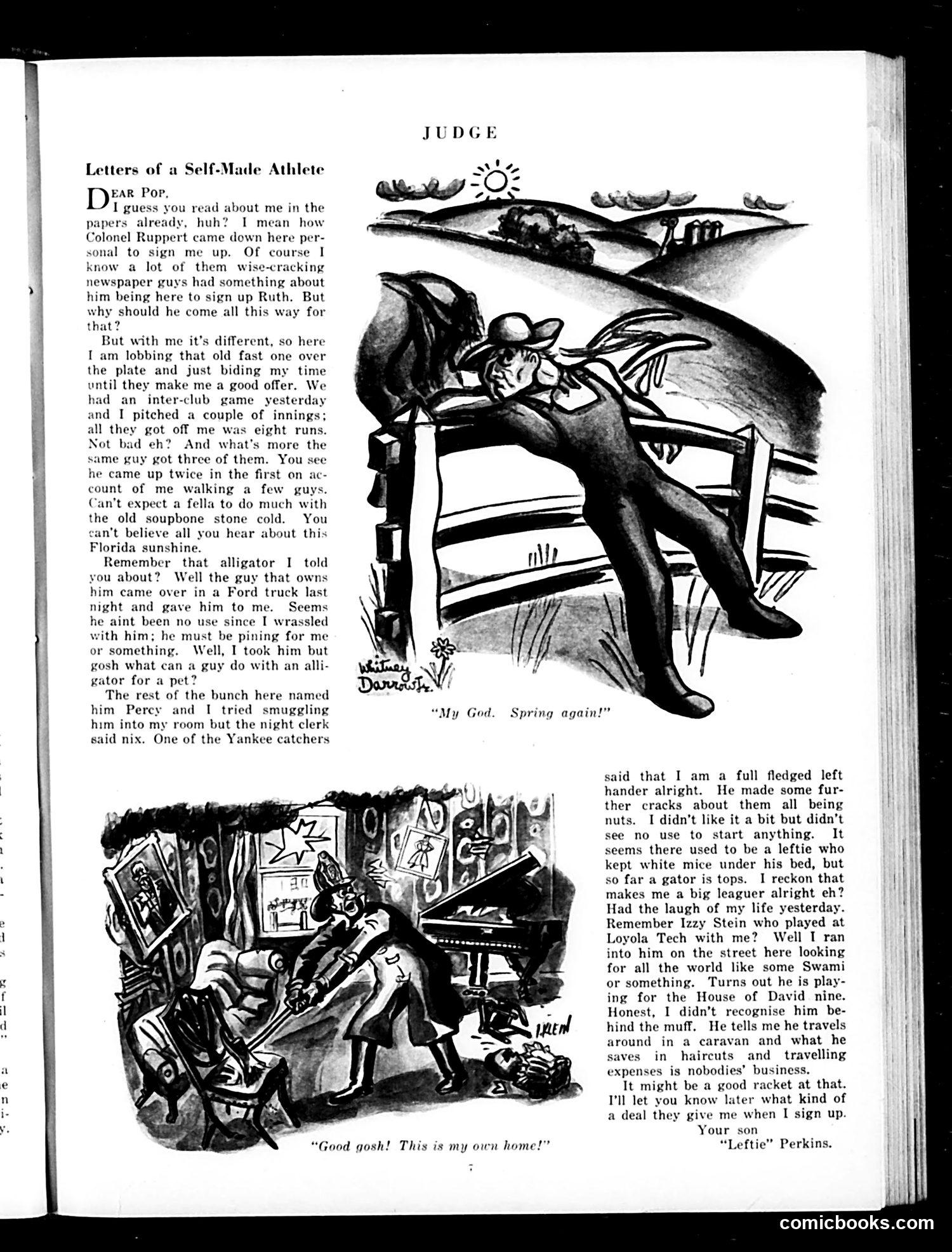
# Analysis: "Letters of a Self-Made Athlete" This satirical piece mocks minor-league baseball aspirants during spring training, likely in Florida. The writer, "Leftie" Perkins, is a delusional young pitcher who confuses his own mediocrity with importance. The humor centers on his inflated ego: Colonel Ruppert (owner of the Yankees) supposedly came to sign *him*, not Babe Ruth. Yet Perkins allowed eight runs in an inning-long appearance. His casual ownership of an alligator (which he "wrestled") and references to eccentric teammates—including "Izzy Stein" playing for the House of David (a real barnstorming team known for Orthodox Jewish players)—highlight the absurdity of minor-league baseball culture. The cartoons show domestic chaos: a man thrown from a horse, and a chaotic home scene. These illustrate the disruption caused by bringing an alligator into lodgings—emphasizing Perkins's poor judgment and the general zaniness he represents.
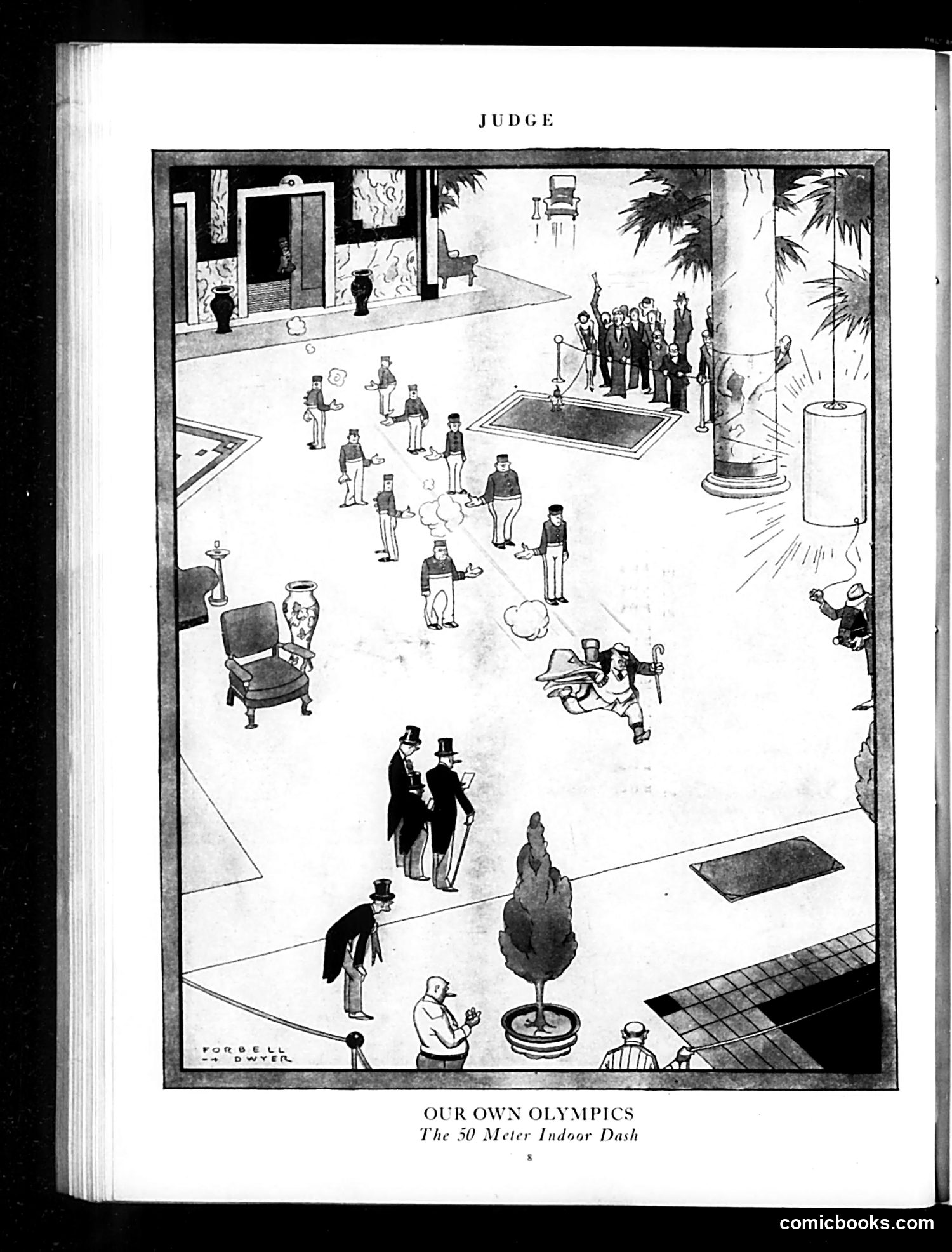
# Judge Magazine: "Our Own Olympics - The 50 Meter Indoor Dash" This cartoon satirizes indoor public spaces—likely a courthouse lobby or civic building—as an absurd athletic arena. The title's deliberate error ("350 Meter" vs. "50 Meter") is part of the joke. Various figures dash, stride, and lounge across an ornate interior featuring classical columns, potted plants, and formal architecture. The humor derives from treating mundane daily activities in grand civic spaces as Olympic competition. People in suits and formal wear engage in exaggerated athletic poses amid dignified surroundings—the incongruity between elevated architecture and chaotic human behavior is the satire's core. This mocks both the pretension of formal public buildings and the undignified rush of people conducting ordinary business within them. The cartoon's title placement beneath "JUDGE" suggests commentary on courthouse or legal system culture specifically.
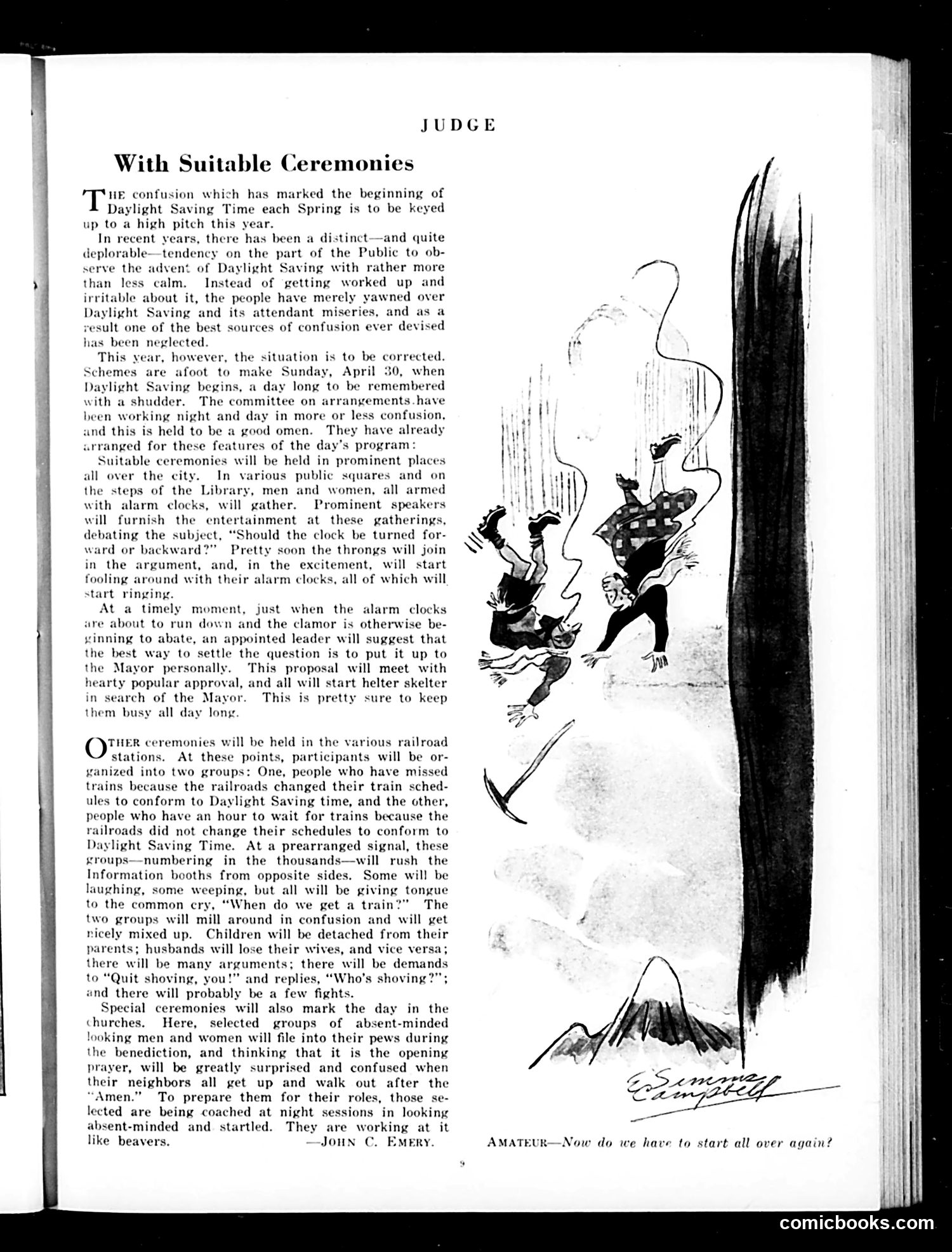
# Daylight Saving Time Satire (Judge Magazine) This is a satirical article by John C. Emery mocking public confusion over Daylight Saving Time's implementation on April 30. The piece describes elaborate, tongue-in-cheek "ceremonies" to commemorate the clock change. The humor targets: 1. **Public apathy**: Citizens have been calmly accepting DST, disappointing those who enjoy the chaos it creates. 2. **Proposed "solutions"**: The article mockingly describes intentional ceremonies designed to maximize confusion—alarm clocks ringing in public squares, people arguing about clock direction, crowds rushing train station information booths, families getting separated. 3. **Institutional dysfunction**: Railroads inconsistently adopting DST, churches staging confused parishioners leaving before services end. The cartoons (by Cesare Lombardi) show people in chaotic struggle with clocks and time. The satire suggests DST itself is inherently confusing, and that the public's reasonable indifference about it is somehow a missed opportunity for entertaining disorder. It's dark comedy about bureaucratic fumbling.
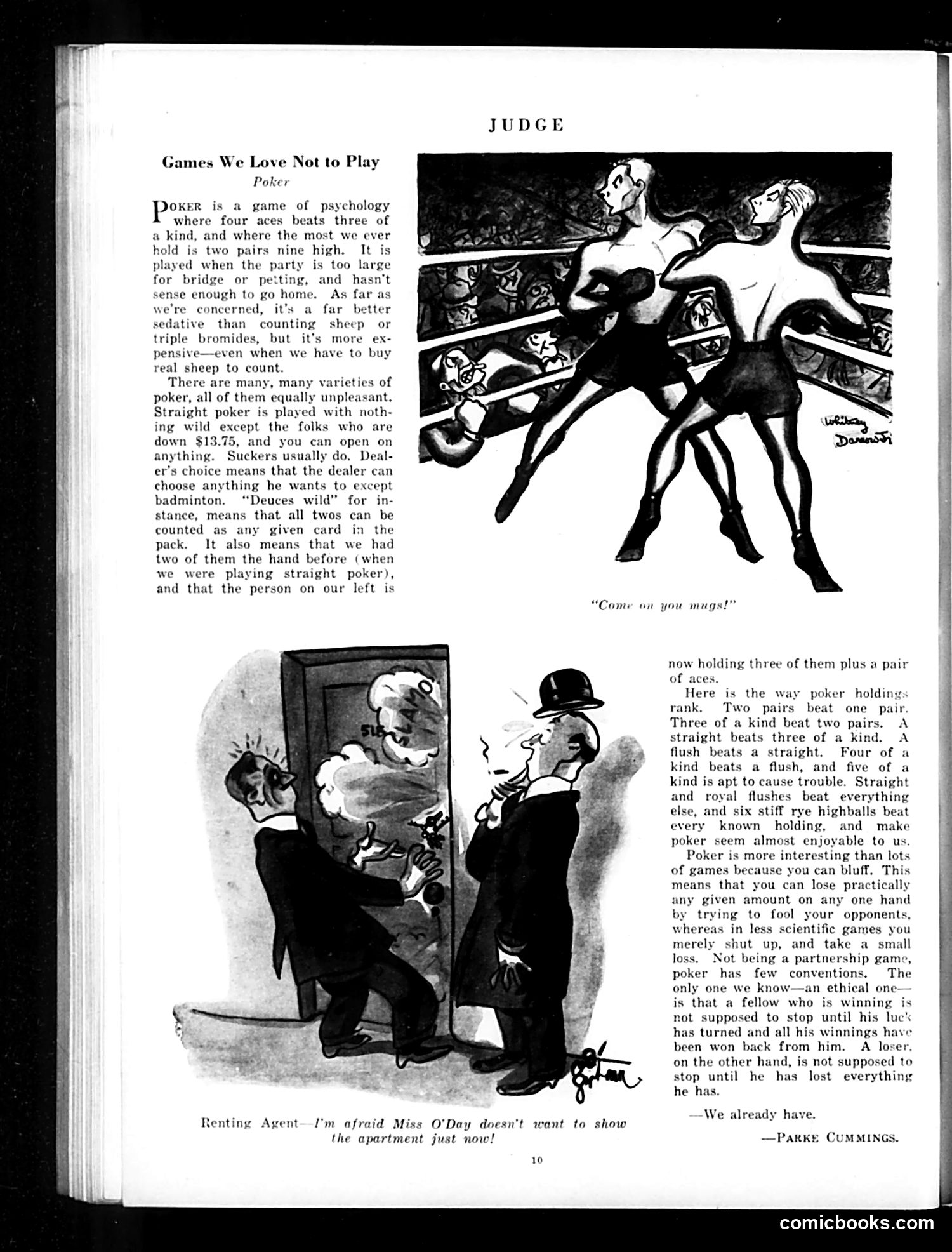
# Analysis of Judge Magazine Page This page satirizes poker as a vice disguised as entertainment. The article humorously condemns the game as psychologically manipulative, expensive, and morally corrupting—yet the author admits playing it anyway. The **top cartoon** shows scantily-clad women boxing, captioned "Come on you mugs!"—likely contrasting frivolous entertainment with the serious money-losing happening at poker tables. The **lower cartoon** depicts a renting agent reluctant to show an apartment because "Miss O'Day doesn't want to show" it—presumably she's engaged in an illicit activity (likely prostitution, given the era and context), suggesting poker and moral dissolution go hand-in-hand in Jazz Age society. The article's final admission—"We already have [lost everything]"—reveals the satire's target: the self-destructive compulsion of gambling, presented with wry humor rather than moral outrage. This reflects Judge's cynical take on 1920s social vices.
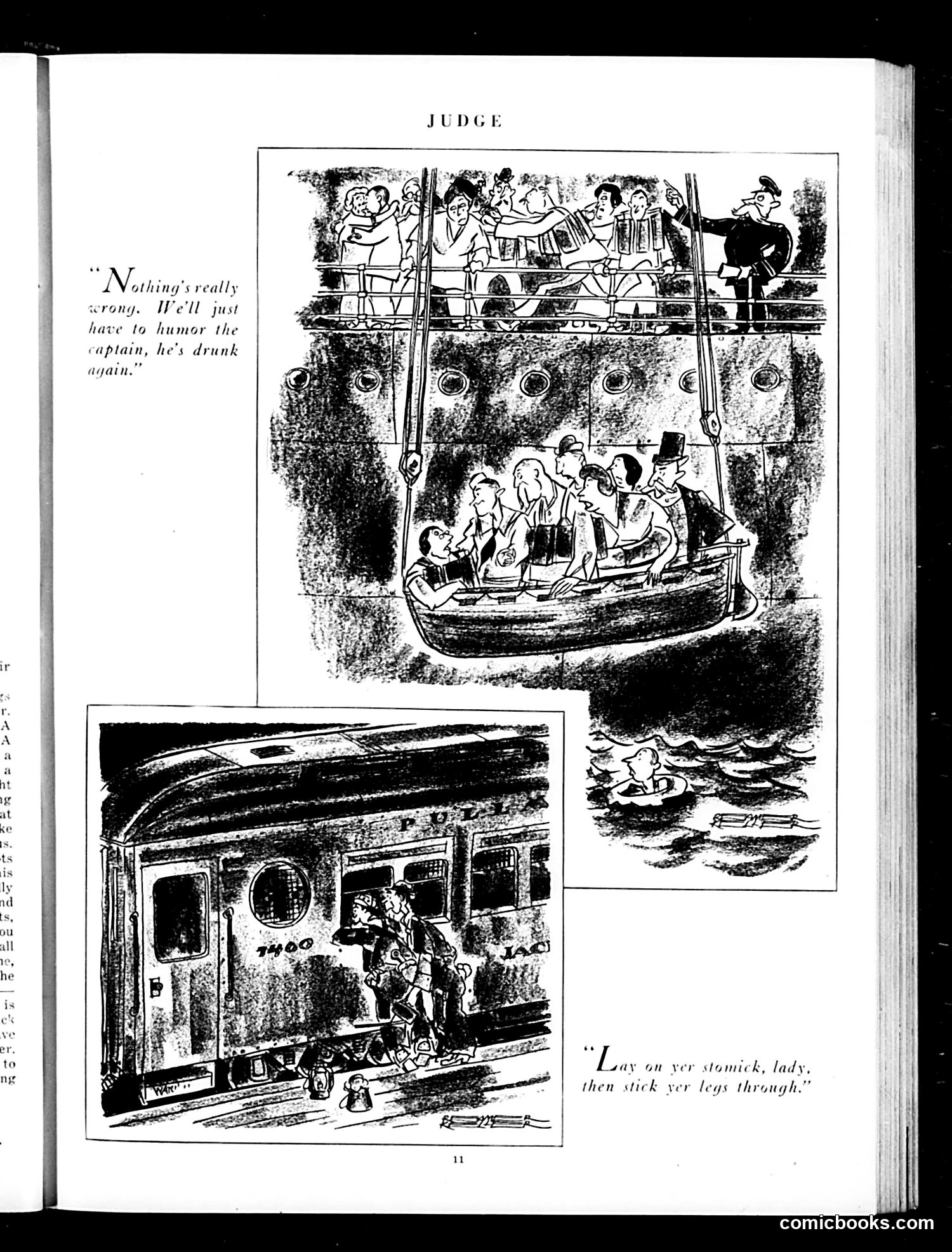
# Judge Cartoon Analysis This page contains two separate cartoons satirizing maritime incompetence. The top cartoon shows a ship's officers dismissing concerns about the vessel's safety, attributing problems to a drunk captain whom they'll "humor." The bottom cartoon depicts a ship's officer giving absurd, degrading instructions to a female passenger during what appears to be an evacuation or lifeboat drill—telling her to lie on her stomach and stick her legs through. Together, these cartoons mock the incompetence and indifference of ship officers toward passenger safety. They suggest casual negligence, alcohol abuse among command staff, and disrespect toward passengers. The satire likely reflects early 20th-century concerns about maritime safety standards and crew professionalism, especially given the era's numerous shipping disasters.