
Judge, 1932-04-09 · page 14 of 36
Judge — April 9, 1932 — page 14: what you’re looking at
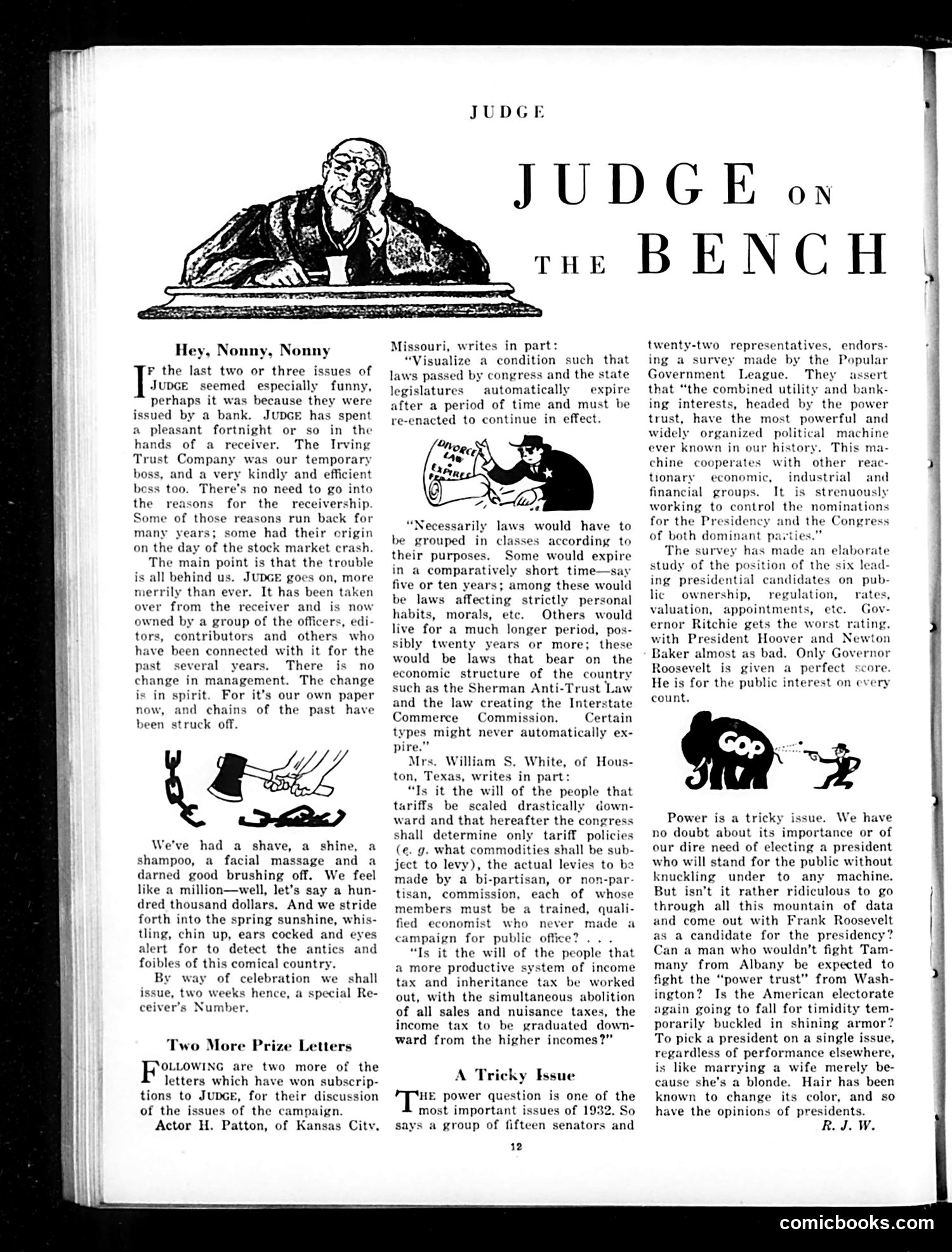
A restored page from Judge, 1932-04-09. Page through the whole issue in the reader above.
📄 Transcribed text from this page (OCR, searchable)
Machine-transcribed from the original scan — historical spelling and the odd misread are preserved.
Hey, Nonny, Nonny F the last two or three issues of JUDGE seemed especially funny, perhaps it was because they were issued by a bank. JUDGE has spent a pleasant fortnight or so in the hands of a receiver. The Irving Trust Company was our temporary boss, and a very kindly and efficient bess too. There’s no need to go into the reasons for the receivership. Some of those reasons run back for many some d their origin on the day of the stock market crash. The main point is that the trouble is all behind us. JUDGE goes on, more merrily than ever. It has been taken over from the receiver and is now owned by a group of the officers, edi- tors, contributors and others who have been connected with it for the past several ars. There is no change in management. The change is in spirit. For it’s our own paper now, and chains of the past have been struck off. We've had a shave, a shine, a shampoo, a facial massage and a darned good brushing off. We feel like a million—well, let’s say a hun- dred thousand dollars. And we stride forth into the spring sunshine, whi tling, chin up, ears cocked and eyes alert for to detect the antics and foibles of this comical country. By way of celebration we shall issue, two weeks hence, a special Re- ceiver’s Number. Two More P OLLOWING are two more of the letters which have won subscrip- tions to JuDGE, for their discussion of the issues of the c: Actor H. Patton, of Kansas City, e Letters JUDGE JUDGE on rune BENCH souri, writes in part: “Visualize a condition such that passed by congres: id the state automatically expire after a period of time and must be re-enacted to continue in effect. “Necessarily laws would have to be grouped in classes according to their purposes. Some would expire in a comparatively short time—say five or ten years; among these would be laws affecting strictly personal habits, morals, etc. Others would live for a much longer period, pos- sibly twenty y or more; these would be laws that bear on the economic structure of the country such as the Sherman Anti-Trust Law and the law creating the Interstate Commerce Commission. Certain rs. William S. White ton, Texas, writes in part: “Is it the will of the people that tariffs be scaled drastically down- ward and that hereafter the congress shall determine only tariff policies (e. g. what commodities shall be sub- ject to levy), the actual levies to be made by a bi-partisan, or non-par- tisan, commission, each of whose members must be a trained, quali- fied economist who never made a campaign for public o os s it the will of the people that a more productive system of income tax and inheritance tax be worked out, with the simultaneous abolition of all sales and nuisance taxes, the income tax to be graduated down- ward from the higher incomes?” of Hous- A Tricky Issue Te power question is one of the most important issues of 1932. So says a group of fifteen senators and 12 twenty-two representatives, endors- ing a survey made by the Popular Government League. They assert that “the combined utility and bank- ing interests, headed by the power trust, have the most powerful and widely organized political machine ever known in our history. This ma- chine cooperates with other reac- tionary economic, industrial and financial groups. It is strenuously working to control the nominations for the Presidency and the Congress of both dominant p The survey has made an elaborate study of the position of the six lead- ing presidential candidates on pub- lic ownership, regulation, rates, valuation, appointments, etc. Gov- ernor Ritchie gets the worst rating. h President Hoover Newton Baker almost as bad. Only Governor Roosevelt is given a perfect score. He is for the public interest on every count. Power is a tricky issue. We have no doubt about its importance or of our dire need of electing a president who will stand for the public without knuckling under to any machine. But isn’t it rather ridiculous to go through all this mountain of data and come out with Frank Roosevelt as a candidate for the presidency? Can a man who wouldn't fight Tam- many from Albany be expected to fight the “power trust” from Wash- ington? Is the American electorate again going to fall for timidity tem- porarily buckled in shining armor? To pick a president on a single issue, regardless of performance elsewhere, is like marrying a wife merely be- cause she’s a blonde. Hair has been known to change its have the opinions of pr comicbooks.com