
Judge, 1932-04-09 · page 24 of 36
Judge — April 9, 1932 — page 24: what you’re looking at
A restored page from Judge, 1932-04-09. Page through the whole issue in the reader above.
📄 Transcribed text from this page (OCR, searchable)
Machine-transcribed from the original scan — historical spelling and the odd misread are preserved.
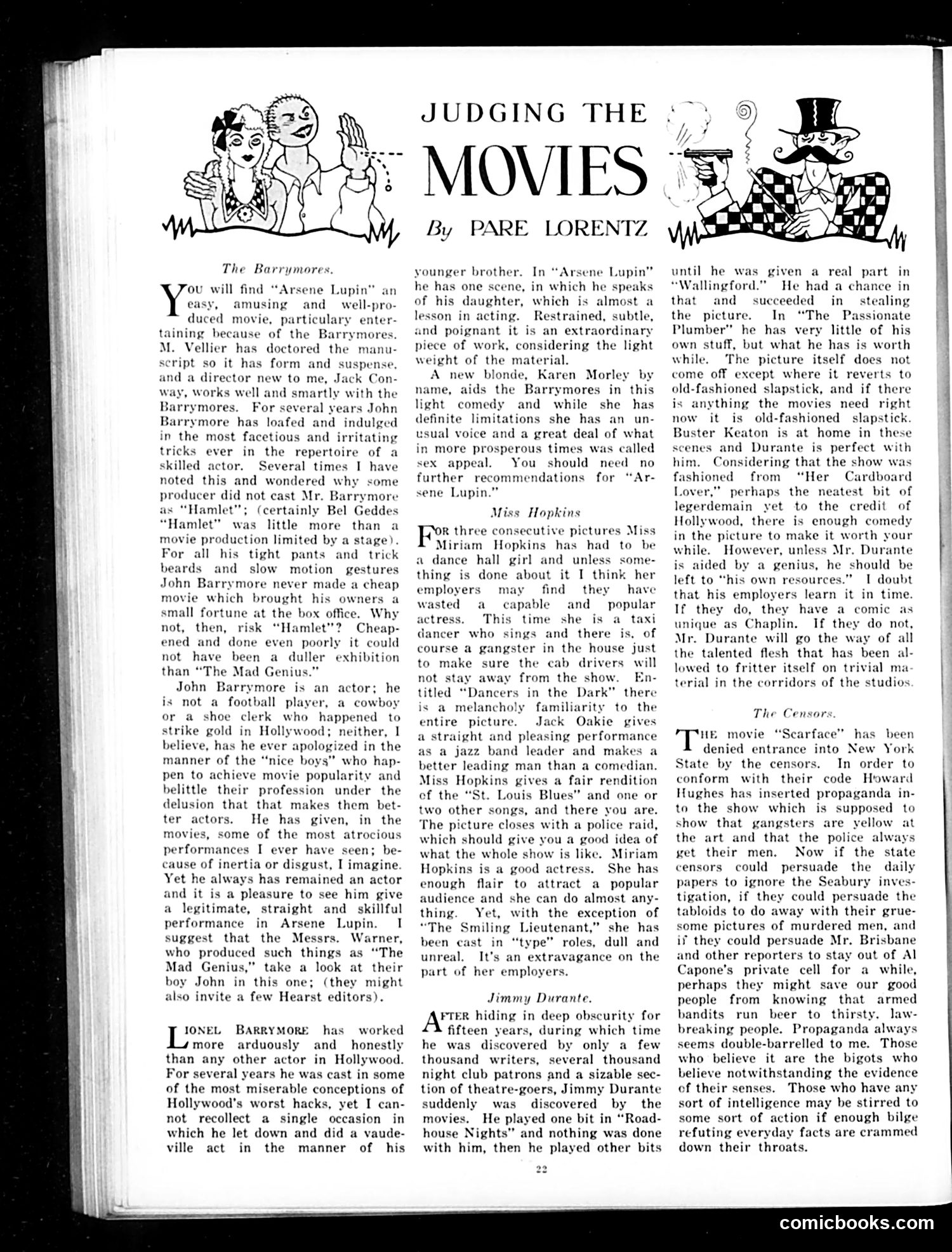
The ou will find “Arsene Lupin” an y, amusing nd well-pro- movie, particu ente taining because of the Barry M. Vellier has doctored the man cript so it has form and suspens and a director new to me, Jack Con- way, Works well and smartly with the Barrymores. For several 3 rs John Barrymore has loafed and indulged in the most facetious and irritating tricks ever in the repertoire of a skilled actor. Several times I have noted this and wondered why some producer did not cast Mr. Barrymore as “Hamlet”; (certainly Bel Geddes famlet” was little more than a movie production limited by a stage). For all his tight pants and trick beards and slow motion gestures John Barrymore never made a ch movie which brought his owner small fortune at the box office. Why not, then, r “Hamlet”? Cheap- ened and done even poorly it could not ve been a duller exhibition than “The Mad Genius.” John Barrymore is an actor; he is not a football player, a cowboy or a shoe clerk who happened to strike gold in Hollywood; neither, 1 believe, has he ever apologized in the manner of the ‘“‘nice boys” who hap- pen to achieve movie popularity and belittle their profession under the delusion that that makes them bet- ter actors. He has given, in the movies, some of the most atrocious performances I ever have seen; be- cause of inertia or disgust, I imagine. Yet he always has remained an actor and it is a pleasure to see him give a legitimate, straight and_ skillful performance in Arsene Lupin. I suggest that the Messrs. Warner, who produced such things “The Mad Genius,” take a look at their boy John in this one; (they might also invite a few Hearst editors). Barrymores. Lox BARRYMORE has worked more arduously and_ honestly than any other actor in Hollywood. For several years he was cast in some of the most miserable conceptions of Hollywood's worst hacks, yet I can- not recollect a single occasion in which he let down and did a vaude- ville act in the manner of his JUDGING THE MOVIES By PARE LORENTZ younger brother. In “Arsene Lupin” he has one scene, in which he speaks of his daughter, which is almost a lesson in acting. Restrained, subtle, and poignant it is an extraordinary piece of work, considering the light weight of the mater A new blonde, Karen Morley by name, aids the Barrymores in this light comedy and while she has definite limitations she has an un- usual voice and a great deal of what in more prosperous times was called sex appeal. You should need no further recommendations for “Ar- sene Lupin.” Miss Hopkins R three consecutive pictures Miss Miriam Hopkins has had to be a dance hall girl and unless some- thing is done about it I think her employers may find they have wasted a capable and popular ctre This time she is a taxi dancer who sings and the is, of course a gangster in the house just to make sure the cab drivers will not stay away from the show. En- titled “Dancers in the Dark” there is a melancholy familiarity to the entire picture. Jack Oakie gives a straight and pleasing performance as a jazz band leader and makes a better leading man than a comedian. Miss Hopkins gives a fair rendition ef the “St. Louis Blues” and one or two other songs, and there you are. The picture closes with a police raid, which should give you a good idea of what the whole show is like. Miriam Hopkins is a good actress. She has enough flair to attract a popular audience and she can do almost any- thing. Yet, with the exception of “The Smiling Lieutenant,” she has been cast in “type” roles, dull and unreal, It's an extravagance on the part of her employers. Jimmy Durante. FTER hiding in deep obscurity for fifteen y , during which time he was discovered by only a few thousand writers, several thousand night club patrons and a sizable sec- tion of theatre-goers, Jimmy Durante suddenly was discovered by the movies. He played one bit in “Road- house Nights” and nothing was done with him, then he played other bits until he was given a real part in “Wallingford.” He had a chance in that and succeeded in stealing the picture. In “The Passionate Plumber” he has very little of his own stuff, but what he has is worth while. The picture itself does not come off except where it reverts to old-fashioned slapstick, and if there is anything the movies need right now it old-fashioned slapstick. Buster Keaton is at home in these ne nd Durante is perfect with him. Considering that the show was fashioned from “Her Cardboard Lover,” perhaps the neatest bit of legerdemain yet to the credit of Hollywood, there is enough comedy in the picture to make it worth your while. However, unless Mr. Durante is aided by a genius, he should be left to “his own resources.” I doubt that his employers learn it in time. If they do, they have a comic as unique Chaplin. If they do not, Mr. Durante will go the way of all the talented flesh that has been al- lowed to fritter itself on trivial ma terial in the corridors of the studios The Censor: HE movie “Scarface” has been denied entrance into New York State by the censors. In order to conform with their code Howard Hughes has inserted propaganda in- to the show which is supposed to show that gangsters are yellow at the art and that the police alw: yet their men. Now if the state censors could persuade the daily papers to ignore the Seabury inves- tigation, if they could persuade the tabloids to do away with their grue- some pictures of murdered men, and iy they could persuade Mr. Brisbane and other reporters to stay out of Al Capone's private cell for a while, perhaps they might ve our good people from knowing that armed bandits run beer to thirsty. law- breaking people. Propaganda always seems double-barrelled to me. Those who believe it are the bigots who believe notwithstanding the evidence of their sense Those who have any sort of intelligence may be stirred to some sort of action if enough bilge refuting everyday facts are crammed down their throats. comicbooks.com