
Judge, 1932-04-09 · page 18 of 36
Judge — April 9, 1932 — page 18: what you’re looking at
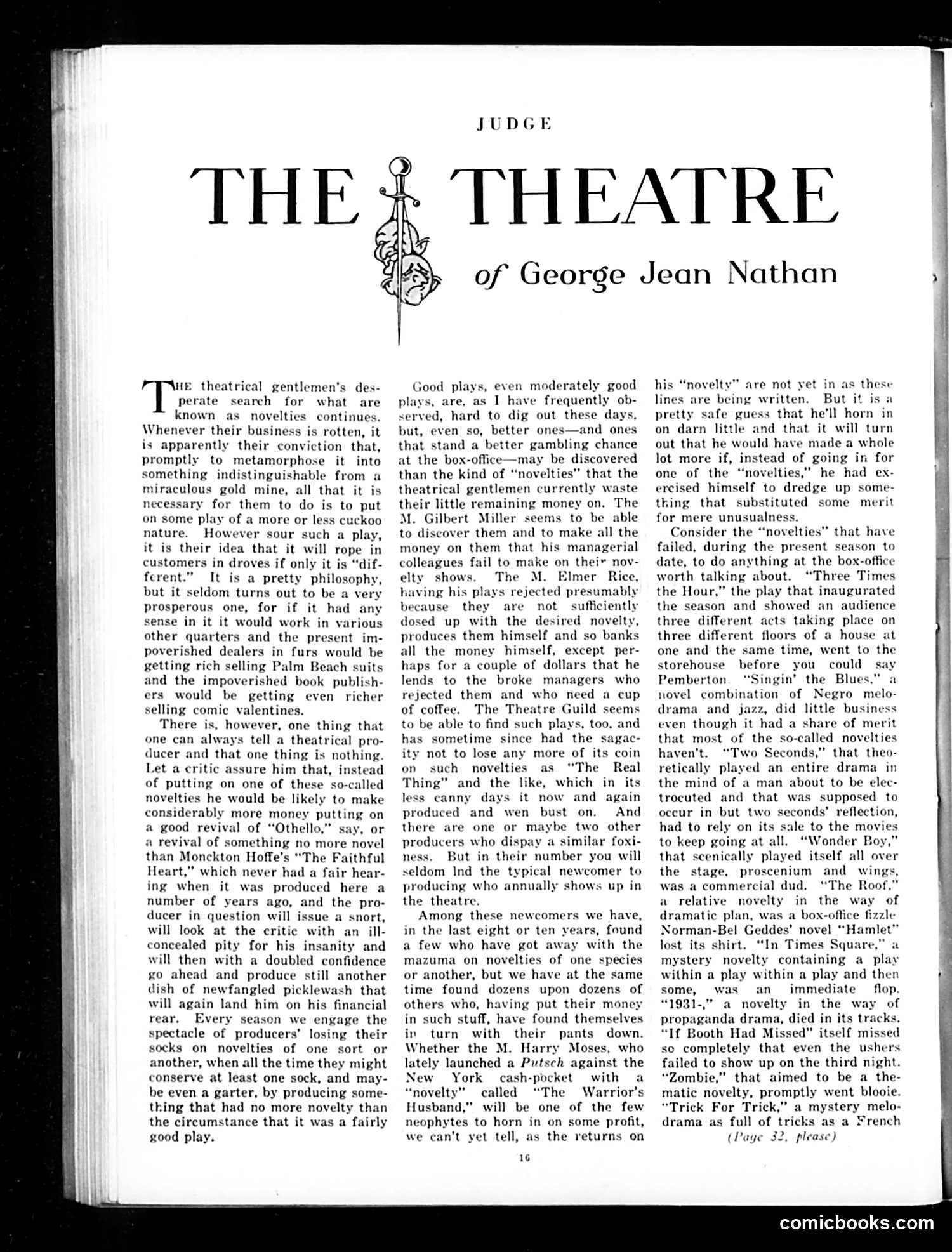
A restored page from Judge, 1932-04-09. Page through the whole issue in the reader above.
📄 Transcribed text from this page (OCR, searchable)
Machine-transcribed from the original scan — historical spelling and the odd misread are preserved.
THE HE theatrical gentlemen's des- perate search for what are known novelties continues. Whenever their business is rotten, it is apparently their conviction that, promptly to metamorphose it into something indistinguishable from a miraculous gold mine, all that it is nec ry for them to do is to put on some play of a more or less cuckoo nature. However sour such a play, it is their idea that it will rope in customers in droves if only it is “dif- ferent It is a pretty philosophy, but it seldom turns out to be a ve prosperous one, for if it had any sense in it it would work in various other quarters and the present im- poverished dealers in furs would be getting rich selling Palm Beach suits and the impoverished book publish- ers would be getting even richer selling comic valentines. There is, however, one thing that one can alw: tell a theatrical pro- ducer and that one thing is nothing. Let a critic assure him that, instead of putting on one of these so-called novelties he would be likely to make considerably more money putting on a good revival of “Othello,” say, or a revival of something no more novel than Monckton Hoffe’s “The Faithful Heart,” which never had a fair hear- ing when it was produced here a number of years ago, and the pro- ducer in question will issue a snort, will look at the critic with an ill- concealed pity for his insanity and will then with a doubled confidence go ahead and produce still another dish of newfangled picklewash that will again land him on his financial rear. Every season we engage the spectacle of producers’ ng their socks on novelties of one sort or another, when all the time they might conserve at least one sock, and may- be even a garter, by producing some- thing that had no more novelty than the circumstance that it was a fairly good play. JUDGE THEATRE of George Jean Nathan Good plays, even moderately good pla are, as I ve frequently ob- served, hard to dig out these da: but, even so, better ones—and ones that stand a better gambling chance at the box-office—may be discovered than the kind of “novelties” that the theatrical gentlemen currently waste their little remaining money on. The M. Gilbert Miller seems to be able to discover them and to make all the money on them that his m colleagues fail to make on their nov- elty show: The M. Elmer Rice, having his plays rejected presumably because they are not sufficiently dosed up with the desired novelty, produces them himself and so banks all the money himself, except per- haps for a couple of dollars that he lends to the broke managers who rejected them and who need a cup of coffee. The Theatre Guild seems to be able to find such plays, too, and has sometime since had the ce ity not to lose any more of its coin on such novelties as “The Real Thing” and the like, which in its less canny days it now and again produced and wen bust on. And there one or maybe two other producers who dispay a similar foxi- ness. But in their number you will seldom Ind the typical newcomer to producing who annually shows up in the theatre. Among these newcomers we have, in the last eight or ten ars, found a few who have got away with the mazuma on novelties of one species or another, but we have at the same time found dozens upon dozens of others who, having put their mon in such stuff, have found themselves in turn with their pants down. Whether the M. Harry Moses, who lately launched a Putsch against the York cash-pocket with a novelty” called “The Warrior's Husband,” will be one of the few neophytes to horn in on some profit, we can’t yet tell, as the returns on 16 his “novelty” are not yet in as these lines are being written. But it is a pretty safe guess that he'll horn in on darn little and that it will turn out that he would have made a whole lot more if, instead of going in for one of the “novelties,” he had ex- ercised himself to dredge up some- thing that substituted some merit for mere unusualness. Consider the “novelties” that have failed, during the present season to date, to do anything at the box-office worth talking about. “Three Times the Hour,” the play that inaugurated the season and showed an audience three different acts taking place on three different floors of a house at one and the ne time, went to the storehouse before you could Pemberton. “Singin’ the Blues,” a novel combination of Negro melo- drama and jazz, did little business even though it had a share of merit that most of the so-called novelties haven't. “Two Seconds,” that theo- retically played an entire drama in the mind of a man about to be elec- trocuted and that was supposed to occur in but two seconds’ reflection, had to rely on its sale to the movi to keep going at all. “Wonder Boy that scenically played itself all over the stage, proscenium and wings, was a commercial dud. “The Roof.” a relative novelty in the dramatic plan, was a box-oflice fiz Norman-Bel Geddes’ novel “Hamle lost hirt. “In Times myste: novelty containing a play within a play within a play and then some, was an immed flop. “1931-," a novelty in the way of propaganda drama, died in its tracks. “If Booth Had Missed” itself missed so completely that even the ushers failed to show up on the third night. “Zombie,” that aimed to be a the- matic novelty, promptly went blooie. “Trick For Trick,” a mystery melo- drama full of trick: a French (Page 32, comicbooks.com