A complete issue · 36 pages · 1931
Judge — May 16, 1931
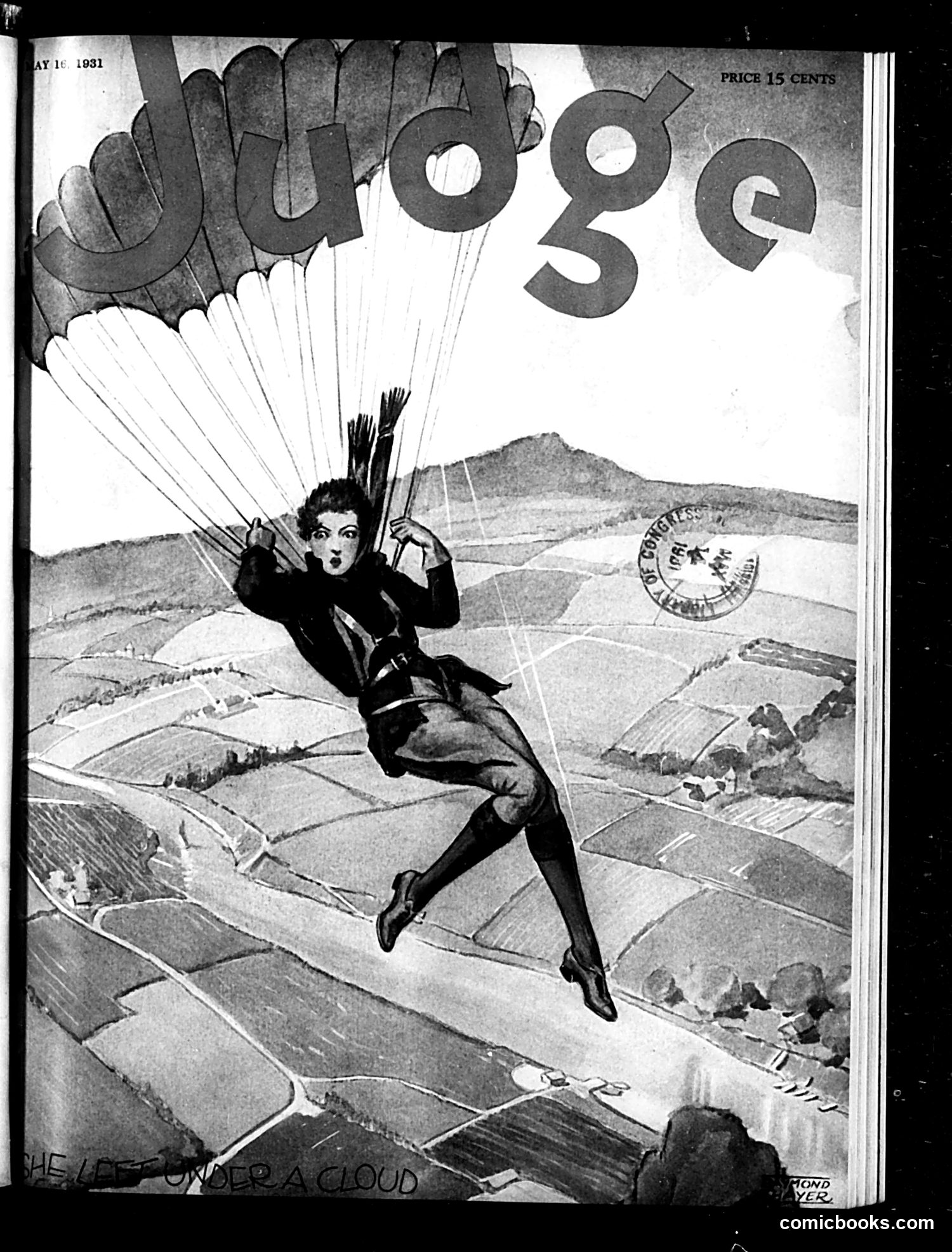
# Judge Magazine Cover Analysis (May 16, 1931) This cover depicts a woman in a black outfit descending by parachute over a patchwork agricultural landscape. The large numbers "1929" appear at top, while text at bottom reads "UNDER A CLOUD." **Historical Context:** This is a commentary on the stock market crash of 1929 and the subsequent Great Depression. The parachute descent suggests financial "crash landing" or emergency descent from prosperity. The woman's expression of shock and the agricultural landscape below symbolize the economic devastation spreading from Wall Street to rural America. The "cloud" reference combines literal imagery (the parachute) with the figurative meaning of a dark shadow over the nation's economic future. This 1931 publication reflects ongoing Depression anxieties two years after the initial crash.
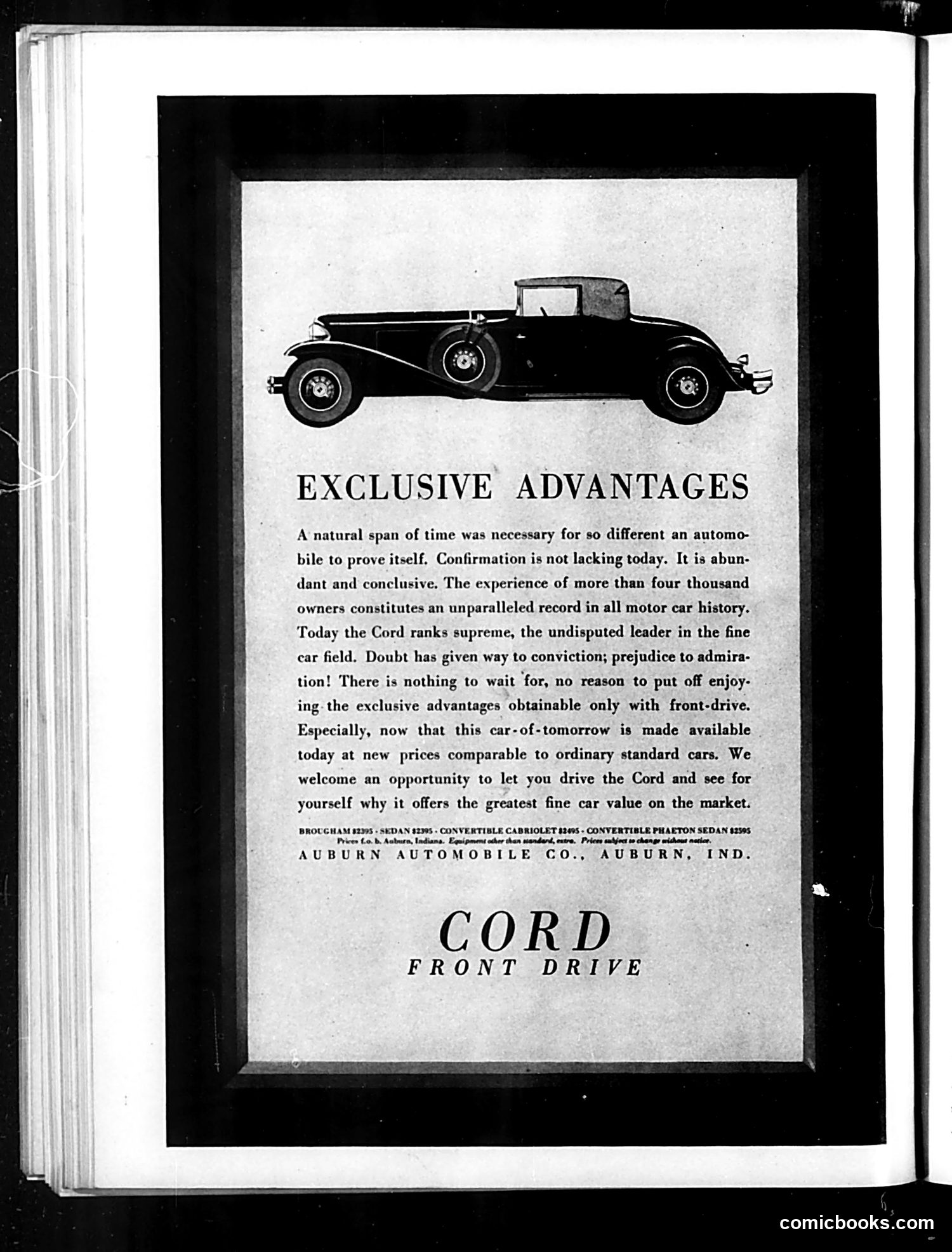
# Analysis This page is primarily **advertising, not satire or political commentary**. It's a Cord automobile advertisement from Auburn Automobile Co. (Auburn, Indiana), promoting the Cord's front-wheel-drive technology as a revolutionary innovation. The ad's "exclusive advantages" pitch emphasizes that the Cord has proven itself through over 4,000 owner experiences—an "unparalleled record." The text argues that doubters have been converted; the car now ranks "supreme" in the fine car field. It highlights that front-wheel drive, previously available only in expensive vehicles, is now offered at prices comparable to standard cars. The elegant side-profile silhouette showcases the vehicle's sleek design, meant to appeal to luxury car buyers. This is straightforward commercial promotion, not satirical content.
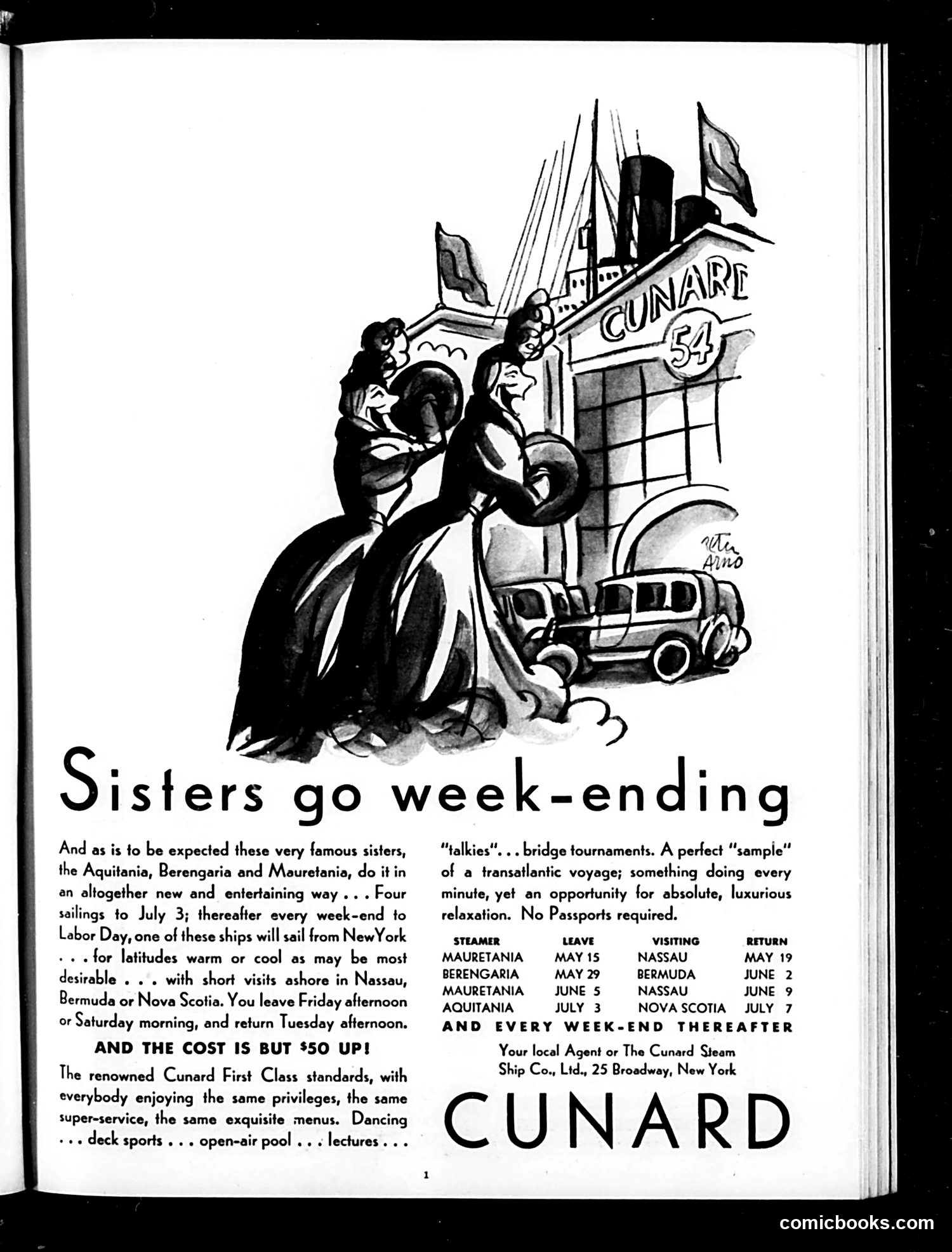
# Analysis of "Sisters Go Week-ending" - Cunard Advertisement This is primarily a **Cunard cruise line advertisement**, not political satire. The illustration depicts wealthy women ("sisters"—likely socialites) boarding the luxury liner Cunard 54, preparing for weekend getaways. The "joke" plays on leisure culture: these famous sisters (the text mentions "Aquitania, Berengaria and Mauretania"—actually ship names, not people) enjoy transatlantic voyages costing only $50 for weekend trips to Nassau, Bermuda, or Nova Scotia. The satire is subtle and class-based: it mocks the casual wealth of the era's upper class, where luxury ocean travel was a casual weekend activity. The caricatured, fashionable women and their animated poses emphasize the frivolous leisure culture of the 1920s-30s among the extremely wealthy.
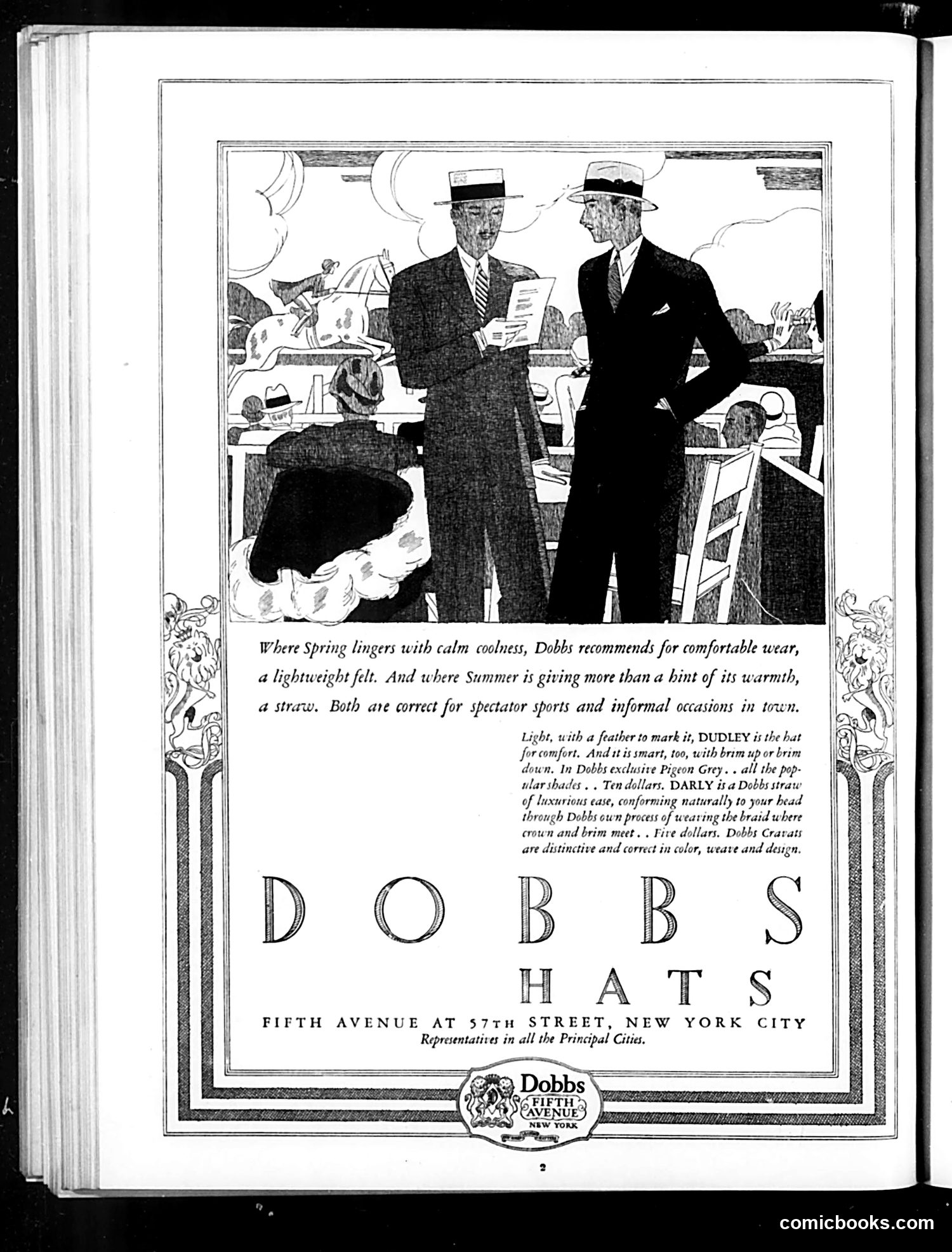
# Analysis This is primarily a **Dobbs Hat advertisement**, not a political cartoon. The image depicts three well-dressed men at what appears to be a sporting or social event, illustrating hat recommendations for different seasons. The ad copy discusses hat choices: a "lightweight felt" for spring and a straw hat for summer, both "correct for spectator sports and informal occasions in town." It then promotes specific Dobbs hat styles—the Dudley, Darby, and Cravatti—with prices ranging from five to ten dollars. The decorative border and formal illustration style are typical of upscale magazine advertising from the early-to-mid 20th century. This represents commercial content rather than satirical commentary, aimed at affluent male readers seeking guidance on proper seasonal attire.
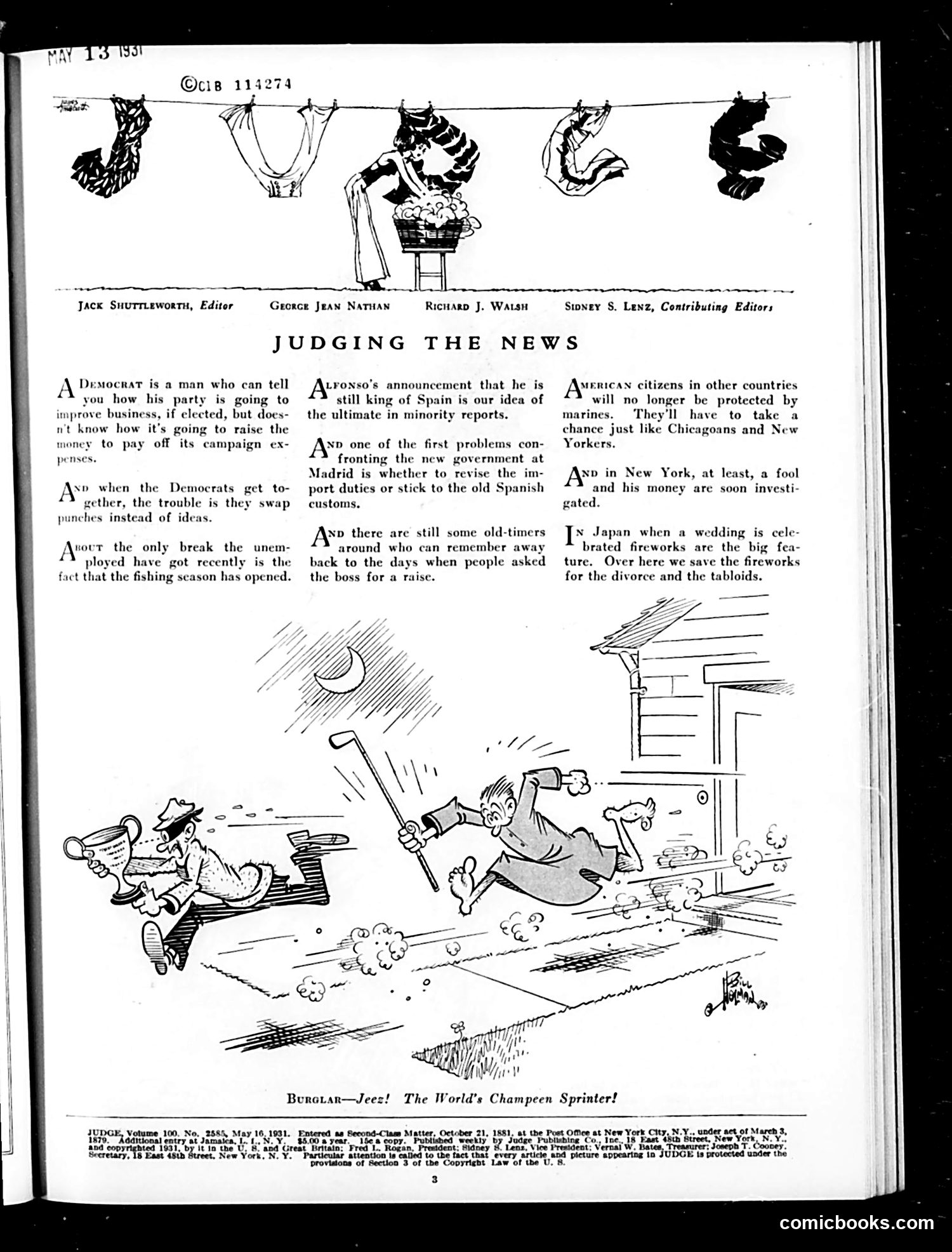
# "Judging the News" - May 13, 1931 This page contains editorial commentary and one cartoon titled "Burglar—Jeez! The World's Champion Sprinter!" The cartoon depicts a burglar fleeing a house at night, running frantically while being chased. The satire comments on crime or criminal activity during the Great Depression era—likely referencing the spike in burglaries occurring as economic desperation increased. The editorial snippets above use humor to critique contemporary politics: Democratic campaign finances, Spain's government changes under Alfonso XIII, unemployment, and American expatriates abroad. One comment jokes that New York fools are "soon investigated," suggesting criticism of New York politics or society. The overall tone is cynical commentary on 1931 American politics and social problems during the Depression.
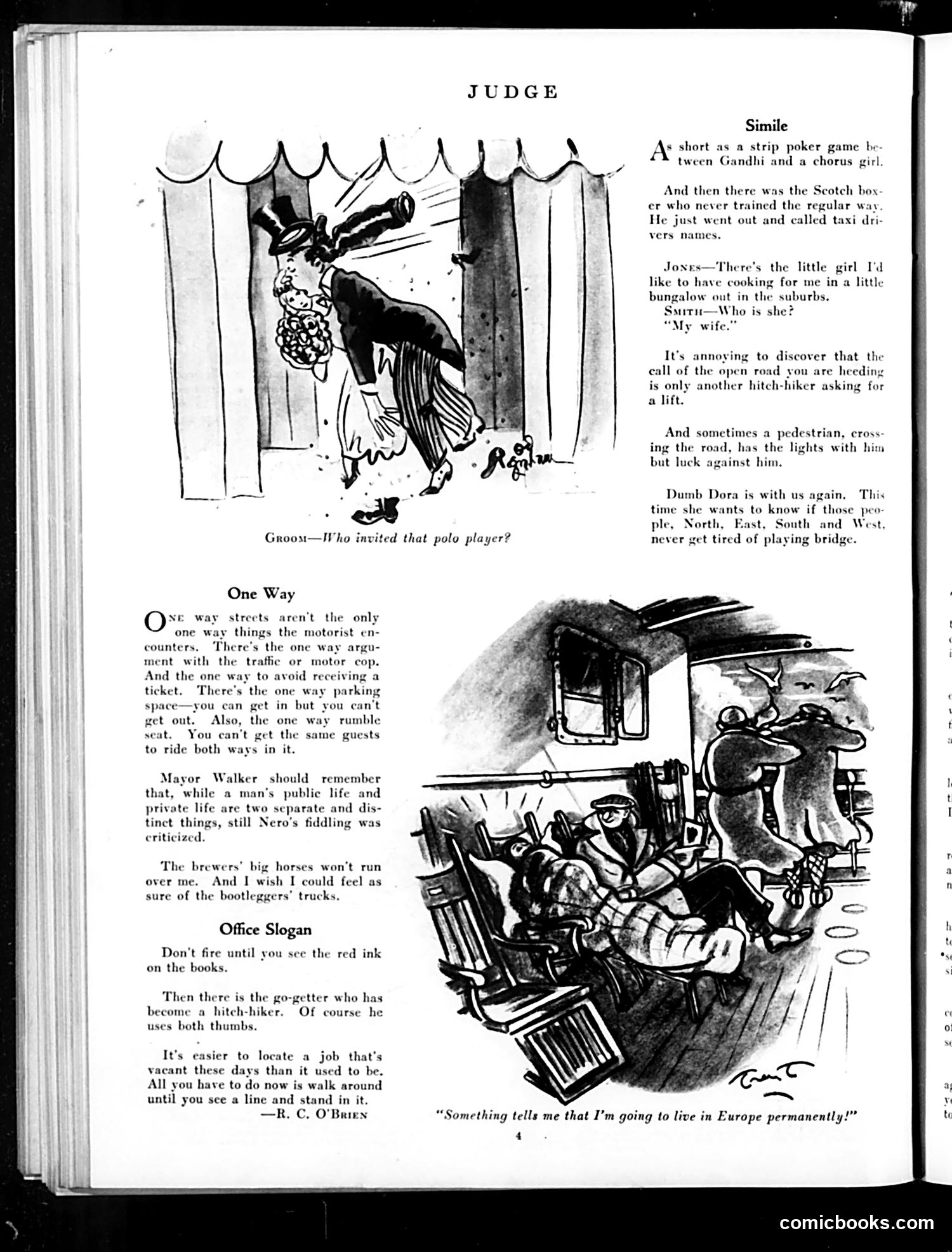
# Judge Magazine Page Analysis This page contains humor columns and two cartoons satirizing early 20th-century American life. **Top cartoon** ("Grooms—Who invited that polo player?"): Shows a disheveled man at what appears to be a formal event, mocking social pretension and the intrusion of wealth-obsessed outsiders into exclusive circles. **"One Way" section**: Critiques traffic regulations and parking absurdities of the motorist era—one-way streets, no-parking zones, and contradictory rules that trap drivers. **Bottom cartoon**: Depicts an overcrowded car full of people heading to Europe, captioned "Something tells me that I'm going to live in Europe permanently!" This satirizes wealthy Americans' exodus abroad, likely referencing post-WWI expatriation trends when many Americans relocated to Europe, particularly Paris. The overall theme mocks modern inconveniences and social pretension.
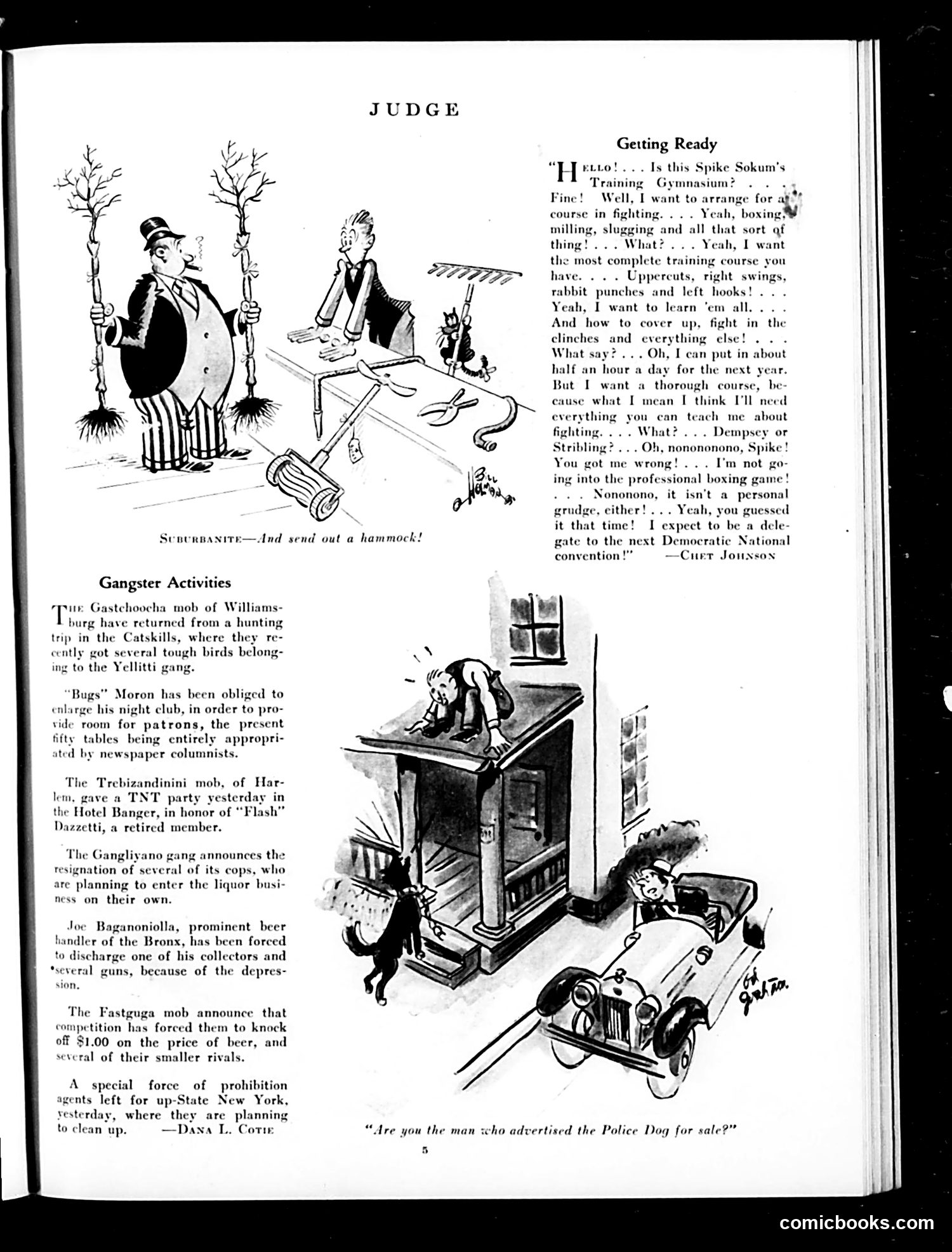
# Judge Magazine Page Analysis This page satirizes **Prohibition-era gangster activities** in 1920s America. The top cartoon shows someone at a boxing gymnasium—a common front for illegal operations during Prohibition. The lengthy dialogue mocks how gangsters disguised criminal enterprises (bootlegging, gambling) as legitimate businesses. The "Gangster Activities" section humorously documents real mob operations: the Gastchoocha mob's hunting trip (likely code for violent activity), "Bugs" Moron's nightclub expansion, and various gangs' turf wars and price-fixing. The bottom cartoon depicts a police dog being sold—likely satirizing law enforcement's ineffectiveness against organized crime. The satire targets both gangster audacity and authorities' inability to combat Prohibition-era crime. Judge's tone suggests bemused exasperation with widespread criminal networks operating openly in major American cities.
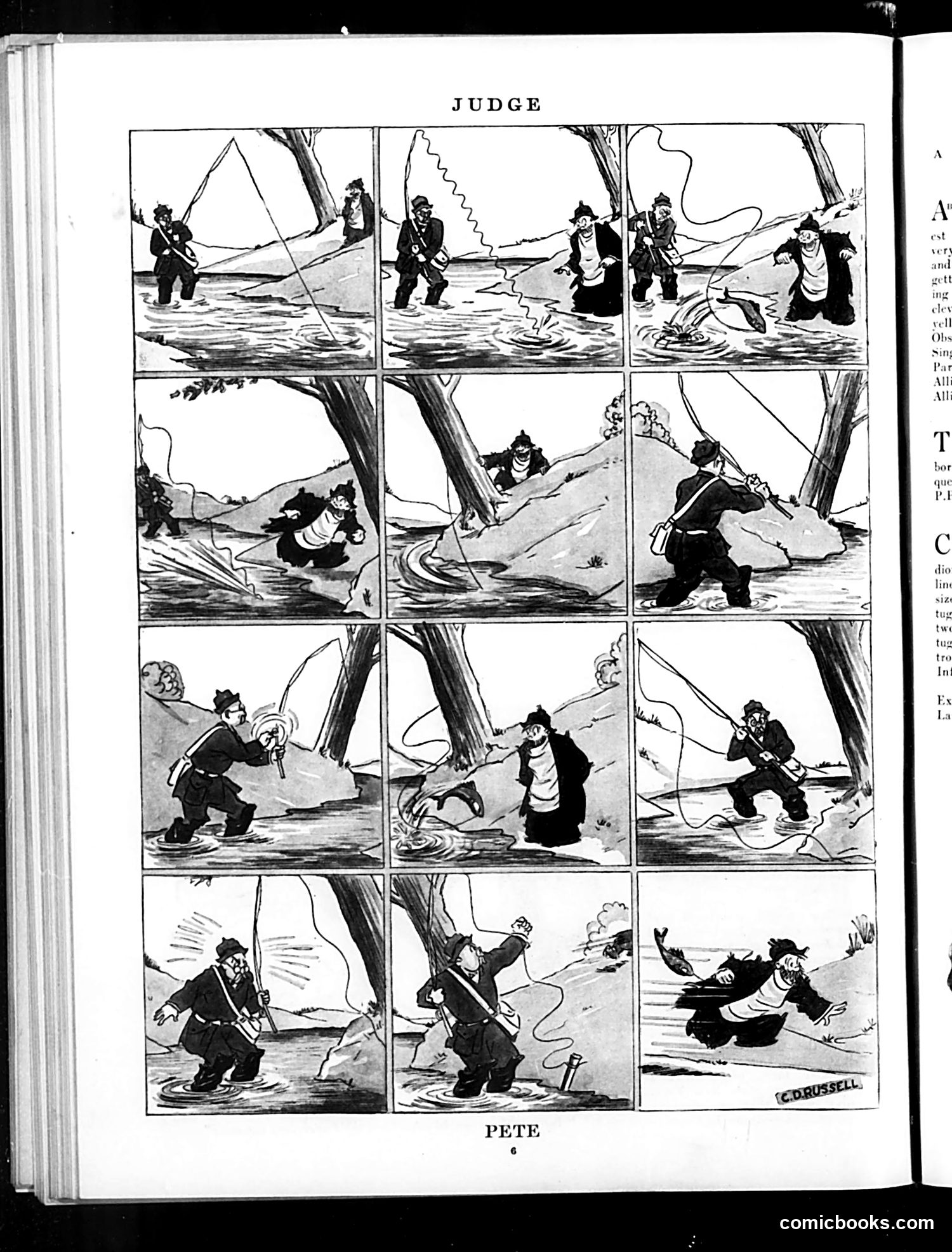
# Judge Magazine Comic: "Judge" and "Pete" This is a fishing-themed comic strip showing two men in formal attire attempting to catch fish in a stream. The title "JUDGE" tops the sequence, while "PETE" appears at the bottom. The humor appears to center on incompetent or comedic fishing attempts—the men repeatedly struggle, fall, or flail with their fishing rods in increasingly absurd ways. The physical comedy and exaggerated poses suggest satirical commentary on amateur fishermen or perhaps specific public figures (the title "Judge" might reference a judge character, though specific identification is unclear without additional context). The cartoonist's signature "C.D.RUSSELL" appears in the lower right. The satire likely relies on contemporary recognition of the figures, which modern readers would require additional historical context to fully appreciate.
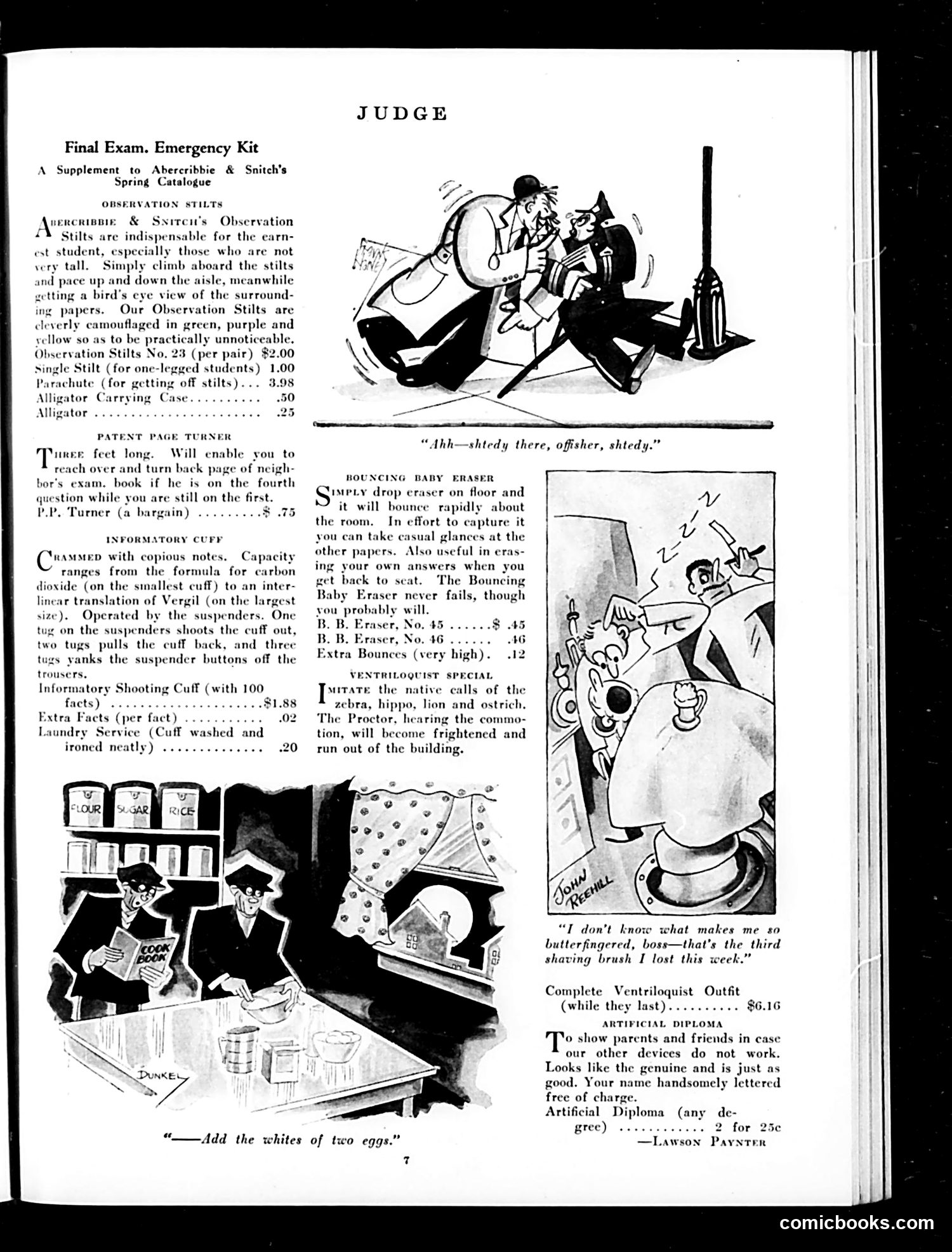
# Judge Magazine Exam Cheating Satire This page satirizes student cheating methods during final exams through a fake "Emergency Kit" catalog. The humor relies on absurdly impractical cheating devices presented as legitimate products: **Key items mocked:** - **Observation Stilts**: Allow students to peek at neighbors' papers while appearing inconspicuous - **Patent Page Turner**: A three-foot pole to turn classmates' exam pages - **Informatory Cuff**: A note-filled sleeve operated by suspenders - **Bouncing Baby Eraser**: An eraser that bounces around, forcing casual glances at others' work - **Ventriloquist Special**: Making animal sounds to distract proctors The cartoons show students caught in these ridiculous schemes—one literally on stilts during an exam, another frantically chasing a bouncing eraser. **The satire's point**: By presenting these cheating aids as ridiculous products with specific prices and detailed instructions, Judge mocks both student desperation during exams and the elaborate dishonesty some employ. The "Artificial Diploma" at the end drives home that cheating defeats education's actual purpose.
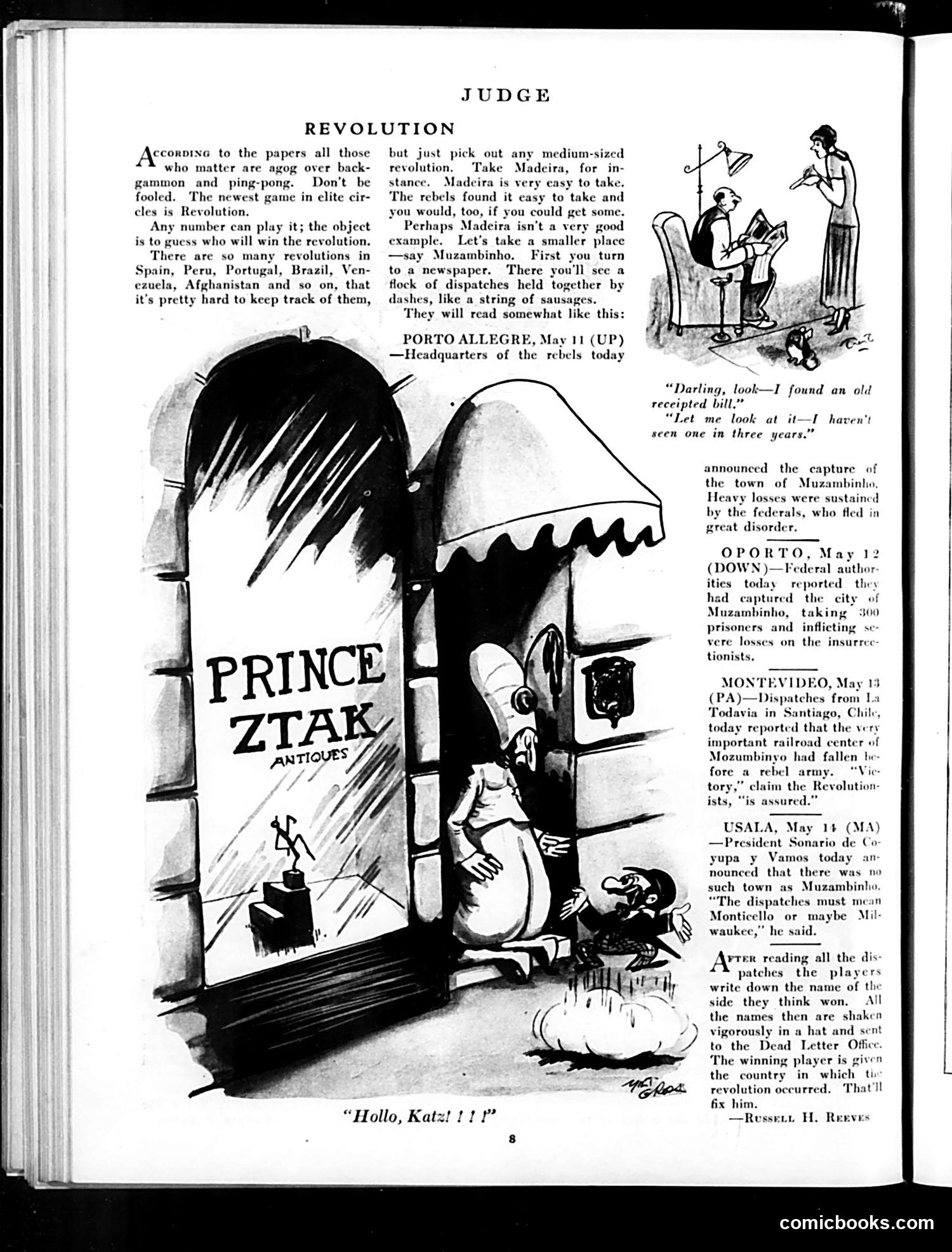
# "Judge Revolution" Analysis This satire mocks the bewildering proliferation of political revolutions in the 1920s-30s Latin America and elsewhere. The article presents "Revolution" as a parlor game because actual revolutions had become so numerous and confusing that tracking them seemed impossible. The joke centers on contradictory newspaper dispatches about the fictional town "Muzambinho"—rebels claim victory in one report, federals claim it in another, and a politician denies the town exists at all. This illustrates how unreliable and contradictory press coverage made it genuinely difficult to determine who actually won any given conflict. The cartoon depicts a figure labeled "Prince Ztak Antiques"—likely a caricatured foreign observer or businessman—bewildered by revolutionary chaos. The game's "prize" is darkly comic: the winning player receives the actual country where the revolution occurred, presented as a punishment ("That'll fix him"). The satire critiques both the instability plaguing multiple nations and the inadequate, conflicting information available to observers trying to understand these events.
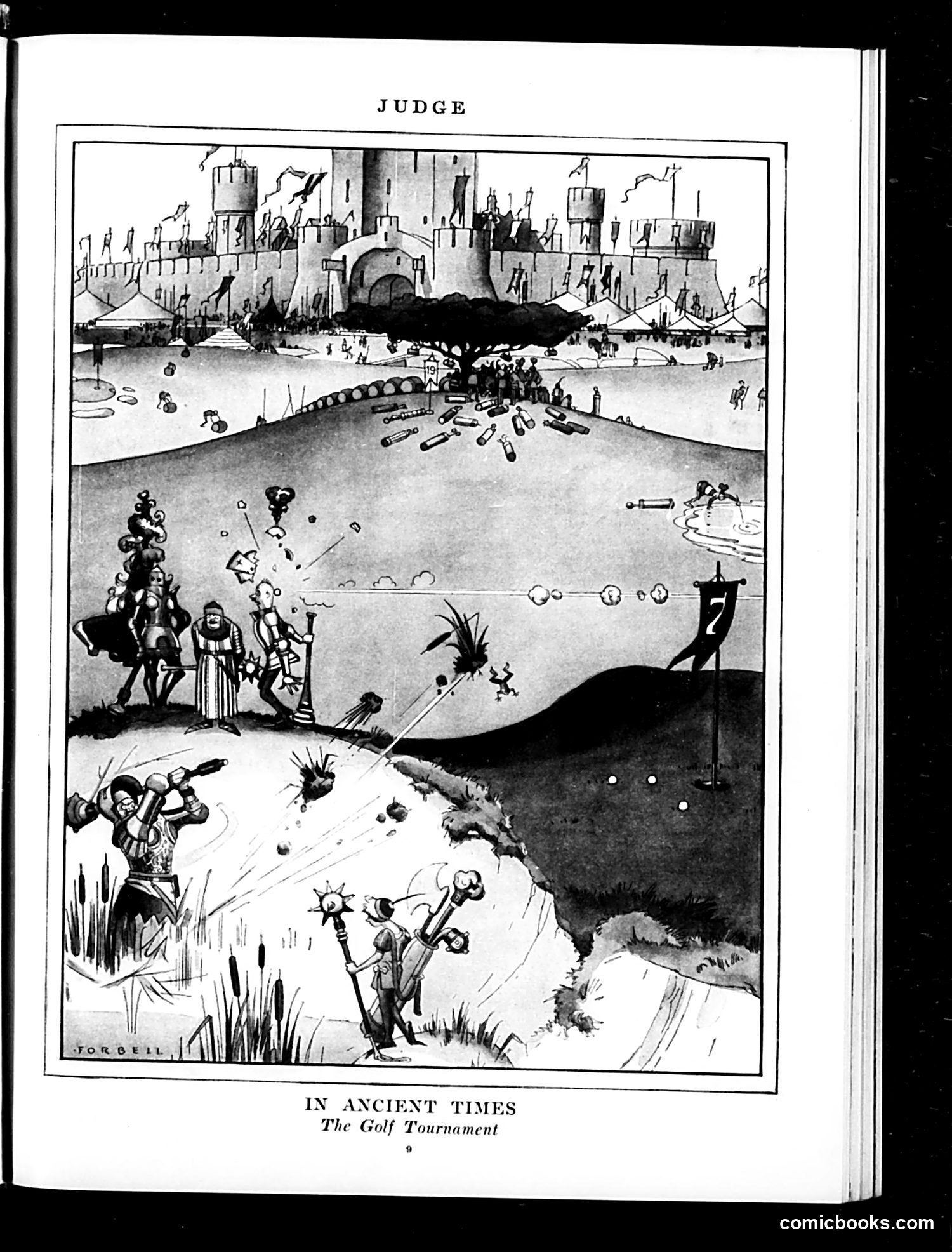
# "The Golf Tournament in Ancient Times" This is a satirical cartoon imagining golf as an ancient medieval sport. The upper half shows a fortified castle city with crowds of spectators. The lower half depicts nobles and knights actively playing golf in a landscape with hazards—water, rough terrain, and what appears to be a large beast or dragon serving as an obstacle. The satire likely mocks the aristocratic pretensions of golf, suggesting that this elite leisure activity has always been a pursuit of the upper classes, even fantastically "back in time." The medieval setting humorously implies golf's perceived snobbery and exclusivity. The presence of dangerous obstacles (the creature, rough water) suggests the sport's challenges are timeless—a gentle joke about golf's inherent difficulty, regardless of era.
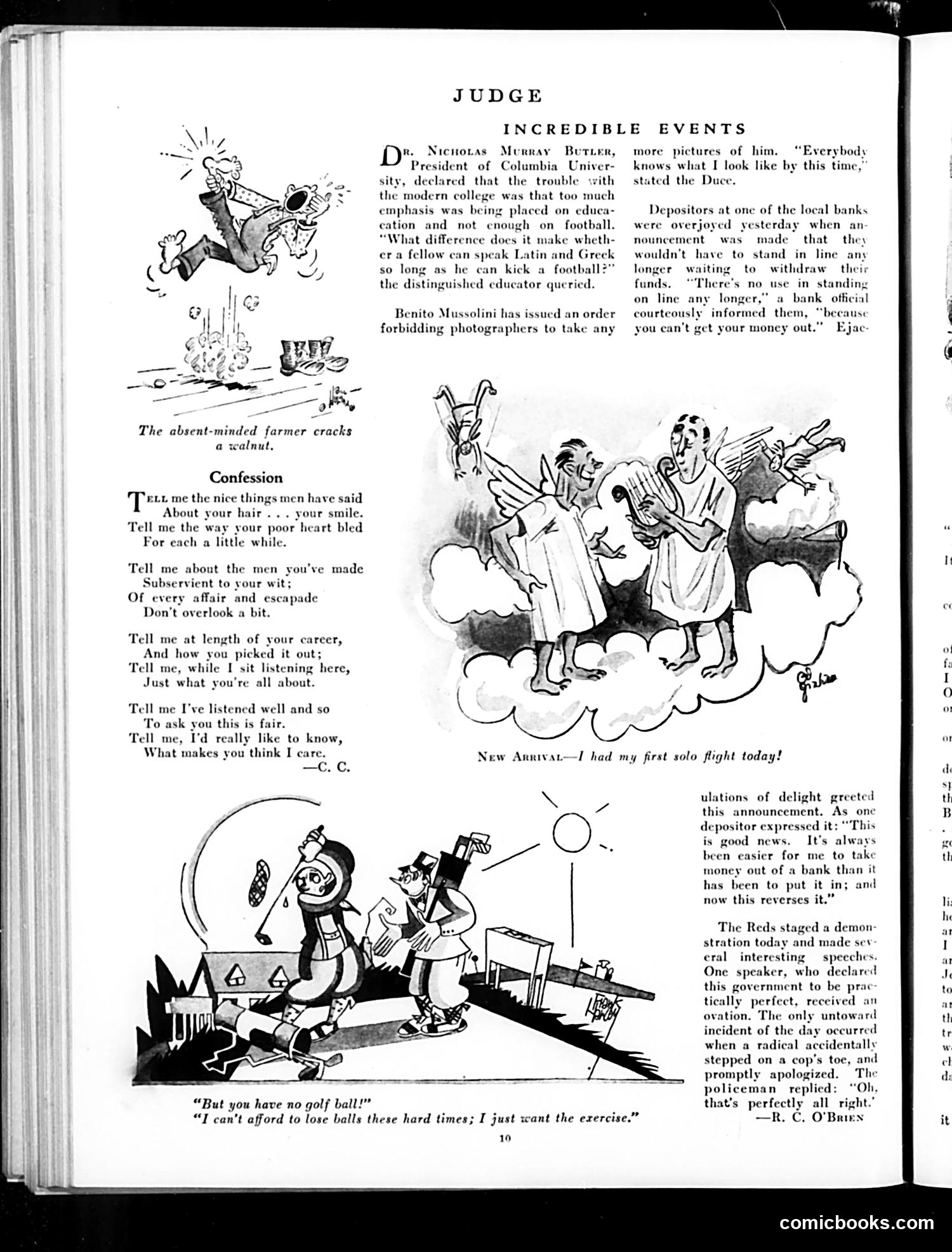
# Political Satire from Judge Magazine This page contains several satirical pieces mocking 1920s-30s American institutions: **Top cartoon**: Dr. Nicholas Murray Butler (Columbia University president) is ridiculed for emphasizing football over academics—the satire suggests colleges prioritize sports over actual education. **Bank cartoon**: References a contemporary banking crisis where depositors couldn't withdraw funds. The joke inverts typical bank problems: usually people struggle to *deposit* money, but now they can't get money *out*—the "good news" is darkly ironic. **"Confession" poem**: A cynical piece about romantic relationships, with the twist ending that the speaker doesn't actually care about the other person's stories. **Bottom cartoon**: A man practices golf without a ball, claiming he can't afford to lose balls during hard economic times—satirizing Depression-era penny-pinching and illogical reasoning. **"New Arrival" caption**: References Mussolini's prohibition on photographers, appearing to mock fascist control while celebrating aviation progress. The overall tone reflects economic hardship and political anxiety of the early Great Depression era.