
Judge, 1931-05-16 · page 10 of 36
Judge — May 16, 1931 — page 10: what you’re looking at
What you’re looking at
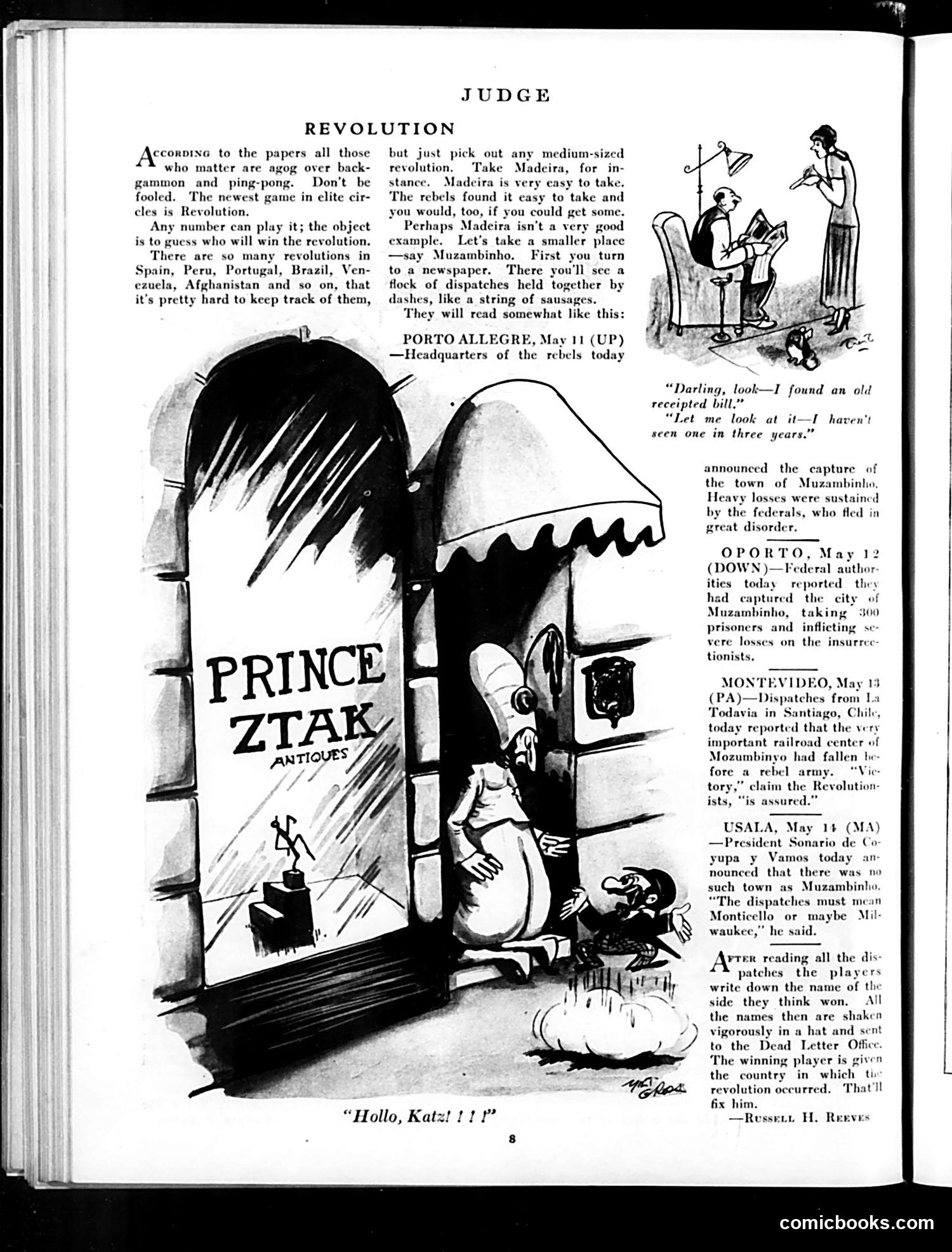
# "Judge Revolution" Analysis This satire mocks the bewildering proliferation of political revolutions in the 1920s-30s Latin America and elsewhere. The article presents "Revolution" as a parlor game because actual revolutions had become so numerous and confusing that tracking them seemed impossible. The joke centers on contradictory newspaper dispatches about the fictional town "Muzambinho"—rebels claim victory in one report, federals claim it in another, and a politician denies the town exists at all. This illustrates how unreliable and contradictory press coverage made it genuinely difficult to determine who actually won any given conflict. The cartoon depicts a figure labeled "Prince Ztak Antiques"—likely a caricatured foreign observer or businessman—bewildered by revolutionary chaos. The game's "prize" is darkly comic: the winning player receives the actual country where the revolution occurred, presented as a punishment ("That'll fix him"). The satire critiques both the instability plaguing multiple nations and the inadequate, conflicting information available to observers trying to understand these events.
📄 Transcribed text from this page (OCR, searchable)
Machine-transcribed from the original scan — historical spelling and the odd misread are preserved.
JUDGE REVOLUTION Acconmtxe to the papers all those who matter are agog over back- gammon and ping-pong. Don’t be fooled. The newest game in elite cir- cles is Revolution. Any number can play it; the object is to guess who will win the revolution. There are so many revolutions in Spain, Peru, Portugal, Brazil, Ven- ezuela, Afghanistan and so on, that it’s pretty hard to keep track of them, D but just pick out any medium-sized revolution. —T: Madeira, for in- stance. Madeira is ve y to take, The rebels found it easy to take and you would, too, if you could get some. Perhaps Madeira isn't a very good example. Let’s take a smaller place —say Muzambinho. First you turn to a newspaper. There you'll see a flock of dispatches held together by dashes, like a string of sausages. They will read somewhat like this: PORTO ALLEGRE, May 11 (UP) —Headquarters of the rebels today “Hollo, Katz! !!!? “Darling, look—I found an old receipted bill.” “Let me look at it—I haven't seen one in three years.” announced the capture of the town of Muzambinho. Heavy losses were sustained by the federals, who fled in great disorder. OPORTO, May 12 (DOWN )—Federal author ities today reported they captured the city of Muzambinho, taking 300 prisoners and inflicting se- vere losses on the insurrec tionists. MONTEVIDEO, May 13 (PA)—Dispatches from La Todavia in Santiago, Chile, today reported that the very important railroad center of Mozumbinyo had fallen Ix a rebel army. “Vic- im the Revolution: assured.” —President Sonario de Co yupa y Vamos. toc nounced that there wi such town as Muzambinho. “The dispatches must_mean Monticello or maybe Mil- waukee,” he said. Avren reading all the dis- patches the players write down the name of the side they think won, All the names then are shaken vigorously in a hat and sent to the Dead Letter Office. The winning player is given the country in which ti revolution occurred, That'll fix him. —Russett. H. Reeves comicbooks.com