
Judge, 1931-05-16 · page 26 of 36
Judge — May 16, 1931 — page 26: what you’re looking at
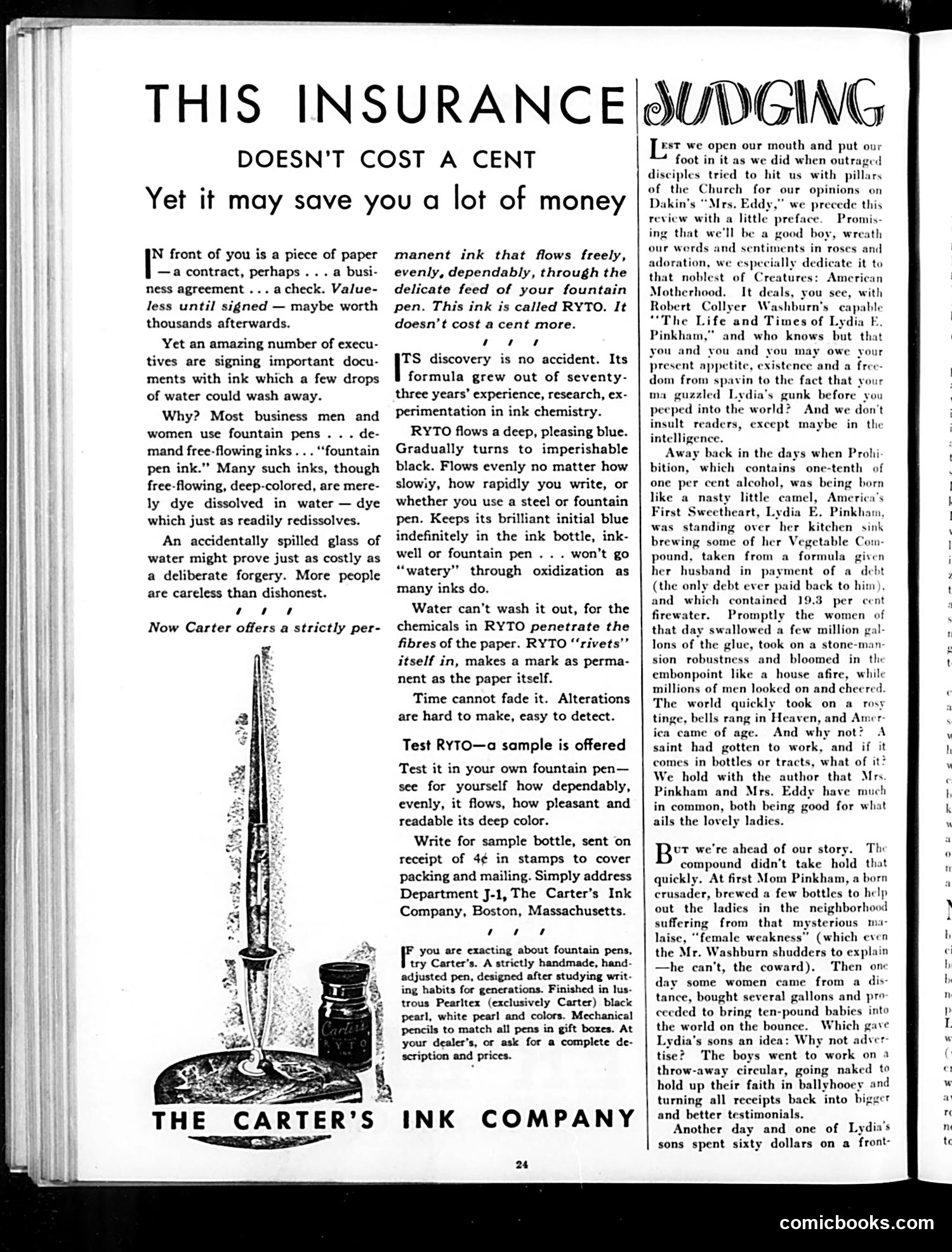
A restored page from Judge, 1931-05-16. Page through the whole issue in the reader above.
📄 Transcribed text from this page (OCR, searchable)
Machine-transcribed from the original scan — historical spelling and the odd misread are preserved.
THIS INSURANCE DOESN'T COST A CENT Yet it may save you a lot of money IN front of you is a piece of paper —a contract, perhaps . . . a busi- ness agreement ... a check. Value- Jess until signed — maybe worth thousands afterwards. Yet an amazing number of execu- tives are signing important docu- ments with ink which a few drops of water could wash away. Why? Most business men and women use fountain pens. . . de- mand free-flowing inks. . . “fountain pen ink.”” Many such inks, though free-flowing, deep-colored, are mere- ly dye dissolved in water — dye which just as readily redissolves. An accidentally spilled glass of water might prove just as costly as a deliberate forgery. More people are careless than dishonest. one Now Carter offers a strictly per- vt od a 2% THE GARTERS) ~SEEa manent ink that flows freely, evenly, dependably, through the delicate feed of your fountain pen. This ink is called RYTO. It doesn’t cost a cent more. a TS discovery is no accident. Its formula grew out of seventy- three years’ experience, research, ex- perimentation in ink chemistry. RYTO flows a deep, pleasing blue. Gradually turns to imperishable black. Flows evenly no matter how slowiy, how rapidly you write, or whether you use a steel or fountain pen. Keeps its brilliant initial blue indefinitely in the ink bottle, ink- well or fountain pen . . . won’t go “watery” through oxidization as many inks do. Water can’t wash it out, for the chemicals in RYTO penetrate the fibres of the paper. RYTO “‘rivets’’ itself in, makes a mark as perma- nent as the paper itself. Time cannot fade it. Alterations are hard to make, easy to detect. Test RYTO—a sample is offered Test it in your own fountain pen— see for yourself how dependably, evenly, it flows, how pleasant and readable its deep color. Write for sample bottle, sent on receipt of 4¢ in stamps to cover packing and mailing. Simply address Department J-1, The Carter’s Ink Company, Boston, Massachusetts. ‘ ‘ ‘ you are exacting about fountain pens, try Carter's. A strictly handmade, hand- adjusted pen, designed after studying writ- ing habits for generations. Finished in lus- trous Pearltex (exclusively Carter) black pearl, white pearl and colors. Mechanical pencils to match all pens in gift boxes. At your dealer’s, or ask for a complete de- scription and prices. “INK COMPANY 24 JUDGING [it e open our mouth and put ou Di tried to hit us with pillars of the Church for our opinions on Dakin's “Mrs. Eddy,” we precede this y with a little preface. Promis- ing that we'll be a good boy, wreath our werds and sentiments in roses and adoration, we especially dedicate it to that noblest of C ures: American Motherhood. It deals, you see, with Robert Collyer Washburn’s capa “The Life and Times of Ly: Pinkham,” and who knows but that you and you and you may owe your present appetite, existence and a free- dom from spavin to the fact that your ma guzzled Lydia's gunk before you peeped into the world? And we don't insult readers, except maybe in the intelligence. Away back in the days when Prohi bition, wi h contains one-tenth of one per cent alcohol, was being born like a nasty little camel, America’s First Sweetheart, Lydia E. Pinkham, was standing over her kitchen sink brewing some of her Vegetable Com- pound, taken from a formula her husband in payment of a debt (the only debt ever paid back to him), and which contained 19.3 per cent firewater. Promptly the women of that day swallowed a few million gal- lons of the glue, took on a stone-man- sion robustness and bloomed in the embonpoint like a house afire, while millions of men looked on and cheered. The world quickly took on a rosy tinge, bells rang in Heaven, and Amer- ica came of age. And why not? A saint had gotten to work, and if it comes in bottles or tracts, what of it? We hold with the author that Mrs Pinkham and Mrs. Eddy have much in common, both being good for what ails the lovely ladies. ut we're ahead of our story. Th compound didn’t take hold that quickly. At first Mom Pinkham, a born crusader, brewed a few bottles to help out the ladies in the neighborhood suffering from that mysterious ma- laise, “female weakness” (which even the Mr. Washburn shudders to explain —he can't, the coward). Then on y some women came from a dis- ce, bought several gallons and pro ceeded to bring ten-pound babies into the world on the bounce. Which gave Lydia’s sons an idea: Why not adver ? The boys went to work on throw-away circular, going naked to hold up their faith in ballyhooey and turning all receipts back into b and better testimonials. Another day and one of Ly sons spent sixty dollars on a front- comicbooks.com