
Judge, 1931-05-16 · page 22 of 36
Judge — May 16, 1931 — page 22: what you’re looking at
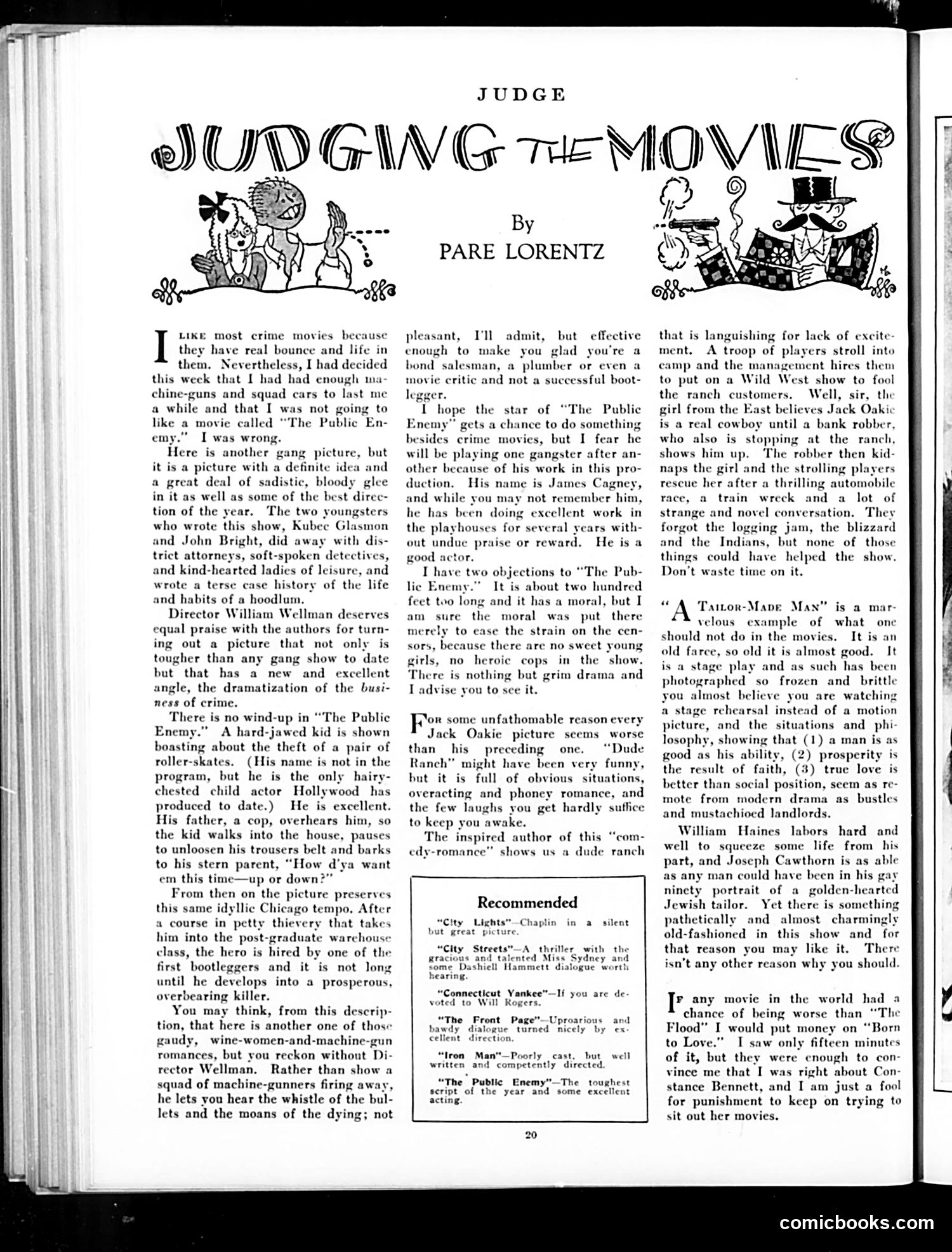
A restored page from Judge, 1931-05-16. Page through the whole issue in the reader above.
📄 Transcribed text from this page (OCR, searchable)
Machine-transcribed from the original scan — historical spelling and the odd misread are preserved.
JUDGWGE TEM they have real bounce and life in them. Nevertheless, I had decided this week that I had had enough ma- chine-guns and squad cars to last me a while and that I was not going to like a movie called “The Public En- emy I was wrong. Here is another it is a picture with ite idea and a great deal of sadistic, bloody glee in it as well as some of the best direc- tion of the year. The two youngsters who wrote this show, Kubec € and John Bright, did away with dis- trict attorneys, soft-spoken detectives, and kind-hearted ladies of leisure, and wrote a terse case history of the life and habits of a hoodlum. Director William Wellman deserves equal praise with the authors for turn- ing out a picture that not only is tougher than any gang show to date but that has a new and excellent angle, the dramatization of the busi- ness of crime. There is no wind-up in “The Public Enemy A hard-jawed kid is shown boasting about the theft of a pair of roller-skates. (His name is not in the program, but he is the only hairy- chested child actor Hollywood has produced to date.) He is excellent. His father, a cop, overhears him, so the kid walks into the house, pauses to unloosen his trousers belt and barks to his stern parent, “How d’ya want em this time—up or down? From then on the picture preserves this same idyllic Chicago tempo. After a course in petty thievery that takes him into the post-graduate warchou class, the hero is hired by one of the first bootleggers and it is not long until he develops into a prosperous, overbearing killer. You may think, from this descrip- tion, that here is another one of those gaudy, wine-women-and-machine-gun romances, but you reckon without Di- rector Wellman. Rather than show squad of machine-gunners firing aw he lets you hear the whistle of the bul- lets and the moans of the dying; not I Like most crime movies picture, but JUDGE By PARE LORENTZ pleasant, I'll admit, but effective enough to make you glad you're a bond salesman, a plumber or even a movie critic and not a successful boot- legger. I hope the star of “The Public Enemy” gets a ch to do something besides crime mov but I fear he ying one gangster after an- other because of his work in this pro- duction. His name is James Cagney, and while you may not remember him, he has been doing excellent work in the playhouses for several years with- out undue praise or reward. He is a good actor. T have two obj new te tions to “The Pub- lic It is about two hundred feet too long and it has a moral, but I am sure the moral was put there merely to ease the strain on the cen- sors, because there are no sweet young girls, no heroic cops in the show. There is nothing but grim drama and I advise you to sce it. Fe some unfathomable reason every Jack Oakie picture seems worse than his preceding one. “Dude Ranch” might have been very funny, but it is full of obvious situations, overacting and phoney romance, and the few laughs you get hardly suffice to keep you awake. The inspired author of this “com- * shows us a dude ranch Recommended “City Lights"—Chaplin in a silent but great pictu “City Streets"—A thriller with gracious and talented Miss Sydney some Dashiell Hammett dialogue w hearing. “Connecticut Yankee”—If you are de voted to Will Rogers. “The Front Page”—Uproarious and bawdy dialogue turned nicely by ex cellent direct “Iron Man"—Poorly cast, but well written and competently directed. “The Public Enemy"—The toughest pt of the year and some excellent acting. OVIES 5 that is languishing for lack of excite- ment, A troop of players stroll into camp and the mar nent hires them to put on a Wild West show to fool the ranch customers. Well, sir, the girl from the East believes Jack Oakic is a real cowboy until a bank robbe who also is stopping at the ranch, shows him up. The robber then kid- naps the girl and the strolling players rescue her after a thrilling automobile race, a train wreck and a lot of strange and novel conversation. They forgot the logging jam, the blizzard and the Indians, but none of those things could have helped the show. Don’t waste time on it. ¥ Taitor-Mave Man” is a mar- velous example of what o should not do in the movies. It is an old farce, so old it is almost good. It is a stage play and as such has been photographed so frozen and_ brittle you almost believe you are watching a stage rehearsal instead of a motion picture, and the situations and phi losophy, showing that (1) a man is as good as his ability, (2) prosperity is the result of faith, (3) true love is better than social position, seem as re- mote from modern drama as bustles and mustachioed landlords. Haines labors hard and ze some life from his part, and Joseph Cawthorn is as s as any man could have been in his gay ninety portrait of a golden-hearted Jewish tailor. Yet there is something pathetically and almost charmingly old-fashioned in this show and for that reason you may like it. There isn’t any other reason why you should. F any movie the world had a chance of being worse than Flood” I would put money on ‘ to Love.” I saw only fifteen minutes of it, but they were enough to con- vince me that I was right about Con- stance Bennett, and I am just a fool for punishment to keep on trying to sit out her movies. ax comicbooks.com